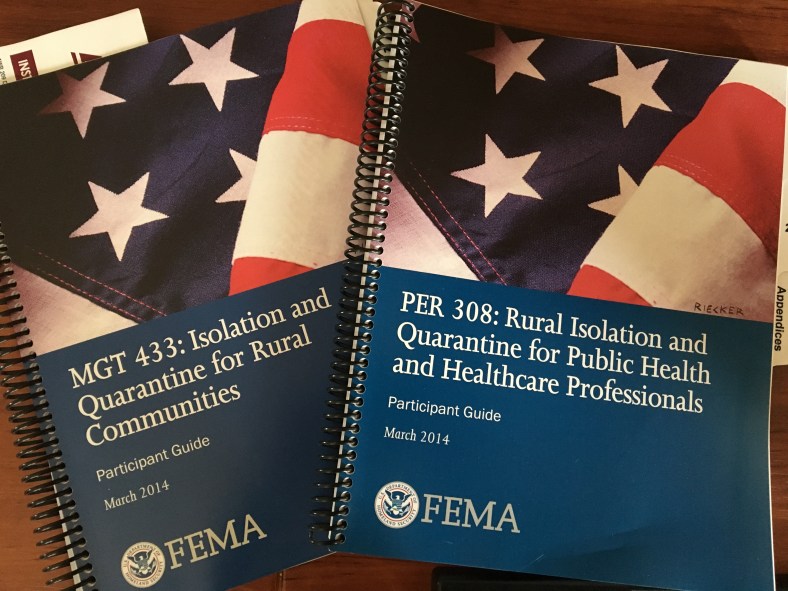
 Last week I had the opportunity to take two courses sponsored by the Rural Domestic Preparedness Consortium (RDPC), MGT 433: Isolation and Quarantine for Rural Communities and PER 308: Rural Isolation and Quarantine for Public Health and Healthcare Professionals. These courses together were completed in one day.
First came MGT 433. This course covered a variety of topics associated with isolation and quarantine, including:
- Case studies
- Legal and ethical issues
- Agencies and entities involved
- Planning priorities
- Resources
While the course is intended for rural audiences, which my home area generally is, the issues and considerations associated with isolation and quarantine are still largely the same for more densely populated areas. While weaving through the various course topics, they mostly all related back to understanding the reasoning behind the use of isolation and/or quarantine as tools to limit the spread of certain communicable diseases and the planning and implementation associated with these activities. The course did elevate my rather foundational knowledge of isolation and quarantine, and provided some great references for future application.
The second course, PER 308, didn’t really provide much more information than the previous course did, although it allowed an opportunity for a greater degree of analysis and discussion through a guided tabletop exercise. The tabletop information from the participant manual was supplemented with several video segments which were produced with reasonable quality and help set the stage for many of the issues one would expect from dealing with an isolation/quarantine event.
Both courses were pretty solid, with only a few little tweaks or updates which I provided feedback on to the instructor. As with most RDPC courses, those from larger agencies and more populated areas shouldn’t be dissuaded from participating – the foundational concepts they present are applicable to any area, rural or otherwise.
The instructor was very personable, professional, and knowledgeable of the course content. While he didn’t have a public health background, which surprised me given the course topics, he clearly has a great cooperative public safety background. I’ve found that the RDPC tends to prefer sending only one instructor to teach a course, along with an assistant to handle administrative matters. While it’s certainly viable to handle the course alone, it’s challenging for both the instructor and the audience.
All in all, these are good courses, and I do recommend you keep a look out for them in your area. Both courses are excellent for furthering your understanding of isolation and quarantine, when to use them, how to use them, and who to involve. They are particularly good courses for public safety leadership and public health leadership and preparedness staff.
© 2016 – Timothy Riecker, CEDP
Emergency Preparedness Solutions, LLC – Your Partner in Preparedness
 The Contrarian Emergency Manager