Throughout all professions and specialties within the broad category of public safety and emergency services, we go through a lot of training. Training within these various professions has become a profession itself, with many individuals, myself included, spending much of their career as trainers. Through the vast quantity and variety of training we’ve received, we see many examples of training across the whole spectrum of quality and effectiveness and have endeavored to improve upon training and increase learner retention.
My Experiences
Much of the training that is most memorable to members of the public safety community is that which is hands-on. Three classes in particular that stand out to me are the New York State Mask Confidence course, the DHS-sponsored Incident Response to Terrorist Bombings (IRTB) course conducted at the New Mexico Energetic Materials Research and Training Center (EMRTC), and the DHS-sponsored Enhanced Incident Management/Unified Command course conducted at the Texas A&M Engineering Extension Service (TEEX).
I attended the Mask Confidence Course about 15 years ago when I was active in the fire service. Course instruction was led by Chuck, a well-respected fire officer in Central New York and an outstanding fire instructor (who, a number of years later, worked for me as an adjunct). The premise of the course is for participants to become confident in their own abilities and limitations while wearing self contained breathing apparatus (SCBA). Much of the course was conducted under blackout conditions, either in a darkened room or wearing a blackout mask, so you had to learn everything by touch – while wearing bulky firefighting gloves. The course started simply, with a timed donning of all gear and SCBA in a darkened gymnasium; and ended with much more complexity several sessions later by navigating a dark, smoke-filled maze on your hands and knees, sometimes having to remove (then re-don) the SCBA pack to fit through tight spaces, all while still ensuring that you can breathe through the mask. The course certainly increased my confidence in wearing SCBA and gave me important lessons learned which I was able to apply in fire operations later.
The IRTB course was an excellent program which instructed participants on the chemistry and physics of explosives – including those in common industrial and military use, as well as improvised devices – first in a classroom environment then in a field lab where we had the opportunity to see these explosives in action first hand. The class was fun and insightful, but rigorous and more cerebral than expected. As with many DHS consortium programs, the EMRTC has its own course managers and draws on expertise from around the nation to aid in instruction.
The Enhanced Incident Command/Unified Command course included a review of ICS concepts – mostly those at the ‘intermediate’ level, with emphasis on the management of a Type III (extended) incident and the necessity of transitioning to the formal planning process within ICS. Learning was reinforced through participants taking on roles in an ICS structure and being challenged by a computer-based simulation. Similar to the EMRTC course, this program drew upon the expertise of instructors from around the country.
Why Scenario-based Learning Works
Why do these three courses stand out for me? Certainly they are topics of interest and had great instruction. That alone should help anyone remember some of the course content, but these shine well above others. Because they were hands-on? Certainly Mask Confidence was hands-on, but to maintain safety, IRTB was mostly hands-off – literally. They didn’t actually let us touch any of the explosives. The TEEX course gave us a computer-based simulation, which is only somewhat hands-on. So what was it that made these programs stick with me? The commonality of these programs is that they were scenario-based.
In each course we first learned foundational material through traditional didactic instruction. Certainly, the use of examples, pictures, and video enhanced our learning. After the didactic portions, we were then challenged with a series of scenarios, each different from the previous and with increasing complexity. Mask Confidence was largely an individual course – intended to build your own skills and confidence with your own life-sustaining equipment in adverse conditions. While IRTB provided a group learning environment, we didn’t necessarily work together to solve problems; rather we were posed with scenarios to examine, akin to an amateur forensic level, to evaluate cause and effect. The Enhanced Incident Command/Unified Command course was very much based upon individuals contributing to group success in solving problems.
Why is scenario-based learning so successful? First, consider the graphic below. We’ve all seen variations of this information. The bottom line is that the increased degree to which a learner is actively engaged, the more information they will retain. Many of the activities I described above for the three classes that stand out in my memory are contained in the 50%+ categories of retention.

Learner retention based upon delivery method
How do we apply this concept to learning? Bloom’s Revised Taxonomy is a regular reference I use when designing courses and can be a great starting point to determining if participants can benefit from scenario-based learning. The essential meaning behind Bloom’s Taxonomy is: What level do participants need to be trained to? In emergency services we often use the term ‘Awareness’ level training to identify a course at the lower levels of Bloom’s Taxonomy – those are the levels where we need to remember or understand information, but aren’t required to use the information. In an ‘Operations’ level training course, learners are expected to apply what they have learned and perhaps do a lower level of analysis. In a ‘Technician’ level course, higher levels of analysis as well as evaluation and creation are often expected as learner outcomes. Compare the terms from the Bloom’s Taxonomy graphic below to those on the right side of the learner retention graphic above and you will see some similarity. The correlation is that if we expect learners to apply, analyze, evaluate, or create, we need to ensure a higher rate of retention – therefore scenario-based learning is often an ideal strategy.
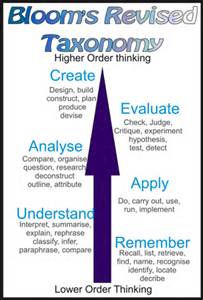
Bloom’s Revised Taxonomy
How to Integrate Scenario-based Learning
Integrating activities into training courses can be tricky. There are a great number of ‘training games’ out there – (Amazon has a huge listing of books on the subject), but every activity in a course has to be meaningful and drive toward one or more course objectives. We’ve all seen gratuitous activities integrated into courses. While some of these may be great, they do nothing to help us achieve the course objectives. Also, simply having activities does not make a course scenario-based. To achieve this, you need to include one or more scenarios. Make sense?
The Bing dictionary defines ‘scenario’ as:
Definition of scenario (n)
- sce·nar·i·o
- [ sə nárree ō ]
- possible situation: an imagined sequence of possible events, or an imagined set of circumstances
- plot outline: an outline of the plot of a play or opera
- screenplay: a screenplay for a movie
We develop scenarios for exercises all the time, so when trying to integrate a scenario into a training course, just consider it a miniature version of an exercise.
First – where to start? As mentioned earlier, a scenario must be associated with one or more learning (course) objectives. It also must have (enabling) objectives of it’s own. In other words, what are the expected outcomes of participating in the scenario for the learner? Perhaps you want your learners to create an Incident Action Plan (course objective). Scenario-based learning is great for this. First, I would use didactic instruction to review the planning process and the tools (ICS forms) associated with this. Then you can assign roles (within an ICS structure) and provide a scenario to help facilitate learning. The scenario should generally be realistic, although you can always put a fun twist on it by using a zombie attack or some such thing. This however, can be distracting – so you are better off sticking with something realistic and familiar to the learners. HazMat incidents tend to work well as scenarios across the nation. Add context by including detail – fixed facility or in transit (road? rail?). Time of day, day of the week, weather. What were the immediate impacts? What are the current threats? The same concepts can be applied for something more hands-on, such as for water rescue training or a hostage negotiation training.
You have a choice of either placing the scenario in a location in which the learners are familiar (they know the roads, the resources, etc.), or providing a fictional location with supplemental information which they have to learn (maps, resource lists, etc.). Both work with a fair amount of success, but you can be challenged if not all participants are familiar with the same area. The HSEEP training course provides fictional jurisdictions I’ve used often for different training courses, as does FEMA and the EPA. You can create a fictional jurisdiction yourself, but to do it right takes time and attention to detail. Consider using a progressive scenario to facilitate several activities through the training program.
Be sure to give your participants clear instructions on what is expected of them. Challenge them, but don’t frustrate them, which can impede learning. Remember, this is NOT a formal HSEEP exercise as we know them. Learners are not being tested, nor are policies, plans, or procedures. You are providing a structured, experience-based learning environment. Be sure they have the tools to succeed. With the Incident Action Planning scenario, an ICS Field Operations Guide (FOG) or text book guidance is a great reference for them. Provide learners with the opportunity and a safe environment to ask questions, and even correct them if they stray too far from the desired path. Remember – perfect practice makes perfect, so learners should be practicing ‘by the book’.
Finally, similar to exercises, hot wash the activity. Ask learners how they feel the activity went. What went well, what didn’t go so well? What feedback do the instructors have? While we aren’t testing learners in these scenarios, we should be evaluating them. This open discussion feedback is important to their learning and can also help you improve your scenario for the next time. The folks in TEEX actually capture video and audio of participants during activities which they use to help facilitate hot wash sessions. This obviously takes time, equipment, and personnel which most don’t have available to them – but it’s great to experience.
Scenario-based learning takes a lot of preparation and forethought. It also takes a lot of training time to implement. When we’re fighting for training time and training dollars, we need to advocate for the value of scenario-based learning. Make sure it’s done right, though… a poorly executed activity can have a negative impact on learning.
Scenario-based learning works. There are best practices in the training of firefighters, police officers, EMTs, and dispatchers using scenarios. They help learners ‘get their head into the task’, helping them bridge the mental gap between an activity and real-world application. Consider how not only to integrate scenario-based training into your courses to reinforce learning, but also to substitute content we are currently delivering by other, less interactive means.
What successes have you found in scenario-based training? What challenges have you encountered? I’d like to hear from you.
Tim Riecker

 The Contrarian Emergency Manager