Planning for a Mass Fatality Incident

Planning for a mass fatality incident can be almost as complex as responding to such an incident.  Mass fatalities can arise from transportation incidents, pandemics, mud slides, mass shooting, or other sudden incidents.  Thankfully mass fatality incidents do not occur often, but due to the impacts and complexity of managing such incidents every jurisdiction should have a plan in place to address them.

A mass fatality incident management plan should be an annex to a comprehensive emergency management plan.  Just as with any deliberate emergency planning effort (ref CPG 101), we start by assembling a planning team.  This planning team should represent all relevant stakeholders from across the community.  Beyond your usual public safety agencies, the team should also include the coroner or medical examiner, public health, public works, hospitals, social services agencies, the American Red Cross, funeral directors, and cemetarians.  It is also important to consider the cultural and/or spiritual requirements of how the deceased are handled so community leaders from these groups should also be included in your planning process.

Your plan should acknowledge the hazards in your community which can lead to a mass fatality incident.  These should already have been identified through your hazard analysis/THIRA.  If you have not conducted a THIRA, your planning team should discuss the impacts of such an event through a briefly outlined credible worst-case scenario then identify what capabilities are needed to address these impacts.

Assisting agencies may have some slightly different roles in the management of a mass fatality incident than they would in other incident responses.  These differences should be identified in the mass fatality incident response plan.  It should also be recognized that the causal nature of the incident is most likely to drive who will be in charge of such an incident.  Typically there are other matters which must be mitigated to save lives, protect property, and stabilize the incident which will determine who is in charge.  Because it is a mass fatality incident the coroner or medical examiner will be managing a significant portion of the incident and may also be driving policy based upon their legal responsibilities, but they may not be in command, although they may be likely to be part of a unified command.

While the coroner or medical examiner will be handling the deceased, it must absolutely be remembered that the living must also be cared for.  First and foremost are the immediate survivors, if any, of the incident who will require emergency medical care.  Depending on the nature of the incident, others may need to be treated for exposure.  Mental health care is a much more prominent issue in a mass fatality than perhaps any other incident – and the need for mental health care applies to everyone working the incident, families and friends of victims and survivors, and the community at large.

A common venue in mass fatality incidents for providing mental health assistance to families and friends of victims and survivors is a Family Assistance Center (FAC).  The Aviation Disaster Family Assistance Act of 1996 requires family assistance centers to be established for major transportation incidents (the joint responsibility of the NTSB and the American Red Cross) but these centers have been used for other mass fatality incidents as well.  In additional to crisis mental health counseling, a variety of other services can also be provided at a FAC.  A FAC should be established very quickly and it should be recognized that surviving victims may be stranded in the area and that family and friends will flock to the area – many of which may have little support structure or plans for essentials such as lodging.  A FAC is also an ideal location for authorities to obtain information from survivors about the missing or deceased which will help with future identification.  FACs are often located in hotels where large conference facilities, lodging, food, and other services can be obtained.

Another facility common to a mass fatality incident is a temporary morgue.  Temporary morgues are established either as a matter of operational convenience (rather than having to transport remains to the jurisdiction’s usual morgue site) or because the usual morgue site is too small to accommodate a larger operation.  Usually in conjunction with a temporary morgue is the need for cold storage for remains.  This is most often accomplished via refrigerated trucks/containers.  The incident morgue is obviously a secure location, with only authorized personnel being allowed access.

The amount of logistical planning required to establish and support facilities such as a family assistance center and temporary morgue lend themselves greatly to pre-planning efforts, including MOUs, site-specific standard operating procedures, mobile caches of disaster supplies, and exercises to test the standard operating procedures for setting up and running such facilities.  There are a variety of resources available to assist you with assembling your mass fatality incident response plan from LLIS, the federal Disaster Mortuary Response Team (DMoRT), state health departments, state emergency management agencies, and funeral home director’s associations.  The National Association of County and City Health Officials also has information which can assist you.

Take the time to create a mass fatality incident management plan, train personnel on the plan, and exercise it regularly.  Mass fatalities represent some of the most complex incidents I’ve ever been involved in and are very multifaceted.  As always, if your jurisdiction needs assistance in any preparedness efforts, Emergency Preparedness Solutions, LLC is here to help!

© 2014 Timothy Riecker
 

The POETE Analysis – Emergency Planning and Beyond

POETE stands for Planning, Organizing, Equipping, Training, and Exercising. These are the five elements that each jurisdiction should be examining their own capabilities by. By examining their capabilities through each of these elements, a jurisdiction can better define their strengths and areas for improvement.

The POETE analysis, often completed as part of a THIRA (Threat and Hazard Identification and Risk Assessment) is actually a component of the State Preparedness Report (SPR) (note that this was the definition of the acronym at the time of the original post. It is now Stakeholder Preparedness Report), which incorporates THIRA data into this annual submission. When properly conducted, a POETE analysis will examine a jurisdiction’s capability targets. These capability targets, through the THIRA process, are individually defined by each jurisdiction, based upon the capability definitions of each of the 31 Core Capabilities (Note: at the time of my original post there were 31 Core Capabilities. There are now 32). The Core Capabilities were identified in the National Preparedness Goal and are an evolution of the legacy Target Capabilities. Gone are the days when many jurisdictions struggled with the definitions of the Target Capabilities and trying to determine how they applied to jurisdictions large and small across the nation. The new Core Capabilities are divided amongst five mission areas – Prevention, Protection, Response, Recovery, and Mitigation. By referencing Core Capabilities in our preparedness efforts, we have a consistent definition of each area of practice.

When a jurisdiction’s stakeholders conduct a POETE analysis, each element is rated on a scale of 1 to 5 – a rating of 5 indicating that the jurisdiction has all the resources needed and has accomplished all activities necessary for that element within that capability area. Using the Core Capability of Fatality Management as an example the jurisdiction will identify a desired outcome and from that a capability target. CPG-201, the guidance published by DHS/FEMA for conducting a THIRA, outlines this process in detail and provides the following capability target for illustrative purposes:

“During the first 72 hours of an incident, conduct operations to recover 375 fatalities.”

The jurisdiction will examine their efforts and resources for each POETE element for this capability target. Below are thoughts on what could be considered for each element:

Planning: What is the state of their plans for mass fatality management? Do they have a plan? Is it up to date? Does it address best practices?

Organizing: Are all stakeholders on board with mass fatality preparedness efforts? Is there a member of the community yet to be engaged? Are lines of authority during a mass fatality incident clear?

Equipping: Does the jurisdiction have the equipment and supplies available to handle the needs of a mass fatality incident? Are MOUs and contracts in place?

Training: Do responders and stakeholders train regularly on the tasks associated with managing a mass fatality incident? Is training up to date? Is training conducted at the appropriate level?

Exercising: Have exercises been conducted recently to test the plans and familiarize stakeholders with plans and equipment? Has the jurisdiction conducted discussion-based and operations-based exercises? Have identified areas for improvement been addressed?

The jurisdiction’s responses to these questions and the subsequent ratings provided for each POETE element will help them identify areas for improvement which will contribute to the overall capability. From personal experience, I can tell you that the discussions that take place amongst stakeholders which reveal both the efforts applied for each element as well as the frustrations and barriers to progress for each are generally quite productive and great information sharing sessions. It is important to capture as many of the factual elements of this discussion as possible as they add context to the numerical value assigned. Having the right people participating in the effort is critical to ensuring that inputs are accurate and relevant.

Once the POETE analysis is completed, what’s next? As mentioned earlier, the POETE analysis is actually a required component of the annual State Preparedness Report, which must be submitted to FEMA/DHS by each state and territory. Ideally, the results of the POETE analysis should be translated from raw data (numbers) to a narrative, explaining the progress and accomplishments as well as future efforts and barriers; in other words, the ratings should be factually explained and these explanations should feed an actionable strategic plan. The priority rating inherent in the THIRA process will help establish relative priority for each Core Capability within the strategic plan. While this is a requirement for states and territories, a comprehensive strategic plan for any emergency management and homeland security program at any jurisdictional level is obviously beneficial and would reflect positively in an EMAP accreditation.

POETE elements should be incorporated into other emergency management activities as well. When needs are identified and defined based upon Core Capabilities, these should be outlined in the jurisdiction’s multi-year Training and Exercise Plan, which should serve as a guiding document for many preparedness activities. The focus that a POETE analysis provides for each Core Capability can help identify training objectives which can help maintain and improve capability

Consider integrating them into your evaluation of exercises. While the Homeland Security Exercise and Evaluation Program (HSEEP) doctrine makes no mention of POETE, much of HSEEP is based upon capabilities. With a POETE analysis being an integral component of measuring our progress toward a capability, I would suggest including it into exercise evaluations. POETE elements can be included in Exercise Evaluation Guides (EEGs) to capture evaluator observations and should be outlined in the After Action Report (AAR) itself for each observation – giving suggestions for improvements based upon each POETE element. Consider how you could incorporate the POETE elements into an AAR as an outline identifying areas for improvement for the EOC management activities of the Operational Coordination Core Capability. As an example:

Planning: The jurisdiction should update the EOC management plan to incorporate all critical processes. Job aids should be created to assist EOC staff in their duties.

Organizing: Lines of authority were not clear to exercise participants in the EOC. Tasks were assigned to agencies but status of tasks was not effectively monitored.

Equipping: There were not enough computers for participating agencies. EOC management software did not facilitate tracking of resources.

Training: EOC agency representatives were not all trained in the use of EOC management software, creating delays in action and missed assignments. The EOC Manager and Planning Section Chief were well versed in the Planning Process and used it well to facilitate the Planning Process.

Exercising: Isolated drills should be conducted to test notification systems on a regular basis. Discussion based exercises will assist in identifying policy issues associated with suspension of laws and their impact on EOC operations.

The POETE analysis is a process which can help us identify strengths and areas for improvement within our emergency management and homeland security programs. While the POETE analysis can be time consuming, the information gathered for each Core Capability is valuable to any preparedness effort. With such a variety of federally-driven programs and requirements extended throughout emergency management and homeland security, we can find the greatest benefit from those which have the ability to cross multiple program areas – such as the Core Capabilities – allowing us to consolidate the evaluation of these programs into one system, providing maximum benefit and minimizing efforts.

Have you conducted a POETE analysis for your jurisdiction?  Did you find it a worthwhile process?

Looking for help with a POETE analysis?  Emergency Preparedness Solutions, LLC can help!  www.epsllc.biz 

© 2014 Timothy Riecker

Emergency Management and Considerations for Visiting Populations

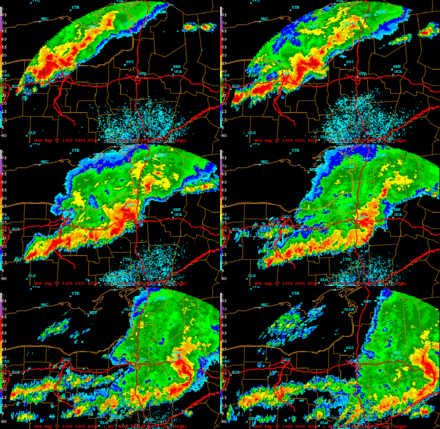
Radar loop, Labor Day 1998 Upstate New York.  This storm impacted the New York State Fair.

Radar loop, Labor Day 1998 Upstate New York. This storm impacted the New York State Fair.

The inspiration for this blog was a paper posted to LLIS by Dr. Susanne Becken, Professor of Sustainable Tourism at Griffith University (Australia) and Lincoln University (New Zealand).  The paper is titled The Christchurch Earthquake and the Visitor Sector, which is also available from this link if you don’t have LLIS access.

Dr. Becken highlights the Christchurch earthquake of February 22, 2011, which killed 185 people from more than 20 nations, 80 of which were listed as visiting, rather than residing in, Christchurch.  She states that as a result of this M 7.1 earthquake infrastructure was badly damaged, accommodation capacity was reduced by half, and the number of international visitors dropped by almost 30 percent in the aftermath.  Dr. Becken identifies many of the challenges visitors had, including loss of travel documentation and other important items, and the value of the tourism industry in the area to assist response efforts (such as providing lodging for displaced citizens as well as responders from out of the area).

This paper brings to mind the vast amounts of visitors and transient populations that are found in many communities across the nation.  When visiting an attraction such as an amusement park, where tens of thousands of people congregate on any given summer day, take a look around.  Many of the amusement parks I know of are in fairly rural areas.  These towns are likely to have small volunteer fire departments and may not even have their own police services, instead relying on a county Sheriff’s Department or State Police.  How about a small city that has popular attractions at certain times of the year, such as horse tracks or other sporting events?  These events will also draw tens of thousands of people from near and far, staying in hotels, motels, and campgrounds.  Sure, these small cities might have a 24-hour staffed fire department, and probably even a small police force.  But how prepared are these types of areas for an incident that can cause mass casualties and fatalities?

Incidents such as this underscore the need for our preparedness to be through and needs-based.  As part of our Threat and Hazard Identification and Assessment (THIRA), which is the latest evolution of the traditional hazard analysis (see CPG-201), we must be sure to recognize visitors and transient populations and the events that bring them to our areas.  We should consider tourist attractions, field days, concerts and performances, large conventions, sporting events, and even college populations.  The potential impacts, in the event of a disaster, are certainly greater with these populations given that they are likely to be unfamiliar with the area, don’t reside locally and probably have no local contacts, and aren’t familiar with the threats.  Given the nature of the event they are attending, they may very well be consuming alcohol, as well.  All this makes for a rather fragile and dependent population in the event of disaster.

Planning on the macro (community) level should consider the specifics mentioned above.  With this information you can estimate the resources needed for certain scenarios (this is part of your THIRA), which will lead you determine gaps which you then plan to address.  Take some time to examine the demographics of the visiting populations.  These demographics will help determine their level of need in the event of a disaster and some areas of support you may need to provide.  Your local chamber of commerce and/or tourism authority can be an important planning partner for this information and other purposes.  Certainly consider the nature of the events and the age range of the attendees.  Are there language or cultural issues that should be prepared for?  Much of this specific information can be obtained event by event, looking at the micro (event-specific) level of planning for these events.  In New York State, a mass gathering permit is supposed to be issued for any event estimating attendance over a certain number.  The primary purpose of these permits is to ensure that officials are aware of the event and that potable water and sanitation is appropriately available, as well as other caveats.  Most states have a similar type of permitting requirement.  Become familiar with it and use it to your advantage.

In any of these events, how will you handle alert and notification in the event of a disaster?  You may have sirens in place, but would a visitor know what it means?  Given that such a high percentage of people have cell phones, use of area blast messaging may be an appropriate consideration.

A lesson learned from airline crashes can and should be brought into your planning: family assistance centers.  Family assistance centers were brought about in the aftermath of the crash of TWA Flight 800, realizing the importance of providing support and information to the families and loved ones of victims.  This concept has been applied as a standard to other mass fatality incidents since then and has proven to be beneficial to all parties.

Be sure to conduct preparedness exercises on these plans, and include members of your local hospitality and tourism industry as they will certainly be involved in some aspect of the greater response should an incident occur.

Sometimes local communities view visiting populations as a hassle, particularly when they don’t have the care for the host community that the locals do.  These populations are usually important to the economy of the local area and, depending in the event, will be back year after year.  No matter what your take is on that argument, you must consider the safety of any visitors or tourists as if they were your own citizens.  Be prepared through regular planning, training, and exercising activities and be sure to include your local chamber of commerce, tourism and hospitality industry as they are not only stakeholders, but they have a great deal of support and information to provide.  Most importantly, remember that all good preparedness efforts begin with a solid needs assessment.  Conduct a THIRA for your community, you might be surprised with what you discover!

What experiences do you have with planning for visiting populations?