So Your AAR Says Bad Things… Now What?

There it is.  Your recently delivered after action report (AAR).  Uncomfortably sitting across the room from you.  You eye it like Tom Hanks looking at Wilson for the first time.

Wilson

Wilson!!!

You know what’s in it.  It says bad things.  Things you don’t like.  Things your boss really doesn’t like.  But what will you do?

First, let’s assume that, despite you being unhappy with the areas for improvement identified in the AAR, they are fair representations.  What will you do with the dreaded information now that you have it?  Your AAR may have come with a corrective action plan (CAP), but this is only guidance that still needs to be reviewed and acted upon.

First, each identified area for improvement should be prioritized.  After all, if everything is important, then nothing is important.  Even if the areas for improvement and/or corrective actions are already identified in the AAR (particularly if done by a third party or if the AAR is representative of a multi-agency exercise) you should review this prioritization with your own organization’s stakeholders.  This means pulling together a committee (sorry for cursing!) comprised of key areas within your organization.  This may even mean people from areas that may not have participated, such as information technology, as I’m betting there was something in the exercise about computer systems, programs, internet connection, data access, data continuity, etc.  Don’t forget the finance people, either… some fixes aren’t cheap!

Once everyone has had an opportunity to review the AAR, each identified area for improvement should prioritized, at least to the degrees of high, medium, and low; with a secondary filtering of short-term vs long-term projects.  While some may be relatively quick fixes, others can take months, if not years, to accomplish.  Activities should also be identified that are dependent upon others which may need to be completed first (i.e. a procedure needs to be written before it can be trained on).

That’s probably enough for one meeting.  But the people you gathered aren’t cut loose yet… in fact they are pretty much locked in, so you need to be sure that the people you bring together for this corrective action group have the knowledge, ability, and authority to commit resources within their respective areas of responsibility.  Now that activities have been prioritized, it’s time to assign them… this is why involvement of your boss (if you aren’t the boss) is so important.

Some individuals within your organization will be able to act on their own to make the corrective actions that are needed – while others will need to work together to make these happen.  Consider that there may be more activities than just those identified in the AAR.  For example, the AAR may identify a need for a resource management plan.  That’s good, but we all know you can’t just build a plan and expect it to be ready for action.

For those who are regular readers of my blog, you know I’m a big fan of the POETE elements.  (More on POETE here).  What is POETE?  POETE is an acronym that stands for:

  • Planning
  • Organizing
  • Equipping
  • Training
  • Exercising

What is the value of POETE and what does it all mean?  POETE is a great reminder of the key activities we need to do to enhance our preparedness.  Given that, when we look at an identified need for improvement, we need to consider how to properly address it.  So start at the top:

  • What plans, policies, and procedures are needed to implement and support this corrective action?
  • What organizational impact will occur? Do we need to change our organization in any way?  Do we need to form any special teams or committees to best implement this corrective action?
  • What equipment or systems are needed to support the corrective action?
  • What do people need to be trained in to support the corrective action? Do we need to train them in the plan, about a new policy or procedure?  Do they need training on organizational changes?  How about training in the use of equipment or systems?
  • Lastly, once you’ve made a corrective action, it’s a good idea to test it. Exercises are the best way to accomplish this.

There are obviously other considerations depending on the specific corrective actions and the circumstances of your organization.  Funding is often times one of the most significant.  If you need to obtain funding to make corrective actions, the AAR is one of the best documented investment justifications you can get.

From a project management perspective, the committee should regularly reconvene as a matter of checking in to see how the corrective actions are going.  On a continuing basis, the progress of corrections should be tracked (spreadsheets are great for this), along with who has been tasked with addressing it, timelines for completion, related finances, progress notes, etc.  Otherwise, in our otherwise busy days, these things get lost in the shuffle.

From a program management perspective, this is a process that should be engrained culturally into your organization.  Ideally, one person should be responsible in your organization for coordinating and tracking this corrective action process.  As additional exercises are conducted and actual incidents and events occur, corrective actions from these will be brought into the mix.  It is all too often that organizations complain of seeing the same remarks on every AAR or from experiencing the same issues for every response.  BREAK THE CYCLE!  Establishing a corrective action program for your organization will go a long way toward making these chronic issues go away.

By the way, the same concept can be applied to multi-organizational/agency efforts at any level – local, county, state, federal, regional, etc.  Since we respond jointly, there are great benefits to joint preparedness efforts.  We will likely find that even that we have our own house in order, working with someone else is a very different experience and will require a whole new list of corrective actions as we identify areas for improvement.  This process works great with multi-agency committees.

The bottom line – the biggest reason why we exercise is to test our capabilities.  When we test them, we find faults.  Those faults need to be corrected.  Capitalize on the investment you made in your exercise effort to address those identified deficiencies and improve your capabilities.

What ideas do you have for addressing corrective actions?

Need help with preparedness activities?  Be Proactive and Be Prepared™ – Reach out to Emergency Preparedness Solutions!  We’re always happy to help.

Thanks for reading!

© 2015 – Timothy Riecker

Emergency Preparedness Solutions, LLC

Gauging Return on Investment in Preparedness: Exercises

In this last article of the Return on Investment series, I’ll be discussing the investments and benefits of preparedness exercises to help organizations determine their return on investment – or ROI.  The series has followed the model of the five POETE elements (Planning, Organizing, Equipping, Training, Exercising).  The inspiration for the series was a piece I wrote called Measuring Return on Investment in Emergency Management and Homeland Security: Improving State Preparedness Reports.  If you haven’t had the opportunity to review the earlier articles in the series, they are linked below:

Planning

Organizing

Equipping

Training

We conduct preparedness exercises for two main reasons: 1) to test plans and procedures, and 2) to provide people with an opportunity to practice their roles and responsibilities.  Exercises can be stand-alone activities or integrated into training and education through scenario-based learning. In the US we use the Homeland Security Exercise and Evaluation Program (HSEEP) as our model for both the macro and micro levels of exercise management.  If you are interested in an in-depth look on HSEEP and its components, you can check out an earlier series I did called Managing an Exercise Program.

As with most major activities we do, exercise-related tasks can be divided out into program management (the macro level) and project management (the micro level).  Since we usually examine ROI for individual activities, we will focus on the micro level of exercises, that is the project management piece, or individual exercises, to identify specific costs (investments) and benefits.

Conducting an exercise takes a fair amount of preparation.  The more complex the exercise, the greater period of time it should take to prepare.  Complexity of an exercise is measured by a few different factors – the number of participants involved, the span of time for the exercise, the complexity of the tasks/plans being exercised, and the number of locations being exercised.  Most of us who have been involved in emergency management and homeland security for a while have seen the full gamut of exercises – from discussion-based exercises like table top exercises, workshops, and seminars; to operations-based exercises like drills, functional, and full-scale exercises.  Often we view functional and full scale exercises as being the most complex, however I’ve been involved in table top exercises and workshops which have involved significant efforts.

Up front, the most significant investment any organization can make in an exercise is personnel time.  All exercise efforts will have a lead planner, and most will be supported by a planning team.  If the exercise involves only one organization, that planning team will typically involve only internal people, while multi-organizational exercises should involve some measure of representation from every organization, either directly or indirectly.  Planning an exercise requires a great attention to detail, drafting and editing of documents, and arranging of logistical matters.  Experience helps, so those who do this less often will typically require more time to do it.  This is why many organizations hire consultants (like me!) to help them with exercises.

During the planning phase for the exercise, you may have some associated costs, such as meeting space, food, and travel for planning meetings.  You may also have these costs for the exercise itself which should be identified during the planning phase.  It is also important to identify any costs associated with audio-visual equipment, communications equipment (including internet connectivity), and even things as simple as name badges and signage.

For the exercise itself, personnel costs are still significant.  You must not only consider the time of all participants (as well as potential travel costs), but also the time of your exercise management staff – an exercise director, controllers, evaluators, and possibly staff for a simulation cell.  Again, experience helps to support a successful exercise, so if you don’t have the depth of experience in your organization, consider hiring consultants for the conduct and evaluation of the exercise as well.  Either way, exercises can be significant investments.

Once the exercise is complete, the activity isn’t over – and neither are the costs.  The evaluation team needs to draft the after action report (AAR), and conduct an AAR meeting with the planning team and principal participants to ensure that everything was captured accurately.  Once the AAR is finalized, action items identified in the AAR are assigned to responsible parties to address improvements.  These improvements are generally not considered part of the cost of the exercise itself, but rather part of your general preparedness costs (these will all fall within the POETE elements).

While exercises come at no insignificant cost, the benefits are tremendous – if the exercise is done properly.  A well designed, conducted, and evaluated exercise provides better outcomes and benefits.  The AAR should reflect not only best practices that should be continued, but also areas for improvement which should be addressed to enhance preparedness.  Any of these, as mentioned in the last paragraph, can fall within the five POETE elements – Planning, Organizing, Equipping, Training, and Exercising.  While each of these certainly have costs associated with them, the benefit from the exercise was identification and documentation of need.  Perhaps you are exercising a new active shooter response plan and through the exercise realize that a certain procedure was based on poor assumptions – if this plan was put in place without being exercised, the outcomes in a real life event could have been catastrophic.  It’s better to identify these issues through an exercise so they can be addressed with much less cost.

As I mentioned earlier, another reason to exercise is to provide participants with an opportunity to practice plans, procedures, or skills in a safe and structured environment.  While there is a great deal of routine to what we do in emergency management, homeland security, and public safety, there are certainly activities that we don’t do very often, resulting in degradation of skill over time.  Many of these activities, though, are absolutely critical when needed, which means that we must give practitioners ample opportunity to practice and apply what they have learned through training.  The benefits of this, depending on the activity, can include increased efficiency (time), reductions in injury and loss of life, and proper use of equipment and protocols.  Additionally, there are benefits to getting people to work together in these activities, especially for those who don’t usually work together.  Emergency management, after all, is about collaboration.

Because of the wide range of things we exercise, it’s up to you to examine what your investments and benefits might be.  At EPS, we can help you with designing, conducting, and evaluating exercises; identifying potential costs and benefits of an exercise; and other preparedness activities.  We’re happy to help!

Feedback from this return on investment series of posts has been very positive, which I greatly appreciate.  We also got some good dialogue across all mediums including the blog home page (www.triecker.wordpress.com) and various LinkedIn discussion groups – some of which provided some excellent additional ideas on how to better capture information on investments and benefits.  The challenge remains to not only identify these, but to convert them into meaningful information for decision makers, which usually involves currency values.  Thank you, as always, for your time and attention.

© 2015 – Timothy Riecker

Emergency Preparedness Solutions, LLC

Preparing to Use the Incident Command System

For a bit of context, if you haven’t already read them, please take a look at these other ICS related articles I’ve posted:

Incident Command System Training Sucks

ICS Training Sucks… So Let’s Fix It

Preparedness – ICS is Not Enough

The crusade to improve ICS training and implementation continues…

We invest a lot of time and effort into training people in the use of the Incident Command System (ICS).  However, as a broad statement, the training we provide is massively inadequate.  We don’t actually train people to do anything – we simply tell them about ICS through an increasingly repetitive and complex series of courses.  At the risk of being repetitive myself, I refer you to the articles linked above for many of my foundational thoughts on the current state of ICS training.

The ICS core training curriculum aside, we – as both individuals and organizations – need to be better prepared to actually use ICS.  The thought that people are able to use ICS the minute they walk out of an ICS course is totally and completely false.  By ‘use ICS’, I don’t mean to simply function within an organizational chain of command that uses ICS, I’m referring to being a driving force within the system itself.  ICS isn’t something that happens automatically, it requires deliberate and constant actions.  This typically involves functioning at the Command or General Staff levels, but also within many of the subordinate positions which are absolutely critical to managing a complex incident and driving the system.

So how do we prepare to use ICS?  I often refer to the preparedness capability elements of POETE (Planning, Organizing, Equipping, Training, and Exercising) when I’m talking about preparedness activities.  These same concepts apply here.  We need to remember that planning is the foundation of all preparedness efforts.  If it’s not documented, then why are we doing it?  So we have to have plans, polies, and procedures which call for the implementation of ICS and direct us in the nuances of how we will manage an incident.  I’m sure everyone’s plan has taken a page from the NIMS Doctrine and includes language about the requirement to use NIMS and ICS.  That’s all well and good, but like many things in our plans, we don’t reinforce these things enough.

I’m not talking about simply giving NIMS and ICS lip service.  I’m talking about procedure level integration of these concepts.  This begins with good planning, which means plans that are implementation-ready.  Would you consider your plans implementation-ready?  Do they describe how to use the ICS structure and concepts to actually implement the plan?  Maybe yes, maybe no.   If not, your team has some plan updating to do.

Your organization must be ready to respond using ICS.  That means that everyone is familiar with their assigned roles and responsibilities.  Often ICS training falls short of this.  This article: Training EOC Personnel – ICS is Not Enough, details many of the reasons why, at least for an EOC environment.  Many of the points made in the article, however, can be reasonably applied to other environments and organizations.  While ICS provides us with overall concepts, the application of those concepts will differ for various organizations and locations.  Every location, county, region, and state have different protocols which must be integrated into incident management practices.  (Refer back to planning).  Our organizations, both those that are static as well as those which are ad-hoc (assembled for the response to a particular incident or event) need to be ready to act.  This means familiarity not only with ICS or our specific applications of it, but also with our plans.  How often do ICS courses actually talk about the implementation of emergency plans?  Rarely.  Yet that’s what we are actually doing.  Do you have people assigned to ICS roles?  Are they ready to take on the responsibilities within these roles?  Do you have backups to these positions?  I’m not necessarily talking about a formal incident management team (IMT), although that may be suitable and appropriate.  Absent an IMT, the responders within a jurisdiction or organization should have a reasonable expectation of the role/roles they will play.  This helps them and your organization to be better prepared.

The implementation of ICS generally doesn’t take much equipping, but there are some basics.  Responders love radios and we use them often.  How about people who aren’t traditional responders, but may be called on to function with your ICS organization?  Do they know how to use a radio?  Do you have a standing communication plan to help you implement their use?  How do you track incident resources?  I didn’t just ask about fire service resources – I mean all resources.  Do you have a system for this?  T-Cards are great, but take training and practice to use them – plus they require that all responders know their responsibilities for accountability.  The same goes with a computer-based solution.  For whatever equipment or systems you plan on using, you must ensure that they are planned through and that people are very familiar with how to use them.

Training… I think I’ve talked about the need for better ICS training quite a bit, so I’m not going to continue with that point here.  What I will mention is a need for refresher training and jurisdiction-specific training on incident management.  This isn’t necessarily ICS focused, but it is ICS based.  For many years now, FEMA has believed that by including three slides on NIMS in every training program that they are helping with NIMS compliance.  Nothing could be further from the truth.  You have to actually talk about how these concepts are key to implementing plans.  Responders need to be familiar with the emergency management system they are working within.  Train people to the plans and procedures.  Let them know who is in charge of what and when, who the decision makers are, and any other training needs identified in the earlier POETE activities.  Prepare them to implement ICS!

Lastly, exercises.  Incident management should be something that is practiced and tested in almost every exercise.  Applying these concepts is not something we do on a regular basis, therefore knowledge and skills erode over time.  Certainly we have to be familiar with the system, not just at an awareness level but at a functional and operational level.  Regardless of the state of the current curriculum, that involves practice.  Exercises don’t have to be elaborate, remember that they can range from discussion-based to operations-based.  Table top exercises are great to talk things through, drills are good for focused activities, and even full-scale exercises can be small and contained.  So long as the exercise is designed, conducted, and evaluated well, that’s what counts.  Don’t forget that evaluation piece.  The feedback to the entire system (plans, organization, equipment and systems, and training) is extremely important to continued improvement.

This is public safety, not a pick-up kick ball game.  We can do better.

Thanks for listening… what are your thoughts?

Does your organization or jurisdiction need help preparing to implement ICS?  Emergency Preparedness Solutions can help!

© 2015 – Timothy Riecker

Emergency Preparedness Solutions, LLC

Gauging Return on Investment in Preparedness: Training

This is my fourth article in a series examining how organizations can gauge their return on investment for various emergency management and homeland security preparedness projects.  These were inspired by an original article I wrote called Measuring Return on Investment in Emergency Management and Homeland Security: Improving State Preparedness Reports.  The POETE model (Planning, Organizing, Equipping, Training, Exercising) helps us to identify all activities related to preparedness.  Thus far, we have covered:

Planning

Organizing

Equipping

If you haven’t already reviewed these articles, check them out for additional context and information.  Within each, I outline the general activities within the preparedness element, and identify the potential costs and benefits of these activities to the organization.  While some costs and benefits are direct (meaning we can readily identify them in terms of currency), most are not, and require some measure of analysis.

We put a lot of money (and faith) into training as a central preparedness activity.  And why shouldn’t we?  Training, by definition, is a transfer of learning.  We have a lot of information to communicate to our staff and other stakeholders, with the goal of that information collectively becoming a body of knowledge, and a vision of these people applying what they have learned to future circumstances.

In emergency management and homeland security we train quite a bit, with some training being required by organizational, local, state, national, international, or federal standards; while other training will help develop and advance staff.  We include HR-required training; soft skills like communication, leadership, decision making, and the like; as well as technical skills such as emergency planning, exercise design, and incident management.  Emergency management and homeland security are broad fields of practice, which intersect public safety, public health, and other essential government and social functions.  Most emergency management and homeland security practitioners have roots in one or more of these fields and typically continue receiving training relative to those as well.

Training comes from a variety of sources including our home organizations, local and county governments, state government, private and not for profit entities, and the federal government.  Particularly for training that is sponsored by a government entity, most training is ‘free’.  In the US, federal training entities, such as FEMA’s Emergency Management Institute, also reimburse travel expenses and provide lodging for all levels of government employees.  On the surface, the cost of most emergency management and homeland security training is fairly low.

Of course depending on perspective, the cost of training can vary.  As a former state training officer who managed all emergency management related training delivered across my state, I could identify our agency’s cost of training.  This would include our staff admin time for course prep and record keeping, the cost of duplicating participant manuals, any costs associated with the hosting facility (although we usually utilized no cost facilities), the cost of paying our instructors for their time and travel, and, if applicable, any lodging and/or meal costs for participants who may have traveled a distance.  These costs, however, are only part of the picture.

What about the cost to the organization that is sending people to be trained?  Directly, this is salary time in which little to no work is actually being accomplished for the organization.  The organization may also be footing the bill for travel costs for their participants.  Depending on who is sponsoring the training, there may be a fee for the course.  Indirectly, what is the cost of that employee being away?  Who is doing their work?  This often depends on the organization and the position the individual holds in that organization.  Firefighters, police officers, health care professionals, and others may be covering shifts that will still need to be filled, especially if policies or union contracts require certain staffing levels.  Sometimes this backfilling isn’t as simple as changing schedules, as most employees are already scheduled at full time status.  Therefore, someone may need to be paid overtime to fill this position for the duration of the training.  Perhaps the learner themselves is being paid overtime to tend to priority tasks outside of training hours.  Maybe others can simply absorb some extra tasks while this person is gone, or the learner will be swamped for some period of time once they return from training.  Each of these mechanisms, all dealing with productivity, has a cost associated to it.

Training can get expensive, which is why it’s often one of the first activities cut when an organization’s budget gets tight.  We try to minimize the cost of training through a variety of practices such as shorter training days, online training, and local training.  These, however, have various impacts on the organization’s ability to obtain the training as well as the overall effectiveness of the training.  Sometimes we simply defer the training, but the organization may have little choice, particularly with mandated training.

So what benefits can training provide?  As mentioned, I have quite a bit of background as a trainer and training manager.  I’d love to tell you that training has the greatest of all benefits, but that would be a complete lie. Just like any other preparedness activity, it has to be properly applied.  Training won’t fix everything.  I’ve written a lot of pieces on training in my blog… just search for ‘training’ and you will find plenty of articles about how training should/shouldn’t be applied.  With that caveat, training can have great benefit.  Not only can it make people more effective and efficient in their jobs and related tasks, it can also help defer liability from the organization.  Training also has benefits which more directly apply to the learner vs the organization, such as providing background for advancement and/or promotion (which can be internal or external to the organization).  There are many practices in emergency management and homeland security for which training aids in health and safety, not only of the staff member who took the training, but also of others.  In training, the impacts can go pretty far… you just have to follow the bouncing ball.  As an example: Jane gets trained in how to write emergency plans.  The emergency plans she writes will help the organization respond more effectively in the event of a disaster.  When the organization responds more effectively, lives and property are protected.  While this is a great ideal outcome, it makes for some difficulty in determining the benefits in terms of currency.

Often, the most direct benefits from training are rooted in compliance and proficiency.  Organizations have a variety of compliance matters they have to meet.  These obligations may be HR driven, required by an executive, a higher level of government, an accreditation body, or a funding source.  Safety matters are also usually linked with a compliance matter.  I often try to associate training activities to these requirements.  Sometimes we can directly link a financial benefit to these compliance matters, while other times compliance is simply factually stated.  Second is proficiency.  People need to stay current in essential skills.  This might require regularly recurring training for staff, well as training for new staff.  Staff need to be proficient in new procedures, software, and equipment operation.  Certain staff may need to be trained to more advanced levels.  Gauging the benefit in financial terms for proficiency is generally more difficult, although the need for the training is apparent.  The benefit simply needs to be extrapolated.  For instance, if the training is in a new process, what is the time and/or quality difference between the old process and the new?

As mentioned earlier, it is often times not easy to determine the financial return on investment for many of our activities.  We need to dig deep and identify quantifiable metrics which can be examined before and after we apply our preparedness activity.  We must assign reasonable currency figures to those metrics to help us and other decision makers better understand our investment and the benefits it will potentially bring.

Soon I’ll be wrapping up this series with the last key preparedness activity – exercises.  As always I’m happy to hear your thoughts on how we can better identify the returns on our investments in preparedness activities.  As a resource, I’d encourage you to search Training Magazine (trainingmag.com), which often has articles on analyzing the return on investment in training.

© 2015 – Timothy Riecker

Emergency Preparedness Solutions, LLC
Gauging Return on Investment in Preparedness: Equipping

I’ve written previous posts on our preparedness investments and how we can gauge our return on those investments.  Following the POETE model (planning, organizing, equipping, training, and exercises), I’ve so far covered some considerations for Planning and Organizing.  This piece will focus on identifying our return on investment for Equipping.  Equipment can be anything from a new fire engine, to a generator, a UAV/drone, a radiological detection device, or incident management software.

Equipping is generally a preparedness activity in which we can more easily identify what our actual investment is.  Unlike Planning, which requires varying amounts of time from a number of people, or Organizational efforts which sometimes have rather esoteric costs, when we purchase or maintain equipment, we usually have a receipt in hand.

Functioning in the bureaucracies we do, however, we tend to add complexities.  We form committees to find the best equipment we can, we leverage our own staff time to keep it maintained, and we often have other associated costs, which reflect back on the other POETE elements… at least we should.  In addition to the cost of the equipment itself, let’s look at what the associated costs could be.

Every significant equipment purchase, first of all, should stem from an identified need.  Maybe it’s a critical element of a process, it’s called for in a plan, or the need was identified in an after action report.  Perhaps you are upgrading or expanding application of a certain piece of equipment?  Regardless, your organization must invest some time to ensure the equipment will meet your needs and how it will impact your operations.  This activity, generally referred to as Assessment, if often rolled into the Planning element.  Once we do obtain the equipment, we also need to plan.  We need to ensure the use of the equipment is accounted for in our plans.  Perhaps it’s as simple as adding it to a resource inventory, or as complex as creating processes or procedures that address its use.

Organizationally, you may need to task an individual or even assemble a team which will be responsible for the care and operation of the equipment.  This, logically, leads to Training.  People need to be properly trained in not only the use of the standard use of the equipment, but also the circumstances which it will be used as well as any processes or procedures for use which are unique to your organization.  Consider what degree of proficiency these individuals may need in the operation of the equipment.  Is it just basic operation, or is there a need for something more advanced?  Will recurring training be needed to maintain proficiency or to train additional people in the future?  Will anyone be trained in higher level maintenance of the equipment?

Exercising the equipment, its effectiveness, and the ability of your resources to use the equipment is essential.  Lastly, we often don’t consider the costs of maintaining and storing the equipment.  It may need replacement parts or regular servicing, which even done in-house, has an associated cost.  It may have certain storage requirements to ensure the safety and readiness of the equipment.

Now that we’ve outlined potential costs or investments, how do we know those investments have made a difference for your organization?  To determine this, we must first look at the original need.  What actually defined the need for the equipment?  Was it to replace something older and less reliable?  Was it to enhance response time?  Was it because of safety?  Did the need identify inefficiencies in previous practices and systems?  Did the new equipment meet that need?

To dig further, what was the value of that need?  To identify this, we should look at the metrics associated with that need.  If the new equipment replaced something aging, we can look at the maintenance costs and down time over a certain period of time for the older equipment.  If it was to shorten response time to get a certain capability on-scene, we should be able to identify the time metrics as well as the difference that equipment makes once it is on scene (eg. a fire department which previously had to call mutual aid to get jaws of life on scene, vs purchasing a set of jaws and having them on scene much faster).  We can associate a dollar-value cost to many of these metrics.

Was there any additional value which the equipment brought your organization?  Perhaps the added capability decreased your insurance rates or made you eligible for a particular industry certification?  Are there any indirect cost savings because of the new equipment?  Does the new equipment somehow aid in generating income?

There are many considerations when it comes to any of our investments to ensure that they are sound, responsible, and reasonable.  Often we need to identify the value of an investment before it is made, but we should certainly keep track of that value after the investment as well.

Need help with planning?  Gap analysis?  Resource inventories?  Maybe with the training or exercising associated with new equipment or other preparedness needs? Contact EPS!

© 2015 – Timothy Riecker

Emergency Preparedness Solutions, LLC 

Musings of October – and the Crusade to End Bad ICS Courses

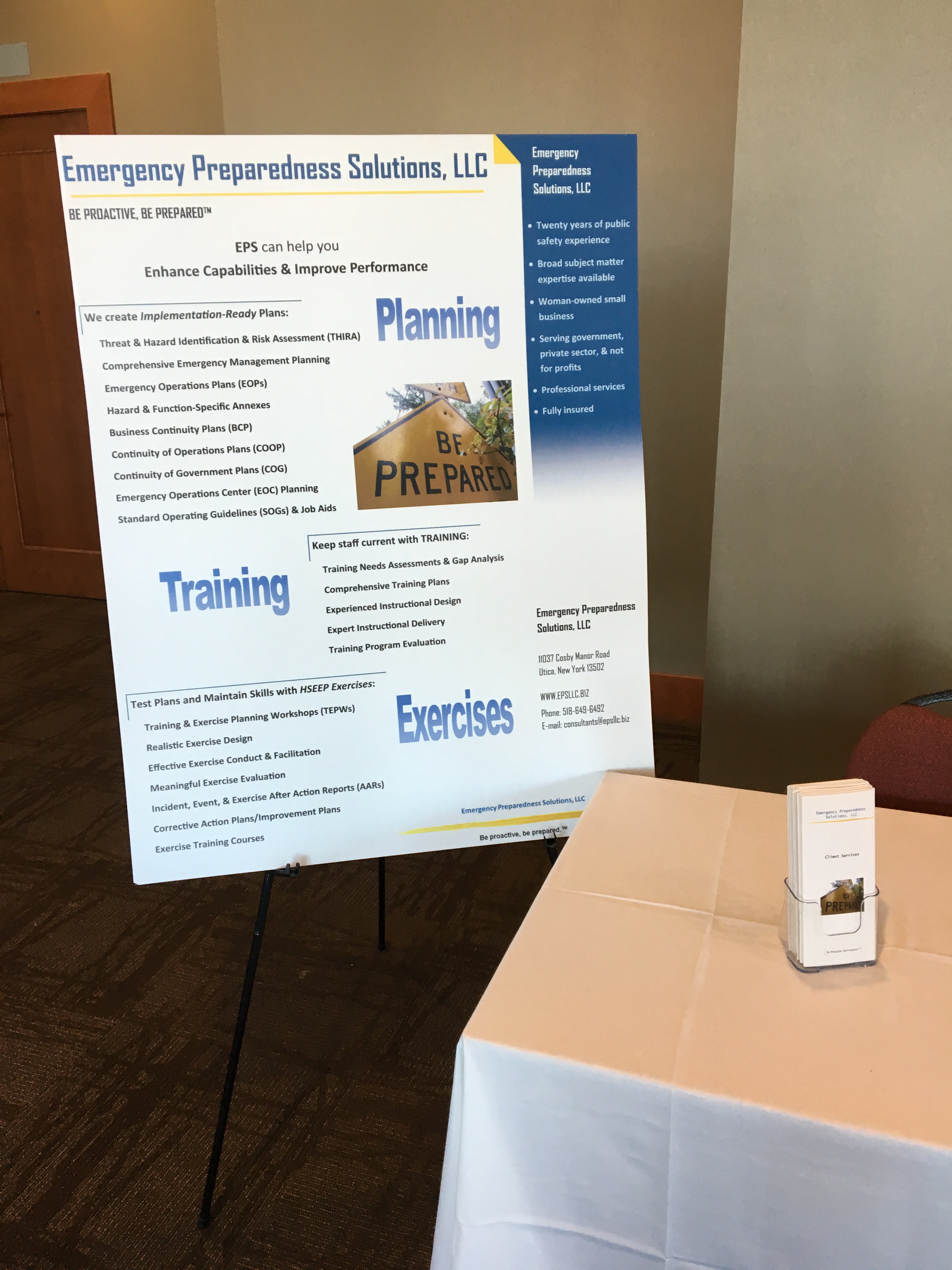
Last month sure was a busy one!  Much of the focus was on marketing for our company Emergency Preparedness Solutions.  I had the opportunity to meet a number of county and local government representatives in a reverse trade show in the Poconos and see some old and new faces at the Vermont Emergency Preparedness Conference.  Pictures of our booth are below.  I also had the opportunity to present with their State Training Officer on the State-Wide Emergency Management and Homeland Security Training Needs Assessment project we completed for the Vermont Division of Emergency Management and Homeland Security a few months ago.  We also need to congratulate Doug Babcock for being honored as Vermont’s Local Emergency Manager of the Year!

IMG_1205

IMG_1206

While those trips were great, the highlight of the month was a trip to Toronto.  The impetus for the trip was the Emergency Preparedness staff of Public Health Ontario, who, after reading my blog posts on the necessity for improvements in Incident Command System (ICS) training, extended an invitation for me to sit in on some training they offer that came about from just that need.  The course I attended was Public Health Emergency Preparedness – An IMS-based Workshop.  Fear not – this is not a reinvention of ICS (or Incident Management System – IMS – as they refer to it in Canada), rather this is an enhancement to the current curriculum.

The Canadian provinces have each adopted curricula for their IMS which are near 100% mirrors of the ICS courses we use here in the States.  While in Toronto, I also had the opportunity to sit in for a bit on an IMS-200 course being conducted by the Toronto Office of Emergency Management.  They were great hosts and have made excellent enhancements to the curriculum for a Toronto-based audience.  (Thank you Sherry and Sarah!) The course offered by Public Health Ontario is truly workshop based, with little lecture and a lot of group work to walk participants through concepts of IMS.  The workshop is positioned between IMS-100 (which most took online) and IMS-200, and is public health focused.

While I’m often weary of discipline-specific courses in emergency management, since the essence of emergency management is cooperative, this workshop absolutely made sense.  Why?  Two big themes built the foundation for this… First, practitioners must be comfortable with their own sand box before they can play with the neighborhood kids.  Second, this particular application works for public health (and several other disciplines) because most of the public health response occurs at the population level, not necessarily at an incident site.  Because of this, public health will almost always function (at least the higher echelons of their incident management structure) from an emergency operations center or departmental operations center.  As such, it pays to invest some training time on a homogeneous audience.  That said, the scenarios that drove the workshop were in no way introverted only to public health concerns and the instructors encouraged thought and discussion toward other activities and associated agencies which would be involved in an incident.

With the positioning of this training between IMS-100 and IMS-200, Public Health Ontario has armed participants with better knowledge and familiarity of the IMS, allowing those who will progress through further (and multi-disciplinary) training a better perspective of how IMS is applied by public health which allows for a better understanding of the system itself.  Not only does the workshop address some internal incident management training needs for public health, it also addresses some of the issues I’ve mentioned previously with ICS training as a whole.  The workshop is expertly designed by the Emergency Preparedness team at Public Health Ontario, and embraces concepts of adult educational methodology which we need to pay more attention to.  The high level of interaction lends to improved transfer of knowledge and better outcomes.  They included information such as the phases of emergency management and the need to reference deliberate planning efforts such as Emergency Operations Plans (EOPs) and Continuity of Operations Plans (COOPs).  This is certainly something we don’t have enough of in ICS courses yet is critically related.  Do you think the majority of our attendees know what these are, much less what is in theirs?  Guess again!

More information on this workshop can be found at https://www.publichealthontario.ca/en/About/Departments/Pages/Incident-Management-System-for-Public-Health.aspx.  Many thanks to Moira, Richard, and Evanna for the invite and the hospitality!

With my road trips complete, I am returning back to the normal pace of work and preparing for another graduate course which begins next month.  I’ve also considered the need to ramp up my concern on this matter of poor ICS curricula from an occasional rant to a crusade.  This is a matter of public safety – from a sociological perspective there is nothing more important than our ability to effectively respond to save lives, stabilize the incident, and preserve property.  Let’s make some changes!

As always, many thanks to my readers; and if you are with a government entity, not for profit, or private interest that is seeking consulting services in the areas of emergency and disaster planning, training, exercises, and anything in between, please feel free to contact me.

© Timothy Riecker

Emergency Preparedness Solutions, LLC
Gauging Return on Investment in Preparedness: Organizing

As a continuation of the Gauging Return on Investment in Preparedness series (read the first one on Planning here), this post’s focus is on the POETE element of Organizing.  There are a number of ‘organizing’ efforts we engage in through our preparedness endeavors.  Some are temporary, like establishing working groups to solve a certain problem; while some are intended to be long-term, like forming an incident response team.

Why organize?  Most organizational efforts are fueled by the need to capitalize on the power of many.  What one person can do, more people can do better.  Problem solving, responding, etc.  Often our organizational efforts are internal, but, particularly in public safety, we coordinate with other agencies.  We might be building a professional response organization, such as an Incident Management Team (IMT), or perhaps we are building a community organization, such as a Community Emergency Response Team (CERT).

What costs are associated with organizational activities?  Foundationally, it’s simply the staff time needed to prepare for, attend, and perform follow up work from meetings and other organizational efforts.  Depending on how complex our efforts are, however, and the intent of our organizational efforts, this can take on full time duties.  You also have to consider who is being drawn into these efforts and what the ‘replacement cost’ is of their time – meaning, what is the cost of someone else performing their work while they are involved in the meetings, etc.?  We also need to identify what costs might be associated with organizing?  The remaining POETE elements (Planning, Equipping, Training, and Exercising) can probably lead you to identifying these.

What are the benefits (value) of organizing?In order to identify the return on our investment, we need to be able to ascertain the benefits our organizational efforts bring – some may be tangible and relatable in dollar figures, others may be more intangible and amorphic.

As with many preparedness efforts, we find ourselves needing to make reasonable assumptions to identify cost savings or value.  We need to follow the bouncing ball of our efforts.  As an example… If we create a CERT team, citizens will be better able to tend to their own needs in the event of a disaster.  This leads to less immediate need of limited resources (first responders), allowing them to focus on more critical needs (i.e. saving lives and protecting infrastructure).   In this example we can make some assumptions about the types of infrastructure to be impacted by a certain incident and the costs associated with it becoming incapacitated.

In regard to saving lives, it’s difficult for us to attach a dollar value to that.  We often say that lives are priceless, and while that may be true, we sometimes need to make an educated guess.  Depending on who you are reporting figures to, they may be satisfied with a reasonable number of lives being saved… others may want to actually compare apples to apples (that is, dollars to dollars).  If you engage the use of your favorite internet search engine and search ‘what is the value of a life’, or something similar, you will find a number of results.  In perusing some of these results myself, I found that the dollar figure assigned to a life is obviously subjective and very much related to the industry in which the question is being asked.  This particular article makes for an interesting read on the subject.  Spoiler alert: they peg the value of a human life at $5M USD (2011).

In the end, organizational efforts need to have a purpose providing a net value.  Even in routine matters and daily business, we should examine the cost of organizational efforts – particularly meetings.  Meetings are one of my biggest bugaboos, as they are often too long, have little purpose, and the objectives can be met in a much more efficient manner.

What ideas do you have on determining the return on investment for organizational activities?

© 2015 – Timothy Riecker

Emergency Preparedness Solutions, LLC

www.epsllc.biz 

National Preparedness Goal: Second Edition Just Released

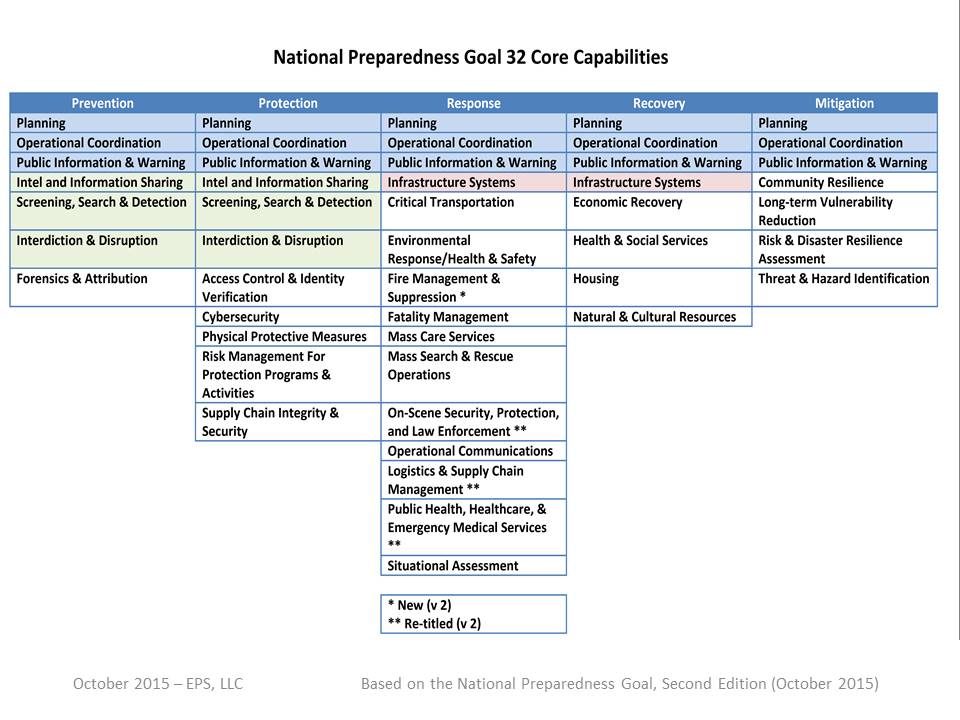
Today FEMA released the second edition of the National Preparedness Goal.  This document, which only has a few substantive changes from the original, provides a vision for preparedness across the nation.  It is best known for identifying the five mission areas of Prevention, Protection, Mitigation, Response, and Recovery; along with the Core Capabilities.  Many thanks to my colleague Jon who brought this release to my attention.  The updated National Preparedness Goal and associated documents can be found here.

There are not many changes in this update, and the changes that are included should be of little surprise if you reviewed the draft released for public comment several months back.  Up front, the update provides some editorial clarification on the definitions and relationships between the federal government and tribes as well as US territories.  It also provides more emphasis on the concept of whole community and the special populations within the whole community which may require additional protections and actions.

Perhaps the most significant changes are reflected in the Core Capabilities, of which there are now 32.  In the preamble to the Core Capabilities which discusses the concept of Risk, it is interesting to note that the Core Capability of Cybersecurity was specifically highlighted as having applicability across all Mission Areas – a concept which I fully agree with.  I’m left wondering, then, why it was not re-defined as a common Core Capability.

NPG 32 Core Capabilities

NPG 32 Core Capabilities

Other changes to the Core Capabilities include the renaming of the On-Scene Security and Protection Core Capability to On-Scene Security, Protection, and Law Enforcement; and the Public Health and Medical Services Core Capability to Public Health, Healthcare, and Emergency Medical Services.  Additionally, the Public and Private Services and Resources Core Capability was renamed to Logistics and Supply Chain Management, which seems to provide better recognition of the intent of that Core Capability.  Finally, a new Core Capability was added – Fire Management and Suppression.

Three of these changes seems to revolve around a stronger recognition and inclusion of the traditional first responder services of Law Enforcement, Fire Service, and Emergency Medical Services; all of which seemed to get lost in the bigger picture of the earlier capability discussions.  I’m hopeful these changes will help bring these services to the table in more communities when capabilities are discussed.  I’m a firm believer that the Core Capabilities provide a consistent, scalable, foundation for discussion of preparedness for every community.

© 2015 – Timothy Riecker

Emergency Preparedness Solutions, LLC
WWW.EPSLLC.BIZ 

LLIS is Back!

Great news from FEMA early this morning – the Lessons Learned Information Sharing (LLIS) resource is back.  Quite a while ago they pulled down the LLIS site and have (very slowly) worked to transition the data and management responsibilities to the Naval Postgraduate School’s Homeland Security Digital Library.  Information from the FEMA release below.

-TR

~

We are pleased to announce that Federal Emergency Management Agency’s Lessons Learned Information Sharing (LLIS) program has completed the consolidation of content previously available on LLIS.gov with the Naval Postgraduate School’s Homeland Security Digital Library (HSDL). As part of the consolidation effort, nearly 23,000 documents were transferred to the HSDL document library. We believe this consolidation will improve the whole community’s access to valuable information. Some of our most recent LLIS products, including Threat/Hazard and Core Capability Trend Analyses, Grant Case Studies, and Lessons Learned and Innovative Practices can be found on FEMA.gov or by visiting HSDL.org.

The content transferred to HSDL will maintain a similar level of accessibility as LLIS.gov. Documents that required a username and password to view on LLIS.gov will also require a username and password on HSDL.org. While your LLIS.gov log-in credentials do not transfer, you can easily create a new HSDL account by visiting the HSDL login page. Please note that some content is available without a password. To search for publicly available documents visit HSDL.org and use the search bar function on the homepage.

If you have additional questions, we encourage you to review our Frequently Asked Questions document. You can also email us at FEMA-lessonslearned@fema.dhs.gov.

Thank you for your patience during this transition. Stay updated on all LLIS program news by signing up for the LLIS newsletter.

Facilities Management and ICS

Earlier in the year I posted a video (something I need to get back into doing) on the positioning of care facilities within the ICS structure (Operations, not Logistics).  I’m currently reviewing some standard operating guidelines created by a county government on the management of such a facility and have made some critical observations….

The biggest observation is that the management of the facility does not have to mirror the ICS organization.  What I mean here is that it really shouldn’t have its own Operations Section, Logistics Section, Planning Section, Finance/Admin Section, PIO, Safety Office, and Liaison Officer.  While I commend the folks who developed this SOG for trying to stick with ICS, I think they are trying too hard.  While the application of this type of organization CAN assist with management of a facility, it’s typically too much.  Yes, ICS is flexible and allows us to activate only the elements needed, but often people feel compelled to utilize the organization to its fullest extent – which in this case can mean the creation of positions which are not needed.  The application of ICS elements to the management of a facility can also be redundant and confusing.  Besides, most jurisdictions don’t have access to multiple Planning Section Chiefs (or persons qualified in other positions) to staff all these areas.

Let’s start at the top… Facilities, per ICS definition, are overseen by Managers.  Not directors or other such titles.  Most facilities have very specific functional activities which should drive their organization.  Yes, most of these would be considered ‘Operations’, and the support of these can be considered ‘Logistics’.  But we really need to look at the responsibilities of the facility and the relationship to the rest of the incident organization to help guide us in the development of how we organize our facility management.  Managers, in ICS, can have assistants, which may be all that’s needed to help address management-level issues that people may be associating with ICS positions.

Does a facility need a Public Information Office (PIO)?  Probably not.  ICS guidelines prescribe one PIO per incident to help ensure coordination and integrity of public information.  If the facility has a need to communicate information to the pubic, they should be working through THE incident PIO.  If the scope of the facilities operations are complicated enough, perhaps that function may have a designated assistant PIO to ensure proper handling of the information, but they are not the incident PIO.

Certainly facilities can have safety issues.  Does they mean they should have a Safety Officer?  Again, ICS prescribes that we have one incident Safety Officer.  Typically the facility manager (or perhaps an assistant facility manager) will have safety included as an additional duty, in coordination with the incident Safety Officer to ensure adherence to all applicable safety standards.  As with the PIO matter, if the facility for some reason has some serious safety concerns, it may warrant the placement of an assistant safety officer by the incident Safety Officer.

The function of a Liaison Officer is fairly high level, with the primary intent of supporting the Incident Commander with the coordination of various organizations involved in the response.  Of course many facilities are likely to be supported by several organizations, but the participation of these organizations has already been addressed by Command, likely with the assistance of the Liaison Officer.  An added Liaison Officer is simply redundant and confusing.

Logistics – while there are certainly support matters that need to be tended to in facilities – such as security, parking, sanitation, etc., this doesn’t warrant a position in the capacity of a Logistics Section Chief.  Yes, they do require some oversight which may be beyond the span of control of the Facility Manager to provide.  This is a good opportunity to assign a Support Services Leader or some other similarly titled position who reports to the Facility Manager.  Additionally, most facilities should not be the ordering point for resources.  If they need resources, the request should be sent up to the incident Logistics Section.  Similarly, there is no need for a facility to have its own Finance/Admin section.

Having an incident action plan is always a critical element of organization.  A care facility should certainly be included in the Incident Action Plan; reflected in objectives and organization, and tasked in a form ICS 204.  That said, I certainly acknowledge that some facilities can be rather complex, with a multitude of personnel and activities and thus can benefit from having more than just an ICS 204 to run by.  Select elements of an IAP can be very helpful, but a full blown IAP is generally not needed.  The development of such a document for a facility generally won’t require a full time position, much less an actual Planning Section Chief.  This is another opportunity to use an assistant facility manager.  The check in function should be coordinated with the incident Planning Section who will either assign someone or the task will be addressed internally by the Facility Manager.

As with most things, there are always exceptions to the rule.  Very large facilities with extensive operations can certainly benefit from having an overhead team.  I’ve seen ‘short teams’ (these are compact versions of Incident Management Teams) assigned to manage everything from staging areas to family assistance centers in very large (Type 1) incidents.  As such this is not something I would generally plan for since it would be an exception to the rule.  Organizationally, a short team/overhead team would become a layer between the facility manager and the task leads/unit leaders to better allow them to focus on their functional jobs while the overhead team addressed the broader management and coordination matters.  If introduced to the organization of the facility, the overhead team must have a carefully defined scope of operations to ensure they were not redundant to functions of the incident’s actual management team.  Also, an overhead team such as this would likely not have a PIO or Liaison Officer.

While we try to introduce ‘hard and fast’ rules to incident management, the reality is that these things are quite fluid and determined by need.  While our general preparedness should support a credible worst-case scenario, we also need to be careful with our planning assumptions.  Otherwise a full-blown plan for a small community could call for a need for a dozen Liaison Officers, which we aren’t likely to get under most any circumstance.  Yes, ICS is flexible, but we need to have a realistic approach.  Similarly, we can use that flexibility of ICS to introduce elements into our organization that might not have been addressed in the plan with a fair amount of ease.  We’re looking at the difference between a shelter in an average high school vs a shelter in a large sports stadium.  All that said, if your catastrophic plan identifies the use of the large sports stadium as a shelter, you should certainly include the provision in that plan for an overhead team to assist in the management of that shelter.

Of course I’m interested in your thoughts on this.

© 2015 – Timothy Riecker

Emergency Preparedness Solutions, LLC

WWW.EPSLLC.BIZ