The Aussie Model of Disaster Recovery

I had recently found a reference to the Emergency Management Victoria Disaster Recovery Toolkit for Local Government.  I’m always curious to see how other nations approach emergency management and even more curious to see the tools and resources they develop to accomplish their goals.  While there is a great deal of consistency between the US model of Disaster Recovery (documented primarily through the National Disaster Recovery Framework), one of the more interesting differences was in the focus areas of each.  While our National Disaster Recovery Framework identifies six recovery support functions (RSFs): Community Planning and Capacity Building, Health and Social Services, Infrastructure Systems, Economic, Housing, and Natural and Cultural Resources; the Aussie model identifies five environments of wellbeing: Natural Environment, Agricultural Environment, Social Environment, Economic Environment, and the Built Environment.

Australian Five Environments of Wellbeing

Australian Five Environments of Wellbeing

While there are certainly commonalities between the two models, each offers a unique perspective on the focus of disaster recovery and what is needed to support communities.  The Disaster Recovery Toolkit for Local Governments, referenced earlier, identifies that local governments are required through legislation to ensure wellbeing to be maintained in each community through each of these environments.

What interesting perspectives have you discovered looking at emergency management globally?

© 2015 – Timothy Riecker

Emergency Preparedness Solutions, LLC

WWW.EPSLLC.BIZ

EM, HS, and Politics

As the mechanizations of election season warm up their engines, let’s be sure to identify the standing of candidates in regard to emergency management and homeland security policies.  While we will never get a fully accurate picture of their intentions in these programs this early on (I’m sure few candidates are even thinking about EM/HS policy aside from immigration), we can get some indication of what their thoughts are and, once primary season is over, who the final candidates might be considering to head important agencies such as DHS and FEMA.

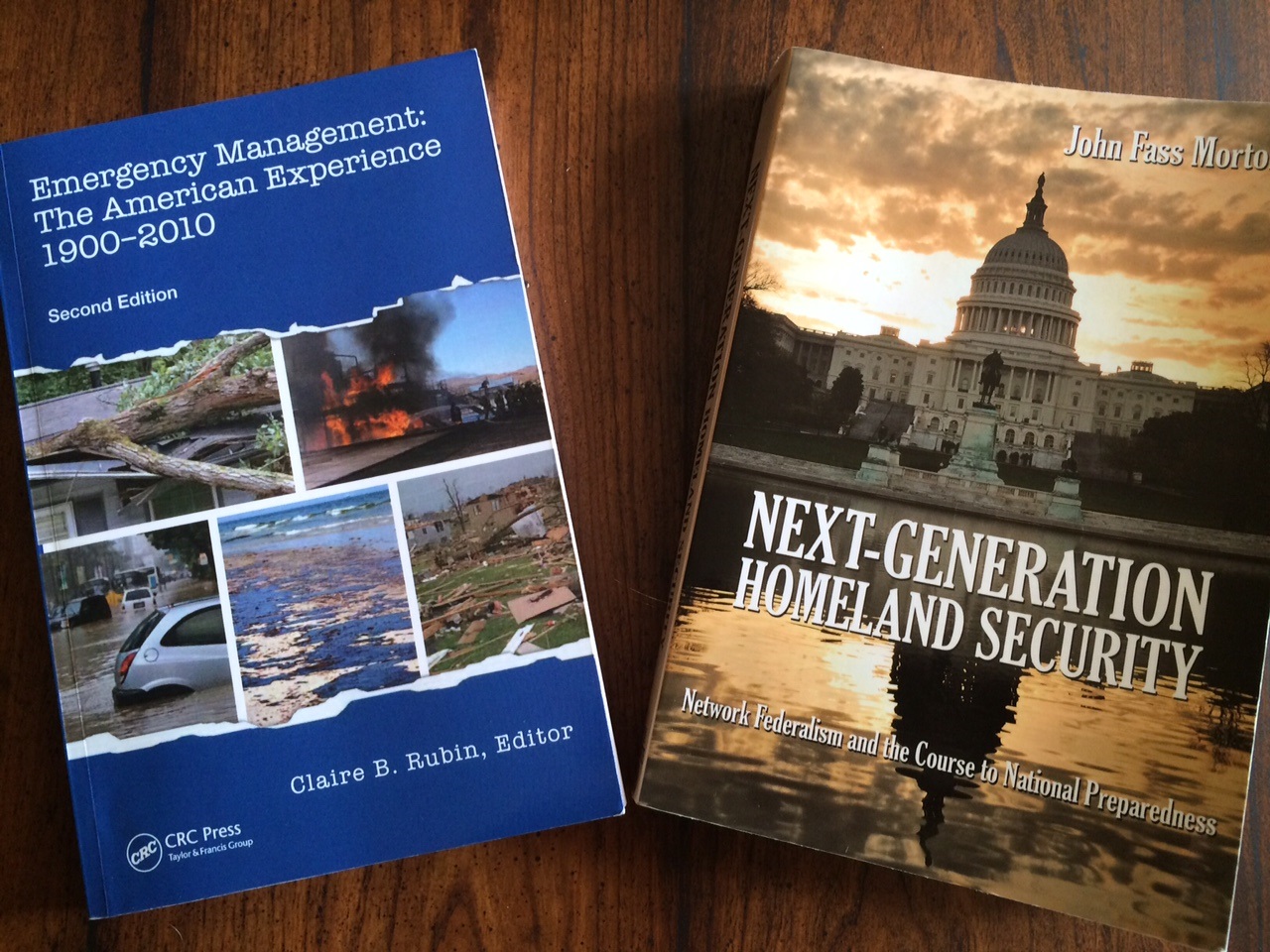
Any examination of this history of emergency management shows that politics seem to shape the direction of what we do as much as significant disasters do.  If you are interested in reading up on this, there are two great sources I’d recommend – Emergency Management: The American Experience 1900-2010 (Rubin. 2012.) provides good summaries of benchmark disasters and legislation through the years; and Next-Generation Homeland Security: Network Federalism and the Course to National Preparedness (Morton. 2012.) provides an in-depth look at this history with detailed references to the administrations, agencies, and people involved.

Rubin and Morton References

Rubin and Morton References

While we have certainly seen an overall positive trend of progress in emergency management (which is heavily influenced and sometimes dictated by federal policy), this has come despite some political actions which have either slowed progress or sometimes fully did away with positive and effective programs.  Having major changes in policy and programs every few years has become unsustainable for our practice, especially at the local level where EM/HS programs are often coordinated by one person.  Change isn’t always bad, but changes should be put in place only after being thought-through and reviewed by professionals to ensure they are effective and sustainable – not just politically motivated.  FEMA has been doing a great job in the last several years by providing public comment periods on new and major changes to guidance.  I hope this continues.

© 2015 – Timothy Riecker

Emergency Preparedness Solutions, LLC

WWW.EPSLLC.BIZ 

Your Complete Guide to the 5 Cybersecurity Bills in Congress

Yesterday Eric Geller, a writer for The Daily Dot, an online internet culture newspaper, posted Your complete guide to the 5 cybersecurity bills in Congress.  This is a great overview of each of the bills and what they entail.  These bills represent an important progression toward a better cybersecurity policy and implementation in the US.  A worthwhile read.

© 2015 – Timothy Riecker

Emergency Preparedness Solutions, LLC

www.epsllc.biz

News in Emergency Management

Regrettably I’ve not posted in a few weeks due to a very busy schedule.  While that hasn’t broken, I did want to take some time to ensure that my readers have seen some recent news that has been circulating in emergency management as of late.

First, the FEMA mobile app has updated and is now providing the ability for users to receive weather alerts from up to five locations across the nation.  This is a particularly handy feature for those who have family and friends in other states or those who travel frequently to different areas.  With hazardous weather season upon us, be sure that you use the FEMA mobile app or other state or local alerting service to ensure that you, your family, and organization receive alerts.

Second, DHS has provided an update on the status of the LLIS (Lessons Learned Information Sharing) Libarary.  From the release I received this morning…

Dear LLIS.gov User,

This spring, the Lessons Learned Information Sharing (LLIS) program will make a significant change. The LLIS.gov website will cease independent operations and will consolidate its content with the Naval Postgraduate School’s Homeland Security Digital Library (HSDL.org) and FEMA.gov.

One of the advantages of this move is that LLIS.gov content such as lessons learned, innovative practices, after-action reports, plans, templates, guides, and other materials will be consolidated with the already substantial database on HSDL.org. This change will allow the homeland security and emergency management communities to find relevant information in one place. FEMA’s LLIS program will continue to produce trend analyses, case studies on the use of FEMA preparedness grants, and webinars relevant to the whole community. These products will be available to the public on FEMA.gov.
They don’t give any timeframe for this migration aside from stating that they will provide updates in the coming weeks.  Personally, I think this is a move that makes sense by consolidating some great sources of information.  I’m also happy to hear that FEMA will continue providing some data and trend analysis, although I’m hopeful that the information they provide is of greater value than what I have seen in the past.  I’m also curious if this will be somehow integrated into the new Data.gov site.  It’s unfortunate that LLIS has been pulled down for so long while they have sorted all this out.

Lastly, good news for coastal communities and those who have suffered inland tropical storm damages in the last few years – the prediction for the 2015 hurricane season is that we will have lower than average activity.  A link to the annual predictive analysis can be found here.

That’s all for now.  Stay safe.

© 2015 – Timothy Riecker

Emergency Preparedness Solutions, LLC

www.epsllc.biz 

Dispatch Transition to EOC Operations

Within the LinkedIn discussion thread of one of my recent posts on applications of ICS, I was prompted to consider that one more awkward element for an EOC operation can be the transition or integration of dispatch with the EOC.  Consider that during ‘routine’ operations, it is dispatch who is supporting field operations and tracking critical actions.  Many jurisdictions encounter a difficulty when activating an EOC locally to support a growing response – what to do with dispatch?

The EOC’s traditional role as ‘expanded dispatch’ aids a field response by providing a greater level of coordination far beyond the tools normally available to most dispatchers by facilitating direct access to agency representatives who are dedicated to supporting the needs of the incident.  Under routine operations, Command (or Logistics) is contacting dispatch directly (usually via radio) to request resources.  Upon activation of an EOC, these requests must be routed to the EOC.  In some jurisdictions, EOCs are co-located with dispatch (at least in the same building), making this transition a bit easier in regard to technology and people, but some jurisdictions have these buildings separated.

How do you solve this awkward dilemma of ICS/EOC interface?  First of all, it needs to be thought through and planned PRIOR to an incident!  This is when we can do our best work, ideally bringing all relevant stakeholders to the table, mapping out processes and procedures, and identifying equipment and technology issues needed to support it.  With everyone together, talk through what you want to do given the circumstances you have.  Each idea likely has pros and cons that have to be weighed.

Some possibilities… Keep all resource orders going through dispatch. In doing so, you are not interrupting the ‘normal’ communications link with field operations.  In this circumstance, though, you need to consider how the dispatcher will transfer the resource request to EOC Logistics.  Since you likely do not want Logistics to be accessing the PSAP system, the dispatcher will likely have to enter the request into another system, such as EOC management software (something they likely don’t use often).  This can be time consuming so it will likely require the dispatcher to be solely dedicated to this incident.  The scope of resources (or ideally missions) is also beyond what a dispatcher usually deals with (thus the reason for activating the EOC), so it would likely require some additional training and use of dispatchers with greater experience.

Another option is to bring the dispatcher into the EOC.  Sometimes physical separation, despite technology, can make things awkward.  If the jurisdiction has the technological ability to bring a dispatcher into the EOC as part of the Communications Unit, they can interact with field operations and facilitate communication better.  The need to enter the resource/mission request into a formal system which is assignable and trackable still exists.

Another option is to pull dispatch out of the incident.  This can cause significant disruption to the incident but is manageable if pre-planned, trained, and exercised.  At this point in an expanded incident the need to use radio communications beyond field operations may be exceeded.  Field Logistics can interface directly with EOC Logistics via phone or other technology to communicate resource requests.  This methodology gets the request directly to EOC Logistics for them to handle.

There are certainly other models and possibilities that exist.  What experiences do you have?  What have you seen work?  What have you seen fail?

© 2015 – Timothy Riecker

Emergency Preparedness Solutions, LLC

WWW.EPSLLC.BIZ 

Flooding – ’tis the Season

In central New York we have experienced 50+ degree (F) weather for the first time in months.  With the warmer weather has come the melting of a fair amount of snow which accumulated through the winter.  Winter temperatures rarely reaching above freezing up here resulting in little melting of snow through the season, so it’s all occurring now. Coupled with spring rains and storms, flood watches and warnings have been issued here and in other locations around the nation.  If you haven’t already, now is the time to prepare for flooding!

Aside from the measures that homeowners, business owners, and facility managers can take (sump pumps, doorway dams, sand bags, and flood barriers), jurisdictions need to be prepared for the impacts of flooding.  If electronic gauges don’t exist in your streams and rivers, be sure to have someone periodically measure and report their depth and progression toward flood stages.  Ensure that culverts are clean and open for the flow of water, and have personnel, equipment, signage, and barriers ready to deploy to address trouble spots and close roads.

Ironically, water and wastewater systems have a significant vulnerability to flooding.  The EPA has issued Flood Resilience: A Basic Guide for Water and Wastewater Utilities that includes worksheets, videos, and flood maps to guide water and wastewater system operators through identifying their flood risk and vulnerability and mitigation options available to them.  Along with that effort, they have issued a Flooding Incident Action Checklist.

Most importantly, make sure that flood awareness is not a unilateral effort.  Involve emergency managers, elected officials, and first response organizations.  Review plans, policies, and procedures and ensure they are up to date.  Consider related actions, such as notification and warning, evacuation, and flood fighting measures.  Preemptive messaging to property owners/residents and business owners to help them be aware and prepared for flooding is also crucial; and make sure everyone knows how to receive local weather alerts so they are aware of any imminent flooding dangers.

Stay dry!

© 2015 – Timothy Riecker

Emergency Preparedness Solutions, LLC

www.epsllc.biz

PPD-8 Revisions and National Engagement Period

A NIMS Alert has just been released announcing the opening of the national engagement (comment) period on revisions to PPD-8 (National Preparedness Goal).  Most notably, these revisions include updated definitions for 10 Core Capabilities and the creation of one new Core Capability – Fire Management and Suppression.

These last few years I have found that FEMA has been more responsive than ever to stakeholder feedback and this is another great opportunity to ensure that their guidance and doctrine continues to be relevant and meaningful to those of us who use it.

A link to the PPD-8 revision site and national engagement period is here: http://www.fema.gov/media-library/assets/documents/103912.

TR

The Human Aspect of ICS and Overcoming Transitional Incidents

Most often when we consider the Incident Command System (ICS), we think of boxes in an organization chart, forms to be completed, and specific processes to be followed.  True, these are, in essence, aspects of ICS, but they alone will not pave the way to success.  What we must remember is that ICS is conducted by people.

Typically the most difficult aspect of a complex incident is the transition from what we normally do and how we normally respond to elevating our response to a more appropriate level given the scope of the incident.  The groundwork for this transition lies in our initial response, which many experienced responders know can set the tone for the entire operation.  This initial response is based largely on the decisions we make with the information we have.  While there are policies, plans, procedures, play books, checklists, and myriad training that help to inform us, it all comes down to the human factor.  People make decisions based upon the stimuli they are presented with and their own experiences.

Chief Cynthia Renaud in her paper The Missing Piece of NIMS: Teaching Incident Commanders How to Function in the Edge of Chaos discusses approaches to initial response as an oft forgotten aspect of how we teach ICS.  While we know that responders conduct initial responses all the time, there is a significant difference in scope between a routine incident and a complex incident.  This difference in scope requires a different and more open mindset.  While our size up actions may generally be the same, we need to think bigger and this kind of thinking is difficult to train.

The implementation of the ‘bigger’ (i.e. beyond what is routinely used) aspects of ICS is also a challenging mindset for responders.  These aspects of ICS, such as the initial delegation of other organizational aspects and the need for a written Incident Action Plan, do not come easily when they are not practiced.  The fact of the matter is that the implementation of ICS requires a conscious, deliberate decision accompanied by people with knowledge and skilled intent to guide its expansion suitable to the incident at hand.  It also requires a bigger picture mindset recognizing the need to expand the management of the response proportionate to the complexity of the incident and the resources required to address it.  When is it needed?  How do we do it?

One problem is that most of the people we count on to manage these initial responses are trained to manage tactics, not large incidents.  They excel at managing a handful of resources in a rapid deployment and resolving an incident quickly.  This is exactly what they are needed for and they do it well.  Chief Renaud indicates a need to train these first level supervisors to recognize complex incidents for what they are and give them the tools (and authority) to implement broader measures, including an expanded implementation of ICS.

I’m a firm believer in ICS, but I know that people have to drive it.  It’s not something we can put on autopilot and expect it to bring us to our destination.  It has to be consciously and deliberately implemented.  When people criticize ICS, I often find that their criticism is due to false expectations and inappropriate implementation.  With that, I firmly believe we need to do a better job at training to address these issues and help responders better understand the system and demystify its use.

How do we make our training better for the average (non Incident Management Team) responder?  How do we help bridge this gap between the routine and the complex?

© 2015 – Timothy Riecker

Emergency Preparedness Solutions, LLC

www.epsllc.biz 

Emergency Managers Need to be More Like Engineers and Less Like Shopkeepers

I was inspired by this short (~1 minute) video from TrainingJournal.com.  In the presenter’s brief but pointed message, he describes many trainers as being akin to shopkeepers, providing organizations often times with rote solutions just as a shopkeeper will pull a product off their shelves. He goes on to say that this these solutions are usually effective, but only for a limited duration.  He offers, instead, that trainers need to be more like engineers, examining every facet of a problem and constructing lasting solutions.  As an experienced trainer and proponent of a detailed root cause analysis, I couldn’t agree more, but as I readied myself to write a post about the implications of this on training, my mind carried this metaphor to many of our practices in emergency management.

Consider how often we quickly dismiss identified gaps with an assumed solution.  Write a plan, conduct a training, install a bigger culvert.  Those are usually our solutions to an identified problem.  Are they wrong?  No – we’re correct more often than not.  Are these lasting solutions?  Rarely!  How often does the problem rear its head again within a relatively short span of time?  How do we address the re-occurrence?  As shop keepers we simply pull another solution off the shelf.  Can we do better?

The things we do in emergency management are often based upon best and current practices.  We address problems through the prevalent way of dealing with such things industry-wide.  Emergency management has a great community of practice.  I’ve mentioned in several previous blog posts the spirit of sharing we have and the benefits we see come of that.  It doesn’t seem often, though, that we engage in an industry-wide groupthink to solve various problems.  We use and adapt ideas of individuals and small groups, we see a steady and determined progression of the practices within our progression, but we rarely see ‘game changing’ ideas that revolutionize how prevent, prepare for, respond to, or recover from disasters.  Why is this?

Perhaps we need a greater collective voice locally, where practitioners are dealing with the problems directly?  Our methods of practice in emergency management are generally driven by the federal government (THIRA, NIMS, HSEEP, etc.).  I’m not saying any of these are bad – in fact they are excellent standards that we need to continue to refine and apply, but it’s generally not the federal government that is dealing directly with the constant flow of issues being dealt with at a state, and even more so, a local level.  We need to follow that metaphor of being engineers to apply more permanent solutions to these problems.  We need to create, innovate, and problem solve. Or do we?

Necessity, as they say, is the mother of invention.  We often miss the necessity of improving because we have current, functional solutions – we have things that work.  So why fix it if it’s not broken?  I say we can do better.  The realization of the need for lasting solutions is the necessity we need.  If the solutions we have on the shelf don’t work for us 100%, let’s figure out a better way.

I don’t know what or how, but I’m sure that as a community we can identify needs and prioritize what must be addressed.  Given the right people, time, and maybe a bit of money, we can be innovative and effect some lasting change.

I’d love to hear what others think on this topic.

© 2015 – Timothy Riecker

Emergency Preparedness Solutions, LLC

www.epsllc.biz

The Need for Practical Incident Command Training

I’ve written a couple of articles in past few months (See: Preparedness – ICS is Not Enough; and Training EOC Personnel – ICS is Not Enough) where I’ve been a little rough on the Incident Command System (ICS), or rather the trust that people put in it as a magic pill to cure all their incident management ills.  As it turns out, there is no apologia; rather I’m going to continue challenging the status quo, this time as it relates to how ICS training is conducted.

The driving force behind this is the realization of a gap that exists in ICS training and the ability of learners to apply what they have learned to a reasonable degree within an emergency response environment.  The foundational ICS courses (ICS 100 – 400) provide learners with a progressive understanding of the concepts, terms, organizational elements, and primary processes within ICS, but provide little opportunity to practically apply what they have learned.  Progressive instructional design methods through course revisions have added more hands-on activities within these courses to enhance learning, but these courses still fall short of providing the kind of practical exercising needed for learners to have any degree of confidence or proficiency.  That said, these courses accomplish exactly what they are intended to.  They are not designed to provide much practical application.

To the other side of the ICS training spectrum is training for Incident Management Teams (IMTs), which provides intensive and in depth training, mostly focused on the individual positions within an incident command organization, and the key activities and responsibilities of those positions.  IMT training also includes capstone courses in which IMTs complete a combination of didactic and hands-on instruction in a team environment.  Much of this training is coordinated by FEMA and the US Fire Administration through the NIMS ICS All-Hazards Position Specific Training Program with their focus primarily on building capability at the Type III (extended operations) level, with training at the higher (Type II and I) levels available through appropriately intensive efforts.  While some training is available for Type IV and V IMTs, this is often not taken advantage of because rural areas may not be able to assemble enough personnel for a functional team.  The training is also still fairly intensive, even at this level, and requires a number of courses, each with a team of instructors.  This comes at a high cost of time and dollars.  The need for local personnel to function within an incident command structure at the local level still exists, but goes largely unaddressed with performance level training being focused on IMTs.

Certainly exercises can provide an opportunity for individuals to work together as an ad-hoc team to resolve an incident.  While exercises provide for great practice, instructive feedback usually doesn’t occur at all, with usually only a few out of context comments coming until well after the experience by way of an After Action Report.  Structured learning environments which provide a series of simulations where individuals can practice what they have learned are ideal, particularly when immediate hotwashes are provided after each scenario, allowing learners to grow and apply what they have learned in the next scenario.

Of the learning opportunities that current exist, the Enhanced All-Hazards Incident Management/Unified Command course (MGT 314) from TEEX comes closest to this type of experience.  I have direct experience taking this course at the TEEX location several years ago and found it to be a great experience.  Because of the technology used to facilitate the course it is only offered as a resident program at TEEX and seats fill quickly.  While this is a great program, we need more like it and an ability to reach down to small local governments where there is an urgent need for this type of practical training.

Several years ago colleagues and I developed a course called the ‘IAP Workshop’, which is a daylong scenario-driven training where students practice working the ICS planning process and ultimately developing an IAP.  Through the day of training, participants go through this process several times in a crawl-walk-run progression with feedback provided by facilitators.  Participants are required to have completed the ICS 300 course as a prerequisite.  This course has proven successful, despite naysayers and traditionalists who default to the ICS curriculum fulfilling all ICS training needs.  That said, there is more to ICS and ICS application than the planning process.

Practical training in any subject, particularly the Incident Command System, builds confidence and improved application of knowledge and skills.  Since most incidents are best managed locally, we need to invest in better training to enhance local capabilities.  The foundational ICS courses are just that – foundational.  IMT training may simply not be the best solution to meet this need.  Let’s talk about the ICS training gap and find some solutions.

What ICS training gaps have you identified?  Have you discovered or designed any solutions?

© 2015 – Timothy Riecker

Emergency Preparedness Solutions, LLC

www.epsllc.biz