Emergency Management Grants – Promoting Planning Standards

We know that good emergency plans are the cornerstone of preparedness.  Often times it is local governments that have difficulty putting quality plans in place because they don’t have knowledgeable personnel or funds available to make this happen.  This gap is critical since we know that all disasters begin and end locally, so quality local plans are an imperative.

States provide financial assistance to local governments through a local allocation of the Emergency Management Performance Grant (EMPG), which is an annual grant program through FEMA/DHS as a component of the Homeland Security Grant Program (HSGP).  While there is always some variance in the goals or focus of EMPG, the overall concept and allowable costs are fairly static and the emphasis is always on preparedness.

Preparedness, however, encompasses a lot of activities.  The best breakdown is POETE – Planning, Organizing, Equipping, Training, and Exercising.  Just from this we can see a lot of opportunity to spend money on a lot of needed activities.  Planning, however, regularly needs to be revisited.  While funding the other activities may be important, they mean very little without a quality, up to date plan.  All preparedness activities should relate somehow back to the plan, such as equipment and training efforts to shore up capabilities identified for need through the planning process.  This applies to everyone by the way – federal, state, and local governments; private sector; and not for profits.

How can states (or any other grant or budget managers) continue to emphasize the importance of planning?  I’ve recently seen a best practice by the State of New Hampshire which is similar to the federal administration of the Community Development Block Grant (CDBG) programs.  First, they make funds available for, and only for, planning.  This includes new plans and plan updates.  Once plans have been developed that meet their standards, then additional funds can be requested for supporting preparedness activities.  This building block preparedness approach helps provide targeted funds solely for plan improvements while helping to ensure that subsequent funds are provided for activities that associate with the plan and addressing or identifying (by way of exercises) gaps.  While it can be a bit cumbersome, I think it’s a great model for promoting preparedness the right way.

Thoughts?

©2014 – Timothy Riecker

Dig Deeper – Ask ‘Why?’ Five Times

Be an archaeologist and DIG DEEPER!

Be an archaeologist and DIG DEEPER!

An old boss of mine once told me that to find the real root of any problem you should ask ‘Why?’ five times.  This sage Yoda-like advice has served me well ever since.  Of course it’s not always necessary to ask it the full five times; in fact you often find the foundational cause sooner.  Nonetheless, this approach will inevitably guide you toward discovering what needs to be fixed.

Those who follow my blog know that I post mostly within two thematic areas – emergency management or training.  The ‘ask why’ methodology applies to both of these areas and darn near anything else I can think of.  My thoughts are below on both themes.  Of course training in the field of emergency management is a combination of the two!

In Emergency Management

I’ve posted numerous times on topics such as hazard analysis, Threat and Hazard Identification and Risk Assessment (THIRA), and other similar topics in emergency management.  It is so incredibly necessary for us to identify needs and vulnerabilities, and to understand our community’s capabilities in order to properly prepare for future disasters and emergencies.  I’ve learned that in public safety, when asking a question, you often get a story and that story is often related to a past incident.  While the story may be elaborate, it usually gives you little substance.  Anecdotes aren’t enough.  You need to dig deeper.

As a culture within public safety we are still trying to drive practitioners to be more analytical.  Quality after action reports are a big step in the right direction.  The benefits of after action reports for incidents, not just exercises, are huge.  After action reports should lead to improvement plans, but without identifying the real reason behind what went wrong we can’t fix the problems.  After action reports require an analysis to dig deeper into the observed action to discover what really needs to be addressed.

In Training

In November I published an article in Training Magazine titled The Importance of Analysis to Identify Root Cause.  While I didn’t reference the ‘ask why’ methodology directly, the subject matter of the article lends itself to this approach.  As a trainer, when a problem is presented to you to ‘fix with training’, you need to figure out what the real issues are so that 1) you can confirm that it is in fact a training issue, and 2) you can determine what the objectives and methodologies of the training need to be.  Without properly identifying and defining the needs you are doomed to fail and will likely be putting forth a lot of effort with little gain.  While the results may put some people on the defensive, they can point the organization in the right direction to address inefficiencies and performance problems.

In any needs assessment, don’t simply accept the first answer given to you – dig deeper!  It’s amazing what you will find!

© 2014 – Timothy Riecker

Examining Needs-Based Emergency Planning

For the past decade and one half we have seen documents such as Civil Preparedness Guide (CPG) 1-8 (1990), State and Local Guide (SLG) 101 (1996), and two versions of Comprehensive Preparedness Guide (CPG) 101 (2009 and 2010) provide us with continually advancing standards and guidance for emergency planning.   We have seen the focus points of planning evolve from assumption-based, to threat and risk-based, to capability-based planning through each of these iterations.  With the release of each new standard, however, the lessons learned from the previous have been preserved, bringing with them remnants of the earlier standards.  Our current standard, Comprehensive Preparedness Guide 101 (2010), maintains a focus on capability-based planning but still stresses the importance of formulating assumptions in our planning as well as identifying threats and risks.  Each of these elements is important, but in these examinations we seem to be forgetting something very important – what is the need?

Planning assumptions, risk and threat, and capabilities assessments are all important informers of emergency planning and must remain in the lexicon for us to be successful.  It seems, though, that while these elements contribute to our planning efforts, they still don’t define the true need.  In examining the real need in any jurisdiction, we need to identify these other elements but we can’t take the jurisdiction itself for granted.  Identifying the needs of the jurisdiction will help us, along with the other elements, to identify what the impacts of a disaster will be and how prepared we are to address them.  Too often we see emergency planning efforts which are very rote, paying little attention to the real needs of the jurisdiction.

If you have followed my blog for any length of time, you likely recall that I am a huge proponent of needs assessments.  As a trainer, a proper needs assessment is everything.  It leads us to the identification of what the desired behavior is and is a critical first step in determining how we will effectively train individuals to achieve it.  Earlier this month I had an article published in Training Magazine on the Importance of Analysis to Identify Root Cause.  The same principles of needs assessment can be easily applied to emergency planning.  Very simply, needs drive objectives.

The identification of needs for a jurisdiction involves an examination of both the physicality of the jurisdiction as well as the population.  Elements of the physicality of the jurisdiction include size and geography, accessibility of areas within the jurisdiction, and critical infrastructure and key resources contained within the jurisdiction.  Examining the population demographics includes age ranges, income levels, disability, vulnerable and at risk populations (the CDC Social Vulnerability Index is a great resource), languages, cultures, religions, population densities, and the ratios of full time residents to transients/visitors, and commuters.  GIS can provide us with much of this information both individually and in aggregate.

Once we collect this data, an analysis is important to identify what it all means (aka defining the need).  Where are there vulnerabilities within the jurisdiction in a steady state?  Under which scenarios exist increased vulnerabilities – such as a bridge that provides the only access to an area of the jurisdiction being washed out.  What religious and cultural matters must be considered in disaster response?  What needs exist for communicating with those with limited English proficiency?  The answers to these questions will inform strategies contained in our emergency plans and annexes.

Good planners dig to these depths and produce quality operational plans – but most don’t.  Plans which have not been written with this detailed process are doomed to fail as the needs of the jurisdiction have not been weighed with our assumptions, threats and risks, and capabilities.  The THIRA process helps to move us in the right direction by asking us to provide threats and hazards with context (our planning assumptions) and then establishing capability targets which will address these impacts.  Still, it’s not direct or detailed enough to provide us with all the information we need.

While CPG 101 guides us to know our communities and to understand the consequences of a potential incident, the current focus on capabilities, while important, is a focus on us – public safety.  The focus must be on the jurisdiction as a whole and an identification and understanding of potential impacts and the resultant needs of the jurisdiction.  It’s not so much a change in process as it is a change in emphasis.  We must first understand needs before we can plan to address them.

Thoughts?

© 2014 – Timothy Riecker

This isn’t my Red Cross

The National Red Cross announced last month another restructuring effort taking place across the country.  It seems every few years the Red Cross attempts to streamline their operations through a similar effort.  What is missing with every restructuring activity is a local perspective, which I think hurts them greatly.  Consider that the Red Cross’ service delivery is mostly local.  Their volunteer base is local.  Their fundraising requests are local.  Yet with each reorganization they draw back further and further from those local roots.

I heard a rather compelling example just this past week of how the Red Cross’ organization has changed in the state of Vermont.  From what I was told, Vermont used to be covered by three chapters.  Reorganization several years ago consolidated those three chapters to one.  This current reorganization effort is now consolidating the Red Cross into one chapter which has responsibility for both Vermont and New Hampshire!  Additionally, they have sold their mobile canteens and have contracted to a restaurant food provider to handle emergency food services.  While this contract does provide for a more sustainable and large scale operation, all these efforts continue to draw the Red Cross out of the community.

I first heard of this most recent reorganization through the blog Disaster Gestalt, written by Joseph Martin who has a long history serving as a Red Cross volunteer.  I shared some of my insights in his blog as I reacted initially to the news he brought me.  Upon hearing more and more about this reorganization and its impacts across the country, I’m really left wondering what happened to my Red Cross.

My involvement with the Red Cross started in high school where our government class required some measure of civic service.  My best friend had gotten some info on the Red Cross and they took us in as volunteer Health and Safety Instructors.  They trained us to teach courses in First Aid and CPR to the community.  We both took to it quickly, finding quite a passion for teaching.  In many ways it began both our careers as instructors and in emergency services.  With this passion, we continued volunteering for our local chapter well beyond our high school requirement.

The staff at the chapter was wonderful and not only helped us grow, but encouraged us to further our involvement.  While we continued to do mostly volunteer work, we also became paid instructors, helping the chapter serve corporate clients and eventually instructor trainers conducting train-the-trainer courses.  I attended community college locally after high school so was able to continue my work for the chapter while also working nearly full time, taking classes full time, and receiving my initial training as a firefighter, EMT, and diver.  I honestly have no idea where that energy came from!

When I left the area to complete my bachelor’s degree and subsequently moved around a bit, I continued teaching for Red Cross chapters around the northeast.  My experience with each of those chapters was very similar to that of my home chapter.  They were all welcoming and thrilled to have help.  Eventually, once I settled into my career I became a board member.  Despite the three hour round trip drive, I served on the board of my home town, where my Red Cross service started.  It was a rewarding experience.  My work and family obligations eventually pulled me away, but I continued to donate and always had a place in my heart for the Red Cross.

In the years since my board service there have been several reorganizations nationally.  Each of these reorganizations worked to centralize chapter activities to regional offices, resulting in layoffs at the chapter level.  While I understand that consolidation can be a cost savings, it decreases the local reach of the chapter.  Additionally, the responsibilities of the chapter executive continued to decrease.  With true management and direction coming from regional offices, there is little left to manage at the chapter level.  Job postings for chapter executives seem to stress fund development more than anything else.  The footprints of chapters continue to expand as chapter consolidations occur.  No longer are chapters community-based as their territories cover many jurisdictions.  It’s all rather impersonal.

In researching this article I was not able to find anything that discussed the national picture of this reorganization.  I found quite a number of stories from local media talking about the impacts of the reorganization on their local chapters, though.  Nearly every article mentioned expanded territory and staff layoffs.  Many also, interestingly enough, mentioned new chapter executives coming on board.  I reached out to the Red Cross to find out more about their current reorganization effort and sent an email through their Public Inquiry function on their website.  I did receive a response back within a few hours.  What they wrote back provided some high level goals but little data on the impacts of the reorganization, which I did request.  Here are some snippets:

The American Red Cross is transforming its operations to meet the growing demand for our services while making the best use of donor dollars.


  • In the past few years, the demand for our services has grown. To meet this demand, we continue to look for ways to touch more lives while keeping our costs low.


  • We have outlined a three year plan to lower the cost of operations by finding more efficient ways to do our work and expanding volunteers in every community.


  • Our goal is to help more people at less cost. We will be even better stewards of our donor dollars because we are an even more cost-conscious organization.

 Guided by recommendations from representatives of local paid and volunteer leadership, we are consolidating Red Cross chapters and putting these savings into serving more people in need.


  • With a consolidated regional structure, we can provide more robust and consistent services across a wider geography. These consolidations enable us to shift donor dollars from costs associated with delivering service to the actual services themselves, enabling us to serve more clients with more direct assistance.


  • We aim to increase both the number of clients served and the resources made available to them – not through the addition of more paid staff – but by adding more volunteer leaders and involving them in more ways.


  • Volunteers have always been and continue to be the backbone of the Red Cross. Their importance will increase as we look to deliver services in more communities across the country. We want to make Red Cross the best place in America to work and volunteer.

 The public can continue to count on the Red Cross to be there to serve the needs of their communities.

 Our goal is to:

  • Increase the number of home fires we respond to. Home fires impact more people across the county each year than all other natural disasters combined.
  • Increase by 10 percent the financial support we give to individual disaster clients. The average amount we give to families affected by home fires has not changed in 10 years.
  • Develop a local structure that allows us to deliver services more efficiently and be in even more local communities. Currently, Red Cross is present in more than 2,000 U.S. communities and military facilities worldwide.

I am still left with many questions about their implementation.  It doesn’t seem to make much sense to expect higher donations and increased service delivery when their physical presence in communities has decreased.  They want to do more with less by increasing chapter territories but decreasing staff.  They say they can fill the gap cost effectively through volunteers.  While the Red Cross has a long history of service delivery through volunteers, the foundation of that is staff who manages and coordinates the activities of volunteers.  While volunteer leaders can certainly help meet needs, paid staff are still the ones ultimately accountable.  Volunteers also like to have connections to paid staff and with the decrease in paid staff and the larger territories it feels more and more impersonal.  Given the operations of the Red Cross, while volunteers are important and certainly critical to the success of the organization, the important role of paid staff and a physical presence in the communities they serve is extremely important.

I’m sure that many folks at national headquarters work very hard on trying to determine how to maximize their funding and the services they provide.  Nearly every organization, be it non-profit, for profit, or government, strives to strike the right balance.  In my opinion, however, this continued trend of regionalization will only continue to hurt the Red Cross.  Their community presence decreases more and more.  When community members don’t see and feel that presence they are less compelled to donate much less volunteer.

To be clear, I still support the mission of the Red Cross.  I am very much a proponent of the Red Cross and the services they provide.  They provide important services to communities and are a critical partner in preparedness and emergency management.  While there is always room for improvement, however, their serial reorganization efforts through the last 15 years or so have achieved a level that is sadly comical.  There must be a better way.  The organization has become so impersonal I no longer feel that they are my Red Cross.

I’m very interested in the opinions of others on this matter.  Do you feel the Red Cross is improving through these reorganization efforts?  If so, how?  Do you feel more or less compelled to donate or volunteer?  Am I missing something?

© 2014 – Timothy Riecker

Training EOC Personnel – ICS is not Enough!

A consistent misconception is that if an emergency operations plan calls for an Emergency Operations Center (EOC) to utilize the Incident Command System (ICS), then EOC personnel only require ICS training to be successful in their jobs.  ICS training, however, only gets personnel part way to success.

Regular readers of my blog know that I am a big advocate of conducting needs assessments.  Often times, agencies don’t know how to conduct a needs assessment, don’t think it’s important enough to conduct one, don’t think that conducting one is necessary, or simply don’t even consider conducting a needs assessment.  The result is creating training or using existing training that does not meet the real needs.  Certainly if an EOC is using the foundations of ICS to define its organizational structure and processes, then ICS training is absolutely important.  Consider, however, the multitude of other processes that take place in an operational EOC that are not included (in whole or in part) in ICS training.  Processes including financial management and procurement, situation reporting, and use of EOC management and resource tracking software are so diverse and can very from jurisdiction to jurisdiction.

The unique application of Multi-Agency Coordination Systems (MACS), an element of the National Incident Management System (NIMS), just like ICS, by each jurisdiction also has to be considered.  While there are numerous best practices in MACS, their interface with ICS – often implemented through an EOC – is influenced significantly by governmental structure, statutory responsibilities, and politics more than can be addressed by any training curriculum. Consider simply the differences between a state EOC, a county EOC, and a local government EOC and their unique roles and needs. For as much standardization NIMS encourages, there will still be different ways of implementing these systems.  In the end, the challenge remains the same – how do we train people to function in EOCs?

First, do conduct that needs assessment.  What do people have to know and what skills must they have to be successful in an EOC?  At this point, I speak foundationally, as additional and more in-depth training can be explored based on position and responsibility.  Certainly ICS – with sufficient detail in positions of the organization and the planning process.    What else do they need to know?  ICS training does not address in detail what an EOC is or does – an important understand for people to have.  What processes must they be familiar with?  What tools or methodologies does the EOC use that must be trained on?  Are there specific organizational elements that require unique interactions with the greater organization (such as emergency support functions <ESFs>)?  Look through your jurisdiction’s EOC Standard Operating Procedures/Guidelines (you do have one, right?) to help you identify some of these needs.

Second, identify how to address these training needs.  ICS organization and the planning process are covered in the ICS-300 course, so that will meet some of your needs.  Unfortunately, since so many of the other needs are unique to your jurisdiction, you will have to build custom training to meet these needs.  Yes, FEMA does have available a course called EOC Management and Operations (IS/G – 775).  While some material in this course may or may help meet your training needs, chances are the course in its entirety will not.  First, it dedicates time discussing ideal facilities for an EOC (not really necessary if you already have such a facility), and second, while it provides an outline for general EOC operations it still won’t address all of your specific needs, although course materials can be used as a resource to inform your instructional design.

Third, build staying power into your training.  Much of what is learned is quickly forgotten, especially when people don’t practice it often.  There are a few strategies to combat this knowledge loss… 1) offer refresher training, 2) conduct regular exercises, 3) create job aids.  ICS is big on job aids – that’s very simply what the ICS forms are.  There are a multitude of additional job aids that you can create for your EOC.  Practically every position and process can have checklists and flow charts which help remind staff of what they need to do and in what order to do it in.

This can all be a lot of work, but it will pay off next time you have to activate your EOC.  Remember, there is always help available.  My consulting firm, Emergency Preparedness Solutions, has a great deal of experience working in a variety of EOCs across the country.  We have developed plans, procedures, job aids, training, and exercises unique to each EOC.  We can help you!  Check out our website at www.epsllc.biz or contact us at consultants@epsllc.biz.  Be Proactive, Be Prepared!™

© 2014 – Timothy Riecker

Preparing for Ebola – and Whatever Else May Come

Unless you’ve been living under a rock lately, you should be quite aware of the headlining threat in public health and public safety – Ebola hemorrhagic fever.  Ebola has been in existence for quite a while, but the current outbreak of this deadly virus in western Africa has garnered much attention.  Thus far, beyond western Africa, infected persons have been identified in Spain and the United States.  The ease and frequency of air travel, combined with the virulence of Ebola have led to a frenzied reaction by politicians, the media, and our health care system.  While we are at a stage in the US where only a handful of infected persons have been identified, this virus is quite dangerous and could easily and rapidly spread.

While I’m not a public health expert, preparedness is universal.  Public health is at the tip of the spear for this fight and must be supported by other professions within public safety and beyond – that’s what emergency management is all about.  That said, this is proving to be quite a test for our public health partners.  The consequences of failure could be devastating.

Considering the five mission areas, we are most strongly functioning within Prevention, Protection, and Response for Ebola.  Certainly the three common Core Capabilities of Planning, Operational Coordination, and Public Information and Warning are all fully engaged across the three mission areas.  Additionally, we are seeing a great deal of work within in the Intelligence and Information Sharing; Screening, Search, and Detection; Public Health and Medical; and Situational Assessment Core Capabilities; along with some work in other capabilities to a lesser degree.  Why is it important to recognize the mission areas and Core Capabilities?  It helps to keep us focused and prompts us to examine the critical activities for each.

In which mission areas and Core Capabilities does your agency fit in?

What are you responsible for?

Are you doing it?

Do you have all the information you need to do it safely and effectively or are you waiting for public health to call and tell you what to do?  I’m betting you haven’t gotten that phone call.

In a situation like this, we are seeing a lot of activity and emphasis at the Federal level through US Health and Human Services and the Centers for Disease Control.  Their focus is on solving the problem in front of them.  While they have people engaged in getting messages out and engaging partners, they have a lot to accomplish and likely haven’t gotten to all the stakeholders.  We will hopefully see some more aggressive messaging given the circumstances that have been described at the Texas hospital where Ebola patients have been treated.  So what should you do?  Hopefully your agency is already in contact with your local health department to discuss both your role in the public safety system and the potential exposures and vulnerabilities you may have to Ebola.  If your local health department doesn’t seem to have much information, reach up to your state health department.  Don’t wait to get a call… by then it could be too late.

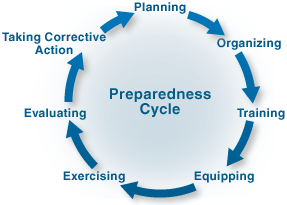
Very simply, we are looking at preparations for your agency’s role.  These preparations, although slightly different based on the agency, apply to all agencies; from first responder agencies, to local government, K-12 and higher education schools, hospitals, private sector, and not for profits.  Let’s break this down with the Preparedness Cycle:

The Preparedness Cycle - FEMA

The Preparedness Cycle – FEMA

Plans, policies, procedures – do you have them in place and up to date?  Depending on the role and function of your agency you can have several of the following – emergency operations plan, emergency procedures, infection control plan and procedures, public health plan, communicable disease or pandemic influenza plan.  You should engage with public health experts to ensure that your plans, policies, and procedures address everything known about Ebola.  You may need to create some procedures specifically addressing issues pertaining to Ebola and your agency’s role.  Do your plans, policies, and procedures link up to your agency’s critical activities for each Core Capability you are engaged in?  What agencies do you need to coordinate with to be effective?

Organizing – depending on your agency’s role, you may need to make some internal changes or designations within your organization to better streamline your activities.

Training – train everyone who has anything to do with any component of the plan in what they need to do.  This is a great opportunity to ensure that everyone is trained up in their role of the emergency operations plan.  If your agency has physical contact with the public, training in personal protective equipment (PPE), identification of signs and symptoms, and patient care are extremely important.  Given the detail of the activities and the just-in-time training, job aids will be a great help to your staff to ensure that they follow the procedures you provide for them.  Don’t get caught short… communicate to your staff in what is going on, what your agency is or may be responsible for, and what they will be called upon to do.

Equipping – your staff need the right equipment for the job.  Not only PPE, but the forms and databases used to record information, decontamination equipment, etc.  It is extremely important that staff are trained not only in how to use equipment but to prevent contamination of equipment and prevention of cross contamination.  Do you have all the equipment you need?  If not, who does?

Exercising – Conduct table top exercises to talk through policies and higher levels plans to validate and become familiar with them.  Identify shortfalls and correct them immediately.  Conduct drills to test the skills of staff for specific activities and larger exercises – functional or full scale – to test multiple functions and plans.

Evaluating – Evaluation is a constant throughout all of the preparedness cycle.  We need to evaluate every step within the preparedness cycle and make adjustments and improvements as needed.  Embrace best practices and fix shortfalls.  This leads directly to the next step…

Taking Corrective Action – Some corrective actions are quick and easy fixes while others can take a while or cost money above budget to address.  A corrective action plan (aka improvement plan) will help you keep track of what needs to be fixed, the priority it holds, who is responsible for making it happen, and a strategy to make it happen – it’s a living document.

The preparedness cycle can be applied to any hazard, be it Ebola or a flood.  With all this attention on Ebola, it’s a great opportunity to pull plans off the shelf and have discussions with internal and external stakeholders on these preparedness steps.

© 2014 – Timothy Riecker

Exercising Foundational Skills with Unorthodox Scenarios

Does the scenario of an exercise activity really matter?  Can we use a zombie scenario to exercise evacuation and sheltering?  Can we use a holiday food distribution to the needy to practice our POD (point of distribution) plan?  Do scenarios always have to be realistic or related to our jurisdiction’s hazards?

I’m a foodie.  As such I find myself occasionally watching shows like Cutthroat Kitchen and Chopped.  These are fun shows that strike a balance of cooking with game shows, including the cash prize in the end.  The competitors are legitimate cooks, some trained in culinary schools, some successful in their careers and earning the title of ‘chef’.  The competitors are given, on the spot, either a dish to create (Cutthroat Kitchen) or a box full of ingredients which must all be incorporated into a dish (Chopped), using a kitchen and pantry generally unfamiliar to them, within a relatively short amount of time – and make it better than their competitors.  Is competing on these shows anything like running a professional kitchen?  Hell no.  Does it make them better cooks?  From interviews I’ve heard, the answer is yes.

Can we recreate this in emergency management?  Of course we can, and we should.  How would this help emergency managers and other public safety professionals?  Recall that within the exercise design component of the HSEEP process the Core Capabilities to be focused on and the objectives to be tested are selected prior to determining the scenario.  This tells us that the activities to be performed are more important than the scenario in which they will be performed.  In these cooking competitions, the participants must fall back on their foundational skills to be successful.  It’s those foundational skills and the activities which they foster that we evaluate in our exercises.

Certainly a scenario has some importance.  It provides context, allowing the participants to get their head into what they are doing.  A scenario can be different, even a bit silly or fantastical (alien invasion, anyone?), but it still has to correlate to the objectives of the exercise; i.e. there must be a compelling reason to perform mass prophylaxis or to evacuate an area.  That said, the scenario is simply a vehicle to get our participants to perform what we intend to test.  Don’t we always tell our participants to not fight the scenario?  Well if it’s something they’ve never before experienced, they have little ground to stand on.

Another benefit to using an unfamiliar or alternate scenario is getting participants to break from the routine and face unexpected and new challenges.  What if digital communications fail?  What if they have to relocate to an alternate EOC? What if that alternate facility is likewise compromised?  Consider using the scenario to remove a critical resource from use.  How will the participants overcome this new problem?  In Cutthroat Kitchen, participants are faced with unseemly injects to their food preparation, such as replacing all cooking utensils with a Swiss Army knife or only being able to cook using a microwave.  Some of your participants may balk at such occurrences, but emergency management is about managing the unknown, the unfortunate, and the unexpected.

Regardless of the measure of reality we choose to base our exercises on, the scenarios we develop are really another level of fiction to help facilitate exercise participation.  Yes, often times we want to test hazard specific plans (a zombie apocalypse exercise can not replace the need of a hurricane exercise), but if the scenario itself doesn’t matter, consider using something ‘outside the box’.  Routine makes us complacent and complacency is very dangerous in emergency management.  We must always expect the unexpected and continually have the mindset to improvise, adapt, and overcome.

© 2014 – Timothy Riecker

Deliberate Planning – Strategic Planning and Business Continuity

Many organizations put forth extraordinary effort to develop strategic plans to give concerted organization-wide direction to the organization for the coming 3-5 years.  Like many of my readers, I have been part of several strategic planning efforts in different organizations, sometimes helping to lead the way.  There is a great deal of value to strategic planning as it helps not only refine the organization’s vision, but also develops objectives to help it get there while (ideally) bringing the entire organization on board – from finance, to HR, to operations, and facilities – everyone is facing in the same direction and striving to accomplish the same goals.  Just as strategic planning should not be performed in a vacuum, business continuity planning should not either.  Just as strategic planning engaged the whole organization, as should business continuity planning.

If the efforts of strategic planning and business continuity planning have such foundational similarities, why not bring the two together?  As the goals of these two efforts are distinctly different we certainly can’t merge the efforts, but the overlaps provide for easily exploitable opportunities within the organization.  How?

First, make business continuity and resilience a goal of your strategic plan.  What does this do for the organization?  Just like the other goals identified in strategic planning, it provides a documented leadership-driven purpose which will engage the whole organization.  Every business unit in an organization has a stake in business continuity.  Just with other goals within your strategic plan, the specific actions will be identified through objectives – be it a start to your business continuity program or a continuation and improvement thereof.  As mentioned in previous posts, business owners and managers put forth a great deal of effort to build and expand their businesses, but we also need plans to stay in business in the event of a disaster.

Second, once the strategic plan is completed, you now have a group of people from across the organization who now hopefully work well together – engage them!  Turn your strategic planning committee into your business continuity committee.  Good strategic planning provides for someone (ideally the planning group) to monitor the implementation of the strategic plan.  This takes minimal time compared to developing the strategic plan, allowing for this group – who has already worked together for some time and has gone through the group dynamics of forming, storming, norming, and performing – to focus on another task.  Why pull together another group of different people?  It’s a waste of time and the team will lag in performance.  Simply reengage them and change their focus.  This group is a great asset who has already proven they can represent their business units while still having an organization-wide perspective.

Third, mine data from the strategic planning process to support business continuity.  A thorough strategic planning process has examined the organization from many angles and perspective – particularly through a SWOT analysis (strengths, weaknesses, opportunities, and threats).  While a SWOT analysis is performed from a business standpoint, much of the data obtained and derived from this analysis can inform both your hazard analysis and the identification of mission essential functions – these are the things which you MUST DO to stay in business and to minimize the greatest losses.

Lastly, continue the relationship between strategic planning and business continuity.  Both work in a cycle of continuous improvement and those cycles obviously intersect – not just at one point but potentially at multiple junctures; an important consideration of a business continuity program is the impact which disasters may have not only on current business operations but also on planned business initiatives.  This shared knowledge and insight between two planning efforts conducted within one group is invaluable.  As strategic planning continues, new objectives for the business continuity program should be included while resiliency opportunities identified through the business continuity program should inform the strategic plan helping the organization overall to become more resilient and sustainable.

What are your thoughts on the synergy between strategic planning and business continuity?  What other opportunities do you see?

As always, if you need help starting, growing, or rebuilding your business continuity or emergency management program, Emergency Preparedness Solutions, LLC can help.  Contact us through www.epsllc.biz or directly at consultants@epsllc.biz.

© 2014 – Timothy Riecker

4 Steps to Individual and Family Preparedness

As mentioned in earlier posts, September is National Preparedness Month.  Through the lens of whole community emergency management, individual and family preparedness is truly the foundation of all our efforts.  If families are not properly prepared our systems in emergency management, response, social services, healthcare, etc. will be completely overwhelmed in the event of a disaster.  If individuals have not prepared themselves for disasters they will not be able to go to work – effectively shutting down government, businesses, and not for profits which provide so many critical services – especially during disasters. 

While my focus lies generally on preparing governments, businesses, and not for profits for disaster, I often get asked questions about individual and family preparedness.  I also stress individual and family preparedness when I speak with clients, as the preparedness of their employees, suppliers, distributors, customers and clients is so important to their continuity of operations.  Every organization should promote preparedness concepts to their employees as part of their business continuity plan. 

There are an abundance of resources out there on individual and family preparedness.  Overall, the best of these resources is Ready.gov.  They make preparedness simple by breaking it down into four key activities:

  1. Get a kit
  2. Make a plan
  3. Be informed
  4. Get involved. 

1. Get a Kit – FEMA promotes getting (or better yet – building) an emergency kit that will sustain you and your family for at least 3 DAYS.  I would suggest that you prepare to be on your own for as long as you can.  If you can do 3 days, why not 4? 

Everyone’s kit is going to be a little bit different based on your needs and your budget. Here are some ideas to get you started.

  • Water.  It’s a biological essential.  Have AT LEAST 1 gallon of water per person per day for hydration and basic sanitation.  If you live in a warmer climate you will need more. 
    • Pro tip – While you should prepare for your water needs with gallon jugs, consider other water sources to supplement this such as the water in the tank of your toilet or your hot water heater. 
  • Food, another biological essential.  Be sure to have at least three days of non-perishable food per person.  Canned food is always an easy option, although it can be heavy (don’t forget the can opener!).  A lighter-weight option would be military MREs (meals ready to eat) or camping meals (found in most outdoors and hunting stores).  Protein bars and dried fruit are great options as well as they are high in calories (something you may need in a survival situation) and nutrient dense. 
    • Pay special attention to dietary needs or restrictions.  Food allergies are important to note when buying your food.  Also note the amount of sodium usually found in pre-packaged food in the event that a member of your family has sodium sensitivities. 
    • Have pets?  Don’t forget food and water for them, too!
  • Medications.  These can consist of over the counter medications such as ibuprofen, anti-histamines, or anti-diuretics which your family may need (and which you should pack!) as well as any prescription medications. 
    • All food, water, and medications have an expiration date.  Keep a list of your items in your kit with expiration dates noted.  Rotate new stock in when needed. 
  • First aid kit.  Injuries can and do occur during disasters so you should be prepared with a first aid kit.  This is something you can purchase in whole or in part, supplemented with additional items.  Rolled gauze, triangular bandages, and bandaids are important and often used – so stock up! 
    • Get training and know how to provide first aid!  Everyone in your family should take a first aid and CPR class.  Check with the Red Cross, your local community college, or ambulance squad.  Keep a small first aid book in your kit as well – you might not remember everything! 
  • Toiletry and sanitation supplies.  Garbage bags are excellent multi-purpose items.  They can be used to dispose of waste (human or otherwise), to carry goods, or to act as a barrier.  Be sure to have some rolls of toilet paper, feminine products, cleaning solution (a spray bottle of bleach solution is best!), and hand wipes.  Have a baby?  Be sure to pack diapers!
    • Toilet seats that fit on 5 gallon buckets are a great convenience and are available through many commercial outlets.  Before a disaster you can also store some of your emergency supplies in the bucket
  • Emergency communications.  Battery operated, solar, or hand crank radios are a great addition to your kit.  They will allow you to stay aware of the situation and receive important government messages.  These are available through many commercial outlets. 
    • Many of these radios also include features such as flashlights and cell phone chargers.  Be sure that you are familiar with their operation before disaster strikes! 
    • Consider how you will store your kit and how you might have to move it in the event of evacuation.  Plastic bins are a great storage solution buy may not be convenient to move.  Store all items in backpacks inside the bins.  Bright red bins are great to use and should be labeled and easy to find and access. 
    • You don’t have to assemble your kit all at once.  If it’s more cost effective for you and your family, create a preparedness budget and purchase items over a period of time. Tools and supplies.  Other tools and supplies may be necessary to help you survive depending on your situation.  Items to consider are duct tape, a good knife, a folding camping or military style shovel, a hatchet, a wrench, and rope or para-cord. 

2. Make a Plan –Along with checklists for your kit, you can also find checklists and templates on Ready.gov for your plans. A family communications plan is one of the most important plans you can make. How will family members contact each other during a disaster? Consider both cell phone and landline contact methods. Also, an out of state contact should be identified. If family members can’t contact each other, perhaps they can contact this out of state person to let them know they are OK.

Families should plan for sheltering in place by identifying the resources and actions necessary for staying where they are and staying safe. Likewise, families should create an evacuation plan in the event that an evacuation is ordered. What will you take with you?

Lastly, you should be knowledgeable of the emergency plans at school and work. How will notifications be made? What will schools do with children? Where will your meeting place be?

3. Be Informed. It is important to be informed about disasters, be notified of them when they are about to occur, and be able to receive emergency alerts and instructions from government in the event of a disaster. Most states have emergency notification systems established which are free to subscribe to. These systems will contact you per your instructions (cell phone, land line, text, email) to notify you of an emergency and provide you with emergency instructions. Some major cities also have their own similar alert systems. Know what is available in your area and subscribe.

4. Get Involved. Once you have prepared you and your family, help your community to become better prepared. There are a variety of organizations who can benefit from your interest in preparedness. Perhaps you would like to be a health and safety instructor with the American Red Cross or maybe you would like to volunteer through a faith based organization such as the Salvation Army or your local church, mosque, or temple. Local Citizen Corps Councils, if you have one, are focused on disaster preparedness and relief efforts. Volunteermatch.org is a great way to find local community organizations to volunteer with.

Remember, this is just a quick synopsis.  More information can be found from Ready.gov or from the other links provided.  More information on individual and family preparedness can also be found from fellow blogger Kathleen at oyoinfo.net

Be Proactive, Be Prepared! ™

 © 2014 – Tim Riecker