Disaster Preparedness – Hong Kong

Seal of Hong Kong

Seal of Hong Kong

I’m interrupting my series on exercise program management (which I’m sure I’ll do several more times) to highlight a news spot I first saw on last night’s NBC News.  The segment was about Storm Preparedness in Hong Kong.  In it they briefly outline the threats to Hong Kong, including being struck by a cyclone seven times a year on average, and they highlight the preparations they’ve taken.  These preparations include underground reservoirs to contain flood waters and runoff and a system of barrier fences to mitigate against landslides.  I always like to see how other people around the world are prepared for their hazards.  Necessity is the mother of invention, as they say, and other places around the globe have come up with innovative ways to protect themselves from natural disasters.  Comparisons were made in this brief segment between NYC and Hong Kong – with the silent inference that if these measures are already being taken elsewhere, then certainly the City of New York can do it.

One thing I noticed wasn’t actually discussed in the video – they showed a brief clip of a Hong Kong area news broadcast which was alerting citizens. Broadcasts are the cornerstone of their notification and alert system and use levels of ‘signals’ to communicate the severity of the threat (the Hong Kong broadcast clip that NBC includes shows them issuing a Signal 10, their most serious).  An easy internet search led me to the Hong Kong Security Bureau which handles emergency management.  This preparedness guide explains their signal system and shows how they color code other hazards based on level of severity such as wild fires and storms.  Their documents are in both Chinese and English.

A little more poking around their website found versions of their contingency plans.  I quickly perused their contingency plan for natural disasters which seemed to include all the right elements.  Certainly, with an average of seven cyclones annually along with the threat of wild fires and landslides all around the city, Hong Kong is well versed in preparedness.  While a quick search for any studies on citizen preparedness didn’t come up with much, I’m hopeful that the preparedness message is getting to them as well.  The broadcast indicated that Hong Kong had recently suffered through a storm event of similar strength as Hurricane Sandy, and survived with no fatalities.  Based on this alone, it would seem to me that the citizens of Hong Kong do take this seriously.

We can always learn from others – especially those who haven’t been jaded by our way of doing things, which I think more often than not holds us all back.  We need to look beyond our borders and share ideas.  It seems to be done in many other fields, but not so much in emergency management.

Managing An Exercise Program – Part 2: Developing the Preparedness Strategy

This post is part of a 10-part series on Managing an Exercise Program. In this series I provide some of my own lessons learned in the program and project management aspects of managing, designing, conducting, and evaluating Homeland Security Exercise and Evaluation Program (HSEEP) exercises. Your feedback is appreciated!

Managing an Exercise Program – Part 1

Managing an Exercise Program – Part 2: Develop a Preparedness Strategy

Managing an Exercise Program – Part 3: Identify Program Resources and Funding

Managing an Exercise Program – Part 4: Conduct an Annual Training & Exercise Planning Workshop.

Managing an Exercise Program – Part 5: Securing Project Funding

Managing an Exercise Program – Part 6: Conducting Exercise Planning Conferences

Managing an Exercise Program – Part 7: Develop Exercise Documentation

Managing an Exercise Program – Part 8: Preparing Support, Personnel, & Logistical Requirements

Managing an Exercise Program – Part 9: Conducting an Exercise

Managing an Exercise Program – Part 10: Evaluation and Improvement Planning


In my last post, I outlined the initial needs of managing a preparedness exercise program, including sources of information for a preparedness assessment.  Recognized as a best practice, I’m following the model of the Homeland Security Exercise and Evaluation Program (HSEEP).  The next step of program management is developing a preparedness strategy.

HSEEP Cycle

HSEEP Cycle

The development of a preparedness strategy is an activity that will involve the highest levels of your organization.  Drawing upon the data collected in the last step (the preparedness assessment), the preparedness strategy will address overcoming the identified gaps in your preparedness.  The mnemonic to remember here is POETE or Planning, Organization, Equipment, Training, and Exercises.  The gaps you identified in your assessment should fall into one of these categories.

Once you have catalogued your gaps, you must develop strategies to overcome each gap.  Here are some helpful hints in strategic planning:

1) Define the gap and identify the underlying cause(s).

2) Create objectives to overcome each gap.  Remember that objectives must be SMART (Specific, Measurable, Attainable, Realistic, and Time-oriented).

3) Establish priorities.  Some gaps may have a higher priority to accomplish based on the vulnerability they pose, legal or regulatory requirements, or other matters.  Additionally, some objectives may need to be accomplished prior to others for many of the same reasons, as well as practical flow of processes.

4) Assign required actions – identify specific actions required to accomplish each objective (there may be several).  Identify who will be responsible for each action and who will be responsible for supporting their work.  Establish a realistic deadline.  NOTE: some gaps may take a long time (years) to overcome.  As such, do the best you can to outline objectives and keep in mind that strategic plans are ‘living documents’.  Early on, you may not be assigning tasks to overcoming certain gaps, but someone will be responsible for monitoring related issues.

5) Marry needed resources to each action item established above.  This may be personnel, funding, facilities, etc.

6) As work is being done to accomplish these tasks, continual monitoring and assessment is necessary to ensure that everyone is staying on track and that the strategic plan continues to reflect the direction and priorities of today.

There are many references out there for strategic planning.  With a bit of insight you can translate this guidance into something useful for these purposes.  The end goal of this step is to have a document in hand that identifies what your organization needs to accomplish to be better prepared.  From this, you will soon develop exercise goals which will be the cornerstone of your exercise program.

What successes have you found from your strategic planning experience?

Coming soon – Managing an Exercise Program Part 3: Identifying Program Resources and Funding.

Managing an Exercise Program – Part 1

This post is part of a 10-part series on Managing an Exercise Program. In this series I provide some of my own lessons learned in the program and project management aspects of managing, designing, conducting, and evaluating Homeland Security Exercise and Evaluation Program (HSEEP) exercises. Your feedback is appreciated!

Managing an Exercise Program – Part 1

Managing an Exercise Program – Part 2: Develop a Preparedness Strategy

Managing an Exercise Program – Part 3: Identify Program Resources and Funding

Managing an Exercise Program – Part 4: Conduct an Annual Training & Exercise Planning Workshop.

Managing an Exercise Program – Part 5: Securing Project Funding

Managing an Exercise Program – Part 6: Conducting Exercise Planning Conferences

Managing an Exercise Program – Part 7: Develop Exercise Documentation

Managing an Exercise Program – Part 8: Preparing Support, Personnel, & Logistical Requirements

Managing an Exercise Program – Part 9: Conducting an Exercise

Managing an Exercise Program – Part 10: Evaluation and Improvement Planning


From inception to improvement planning, I think preparedness exercises provide great value to the jurisdictions, companies, and organizations that do them.  From a seminar to a full-scale exercise, there is much to be learned by participants as well as the strengths and areas for improvement identified from emergency plans.  I’ve been inspired to write a series of blog posts on each of the phases within the Homeland Security Exercise Evaluation Program (HSEEP) cycle.  The cycle, shown below, encompasses not just the steps in executing an exercise (project management), it includes exercise program management as well, which I think is often neglected.  Doings exercises is great, but to ensure continuity, quality, and continuous improvement, any entity that does exercises should have an exercise program.  Having a structured exercise program will ensure that your organization capitalizes on your exercise investments to the greatest degree possible.  Just like any other functional program, it needs to be managed.
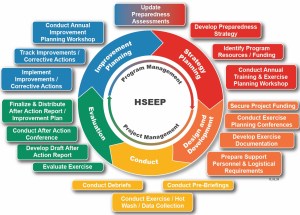
HSEEP Cycle

Each blog post will give some insight and lessons learned from my own experiences with exercises large and small and I will reflect on exercise program management responsibilities throughout the cycle.  For more in-depth information on exercise program management, I refer you to HSEEP Volume I.  I will also have an update on this HSEEP volume in the near future as DHS will soon release a revision.

The first thing I want to cover is exercise program management as a general concept.  As stated in HSEEP Volume I, “Exercise program management is directed toward achieving the objectives established during the multi-year planning process…”.  As an exercise program grows, so should the responsibilities of managing it.  Most organizations don’t need a full-time exercise program manager, but they will require someone with the flexibility to vary how much time they spend on the exercise program.  The planning and conduct of an exercise can take up a considerable amount of time, and the program manager needs to shepherd this process.  In small organizations, the exercise program manager may be one of the few people involved in these activities as well.

Obviously the person in charge of an exercise program needs to be knowledgeable and experienced in exercises.  As with the oversight of any program, you need to have the right person in place.  Some caution should be used here, however – there are plenty of folks with LOTS of exercise experience… BUT the vast majority of experience out there is as a player.  Players, as a general rule, don’t experience all the machinations behind putting an exercise together.  Someone may have been a player in the largest exercise known to human kind, but that doesn’t make them adept at exercises.  There is plenty of training out there addressing various areas of exercises: the HSEEP training course, Exercise Design, Exercise Evaluation, and others.  These are great – but the world is full of ‘trained’ people.  Do they have the experience to do the job?  It doesn’t take a lot of experience, in fact, in my opinion, a little experience can go a long way – especially if it’s the right experience and they were taught the right way to do it from someone with a lot of experience.  I’ve fully immersed interns in many of the areas of exercise program management and would be fully confident in their ability to run a program for an organization.

As mentioned above, exercise program management centers on the multi-year training and exercise plan (MYTEP), which makes sense as this document will outline requirements, goals, and benchmarks for the program.  Building this plan is not the first, though.  We know that before we can write a plan, we need to do an analysis or an assessment of where we stand.  This is why the first step in the HSEEP cycle (above) is Updating Preparedness Assessments.  As much of a fan as I am of the HSEEP documents, they do fall rather short on providing guidance relative to this step.  It can be broken down easily enough, though.

A preparedness assessment, to me, would identify where we stand and where we want to be in terms of preparedness.  The resultant gap would then feed the second step in the HSEEP cycle – developing a preparedness strategy.  Let’s define preparedness: traditionally, it involves planning, training, and exercising; we can build from this to give us the data we need.  An absolute priority is identifying and assessing risk.  Hopefully your jurisdiction has a recent hazard analysis or THIRA, or your company or organization has a recent business impact analysis (BIA).  Having a recent hazard analysis done will identify the threats you need to be prepared for.  If you don’t have a recent one of these, I would suggest that you are way ahead of yourself with exercises and need to take a step back in emergency management to do one of these and build a plan.  Based upon the results of your hazard analysis, do you have the necessary plans (and are they up to date?) to address the hazards?

The second assessment should be a capabilities assessment.  You can reference FEMA‘s list of core capabilities to ensure that you are examining everything you need to.  Keep in mind that not everyone needs to have every capability.  You may not have a need for certain capabilities or it may not be feasible for you to have it based upon costs – so long as you can obtain that capability from someone else in times of disaster.  However, there are certain capabilities, based upon your hazards, that you want to ensure that you have.  If you don’t have them, they need to be developed.  That’s a gap.

A third assessment, related to the second, would be to identify needs to develop personnel capabilities – specifically through the means of training.  Yep, a Training Needs Assessment.  I’ve blogged previously about this.  Your identified needs become another gap to include in your preparedness assessment.

Lastly, you should do an assessment of exercises and real life events to date.  While you are just starting to formalize your exercise program, I still think an assessment of exercise progress to date is important.  While you may not have had a formal program, you have likely done some exercises or at least participated in someone else’s.  What plans have been tested with these exercises?  How long ago were they conducted?  Do you have After Action Reports?  (Read my article in Emergency Management Magazine on the importance of AARs and implementing corrective actions).  How about lessons learned and after action reports from actual incidents?  What gaps from these still need to be addressed?

All of this data and these documents can be pulled together and referenced in a simple, cohesive document outlining your preparedness needs.  It seems like a lot of work, but without identifying our needs, we can’t move forward with an effective exercise program.

What are your thoughts on identifying preparedness needs?  Is there anything I’ve missed?

Thanks for reading and be on the lookout for part two of Managing an Exercise Program where I will outline the development of a preparedness strategy.


 

The Emergence of Whole Community Planning

FEMA has contracted the development of a national Whole Community disaster training program.  This should result in some of the best planning guidance ever put forward by FEMA since CPG-101.  What is ‘Whole Community’ planning?  Whole Community planning takes into account everything in your community, not just the hazards, but also the vulnerable populations, as well the community’s resources – all of them, to include the private sector.  This is smart planning!

Timothy RieckerI don’t know what the final guidance will look like, but I’m imagining a process, imbedded within our existing planning process, which is similar to a SWOT analysis (strengths, weaknesses, opportunities, and threats) which has long been used as a business analysis tools.  Strengths and weaknesses are internal reflections, while opportunities and threats have you looking to the outside.  From the perspective of an emergency planner for a community, strengths and weaknesses would reference their innate government-based capabilities (remember capabilities-based planning?  I’m still a big fan); while opportunities and weaknesses would reference what is brought to the table by the rest of the community (i.e. private sector, NGO, and even the citizens themselves – such as a neighborhood watch or CERT).
In many ways, good planners and emergency managers have already been doing this.  They have been capitalizing on relationships with the private sector and NGOs and building plan annexes based upon these relationships – such as human services oriented plans and logistics plans.  Moving forward as a ‘branded’ concept, Whole Community planning will become the standard, not just a best practice, and will evolve as more people do it and make it better.  This concerted effort will ensure that the entire community is moving forward in a coordinated fashion and with common goals in the response to and recovery from an incident.  I’m also hopeful that this Whole Community guidance will give some input on community preparedness as well.

The project will be released in phases over the next three years, so be looking out for it.

NYC Transportation Post Hurricane Sandy

This study – Transportation During and After Hurricane Sandy – was brought to my attention by Claire Rubin by way of her blog.  Thank you Claire!

This is a great study and very timely.  Having worked with these transportation entities in the past, I can attest that what they have accomplished is not easily done.  The variety of agencies that cover the array of transportation systems and modes in the greater NYC area creates challenges – City agencies, State agencies, and multi-state authorities.  Each owns not only their own modes, but their own infrastructure as well.  They also have their own reporting chain, making coordinated decision-making a challenge.  Additionally, any decisions made that impact transportation systems must also consider evacuations.  Systems and infrastructure can’t be shut down until evacuations have been effected.  The folks on Long Island have to move to higher ground or out of the area completely before bridges are shut down around NYC.

They have come a long way through the last several years.  The study mentions some significant flooding in 2004 and 2007 in which lessons were learned.  We also conducted an exercise, the largest of its kind at the time, in the summer of 2008 simulating landfall of a hurricane in the NYC metro area.  This exercise provided great feedback and spurred changes to both state and local plans.  In 2011, Irene came up the coast, eerily following a track very similar to our simulated hurricane in 2008.  Plan improvements were made again, and they will be yet again in the aftermath of Hurricane Sandy.

A significant item that was barely touched upon in this paper is the role of the private sector.  Much of the impact of private sector policy is demonstrated on page 25 of the study, where we see that prior to the hurricane only 2% of New Yorkers telecommuted, whereas following the hurricane (November 1-2) 22% telecommuted.  It’s great to see that so many companies saw the sense in allowing employees to telecommute instead of contributing to the transportation nightmare that occurred on these days.  I would challenge more private entities to do the same!  The best way to implement this, of course, is to include it in your business continuity plan.

In Emergency Management it is not only important that we improvise, adapt, and overcome; we must also learn and change.  We must turn lessons observed into lessons learned by creating a corrective action plan and actually implementing these changes.  It’s positive to see these types of documents, all After Action Reports (AARs) in their own right, which use facts and observations to highlight what went well and what needs to be improved upon.  The challenge is making these changes.  Change, good or bad, is stressful and counterintuitive to us.  We default to what is comfortable (i.e. ‘the way we’ve always done things’).  Change may require funding – sometimes vast amounts of it.  Some change is drastic, some subtle, some long-term, some immediate.  Nonetheless, with the ultimate goal of saving lives, we must change.  That, if anything, is our burden.

Let’s Bring Human Interaction Back Into Training

I love technology.  I really do.  I generally don’t have any problems with the accomplishments or advancements we’ve made and I’m not looking to abolish any of the triumphs or practices we have in place as a result of technology, but there are some things we have to step back on a bit.  One of those things is the extreme volume of self-paced, internet learning, e-learning, independent study, etc. types of programs out there.  We’ve accomplished a great deal in regard to these self driven types of programs and they do have value – yet I think we’re losing touch with the human factor.

When I started in the training business, the internet was still fairly youthful and humanity hadn’t yet realized all the potential it held (we still don’t, but we were a much longer ways away from it then).  There was no such thing as online learning.  You could download training materials and references, maybe even submit test answers online (although the norm was still to fax answers), but that was about as interactive as it got.  The next step was pretty pathetic – uploading slides in a PowerPoint format or something similar, to the internet for people to view.  As time progressed, we saw great advances in online learning.  Now we have video, audio, in-course quizzes and learning checks, even biometrically-driven verification systems to ensure that it’s still you taking the course (don’t believe me?  take the defensive driving course on-line).  Courses are much more comprehensive and provide both internal and external links to additional information and content areas.  I think it’s fantastic and we can’t stop this advancement – but we can’t let it take over, either.  All things in moderation.

People need interaction.  In 1970, Malcolm Knowles identified, as one of his six characteristics of adult learners, that adult learners are generally autonomous and self-directed.  While this may be true, it doesn’t mean that all learning is to be accomplished in isolation or without facilitation.  Adult learners still need human interaction.  While the degree of interaction necessary may vary based upon each individual’s preferred learning styles and personality type, that need still exists.  This is an interaction that generally can’t be replaced by games or other interactive components in e-learning programs.  Yes, many adults love the concept and process of self discovery, and some will excel greatly at absorbing information completely on their own, but most people need and desire human interaction.  We can’t forget this.

Some content areas are much more suited (read: ideal) for e-learning.  I recently began working with a company that has employees nation-wide.  E-learning is certainly the best structure to disseminate required programs such as business ethics and workplace harassment.  In fact, these programs were extremely well done.  They used a lot of audio, pictures, and knowledge checks throughout the programs.  They were designed to provide variety and appeal to the senses.  They were well structured and didn’t contain any of the cheesy videos many of us remember from previous iterations of these types of programs.  I can honestly say that I preferred these in an e-learning format over any previous classroom experience in the same subject areas I’ve ever had.

Why do programs like ethics and workplace harassment work very well in an e-learning format?  Because, if designed well, they require very little human interaction to facilitate the learning process.  There are programs that I have taught for many years, however, that MUST have human interaction, such as incident management and emergency planning topics.  I think the key here is that they are complex topics, with a lot of variables, and the real world execution of these topics requires team work and human interaction.  You can’t manage an incident inside a barrel nor can you write an emergency plan (a good one) without input from an entire team of people.  The instructors have to have experience in these areas and be subject matter experts that the learners can consult throughout the class.  Access to an SME helps the learners become more comfortable with the topic.  All this said, do these courses need to be delivered in a classroom environment?  Not necessarily.  We can still be interactive with others without being face to face.  It’s all about creativity, leveraging technology and other resources, and paying attention to the needs of our learners as well as the objectives of the courses themselves.

We have a number of distance learning options we can leverage, from webinars, to video teleconference, to chat room types of environments (and these can be highly integrated such as the ones used by educational institutions).  Does course participation (in whole or in part) have to be synchronous (the instructor is present with all learners at the same time) or can it be asynchronous (the instructor and learners can log in at different times, able to download and upload materials and leave messages for each other)?  It all depends on what needs to be accomplished.  Once again, as in previous blogs, I defer back to the needs assessment.  The data collected from the needs assessment will provide an astute instructional designer with information necessary to identify the delivery modes that would be appropriate for the learners.

With all the technology we have available to us, I think many learning organizations are being seduced into using e-learning platforms for everything.  E-learning and content management systems are very powerful and valuable tools, but can’t forget the human factor.  We need to be very careful with what we use and how we use it – and ensure that we are meeting the needs of our learners in the best way possible.  I encourage you to use caution and always consider what is best for the learner.

It’s about the customer, stupid!

Yesterday I received my very first issue of Training Magazine in the mail.  After over 16 years as a training professional, I’m really not sure why I never read Training before – but I’m glad I started.  Right off the bat I was quite pleased with what I was reading.  Like many trade magazines, the edition opens with a letter from the editor.  Lorri Freifeld, the editor in chief of Training, does just that.  Her editorial is titled ‘Ask and You Shall Receive’, and includes an example from training professional Michael Marr, who mentions that training folks have a tendency to agree to developing and delivering training without out determining the true need.  Lorri expands on this by illustrating the simple process of going to a coffee shop.  They don’t just hand you a cup of coffee when you go in (well they do maybe if you are a regular there), instead they ask you what you would like.  As trainers we must always keep our finger on the pulse of the needs of the customers.

I’ve blogged previously about the necessity of conducting training needs assessments and how critical they are to learner outcomes.  Yes, sometimes the need seems very apparent, and you may be right, but peel back the layers of this anyway just to make sure.  Not only does this give you the opportunity to verify the purported need, but it will also give you insight into the driving forces behind that need – which may lend itself well as fodder for training content.  You may be surprised to find that the issue is not training related at all, but rather a fault in the process or equipment.   Remember, training is the greatest example of the ‘garbage in – garbage out’ theory.  If you don’t invest your time, energy, and resources into making a quality product that meets needs, then you are simply wasting the time, energy, and resources – and in this economy, more than ever, we can’t afford to waste those things.

10 Years of the Department of Homeland Security

A few days ago I looked at four different links related to the 10 year anniversary of the US Department of Homeland Security (DHS).  Every one of these links (here’s one of them) called for the abolishment of the department and decried everything they have done and stand for.  Being the relative moderate that I am, I take a slightly different view on this – let’s make some changes, but in the end DHS will still stand – albeit a different agency.

On November 25, 2002 President George W. Bush signed into law the Homeland Security Act of 2002, which authorized the largest governmental reorganization in the US since the creation of the Department of Defense.  The goal was to bring, in whole or in part, 22 US agencies which were chartered in some way with domestic terrorism protections under one agency umbrella.  Interestingly enough, two agencies who took a lot of heat for perceived intelligence and coordination  failures prior to the 9/11 attacks – the FBI and CIA – were not included in this reorganization… thankfully!  It seems that over the last decade, nearly every entity brought into DHS has suffered in some way.

Looking back, there absolutely was a need for increased coordination amongst federal agencies when it came to intelligence.  The US Intelligence Community is significant, with a multitude of agencies all playing a necessary role.  In my humble opinion, there should have been a strengthening of the role and powers relative to intelligence coordination of the Director of National Intelligence.  Perhaps even some agencies could have been merged, in whole or in part, to streamline missions.

Relative to the agencies brought into the fold of DHS, intelligence is a secondary or tertiary function to many of them (I speak of the function, not mental capacity).  Similar to streamlining missions amongst intelligence agencies, certainly there could have been some mergers, again in whole or in part, amongst these 22 DHS-bound agencies to help streamline the response, training, and critical infrastructure missions that many of them touch upon.  This would have had a much greater (positive) impact to the public safety and emergency management community than stuffing them all into one house and hoping they would get along.  Despite intelligence not being a primary function of these agencies, DHS has jumped head first into the deep end of intelligence as a knee jerk reaction instead of going about it the right way.  In this haste, we see some big mistakes with fusion centers, grabbing a lot of media attention.  In government there tends to be a desire to over-legislate things.  When we see a problem we create a bill and pass a law.  That law creates a new agency or charges an existing agency to do something different.  Often times, an existing agency is already doing what needs to be done or has the resources available to do it – which would be the easy fix.  Instead we see something called mission creep, where agencies will wander into mission areas already occupied by someone else, and using some legal charter to justify the action.  The creation of the US Department of Homeland security was the worst possible amalgamation of these circumstances, forcing changes in command structure and hierarchy of 22 different agencies – even taking away the cabinet-level position held by one of those agencies (FEMA) – a move that was realized as a significant mistake when Hurricane Katrina struck.  The Washington Times even reports that President Bush was resistant to the concept, not seeing a need for such a large agency.

DHS became a massive bureaucracy, not only through the merging of these 22 agencies, but through the creation of a substantial overhead organization.  That overhead organization does little to provide shared services for those 22 agencies such as HR, payroll, purchasing, finance, etc. – which would be an ideal use.  Instead, things grew so complex that for several years of the last decade, KPMG – one of the largest audit firms in the nation – was unable to complete an audit of the agency.  Hundreds of billions of dollars have been budgeted to DHS over the last decade – dollar amounts far in excess of the value to the American public.  Even their grants, which have benefitted many state, county, and local governments, have gone overboard and lack proper accountability.  Some of the grant rules are so cumbersome that many jurisdictions haven’t been able to spend grant funds going back several years.

But should we get rid of DHS?  I say no.  The Department of Homeland Security, originally created as the Office of Homeland Security (prior to the Homeland Security Act) was charged with developing a national strategy to secure our nation from terrorist attacks to include the coordination of detection, preparation, prevention, response, and recovery efforts.  The creation of DHS should have been a modest and conservative reflection of this original charter, drawing in the necessary agencies and resources to accomplish this mission.  It should not have swallowed agencies that have their own distinct missions, those that functionally don’t belong under another agency (i.e. emergency management as a function of homeland security) or those who best function with cabinet-level representation (i.e. FEMA).  Yes, I do stand in obvious defense of FEMA, but 21 other agencies were also impacted significantly by this.

It’s not too late to make the necessary changes.  As I’ve said in the past – let’s be smart and use some common sense.

The Death of ADDIE?

In a recently received email solicitation for ASTD (American Society for Training and Development) membership, they are offering a free copy of Michael Allen’s new book Leaving ADDIE for SAM.  Like many practicing trainers who also design and develop training material, I’ve used the ADDIE model my entire career to facilitate the process.  ADDIE, if you aren’t familiar, is an acronym for the steps in this universally accepted instructional design process standing for Analysis, Design, Development, Implementation, and Evaluation.  This process, when used properly, is a key to success in instructional design.


So, being intrigued by this concept of replacing ADDIE with another model, I did some research on the new model – SAM – which stands for Successive Approximation Model.  I came across a few articles and blogs which helped explain things to me.

This article is from Allen Interactions, Mr. Allen’s company which is promoting this new model.  Here’s another blog which promotes the Successive Approximation Model.  While these articles provided me with some insight and clarification on the SAM process, I’m honestly not sold.  I don’t think the ADDIE model is broken – any identified deficiencies (Mr. Allen identifies seven of them) are, in my humble opinion, errors in use rather than the model itself.  One must know how to use the model to be effective.  That’s like saying that a computer is broken because the user doesn’t know how to operate it.  I was actually put off by the insinuation in the previously linked article that the ADDIE model lends to ‘boring, lifeless training’.  I’m sorry, but no model is going to lend itself to or prevent that – that’s completely on the shoulders of those who design the training.  Admittedly, I’d like to learn more about SAM, but these are my first impressions.

All this said, can the ADDIE model be enhanced?  Absolutely.  There have been several modified ADDIE models proposed over the years, yet none have seemed to stick.  The essential differences in these models, including what’s captured in Mr. Allen’s SAM process, is to make the model less linear and to include feedback loops within the process for regular look backs, particularly to the data from the analysis phase.  The problem with these models, including SAM, is that they seem to require redundancy.  There are certainly instances when such redundancy is not necessary.  Regardless of these differences, I’m not sure that the ADDIE model was designed to be a strictly linear process anyway, and anyone who is a slave to a process without regularly reflecting on the quality of the product/outcome (and in training it’s all about learner outcomes) is likely in need of some remedial training on the matter.  I actually prefer this cyclic visualization of ADDIE to better show the interactions between the phases.

ADDIE Viewed as a Cycle

The initial instructional design training that folks go through may actually be the root cause of the problem.  If they are not taught to utilize flexibility inherent in the process then they obviously won’t see that flexibility.

The bottom line, regardless of what process we use, is that we must produce quality outcomes.  No outlined process will give us all the answers or a turn by turn roadmap to lead us to success.  We need to use our brains and apply what we’ve learned while keeping our ultimate goal in mind.

I’d love to hear your thoughts on the matter.

Public Safety Mega-Event Planning aka Super Mardi Gras Bowl

Super Bowl XLVII, February 3 2013, New Orleans.   The Mardi Gras Carnival, January 19-February 12 2013, New Orleans.

One word – wow!

The Super Bowl is being held at the Mercedes Benz Superdome in New Orleans, LA.  Fan capacity – 72000+.  Add in the teams and their entourages, Beyonce and her entourage, event staff, facility staff, security staff, media, vendors, etc… let’s just settle on about 120,000 inside and out of the Superdome.

Carnival – a weeks long celebration leading up to Fat Tuesday (Mardi Gras).  The most spectacular of these celebrations is in New Orleans, LA.  Crowds of up to one million can be expected each year.

Either one of these mega-events is a public safety planning nightmare.  So why not do them both?

There can be no doubt that the city of New Orleans has healed from the devastation of Hurricane Katrina.  No one takes on something like this without being whole.  Yes, there is some scarring and some unfinished business with Katrina, but the people of the Gulf Coast must look ahead, not back.

So how does a community plan for two events like this?  First of all, not every community would be able to pull this off as easily as New Orleans will.  The biggest benefit they have in all this is that these two events occur every year.  The people who plan these things are true experts.  While the Super Bowl isn’t held there every year, the city does have experience with it.  The city of the Saints has hosted the game nine times previous, the most recent in 2002 – which you might recall was a very emotional (and highly secure) game as the first after 9/11.  The NFL itself lends a great deal of support with a small army to ensure their show case event is flawless – right down to the wardrobe malfunctions.  Additionally, as a high-profile event, Federal agencies swarm the venue months ahead of time to be part of the public safety planning effort.

The City of New Orleans knows how to plan for Carnival and Mardi Gras.  It’s in their blood and they do it well every year.  We plan Super Bowls annually in places all around the nation and do it well every year.  Combining the two is really just a matter of more people and more resources.  They are doing this wisely, though – by suspending Carnival events for a few days around the Super Bowl.  This was a very wise move, helping to ensure that resources can be focused on one event at a time.  So, in essence, both events aren’t truly being held at the same time.

These things do take a vast amount of coordination and planning.  Plans must address all possible threats and hazards and the contingency plans to respond to them.  An operational organization (the Incident Command System) must be in place to manage public safety resources and responses for the event.  This type of planning begins months ahead of time.  I coordinated the emergency planning efforts for Woodstock 99 here in Central New York.  Just like Mardi Gras or the Super Bowl, it involved a great deal of coordinated effort between local, county, State, and federal agencies as well as private sector entities and not for profits.  Keep in mind that we weren’t planning the event, either – just the public safety portion of it – i.e. what could go wrong and how would we respond to it?  There was no official attendance count… ticket sales were close to a quarter million but actual attendance was estimated near 400,000.  Through the preparedness effort you need to ensure operational coordination and unity of effort and synchronized plans.  Train people to the plan to ensure that they are familiar with its content and their roles.  Lastly, exercise exercise exercise.  If you don’t bring people together to discuss their actions and the plans you are doing yourself a massive disservice.  Exercises familiarize people with the plans in the best possible way and also identify gaps in those plans (and there will be gaps).  It’s better to identify them now and have a chance to fix them rather than finding them during the event itself.

Want to know more about public safety planning for an event?  Take the Special Events Contingency Planning Independent Study course – it’s free!