Thinking Beyond the Active Shooter

While there is obviously a great deal of attention placed on preparing for, preventing, and responding to active shooter events, is that where the focus really needs to be?  Yes, active shooter incidents are devastating, but they aren’t taking into consideration the full potential of we might be facing.  The DHS definition of ‘active shooter’ actually allows room for additional potential, but the term is still misleading and indicates the presence of only one perpetrator.  (DHS definition: “Active shooter is an individual actively engaging in killing or attempting to kill people in a confined and populated area.”)

First, let’s consider that more than one person could be perpetrating the incident.  Second, let’s consider that the perpetrator/perpetrators might be using something other than or in addition to firearms.  This could include edged weapons, blunt weapons, improvised explosives, or other threats.  Third, let’s consider an increased complexity, including synchronized attacks conducted by one or more independent teams occurring at multiple locations sequentially or in close succession.

To address these potentials, we’ve heard the terms ‘Active Assailant’, which certainly addresses individual(s) using any form of weapon(s) in their attack methodology.  This can also address the more highly complex incident type, which is commonly referred to as a ‘Complex Coordinated Attack’ or ‘Complex Coordinated Terrorist Attack’.  In essence, we are talking about the same conceptual incident, with varying complexity.  But what’s the difference?

The difference is that we should be preparing for a credible worst-case scenario.  While a single shooter is more likely to occur in most places, we’ve seen incidents of knife attacks such as those in recent months in London and Japan.  We’ve also seen motor vehicle attacks in Berlin and NiceThe Columbine High School attack involved firearms, knives, and improvised explosive devices, although the latter weren’t successfully detonated.  For their own reasons, none of these seem to match up with the impression most have with the term ‘Active Shooter’.  ‘Active Assailant’ might be better a better term generally for these kinds of incidents.   More specifically, by current standards, Columbine would likely meet the definition of ‘Complex Coordinated Attack’.  A complex coordinated attack doesn’t necessarily require a high value target or an international terrorist group to perpetrate.

When a jurisdiction plans for a flood, they generally don’t prepare for a couple of road washouts that might occur with a hard rain storm.  They should be preparing for the sudden destructive power of flash floods and the slower but equally devastating potential of areal flooding.   If the jurisdiction is prepared for the credible worst-case scenario, their preparations should be able to address flooding of a lower magnitude.  I’d argue the same for the range of active assailant incidents.  Active shooter incidents are one specific type of active assailant incident, but are not what our preparedness activities should be focused on, as these kinds of incidents can be much more complex and devastating.  Preparedness efforts should, instead, focus on the complex coordinated attack, which is arguably the most multifaceted and impactful type of this incident.  Preparing for the credible worst-case scenario will help ensure our preparedness across the entire spectrum of this kind of incident.

As always, feedback is appreciated.

© 2017 – Timothy Riecker, CEDP

Emergency Preparedness Solutions, LLC

Reviewing Health Care and Public Health Capabilities

Most in emergency management and homeland security are aware of the National Preparedness Goal’s 32 Core Capabilities, but are you aware of the Health Care and Public Health capabilities promulgated and published by the HHS/ASPR and the CDC?

Recently updated, the 2017-2022 Health Care Preparedness and Response Capabilities are assembled by the US Department of Health and Human Services (HHS) Assistant Secretary for Preparedness and Response (ASPR).  According to ASPR, these capabilities are intended to ‘describe what the health care delivery system must do to effectively prepare for and respond to emergencies that impact the public’s health’.  The health care delivery system includes health care coalitions (HCCs), hospitals, and EMS.  These consist of four capabilities:

  1. Foundation for Health Care and Medical Readiness
  2. Health Care and Medical Response Coordination
  3. Continuity of Health Care Service Delivery
  4. Medical Surge

The Centers for Disease Control and Prevention (CDC) (also part of HHS) publishes the Public Health Preparedness Capabilities.  The current version of the Public Health capabilities is dated 2011, with the CDC being anticipated to begin updating the document in late summer of 2017.  The CDC’s Public Health Preparedness Capabilities help to establish standards for state and local public health preparedness through 15 capabilities, which are:

  1. Community Preparedness
  2. Community Recovery
  3. Emergency Operations Coordination
  4. Emergency Public Information and Warning
  5. Fatality Management
  6. Information Sharing
  7. Mass Care
  8. Medical Countermeasure Dispensing
  9. Medical Material Management and Distribution
  10. Medical Surge
  11. Non-Pharmaceutical Interventions
  12. Public Health Laboratory Testing
  13. Public Health Surveillance and Epidemiological Investigation
  14. Responder Safety and Health
  15. Volunteer Management

Similar to the use of the Core Capabilities in emergency management and homeland security broadly, I see the ASPR and CDC sets of capabilities as providing an opportunity to identify capabilities which are functionally focused.  Aside from the three common Core Capabilities (Planning, Public Information and Warning, and Operational Coordination), there is only one public health/health care-specific Core Capability: Public Health, Health Care, and Emergency Medical Services.  It makes sense for these areas to need to further identify and refine their own capabilities.  It might be interesting to see other sub-sets of public safety, such as fire and law enforcement do the same relative to the Core Capabilities they each heavily participate in.  Or it might send us down a rabbit hole we don’t need to jump down…

That said, I always champion opportunities for synergy and streamlining of existing systems and doctrine, and I’m rather disappointed that has not been done.  There is clearly overlap between the ASPR and CDC capabilities as compared to the Core Capabilities; that being apparent in even the titles of some of these capabilities addressing topics such as operational coordination, mass care, and public information and warning.

Corresponding to the recent release of ASPR’s updated Health Care Preparedness and Response Capabilities, I sat through a webinar that reviewed the update.  The webinar gave an opportunity for me to ask if there was any consideration given to structuring these more similarly to the National Preparedness Goal’s Core Capabilities.  In response, ASPR representatives stated they are working with the Emergency Preparedness Grant Coordination Working Group, which consists of ASPR, CDC, Health Resources and Services Administration, DHS/FEMA, US DOT, and the National Highway Traffic Safety Administration.  This working group has developed an interim crosswalk, applicable to the current documents, and expected to be updated with the CDC’s update to the Public Health Preparedness Capabilities.  While a crosswalk helps, it still acknowledges that each are operating within their own silos instead of fully coordinating and aligning with the National Preparedness Goal.  The world of preparedness is dynamic and made even more complex when efforts aren’t aligned.

Regardless of the lack of alignment, these are great tools.  Even if you aren’t in public health and health care, you should become familiar with these documents, as they represent important standards in these fields.  Similar to the Core Capabilities, grants and preparedness activities are structured around them.  If you interface with public health and health care, you have even more reason to become familiar with these – as they are likely referenced in multi-agency discussions and you should be aware of the similarities and differences between these and the Core Capabilities.

© 2017 – Timothy Riecker, CEDP

Emergency Preparedness Solutions, LLC

Pre-Disaster Recovery Planning Guidance

So much of preparedness focuses on the Response mission area, which is necessary, given the need to protect life and property in the immediate aftermath of a disaster; but we should never leave disaster recovery by the way side.  I’ve blogged in the past about the significant lack of Recovery mission area exercises we typically see, but we shouldn’t forget that the foundation of preparedness is planning.  How does your pre-disaster recovery plan look?

If jurisdictions have a pre-disaster recovery plan at all (and I mean beyond two paragraphs in their comprehensive emergency management plan), it’s typically focused on debris management.  This isn’t without good cause.  Debris management is incredibly complex, has a lot of benchmarks to follow in terms of best practices, and must include all of FEMA’s requirements, which largely stem from lessons learned in debris management.  Having a debris management plan in place can also qualify a jurisdiction to receive a higher percentage of reimbursement.  That said, debris management isn’t the only aspect of recovery that must be planned for.

FEMA recently released the Pre-Disaster Recovery Planning Guide for State Governments (November 2016).  I’ll admit, the first thing I looked for in the document were references to CPG-101, which is FEMA’s established standard for planning.  I was thrilled to find that it’s not only mentioned, but much of the document is based upon CPG-101.  Found in the document’s early narrative are topics such as the importance of aligning disaster recovery with hazard mitigation, as well as aligning disaster recovery with response.  These are two important factors which make disaster recovery even more complex, as disaster recovery is clearly not only an end state itself, but also a bridge between response and mitigation.

The document also outlines the differences and similarities between pre-disaster recovery planning and post-disaster recovery planning.  Another important distinction.  Many give the excuse of not having a vigorous pre-disaster recovery plan because there are too many unknown variables to anticipate and plan for.  I usually throw my bullshit flag on this statement.  While there is some truth to the statement, it’s also a convenient excuse.  For the same reasons why we create emergency operations plans before a disaster ever strikes, we must develop recovery plans before a disaster strikes.  While there are unknowns, there are also many solid assumptions we can make for the foundation of our planning.  We can identify key activities, assign responsibility, and work toward identifying gaps and building capability and capacity.  Once a disaster does occur, we then pull people out of the response to begin drawing up more specific plans for disaster recovery, hopefully capitalizing on our pre-disaster planning efforts.

Much of the document is a breakdown of CPG-101 planning steps in the context of disaster recovery.  They give some great examples and references throughout the document.  From my quick review, this is a pretty solid document.  While the intended audience is state government, I see easy applicability of this document to most, if not all, local governments – so long as it’s approached with a scaled perspective.

I’m very pleased that FEMA continues to tie preparedness standards together, doing away with decades long practices of response-oriented preparedness tasks being handled one way, while the tasks of other mission areas are handled very differently.  Across the whole spectrum of preparedness, in consideration of every mission area and each of the POETE elements, we need to start identifying critical intersections which will help us capitalize on efforts.  We need to do away with the isolation and siloing of these, and begin working more collaboratively.  From this, we will see greater success.

Consume and ponder.  Feedback is always appreciated.

© 2017 – Timothy Riecker, CEDP

Emergency Preparedness Solutions, LLC

Measuring Preparedness – An Executive Academy Perspective

A recent class of FEMA’s Emergency Management Executive Academy published a paper titled Are We Prepared Yet? in the latest issue of the Domestic Preparedness Journal.  It’s a solid read, and I encourage everyone to look it over.

First off, I wasn’t aware of the scope of work conducted in the Executive Academy.  I think that having groups publish papers is an extremely important element.  Given that the participants of the Executive Academy function, presently or in the near future, at the executive level in emergency management and/or homeland security, giving others the opportunity to learn from their insight on topics discussed in their sessions is quite valuable.  I need to do some poking around to see if papers written by other groups can be found.

As most of my readers are familiar, the emphasis of my career has always been in the realm of preparedness.  As such, it’s an important topic to me and I tend to gravitate to publications and ideas I can find on the topic.  The authors of this paper bring up some excellent points, many of which I’ve covered in articles past.  They indicate a variety of sources, including literature reviews and interviews, which I wish they would have cited more completely.

Some points of discussion…

THIRA

The authors discuss the THIRA and SPR – two related processes/products which I find to be extremely valuable.  They indicate that many believe the THIRA to be complex and challenging.  This I would fully agree with, however I posit that there are few things in the world that are both simple and comprehensive in nature.  In particular regard to emergency management and homeland security, the inputs that inform and influence our decisions and actions are so varied, yet so relevant, that to ignore most of them would put us at a significant disadvantage.  While I believe that anything can be improved upon, THIRA and SPR included, this is something we can’t afford to overly simplify.

What was most disappointing in this topic area was their finding that only a scant majority of people they surveyed felt that THIRA provided useful or actionable information.  This leaves me scratching my head.  A properly done THIRA provides a plethora of useful information – especially when coupled with the SPR (POETE) process.  Regardless, the findings of the authors suggest that we need to take another look at THIRA and SPR to see what can be improved upon, both in process and result.

Moving forward within the discussion of THIRA and SPR, the authors include discussion of something they highlight as a best practice, that being New York State’s County Emergency Preparedness Assessment (CEPA).  The intent behind the CEPA is sound – a simplified version of the THIRA which is faster and easier to do for local governments throughout the state.  The CEPA includes foundational information, such as a factual overview of the jurisdiction, and a hazard analysis which ranks hazards based upon likelihood and consequence.  It then analyses a set of capabilities based upon the POETE elements.  While I love their inclusion of POETE (you all know I’m a huge fan), the capabilities they use are a mix of the current Core Capabilities (ref: National Preparedness Goal) and the old Target Capabilities, along with a few not consistent with either and a number of Core Capabilities left out.  This is where the CEPA falls apart for me.  It is this inconsistency with the National Preparedness Goal that turns me off.  Any local governments looking to do work in accordance with the NPG and related elements, including grants, then need to cross walk this data, as does the state in their roll-up of this information to their THIRA and SPR.

The CEPA continues with an examination of response capacity, along the lines of their response-oriented capabilities.  This is a valuable analysis and I expect it becomes quite a reality check for many jurisdictions.  This is coupled with information not only on immediate response, but also sustained response over longer periods of time.  Overall, while I think the CEPA is a great effort to make the THIRA and POETE analysis more palatable for local jurisdictions, it leaves me with some concerns in regard to the capabilities they use.  It’s certainly a step in the right direction, though.  Important to note, the CEPA was largely developed by one of the authors of the paper, who was a former colleague of mine working with the State of New York.

The Process of Preparedness

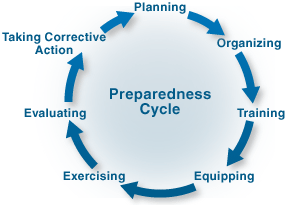
There are a few topic areas within their paper that I’m lumping together under this discussion topic.  The authors make some excellent points about our collective work in preparedness that I think all readers will nod their heads about, because we know when intuitively, but sometimes they need to be reinforced – not only to us as practitioners, but also to other stakeholders, including the public.  First off, preparedness is never complete.  The cycle of preparedness – largely involving assessment, planning, organizing, equipping, training, and exercising – is just that – a cycle.  It’s endless.  While we do a great deal of work in each of these, our accomplishments are really only temporary.

The authors also mention that our information is not always precise.  We base a lot of what we do in preparedness on information, such as a hazard analysis.  While there are some inputs that are factual and supported by science, there are many that are based on speculation and anecdote.  This is a reality of our work that we must always acknowledge.  As is other of their points – there is no silver bullet.  There is no universal solution to all our woes.  We must constantly have our head in the game and consider actions that we may not have ever considered before.

ICS Improvement Officer

The authors briefly discuss a conceptual position within the ICS Command Staff they call the ICS Improvement Officer.  The concept of this fascinating, if not a bit out of place in this paper given other topics of discussion.  Essentially, as they describe this position, it is someone at the Command Staff level who is responsible for providing quality control to the incident management processes and implementations of the organization.  While I’ve just recently read this paper and haven’t had a lot of time to digest the concept, I really can’t find any fault with the concept.  While the planning process itself is supposed to provide some measure of a feedback loop, there isn’t anyone designated in the organization to shepherd that process beginning to end and ultimately provide the quality control measures necessary.  In practice, I’ve seen this happen collaboratively, among members of the Command and General Staff of a well-staffed structure, as well as by the individual who has the best overall ICS insight and experience in an organization – often the Planning Section Chief.  The authors elude to this position also feeding an AAR process, which contributes to overall preparedness.  I like this idea and I hope it is explored more, either formally or informally.

Conclusion

There are a number of other topic areas of this paper which I haven’t covered here, but I encourage everyone to read on their own.  As mentioned earlier, I’d like to see more of the research papers that come from FEMA’s Emergency Management Executive Academy available for public review.  Agree or disagree with their perspectives, I think their discussions on various topics are absolutely worth looking at.  It’s these discussions like these which will ultimately drive bigger discussions which will continue to advance public safety.

I’m always interested in the perspectives of my readers.  Have you read the paper?  What do you think of the discussion topics they presented?

© 2017 – Timothy M Riecker, CEDP

Emergency Preparedness Solutions, LLC


In a POETE State of Mind

One of the searches that has most often brought people to my blog over the last couple of years has been POETE.  In case you forgot, POETE stands for Planning, Organizing, Equipping, Training, and Exercising.  If you conduct an internet search for POETE, there are very few relevant results.  Along with a few of my blog posts, there are a couple of articles published by others, and a few FEMA documents that include obscure references to POETE.  Sadly, there is nothing available that provides (official) guidance, much less doctrine.

Why is it that such a great tool has so few tangible references?  Unfortunately, I don’t have an answer to that.  I hope that will soon change.

POETE was most widely indoctrinated several years ago as an analysis step within the State Preparedness Reports (SPRs), which are annual submissions completed by every state, UASI (Urban Area Security Initiative-funded program), and territory.  Note: The SPR templates and guidance are generally not publicly posted, as they are sent directly to the points of contact for each jurisdiction – thus they generally don’t come up in internet search results.

The SPR is a step beyond the THIRA (Threat and Hazard Identification and Risk Analysis), which is a very in-depth hazard analysis.  The SPR examines each jurisdiction’s level of preparedness for hazards, referencing the 32 Core Capabilities.  Each Core Capability is then analyzed through the lens of POETE.

As a conceptual example, let’s use the Operational Communications Core Capability.  The POETE analysis will examine the jurisdiction’s preparedness by examining:

  • Planning (are plans adequate? Have they been tested?  What improvements need to be made?);
  • Organizing (are there organizational barriers to success? What human operational communications resources are available?  Are there gaps?  Have teams been exercised? What improvements need to be made?);
  • Equipment (does the jurisdiction have equipment necessary for operational communications? What needs are there relative to the resource management cycle?);
  • Training (what training has been provided? What training gaps exist?  When/how will they be addressed?);
  • Exercises (what exercises have been conducted that include the operational communications Core Capability? What were the findings of the AAR/IPs?  What future exercises are scheduled that include this Core Capability?).

Along with answering a few questions on each element, jurisdictions are asked to rate their status for each POETE element for each Core Capability.  If they look at their reports submitted historically, they can see the measure of progress (or lack thereof) with each.  They also have a tracking of identified action items to help them improve their measure of preparedness.

While this analysis can be quite tedious, it’s extremely insightful and informative.  Often, stakeholders have conceptual ideas about the state of preparedness for each Core Capability, but absent conducting this type of in-depth analysis, they rarely see the details, much less have them written down.  Documenting these helps with recognition, awareness, tasking, tracking, and accountability.  It’s a valuable activity that I would encourage all jurisdictions and organizations to conduct.

What else can POETE be applied to?  In the past few years, POETE is being included in DHS preparedness grants.  They often want applicants to identify key tasks within the POETE structure, and awardees to chart progress along the same lines.

I’ve advocated in the past to use the POETE structure in improvement plans, which are a step beyond after action reports from exercises, events, and even incidents.  Having key activities identified across each POETE element for the Core Capabilities analyzed is extremely helpful, and ensures that issues are being identified comprehensively.

Using the POETE concept across all preparedness efforts helps to tie them together.  By documenting each element for each Core Capability, you will have full visibility and reference to your current status and what needs to be improved upon.  It helps drive accountability, a comprehensive approach, and reduces duplication of efforts – especially in larger organizations.  While implementing such a program will take some investment up front to begin to identify, organize, and chart progress and establish an organizational system to do so, I feel it’s an investment that will pay off.

I’m hopeful that the use of POETE continues to see adoption across all of emergency management and homeland security, and that it is further reinforced as a standard through DHS, FEMA, NFPA, and other organizations which hold sway for settings standards and/or requirements.

How does your organization, agency, or jurisdiction use POETE?

© 2017 – Timothy M Riecker, CEDP

Emergency Preparedness Solutions, LLC

Incident Evaluation

I’ve written at length about the importance of quality evaluation of exercises.  Essentially, if we don’t evaluate exercises, and do it well, the benefits of the exercises are quite limited.  Generally, we don’t see a benefit to incidents.  By their very nature, incidents threaten and impact life, property, and environment – things we don’t view as being beneficial.  However, benefits are often a product of opportunity; and we absolutely should take the opportunity to evaluate our responses.

Many incidents do get evaluated, but through research after the fact.  We retrace our steps, review incident documents (such as incident action plans), interview personnel, and examine dispatch logs.  These efforts usually paint a decent picture of intent and result (things that are often different), but often miss the delta – the difference between the two – as well as other nuances.  When we evaluate an exercise, we do so in real time.  Th evaluation effort is best done with preparation.  Our evaluation plans, methodologies, and personnel are identified in the design phase of the exercise.  Just as we develop emergency operations plans and train personnel to respond, we can develop incident evaluation plans and train personnel to evaluate incident responses.

Understandably, a hurdle we might have is the availability of personnel to dedicate solely to evaluation, especially on larger incidents – but don’t be afraid of asking for mutual aid just to support incident evaluation (just be sure to include them in your preparedness efforts).  Just as regional exercise teams should be developed to provide cooperative efforts in exercise design, conduct, and evaluation; incident evaluation teams should be developed regionally.  To me, it makes sense for many of these personnel to be the same, as they are already familiar with how to evaluate and write up evaluations.

In exercises, we often use Exercise Evaluation Guides (EEGs) to help focus our evaluation efforts.  These are developed based upon identified Core Capabilities and objectives, which are determined early in the exercise design process.  While we don’t know the specific objectives we might use in an incident, we can identify these in general, based upon past experiences and our preparedness efforts for future incidents.  Similarly, our emergency planning efforts should be based around certain Core Capabilities, which can help inform our incident evaluation preparedness efforts.  Job aids similar to EEGs, let’s call them incident evaluation guides (IAGs), can be drafted to prepare for incident evaluation, with adjustments made as necessary when an incident occurs.

Evaluating an incident, in practice, is rather similar to how we would evaluate an exercise, which is why the training for these activities is relatively portable.  Evaluation efforts should avoid evaluating individuals, instead focusing on the evaluation of functions and processes.  Don’t reinvent the wheel – evaluate based upon documented (hopefully!) plans and procedures and use the Homeland Security Exercise and Evaluation Program (HSEEP) standards to guide your process. Incident evaluation must be managed to ensure that evaluation gaps are minimized and that evaluation progresses as it should.  Observations should be recorded and, just as we would for an exercise, prepared for and eventually recorded in an after action report (AAR).

I favor honest after action reports.  I’ve seen plenty of after action reports pull punches, not wanting the document to reflect poorly on people.  Candidly, this is bullshit.  I’ve also heard many legal councils advise against the publication of an after action report at all. Similarly, this is bullshit.  If our actions and the need to sustain or improve certain actions or preparations is not properly recorded, necessary changes are much less likely to happen.  If an AAR isn’t developed, a corrective action plan certainly won’t be – which gives us no trackable means of managing our improvements and disavows our intent to do so.

As a profession, public safety must always strive to improve.  We have plenty of opportunity to assess our performance, not just through exercises, which are valuable, but also through the rigors of incident responses.  Prepare for incident evaluation and identify triggers in your emergency plans for when evaluation will be employed, how, and who is involved.  Begin evaluation as early as possible in an incident – there are plenty of lessons learned in the early, and often most critical moments of our incident response.  Finally, be sure to document lessons learned in an AAR, which will contribute to your overall continuous improvement strategy.

How does your agency accomplish incident evaluation?  If you don’t, why?

Need help with the evaluation of incidents?  We are happy to help!

© 2017 – Timothy Riecker, CEDP

Emergency Preparedness Solutions, LLC

2017 HSEEP Course Information

Emergency Preparedness Solutions is regularly looking for Homeland Security Exercise and Evaluation Program (HSEEP) trained personnel to help us design, conduct, and evaluate exercises.  The following training bulletin from FEMA’s Emergency Management Institute provides updated information on the course offerings and application process.  Below the training bulletin is a listing of the webinar-based offerings of HSEEP (K0146).

Training Bulletin

Course:  K/L0146 – Homeland Security Exercise Evaluation Program

 (HSEEP): Basic Course

Emmitsburg, MD — You are subscribed to EMI News for FEMA. The following information has recently been updated, and is now available on http://training.fema.gov/EMI/

1263 – REVISED – Training Bulletin – K-L0146 – updated – Jan 12, 2017

The K/L0146 HSEEP is an intermediate-level course that provides a comprehensive overview of exercise design along with practical skill development in accordance with the HSEEP Doctrine.  The course uses activities that will give participants an opportunity to interact with many of the templates and other materials that are provided by the National Exercise Division to ensure exercises are conducted in a consistent manner.  Upon completion of this course, participants will gain a better understanding of what constitutes a HSEEP consistent exercise.

Read more in Training Bulletin 1263.


Course Start End
K0146: Homeland Security Exercise and Evaluation Program (HSEEP) Training Course
(M,T,W,R 1:00-5:00 p.m. EST)
4/10/2017 4/13/2017
K0146: Homeland Security Exercise and Evaluation Program (HSEEP) Training Course
(M,T,W,R 1:00-5:00 p.m. EST)
5/8/2017 5/11/2017
K0146: Homeland Security Exercise and Evaluation Program (HSEEP) Training Course
(M,T,W,R 1:00-5:00 p.m. EST)
6/5/2017 6/8/2017
K0146: Homeland Security Exercise and Evaluation Program (HSEEP) Training Course
(M,T,W,R 1:00-5:00 p.m. EST)
7/10/2017 7/13/2017
K0146: Homeland Security Exercise and Evaluation Program (HSEEP) Training Course
(M,T,W,R 1:00-5:00 p.m. EST)
8/7/2017 8/10/2017
K0146: Homeland Security Exercise and Evaluation Program (HSEEP) Training Course
(M,T,W,R 1:00-5:00 p.m. EST)
9/18/2017 9/21/2017
K0146: Homeland Security Exercise and Evaluation Program (HSEEP) Training Course
(M,T,W,R 1:00-5:00 p.m. EST)
3/13/2017 3/16/2017
K0146: Homeland Security Exercise and Evaluation Program (HSEEP) Training Course
(M,T,W,R 1:00-5:00 p.m. EST)
2/6/2017 2/9/2017


Incident Action Planning

Hello readers!  It’s been a couple of months since I’ve last posted – along with the holidays, I’ve been fortunate to be busy with some great projects and a bit of travel.  While I’m still busy, I’ve been itching to get back to posting.

Over the past few months, I’ve had an opportunity to look at some different aspects of incident action planning.  Having worked as a Planning Section Chief for numerous state and federally declared disasters, I’ve created Incident Action Plans (IAPs), part and parcel, for a variety of incidents.  Teaching hundreds of course offerings of ICS and EOC management, I’ve also had a lot of opportunity to help others understand and appreciate the value of an IAP.

What is an IAP?

The Incident Action Plan is really the culmination of the planning process.  It documents our expected actions for the next operational period, which, through that planning process, should be ready to be supported through an identified organization and necessary resources.  It begins, foundationally, with an understanding of the situation and objectives built to solve the problems that situation imposes upon us.  IAPs identify some situational information, the incident objectives, and tactics – which specific resource assignments – to accomplish those objectives.  To support the tactics, additional elements are added to the IAP, such as the organizational structure, a medical plan (for responders), a communications plan, and specific safety messages.  Based upon the unique characteristics of each incident, additional material can be added.

The planning process, and thus IAPs, are a standard of practice within NIMS/ICS.

Issues with Teaching the Planning Process

For those coming up through the ranks, as it were, of ICS training, the forms integrated into ICS are often one of the most frustrating aspects.  Responders want to do the hands-on stuff, not fill out forms.  Most areas and systems, however, are able to find the responders who are interested in becoming involved in incident management aspects, and engage them in formal or ad-hoc incident management teams.

Often the only exposure that responders have to IAPs is from the ICS 300 course, where they are able to see some samples and are walked through the planning process and associated forms of the IAP.   Having taught hundreds of these, I know it’s a challenge*.  We inundate course participants with a pile of forms and expect them to leave the class to go out and do great things.  While it might be a reasonable initial exposure, this needs to be followed up on, practices, and reinforced if we expect anyone to be successful, much less use the system.

*note: if you aren’t familiar with my position on the current state of ICS training, here are a few other blog posts to orient you.  In short… ICS Training Sucks!

The planning process can be confusing – who does what?  When?  Based upon what information?  The Planning P is the best visual out there and incident management handbooks (aka Field Operations Guides or FOGs) are references that every IMT member should have in the utility pocket of their 5.11s.  While all based on the same system, I find the United States Coast Guard to have the best handbook out there.  These are great job aids for something we don’t go to work and do every day, no matter how proficient you might think you are.
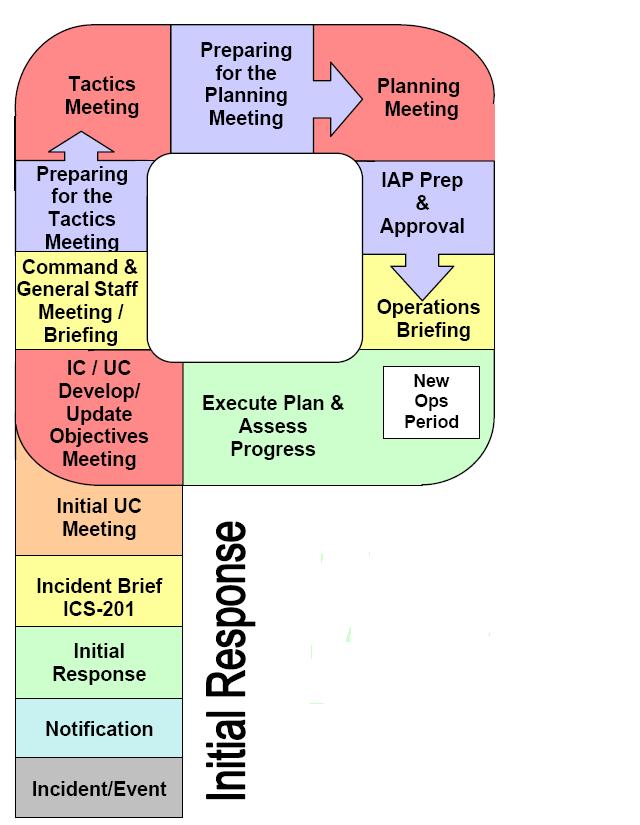
planning P for Planning

Uses of IAPs

IAPs can be applied to anything we can/should apply the planning process to.  These include incidents, pre-planned events, and exercises.  Planned events and exercises provide a great opportunity to practice the planning process and development of IAPs.  It is certainly something that requires practice to be proficient.  Every member of the Command and General staff, as well as a number of support positions, have an important role to play and responsibilities to contribute to the planning process.  The forms themselves even require some practice to ensure that the right information is obtained.  Large incidents can also require a great deal of tactical planning, which means greater time for that and for documenting the tactics and necessary support.

One aspect that is often forgotten in the heat of battle is that our response should, ideally, be based on our emergency operations plans (EOPs).  These should be a regular reference to the Command and General staff, as they can, at the very least, provide some general guidance.  Good EOPs, and their associated annexes, should provide some detailed guidance on certain aspects of response, which can prevent the IMT from having to re-invent a plan in the midst of chaos.  The direction of EOPs, to the greatest extent possible, should be referenced in the planning process and reflected in the IAPs.  EOPs should serve as the foundation for the planning process – with that in mind, EOPs can be implementation-ready.  More thoughts on emergency plan development here.

As mentioned, exercises are a great opportunity for participants to practice the planning process and IAP development, along with other facets of ICS – especially those that we don’t get to apply so often.  Also consider, however, the use of an IAP for exercise management.  Our company, Emergency Preparedness Solutions, worked with the State of Vermont this past summer providing exercise control and evaluation services for their Vigilant Guard exercise.  This week-long exercise spanned nearly 60 distinct venues across the state and involved thousands of participants.  We coordinated over 100 control and evaluation staff throughout the exercise.  While staffing decisions were made weeks in advance, we knew that with so many variables, needs and assignments were bound to change.  For each operational period of the exercise, venues had staff assigned, a point of contact they should coordinate with, a need to communicate with the simcell and exercise management staff, a need to be aware of weather and safety matters, and processes to follow in regard to exercise management and reporting.  We recognized the similarities to a tactical deployment and decided to develop incident action plans for exercise management.  We called these eXercise Action Plans (XAPs).  Within just a couple of operational periods, we were receiving great feedback on the documents from exercise staff.  Use of XAPs were identified as a best practice in exercise management for that project.

Final Thoughts

Incident Action Plans are great tools that can help us put our emergency plans in action.  They allow us to apply incident or event-specific ground-truths and the realities of incident needs and resources.  While it’s understanding that some are frustrated with the forms used, the forms are job aids, tested through decades, to help us navigate complex incident management.  When I walk into a command post or an EOC, the IAP is the first thing I look for.  Because the format and forms are relatively standardized, I can flip through it, and in a couple of minutes have a good sense of the activity and who is responsible for what.  Someone told me long ago that ICS is forms facilitated, not forms driven – and that’s very true.  The forms (and thus the IAP) are products of the planning process, which is another decades-old practice in incident management.

What best practices have you seen in the application of the planning process and incident action plans?

Need assistance with planning, training, or exercises?  Emergency Preparedness Solutions can help!

Until next time.

© 2017 – Timothy Riecker, CEDP


ICS and the Human Factor

A number of my articles have mentioned the unpredictable human factor in executing emergency plans and managing incidents, particularly for complex incidents.  We can build great plans and have a great management system to facilitate the incident management process, but the human factor – that largely intangible level of unpredictability of human behavior – can steer even the best emergency plan astray or derail an incident management process.

An article published in the Domestic Preparedness Journal yesterday, written by Eric McNulty, reflects on this.  Mr. McNulty cites several human factors which have relevance within incident management and encourages leaders to understand these factors within themselves and others to bring about more effective leadership.  The introductory paragraph of his article suggests the need for integrating behavior training into ICS training to ‘improve performance and outcomes’.  Given the impact of behavior factors on how we respond, this is a concept I can certainly endorse for a much-needed rewrite of the ICS curriculum.

I’ve heavily referenced Chief Cynthia Renaud’s paper, The Missing Piece of NIMS: Teaching Incident Commanders How to Function in The Edge of Chaos, in the past and continue to hold her piece relevant, especially in this discussion.  Chief Renaud’s suggestions draw lines parallel to behavioral factors, which suggest to me that we certainly need to integrate leadership training into ICS training.  The current ICS 200 course attempts to do so, but the content simply panders to the topic and doesn’t address it seriously enough.  We need to go beyond the leadership basics and explore leadership training done around the world to see what is the most effective.

Incident management is life and death – not a pick-up game of stick ball.  Let’s start taking it more seriously and prepare people better for this responsibility.

© 2016 – Timothy Riecker, CEDP

Emergency Preparedness Solutions, LLCYour Partner in Preparedness

Do We Need Different Systems for Catastrophic Incidents?

We’ve long heard, albeit in small pockets, people proclaiming that emergency management and public safety need different systems for larger incidents vs smaller incidents.  For years, the Incident Command System (ICS) fought that stigma, with many saying that ICS is only used for hazardous materials incidents (specifically because of OSHA requirements) or for large incidents that required such a high degree of organization.  Following the release of HSPD-5 and the resultant requirements for everyone to use the National Incident Management System (NIMS), we finally seemed to transcend that mentality – although we are still seeing people apply ICS poorly, and often with the thought that it will all work out fine when a large incident occurs.

Since the mid-2000s, coupled with the push for ‘catastrophic planning’, I’ve been hearing people proclaiming that catastrophic incidents require different systems – be it for planning or management.  Recently, I’m hearing this mentioned again.  Yet, interestingly enough, none of the arguments identify specifically what it is about our current systems of preparedness or incident management that fail at the sight of a catastrophic incident.

While I’m a critic of various aspects of our current systems, I’m a believer in them overall.  Do we need a new system of planning?  No, we just need to do it better.  When we plan for a catastrophic level event, we must consider that NOTHING will work in the aftermath of such an incident.  I’m shocked that some people are still counting on the existence and functionality of critical infrastructure following a catastrophic event.  No roads, no communications, no life lines.  These surprised disclosures are revealed in the After Action Reports (AARs) of incidents and exercises that test catastrophic incidents, such as the recent Cascadia Rising exercise.

Fundamentally, are these losses all that different than what we experience in smaller disasters?  Not so much.  Smaller disasters still take out our roads and disable our communications systems – but such disasters are small enough that we can work around these issues.  So how is it a surprise that a large hurricane or earthquake will do even more damage?  It really shouldn’t be.  It’s essentially a matter of scale.

That said, I certainly acknowledge the difficulties that come with the combined impacts of a catastrophic disaster, coupled with the sheer magnitude of it all.  There are challenges offered that we don’t normally see, but a new system of planning is not the answer.  The current frameworks and standards, such as CPG-101 and NFPA 1600 are absolutely substantial.  The processes are not flawed.  The issue is a human one.  We can’t blame the standards.  We can’t blame the plans.  The responsibility lies with the people at the table crafting the plan.  The responsibility lies with them to fully understand the hazards and the potential impacts of those hazards.  Conducting a hazard analysis is the first step for a planning team to accomplish, and I think this is often taken for granted.  While the traditional hazard analysis has value, the current standard is the Threat and Hazard Identification and Risk Assessment (THIRA).  It is an exhausting and detailed process, but it is highly effective, with engaged teams, to reveal the nature and impacts of disasters that can impact a community.  Without a solid and realistic understanding of hazards, including those that can attain catastrophic levels, WE WILL FAIL.  It’s that simple.

As we progress through the planning process and identify strategies to accomplish objectives, alternate strategies must be developed to address full failures of infrastructure and lack of resources.  Assumptions are often made in plans that we will be able to apply the resources we have to fix problems; and if those resources are exhausted, we will ask for more, which will magically appear, thus solving our problems.  Yes, this works most of the time, but in a catastrophic incident, this is pure bullshit.  This assumption needs to be taken off the table when catastrophic incidents are concerned.  The scarcity of resources is an immediate factor that we need to address along with acknowledging that a severely damaged infrastructure forces us out of many of the technological and logistical comforts we have become accustomed to.  It doesn’t require a new system of planning – just a realistic mentality.

This all logically ties to our incident management system – ICS.  ICS is fully able to accommodate a catastrophic-level incident.  The difficulties we face are with how we apply it (another human factor) and integration of multiple ICS organizations and other incident management entities, such as EOCs.  The tenant in ICS is that one incident gets one incident command system structure.  This is obviously not a geo-political or practical reality for a catastrophic incident that can have a large footprint.  This, however, doesn’t mean that we throw ICS out the window.  This is a reality that we deal with even on smaller disasters, where different jurisdictions, agencies, organizations, and levels of government all have their own management system established during a disaster.  Through implementations such as unified command, multi-agency coordination, agency representatives and liaison officers, and good lines of communication we are able to make effective coordination happen.  (Side note: this is absolutely something I think we need to plan for and tighten up conceptually.  It’s often pulled together a bit too ad-hoc for my comfort).

While some time and effort needs to be applied to develop some solid solutions to the issues that exist, I’m confident that we DO NOT need to create alternate preparedness or response systems for addressing catastrophic incidents – we simply need to apply what we have better and with a more realistic perspective.  The answers won’t come easy and the solutions might be less than ideal, but that’s the nature of a catastrophic event.  We can’t expect it to be easy or convenient.

© 2016 – Timothy Riecker, CEDP

Emergency Preparedness Solutions, LLCYour Partner in Preparedness