FEMA Releases a Consolidated Online Training Course Catalog for First Responder Training

This is a great resource I discovered last week that has just been officially announced this week. It is comprehensive and easy to use. Check it out and see what’s out there! – TR 

(Official release follows)

FEMA released a consolidated online training catalog for the First Responder Training System, including courses available through the Emergency Management Institute (EMI), the Center for Domestic Preparedness (CDP), the National Domestic Preparedness Consortium (NDPC) and the Continuing Training Grant (CTG) program. The site was developed in response to customer requests and is known as the “National Training & Education Online Course Catalog.” It allows users to search for all FEMA preparedness training initiatives in one location.  

The main entry page of the combined catalog briefly describes each training organization—EMI, CDP, and the National Training and Education Division—while providing a list of training courses in each catalog, along with links for scheduling and individual websites for each training organization. First responders can access the consolidated course catalog by clicking directly at www.firstrespondertraining.gov/NTE

The catalog itself is searchable and can be viewed in full or by the individual NTE training entities. Users are able to filter by organization and/or training provider, delivery type, discipline, core capability and mission area at www.firstrespondertraining.gov/ntecatalog.

Course catalog feedback can be sent to firstrespondertraining@fema.dhs.gov.

Course Review: AWR-147 Rail Car Incident Response

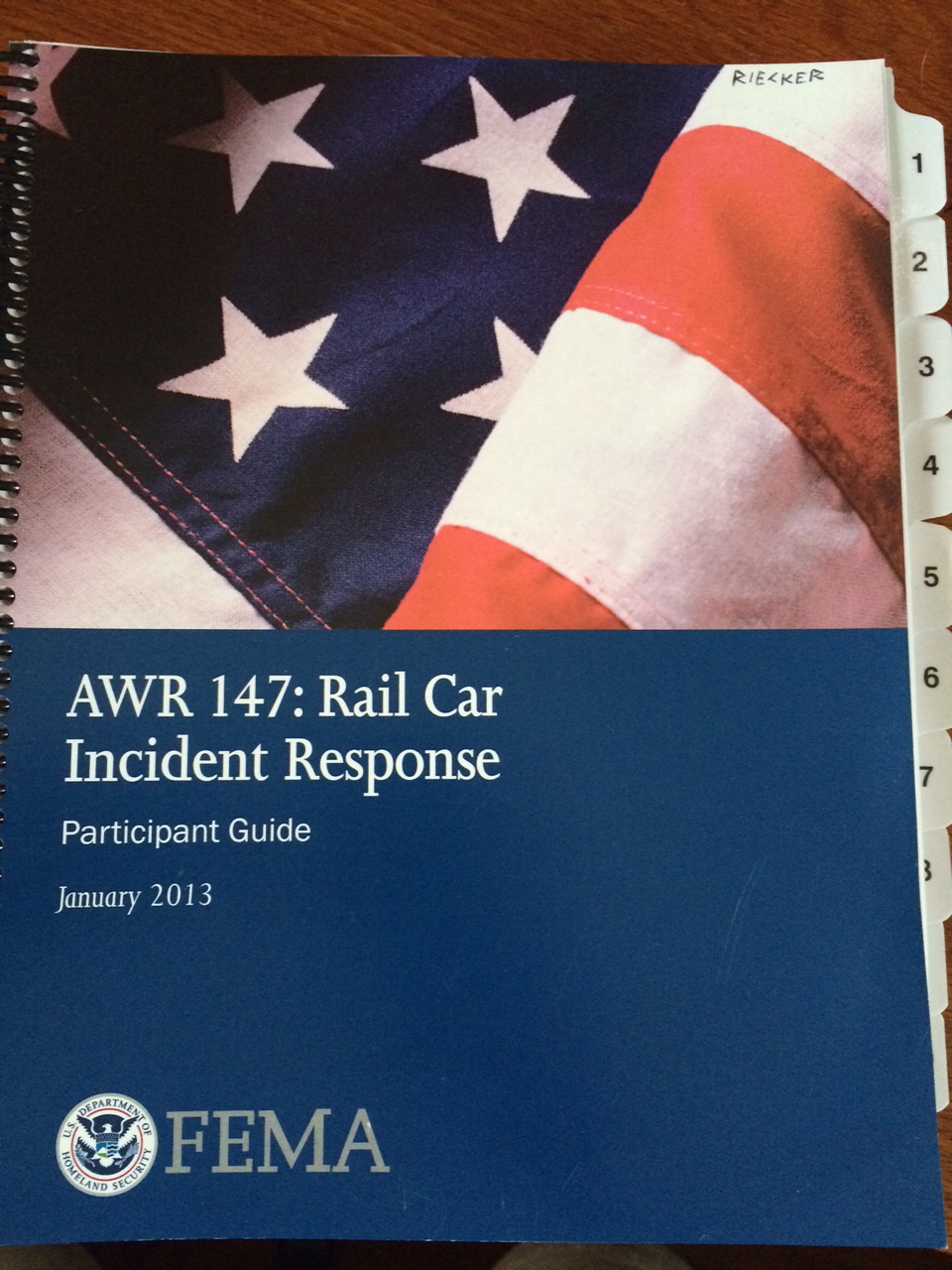
This past weekend I had the opportunity to attend AWR-147 Rail Car Incident Response conducted by the Rural Domestic Preparedness Consortium (RDPC) and Findlay University.  This is a one day awareness level course that focused on response to incidents involving freight rail cars and hazardous materials.

AWR-147 Participant Manual

AWR-147 Participant Manual

All in all this was a good course which I recommend to anyone who has the opportunity to attend it.  For those not familiar with the RDPC you can find their website at https://www.ruraltraining.org/.  Although only an awareness level course, it is suitable for any responder or emergency manager who has a jurisdiction with freight rail lines.  It’s also quite suitable as additional training for HazMat teams, as the information provided relative to the identification of the different types of rail cars and potential hazards associated with them is excellent.

The course construction follows the usual DHS format, including a pre and post test, plenty of student materials, and a mix of instruction, videos, and participant interaction and discussion.  Given the variety of rail cars which can be encountered and rail incidents do dissect, there are plenty of visuals and case studies to drive the program.

I would have liked to have seen the inclusion of a unit to discuss current topics, particularly Bakken crude and even a bit on HazMat associated with passenger train incidents.  Also, while the course focused on response, there was little mention of community preparedness measures which can/should be taken.  Of course I had a small ulcer form with one of the final units which was on NIMS/ICS.  I see little value in rehashing the primary components of NIMS and showing an ICS org chart, particularly when there is little/no discussion on the nuances of applicability relative to a rail incident.  It was all rather gratuitous.

There were some great activities which reinforced use of the DOT Emergency Response Guidebook as well as other sources of information which can be referenced during a rail response, including a worksheet which could easily be used as a job aid for real life application.  Along with the participant manual, all students received a copy of the current DOT Guidebook as well as the Association of American Railroads Field Guide to Tank Cars, which is a handy reference to help you identify the specific type of tank car you are dealing with and where key infrastructure on each (brakes, vents, valves, etc.) can be located.

This was the first course I had taken from the RDPC, although I have been aware of their course selection for quite some time and have referred others to their great array of courses.  Don’t let the term ‘rural’ fool you – the material they teach is relevant to rural, suburban, and urban responders alike.  I had taken CSX’s rail response course several years ago and this course blows it away.  Overall well done and highly recommended.

© 2015 – Timothy Riecker

Emergency Preparedness Solutions, LLC

WWW.EPSLLC.BIZ

Incident Command System Training Sucks

There it is.  I said it.  Before you unleash the hounds, hear me out.

A bit of background:

As another grad course at American Military University was coming to a close last month I was racking my brain over the theme of my term paper.  In one of our final assignments I was dissecting NIMS – and that’s where it struck me.  ICS training is all wrong.  Now that my paper is all wrapped up and submitted, I wanted to get some discussion on my blog.  So, since I don’t want to bore everyone with the paper itself, what follows is a much less academic and more conversational version of my term paper.

For those of you who read my blog, you will be familiar with a few fairly recent posts that involve ICS:  The Human Aspect of ICS and Overcoming Transitional Incidents, Preparedness – ICS is Not EnoughTraining EOC Personnel – ICS is not Enough, and finally The Need for Practical Incident Command Training.  In that last one I feel I was headed in the right direction but not yet on the right road.

Before we go any further, here is my disclaimer.  I am a big believer in ICS.  If you take a look at the aforementioned posts, you’ll see that.  It’s a system that has been in use for a long time and has a proven track record of working well when properly applied.  Along with that, I’ve been an ICS practitioner, instructor, and instructor trainer – since before NIMS, in fact.  I’ve also been in positions influencing NIMS-related policy at both the state and national level.  So I have a fair amount of familiarity with the system, how it is used, and how it is taught.

Defining the need:

A great many after action reports (AARs) reflect on Operational Coordination (the current core capability which most heavily features ICS), On-Scene Incident Management (the previous iteration under the target capabilities), and just ICS in general.  These AARs often go on to recommend that responders need more ICS training.  How can they say that, though?  Following NIMS compliance requirements, darn near everyone who has been required to take ICS training has done so over the past 10 years.  So how could we be so off base?

The reality is summed up in this simple statement from John Morton: “With respect to using ICS from NIMS… training incorporated in the NIMS doctrine largely does not provide any actual skills training or development.”  If you aren’t yet familiar with John Morton’s work, I suggest you take a look here: Book Review – Next-Generation Homeland Security.  Brilliant guy.

Looking at the substance of Mr. Morton’s quote, it’s true that the foundational ICS courses (ICS-100 through ICS-400) don’t provide any skills training.  However, there is a significant expectation that taking these courses is somehow a magic bullet.

Much of my paper focuses on the ICS-300 and ICS-400 courses.  The ICS-100 and ICS-200 courses are probably not far off from where they actually need to be.  There exists, however, a higher expectation from people to have learned something from the ICS-300 and ICS-400 courses which can be readily applied in the field.  One of the foundations for my paper was an analysis of the course objectives from the current ICS-300 and ICS-400 courses through the lens of Bloom’s Taxonomy.  Bloom’s is a learning hierarchy which helps identify the depth of instruction and thus learning.  The revised version of Bloom’s is a scale of six levels, ranging from ‘Remembering’ to ‘Creating’, with remembering being pretty basic and creating being quite advanced.  The expectation of ICS training, obtained from a few sources as well as our perception, is that it falls somewhere in the middle under the taxonomy level of ‘Applying’.   The reality is that most of the objectives from these two courses fall short of that expectation.

How is it possible that we have been expecting more from people when we haven’t been giving them the proper training to do so?  In essence, all we have been training people in is theory.  Sorry, but theory doesn’t save lives, application does.  Why does the fire chief of even the small city (population ~62k) closest to me care what an incident complex or branch-level planning is?  It’s not something he can use.  He and his officers require proficiency in the system for not only the day to day type 4 and 5 incidents they deal with (which they generally have), but also enough for the type 3 incidents which occasionally occur from storms, hazmat incidents, and the like.

Yes, we do have position-specific courses for those who are members of incident management teams (IMTs).  Those courses presumably identify at a higher taxonomy level (I haven’t had a chance to do an analysis on them).  IMTs are great assets, but let’s have another brief shot of reality … not every jurisdiction is suited for an IMT.  Identifying potential members, getting them trained and experienced, and maintaining their skills is an investment that most jurisdictions simply aren’t willing or able to make.  The result is a huge gap between those who have only the core ICS training, which we have already identified does not meet the real need, and an IMT from a larger jurisdiction or region.  Jurisdictions need to be able to function for at least two days, if not longer, on their own.  Most incidents will be resolved at that point or ready for transition to an IMT.  If appropriate, the IMT can then apply things like branch-level planning.  That is the level of application expected from IMTs.

What can we do about it:

So what is needed?  Here are my rough ideas.  First off, at a micro level, we need a full rewrite of the ICS-300 and 400 courses.  Let’s make them more meaningful and focus on application.  Pull out all the theory and structure them around practical learning practices.  Second, we need refresher training.  Let’s stop the argument about that.  Knowledge and skills deteriorate over time, we all know that.  So let’s go with annual refresher training.  Not a day of being lectured, to, either.  Something more involved which reflects the identified need for applicable learning.  Third, continued reinforcement through exercises.  If you don’t use it you lose it.  The last ten years or so have seen a strong emphasis on exercises which we should certainly continue.  Lastly, all of this culminates at the macro level as a restructuring of the whole training program.  Why is that needed?  Well, aside from the current one being ineffective, we need to logically identify what training is needed for certain audiences based upon their roles and responsibilities and support it through accessible training programs.

In regard to restructuring the whole training program, I would suggest adoption of the Awareness, Management and Planning, and Performance course structure (AWR, MGT, PER).  ICS-100 is certainly awareness.  Awareness level training is appropriate for most responders and staff of assisting and supporting agencies who don’t have any leadership or decision-making roles and don’t need to have a high degree of interaction with larger system.  ICS-200 has some operational application for first line supervisors, so it’s probably a suitable introductory MGT course.  The ICS-300 should continue with a focus on the planning process but obviously needs to be bolstered with more application-level content and instruction.  With that, the target here is probably higher level management and planning.  The ICS-400, still needing a rewrite, is best left for those functioning at higher levels of incident management, such as EOC management and IMTs.  It will probably serve as a good foundational performance level course.  Now, just don’t leave it at that.  Let’s pull other courses in line to support this.  Many of those courses already exist, particularly those that have a strong ICS relationship, like the FEMA EOC and ICS/EOC courses (which are also in desperate need of rewrites to focus on application), the TEEX Enhanced Incident Management course (which is excellent), and others.  Let’s build a real, viable program for incident management as we have for other technical areas.  Without incident management we remain in chaos and the impacts of other activities are greatly minimized.  Let’s give it the respect it deserves.

Now that I’ve put all that out there, I’m absolutely prepared for your thoughts, ideas, and feedback.  I’m also hoping that someone forwards this on to Doc Lumpkins at the NIC.  Doc – let’s talk!  I might have an idea or two…

Unleash the hounds!

© 2015 – Timothy Riecker

Emergency Preparedness Solutions, LLC

WWW.EPSLLC.BIZ
Emergency planning – A linear approach or ‘choose your own adventure’?

When creating deliberate emergency operations plans, and especially the associated standard operating procedures/guidelines (SOPs/SOGs) that accompany them (you do develop these, right?) there is always a consideration for how to progress through the written plan – chronologically or topically.  There are pros and cons to both approaches you should be aware of.

Chronological progression of your planning efforts assume that an incident starts at A and progresses to Z, in a particular order.  At a glance, this is a lot of structure for emergency management, but an analysis of most incidents will show that they generally tend to progress in this fashion.  It’s human nature for us to like order and to try to put things into a logical progression.  There are, of course, the outliers – those incidents which have tangential or cascading impacts which don’t necessarily have a linear progression.  It’s these unknown factors that make us stumble a bit.  How do we account for these disruptions of our orderly progression?  We have to skip around in the plan.  If our plan isn’t designed for skipping around, it can be rather awkward and not easy to use.

A Choose Your Own Adventure book

A Choose Your Own Adventure book

The other side of the coin argues that if you are likely to skip around in the plan anyway, why not build a topical, or ‘choose your own adventure’ style, plan?  Remember choose your own adventure books?  The story always starts the same, building a foundation for the adventure you will face, but you, the reader, eventually get to decide what the main character will do.  At some point, you will be faced with a choice.  Should your hero take the left tunnel or the right?  If you take the left, go to page X, if you go right, turn to page Y.

Non-linear planning will chunk the content of your plan so individual sections focus on each potential impact and major activity – be it hazard-specific or function-specific – with reference back to a core plan, kind of a hub and spoke approach.  (By the way, ‘chunking’ is an actual term.  We use it primarily in instructional design).  It can make for some flipping around through the plan, and sometimes a bit of redundancy if each section starts with the same concept of operations (thus the need to reference back to a core plan), but it more easily accommodates the unknowns of an incident by looking at separate impacts or major activities as individual components related to a central response.

What are your thoughts?  Do we try to keep things orderly, or do we give in to a modular, ‘choose your own adventure’ approach?  Which do you think is more complex?  Which do you think is more effective?

© 2015 – Timothy Riecker

Emergency Preparedness Solutions, LLC

WWW.EPSLLC.BIZ
National Planning Frameworks: National Engagement Webinars

FEMA is hosting a series of 60-minute engagement webinars to discuss the update of the National Planning Frameworks. All webinars are open to the whole community, which encompasses—individuals (including those with disabilities and others with access and functional needs), businesses and nonprofits, faith-based and community groups, schools, and all levels of government. The sessions are scheduled for:

• Monday, May 18, 3:00 PM EDT
• Wednesday, May 20, 11:00 AM EDT
• Wednesday, May 27, 12:00 PM EDT
• Thursday, May 28, 10:30 AM EDT

Because each engagement webinar will cover the same information, please choose the session most convenient for you. Advance registration is required due to space limitations. Registration is on a first come, first serve basis. To register, please visit: https://www.vjpo.org/private/ppd8/events/frameworksupdate.

If you require accommodations to participate in these events, please provide details in the Disability Related Accommodations field on the registration page or contact us at PPD8-Engagement@fema.dhs.gov.

To review the draft National Planning Frameworks, please visit http://www.fema.gov/learn-about-presidential-policy-directive-8. To provide comments, please complete the feedback form and submit to PPD8-Engagement@fema.dhs.gov. Comments made during the webinars are considered to be for discussion purposes only and may not be adjudicated formally.

The National Planning Frameworks, which are part of the National Preparedness System, set the strategy and doctrine for building, sustaining, and delivering the core capabilities identified in the National Preparedness Goal. They describe the coordinating structures and alignment of key roles and responsibilities for the whole community and are integrated to ensure interoperability across all mission areas.

This update of the National Planning Frameworks focuses on discrete, critical content revisions, and confirming edits as a result of comments received on the National Preparedness Goal. Additional changes in the current draft of the Frameworks are the result of the lessons from implementing the Frameworks and recent events, as well as the findings of the National Preparedness Report.

Questions can be directed to FEMA’s NIC at: PPD8-Engagement@fema.dhs.gov.

For more information on national preparedness efforts, visit: http://www.fema.gov/national-preparedness.

Finally – an Emergency Management Podcast Worth Listening To!

I’m a bit of a podcast addict.  I listen to them all the time – at the gym, mowing the lawn, long drives, etc.  There are podcasts out there for all interests.  I’ve struggled, however, these last few years, with finding a good emergency management podcast.  Sure, I’ve found a few, but I find them to generally have limited relevancy and also to be boring as hell.  Yes, I want to learn, but I also want to be entertained.  Last week, after seeing a tweet from Brandon Greenburg about guesting on a podcast, I was immediately intrigued.

First off, if you aren’t familiar with Brandon, you should be.  He blogs regularly about disasters and technology, usually together, and has great thoughts and ideas.  Brandon is not only a practitioner, but also an academic, currently pursuing a Ph.D. from GWU in technology and disaster management.  Brandon is one of those colleagues who I’ve never met, yet correspond with via our blogging and social media platforms.  Since he knows EM and he knows tech and social media, anything Brandon would be on immediately gives me cause to pay attention.  For more on Brandon, visit www.disasternet.co or on Twitter @disasternet.

Getting to the podcast, the name is the Dukes of Hazards, hosted by Mitch Stripling and Andrew McMahan.  From their website, the podcast is “… an irreverent (but useful) podcast about disaster response, emergency management, mobilization culture, community resilience, and life in emergency operations.  Also, drones.  Research.  Movie reviews.  Jokes.”  It really is all of that.  And a clever name!

Mitch and Andrew have clearly cracked the secret code of podcasting – talk about any subject (even one that is serious, like emergency management) and make it both informative and entertaining.  They clearly have a good time recording (the beer and cookies probably help with that), they are experienced in EM, and they continue to stay current in the practice.  Their discussion topics are interesting and relevant, and they fully use dialogue – with each other, guests, and written listener feedback – to help you feel engaged in their discussion.

Dukes of Hazards looks at current events in EM, new practices and ideas, and discusses the future direction of different facets of our field.  They even occasionally poke fun at some of our idiosyncrasies and common personality traits, which is a breath of fresh air! There are also some occasional pop culture references like Star Wars and The Walking Dead that make me quite happy.

Bottom line – informative, entertaining, beer and cookies.  Need I say more?

Check out Dukes of Hazards at www.hazardspodcast.com for more info.  You can listen to their podcasts from the website, iTunes, and other outlets.  They can also be found on Twitter at @hazardspodcast. You won’t be sorry.

© 2015 – Timothy Riecker

Emergency Preparedness Solutions, LLC

WWW.EPSLLC.BIZ

@EPS_LLC

The Aussie Model of Disaster Recovery

I had recently found a reference to the Emergency Management Victoria Disaster Recovery Toolkit for Local Government.  I’m always curious to see how other nations approach emergency management and even more curious to see the tools and resources they develop to accomplish their goals.  While there is a great deal of consistency between the US model of Disaster Recovery (documented primarily through the National Disaster Recovery Framework), one of the more interesting differences was in the focus areas of each.  While our National Disaster Recovery Framework identifies six recovery support functions (RSFs): Community Planning and Capacity Building, Health and Social Services, Infrastructure Systems, Economic, Housing, and Natural and Cultural Resources; the Aussie model identifies five environments of wellbeing: Natural Environment, Agricultural Environment, Social Environment, Economic Environment, and the Built Environment.

Australian Five Environments of Wellbeing

Australian Five Environments of Wellbeing

While there are certainly commonalities between the two models, each offers a unique perspective on the focus of disaster recovery and what is needed to support communities.  The Disaster Recovery Toolkit for Local Governments, referenced earlier, identifies that local governments are required through legislation to ensure wellbeing to be maintained in each community through each of these environments.

What interesting perspectives have you discovered looking at emergency management globally?

© 2015 – Timothy Riecker

Emergency Preparedness Solutions, LLC

WWW.EPSLLC.BIZ

EM, HS, and Politics

As the mechanizations of election season warm up their engines, let’s be sure to identify the standing of candidates in regard to emergency management and homeland security policies.  While we will never get a fully accurate picture of their intentions in these programs this early on (I’m sure few candidates are even thinking about EM/HS policy aside from immigration), we can get some indication of what their thoughts are and, once primary season is over, who the final candidates might be considering to head important agencies such as DHS and FEMA.

Any examination of this history of emergency management shows that politics seem to shape the direction of what we do as much as significant disasters do.  If you are interested in reading up on this, there are two great sources I’d recommend – Emergency Management: The American Experience 1900-2010 (Rubin. 2012.) provides good summaries of benchmark disasters and legislation through the years; and Next-Generation Homeland Security: Network Federalism and the Course to National Preparedness (Morton. 2012.) provides an in-depth look at this history with detailed references to the administrations, agencies, and people involved.

Rubin and Morton References

Rubin and Morton References

While we have certainly seen an overall positive trend of progress in emergency management (which is heavily influenced and sometimes dictated by federal policy), this has come despite some political actions which have either slowed progress or sometimes fully did away with positive and effective programs.  Having major changes in policy and programs every few years has become unsustainable for our practice, especially at the local level where EM/HS programs are often coordinated by one person.  Change isn’t always bad, but changes should be put in place only after being thought-through and reviewed by professionals to ensure they are effective and sustainable – not just politically motivated.  FEMA has been doing a great job in the last several years by providing public comment periods on new and major changes to guidance.  I hope this continues.

© 2015 – Timothy Riecker

Emergency Preparedness Solutions, LLC

WWW.EPSLLC.BIZ 

Your Complete Guide to the 5 Cybersecurity Bills in Congress

Yesterday Eric Geller, a writer for The Daily Dot, an online internet culture newspaper, posted Your complete guide to the 5 cybersecurity bills in Congress.  This is a great overview of each of the bills and what they entail.  These bills represent an important progression toward a better cybersecurity policy and implementation in the US.  A worthwhile read.

© 2015 – Timothy Riecker

Emergency Preparedness Solutions, LLC

www.epsllc.biz

News in Emergency Management

Regrettably I’ve not posted in a few weeks due to a very busy schedule.  While that hasn’t broken, I did want to take some time to ensure that my readers have seen some recent news that has been circulating in emergency management as of late.

First, the FEMA mobile app has updated and is now providing the ability for users to receive weather alerts from up to five locations across the nation.  This is a particularly handy feature for those who have family and friends in other states or those who travel frequently to different areas.  With hazardous weather season upon us, be sure that you use the FEMA mobile app or other state or local alerting service to ensure that you, your family, and organization receive alerts.

Second, DHS has provided an update on the status of the LLIS (Lessons Learned Information Sharing) Libarary.  From the release I received this morning…

Dear LLIS.gov User,

This spring, the Lessons Learned Information Sharing (LLIS) program will make a significant change. The LLIS.gov website will cease independent operations and will consolidate its content with the Naval Postgraduate School’s Homeland Security Digital Library (HSDL.org) and FEMA.gov.

One of the advantages of this move is that LLIS.gov content such as lessons learned, innovative practices, after-action reports, plans, templates, guides, and other materials will be consolidated with the already substantial database on HSDL.org. This change will allow the homeland security and emergency management communities to find relevant information in one place. FEMA’s LLIS program will continue to produce trend analyses, case studies on the use of FEMA preparedness grants, and webinars relevant to the whole community. These products will be available to the public on FEMA.gov.
They don’t give any timeframe for this migration aside from stating that they will provide updates in the coming weeks.  Personally, I think this is a move that makes sense by consolidating some great sources of information.  I’m also happy to hear that FEMA will continue providing some data and trend analysis, although I’m hopeful that the information they provide is of greater value than what I have seen in the past.  I’m also curious if this will be somehow integrated into the new Data.gov site.  It’s unfortunate that LLIS has been pulled down for so long while they have sorted all this out.

Lastly, good news for coastal communities and those who have suffered inland tropical storm damages in the last few years – the prediction for the 2015 hurricane season is that we will have lower than average activity.  A link to the annual predictive analysis can be found here.

That’s all for now.  Stay safe.

© 2015 – Timothy Riecker

Emergency Preparedness Solutions, LLC

www.epsllc.biz