Preparing for Ebola – and Whatever Else May Come

Unless you’ve been living under a rock lately, you should be quite aware of the headlining threat in public health and public safety – Ebola hemorrhagic fever.  Ebola has been in existence for quite a while, but the current outbreak of this deadly virus in western Africa has garnered much attention.  Thus far, beyond western Africa, infected persons have been identified in Spain and the United States.  The ease and frequency of air travel, combined with the virulence of Ebola have led to a frenzied reaction by politicians, the media, and our health care system.  While we are at a stage in the US where only a handful of infected persons have been identified, this virus is quite dangerous and could easily and rapidly spread.

While I’m not a public health expert, preparedness is universal.  Public health is at the tip of the spear for this fight and must be supported by other professions within public safety and beyond – that’s what emergency management is all about.  That said, this is proving to be quite a test for our public health partners.  The consequences of failure could be devastating.

Considering the five mission areas, we are most strongly functioning within Prevention, Protection, and Response for Ebola.  Certainly the three common Core Capabilities of Planning, Operational Coordination, and Public Information and Warning are all fully engaged across the three mission areas.  Additionally, we are seeing a great deal of work within in the Intelligence and Information Sharing; Screening, Search, and Detection; Public Health and Medical; and Situational Assessment Core Capabilities; along with some work in other capabilities to a lesser degree.  Why is it important to recognize the mission areas and Core Capabilities?  It helps to keep us focused and prompts us to examine the critical activities for each.

In which mission areas and Core Capabilities does your agency fit in?

What are you responsible for?

Are you doing it?

Do you have all the information you need to do it safely and effectively or are you waiting for public health to call and tell you what to do?  I’m betting you haven’t gotten that phone call.

In a situation like this, we are seeing a lot of activity and emphasis at the Federal level through US Health and Human Services and the Centers for Disease Control.  Their focus is on solving the problem in front of them.  While they have people engaged in getting messages out and engaging partners, they have a lot to accomplish and likely haven’t gotten to all the stakeholders.  We will hopefully see some more aggressive messaging given the circumstances that have been described at the Texas hospital where Ebola patients have been treated.  So what should you do?  Hopefully your agency is already in contact with your local health department to discuss both your role in the public safety system and the potential exposures and vulnerabilities you may have to Ebola.  If your local health department doesn’t seem to have much information, reach up to your state health department.  Don’t wait to get a call… by then it could be too late.

Very simply, we are looking at preparations for your agency’s role.  These preparations, although slightly different based on the agency, apply to all agencies; from first responder agencies, to local government, K-12 and higher education schools, hospitals, private sector, and not for profits.  Let’s break this down with the Preparedness Cycle:
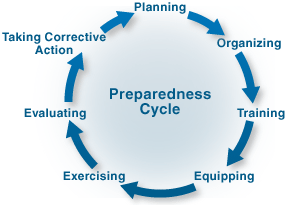
The Preparedness Cycle - FEMA

The Preparedness Cycle – FEMA

Plans, policies, procedures – do you have them in place and up to date?  Depending on the role and function of your agency you can have several of the following – emergency operations plan, emergency procedures, infection control plan and procedures, public health plan, communicable disease or pandemic influenza plan.  You should engage with public health experts to ensure that your plans, policies, and procedures address everything known about Ebola.  You may need to create some procedures specifically addressing issues pertaining to Ebola and your agency’s role.  Do your plans, policies, and procedures link up to your agency’s critical activities for each Core Capability you are engaged in?  What agencies do you need to coordinate with to be effective?

Organizing – depending on your agency’s role, you may need to make some internal changes or designations within your organization to better streamline your activities.

Training – train everyone who has anything to do with any component of the plan in what they need to do.  This is a great opportunity to ensure that everyone is trained up in their role of the emergency operations plan.  If your agency has physical contact with the public, training in personal protective equipment (PPE), identification of signs and symptoms, and patient care are extremely important.  Given the detail of the activities and the just-in-time training, job aids will be a great help to your staff to ensure that they follow the procedures you provide for them.  Don’t get caught short… communicate to your staff in what is going on, what your agency is or may be responsible for, and what they will be called upon to do.

Equipping – your staff need the right equipment for the job.  Not only PPE, but the forms and databases used to record information, decontamination equipment, etc.  It is extremely important that staff are trained not only in how to use equipment but to prevent contamination of equipment and prevention of cross contamination.  Do you have all the equipment you need?  If not, who does?

Exercising – Conduct table top exercises to talk through policies and higher levels plans to validate and become familiar with them.  Identify shortfalls and correct them immediately.  Conduct drills to test the skills of staff for specific activities and larger exercises – functional or full scale – to test multiple functions and plans.

Evaluating – Evaluation is a constant throughout all of the preparedness cycle.  We need to evaluate every step within the preparedness cycle and make adjustments and improvements as needed.  Embrace best practices and fix shortfalls.  This leads directly to the next step…

Taking Corrective Action – Some corrective actions are quick and easy fixes while others can take a while or cost money above budget to address.  A corrective action plan (aka improvement plan) will help you keep track of what needs to be fixed, the priority it holds, who is responsible for making it happen, and a strategy to make it happen – it’s a living document.

The preparedness cycle can be applied to any hazard, be it Ebola or a flood.  With all this attention on Ebola, it’s a great opportunity to pull plans off the shelf and have discussions with internal and external stakeholders on these preparedness steps.

© 2014 – Timothy Riecker

Exercising Foundational Skills with Unorthodox Scenarios

Does the scenario of an exercise activity really matter?  Can we use a zombie scenario to exercise evacuation and sheltering?  Can we use a holiday food distribution to the needy to practice our POD (point of distribution) plan?  Do scenarios always have to be realistic or related to our jurisdiction’s hazards?

I’m a foodie.  As such I find myself occasionally watching shows like Cutthroat Kitchen and Chopped.  These are fun shows that strike a balance of cooking with game shows, including the cash prize in the end.  The competitors are legitimate cooks, some trained in culinary schools, some successful in their careers and earning the title of ‘chef’.  The competitors are given, on the spot, either a dish to create (Cutthroat Kitchen) or a box full of ingredients which must all be incorporated into a dish (Chopped), using a kitchen and pantry generally unfamiliar to them, within a relatively short amount of time – and make it better than their competitors.  Is competing on these shows anything like running a professional kitchen?  Hell no.  Does it make them better cooks?  From interviews I’ve heard, the answer is yes.

Can we recreate this in emergency management?  Of course we can, and we should.  How would this help emergency managers and other public safety professionals?  Recall that within the exercise design component of the HSEEP process the Core Capabilities to be focused on and the objectives to be tested are selected prior to determining the scenario.  This tells us that the activities to be performed are more important than the scenario in which they will be performed.  In these cooking competitions, the participants must fall back on their foundational skills to be successful.  It’s those foundational skills and the activities which they foster that we evaluate in our exercises.

Certainly a scenario has some importance.  It provides context, allowing the participants to get their head into what they are doing.  A scenario can be different, even a bit silly or fantastical (alien invasion, anyone?), but it still has to correlate to the objectives of the exercise; i.e. there must be a compelling reason to perform mass prophylaxis or to evacuate an area.  That said, the scenario is simply a vehicle to get our participants to perform what we intend to test.  Don’t we always tell our participants to not fight the scenario?  Well if it’s something they’ve never before experienced, they have little ground to stand on.

Another benefit to using an unfamiliar or alternate scenario is getting participants to break from the routine and face unexpected and new challenges.  What if digital communications fail?  What if they have to relocate to an alternate EOC? What if that alternate facility is likewise compromised?  Consider using the scenario to remove a critical resource from use.  How will the participants overcome this new problem?  In Cutthroat Kitchen, participants are faced with unseemly injects to their food preparation, such as replacing all cooking utensils with a Swiss Army knife or only being able to cook using a microwave.  Some of your participants may balk at such occurrences, but emergency management is about managing the unknown, the unfortunate, and the unexpected.

Regardless of the measure of reality we choose to base our exercises on, the scenarios we develop are really another level of fiction to help facilitate exercise participation.  Yes, often times we want to test hazard specific plans (a zombie apocalypse exercise can not replace the need of a hurricane exercise), but if the scenario itself doesn’t matter, consider using something ‘outside the box’.  Routine makes us complacent and complacency is very dangerous in emergency management.  We must always expect the unexpected and continually have the mindset to improvise, adapt, and overcome.

© 2014 – Timothy Riecker

Deliberate Planning – Strategic Planning and Business Continuity

Many organizations put forth extraordinary effort to develop strategic plans to give concerted organization-wide direction to the organization for the coming 3-5 years.  Like many of my readers, I have been part of several strategic planning efforts in different organizations, sometimes helping to lead the way.  There is a great deal of value to strategic planning as it helps not only refine the organization’s vision, but also develops objectives to help it get there while (ideally) bringing the entire organization on board – from finance, to HR, to operations, and facilities – everyone is facing in the same direction and striving to accomplish the same goals.  Just as strategic planning should not be performed in a vacuum, business continuity planning should not either.  Just as strategic planning engaged the whole organization, as should business continuity planning.

If the efforts of strategic planning and business continuity planning have such foundational similarities, why not bring the two together?  As the goals of these two efforts are distinctly different we certainly can’t merge the efforts, but the overlaps provide for easily exploitable opportunities within the organization.  How?

First, make business continuity and resilience a goal of your strategic plan.  What does this do for the organization?  Just like the other goals identified in strategic planning, it provides a documented leadership-driven purpose which will engage the whole organization.  Every business unit in an organization has a stake in business continuity.  Just with other goals within your strategic plan, the specific actions will be identified through objectives – be it a start to your business continuity program or a continuation and improvement thereof.  As mentioned in previous posts, business owners and managers put forth a great deal of effort to build and expand their businesses, but we also need plans to stay in business in the event of a disaster.

Second, once the strategic plan is completed, you now have a group of people from across the organization who now hopefully work well together – engage them!  Turn your strategic planning committee into your business continuity committee.  Good strategic planning provides for someone (ideally the planning group) to monitor the implementation of the strategic plan.  This takes minimal time compared to developing the strategic plan, allowing for this group – who has already worked together for some time and has gone through the group dynamics of forming, storming, norming, and performing – to focus on another task.  Why pull together another group of different people?  It’s a waste of time and the team will lag in performance.  Simply reengage them and change their focus.  This group is a great asset who has already proven they can represent their business units while still having an organization-wide perspective.

Third, mine data from the strategic planning process to support business continuity.  A thorough strategic planning process has examined the organization from many angles and perspective – particularly through a SWOT analysis (strengths, weaknesses, opportunities, and threats).  While a SWOT analysis is performed from a business standpoint, much of the data obtained and derived from this analysis can inform both your hazard analysis and the identification of mission essential functions – these are the things which you MUST DO to stay in business and to minimize the greatest losses.

Lastly, continue the relationship between strategic planning and business continuity.  Both work in a cycle of continuous improvement and those cycles obviously intersect – not just at one point but potentially at multiple junctures; an important consideration of a business continuity program is the impact which disasters may have not only on current business operations but also on planned business initiatives.  This shared knowledge and insight between two planning efforts conducted within one group is invaluable.  As strategic planning continues, new objectives for the business continuity program should be included while resiliency opportunities identified through the business continuity program should inform the strategic plan helping the organization overall to become more resilient and sustainable.

What are your thoughts on the synergy between strategic planning and business continuity?  What other opportunities do you see?

As always, if you need help starting, growing, or rebuilding your business continuity or emergency management program, Emergency Preparedness Solutions, LLC can help.  Contact us through www.epsllc.biz or directly at consultants@epsllc.biz.

© 2014 – Timothy Riecker

4 Steps to Individual and Family Preparedness

As mentioned in earlier posts, September is National Preparedness Month.  Through the lens of whole community emergency management, individual and family preparedness is truly the foundation of all our efforts.  If families are not properly prepared our systems in emergency management, response, social services, healthcare, etc. will be completely overwhelmed in the event of a disaster.  If individuals have not prepared themselves for disasters they will not be able to go to work – effectively shutting down government, businesses, and not for profits which provide so many critical services – especially during disasters. 

While my focus lies generally on preparing governments, businesses, and not for profits for disaster, I often get asked questions about individual and family preparedness.  I also stress individual and family preparedness when I speak with clients, as the preparedness of their employees, suppliers, distributors, customers and clients is so important to their continuity of operations.  Every organization should promote preparedness concepts to their employees as part of their business continuity plan. 

There are an abundance of resources out there on individual and family preparedness.  Overall, the best of these resources is Ready.gov.  They make preparedness simple by breaking it down into four key activities:

  1. Get a kit
  2. Make a plan
  3. Be informed
  4. Get involved. 

1. Get a Kit – FEMA promotes getting (or better yet – building) an emergency kit that will sustain you and your family for at least 3 DAYS.  I would suggest that you prepare to be on your own for as long as you can.  If you can do 3 days, why not 4? 

Everyone’s kit is going to be a little bit different based on your needs and your budget. Here are some ideas to get you started.

  • Water.  It’s a biological essential.  Have AT LEAST 1 gallon of water per person per day for hydration and basic sanitation.  If you live in a warmer climate you will need more. 
    • Pro tip – While you should prepare for your water needs with gallon jugs, consider other water sources to supplement this such as the water in the tank of your toilet or your hot water heater. 
  • Food, another biological essential.  Be sure to have at least three days of non-perishable food per person.  Canned food is always an easy option, although it can be heavy (don’t forget the can opener!).  A lighter-weight option would be military MREs (meals ready to eat) or camping meals (found in most outdoors and hunting stores).  Protein bars and dried fruit are great options as well as they are high in calories (something you may need in a survival situation) and nutrient dense. 
    • Pay special attention to dietary needs or restrictions.  Food allergies are important to note when buying your food.  Also note the amount of sodium usually found in pre-packaged food in the event that a member of your family has sodium sensitivities. 
    • Have pets?  Don’t forget food and water for them, too!
  • Medications.  These can consist of over the counter medications such as ibuprofen, anti-histamines, or anti-diuretics which your family may need (and which you should pack!) as well as any prescription medications. 
    • All food, water, and medications have an expiration date.  Keep a list of your items in your kit with expiration dates noted.  Rotate new stock in when needed. 
  • First aid kit.  Injuries can and do occur during disasters so you should be prepared with a first aid kit.  This is something you can purchase in whole or in part, supplemented with additional items.  Rolled gauze, triangular bandages, and bandaids are important and often used – so stock up! 
    • Get training and know how to provide first aid!  Everyone in your family should take a first aid and CPR class.  Check with the Red Cross, your local community college, or ambulance squad.  Keep a small first aid book in your kit as well – you might not remember everything! 
  • Toiletry and sanitation supplies.  Garbage bags are excellent multi-purpose items.  They can be used to dispose of waste (human or otherwise), to carry goods, or to act as a barrier.  Be sure to have some rolls of toilet paper, feminine products, cleaning solution (a spray bottle of bleach solution is best!), and hand wipes.  Have a baby?  Be sure to pack diapers!
    • Toilet seats that fit on 5 gallon buckets are a great convenience and are available through many commercial outlets.  Before a disaster you can also store some of your emergency supplies in the bucket
  • Emergency communications.  Battery operated, solar, or hand crank radios are a great addition to your kit.  They will allow you to stay aware of the situation and receive important government messages.  These are available through many commercial outlets. 
    • Many of these radios also include features such as flashlights and cell phone chargers.  Be sure that you are familiar with their operation before disaster strikes! 
    • Consider how you will store your kit and how you might have to move it in the event of evacuation.  Plastic bins are a great storage solution buy may not be convenient to move.  Store all items in backpacks inside the bins.  Bright red bins are great to use and should be labeled and easy to find and access. 
    • You don’t have to assemble your kit all at once.  If it’s more cost effective for you and your family, create a preparedness budget and purchase items over a period of time. Tools and supplies.  Other tools and supplies may be necessary to help you survive depending on your situation.  Items to consider are duct tape, a good knife, a folding camping or military style shovel, a hatchet, a wrench, and rope or para-cord. 

2. Make a Plan –Along with checklists for your kit, you can also find checklists and templates on Ready.gov for your plans. A family communications plan is one of the most important plans you can make. How will family members contact each other during a disaster? Consider both cell phone and landline contact methods. Also, an out of state contact should be identified. If family members can’t contact each other, perhaps they can contact this out of state person to let them know they are OK.

Families should plan for sheltering in place by identifying the resources and actions necessary for staying where they are and staying safe. Likewise, families should create an evacuation plan in the event that an evacuation is ordered. What will you take with you?

Lastly, you should be knowledgeable of the emergency plans at school and work. How will notifications be made? What will schools do with children? Where will your meeting place be?

3. Be Informed. It is important to be informed about disasters, be notified of them when they are about to occur, and be able to receive emergency alerts and instructions from government in the event of a disaster. Most states have emergency notification systems established which are free to subscribe to. These systems will contact you per your instructions (cell phone, land line, text, email) to notify you of an emergency and provide you with emergency instructions. Some major cities also have their own similar alert systems. Know what is available in your area and subscribe.

4. Get Involved. Once you have prepared you and your family, help your community to become better prepared. There are a variety of organizations who can benefit from your interest in preparedness. Perhaps you would like to be a health and safety instructor with the American Red Cross or maybe you would like to volunteer through a faith based organization such as the Salvation Army or your local church, mosque, or temple. Local Citizen Corps Councils, if you have one, are focused on disaster preparedness and relief efforts. Volunteermatch.org is a great way to find local community organizations to volunteer with.

Remember, this is just a quick synopsis.  More information can be found from Ready.gov or from the other links provided.  More information on individual and family preparedness can also be found from fellow blogger Kathleen at oyoinfo.net

Be Proactive, Be Prepared! ™

 © 2014 – Tim Riecker


Business Continuity in the Food Service Industry

Last year I had the pleasure of working with a number of folks in the food service industry on business continuity.  Just like any industry, they have some very specific mission essential functions which must be maintained or minimally disrupted in the event of a disaster. 

If you’ve watched Bar Rescue or other similar shows (or eaten in a restaurant) you should know that sanitation is a critical issue in the food service industry.  Sanitation is the aspect of food service which is most heavily inspected (not as often as it should be in my opinion) and cited.  It is a critical component of regulation in the food service industry (usually done by local health departments) and failure to comply with sanitation can, will, and should result in being shut down.  Operating in a disaster environment is no exception to this – particularly when people are more susceptible and more exposed to food borne illness during disasters.  Part of sanitation, by the way, also includes the control of vermin. 

In my discussions with food service folks on business continuity, sanitation is the primary mission essential function they must maintain.  Others on the list include receiving and storage (at appropriate temperatures) of food goods and preparation of food (to proper temperatures and maintaining those temperatures until food is served). 

As restaurants examine their hazards they need to know what impacts hazards can have on their operations.  Certainly a loss of power can inhibit their ability to store and prepare food – but does it make it impossible to do so?  Maybe.  Dry ice can help regulate cold storage, but must be carefully monitored.  Food preparation is often done with natural gas or propane stoves, so power may not necessarily be required.  Even refrigeration can be outfitted to be powered by propane or natural gas.  That’s how food trucks and carts do it. 

Other considerations during a disaster are the ability of employees, customers, and suppliers to access your location.  You may have to operate with minimal staff as some of your staff could have been impacted by the disaster.  Assuming access is viable and that you can safety store and prepare food, it is possible for you to make money or at least minimize losses, even with a smaller menu, since those impacted by a disaster may not be able to make their own food and responders and relief workers will be happy to sit down and enjoy a warm meal. 

The best way to minimize your losses during a disaster is to have a business continuity plan.  If you need help building one, call Emergency Preparedness Solutions, LLC.  Reach us at consultants@epsllc.biz or www.epsllc.biz

National Preparedness Month Webinars for Businesses

September is National Preparedness Month in the US and to help promote preparedness across the whole community, FEMA is partnering with the Small Business Administration and their consultant Agility Recovery to spread the word to the business community.  Below is information on a webinar series with topics to help prepare your business!  

Get Your Business Ready For Any Kind of Disaster at Free National Preparedness Month Webinar Series

 WASHINGTON – Each year small businesses nationwide are forced to close their doors in the aftermath of severe storms, flooding, tornadoes, wildfires and hurricanes. Business interruptions, even if they last just a few hours, are costly in terms of lost productivity and profits.

 You can get help with your own business preparedness planning through a series of free webinars in September hosted by the U.S. Small Business Administration and Agility Recovery.   The September series is presented in collaboration with FEMA’s Ready Campaign as part of National Preparedness Month.  

 The SBA wants to help business owners take charge of the well-being of their own companies, the safety of their employees, and the sustenance of their local economies by being prepared to rebound quickly from any kind of disaster.

 The half-hour webinars will be presented at 2 p.m., Eastern time, each Wednesday in September. Visit http://snurl.com/296yw4e to register for any or all of the webinars listed below:

 September 3: Crisis Communications for Any Organization

Learn best practices for developing an emergency communication strategy.

 September 10: How to Plan for a Power Interruption…and Recover Fast

Tips on how to make your company resilient and better prepared to mitigate losses during power outages.

 September 17: The Top 5 Steps for Preparedness This Year

The top five ways to prepare for disaster-related business interruptions will be discussed.

 September 24: If You Do Nothing Else This Year

Simple, low-cost tips on building a solid business continuity plan.

 SBA has partnered with Agility Recovery to offer business continuity strategies through their “PrepareMyBusiness” website. Visit www.preparemybusiness.org to check out the archived webinars and for more disaster preparedness tools.

What Planning Format To Use?

Comprehensive Preparedness Guide 101 (CPG 101) describes three format options for your emergency operations plan (EOP): The traditional functional EOP format, the Emergency Support Function (ESF) format, and the agency/department focused format.  As mentioned in CPG 101 the traditional functional EOP format is the most popular and widely used.  It generally provides for three major sections – the basic plan, functional annexes, and hazard specific annexes.  The traditional format provides for the greatest flexibility and allows a jurisdiction or organization to easily evolve their plan as the need for addressing additional issues or hazards is recognized.  Continuity of Government/Continuity of Operations (COG/COOP) plans are easily integrated as annexes as our newer concepts such as resiliency plans and climate change plans. 

Agency/department focused EOP formats provide utility for those folks that like to crack open the book looking to answer the question ‘what is expected of me?’.  This format offers some flexibility, but under most occurrences where the need to address a new issue arises edits need to be made through much of the plan to identify and address each agency’s involvement in said issue.  It can also be awkward to include other associated plans, such as the afore mentioned COOP and COG plans.  It does work for smaller communities, though, whose hazards and other planning areas stay fairly static. 

The ESF EOP format is modeled after the National Response Framework (NRF) (originally the Federal Response Plan) which addresses functions by grouping agencies and organizations with responsibility and resources to address those functions.  This model has worked fairly well for the federal government given their structure and the general federalist approach of most agencies (aside from those agencies with direct authorities such as the US Coast Guard).   There is some flexibility in this model with the ability to include both support and hazard specific annexes, but one must be cautioned not to confuse the ESF annexes with the support annexes.  The key word in the format is ‘support’, which is largely what the federal government does in response to a disaster. 

Last week Lucien Canton posted an article Emergency Support Functions: Misunderstood and Misapplied.  Read this!  As usual, Lu states his point expertly as he discusses the pros, cons, and uses for the ESF structure.  Many jurisdictions, in an effort to mirror a system which seems to work for the federal government, create their EOP in an ESF format.  I’ve rarely ever seen it well applied – at least not in the form that the feds use.  Understanding that the feds structure their ESFs to address policy and coordination, these same needs may not exist at a state or local level.  Therefore states and locals change the ESF structure.  While there is certainly no requirement to use only those ESFs which are used in the NRF, using a different format can cause great confusion.  For example, what is ESF #12 (Energy) in the NRF may be an ESF for economic recovery for a city or county.  Now we have what we’ve been trying to avoid in incident management – a lack of common terminology. 

Each jurisdiction and organization should choose which format works best for them.  I would strongly recommend the traditional format which is the easiest to shape to meet your needs rather than trying to work within an awkward planning framework.  Remember that no plan is ever perfect, but requires regular attention to ensure that it evolves with and addresses your needs.  Don’t try to tackle it all at once, either, or on your own.  Proper planning is a team effort requiring input from multiple stakeholders in your jurisdiction or organization.  CPG 101 references ‘whole community’ planning which is a great idea to ensure that you capture multiple perspectives and that all stakeholders are bought into the process and the product.  Take on your planning work in small bites, one component at a time.  First work on the base plan – the most essential part.  Then identify those functional and hazard specific annexes which are most important – accomplish those next.  To help guide your work it will help to create a project chart for your planning efforts identifying timelines and benchmarks, stakeholders, and needed inputs.  Finally, don’t forget to exercise your plans to validate them! 

Lastly, my marketing plug – If you need help planning please contact Emergency Preparedness Solutions!  EPS is experienced in working with governments, private sector, and not for profits in all facets of preparedness including assessment, planning, training, and exercises.  We are happy to discuss your needs and determine the best way to meet them. 

What planning format do you prefer and why?

© 2014 – Timothy Riecker


What, if Anything, Will Change in Law Enforcement?

The events this past month in Ferguson, MO have caught not only national but international attention.  As I’ve mentioned in earlier blog posts and comments to others, we still do not yet know all the facts of what actually transpired in the death of Michael Brown, therefore I urge everyone to hold off on any analysis or judgment and allow the family to grieve and judicial processes to work. 

The other topic of discussion related to Ferguson, MO has been the use of police force and the equipment used by law enforcement.  This has spurred a number of national-level news stories and even a request by the President to examine the programs which provide surplus military-grade equipment to law enforcement authorities.  One such article can be found here

Such inquiries can certainly be conducted but the fact of the matter is that the items that law enforcement is obtaining, such as body armor and armored vehicles, can be purchased on the open market.  Armored vehicles of some type have been in the possession and use of law enforcement agencies decades before this post-9/11 program ever existed.   The primary intent of the post-9/11 program is to bolster the resources of law enforcement agencies in the event that they encounter a terrorist threat.  Having these resources for that purpose doesn’t mean we should moth-ball them away in the event of a terrorist attack, however.  They should be used so our officers are familiar with them.  We’ve certainly seen other legitimate uses such as responses to mass shootings, busting drug labs, and gang-related responses and arrests.  Examine the case of the 1997 North Hollywood bank robbery where heavily armed and armored men simply had their way with LAPD.  Law enforcement should never be caught in this type of situation again.  A badge and a six-shooter just don’t cut it any more.  Gun control laws have proven wholly ineffective against criminals who are determined to obtain high powered weapons.  Clearly law enforcement must continue to have the upper hand to defeat these criminals and protect the public. 

The CBS article referenced in the second paragraph does bring about some interesting examples of potential overzealousness in the use of these resources, however.  Note that I do say ‘potential’, as a mere mention by the media does not tell the whole story, but we have seen articles with similar mentions over the last few years which do give cause to at least raise an eyebrow.  The article suggests that perhaps additional training is needed in the deployment and use of such resources.  I would suggest that the use of these resources must first be rooted in policy and procedure, accountability, and then training – just like everything else done in law enforcement and throughout most of public safety.  I’m sure most departments who possess these resources already have such things in place, but some may not.  Clearly we need to balance officer safety with operational necessity and even public perspective. 

While I’ve worked with law enforcement for years, I’ve never worked in law enforcement.  I’m curious about what others think.  What, if anything, will change in law enforcement as a result of the events in Ferguson, MO? 

© 2014 – Timothy Riecker

Emergency Visions Experts Corner

I’m proud to announce that I have been recently included in the Emergency Visions Experts Corner.  Emergency Visions is a company I have recently been chatting with regarding their technology solutions for THIRA and resource management.  The Emergency Visions software solutions are well thought through to ensure applicability across any jurisdiction or organization helping clients to track data real-time and perpetually to aid in preparedness, response, and recovery efforts. 

As part of their Experts Corner, I will partner with Emergency Visions to provide topical information, similar to this blog, and also have plans to conduct a webinar this October with them and their partner Carahsoft on the THIRA process and integrating THIRA results into other preparedness endeavors.  I encourage you to check out some of the blog posts and webinars already listed on the Emergency Visions website.  I’ll post information on the upcoming webinar once we have the details hammered out. 

Thanks as always for following this blog.  I’m grateful for the opportunity to continue to share ideas with others in the emergency management and homeland security field. 

– Tim Riecker

An Academic Study in Ferguson Civil Disorder

From an academic and emergency management lessons learned perspective, there will be a great deal to learn from the events in Ferguson, Missouri.  In this brief article on Western Illinois University’s Emergency Management program, faculty comment on how a few of the courses within their degree program expect to analyze this social disaster. 

I anticipate a lot of post-incident analysis once we have the facts of this event.  Respecting the loss of life as we do in any disaster, the practice of emergency management within the greater professions of public safety and even government administration stand to learn a great deal from an after action analysis of this incident to help us improve by preparing for and preventing the impacts of future incidents.