Talking Turkey – Point of Distribution (POD) Exercise

I recently read an article (although I can’t find it) about a health department who conducted a point of distribution (POD) exercise during the holidays.  Instead of handing out Tic Tacs or some other silliness, they did something great for their community – they distributed turkey dinners to those in need.  As I don’t have the article to reference and I had only skimmed over it the first time through, I don’t have the details of how they pulled this off, but having participated in the planning of POD exercises (particularly those that have a direct impact on the community, such as one that distributed preparedness kits and information) I can surmise how they did it.

As most of my readers know, emergency management is a collaborative process.  While local health departments are responsible for medical points of distribution, they can’t do it alone.  These are massive efforts to inoculate or prophylax hundreds if not thousands of persons within a narrow time frame.  These efforts require cooperation and support from emergency management, law enforcement, fire service, EMS, hospitals, volunteer organizations, and the private sector.  Commodity PODs can also be established, not necessarily run by the health department, with the intent of distributing needed commodities – such as tarps, food, or water – to the populace.  Health departments, however, are required to exercise their POD plans, which requires registration, intake, education, and inoculation of citizens.

In the example I linked to in the first paragraph regarding the preparedness kits, the health department was able to purchase most items and utilized a mix of staff and volunteers to run the POD, with support from other agencies to address traffic, parking, and other needs.  In the turkey dinner exercise, I imagine they were able to pay for some items and had others donated for this worthwhile effort.  It’s a great way of supporting the community with an immediate need while preparing for a future need.  Kudos to that community!

Now if I can only find that article…

~~~~~

6/17/14 Edit… I found a reference!

LLIS posted an ‘Innovative Practice’ bulletin about this exercise.  It can be found here.  To clarify/correct, it was actually an SNS exercise.


© 2014 Timothy Riecker

Verizon Ready for Storm Season

Great article from the Wall Street Journal on Verizon’s preparedness efforts for hurricane season.  The article seems to indicate all the right preparations, from planning and exercises to equipment and staging, response teams, and their own corporate EOC.  Much of our critical infrastructure is owned and operated by the private sector – it’s good to see the measures of preparedness Verizon takes responsibility for.  It’s certainly a model for other companies and industries – and even local governments.

-TR

Was the Sewol Korea’s Katrina?

By now everyone is familiar with the South Korean disaster this past April – the sinking of the MV Sewol and the loss of almost 300 passengers, most of which were high school students, and to date, two divers involved in the recovery of the bodies.  The vessel was carrying almost 4000 tons of cargo – over 4 times its rated limit.  The morning of its fateful trip, the top-heavy Sewol took on water and capsized.  A lack of leadership on the vessel resulting in confusion, trapping hundreds in a watery grave.  This would be a horrific disaster for any nation to face.

Through the years we’ve seen numerous ferry boat disasters around the world, most of which are off the shores of developing nations – those with few if any safety standards and a lack of regulatory and enforcement agencies.  Rarely, however, do we see ferry boat disasters occurring in developed nations.  In many regards we consider South Korea our peer and sometimes even an innovator, especially in the areas of technology and engineering.  It seems, however, that regulation has not kept up with innovation.  South Korea’s response efforts have also been criticized.

In 2005, the United States suffered the impacts of Hurricane Katrina on the Gulf Coast.  Over 1800 people lost their lives.  The disaster within the disaster was how poorly our emergency management system worked.  Their were failures at higher levels of Federal and State government, resulting in response delays and poor coordination and delivery of resources.  FEMA was blamed for most of these failures.  People were fired or asked to resign and new plans were created and implemented – most of which at the behest of legislators.

Now in South Korea in the wake of the ferry tragedy, their federal government is on the verge of launching a new national safety agency, meant to usurp responsibilities from various other federal agencies including the Ministry of Security and Public Administration, the National Emergency Management Agency, the Ministry of Oceans and Fisheries, and the Coast Guard.  Change is clearly needed, but will a new organization bring about the changes needed to protect the citizens of South Korea?

We tend to see a great deal of change when tragedies such as this occur.  Obviously changes need to be made, but few accept responsibility.  Changes also seem to be made to give the illusion of progress, with no real plans set in place to address the underlying issues that exist.  It seems people feel that change itself will provide the fixes which are needed.  We’ve seen reorganizations put in place at FEMA on several occasions, intended to streamline or address dysfunctionality.  We’ve seen the same happen with the American Red Cross – who seems to alternate between two different organizational models with each decade.  Just recently the Secretary of the Veterans Affairs Administration resided amidst their scandal – activities which have taken place quite a distance from his post, activities which you hear little responsibility taken by the individual hospital administrators where it truly lies.

It’s not to say that all organizational change is unnecessary.  Organizations are organic, living, breathing entities – not static creations.  They must evolve and adapt to continue being successful.  That doesn’t mean, however, that every occurrence of negative press necessitates an organizational change.  Organizational changes are expensive in time, money, and the anxiety of employees.  They stall out progress of the organization until rebuilding is complete, then progress resumes slowly as the kinks are worked out.  Many think a plan for reorganization is simply drawing a new organization chart and that its implementation, after the firing of a few people and handing out new titles to others can be implemented overnight.  This, clearly, is fundamentally wrong.  Consider that even small businesses put a great deal of time into creating business plans which outline the resources, organization, and strategy of a new company.

I would challenge that it’s the people and the culture of these agencies that need to change.  Certainly they need new or different approaches to problems, some adjustments in their chain of command, and the tools to do their jobs better.  A radical reorganization should only take place if it’s completely necessary.  Consider what the creation of DHS has done for us – yes, their have been some improvements in prevention, preparedness and response; but at what cost?  A massive umbrella agency with coordination and leadership problems of its own.  DHS didn’t escape Katrina unscathed either due to its position between the FEMA Administrator and the President.

It seems that reorganization is the easy knee-jerk answer to problems.  Let’s slow down a bit, assess the failures and their causes, and address the internal problems first.  Without doing so, new agencies and new titles will carry the same problems.

© Timothy Riecker 2014

International Cooperation in Emergency Management

I just read an article discussing some high-level meetings between the nations of Turkey and Azerbaijan in regard to emergency management.  While the article was short, it seemed to indicate hope in further discussions and cooperation between the two nations.  Admittedly, I didn’t know precisely where Azerbaijan is relative to Turkey so I looked up the region on Google Earth.  Interestingly enough, the two nations don’t border each other, being separated by the nations of Georgia to the north and Armenia to the south.  Kudos to them for meeting and learning from each other.  These types of relationships have to start somewhere, and it usually starts with understanding.

I continue to be interested in topics on international emergency management.  Even here in the US, despite the amount of cooperation that exists along our northern border with Canada, we aren’t as familiar as we should be with many of their practices in emergency management (for info on EM in Canada, visit this blogger’s website).  I’ve written in the past about some emergency preparedness practices in Cuba and programs and projects elsewhere around the globe, have visited emergency managers in Australia (who in recent news announced the Australian Emergency Management Institute will be shutting down physical operations due to budget issues – very unfortunate), worked a fair amount with our Canadian neighbors, met with a delegations from Israel and South Africa, and hope to visit emergency managers in other nations as I travel.  But that’s really not a lot… I want to learn more.

Unfortunately, many emergency management texts I’ve come across, either in professional or academic research, discuss ‘international emergency management’ in globalized terms.  They discuss USAID, the United Nations, the International Red Cross, and other large-scale efforts.  These are certainly important facilitators of global response and relief, but I’d like to know more about the programs of individual nations.  Where in government do their emergency management agencies reside?  Is it within the Ministry of the Interior, such as in Turkey, or does it fall within their military like many other nations?

What can we learn from other nations?  My previously mentioned post on Cuba cites quite a bit we can learn from them (isn’t it time to move past this diplomatic silliness we have with Cuba?).  It’s rather self-centered of us here in the United States to think that we do it best or that we can’t learn from others.  Many international conferences on emergency management are held in other nations (especially within the EU).  I wonder how well represented the US is at these conferences.The International Association of Emergency Managers is headquartered here in the US, but the IAEM conferences don’t see much of an international representation.  Certainly we have identified many best practices here in the US – things we should share with others – but we should also be open and willing to learn from others as well.

So much of our lives is global in nature.  We have a global economy.  My Toyota pick up truck, sold in the US, was made in Mexico.  Our cultures, foods, and customs have blended.  We track health epidemics globally because we know how quickly they can spread.  Many people are bi- and tri- lingual – often by necessity of business or family.  And certainly we recognize the global impact of disasters where no one is immune to their impacts.  While I’m not involved in international emergency management efforts, it seems, from an outsider’s perspective, that few people are.  Let’s learn more from each other.  We’ll all be better for it.

Tim Riecker


Are you Ready for Hurricane Season 2014?

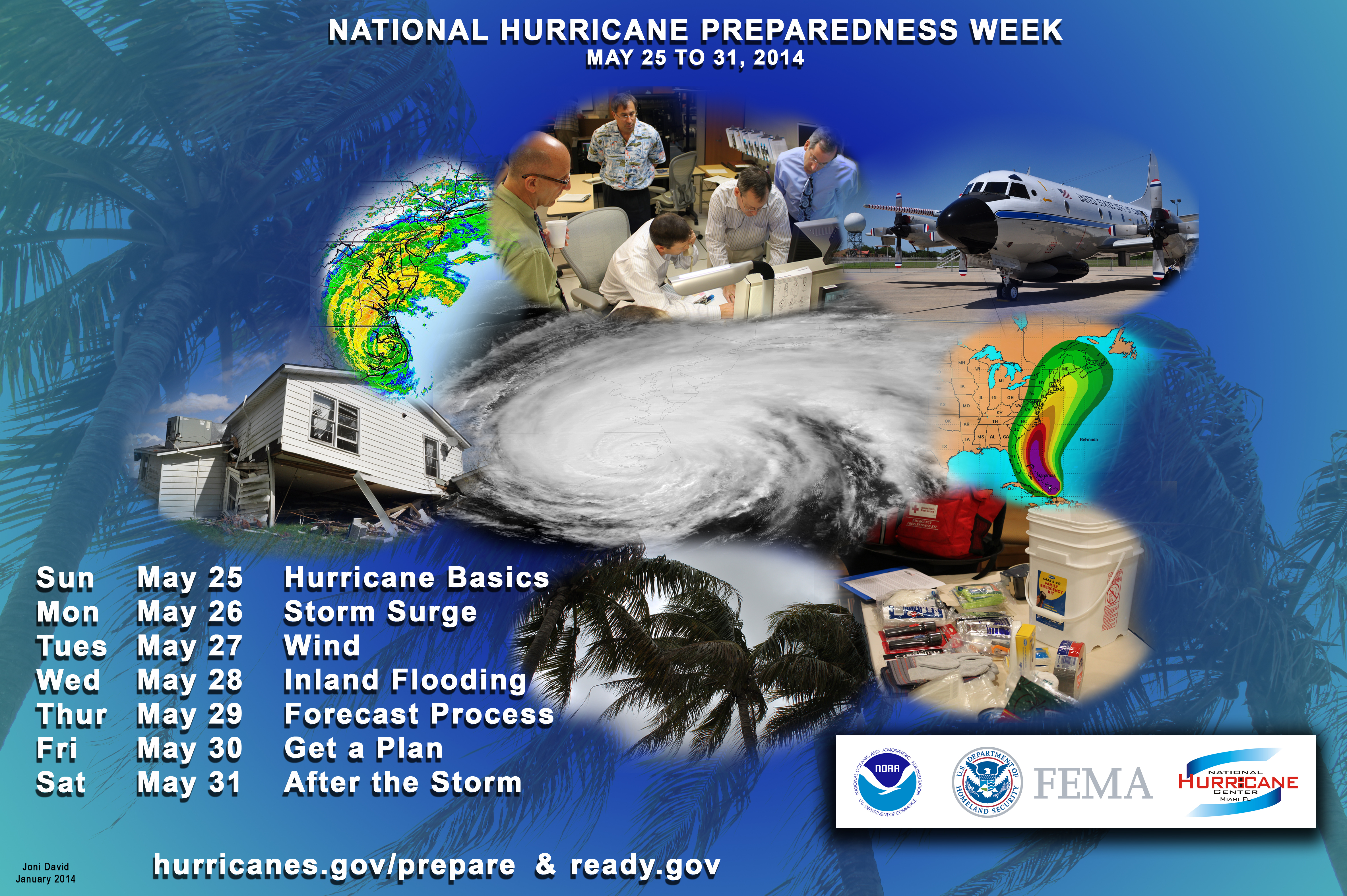
Today begins National Hurricane Preparedness Week, ushering in hurricane season which starts a week from today on June 1st.  In the last 10 years we have seen some absolutely devastating hurricanes, including Hurricane Katrina in 2005 and Hurricane Sandy in 2012.  These storms are powerful, taking lives, destroying homes and infrastructure, and changing the landscape.  We were reminded that these storms can bring strong winds and flooding rainfall not only to coastal areas but well inland where governments and residents may not be as prepared as they should.

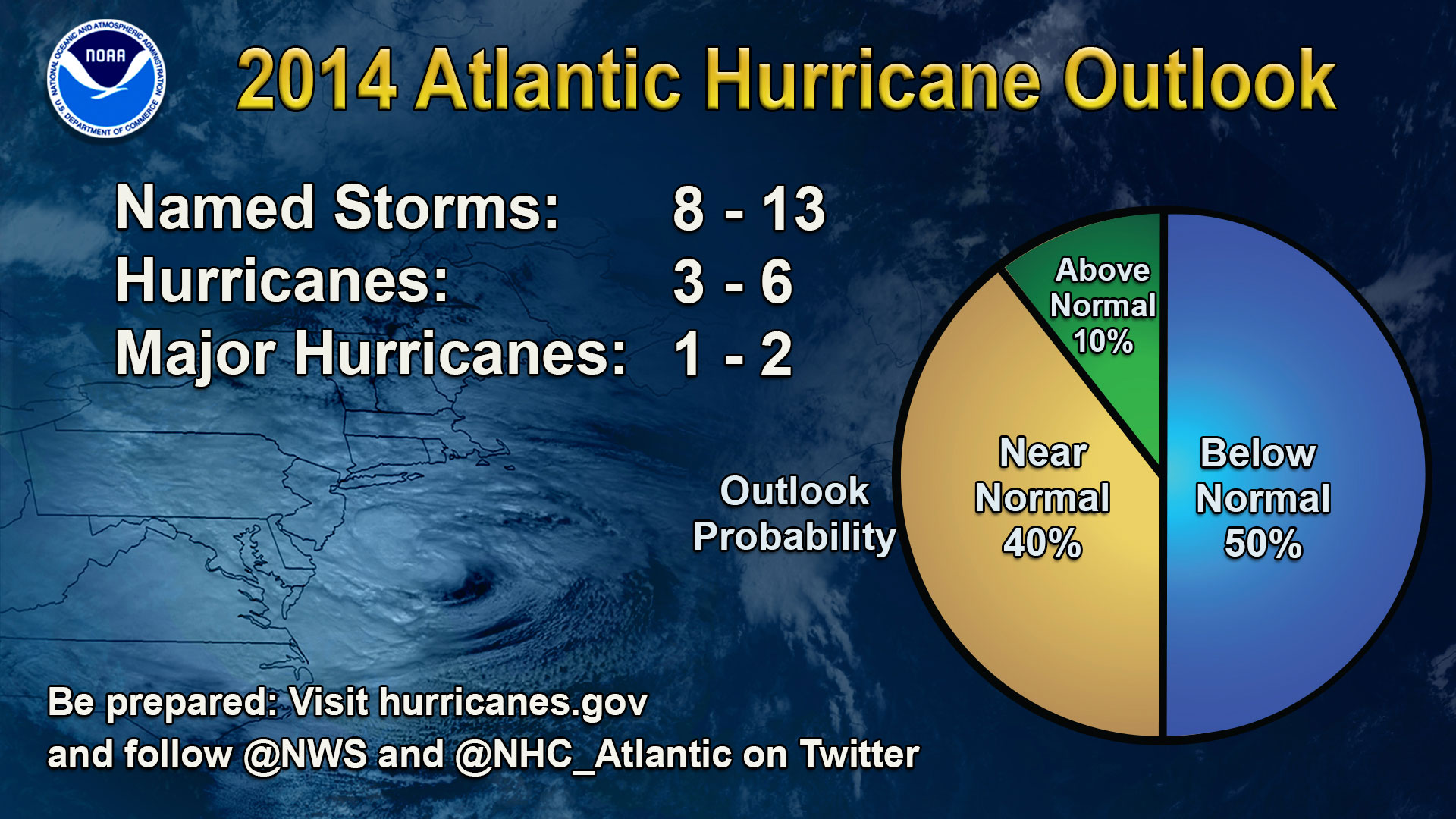
The graphic below is the National Hurricane Center’s prediction for the year.  While there is plenty of science behind this, it’s an imperfect science.  It’s one thing to predict tomorrow’s weather, it’s something else entirely to predict Atlantic storms two months from now.  Like most things in emergency management, it’s a guide – so don’t let it lull you into false confidence.  Be sure to prepare!

2014 Atlantic Hurricane Forecast

2014 Atlantic Hurricane Forecast

What do you need to know to prepare?  The graphic below has a list of seminars conducted by the National Hurricane Center which are accessible via YouTube.  The first one starts today!  Go to this website for more information and the links to the YouTube videos.

Hurricane Preparedness Courses

Hurricane Preparedness Courses

Be smart this year and make sure you and your family are prepared and safe.  Government and business emergency managers – be sure to give your hurricane plans and associated annexes one more look this week to make sure they are current and ready to activate.  Also, there is no time like the present to make improvements.  Just because we’re entering hurricane season doesn’t mean you can’t update plans now.  Don’t wait until hurricane season is over!  Be sure to distribute copies of the plans to key stakeholders and to run a seminar to remind people of the general content of the plan and what is expected of them in the implementation of the plan.  Pay special attention to trigger points, decision points, and succession.  Be sure to verify the availability of key resources; test generators and IT fail overs.

If you are looking for some assistance in reviewing your plans, training staff, or exercising plans please contact Emergency Preparedness Solutions, LLC at consultants@epsllc.biz.  We’re happy to assist you!

Are you ready???

Creating Operational Emergency Plans

I was inspired for this article from an email I received earlier today from Lu Canton, a rather prolific emergency management consultant who has branched a bit into consulting consultants.  His email today (a forward from his blog) was about making emergency plans ‘real’.  His point was that many planners focus on checking the boxes of the list of planning requirements (those prescribed by law, regulation, etc.) rather than focusing on ensuring that you have a plan that can actually be implemented.  He conducted a webinar over a year ago which I had blogged about.

Planning requirements are important, as they largely stem from lessons learned from earlier incidents.  Granted, some of these requirements come about being translated through the eyes and ears of politicians whose staffers write the legislation and don’t understand emergency management at all – resulting in convoluted, contradictory, and poorly focused requirements.  Requirements lead to standards, helping to ensure that emergency managers are addressing the needs of their jurisdiction and best practices in the industry.  To help guide us through this, many higher level agencies provide templates.  I’ve pontificated in the past about the danger of templates, which have a place in reminding us of these requirements and help us with format and flow, but are often misused by individuals who simply seek to fill in the blank with the name of the jurisdiction and claim they have a finalized plan.

How do we avoid falling into this trap?  Follow the planning process!  FEMA’s Comprehensive Preparedness Guide (CPG) 101 provides an overview of this process for creating emergency operations plans.  The two initial steps – forming a planning team and conducting a hazard analysis – are absolutely critical to the integrity of the process and ensuring a quality plan that meets the needs of your jurisdiction by addressing your threats and hazards.  Planning teams then need to consider these threats and hazards, make reasonable assumptions about their impacts (using a credible worst case scenario), then identify resources and strategies the jurisdiction will undertake to solve the problems they will face.

Does all this mean that a plan needs to be written from scratch?  Of course not!  In fact I strongly encourage people against it.  It’s practically guaranteed that you will forget a critical element.  One of the greatest things in the emergency management community is how we learn from each other.  You can reference templates you find, examine plans of your neighboring jurisdictions or jurisdictions similar to you, check out what is on LLIS.  There is plenty of great content you can examine and apply for your own use.  Just ensure that you carefully review and consider how it applies to you.

As you write the plan, think the details through.  This will help ensure that your plan is operational, not just meeting requirements.  Discuss with your planning team what is expected of each assisting and cooperating agency for each incident type.  Who will be in charge?  What resources will be necessary and where will you get them from?  What would the objectives be and what processes and decision points must be conducted to accomplish those objectives.  As you create the plan, map out these processes and ensure that you’ve considered the who, what, where, when, and how of each step in each process.  Recall that you are planning at a strategic level, not a tactical level.  Planning at a tactical level is nearly impossible with a pre-incident (aka ‘deliberate’) plan.  Tactics will be addressed during the actual response, hopefully referencing the EOP/CEMP you are writing now, and implemented through an incident action plan (IAP).

Remember, though, the proof is in the pudding, as they say.  Your plan needs to be tested to ensure viability.  Use a table top exercise to test policy and decisions, then a functional exercise to test the implementation of the plan and higher level tactics.  Full scale exercises and drills can test the tactical implementation of plans.  Good evaluation of the exercises will lead to planning improvements.  For insight on the exercise process, you can check out my exercise management series of posts referenced here.

Remember: when it comes to planning – keep it real!

Tim Riecker

Critical Infrastructure Vulnerability – Water Delivery Systems

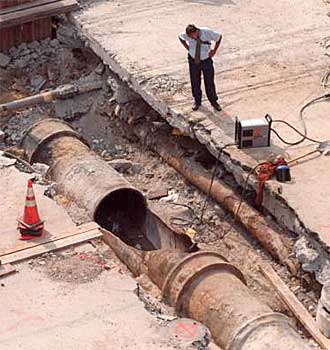
Picture of the Baltimore Water Main Break, July 18, 2001

40-inch Water Main Break, Baltimore July 18, 2001. Source: Baltimore Sun

I’ve written several posts in the past on the vulnerabilities of our electrical infrastructure – both to natural and human causes.  Yet, our electrical infrastructure is not the only element of critical infrastructure that is vulnerable to failures and attacks.   We have a very old water infrastructure in our nation, with many areas still maintaining Civil War era cast iron pipes, with an estimated useful life of 150 years (at the time of installation).  How often does your area experience a water main break?

According to the US Conference of Mayors A major symptom of the aging water infrastructure includes 300,000 water main breaks in North America as result of the widespread corrosion problems adding up to a $50.7 billion annual drain on our economy. Leaking pipes are also losing an estimated 2.6 trillion gallons of treated drinking water annually (17 percent of all pumped water in the US), representing $4.1 billion in wasted electricity every year.”

This aging infrastructure has also failed us when we needed it most.  You might recall the Howard Street Rail Tunnel fire in Baltimore, MD on July 18, 2001.  I’ve designed exercise scenarios based upon this incident and have even received feedback from participants about the scenario being unlikely – they are rather surprised to learn that it is based on an actual event.

From the USFA Report on the incident:

“At 3:07 p.m. on Wednesday, July 18, 2001, a CSX Transportation train derailed in the Howard Street Tunnel under the streets of Baltimore, Maryland. Complicating the scenario was the subsequent rupture in a 40-inch water main      that ran directly above the tunnel. The flooding hampered extinguishing efforts, collapsed several city streets, knocked out electricity to about 1,200 Baltimore Gas and Electric customers, and flooded nearby buildings. The crash interrupted a major line associated with the Internet and an MCI WorldCom fiber optic telephone cable.

Throughout the incident, fire officials were plagued with three problems: fighting the fires in the tunnel; the presence of hazardous materials; and the weakening structural integrity of the tunnel and immediate surrounding areas.”

In reading the report you will see that the water main break both help and hurt the response.  The 40-inch main flooded streets and nearby businesses, but also was allowed to flow into the tunnel for a period of two hours, helping to decrease the temperature in the tunnel.  While no reports seem to indicate the impact of the water main break on nearby hydrants, I do include that impact in my exercise scenarios.

Water main breaks plague many areas around the nation.  The lack of potable water resulting from them creates a public health concern, resulting in many businesses and public buildings shutting down and households advised to boil water.  These breaks impact our ability to fight fires and, as a result of undermining, they can cause sink holes and damage to roadways.

In speaking to public works officials through the years, I’ve been told that every water system has leaks of varying severity.  Minor leaks often go undetected for a great period of time.


Securing our water supply is important as well.  Much of our water storage is in reservoirs, open and vulnerable to intentional contamination.  Most reservoirs have some measure of passive security (fences) and some even take more active security precautions.  However, we know that people who are determined can overcome these systems.  Luckily the sheer volume of water in most reservoirs would severely dilute any contamination introduced to them, but there may be agents so concentrated as to inflict harm.  The City of New York, for example, has a massive water supply system, with reservoirs as far north as the Catskills.  Their aqueducts, made famous in the third Die Hard movie, are massive.  The New York City Department of Environmental Protection is charged with securing the City’s water supply and does so through both active and passive security measures as well as active and on-demand water quality sampling.  Most areas, however, don’t have these law enforcement or public health resources available in such abundance.

Water is a critical component of our infrastructure and therefore must be protected.  It’s important not only to business and industry, but is also essential to human life, agriculture, and food production.  Similar to our roadways and electrical infrastructure, our water systems need a plan for restoration and funding to put that plan into action.  Beyond some more capable and financially stable municipalities, most water systems are implementing ad-hoc fixes and are only able to replace small sections of the system each year.

Does your plan account for water system failure?

Tim Riecker
Does Your Municipality Have an Emergency Management Handbook?

I recently came across an emergency management handbook assembled for municipalities in Connecticut.   First of all, I’m thrilled that officials in CT are openly sharing this handbook.  Doing so makes it easier for their municipal officials to find and, in the spirit of sharing found within emergency management, it is always great to share best practices.  There are a great deal of concepts, templates, checklists, and the sort which are benchmarked and shared throughout the emergency management community, by way of the Lessons Learned Information Sharing (LLIS) site and other means, which are of great help the collective profession.  If someone else has already done something and it seems to work, why not adapt it to your own needs instead of trying to create something completely different?

I recall early in my career when handbooks and reference guides assembled by states for their local governments were common practice.  For a period of time we seemed to get away from that for some reason, but the practice now is making a resurgence.  I consulted on a project a year ago for the creation of a UASI regional handbook and have seen others in use.  The CT handbook which I linked to at the beginning of the article is an excellent example of what should be included in a handbook and how it should be structured.  Recall from my training-related articles that my focus is always on the audience and their needs.  This audience-centered approach doesn’t only apply to training – it also applies perfectly well to document development. So who is the audience for these handbooks?  Certainly the chief elected officials of counties, cities, towns, and villages.  Their subordinates (department heads) can also benefit greatly from the content.  How about schools (primary and secondary education alike) and hospitals?  The more people who are familiar with the foundational concepts of emergency management and how it is applied in a particular state, the better.  With some modification to include more information for them, I’d also include private sector entities as well.

The structure of the CT document is also one to be benchmarked.  They make reference with brief explanations to federal and state laws and related authorities of individuals and agencies regarding emergency management and related topics, such as NIMS.  For these and other references throughout the document, they include external links where additional information can be found.  They include emergency management structure and flow, which helps local governments identify who they need to coordinate with and who they should request assistance from.  They break down the document into the phases of incident management and include information on each; including planning, training, exercises, and grants within Preparedness; communication, coordination, notification, resources, and other information within Response; debris management, PDAs, and recovery programs in Recovery; and the variety of common mitigation programs in Mitigation.  Appendices provide information sheets on things like the CT VOAD and 211, as well as templates and checklists for the critical elements of each phase of emergency management.

Recalling the needs of the audience, CT addresses them well with this document, which was a collaborative effort between their state emergency management department, emergency management association, state conference of municipalities, council of small towns, and association of regional planners.  These types of collaborative efforts help ensure that the right information is being conveyed.  Most new elected and appointed officials know little about emergency management and need to become familiarized with it before a disaster occurs.  While response is the most prominent phase of emergency management, the other phases are necessary to promote an effective response and a good, overall program.  Even for those experienced in emergency management, a guide such as this provides excellent references for the critical information.  The handbook is of reasonable size – only 90 pages – so it is easy to navigate.  While it has value in print, it is even more valuable electrically given the addition of hyperlinks which bring you to other information.  As a PDF, it’s handy to keep in the library of a iPad or other tablet where it can be referenced easily.  Overall, the information is succinct, giving only what is needed for foundational understanding.  The templates, checklists, and quick reference guide found in the appendices help turn the information into actionable content.

Lastly, the structure and content of the document lends itself well to a structured review (i.e. training), which gives people the opportunity to look at the document in-depth and ask questions.

Does your state or municipality have a handbook similar to this?  What are your thoughts on the one CT provides?  Would you like to see more content or less?  Have they missed something essential?


Tim Riecker

Is the Department of Defense Planning for a Zombie Attack?

No, not really.  But they are using the zombie scenario as highly effective training tool.

I reference, of course, the recent news releases (such as this one from ForeignPolicy.com) concerning the United States Strategic Command document titled: CONPLAN-8888 – Counter-Zombie Dominance (April 30, 2011).  You’ll see in the Disclaimer section of the document, beginning on the second page, that this scenario was selected because of its improbability of occurring, unlike other scenarios which may be used as the basis for training and exercises, which could be mis-perceived by the public.

The training they refer to is the Joint Operations Planning Process (JOPP).  Typically the word ‘Joint’ in military doctrine refers to activities which include two or more branches of military service. Not only do the US Military Services use joint planning and conduct joint operations, but the Army and Air National Guards do as well.  For as much as it makes sense, the concept of ‘jointness’ has really only seen large-scale attention in the last decade or so.  Having worked extensively with the National Guard in recent years, the ‘jointness’ has become the foundation of nearly all activity.  This is a great accomplishment as there is considerable competition between the branches, sometimes to the level of disdain, and certainly a great many differences, even in terminology and rank structure.  Despite the decades-long existence of the Joint Chiefs of Staff, true joint integration at an operational level rarely occurred and was generally not executed well.

Joint operations are simply a military version of the Incident Command System (ICS), where different disciplines and agencies – some often very different from each other – can function together within one organizational structure for the purpose of addressing an incident.  If you are interested in additional information on Joint Planning and Operations, I suggest you visit the DoD’s Joint Electronic Library where you can find documents which I have referenced often when working with the National Guard on preparedness and response activities – including the Universal Joint Task List (UJTL) (similar to the old DHS Universal Task List, in concept) and the Joint Publications (such as Joint Publication 5-0, Joint Operation Planning – which is the foundation for JOPP).

As mentioned in earlier posts, I love the integration of zombies and other apocalyptic lore into preparedness activities.  While tongue in cheek, they help planners and responders do away with pre-conceived notions they may have with other, more realistic scenarios.  In emergency management, we know that every incident is different.  While we learn from our experiences and hopefully apply what we learned to the new challenges we face, we sometimes go into the next incident with a bias.  The introduction of totally fictional scenarios, such as a zombie attack, help make the situation faced completely new – while many of the specific problems faced are things we do have plans for, such as mass fatalities, hazmat, contagious diseases, etc.  It’s a great approach which I strongly advocate.  The only caution we may have is that the premise of the scenario itself may cause some to not take the activity seriously or may cause a distraction.

Have you used any non-traditional or totally fictional scenarios?  What were they?  How were they received?

/s/

Tim Riecker

NYC Ready for Godzilla

Godzilla Movie Poster

Godzilla Movie Poster

If you’ve read some of my earlier posts, you know I love emergency management campaigns that draw on pop culture – especially post apocalyptic shows like The Walking Dead.  This article from the NY Daily News where NYC Office of Emergency Management Commissioner Joe Bruno indicates that the impacts of an attack on the city by a creature such as Godzilla would be manageable.  In essence, they are right.  Why?  Because NYC follows a model of all-hazard preparedness.  Do they have a Rampaging Radioactive Monster plan?  Of course not.  But they do have plans that address “fire, explosions, casualties, damage, debris, bridges and tunnels being out.  Roads being out, power issues…” as Commissioner Bruno said.  He continued on, joking that they don’t have a plan for slime.  (I don’t think Godzilla leaves slime, though)

A few weeks ago I blogged about all hazard planning and included some thoughts on asteroid strike and other low probability events that we don’t necessarily need a specific plan for – we simply needs plans that address the impacts and how we will respond to and manage them.

While the article is largely tongue in cheek, even including a link to an article about the US Air Force’s capability to take down Godzilla and referencing a study conducted by the Hollywood Reporter estimating the dollar cost of the damages in NYC from the Chitauri invasion featured in the Avengers movie, it still leaves a subliminal message to the reader that we (or at least NYC) is well prepared for the impacts of disaster.