Emergency Managers Need to be More Like Engineers and Less Like Shopkeepers

I was inspired by this short (~1 minute) video from TrainingJournal.com.  In the presenter’s brief but pointed message, he describes many trainers as being akin to shopkeepers, providing organizations often times with rote solutions just as a shopkeeper will pull a product off their shelves. He goes on to say that this these solutions are usually effective, but only for a limited duration.  He offers, instead, that trainers need to be more like engineers, examining every facet of a problem and constructing lasting solutions.  As an experienced trainer and proponent of a detailed root cause analysis, I couldn’t agree more, but as I readied myself to write a post about the implications of this on training, my mind carried this metaphor to many of our practices in emergency management.

Consider how often we quickly dismiss identified gaps with an assumed solution.  Write a plan, conduct a training, install a bigger culvert.  Those are usually our solutions to an identified problem.  Are they wrong?  No – we’re correct more often than not.  Are these lasting solutions?  Rarely!  How often does the problem rear its head again within a relatively short span of time?  How do we address the re-occurrence?  As shop keepers we simply pull another solution off the shelf.  Can we do better?

The things we do in emergency management are often based upon best and current practices.  We address problems through the prevalent way of dealing with such things industry-wide.  Emergency management has a great community of practice.  I’ve mentioned in several previous blog posts the spirit of sharing we have and the benefits we see come of that.  It doesn’t seem often, though, that we engage in an industry-wide groupthink to solve various problems.  We use and adapt ideas of individuals and small groups, we see a steady and determined progression of the practices within our progression, but we rarely see ‘game changing’ ideas that revolutionize how prevent, prepare for, respond to, or recover from disasters.  Why is this?

Perhaps we need a greater collective voice locally, where practitioners are dealing with the problems directly?  Our methods of practice in emergency management are generally driven by the federal government (THIRA, NIMS, HSEEP, etc.).  I’m not saying any of these are bad – in fact they are excellent standards that we need to continue to refine and apply, but it’s generally not the federal government that is dealing directly with the constant flow of issues being dealt with at a state, and even more so, a local level.  We need to follow that metaphor of being engineers to apply more permanent solutions to these problems.  We need to create, innovate, and problem solve. Or do we?

Necessity, as they say, is the mother of invention.  We often miss the necessity of improving because we have current, functional solutions – we have things that work.  So why fix it if it’s not broken?  I say we can do better.  The realization of the need for lasting solutions is the necessity we need.  If the solutions we have on the shelf don’t work for us 100%, let’s figure out a better way.

I don’t know what or how, but I’m sure that as a community we can identify needs and prioritize what must be addressed.  Given the right people, time, and maybe a bit of money, we can be innovative and effect some lasting change.

I’d love to hear what others think on this topic.

© 2015 – Timothy Riecker

Emergency Preparedness Solutions, LLC

www.epsllc.biz

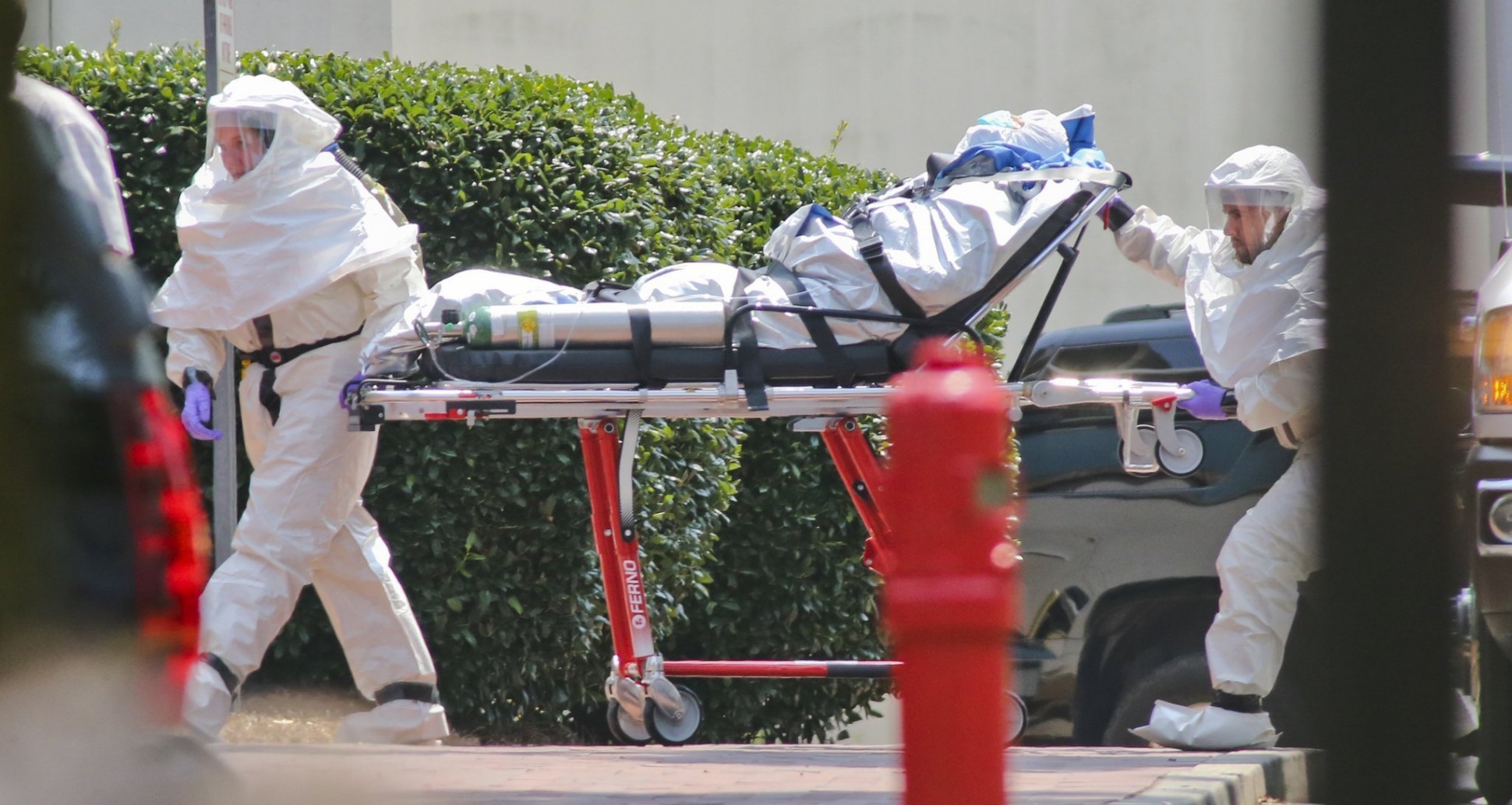
Ebola Reflection Measures our Preparedness

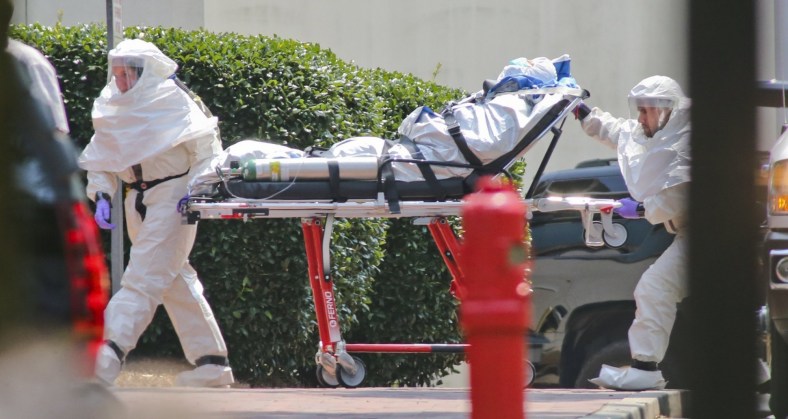
NBC News recently posted an article citing a report published by the Presidential Commission for the Study of Bioethical Issues.  The link provided to the report in the NBC News article doesn’t seem to work, but I’ve found what I believe to be the report here.  The focus of the report is on the ethical challenges faced by the US in responding to this issue.  The report summarizes a variety of ethics related concerns and considerations in this ongoing response and paints a fairly accurate picture of our failures and what needs to be addressed – at least within the topics it discusses.

Photo credit: Forbes.com

Photo credit: Forbes.com

As you might expect from a report on bioethics, it is very public health focused.  While they do make mention of very public health centered topics such as clinical drug trials, they do cover topics which are much more broadly rooted in emergency management and homeland security, such as community and responder education, and ethics associated with quarantine.  This report, while fairly focused, opens a virtual Pandora’s box of issues related to our domestic response to Ebola.

Needless to say, our collective response to this matter was horrible.  Public health policy and guidance was a moving target for weeks; responders were ill prepared to handle potentially infected persons; and the collective of society, politicians, and public safety were largely reluctant to deal with matters of quarantine much less prepared for it.  Was this our first consideration of something like Ebola?  Of course not.  Didn’t we have preparations in place?  Kind of.

Back in the late 90s, pushed mostly by the Nunn-Lugar-Domenici act of 1996, preparedness efforts for state and local responders were funded to enhance our capabilities in dealing with WMD incidents.  Several years later, after 9/11 and the anthrax attacks, another surge of funding was pushed down to state and local governments from HHS/CDC for the purpose of bolstering public health preparedness including preparedness for WMD/weaponized biologicals and naturally occurring pandemic incidents.  These two programs alone, not including other related funding, fostered the creation of plans and organizations to support them, purchased entire stockpiles of equipment and supplies, trained tens of thousands of responders and public health workers, and encouraged exercises across the nation to test capabilities (it was actually these exercises which largely influenced the creation of what we now know as HSEEP).  A lot of good came from these programs, but when suddenly tested with the reality of implementation we seemed to fall apart.  Why?

First of all, many of these preparedness efforts occurred between 10 and nearly 20 years ago.  Many of the people initially trained in these programs have since retired from public service with their organizations losing a great deal of institutional knowledge.  While training programs have continued and still exist, there have been systemic gaps in tying this type of training to other preparedness efforts (planning, policy, equipment, etc.).  Some equipment purchased near the beginning of these programs has likely been retired as well.  Much of it still exists, but has been brought into the fold of other applications, such as HazMat – which is certainly appropriate, but yet again we see gaps, this time our ability to readily utilize equipment specifically for public health threats.

In my opinion many of the planning efforts we saw after 9/11 were misguided.  This started with the people who were doing the planning.  Many health organizations emphasized health care experience for these positions instead of EM or planning experience – which was their main function.  Certainly health care knowledge had some importance, but that could be supplemented through a good advisory committee (EM after all is a team effort).  Exacerbating poor hiring decisions was a lack of investing in the people that were hired.  Many organizations expected them to churn out pandemic influenza plans in short order, with little/no training on the planning process or integral systems that must be considered.  Further, much of the planning had been done in a vacuum – that is, it had been performed with little/no input from other stakeholders.  I had reviewed many of these plans, finding things such as inappropriate applications of ICS and wild assumptions of resource availability.  In no way were these plans realistic or applicable.

There were many exercises performed and most of them had great value.  The problem is that there were a lot of assumptions in these exercises and policy decisions made in the exercises were rarely challenged as they would be in reality.  The US Ebola response brought this all to light as decisions such as quarantine were being handled at the governor level and under significant controversy.  So in this recent response I ask why were decisions delayed and deferred to higher authorities?  Why were adequate local/regional plans not in place to address the care and handling of potentially infected persons?  Why did procedural issues take weeks to resolve?  The simple answer is that there was a lack of proper preparedness.

Back in October of last year, when Ebola was emerging in the US, I posted an article titled Preparing for Ebola – and Whatever Else May Come.  The article still has a great deal of relevancy since I’ve seen very little preparedness for future occurrences – only a harried response to the most recent incident.  There have certainly been a great deal of policies and procedures assembled for the current Ebola issue, but these have a feeling of being temporary, throwaway, or single-use documents, applied only for this instance instead of durable and lasting plans.  Many will keep them ‘on the books’, only to find that their hasty assembly wasn’t comprehensive enough for the next occurrence.  Emergency management and homeland security professionals, public health leaders, and elected and appointed officials need to take a step back and re-look at out preparedness efforts – especially in regard to public health issues.  While we should learn from what we have experienced, we also need to think comprehensively about what is needed.  Well considered policies need to be put in place, supported by our laws and responsibilities to protect the public while also considering protection of civil liberties.  Other preparedness efforts such as planning, training, and exercising need to continue to occur but must have their connections strengthened and intentional.  Exercises need to test plans and policies and challenge decision makers who are certainly making difficult decisions that may include ethics and moral issues in the consideration of caring for few while protecting the greater society.

These are not easy things to be done – which supports the need to work on them now, when we aren’t facing an imminent disaster.  While Ebola certainly wasn’t a health care crisis and there were a lot of things done right, there is always room for improvement – especially when the next biological occurrence could be a crisis.

What have you and your organization learned from the Ebola response?  What gaps have you addressed?  What do you feel still needs to be addressed?

© 2015 – Timothy Riecker

Preparedness – ICS is Not Enough

Back in October I wrote a post about ICS training not being enough for EOC personnel.  You can give it a read to see my reasons, which essentially boil down to the specific role of the EOC (Emergency Operations Center) in the incident management structure and the unique processes which take place in an EOC both not being addressed in ICS (Incident Command System) training.

As I continue to work in various jurisdictions to enhance their preparedness, I am expanding my thoughts on ICS training not being enough – this time for all of preparedness.  In meeting with jurisdictions and discussing their current state of preparedness, many believe they are well prepared to respond to any incident simply because their personnel have received ICS training.  Why am I concerned by this?

Folks, in the grand scheme of things, ICS training alone does not teach you to do very much except how to function within a system.  First off, I’m a huge believer in ICS and the success it can help facilitate in incidents and events.  Not only have I seen it work, but I use it and advocate for it as a chief practice of emergency management.  I’ve been teaching ICS courses since 2001 and have led hundreds of course deliveries amongst the various levels.  That said, in seeing the faith that people are putting in ICS as their savior from disaster, I think that faith has become exaggerated and misplaced.  While ICS gives us guidance on structure, processes, and standards, it still doesn’t tell us HOW to manage the incident and its impacts – and it never well.

The structure, processes, and other standards that ICS provides – when properly applied – are greatly beneficial to our ability to manage a disaster.  Let’s not forget, though, everything else that is needed to be successful.  There is an abundance of training available for personnel to address identified needs to make them better at what they do and thus enhance the capabilities of the jurisdiction or entity.  Some of this may certainly include higher level and more functional training in ICS (i.e. position-specific and incident management team training), but we can’t forget that we must focus on our needs and developing to meet those needs.  More on identifying training needs here and here.

The best way of identifying those needs, comprehensively, is through our plans.  Planning is the cornerstone of preparedness and serves as the foundation of our response.  Planning to appropriate depth is not often performed and always needs to be enhanced (more training in the activities of planning is certainly an identified need!).  Once plans are in place, we need to train all stakeholders on the contents of those plans and of course exercise them.  The process of planning and the exercises we conduct will identify other gaps in preparedness efforts that the jurisdiction or entity should address.  These gaps are most easily analyzed through through five key elements – Planning, Organizing, Equipping, Training, and Exercising (POETE).  More on POETE analysis here.

When a plan is being written or reviewed, we need to follow the bouncing ball for each of the identified activities.  Is it enough for the plan to say that certain stakeholders will be contacted when an incident occurs?  Of course not – we need to identify WHO will contact them, HOW they will be contacted, specifically WHEN they will contact and what is the trigger event, and WHAT they will be told.  Also, what happens if someone is unreachable?  What actions are they expected to take?  Do they then need to make any notifications?  If they are doing nothing with the information, WHY are we even contacting them?  This simple task requires planning (process and decision mapping as well as a specific procedure), organizing (identifying specific personnel and alternates to do this), equipping (the equipment needed for them to make contact; including access, maintenance, operation, and redundancies), training (training and job aids in the procedures and equipment), and exercising (to ensure that all the previous elements function appropriately).

The example above is simple, but shows how far-reaching and complex a seemingly simple activity can be.  ICS training won’t address this.  While ICS practices should be penetrating the deepest aspects of our incident response organization, ICS as a concept is fairly high-level and conceptual.  While it helps structure our tactical resources, ICS itself is not a tactical application – it is simply the structure we perform in.  The processes it provides are not tactical processes, they are incident management processes, but we still need to know about the incident and what to do – ICS will not provide those answers.  ICS is a great tool, but just like a carpenter we must have a variety of tools to do the job properly.

What needs have you identified?

If you need assistance with your preparedness – planning, training, exercising, or needs assessments – reach out to Emergency Preparedness Solutions!

© 2015 – Timothy Riecker

Emergency Preparedness Solutions, LLC

www.epsllc.biz  

Dig Deeper – Ask ‘Why?’ Five Times

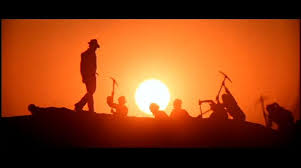
Be an archaeologist and DIG DEEPER!

Be an archaeologist and DIG DEEPER!

An old boss of mine once told me that to find the real root of any problem you should ask ‘Why?’ five times.  This sage Yoda-like advice has served me well ever since.  Of course it’s not always necessary to ask it the full five times; in fact you often find the foundational cause sooner.  Nonetheless, this approach will inevitably guide you toward discovering what needs to be fixed.

Those who follow my blog know that I post mostly within two thematic areas – emergency management or training.  The ‘ask why’ methodology applies to both of these areas and darn near anything else I can think of.  My thoughts are below on both themes.  Of course training in the field of emergency management is a combination of the two!

In Emergency Management

I’ve posted numerous times on topics such as hazard analysis, Threat and Hazard Identification and Risk Assessment (THIRA), and other similar topics in emergency management.  It is so incredibly necessary for us to identify needs and vulnerabilities, and to understand our community’s capabilities in order to properly prepare for future disasters and emergencies.  I’ve learned that in public safety, when asking a question, you often get a story and that story is often related to a past incident.  While the story may be elaborate, it usually gives you little substance.  Anecdotes aren’t enough.  You need to dig deeper.

As a culture within public safety we are still trying to drive practitioners to be more analytical.  Quality after action reports are a big step in the right direction.  The benefits of after action reports for incidents, not just exercises, are huge.  After action reports should lead to improvement plans, but without identifying the real reason behind what went wrong we can’t fix the problems.  After action reports require an analysis to dig deeper into the observed action to discover what really needs to be addressed.

In Training

In November I published an article in Training Magazine titled The Importance of Analysis to Identify Root Cause.  While I didn’t reference the ‘ask why’ methodology directly, the subject matter of the article lends itself to this approach.  As a trainer, when a problem is presented to you to ‘fix with training’, you need to figure out what the real issues are so that 1) you can confirm that it is in fact a training issue, and 2) you can determine what the objectives and methodologies of the training need to be.  Without properly identifying and defining the needs you are doomed to fail and will likely be putting forth a lot of effort with little gain.  While the results may put some people on the defensive, they can point the organization in the right direction to address inefficiencies and performance problems.

In any needs assessment, don’t simply accept the first answer given to you – dig deeper!  It’s amazing what you will find!

© 2014 – Timothy Riecker

The POETE Analysis – Emergency Planning and Beyond

POETE stands for Planning, Organizing, Equipping, Training, and Exercising. These are the five elements that each jurisdiction should be examining their own capabilities by. By examining their capabilities through each of these elements, a jurisdiction can better define their strengths and areas for improvement.

The POETE analysis, often completed as part of a THIRA (Threat and Hazard Identification and Risk Assessment) is actually a component of the State Preparedness Report (SPR) (note that this was the definition of the acronym at the time of the original post. It is now Stakeholder Preparedness Report), which incorporates THIRA data into this annual submission. When properly conducted, a POETE analysis will examine a jurisdiction’s capability targets. These capability targets, through the THIRA process, are individually defined by each jurisdiction, based upon the capability definitions of each of the 31 Core Capabilities (Note: at the time of my original post there were 31 Core Capabilities. There are now 32). The Core Capabilities were identified in the National Preparedness Goal and are an evolution of the legacy Target Capabilities. Gone are the days when many jurisdictions struggled with the definitions of the Target Capabilities and trying to determine how they applied to jurisdictions large and small across the nation. The new Core Capabilities are divided amongst five mission areas – Prevention, Protection, Response, Recovery, and Mitigation. By referencing Core Capabilities in our preparedness efforts, we have a consistent definition of each area of practice.

When a jurisdiction’s stakeholders conduct a POETE analysis, each element is rated on a scale of 1 to 5 – a rating of 5 indicating that the jurisdiction has all the resources needed and has accomplished all activities necessary for that element within that capability area. Using the Core Capability of Fatality Management as an example the jurisdiction will identify a desired outcome and from that a capability target. CPG-201, the guidance published by DHS/FEMA for conducting a THIRA, outlines this process in detail and provides the following capability target for illustrative purposes:

“During the first 72 hours of an incident, conduct operations to recover 375 fatalities.”

The jurisdiction will examine their efforts and resources for each POETE element for this capability target. Below are thoughts on what could be considered for each element:

Planning: What is the state of their plans for mass fatality management? Do they have a plan? Is it up to date? Does it address best practices?

Organizing: Are all stakeholders on board with mass fatality preparedness efforts? Is there a member of the community yet to be engaged? Are lines of authority during a mass fatality incident clear?

Equipping: Does the jurisdiction have the equipment and supplies available to handle the needs of a mass fatality incident? Are MOUs and contracts in place?

Training: Do responders and stakeholders train regularly on the tasks associated with managing a mass fatality incident? Is training up to date? Is training conducted at the appropriate level?

Exercising: Have exercises been conducted recently to test the plans and familiarize stakeholders with plans and equipment? Has the jurisdiction conducted discussion-based and operations-based exercises? Have identified areas for improvement been addressed?

The jurisdiction’s responses to these questions and the subsequent ratings provided for each POETE element will help them identify areas for improvement which will contribute to the overall capability. From personal experience, I can tell you that the discussions that take place amongst stakeholders which reveal both the efforts applied for each element as well as the frustrations and barriers to progress for each are generally quite productive and great information sharing sessions. It is important to capture as many of the factual elements of this discussion as possible as they add context to the numerical value assigned. Having the right people participating in the effort is critical to ensuring that inputs are accurate and relevant.

Once the POETE analysis is completed, what’s next? As mentioned earlier, the POETE analysis is actually a required component of the annual State Preparedness Report, which must be submitted to FEMA/DHS by each state and territory. Ideally, the results of the POETE analysis should be translated from raw data (numbers) to a narrative, explaining the progress and accomplishments as well as future efforts and barriers; in other words, the ratings should be factually explained and these explanations should feed an actionable strategic plan. The priority rating inherent in the THIRA process will help establish relative priority for each Core Capability within the strategic plan. While this is a requirement for states and territories, a comprehensive strategic plan for any emergency management and homeland security program at any jurisdictional level is obviously beneficial and would reflect positively in an EMAP accreditation.

POETE elements should be incorporated into other emergency management activities as well. When needs are identified and defined based upon Core Capabilities, these should be outlined in the jurisdiction’s multi-year Training and Exercise Plan, which should serve as a guiding document for many preparedness activities. The focus that a POETE analysis provides for each Core Capability can help identify training objectives which can help maintain and improve capability

Consider integrating them into your evaluation of exercises. While the Homeland Security Exercise and Evaluation Program (HSEEP) doctrine makes no mention of POETE, much of HSEEP is based upon capabilities. With a POETE analysis being an integral component of measuring our progress toward a capability, I would suggest including it into exercise evaluations. POETE elements can be included in Exercise Evaluation Guides (EEGs) to capture evaluator observations and should be outlined in the After Action Report (AAR) itself for each observation – giving suggestions for improvements based upon each POETE element. Consider how you could incorporate the POETE elements into an AAR as an outline identifying areas for improvement for the EOC management activities of the Operational Coordination Core Capability. As an example:

Planning: The jurisdiction should update the EOC management plan to incorporate all critical processes. Job aids should be created to assist EOC staff in their duties.

Organizing: Lines of authority were not clear to exercise participants in the EOC. Tasks were assigned to agencies but status of tasks was not effectively monitored.

Equipping: There were not enough computers for participating agencies. EOC management software did not facilitate tracking of resources.

Training: EOC agency representatives were not all trained in the use of EOC management software, creating delays in action and missed assignments. The EOC Manager and Planning Section Chief were well versed in the Planning Process and used it well to facilitate the Planning Process.

Exercising: Isolated drills should be conducted to test notification systems on a regular basis. Discussion based exercises will assist in identifying policy issues associated with suspension of laws and their impact on EOC operations.

The POETE analysis is a process which can help us identify strengths and areas for improvement within our emergency management and homeland security programs. While the POETE analysis can be time consuming, the information gathered for each Core Capability is valuable to any preparedness effort. With such a variety of federally-driven programs and requirements extended throughout emergency management and homeland security, we can find the greatest benefit from those which have the ability to cross multiple program areas – such as the Core Capabilities – allowing us to consolidate the evaluation of these programs into one system, providing maximum benefit and minimizing efforts.

Have you conducted a POETE analysis for your jurisdiction?  Did you find it a worthwhile process?

Looking for help with a POETE analysis?  Emergency Preparedness Solutions, LLC can help!  www.epsllc.biz 

© 2014 Timothy Riecker

Business Continuity Training in the Mohawk Valley

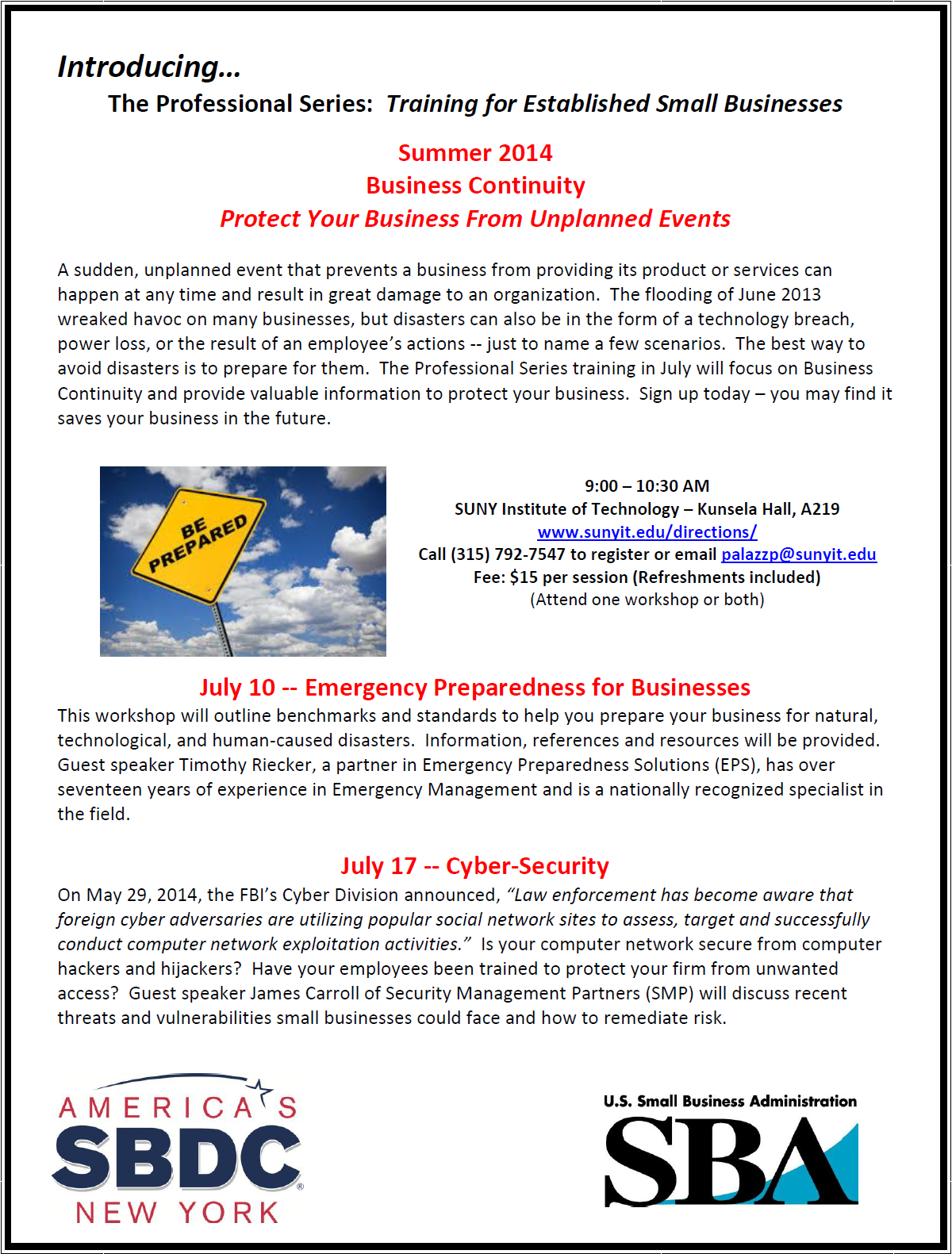
I’m very pleased to be working with the Mohawk Valley Small Business Development Center (SBDC) in Utica, NY to present a seminar for small business owners and others who may be interested in how to prepare their businesses for disaster.  I’ll be providing information and resources on the steps you should take to prepare your business and your employees.  The seminar will be held on Thursday July 10 at the SBDC offices at SUNY IT from 9:00 – 10:30 am.  To register please call 315-792-7547 or email palazzp@sunyit.edu.  The workshop fee is $15.

There will also be a presentation on July 17 on Cyber Security conducted by Mr. James Carroll of Security Management Partners.  Registration and fee information is the same.

I hope to see you there!

MV Business Continuity Flyer

MV Business Continuity Flyer

Scenario-based Learning in Emergency Services – Success, how to, and the need for more!

Throughout all professions and specialties within the broad category of public safety and emergency services, we go through a lot of training.  Training within these various professions has become a profession itself, with many individuals, myself included, spending much of their career as trainers.  Through the vast quantity and variety of training we’ve received, we see many examples of training across the whole spectrum of quality and effectiveness and have endeavored to improve upon training and increase learner retention.

My Experiences

Much of the training that is most memorable to members of the public safety community is that which is hands-on.  Three classes in particular that stand out to me are the New York State Mask Confidence course, the DHS-sponsored Incident Response to Terrorist Bombings (IRTB) course conducted at the New Mexico Energetic Materials Research and Training Center (EMRTC), and the DHS-sponsored Enhanced Incident Management/Unified Command course conducted at the Texas A&M Engineering Extension Service (TEEX).

I attended the Mask Confidence Course about 15 years ago when I was active in the fire service.  Course instruction was led by Chuck, a well-respected fire officer in Central New York and an outstanding fire instructor (who, a number of years later, worked for me as an adjunct).  The premise of the course is for participants to become confident in their own abilities and limitations while wearing self contained breathing apparatus (SCBA).  Much of the course was conducted under blackout conditions, either in a darkened room or wearing a blackout mask, so you had to learn everything by touch – while wearing bulky firefighting gloves.  The course started simply, with a timed donning of all gear and SCBA in a darkened gymnasium; and ended with much more complexity several sessions later by navigating a dark, smoke-filled maze on your hands and knees, sometimes having to remove (then re-don) the SCBA pack to fit through tight spaces, all while still ensuring that you can breathe through the mask.  The course certainly increased my confidence in wearing SCBA and gave me important lessons learned which I was able to apply in fire operations later.

The IRTB course was an excellent program which instructed participants on the chemistry and physics of explosives – including those in common industrial and military use, as well as improvised devices – first in a classroom environment then in a field lab where we had the opportunity to see these explosives in action first hand.  The class was fun and insightful, but rigorous and more cerebral than expected.  As with many DHS consortium programs, the EMRTC has its own course managers and draws on expertise from around the nation to aid in instruction.

The Enhanced Incident Command/Unified Command course included a review of ICS concepts – mostly those at the ‘intermediate’ level, with emphasis on the management of a Type III (extended) incident and the necessity of transitioning to the formal planning process within ICS.  Learning was reinforced through participants taking on roles in an ICS structure and being challenged by a computer-based simulation.  Similar to the EMRTC course, this program drew upon the expertise of instructors from around the country.

Why Scenario-based Learning Works

Why do these three courses stand out for me?  Certainly they are topics of interest and had great instruction.  That alone should help anyone remember some of the course content, but these shine well above others.  Because they were hands-on?  Certainly Mask Confidence was hands-on, but to maintain safety, IRTB was mostly hands-off – literally.  They didn’t actually let us touch any of the explosives.  The TEEX course gave us a computer-based simulation, which is only somewhat hands-on.  So what was it that made these programs stick with me?  The commonality of these programs is that they were scenario-based.

In each course we first learned foundational material through traditional didactic instruction.  Certainly, the use of examples, pictures, and video enhanced our learning.  After the didactic portions, we were then challenged with a series of scenarios, each different from the previous and with increasing complexity.  Mask Confidence was largely an individual course – intended to build your own skills and confidence with your own life-sustaining equipment in adverse conditions.  While IRTB provided a group learning environment, we didn’t necessarily work together to solve problems; rather we were posed with scenarios to examine, akin to an amateur forensic level, to evaluate cause and effect.  The Enhanced Incident Command/Unified Command course was very much based upon individuals contributing to group success in solving problems.

Why is scenario-based learning so successful?  First, consider the graphic below.  We’ve all seen variations of this information.  The bottom line is that the increased degree to which a learner is actively engaged, the more information they will retain.  Many of the activities I described above for the three classes that stand out in my memory are contained in the 50%+ categories of retention.

Learner retention based upon delivery method

Learner retention based upon delivery method

How do we apply this concept to learning?  Bloom’s Revised Taxonomy is a regular reference I use when designing courses and can be a great starting point to determining if participants can benefit from scenario-based learning.  The essential meaning behind Bloom’s Taxonomy is: What level do participants need to be trained to?  In emergency services we often use the term ‘Awareness’ level training to identify a course at the lower levels of Bloom’s Taxonomy – those are the levels where we need to remember or understand information, but aren’t required to use the information.  In an ‘Operations’ level training course, learners are expected to apply what they have learned and perhaps do a lower level of analysis.  In a ‘Technician’ level course, higher levels of analysis as well as evaluation and creation are often expected as learner outcomes.  Compare the terms from the Bloom’s Taxonomy graphic below to those on the right side of the learner retention graphic above and you will see some similarity.  The correlation is that if we expect learners to apply, analyze, evaluate, or create, we need to ensure a higher rate of retention – therefore scenario-based learning is often an ideal strategy.
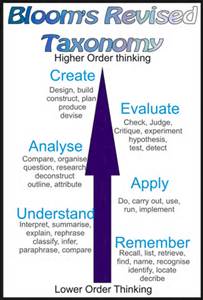
Bloom's Revised Taxonomy

Bloom’s Revised Taxonomy

How to Integrate Scenario-based Learning

Integrating activities into training courses can be tricky.  There are a great number of ‘training games’ out there – (Amazon has a huge listing of books on the subject), but every activity in a course has to be meaningful and drive toward one or more course objectives.  We’ve all seen gratuitous activities integrated into courses.  While some of these may be great, they do nothing to help us achieve the course objectives.  Also, simply having activities does not make a course scenario-based.  To achieve this, you need to include one or more scenarios.  Make sense?

The Bing dictionary defines ‘scenario’ as:

Definition of scenario (n)

  • sce·nar·i·o
  • [ sə nárree ō ]
  1. possible situation: an imagined sequence of possible events, or an imagined set of circumstances
  2. plot outline: an outline of the plot of a play or opera
  3. screenplay: a screenplay for a movie

We develop scenarios for exercises all the time, so when trying to integrate a scenario into a training course, just consider it a miniature version of an exercise.

First – where to start?  As mentioned earlier, a scenario must be associated with one or more learning (course) objectives.  It also must have (enabling) objectives of it’s own.  In other words, what are the expected outcomes of participating in the scenario for the learner?  Perhaps you want your learners to create an Incident Action Plan (course objective).  Scenario-based learning is great for this.  First, I would use didactic instruction to review the planning process and the tools (ICS forms) associated with this.  Then you can assign roles (within an ICS structure) and provide a scenario to help facilitate learning.  The scenario should generally be realistic, although you can always put a fun twist on it by using a zombie attack or some such thing.  This however, can be distracting – so you are better off sticking with something realistic and familiar to the learners.  HazMat incidents tend to work well as scenarios across the nation.  Add context by including detail – fixed facility or in transit (road?  rail?).  Time of day, day of the week, weather.  What were the immediate impacts?  What are the current threats?  The same concepts can be applied for something more hands-on, such as for water rescue training or a hostage negotiation training.

You have a choice of either placing the scenario in a location in which the learners are familiar (they know the roads, the resources, etc.), or providing a fictional location with supplemental information which they have to learn (maps, resource lists, etc.).  Both work with a fair amount of success, but you can be challenged if not all participants are familiar with the same area.  The HSEEP training course provides fictional jurisdictions I’ve used often for different training courses, as does FEMA and the EPA.  You can create a fictional jurisdiction yourself, but to do it right takes time and attention to detail.  Consider using a progressive scenario to facilitate several activities through the training program.

Be sure to give your participants clear instructions on what is expected of them.  Challenge them, but don’t frustrate them, which can impede learning.  Remember, this is NOT a formal HSEEP exercise as we know them.  Learners are not being tested, nor are policies, plans, or procedures.  You are providing a structured, experience-based learning environment.  Be sure they have the tools to succeed. With the Incident Action Planning scenario, an ICS Field Operations Guide (FOG) or text book guidance is a great reference for them.  Provide learners with the opportunity and a safe environment to ask questions, and even correct them if they stray too far from the desired path.  Remember – perfect practice makes perfect, so learners should be practicing ‘by the book’.

Finally, similar to exercises, hot wash the activity.  Ask learners how they feel the activity went.  What went well, what didn’t go so well?  What feedback do the instructors have?  While we aren’t testing learners in these scenarios, we should be evaluating them.  This open discussion feedback is important to their learning and can also help you improve your scenario for the next time.  The folks in TEEX actually capture video and audio of participants during activities which they use to help facilitate hot wash sessions.  This obviously takes time, equipment, and personnel which most don’t have available to them – but it’s great to experience.

Scenario-based learning takes a lot of preparation and forethought.  It also takes a lot of training time to implement.  When we’re fighting for training time and training dollars, we need to advocate for the value of scenario-based learning.  Make sure it’s done right, though… a poorly executed activity can have a negative impact on learning.

Scenario-based learning works.  There are best practices in the training of firefighters, police officers, EMTs, and dispatchers using scenarios.  They help learners ‘get their head into the task’, helping them bridge the mental gap between an activity and real-world application.  Consider how not only to integrate scenario-based training into your courses to reinforce learning, but also to substitute content we are currently delivering by other, less interactive means.

What successes have you found in scenario-based training?  What challenges have you encountered?  I’d like to hear from you.


Tim Riecker
App Review – The ASTD Trainer’s Toolkit

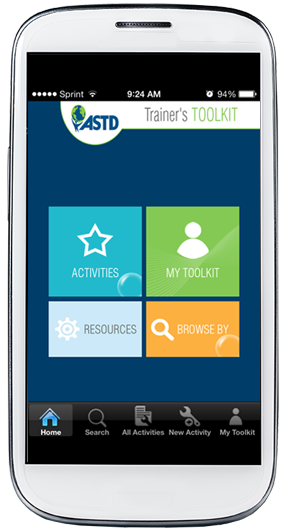
ASTD app home screen

ASTD app home screen

A few weeks ago I downloaded the new ASTD (the American Society for Training and Development – recently changed to the Association for Talent Development) iOS app, the ASTD Trainer’s Toolkit.  Surprisingly, as the ASTD doesn’t give much away, this app is FREE!  The ASTD info site for the app can be found here.  As their website states, the app includes 20 original classroom and virtual training activities to energize, motivate, and help learners to retain content.  The activities include closings, energizers, forming groups, and topical openings.  All of this content is internal to the app.  The app also includes links to external content such as articles on Training and Development (T&D) and a selection of T&D books through links to external content (the ASTD website for articles, and the iTunes Library – for iOS users – for the books).  There is an article native to the app titled ‘Intro to Facilitation’ and an ability to create your own notes, add your own activities (they provide you with a template), and add their activities to your own list of favorites.  While the app can function as a stand-alone on your device, you can also log in through Facebook or Google to access your data from anywhere.

This can be a handy app when you are stuck trying to think of a learning activity for a group.  They break each activity down with a variety of essential pieces of information, including the size of the group the activity is applicable for, the time of the activity, the person who contributed the activity, the goal of the activity, the materials and/or technology needed for the activity, search tags related to the activity, and a step by step process for conducting the activity.  They also provide some facilitator notes/tips for each activity.  The user can enter their own notes for each activity or use an in-app timer.  You can also tap the ‘favorite’ star in the upper right corner to add the activity to your list of favorites.  You can also use the in-app search function to find activities based on various metrics such as group size or time limit.

In typical ASTD fashion, however, there are plenty of opportunities for in-app purchases.  Not only the books, but you can also download additional activities from the app.  These additional activities include Icebreakers, Openings, Reviews and Teachbacks, Trainer Tools and Techniques – each for $1.99, or all of them for $5.99.  There does not appear to be a limit on the number of article views from the app – if you are familiar with ASTD’s website, non-members have a great deal of restrictions on viewing their articles.

All in all, it’s a good app with solid, easy to reference information.  The app did crash on me since my first download of it, resulting in a need to delete the app and reinstall it.  I’d also like to see more information provided in the app.  Activities are great – and we should all include more objective-driven activities into our training – but what about other areas of training?  Perhaps the steps of instructional design – be it the ADDIE or SAM process?  Perhaps a reference for Bloom’s Taxonomy or the Kirkpatrick levels of evaluation – two things I often reference when designing instruction or when writing a proposal involving instructional design (especially the action words associated with each level of Bloom’s Taxonomy!).  Remember that training is more than just what occurs in a classroom.  I appreciate the ASTD/ATD for providing us with this app, but challenge them to give us more (and for free, thank you very much!).

Give the app a try yourself and let me know what you think.

TR

Emergency Managers as Curators

The training and development industry, championed by the American Society for Training and Development (ASTD), suggested a couple of years ago that trainer are curators of information. This suggestion caught like wildfire in the training and development community. The ASTD compares a trainer to the curator of a museum who organizes and selects specific items or collections for an exhibit; similar to how trainers draw upon knowledge and information, organizing and selecting certain pieces for training purposes. As a trainer myself, I appreciate the meaning of the analogy and considered that the same analogy could certainly be applied to other professions, particularly Emergency Management.

Do we curate in Emergency Management? Emergency Management is certainly a unique profession. It is highly dependent on a broad set of knowledge, much of which is applied to nearly all activities but some applied very specifically. A county emergency manager could be participating in a nuclear power plant exercise one day and giving a presentation on flood preparedness to local communities the next. Both have to do with preparedness, but each require separate and specific applications of technical knowledge. Emergency managers are often jacks of many trades, perhaps specializing in one or two areas, but typically being reasonably well versed in many other topics. In the event that more knowledge is needed, emergency managers know who to reach out to.

Emergency managers coordinate to a higher degree than most other professions – So much so that the profession is actually dependent upon it. No emergency manager in any community can be successful without coordinating with and having cooperation from other community stakeholders. This premise is applied not only to response, but to all phases of emergency management. At present I’m working on a plan for a community that requires some very specific public health expertise. I can write a plan, but the plan won’t have maximum effectiveness without the input of certain subject matter experts.

Similar to trainers, most emergency managers I know have collections of books and reference materials. Many are from courses or seminars they have attended, text books, trade periodicals, and an extensive collection of electronic files. Lessons Learned Information Sharing (LLIS) is an excellent living library of reference materials from contributors all over the nation which I go to often to review best practices.

So what do you think about emergency managers being curators?

Book Review – The Manager’s Guide to Presentations

I was recently asked by Impackt Publishing to review one of their newest publications, The Manager’s Guide to Presentations (2014. ISBN-13 978-1783000142. http://www.amazon.com/The-Managers-Guide-Presentations-Lauren/dp/1783000147/ref=sr_1_1?ie=UTF8&qid=1394631990&sr=8-1&keywords=the+managers+guide+to+presentations).  The book was authored by Lauren M. Hug, an attorney who has likely both seen and conducted a number of presentations.  The books is available in both paperback (which I reviewed) and e-book.  Providing full disclosure, I was not compensated for the review, but was provided with a review copy. 

Initially I was a bit skeptical, as the paperback version is only 44 pages.  Tomes of 100s of pages have been published on the topic.  What information worth publishing can be found in only 44 pages?  Surprisingly, quite a bit! 

The target audience for the book is new managers, who often, as I can personally attest, often have little to no experience developing or delivering presentations.  Yet, given their position, are often called upon to give a variety of presentations.  The book is concise, which is perfect for managers with little available time, providing step by step guidance and several job aids to help them identify needs, outline presentation content, and deliver their presentation. 

If you’ve read any of my blog posts in the past on presentations or training, you know I’m big on ensuring an audience focus – they are, after all, the reason why we are doing the presentation in the first place.  Given that, I was initially dismayed that there was little mention of the audience in the early pages of the book.  However, as I progressed through the book, I realized the sense of the author’s approach.  Instead of focusing first on the audience, the author, keeping in mind that HER target audience was new managers, asks these new managers to put the focus on themselves first.  It’s a great reality check for new managers.  The author emphasizes the need for new managers to examine their own preferences, presentation tendencies, fears, and their particular goal for the presentation.  Some of these reflections are longer-term issues which likely don’t need to be examined for each and every presentation, but certainly the question of the new manager’s goal for the presentation is one that should be asked for each presentation given. 

Once the internal reflection is complete, the author directs the new manager toward the needs of the audience.  While she doesn’t spend as much time on audience analysis as I would like, she still hits the highlights.  She also provides a few items of consideration toward the logistical needs and environment of the presentation, with heavy emphasis on knowing the environment you are stepping into and being prepared for it. 

The second chapter focuses on designing the presentation.  I was pleased here to see considerable reference to the audience, their needs, and what the presenter needed them to walk away with.  Job aids prompting the reader to identify the audience appeal, presentation points, and a call to action help focus the neophyte presenter – brief but good points that Nancy Duarte would be proud of.  They finish off the chapter with several points on audience interaction.  I was quite pleased to see this, particularly since many presenters (both new and experienced) have a tendency to simply present rather than engage the audience. 

The third and final chapter focuses on body language and practicing the presentation.  A number of great ideas are given in this chapter, including pre-presentation discussions with stakeholders, when and how to rehearse, and conducting Q&A sessions. 

Overall, the book is quite effective.  It’s short and to the point, which is ideal for managers who have their attention pulled in many directions.  I would feel confident in handing this book off to a new manager and, if they followed the guidance contained therein, they would be successful in their presentation endeavor.  It’s not going to turn anyone into a presentation expert, but that’s not the goal of the book.  It provides great ideas and insight and the job aids are excellent.  Kudos to the author and publisher for identifying a need and providing good, concise information to address it.