The Death of ADDIE?

In a recently received email solicitation for ASTD (American Society for Training and Development) membership, they are offering a free copy of Michael Allen’s new book Leaving ADDIE for SAM.  Like many practicing trainers who also design and develop training material, I’ve used the ADDIE model my entire career to facilitate the process.  ADDIE, if you aren’t familiar, is an acronym for the steps in this universally accepted instructional design process standing for Analysis, Design, Development, Implementation, and Evaluation.  This process, when used properly, is a key to success in instructional design.


So, being intrigued by this concept of replacing ADDIE with another model, I did some research on the new model – SAM – which stands for Successive Approximation Model.  I came across a few articles and blogs which helped explain things to me.

This article is from Allen Interactions, Mr. Allen’s company which is promoting this new model.  Here’s another blog which promotes the Successive Approximation Model.  While these articles provided me with some insight and clarification on the SAM process, I’m honestly not sold.  I don’t think the ADDIE model is broken – any identified deficiencies (Mr. Allen identifies seven of them) are, in my humble opinion, errors in use rather than the model itself.  One must know how to use the model to be effective.  That’s like saying that a computer is broken because the user doesn’t know how to operate it.  I was actually put off by the insinuation in the previously linked article that the ADDIE model lends to ‘boring, lifeless training’.  I’m sorry, but no model is going to lend itself to or prevent that – that’s completely on the shoulders of those who design the training.  Admittedly, I’d like to learn more about SAM, but these are my first impressions.

All this said, can the ADDIE model be enhanced?  Absolutely.  There have been several modified ADDIE models proposed over the years, yet none have seemed to stick.  The essential differences in these models, including what’s captured in Mr. Allen’s SAM process, is to make the model less linear and to include feedback loops within the process for regular look backs, particularly to the data from the analysis phase.  The problem with these models, including SAM, is that they seem to require redundancy.  There are certainly instances when such redundancy is not necessary.  Regardless of these differences, I’m not sure that the ADDIE model was designed to be a strictly linear process anyway, and anyone who is a slave to a process without regularly reflecting on the quality of the product/outcome (and in training it’s all about learner outcomes) is likely in need of some remedial training on the matter.  I actually prefer this cyclic visualization of ADDIE to better show the interactions between the phases.

ADDIE Viewed as a Cycle

The initial instructional design training that folks go through may actually be the root cause of the problem.  If they are not taught to utilize flexibility inherent in the process then they obviously won’t see that flexibility.

The bottom line, regardless of what process we use, is that we must produce quality outcomes.  No outlined process will give us all the answers or a turn by turn roadmap to lead us to success.  We need to use our brains and apply what we’ve learned while keeping our ultimate goal in mind.

I’d love to hear your thoughts on the matter.

Find Out What You Need

As mentioned in previous posts, I am, by trade, a trainer.  Many of those years have been in the realm of public safety and emergency management, but I’ve had the opportunity to apply my trade to a few other areas as well.  Quite possibly the most important things I’ve learned, both by training as well as  experience, is the necessity of a needs assessment.  A needs assessment, as defined by The 30-Second Encyclopedia of Learning & Performance is “a systematic study or survey of an organization for the purpose of making recommendations, and is often employed … to get to the cause of a performance problem.”  This definition is on page three of the book, by the way.  It’s that important.

In training and other professions we do needs assessments all the time; some formal, many informal.  So informal, in fact, that oftentimes we don’t realize we’re doing them.  I’m big on common sense and in trusting professionals, but I think this oft lackadaisical approach leads to incomplete and sometimes shoddy results – not where we want to be as professionals.

In the instance of doing a training needs assessment of an organization, one needs to be certain to assess both internally and externally.  One internal focus, obviously is the employees themselves.  First, we look at the tasks – what do they do, how do they do it, and how well do they actually do it (aka actual outcome).  We compare this to expectations the performance expectations (which, ideally, are documented).  The gap between actual outcome and expected outcome is, usually, a training need.  These would translate to what I call Tier I training needs – those necessary to do business.

To digress a bit, here’s where a trainer often times becomes an organizational development consultant.  Likely, the processes a company performs haven’t been looked at in years, with layers of policy and procedure added every time a problem was identified.  The trainer, upon examination, may find that the process itself is faulty or outdated, which wouldn’t be a performance deficiency of the employees.  These types of findings should be noted to management immediately.

Still looking internally, the trainer also needs to look at the wants and desires, in terms of training, of both management and the employees.  Management may have training they want applied to all employees (by the way, this is worth analyzing, as often times something like this is ‘a good idea’ vs something identified by way of a needs assessment’) and the employees themselves (or their union) may want to incorporate training to allow for development, career paths, etc.  These are all certainly viable candidates for Tier II training needs – those that aid the organization.

A good needs assessment must also look externally as well.  The Tier I external factor would be safety and regulatory requirements – i.e. the legal things that must be done, such as OSHA training.  External Tier II factors would be non-required industry standards.  These are things usually obtained by way of certifications, conferences, etc.  While they aren’t necessary, they can help the company’s resume and aid in keeping the company near the head of their industry.  So often do we see these as some of the only trainings that employees receive, which is very frustrating.  These are typically rather expensive (especially when you factor in lost productivity and travel), are not focused (at least on the needs of the employer), and the ‘training’ received is usually not shared at all with the employer.

Needs assessments are certainly applied in other areas.  In emergency planning we do things like a hazard analysis, a vulnerability assessement and a capabilities assessment to determine preparedness needs.  In emergency response we do a situational assessment to determine what is needed to resolve the incident – often times over and over again, as these needs change as the scope of the incident changes.  In disaster recovery we analyze the needs of victims and survivors so we can provide the best services to them.  Needs assessments are vital to many professions and fields of practice.  It seems we’ve lost the quality of services that managers and customers expect.  I feel that much of this is related to people being lazy, not taking pride in what they do, and taking short cuts in their work.  If you short cut a needs assessment, you cut short your potential.  Do it right and start off your whole process with the right information to do the job right.

Duarte Done

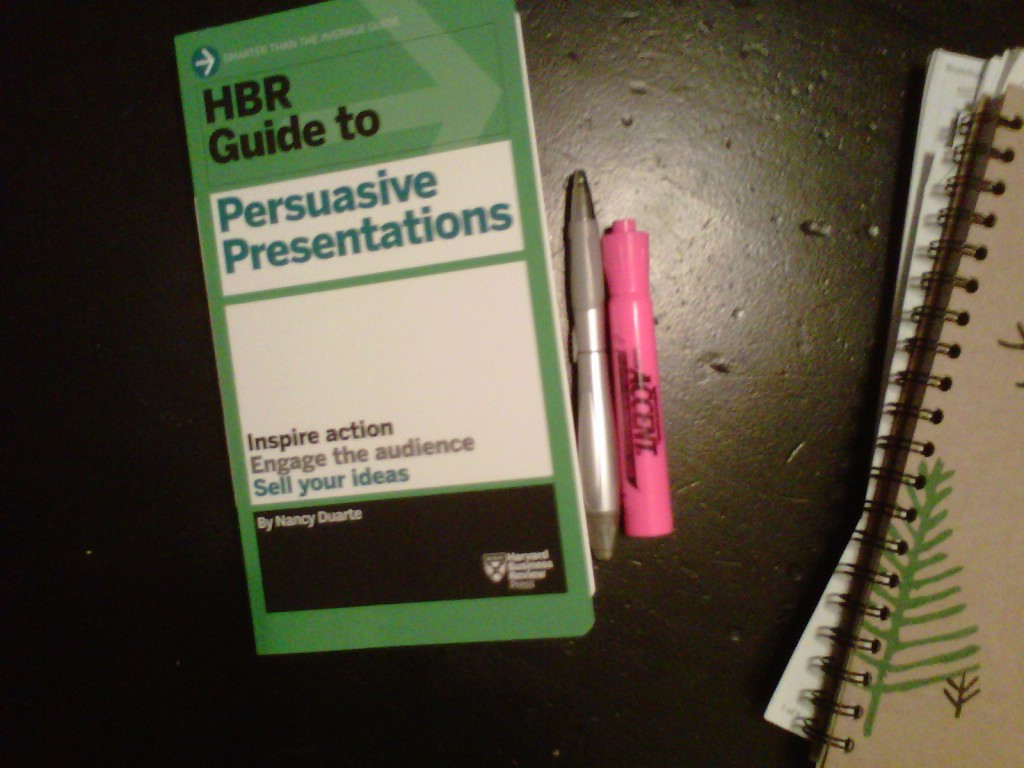
A few days ago I finished the latest Nancy Duarte book, Persuasive Presentations, published by Harvard Business Review.  See my earlier post, Presentations… Inspired, for some additional background on this.

Photo courtesy of Alex Rister who also wrote about this book.

Persuasive Presentations was a very fast paced read.  I love the format of this book.  It was composed of a number of mini chapters, each only two to three pages long.  Nancy is no hypocrite – she practices what she preaches.  While a book is no presentation, many of the concepts regarding habits of adult learners, attention spans, etc., still apply.  Therefore, she chopped her content up into small manageable bites.  No long drawn out chapters here.  No complicated explanations.  It was all very straight forward.To help drive home the point, she makes external references, provides graphics and illustrations, and cross references within the book.  She covers everything from the needs assessment (audience and topic), to development, design, format and medium, reading the audience, presenting via video, incorporating social media, and follow-up.  This is a great book for the new presenter or trainer, or the seasoned professional.  I can even see it as reading for an undergraduate level course on communications and presentations.  Nancy covers all the relevant topics including contemporary subject matter.  A great read – highly recommended.  Thanks Nancy!