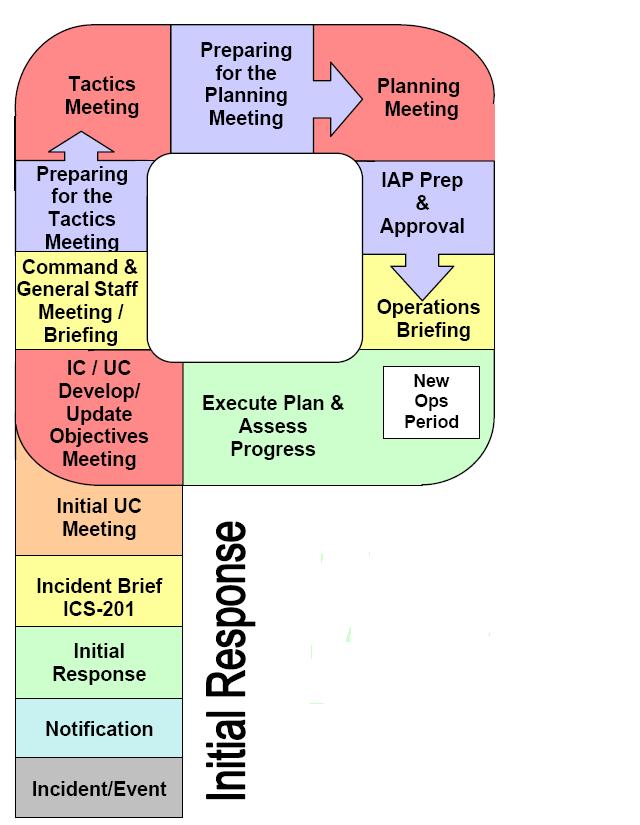
ICS and the Human Factor

A number of my articles have mentioned the unpredictable human factor in executing emergency plans and managing incidents, particularly for complex incidents.  We can build great plans and have a great management system to facilitate the incident management process, but the human factor – that largely intangible level of unpredictability of human behavior – can steer even the best emergency plan astray or derail an incident management process.

An article published in the Domestic Preparedness Journal yesterday, written by Eric McNulty, reflects on this.  Mr. McNulty cites several human factors which have relevance within incident management and encourages leaders to understand these factors within themselves and others to bring about more effective leadership.  The introductory paragraph of his article suggests the need for integrating behavior training into ICS training to ‘improve performance and outcomes’.  Given the impact of behavior factors on how we respond, this is a concept I can certainly endorse for a much-needed rewrite of the ICS curriculum.

I’ve heavily referenced Chief Cynthia Renaud’s paper, The Missing Piece of NIMS: Teaching Incident Commanders How to Function in The Edge of Chaos, in the past and continue to hold her piece relevant, especially in this discussion.  Chief Renaud’s suggestions draw lines parallel to behavioral factors, which suggest to me that we certainly need to integrate leadership training into ICS training.  The current ICS 200 course attempts to do so, but the content simply panders to the topic and doesn’t address it seriously enough.  We need to go beyond the leadership basics and explore leadership training done around the world to see what is the most effective.

Incident management is life and death – not a pick-up game of stick ball.  Let’s start taking it more seriously and prepare people better for this responsibility.

© 2016 – Timothy Riecker, CEDP

Emergency Preparedness Solutions, LLCYour Partner in Preparedness

Do We Need Different Systems for Catastrophic Incidents?

We’ve long heard, albeit in small pockets, people proclaiming that emergency management and public safety need different systems for larger incidents vs smaller incidents.  For years, the Incident Command System (ICS) fought that stigma, with many saying that ICS is only used for hazardous materials incidents (specifically because of OSHA requirements) or for large incidents that required such a high degree of organization.  Following the release of HSPD-5 and the resultant requirements for everyone to use the National Incident Management System (NIMS), we finally seemed to transcend that mentality – although we are still seeing people apply ICS poorly, and often with the thought that it will all work out fine when a large incident occurs.

Since the mid-2000s, coupled with the push for ‘catastrophic planning’, I’ve been hearing people proclaiming that catastrophic incidents require different systems – be it for planning or management.  Recently, I’m hearing this mentioned again.  Yet, interestingly enough, none of the arguments identify specifically what it is about our current systems of preparedness or incident management that fail at the sight of a catastrophic incident.

While I’m a critic of various aspects of our current systems, I’m a believer in them overall.  Do we need a new system of planning?  No, we just need to do it better.  When we plan for a catastrophic level event, we must consider that NOTHING will work in the aftermath of such an incident.  I’m shocked that some people are still counting on the existence and functionality of critical infrastructure following a catastrophic event.  No roads, no communications, no life lines.  These surprised disclosures are revealed in the After Action Reports (AARs) of incidents and exercises that test catastrophic incidents, such as the recent Cascadia Rising exercise.

Fundamentally, are these losses all that different than what we experience in smaller disasters?  Not so much.  Smaller disasters still take out our roads and disable our communications systems – but such disasters are small enough that we can work around these issues.  So how is it a surprise that a large hurricane or earthquake will do even more damage?  It really shouldn’t be.  It’s essentially a matter of scale.

That said, I certainly acknowledge the difficulties that come with the combined impacts of a catastrophic disaster, coupled with the sheer magnitude of it all.  There are challenges offered that we don’t normally see, but a new system of planning is not the answer.  The current frameworks and standards, such as CPG-101 and NFPA 1600 are absolutely substantial.  The processes are not flawed.  The issue is a human one.  We can’t blame the standards.  We can’t blame the plans.  The responsibility lies with the people at the table crafting the plan.  The responsibility lies with them to fully understand the hazards and the potential impacts of those hazards.  Conducting a hazard analysis is the first step for a planning team to accomplish, and I think this is often taken for granted.  While the traditional hazard analysis has value, the current standard is the Threat and Hazard Identification and Risk Assessment (THIRA).  It is an exhausting and detailed process, but it is highly effective, with engaged teams, to reveal the nature and impacts of disasters that can impact a community.  Without a solid and realistic understanding of hazards, including those that can attain catastrophic levels, WE WILL FAIL.  It’s that simple.

As we progress through the planning process and identify strategies to accomplish objectives, alternate strategies must be developed to address full failures of infrastructure and lack of resources.  Assumptions are often made in plans that we will be able to apply the resources we have to fix problems; and if those resources are exhausted, we will ask for more, which will magically appear, thus solving our problems.  Yes, this works most of the time, but in a catastrophic incident, this is pure bullshit.  This assumption needs to be taken off the table when catastrophic incidents are concerned.  The scarcity of resources is an immediate factor that we need to address along with acknowledging that a severely damaged infrastructure forces us out of many of the technological and logistical comforts we have become accustomed to.  It doesn’t require a new system of planning – just a realistic mentality.

This all logically ties to our incident management system – ICS.  ICS is fully able to accommodate a catastrophic-level incident.  The difficulties we face are with how we apply it (another human factor) and integration of multiple ICS organizations and other incident management entities, such as EOCs.  The tenant in ICS is that one incident gets one incident command system structure.  This is obviously not a geo-political or practical reality for a catastrophic incident that can have a large footprint.  This, however, doesn’t mean that we throw ICS out the window.  This is a reality that we deal with even on smaller disasters, where different jurisdictions, agencies, organizations, and levels of government all have their own management system established during a disaster.  Through implementations such as unified command, multi-agency coordination, agency representatives and liaison officers, and good lines of communication we are able to make effective coordination happen.  (Side note: this is absolutely something I think we need to plan for and tighten up conceptually.  It’s often pulled together a bit too ad-hoc for my comfort).

While some time and effort needs to be applied to develop some solid solutions to the issues that exist, I’m confident that we DO NOT need to create alternate preparedness or response systems for addressing catastrophic incidents – we simply need to apply what we have better and with a more realistic perspective.  The answers won’t come easy and the solutions might be less than ideal, but that’s the nature of a catastrophic event.  We can’t expect it to be easy or convenient.

© 2016 – Timothy Riecker, CEDP

Emergency Preparedness Solutions, LLCYour Partner in Preparedness

EMS is in Trouble

If you’ve worked in or with Emergency Medical Services (EMS) over the past couple of decades, you probably know it’s in trouble in many areas around the nation.  As with many organizations, finances are the culprit.  Many EMS organizations simply can’t make ends meet.  Costs for equipment, insurance, fuel, training, and facilities often can’t be balanced in the black against recovered income.  It’s not to say it can’t be done – some are doing it, and successfully.  But many are having a difficult time.  Staffing is another problem.  Volunteer services must constantly recruit and work to retain staff.  Volunteer fire services are experiencing similar recruitment and retention problems.  Even with diligent efforts, day time coverage in some areas is a challenge while many of these volunteers are working at their primary jobs.  Paid services struggle with staffing as well.  It’s no mystery that EMTs and Paramedics don’t get into this business to make good money.  According to a study posted by Monster, the highest paid states provide pay in the $20-$35/hour range, but it slides quickly, with not only the lowest paying states paying in the teens, but the average also sitting in the teens.  Yep, you could be out saving lives and someone working at McDonald’s makes more money than you do.  It’s a rather depressing valuation.

When you couple these two big factors – volunteer staffing and finances – it gets even more difficult.  Paid and volunteer services alike are kicking calls over to mutual aid providers because of being short staffed, which means they miss revenue, which continues to make matters worse.  Many volunteer EMS services, as well as volunteer fire services, are hiring day-shift staff so they can continue to meet needs in their communities during these more difficult timeframes.  For those of you keeping score at home, that’s more cash out.  It might pay off for a busier provider, but certainly not for a provider whose call volume doesn’t balance the checkbook.  Yes, it continues to provide a service to the community, but it’s not sustainable in the long run.

How are the private paid services doing?  Many aren’t doing so well, either.  We see service areas shrinking all around the nation, with paid services seeing diminishing revenues from less dense population areas.  Quite a few paid services make ends meet from interfacility transfers, which are low cost but require volume to make reasonable revenue.

Municipal services are another category which generally have a poor income statement.  I think it’s great that some municipalities provide EMS transport services.  Financially, these services are underwritten by tax payers, with some cost recovery possible through billing insurance companies.  The costs of most municipal services, however, are generally higher, as EMTs and paramedics are government employees, often unionized, and with benefits.  It’s great for them, but not good for the municipal comptroller.  That said, it’s one of the most sustainable models since the underlying financing is spread across all the jurisdiction’s tax payers.  Still a challenge, though, when you consider the tough financial constraints many jurisdictions are facing.

So what’s to be done?  We will eventually need to see a shift in how EMS is provided across the nation.  It is an absolutely necessary service, just as important as roads, fire protection, or law enforcement.  While we won’t see a sudden change, I believe the way forward will be municipal services, or municipally-funded services (those being private or volunteer, but under contract with one or more municipalities).  EMS, similar to other disciplines in public safety, is a public service, and foundationally will need to be publicly funded in order to sustain.  This is nothing new, as there are a number of EMS providers already following this model – that being the maintenance of a contract with one or more municipalities to provide EMS services, for a fee, while also gaining revenue from third party billing, as well as fees for stand-by services for sporting events and other mass gatherings.

What trends do you see in EMS organizational models where you are?  Are the current models sustainable?  Do you view EMS as a public safety endeavor similar to law enforcement and the fire service?

© 2016 – Timothy M. Riecker, CEDP

Emergency Preparedness Solutions, LLCYour Partner in Preparedness


Embracing the Playbook in Emergency Management

This morning I suggested to a client the possible use of a playbook as a training supplement for their duty officer program.  A playbook is a job aid, but more than just a check list or a chart.  Ideally, a playbook is a structured collection of job aids, broken down by situation for easy reference by whomever needs the information.

Playbooks are best known to be most extensively used in American football.  They contain a variety of strategies for accomplishing certain objectives (short yardage gain, long yardage gain, end zone scoring, kick return, etc.), with each strategy often accompanied by one or more diagrams of Xs (the opposition) and Os (your team), with lines showing movement and action by certain positions.  Playbooks are tested, practiced, and memorized by players before the season begins, but are constantly referenced every game by coaches and players alike.

playbook-diagram

Fundamentally, the play book exists because there are so many situations the team needs to respond to and several different ways in which they can respond.  While some of their plays are fairly routine, others are rarely, if ever, used.  Just like emergency management, however, it’s good to have the plan available if we need it.

Assembling a playbook for emergency management purposes doesn’t have any set standard, but as with any other tool or plan we assemble, we must first identify the purpose and the audience.  Play books can be assembled for elected officials and executives, duty officers and middle management, or dispatchers and first responders – it all depends on what is needed.  One thing that should be stressed, though… playbooks are NOT plans, nor should they be treated as a replacement for training.  Playbooks should be based upon established policy, plans, and procedures; and training still should be conducted on those policies, plans, and procedures.  A playbook is the collection of job aids which will help us to navigate the things people may not routinely do – which makes them excellent for emergency management applications.

Consider that the content of the playbook won’t (and probably shouldn’t) try to map out an incident from inception to completion.  The playbook is intended to address critical actions within an early timeframe of the incident.  Following this, a team should be assembled and striving to manage the incident using the planning process and referencing the foundational plans and policies.  There may be a few nuanced circumstances and activities within the playbook that are still relevant in the extended response, but these should be few.

The organization and content of the playbook should depend on the objectives and audience of the tool.  It should not be heavy in narrative and doesn’t require a lot of background as a plan might.  For emergency management purposes, most playbooks are organized by hazard and/or impact, with topics such as Mass Shooting, Severe Storm, or Power Outage.  For each topic, the essential elements of response can be identified, perhaps in check-list format.  Additional job aids such as decision tables, flow charts, and references can also be incorporated.  While I’m a big fan of keeping things digital, playbooks and similar references are better in hard copy, as this helps to ensure the information is always accessible.  Bind it (a three ring binder is best, so content can be updated as needed) and insert tabs for easy reference.  Be sure to give all users their own copy.

When creating the playbook, consider what information needs to be conveyed.  While some repetition may be necessary from topic to topic, reduce the amount of in-document references (i.e. See page 19 for additional information), as the purpose of the document is to help keep people organized.  Always keep the user in mind, ensuring that they understand each step and that they have the ability, resources, and authority to perform the identified actions.  Ensure that the playbook is a proper reflection of established policy and procedure and be sure to test it for effectiveness.  Train people in its content and use, and be sure to provide regular training and content updates and to incorporate its use into exercises.

I’m interested in hearing your thoughts on playbooks and if you have created and/or used them.  Of course, if your jurisdiction or organization is looking for assistance in developing a playbook for your critical activities, let us know!

© 2016 – Timothy M. Riecker

Emergency Preparedness Solutions, LLCYour Partner in Preparedness


New and Timely Cyber Security Information

October is National Cyber Security Awareness Month.  With it, the DHS Private Sector Office has provided a number of resources to help organizations get involved in cyber security awareness.  These include weekly themes, such as Stop. Think. Connect., information on a weekly Twitter Chat series, and other information.

Perhaps released intentionally during National Cyber Security Awareness Month is the call for public comment on the National Cyber Incident Response Plan.  From their website, DHS’ National Protection and Programs Directorate and FEMA’s National Integration Center are leading the development of this document in coordination with the US Department of Justice, the Secretary of Defense, and other partners.  This plan is intended to provide a nation-wide approach to cyber incidents, incorporating roles for the private sector and all levels of government (TR – similar to the National Planning Frameworks, which this document rather heavily references).  The National Engagement Period ends on October 31, so be sure to review the document and provide feedback.  There are also a series of webinars referenced on the website.

In my initial and very cursory review of the plan, I was pleased to see the references to the National Preparedness Goal and National Planning Frameworks.  I’ve mentioned before that we need to strive to align and integrate all preparedness efforts along these lines and I’m thrilled to see it happening.  It’s even more encouraging to see this occurring with something that could be considered a bit fringe to traditional emergency management.  The plan directly references a number of Core Capabilities.  They take an interesting approach with this.  Instead of identifying which Core Capabilities the plan organizes under, they instead align certain Core Capabilities within what they call Lines of Effort.  These Lines of Effort include Threat Response, Asset Response, and Intelligence Support.  For each Core Capability they define the Core Capability, a la the National Preparedness Goal, and describe how that Core Capability applies to Line of Effort, along with listing associated critical tasks. (inserted is Table 2 from the plan which shows this alignment)

cyber-cc-by-loe

What I find even more interesting is the array of Core Capabilities they identified for their Lines of Effort.  While this plan is oriented toward response, the Core Capabilities they identify come from the Mission Areas of Prevention, Protection, Response, and Mitigation, along with including the three common Core Capabilities.  This further reinforces the thought that the Cyber Security Core Capability should also be included as a common Core Capability.  This is an interesting document which I look forward to reviewing in more detail.

© 2016 – Timothy Riecker, CEDP

Emergency Preparedness Solutions, LLCYour Partner in Preparedness


Grading Preparedness Training

While there is an abundance of training available in public safety, emergency management, and homeland security, do we have enough training available on the foundational preparedness activities?  By which, I mean Planning, Organizing, Equipping, Training, and Exercising – or POETE.  There is a wide variety of training available on tactics and application of skills, which is certainly important to our preparedness, but what is available (in the United States, by necessity of focusing this article) to help bolster our foundational preparedness skills?  Let’s look at each.

Exercises

For purposes of making comparisons throughout each of these preparedness elements, I actually want to start at the end of the POETE acronym, with Exercises.  At a glance, there seems to be a significant number of courses available to teach people how to design, conduct, and evaluate exercises.  To begin, there are a variety of exercise training courses available from FEMA’s Independent Study program, both foundational as well as hazard or function specific, such as those for radiological exercises or continuity of operations.  Independent Study courses provide an excellent overview of topics, but, by nature of the medium, generally don’t allow for an in depth analysis of the information or interaction with an instructor or other students.  So if you’ve taken the Independent Study courses and you need more information, what’s next?

Basic-level classroom-based training in exercises have all but disappeared.  Most of these programs, such as Exercise Design or the Homeland Security Exercise and Evaluation Program (HSEEP) course were historically offered by the state emergency management offices, but are no longer listed by FEMA as available state-sponsored training, which is quite a shame since this is generally how the greatest needs are often met.  FEMA offers the new Exercise Design course, which is part of the Basic Emergency Management Academy, but is only offered directly through FEMA, either as a field delivered course or at the Emergency Management Institute.  FEMA also offers the HSEEP course as a ‘local delivery’, meaning that the course can be delivered at locations around the country, but this typically happens with much less frequency and volume than state-sponsored training, especially for a program that is so necessary to our preparedness efforts.  FEMA also offers the HSEEP course as an instructor-led webinar, which does help address some issues of accessibility and volume, but I feel misses the need for this being a classroom based course.  Some states are still conducting classroom versions of Exercise Design and HSEEP, along their own customized exercise-related training to meet needs which continue to exist in their states.  Technically they can, although FEMA isn’t supporting those courses with updated content.  There is also an issue with FEMA only permitting their own local or webinar-based deliveries of HSEEP to meet the prerequisite for the Master Exercise Practitioner (MEP) program.

MEP is designed to be an advanced program, with three week-long courses generally taken in-residence at FEMA’s Emergency Management Institute.  In full disclosure, I am not a MEP.  Not sure if I ever will be, but given the feedback I’ve received over the years about the program, I’m not likely to until it gets an overhaul.  While I’m sure the MEP is great for many who take it, the more experienced exercise practitioners I speak with have much concern about it not being advanced enough, mentioning that a lot of time is spent reviewing basics that should have been learned in courses prior.  And while many people mention that the out of class activities designing discussion-based and operations-based exercises are good, they do little to enhance learning for those who have been doing this for a while.  Granted, it’s understood that you can’t make everyone happy, and with an advanced class you always run the risk of people coming in who already have experience at the level of the course or higher.  That said, MEP has become an industry standard accomplishment, and I’d like to see the program exceed more people’s expectations.  Grade: B

Planning

Let’s now go back to the beginning of POETE with Planning.  There are a fair amount of courses out there that teach people how to plan.  Again, FEMA’s Independent Study program offers courses not only in foundational aspects of planning, but also those with consideration toward various hazards and functions.  At the next level, there are also quite a number of courses which are locally delivered, by state emergency management offices, FEMA, and other training partners such as TEEX or the Rural Domestic Preparedness Consortium; with courses cutting through various taxonomy levels and addressing foundational planning activities as well as those that are hazard and function specific.

There are courses available, both locally delivered, as well as in-residence at locations like EMI, CDP, or TEEX, to address a variety of planning related interests within the broad realm of public safety, emergency management, and homeland security.  A vast number of courses, which may not be specifically for planning, can certainly support planning efforts for certain populations, hazards, and functions.  Some states offer courses on emergency planning, either as self-sustained versions of the Emergency Planning course which is now only an Independent Study course and not supported by FEMA as a classroom delivery, or home grown courses.  Emergency planning is such an important and foundational topic that it must be more accessible.  While there are some courses on planning for recovery and mitigation, we need to support this as well – planning is not reserved solely for response.

The reason why I started the discussion of this post with Exercises is because they have the MEP program.  Regardless of the possibility of the program needing an overhaul, the concept of the MEP – that being an advanced level program – is certainly a best practice that should be reflected across these other preparedness elements.  I’ve heard a rumor of a Master Planner Program, similar to a MEP, being piloted within the last couple of years, but I’ve not seen anything official on it as of yet.  Overall, in regard to training courses for planning, I’d like to see a more cohesive approach, along with a ‘master level’ program.  Grade: B-

Organizing

Training on Organizing is not as direct of a topic as the others, but it is addressed, although I think this is another area that could be bolstered.  Most training on the topic of organization needs to dig not only into the foundational concepts of emergency management, which will aid in recognizing the resources and relationships that exist, but training in coordination, supervision, and management also need to better addressed.  FEMA does offer some very basic courses in their Professional Development Series which begin to address some of this.  There also exists the National Emergency Management Academies, but despite these being segregated into ‘Basic’, ‘Advanced’, and ‘Executive’, they are still largely offered only at EMI, which limits accessibility, especially at that area in the middle where most people need support.  We can also consider that the Incident Command System (ICS) provides us with some important support to the Organization capability element… take a look at my commentaries on available ICS training here.  Other training opportunities that support training for the organizational element can be found from non-emergency management sources, such as programs that address more traditional staff development and management concepts.  Often seen as ‘soft skills’, we shouldn’t ignore these training opportunities which help us to work within and understand organizations better.  Grade: C

Equipping

Training on Equipping is something else we don’t often seen as being offered by FEMA or the consortium entities.  Much of the training on equipment is and should be offered by the people who are specialists in the equipment or systems used.  This can range from the EOC management system you use to the interoperable communications equipment in your mobile unit.  The manufacturers and other subject matter experts should be delivering the initial training on this.  Ensure that training materials are provided so you can continue to train new staff or offer refresher training as needed.

If we look at the Equipping capability element in its broadest sense, however, we should consider the entire continuum of resource management.  This is an area where we see some training available from our traditional emergency management sources, including a few Independent Study courses and some classroom courses, including those addressing the responsibilities of the ICS Logistics Section.  It appears to me that there is a training gap here, as much of emergency management and incident management center on the resource management cycle, from preparedness through recovery.  While there exists an Independent Study course reviewing the concepts of resource management within NIMS, I have yet to see a solid, comprehensive, performance-level course on resource management that is practical for emergency management personnel.  Grade: D

Training

Training on Training… To my core, I’m a trainer, so I happen to have some strong feelings about how trainers and instructional designers (certainly different activities and not necessarily the same people) are trained and supported.  Broadly, in emergency services, the fire service has various levels of fire instructor courses and law enforcement has some courses available for instructor development.  Even in EMS we teach our instructors how to train.  Depending on the course, these programs can help refine platform delivery skills, or teach someone how to actually build curriculum (important note: a bunch of PowerPoint slides is NOT a training course… that’s a presentation).  In emergency management, there exists a state-delivered FEMA course on instructional presentation and evaluation skills, which is rarely seen delivered, but some states strongly use it to build and sustain their trainer cadre.  At a slightly more advanced level, FEMA offers the Trainer Program (formerly the Master Trainer Program).  Within this program are two tracks – the Basis Instructor Certificate and the Basic Instructional Design Certificate.

As a graduate of the Master Trainer Program, I was sad to see it go.  Despite some curriculum revisions and streamlining, the need wasn’t supported.  While I understand and somewhat agree with the initial intent of the course, the six courses that made up the program were a significant commitment.  The job of training also isn’t seen to be as sexy as exercises, so comparatively, the MEP program had fared better.  FEMA’s separation of instruction from instructional design was a wise move, as some jurisdictions don’t do much course development, but do need to develop platform instructors.  While advanced courses in training and instructional design are no longer available from FEMA, they can be obtained from sources like the Association for Talent Development (formerly the American Society for Training and Development), but at a not insignificant cost.  Grade: B-

Assessment

Just when you thought we might be done… I often like to include Assessment in with POETE.  I believe assessment is a necessary activity within preparedness to identify where we stand, where we need to be, and evaluate efforts on an ongoing basis.  Assessment is an interesting topic to identify training on.  Within the realm of emergency management training, there is really little that directly supports assessment, yet most courses can by providing us with better information on projects, concepts, and applications.  These provide us the context in which to assess, but there still isn’t much out there to tell us how to assess.  We need to assess our plans, our organization, equipment, training, and exercises.  Sometimes we find some guidance that can help us, such as broad planning standards in CPG 101 or specific checklists on evaluating hazard mitigation plans.  Guidance and job aids are great, but having a critical eye to assess programs and projects is something that must be trained.  Big gap here.  Grade: D

Where this leaves us…

Average Grade: C

While C is a passing grade, it’s not great.  It’s closer to failure than it is to excellence.  We have some great training programs out there, but there are certainly training gaps that exist in these key preparedness activities.  While standards have been established for some of these activities (standards should exist for all of them!), training must support this guidance to ensure that it is followed (historical perspective: some training programs took quite some time to incorporate standards, such as HSEEP).  Further, training must be kept current to ensure that best practices and improvements are embraced and communicated.  One-and-done training may not be suitable for these topics.  All of this informs training need, which we must constantly assess to identify what training is needed, for who, to what degree of expertise, and by what delivery method.  The bottom line is that for people to conduct these important preparedness activities, they need to know how to do it and they need to stay up to date on the standards of practice.  Those who set the standards and those funded to support implementation must always pay heed to the training needs surrounding them.  There must also be a balance in training… we need to minimize burdensome, extraneous training and instead maximize quality, practical training that will build capability.

Trends

A great deal of homeland security funds are spent on the development of training across the nation by state and local entities, resulting in some incredible and innovative courses (as well as some rather mundane ones) which meet local needs.  This is a great program and should certainly continue.  Things to watch out for, though…  Many of these courses can be utilized regionally or nationally to support needs, but they may require modifications.  Additionally, while I will rarely discourage any jurisdiction from meeting training needs they might have, we do run the risk of developing non-standardized training across the nation.

Over the past 15 years, we have certainly seen an increase in the variety and volume of courses available from FEMA and consortium entities.  The training they offer is generally fantastic, but now we are faced with the other side of standardization – some courses are too generic, as they need to be applied nation-wide.  Additionally, while scheduling of these courses, particularly the locally delivered ones, has become streamlined and easy through state training officers, many courses have a significant wait list, with some courses being scheduled out not just months, but years.  This significantly delays the progress of preparedness efforts in many areas across the nation.

Overall, the number of state-delivered courses supported by FEMA has appeared to steadily decrease over the past few years.  Certainly one reason for this is the lack of staff and staff time at FEMA’s Emergency Management Institute to support these courses and keep content relevant.  This is generally no fault of EMI, as their funding allocations have not supported staffing for these purposes as of late.  As a former state training officer, I suggest that states and regions are in the best position to identify and track training needs and to deliver a great deal of courses, certainly at the awareness and performance/operations level, and some at higher levels.  These programs, however, need to be supported with expertise, funds, and regional collaboration.

Interested to hear your thoughts…

© 2016 – Timothy Riecker, CEDP

Emergency Preparedness Solutions, LLC Your Partner in Preparedness

Must Read – Evaluating Preparedness at Different Levels of Analysis by Brandon Greenberg

In the past I’ve made references to the DisasterNet blog written by Brandon Greenberg.  If you aren’t reading his blog, you certainly should be, as he routinely posts great material.  Yesterday’s post was no exception.

Brandon has been doing some research on evaluating preparedness, which is a topic I’ve also written about in the past and I feel is of great importance to continued improvements in emergency management.  His article, Evaluating Preparedness at Different Levels of Analysis provides a number of insightful thoughts and information which are certainly going down the right path.  With all hope, Brandon’s continued work may help us find better ways to evaluate preparedness.

-TR


Planning for Preparedness

Yes, planning is part of preparedness, but organizations must also have a plan for preparedness.  Why?  Preparedness breaks down into five key elements  – remember the POETE mnemonic – Planning, Organizing, Equipping, Training, and Exercising.  I’m also in favor of including assessment as a preparedness element.  Needless to say, we do a lot when it comes to preparedness.  Each of these elements alone involves significant activity, and together there are opportunities for activities to be synchronized for maximum benefit.  In smaller organizations, these elements may be addressed by one or two people, which itself can be challenging as these are the same people running the organization and addressing myriad other tasks.  In larger organizations each element alone may be addressed by a number of people, which also provides a complication of synchronizing tasks for maximum benefit.  Either way, as with all project and program management, without a plan of action, we may forget critical tasks or do things out of order.

By establishing a preparedness plan, we can address many of these issues.  The plan can be as detailed as necessary, but should at least identify and address requirements (internally and externally imposed) as well as benchmarks to success.  But what do we plan for?

Assessment – Yes, I’m including this as an element.  Assessment is something we should constantly be doing.  Just as we strive to maintain situational awareness throughout an incident, we have to be aware of and assess factors that influence our state of readiness.  There are a variety of assessments that we do already and others that can be done as they relate to the other five elements.  In fact, assessments will inform our preparedness plan, helping us to identify where we are and where we need to be.  We can review after action reports from incidents, events, and exercises to determine what improvements must be made.  We can research best practices and examine funding requirements, legal requirements, and standards such as EMAP or NFPA 1600 which can broadly influence our programs.  We assess current plans to identify what our gaps are and what plans need to be revisited.  We can assess our organization to determine if staffing is maximized and that policy, procedure, and protocol support an agile organization.  The status of equipment can be assessed to determine what is operational and ready to deploy.  We can conduct a training needs assessment to identify what training is needed; and lastly, we can assess opportunities to exercise.  Not only should our assessments inform what needs to be accomplished for each of the POETE elements, but regular assessment check ins and activities should be identified, nay planned for, within our preparedness plan.  Consider what else can inform our preparedness plan.  A recent hazard analysis, THIRA, or state preparedness report (SPR) can feed a lot of information into a preparedness plan – especially the state preparedness report, as it is specifically structured to identify POETE gaps.

Planning – We should always examine what we have.  If plan reviews aren’t scheduled, they often fall to the wayside.  Plan review teams should be identified for each plan, and a review schedule or cycle established.  Benchmark activities for plan review activities should also be identified.  The need for new plans should also be highlighted.  Based on standards, requirements, best practices, or other need, what plans do you organization need to assemble in the next year or two?  Again, identify benchmarks for these.

Organization – Assessments of your organization, either as direct efforts or as part of after action reports or strategic plans can identify what needs to be accomplished organizationally.  Maybe it’s a reorganization, an increase in staffing levels, an impending change in administration, expected attrition, union matters, or something else that needs to be addressed.  As with many other things, some matters or organization are simple, while others are very difficult to navigate.  Without a plan of action, it’s easy to allow things to fall to the wayside.  What changes need to be made?  Who is responsible for implementing them?  Who else needs to be involved? What’s a reasonable timeline for making these changes happen?

Equipping – Many logisticians are great at keeping accurate records and maintenance plans.  This measure of detail isn’t likely needed for your preparedness plan, but you still should be documenting the big picture.  What benchmarks need to be established and followed?  Are there any large expenditures expected for equipment such as a communications vehicle?  Is there an impending conversion of equipment to comply with a new standard?  Are there any gaps in resource management that need to be addressed?

Training – Informed by a training needs assessment, a training plan can be developed.  A training plan should identify foundational training that everyone needs as well as training needed for people functioning at certain levels or positions.  Ideally, you are addressing needs through training programs that already exist, either internally or externally, but there may be a need to develop new training programs.  A training plan should identify what training is needed, for who, and to what level (i.e. to steal from the hazmat world – Awareness? Operations? Technician?).  The plan should identify who will coordinate the training, how often the training will be made available, and how new training will be developed.

Exercises – We have a standard of practice for identifying exercises into the future – it’s called the multi-year training and exercise plan (MYTEP).  While it’s supposed to include training (or at least training related to the identified exercises), training often falls to the wayside during the training and exercise planning workshop (TEPW).  The outcomes of the TEPW can be integrated into your preparedness plan, allowing for an opportunity to synchronize needs and activities across each element.

Just as we do with most of our planning efforts, I would suggest forming a planning team to shepherd your preparedness plan, comprised of stakeholders of each of the elements.  I envision this as a group that should be in regular communication about preparedness efforts, with periodic check-ins on the preparedness plan.  This engagement should lead to synchronization of efforts.  Identify what activities are related and how.  Has a new plan been developed?  Then people need to be trained on it and the plan should be exercised.  Has new equipment been procured?  Then people should be trained in its use and plans should account for the new or increased capability.

Like any effort, endorsement from leadership is necessary, especially when multiple stakeholders need to be brought together and working together.  Many emergency management and homeland security organizations have positions responsible for preparedness, often at the deputy director level.  The formation and maintenance of a comprehensive preparedness plan should be a foundation of their efforts to manage preparedness and forecast and synchronize efforts.

Does your organization have a plan for preparedness beyond just a multi-year training and exercise plan?  What elements do you tie in?  Do you find it to be a successful endeavor?

Do you need assistance in developing a preparedness plan?  Contact us!

© 2016 – Timothy Riecker

Emergency Preparedness Solutions, LLCYour Partner in Preparedness

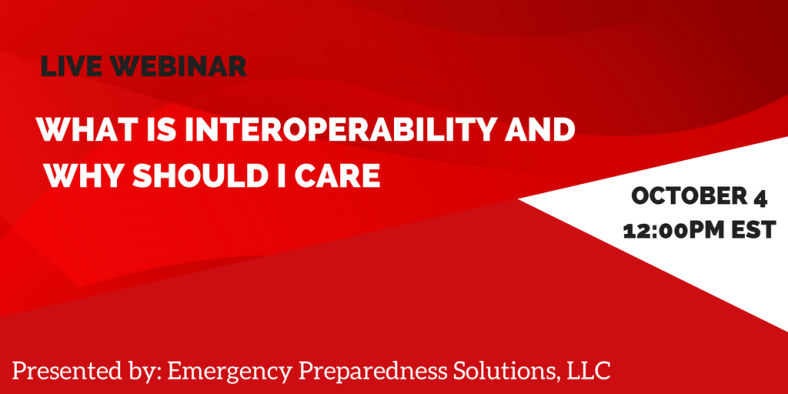
Webinar – What is Interoperability and Why Should I Care?

EPSLLC.png

Click here to register!

I’m pleased to be taking part in this webinar, hosted by BaseCamp Connect.  I’ll be joining Damien Coakeley, retired from the Ottawa Police Service and currently Chair of the Board of Directors of the Ottawa Safety Council and owner of Veritas Emergency Management Consultants.

What we’re talking about:

With the ever-increasing complexity, frequency and breadth of emergencies, crises and disasters, the notion of interoperability between responding agencies and emergency managers is becoming exponentially more important than ever before.

WHEN: October 4 at 12:00pm EST

Together, Damien Coakeley and Timothy Riecker have more than 50 years experience in emergency management ! Join us to learn:

  • What does interoperability really mean to them
  • Different types of interoperability: communication, equipment, law, etc.
  • Interoperability problems encountered in the field
  • Tips and advice
  • And much more !

Click here to register!

Emergency Management: Why Failure is Necessary

One of the many podcasts I listen to is the TED Radio Hour from NPR.  For the uninitiated, the TED Radio Hour is a compilation of highlights from several TED Talks (you know what these are, right?) arranged around certain topics.  I like the topical arrangement and the sampling they do of the presentations, as well as the inclusion of interviews with many of the presenters.  Yesterday I listed to one from July 29, 2016 titled Failure is an Option.  In it, I was most drawn to the points made by Tim Hartford, an economist, and began to think that this guy needs to speak at some emergency management conferences.  What can an economist tell emergency managers?  His TED Talk is titled Trial, Error, and the God ComplexIt’s worth checking out.

How often do you hear someone in public safety proclaim that they don’t know about a certain topic or how to handle a certain situation.  Not very often.  Certainly we have a lot of confident, Type A people (myself included) who will not be stopped by a problem, even if we don’t know right off how we will solve it.  At the extreme end of this are those who refuse to plan.  Why?  Maybe they don’t want to be constrained by a plan, or maybe they don’t want something put in writing.  Maybe they simply don’t know right now what they will do, either a) hoping that it never happens, or b) assuming they will figure it out when it does.  Determination and persistence is good, but we can’t become ignorant despite it.  As I often mention in my posts, this is public safety, not a pick-up game of kick ball.  To me, there is nothing more serious.

Our egos drive us to feel that everything is on the line all the time.  While some may refuse to plan, others do plan, but the approach may not be realistic.  We’ve all seen plans that begin with one, two, maybe even three pages of assumptions.  That’s a lot of assuming for an emergency or disaster situation, which we all know is uncertain and dynamic.  Those long lists make me uncomfortable, as they should you.  Why do we do it?  Sure there are some things we can expect, but otherwise we are trying to dictate terms to the disaster.  Trust me, the disaster doesn’t give a damn about the plan you wrote or the terms and conditions you try to lay out for it.  But it makes us feel better by putting the disaster in a very defined box.  I know I’ve been guilty of this.

Let’s remove the ego.  Let’s proclaim that maybe we have no idea, or we have a few ideas but we aren’t sure which one is best.  Preparedness should be collaborative.  Get lots of ideas from people.  Talk though them and figure out which ones are the most viable.  Get these ideas down on paper, even loosely, and try them out.  We need to take advantage of our preparedness work to figure out the things we don’t know.

A number of years ago, it was identified through feedback and after action reports of incidents that the flow of information and resource requests in a certain EOC simply wasn’t working the way it was intended.  While I’m a big fan of the application of ICS in an EOC, the specific role an EOC plays as a multi-agency coordination center, the cross functions of some staff, and the politics involved aren’t really accounted for in ICS, so the strictest applications of ICS sometimes don’t apply well.  A small group of us were tasked to fix it.  While we each had some theories, none of really knew why the current processes weren’t working.  So we set up a small exercise solely for this purpose.  Our observations helped us identify the root cause of the problem.  The members of our group, all experienced EOC personnel, had different theories on how to solve the problem.  We went again to exercises, this time a series of small ones.  We ushered some people into the EOC, each time giving them a flow chart and some narrative on what each person should be doing relative to the processes we devised.  The injects flowed and we observed the outcomes.  We saw what worked and what didn’t.  We then assembled an amalgamation of the best traits of each methodology into a new process.  Then guess what we did – we exercised that – and it worked.  Not only did we have a great scientific and structured approach, we also had validation of our final product – one that stood up to further exercises and actual incidents.

Does trial and error take time?  Sure it does.  Does it always yield results?  Yes – although not always positive ones – but those are still results.  It’s important to remember to collect data on each of our attempts.  Just like an exercise we want to evaluate and document.  Sometimes our ideas turn out to be epic failures, and that’s OK.  Had we not found this out during our trial and error, just like an exercise, it could have been devastating and costly in a real life application.  A severe mistake during an incident can be career ending for you, and life ending for those you are sworn to protect.

The bottom line is that it’s OK to fail – just try to control when and how you fail.  In order to accept that premise, however, we need to let go of the super Type A hero/god/ego thing.  Yes, we can learn from successes, but we learn more from failure, especially with a little root cause analysis.  Sometimes things look great on paper, but unless you actually try them out, you’ll never know.  In your trial and error, also consider different variables which may have influence on the outcomes.  It’s great to plan for a response and practice it on a sunny day, but what about pouring rain, freezing temperatures, or high winds?  How does this impact your plan?  Often we can make assumptions (remember those?), but we’ll never really know unless we try.

Do you buy into this?  Thoughts appreciated.

© 2016 – Timothy Riecker, CEDP

Emergency Preparedness Solutions, LLCYour Partner in Preparedness