Through the past several years of my blog, the central theme of my posts has really been to ask ‘why?’. Why do we do the things we do in emergency management? Why do we accept things as they are? Why haven’t we endeavored to change, update, or improve upon some of these things that range, at best, from mediocracy to, at worst, absolute crap?
A boss of mine many (so many) years ago taught me the concept of ‘ask why five times’ if you want to get to the root of anything. Of course, you need to seek the proper people to ask or sources to conduct your research, but the concept still stands – often we can’t just ask ‘why’ once and expect that one answer to explain everything for us.
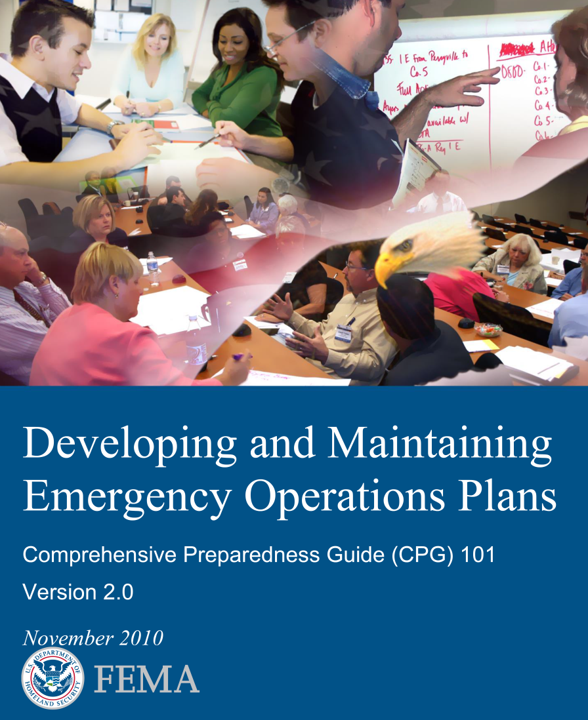
Our field of practice is filled with so many things which can be considered standards. They may be true standards, such as NFPA 1660, or simply a de facto standard – something that has become widely accepted in practice, such as CPG 101.
Standards are a double-edged sword. On the better side, they give us commonality. We can expect that, if reasonably applied, the outputs will have substantial similarity and will, at minimum, meet a base-line expectation. Consistency is generally viewed as good and beneficial in largely any application. On the other hand, standards can stifle innovation. They can encourage laziness. They often promote shortcuts like templates, which, while there are benefits, largely remove the inclination of critical thinking from the work that is done and assume that all applications can fit within someone else’s concept of how things should be.
As we face a significant possibility of a number of de facto standards from FEMA no longer being maintained due to changes in focus and reduction in force – things like the homeland security exercise and evaluation program (HSEEP), CPG 101, and even the National Incident Management System (NIMS) – how will things be done in what may become a new era of emergency management?
There are some that are shilling the downfall of emergency management. While I don’t think this extreme is quite realistic, there will most certainly be some significant changes and impacts to which we must adapt. In the realm of standards (and likely other gaps created), I feel the profession will realize the need to take care of itself, taking a path of self-determination and filling a role that has been, most successfully, done by FEMA. Early on, in the absence of a central coordinating entity (FEMA) maintaining these de facto standards, we will see several disparate efforts of upkeep, with results likely following a bell curve of quality – most will be deemed reasonable, though outliers will exist on both ends of the spectrum, with one side being garbage and the other fairly inspired and progressive. Here enters opportunity. Opportunity for improvement, innovation, different perspectives, and simply seeking better ways of doing things. Though this process begs some questions – Whose version will reign supreme? And what authority does the author have to publish any given standard? Is some measure of authority even required for such a thing for it to be, even unofficially, adopted by the profession?
I feel that regardless of this circumstance, we must periodically examine our standards of practice. Ask ‘why?’ five times (or really however many times is necessary). This can range from asking the same question over and over until you get to some foundational answer you are seeking, or asking a chain of related questions to poke at different sides of the standard. Consider questions like ‘Why does the standard exist?’, ‘Why does the standard exist as it is?’, ‘How did this standard evolve?’, ‘What are the strengths of the current standard?’, ‘What are the weaknesses of the current standard?’, ‘What can we do better and how?’.
There has been some effort lately (also spearheaded by FEMA) toward the concept and implementation of continuous improvement. Standards should also fit within this movement. Standards need to evolve and change and support the practice, though they should be constructed in such a fashion that does not limit a range of application (i.e. can it be used by states as well as small towns? Does it need to be?) or stifle innovation. And while evolution is necessary, I’ll also caution against wholesale change – unless a truly better way is developed and validated. Standards should not change based simply on someone’s good idea, a different perspective, or political influence. Standards (true or de facto) or any part thereof and in any industry should be peer developed and peer reviewed. Changes need to be carefully considered, but also not feared. While I feel FEMA has been a good steward of our standards of practice, that time may be coming to an end, at least for a while. The standards of practice across emergency management must be maintained if this disruption comes to fruition. This is a challenge. This is an opportunity. This is a necessity. We must rise to the occasion.
© 2025 – Tim Riecker, CEDP





 The Contrarian Emergency Manager