Can we Require Preparedness?

The City of Pittsburgh recently lost an effort to require emergency preparedness training for security officers and building service employees.  The Commonwealth Court ruled that the City did not have the authority to require such an ordinance.  This is just another example we’ve seen with difficulties across the US with requirements for preparedness measures.  Why is it so challenging?  It often comes down to the legality of the requirement.

When it comes to the interface of local jurisdictions with states, we often see the concept of home rule providing one of the greatest challenges.  Some interpretations of home rule laws identify that states can’t require local (often to include county) jurisdictions to conduct certain activities, such as have certain plans, attend training, or conduct exercises.  In some states, we see law or regulation that states that if a jurisdiction is to have an emergency plan, then there is a required format of said plan.  But if there is no stick, there is often a carrot.

If requirements can’t be established, then incentives are often the best alternative.  Again, in the local/state relationship, states have grant allocations which can be provided to local governments.  Grant rules can be established that identify certain requirements as conditions of funding.  This tends to be highly effective, especially when funding is expected to continue year after year, and the grants continue to reinforce sustained maintenance on these requirements, such as periodic updates to emergency plans.  Generally, I see no down side to this alternative, so long as the required initiatives are well thought out and realistic given the amount of funds the jurisdiction is receiving.  To ensure effectiveness, however, there must be accountability and quality control measures in place to monitor execution of these requirements; such as reviewing plans, After Action Reports, and auditing training programs. This same methodology is typically how DHS/FEMA is able to get states and funded urban areas (UASIs) to comply with their wishes for various initiatives.

Outside of government, requirements can still be difficult.  While regulations may be put into place for certain industries and under certain conditions, we often have to rely on other, more practical, means of getting businesses, industry, and even not for profits on board.  This often comes with certifications.  An example would be ISO certifications, which some businesses and industry need to compete in certain markets.  Yes, there is even an ISO standard for emergency management.

Unfortunately, many entities, be they public, private, or even individuals, don’t want to be bothered with preparedness.  Most will agree that it’s a good idea, but it takes time, money, and effort.  It’s long been said that you can’t legislate preparedness, and that is often true.  Even if a requirement is able to be established, the extent of implementation can range widely, depending on the internal motivations and resources available to the entity.  Establish whatever requirements you want, but I guarantee there are some that will barely meet those requirements, and in doing so likely not meet the actual intent of the requirement; while others who are believe in the requirement and have available resources, will exceed the requirement.  Largely, organizations are motivated by funding and certification standards.

I’m interested in the perspectives you have on requiring preparedness, both in the US as well as other nations.

© 2017 – Timothy Riecker, CEDP

Emergency Preparedness Solutions, LLC

Supporting a Public Safety Training Program

Today happens to be National Teacher’s Day.  Be sure to show some appreciation for the teachers and professors who have influenced you and provide quality experiences for your kids.  Also consider expanding the definition of ‘teacher’.  In the public safety professions, we do a lot of training.  Some of us have structured academies, and while others may not, there are a lot of training opportunities provided locally, state-wide, and nationally.  Depending on the size and scope of your agency, you may run your own training program for internal, and potentially external stakeholders.

For a few years, I ran the training and exercise program of a state emergency management agency.  We delivered training programs state-wide to a variety of stakeholders.  We also developed some training programs to address needs which curricula from FEMA or other national providers could not meet.  Fundamentally, delivering training is easy, but properly managing a training program can have challenges.  Some thoughts…

  • Find the right people for the job. While we hired some personnel full time to be trainers, we also used people from elsewhere in the agency, as well as personnel from partner agencies, and hired some as 1099 employees.  There are a lot of highly qualified individuals in public safety – if you don’t know any, just ask, and they will be sure to tell you!  Assuming their qualifications are valid, are the most experienced and knowledgeable people always the best instructors?  Absolutely not.  While they may be subject matter experts, it doesn’t mean they have good presentation skills, much less comfort in doing so.  On the flip side, you might also have someone with little experience who has great delivery skills.  That might be a person to develop.
  • Quality control. When people are delivering training, peek in once in a while.  I traveled around the state regularly, and once in a while would see if one of our courses was being held somewhere along my route.  If I had the time, I would stop in and see how things were going.  While the visit was a surprise, our instructors knew this is something that might happen.  There are a few things this accomplishes.  First of all, it gives you an opportunity to observe and provide feedback.  Everyone can improve, and hopefully they can handle some constructive feedback.  Evaluation, formal or informal, is positive for the instructor and the program.  Look for consistency of practice (see the next bullet point) and professionalism.  On one of my surprise visits, I found an instructor wearing jeans and a sweatshirt.  When I discussed it with him, his response was that he was ‘retired’ (teaching for the agency was a retirement job for him) and that he could do whatever he wanted to.  After that discussion was happy to retire him further. Stopping in also shows support for your instructors and for the program as a whole.  Weather traveling across the state or down the hall, instructors want to know they are being supported.  A big part of support is simply being present.
  • Consistency counts. Training programs should be consistent.  While we might change around some examples or in-class scenarios, training delivered in one location by instructor a should largely match the training delivered another day, in a different location by instructor b.  Coming up through the ranks as a field trainer, I was part of a group that wanted to heavily modify the courses we delivered.  As I rose to management, I realized how detrimental this was.  If improvements are warranted, work with your instructors to integrate those improvements into the course.  Make sure that improvements are in line with best practices, not only in instructional design (remember: content must match objectives), but also with the subject matter.  Consistency not only ensures that all your learners are provided the same information, but also makes your curriculum and instructors more legally sound.  Too often we see instructors ‘going rogue’, thinking that they know a better way.
  • Programs need systems. A big part of building and maintaining a program is having adequate systems in place.  Systems require policies, procedures, and tools.  This is largely the behind the scenes stuff of a training program.  This includes annual curriculum reviews, performance reviews of instructors, selection/hiring and firing of instructors, maintaining instructors (see the next bullet), ordering course materials, maintaining training records, posting a course, course registrations, course cancellations, and so much more.  While it sounds bureaucratic, there should be a piece of paper that covers every major activity, identifying how it’s done, by who, with what approvals, and at what time.  Systems make sure that things aren’t missed, give you a basis of performance to evaluate the system and to train new staff, and help ensure consistency.  Systems contribute to your professionalism and are also good practices for business continuity.  Lots of credit to Cindy who was highly dedicated to establishing systems!
  • Keep instructors engaged. With either a large or small training shop, it’s important to maintain contact with your instructors.  Not just in handing them assignments and shuffling paperwork, but to really engage them.  We established twice a year ‘instructor workshops’, bringing our instructors together for two days.  From a management and administrative perspective, we used some of this time to express appreciation for their work, and provide information on curriculum updates and other information.  We encouraged much of the workshop agenda to be developed by the instructors themselves, with professional development provided by their peers.  This could include instructor development, after action reviews of incidents, case studies, and a variety of other activities and information.

Those are just a few tips and lessons learned.  I’m sure you may also have some to add to the list – and please do!

© 2017 – Timothy Riecker, CEDP

Emergency Preparedness Solutions, LLC

Emergency Alerting – A Case Study

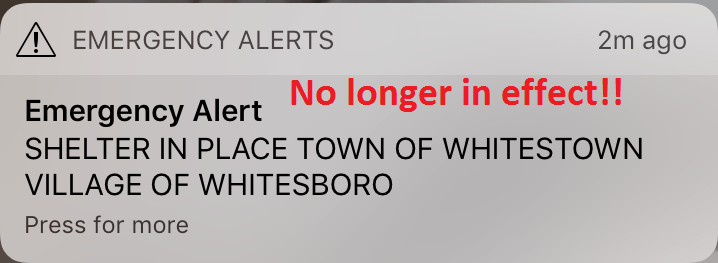
Two days ago, much of the northeast was subject to a powerful storm front, which brought high winds, torrential rains, lightning, and several yet to be confirmed tornadoes.  Corresponding with these threats, areas saw a variety of National Weather Service warnings and watches.  Needless to say, when this emergency alert came up on my phone in the midst of these storms, I assumed the shelter in place order was weather related.  Well, you know what they say about assuming things… and of course I should have known better.

While the area of the alert didn’t impact me, Whitestown is just a couple of towns over, so after a few minutes I figured I should do a bit of research to see if whatever prompted the alert might eventually impact my area.  Unfortunately, ‘pressing for more’, as the alert message indicates, gave no further information.  News media in my area is notoriously slow and uninformative for a period of time, something that held true with this event as well.  Approximately 20 minutes later, a local news outlet Tweeted a message about law enforcement activity in that area related to an armed suspect.

Public information and warning is a big deal.  When we don’t communicate clearly and concisely with the public, we can suffer unintended consequences. While I’m not aware of any severe unintended consequences from the lack of any additional information from this emergency alert, officials must understand that the public (and other public safety professionals) want additional information.  They may also need it so they can make better decisions.

This particular example certainly should have included some brief context as to why the alert was issued.  Given the standing tornado watch which was in place at the time, I’m sure there were plenty of others who assumed this was for a tornado or other storm activity.  Such an occurrence would give me cause to gather my family in the basement for safety, rather than locking my doors, closing my blinds, and ensure that no family members left the house.  Shelter in place can mean a lot of things to different people and adding context could have assisted with ensuring better public safety.  There was also no follow up to this alert lifting the shelter in place message.  (Note: the ‘No longer in effect’ tag is my own, as an effort to be responsible with the image)

While I applaud the use of public alerting tools, issues such as this are seen far too often.  Jurisdictions should have public information and warning components to their emergency operations plans, with specific procedures outlined for not only how to activate an alert, but the proper messaging which should be included to maximize message effectiveness.  Sure, you do it, but do you do it well?

What do you do to ensure effectiveness of your messaging?

© 2017 – Timothy Riecker, CEDP

Emergency Preparedness Solutions, LLC

What’s in a Title?

The most recent issue of Domestic Preparedness Journal includes an article by Chas Eby titled Emergency Management – A Misnomer. In his article, Mr. Eby posits that the title of emergency manager does not adequately describe the discipline or represent the skill sets of practitioners.  While I agree with many of the points Mr. Eby makes, particularly in regard to the huge variety of knowledge, skills, and abilities (KSAs) leveraged by most emergency managers which are largely taken for granted, I disagree wholeheartedly that the term or title of emergency manager is limiting, as his conclusion states.

Functionally, we absolutely see emergency managers, at various levels, conducting a variety of activities.  They may be support staff or executives, decision makers or operators.  They may specialize in any single or multiple facets of the profession.  They must have an ability to coordinate and collaborate, work with grants and budgets, and handle daily administrative matters as well as emergency conditions.  They may specialize in one or more specific applications, such as hazard mitigation, disaster recovery, operations, or preparedness (to include planning, training, or exercises).

Does the title of Chef fully define all the duties of managing a restaurant kitchen including staff, developing a menu, ordering food, establishing processes and systems, and maintaining quality control?  No… because titles that are sentences long are impractical.  People within the profession, and some outside the profession, should be aware of what these titles mean and the KSAs and responsibilities that go along with them.

Sometimes I feel that those fighting for emergency management to become a more ‘established’ profession do more harm than good.  My point is, many skill sets don’t define a profession.  A vast array of professions require the ability to use a copy machine and make critical decisions all in the same breath.  It’s the context in which we apply those skill sets that makes the difference.  Yes, I agree that the skill sets of many emergency managers are taken for granted – but often by emergency managers themselves.

© 2017 – Timothy Riecker, CEDP

Emergency Preparedness Solutions, LLC

2017 Health Security Index

The 2017 National Health Security Preparedness Index has been released by the Robert Wood Johnson Foundation.  The Index provides measures of data nationally and for each state in the US across six public health domains, which include:

  1. Health security surveillance
  2. Community planning and engagement
  3. Information and incident management
  4. Healthcare delivery
  5. Countermeasure management
  6. Environmental and occupational health

The documents found on the website indicate a continued trend of improvement across the nation, but progress is slow, with some states lagging behind significantly according to the study, particularly in the deep south and mountain west regions.

The report identifies the following factors as having the greatest influence on the increase and intensity of US and global health threats:

  • Newly emerging and resurgent infectious diseases like Zika, MERS, and Ebola.
  • Growing antibiotic resistance among infectious agents.
  • Incomplete vaccination coverage.
  • Globalization in travel and trade patterns.
  • Political instability, violence and terrorism risks.
  • Aging infrastructure for transportation, housing, food, water, and energy systems.
  • Extreme weather events including storms, fires, floods, droughts, and temperature extremes.
  • Cyber-security vulnerabilities.

I think it’s important to note that while some of the factors listed above are distinctly within the public health realm, others are more universal in nature.  So not only are the findings of this study relevant to everyone, because public health is relevant to everyone, but many of the factors that influence the threats fall within areas of responsibility of broader emergency management and homeland security.

Public health matters are near the top of my list of greatest concern.  This report clearly shows that while we have made great strides in public health preparedness, we have a long way to go.  There is also no end game.  We don’t get to say we won after playing four quarters, three periods, or nine innings.  These are efforts in which we must persist, and not only with today’s tools and capabilities, but we must constantly look toward new tools.  However, as we do this, new threats will emerge.  It may seem intimidating, but it’s essential.

What are you doing to further public health preparedness capabilities?

© 2017 – Timothy Riecker, CEDP

Emergency Preparedness Solutions, LLC

When in Doubt, Speak from Experience

Last week I had the pleasure of being invited to speak at a conference on incident management. This two-conference covered a variety of topics ranging from preparedness, response, and recovery; and while there was a lot of discussion on mass shootings, the conference covered all hazards.  There were a number of great presenters providing interesting insight and information.  Of course one of the most interesting and effective ways of learning, in public safety and other industries, is through lessons learned of actual incidents and events.  We had some detailed reviews of various incidents, including the Dallas shooting, the Aurora theater shooting, and the San Bernardino shooting.  These had extraordinary detail and discussion, driven by presenters who worked those incidents.

There was one presenter, however, who enjoyed telling stories of incidents which he had no involvement in.  Generally, most people who do such a thing have the common sense of keeping it to brief illustrative points based on specific factual information.  If someone is taking a scholarly approach, we would see more detail, but based upon their research and interviews.  This particular presenter, we’ll call him Bart (name changed), took neither approach.  He was a retired Sherriff’s deputy from a county in California.  He clearly had enough credentials to get himself invited to things, but if this was his general pattern of presenting, I’m guessing he rarely gets invited back.

Aside from his presentations not at all addressing the topic, he liked to tell stories, speaking at length about incidents and locations he has never been involved in.  He even admitted to not having any involvement, and instead citing ‘something he read’ as his source.  This would be sketchy on the surface, but it was even more frustrating when he told stories of NYC 9/11 and recent events in the National Capital Region with myself and a colleague seated at the front table… myself having worked a variety of aspects of 9/11 and my colleague who presently works in the National Capital Region.

Bart presented twice, once the first day, and again on the second day.  While we casted a couple of corrections his way on the first day, we were mostly shocked that he would venture into such territory, providing information that was at best 80% fact.  During his presentation the second morning, we were much less forgiving.  His continued anecdotes about these areas and incidents were relentless, and his lack of facts in the telling of these stories was simply unprofessional.  We called him out on it several times and it was clear from body language and general lack of interest that the room fully understood what was going on.

My general rule of thumb is to speak from experience.  Don’t tell someone else’s story.  That’s not to say you can’t speak about an incident or event you weren’t involved in, just make sure you stick to the facts and be respectful that you have ventured into someone else’s territory.  If you were involved in an incident, you may be inclined to be a bit more casual about your manner because you lived it, but if you weren’t at the incident, keep it formal, cite your fact, associate it with your point, and move on.  Don’t be Bart.

Needless to say, I had several conversations with the conference organizer, who had no prior experience with Bart and was rather appalled at his presentations.

When in doubt, speak from experience.  Don’t be Bart.

© 2017 – Timothy Riecker, CEDP

Emergency Preparedness Solutions, LLC

Operational Readiness – What is It?

A recent project I’ve been working on references ‘operational readiness’ as a key element of the training course.  We all know what operational readiness is, right?  We use the term all the time.  Surely, we must be able to find it defined in some key doctrine of FEMA.  Surprisingly not (and please, don’t call me Shirly).

Ah the internet… you’ll never find a more wretched hive of scum and villainy.  Searches for the definition of operational readiness reveal two different concepts.  The first is a corporate perspective on operational readiness, which focuses on an organization’s ability to do what it is supposed to do on a daily basis.  This definition also seems to be adopted by hospitals.  While tangential, the focus on daily operations isn’t really what we are looking at relative to emergency management.  The second is of military derivation.  Drawn akin to combat readiness, the definition speaks to the capability of a unit, system, or equipment to perform the function for which it was designed.  Yes, this gets a lot closer; such as operational readiness of an EOC to perform as intended when it is activated.  I find it interesting, however, that such a simple, yet powerful concept isn’t defined within our own area of practice.

Edit: A few days after publishing this article I did find a definition of operational readiness in the context of emergency management.  The source is Title 6 (Domestic Security) of the US Code § 741 (National Preparedness System).  Title 6 is essentially the codification of the Homeland Security Act of 2002.  The definition provided therein is largely akin to the definition provided previous of  military derivation, but at least we have something linked directly to emergency management.  See https://www.law.cornell.edu/uscode/text/6.  

If we examine the definitions of each word, there is a bit of redundancy.  One of the definitions of the word operational (an adjective), provided by Merriam-Webster, states ‘ready for or in condition to undertake a desired function’.  A definition provided by the same source for readiness (a noun) states ‘ready for immediate use’.  (weren’t we always taught to not use the word we were defining in the definition?).  Anyhow, this doesn’t seem particularly helpful to us.

Let’s consider what our expectations are of operational readiness in the context of emergency management and homeland security.  Fundamentally (and reinforced by what we covered in the previous paragraph), both words, operational and readiness, imply an ability to perform within defined parameters at any time.  Readiness is often seen as a synonym of preparedness, although I would suggest that in this context, readiness is achieved through preparedness.  If we don’t have each of our POETE elements in order, our state of readiness is likely to be severely diminished.

The context of the term operational readiness generally focuses on a goal we want to achieve and maintain.  We want units, systems, and equipment (reasonably drawn from the militarily-derived definition) to perform in an emergency response to accomplish intended results.  I like to emphasize a difference from the military definition in that last part.  While we have expectations of resources to perform as they were designed to, in emergency management we do on occasion call upon resources (units, systems, and equipment) to perform, not necessarily as they were designed or originally intended, but in creative ways, either pre-planned or ad-hoc.  I think that our definition of operational readiness must leave room for innovation – which is application (and thus readiness) at a higher taxonomy level.

All that aside, I’m not intending to create a definition for the term here, but largely wanted to raise awareness of the lack of a definition within our own area of practice and provide some consideration for what we expect the term to mean through our regular usage.  There is certainly discussion that can be had on measuring operational readiness, which is a separate topic that I’ve largely explored (although not using that particular phrasing) through posts on preparedness and POETE assessments (see the previous link provided).

What thoughts do you have on operational readiness as a term and a concept? Have you come across a definition in emergency management or homeland security doctrine that I might have missed?

© 2017 – Timothy Riecker, CEDP

Emergency Preparedness Solutions, LLC

A New Standard for Emergency Management Programs

Over two years ago I wrote on the two primary standards for emergency management programs in the United States – the Emergency Management Accreditation Program (EMAP) and the National Fire Protection Association (NFPA) 1600: Standard on Disaster/Emergency Management and Business Continuity Programs.  These two standards are voluntary in their adoption and provide common sense guidelines on proven effectiveness and best practices for emergency management programs.  EMAP goes the additional step in offering accreditation for jurisdictions and/or programs based upon compliance with their standards.

Recently, New York’s Governor Cuomo announced what is apparently the nation’s first state-coordinated local emergency management accreditation program.  New York’s program is based upon 21 standards, created and maintained by a committee co-chaired by the NYS Emergency Management Association and the NYS Office of Emergency Management.  The accreditation process identified by NYS’ program guidance is fairly similar to EMAP’s, with application, preparation, a site visit, and committee review.

On the plus side, New York’s system is a further encouragement of the use and application of standards and has enough similarity to EMAP which puts the two accreditations on a close enough path that a jurisdiction can pursue both with little deviation.  The processes of preparation, an on-site review, and final accreditation council review are very similar. Further, agencies accredited through the New York State program are granted the ability to display the accreditation program logo, similar to EMAP, as a matter of pride and recognition.  New York’s system also requires a periodic reaccreditation, which encourages jurisdictions to maintain their accreditation standards.

Where New York’s program differs from EMAP…

  • EMAP accreditation is available to any entity, whereas New York’s appears to be specifically designed for local/county emergency management offices, although it does acknowledge the need for a whole community approach to emergency management
  • EMAP standards identify what components must be in place, not the means and methods used to accomplish those components. This is a significant difference from New York State’s program, which rather heavy handedly dictates means and methods, including mandatory completion of New York State’s emergency management and certification training by key staff, completion of the State’s County Emergency Preparedness Assessment (CEPA) program, and active use of the NY Responds system.  While fundamentally, I agree with promoting these as standards across the state, requiring them for accreditation can lead to a stagnated or stalled program if better training or systems are made available and the standard is not able to be kept current.  Required means and methods also stall innovation, which is another reason by NFPA 1600 and EMAP shy away from this practice.  That said, the aforementioned means and methods are the standard of practice in New York State, so this is a good opportunity to reinforce use of those standards.

New York’s new standard provides a solid exploration into the new territory of state-coordinated accreditation.  I’m a big proponent of states’ rights, and firmly believe this to be a good practice, especially when such accreditations reflect the principles of nationally recognized standards such as EMAP and NFPA 1600.  I don’t view New York’s system as being competitive with EMAP, rather it is quite complimentary.  With additional interests in standards, I’m hopeful that all standards will remain contemporary and cutting edge, constantly encouraging excellence and striving for improvements.

As always, I’m interested in your thoughts on state-coordinated accreditation and emergency management standards in general.

© 2017 – Timothy Riecker, CEDP

Emergency Preparedness Solutions, LLC

Thinking Beyond the Active Shooter

While there is obviously a great deal of attention placed on preparing for, preventing, and responding to active shooter events, is that where the focus really needs to be?  Yes, active shooter incidents are devastating, but they aren’t taking into consideration the full potential of we might be facing.  The DHS definition of ‘active shooter’ actually allows room for additional potential, but the term is still misleading and indicates the presence of only one perpetrator.  (DHS definition: “Active shooter is an individual actively engaging in killing or attempting to kill people in a confined and populated area.”)

First, let’s consider that more than one person could be perpetrating the incident.  Second, let’s consider that the perpetrator/perpetrators might be using something other than or in addition to firearms.  This could include edged weapons, blunt weapons, improvised explosives, or other threats.  Third, let’s consider an increased complexity, including synchronized attacks conducted by one or more independent teams occurring at multiple locations sequentially or in close succession.

To address these potentials, we’ve heard the terms ‘Active Assailant’, which certainly addresses individual(s) using any form of weapon(s) in their attack methodology.  This can also address the more highly complex incident type, which is commonly referred to as a ‘Complex Coordinated Attack’ or ‘Complex Coordinated Terrorist Attack’.  In essence, we are talking about the same conceptual incident, with varying complexity.  But what’s the difference?

The difference is that we should be preparing for a credible worst-case scenario.  While a single shooter is more likely to occur in most places, we’ve seen incidents of knife attacks such as those in recent months in London and Japan.  We’ve also seen motor vehicle attacks in Berlin and NiceThe Columbine High School attack involved firearms, knives, and improvised explosive devices, although the latter weren’t successfully detonated.  For their own reasons, none of these seem to match up with the impression most have with the term ‘Active Shooter’.  ‘Active Assailant’ might be better a better term generally for these kinds of incidents.   More specifically, by current standards, Columbine would likely meet the definition of ‘Complex Coordinated Attack’.  A complex coordinated attack doesn’t necessarily require a high value target or an international terrorist group to perpetrate.

When a jurisdiction plans for a flood, they generally don’t prepare for a couple of road washouts that might occur with a hard rain storm.  They should be preparing for the sudden destructive power of flash floods and the slower but equally devastating potential of areal flooding.   If the jurisdiction is prepared for the credible worst-case scenario, their preparations should be able to address flooding of a lower magnitude.  I’d argue the same for the range of active assailant incidents.  Active shooter incidents are one specific type of active assailant incident, but are not what our preparedness activities should be focused on, as these kinds of incidents can be much more complex and devastating.  Preparedness efforts should, instead, focus on the complex coordinated attack, which is arguably the most multifaceted and impactful type of this incident.  Preparing for the credible worst-case scenario will help ensure our preparedness across the entire spectrum of this kind of incident.

As always, feedback is appreciated.

© 2017 – Timothy Riecker, CEDP

Emergency Preparedness Solutions, LLC