Management and Organization of EOCs

I’ve always been fascinated by emergency operations centers (EOCs).  Through my career I’ve worked in many of them across the nation as a responder, trainer, and exerciser (is that a word?).  I’ve seen EOCs large and small, dedicated facilities and multi-use rooms.  I’ve been in EOCs on the top floor of buildings, so as to have a bird’s-eye view; and those underground, originally designed to withstand a Soviet nuclear attack.  I’ve seen technology that rivals NASA’s Mission Control, and EOCs that drop phone and internet lines from the ceiling when needed.  While the size, layout, and technology can all support an EOC’s mission, it’s really all about the people.

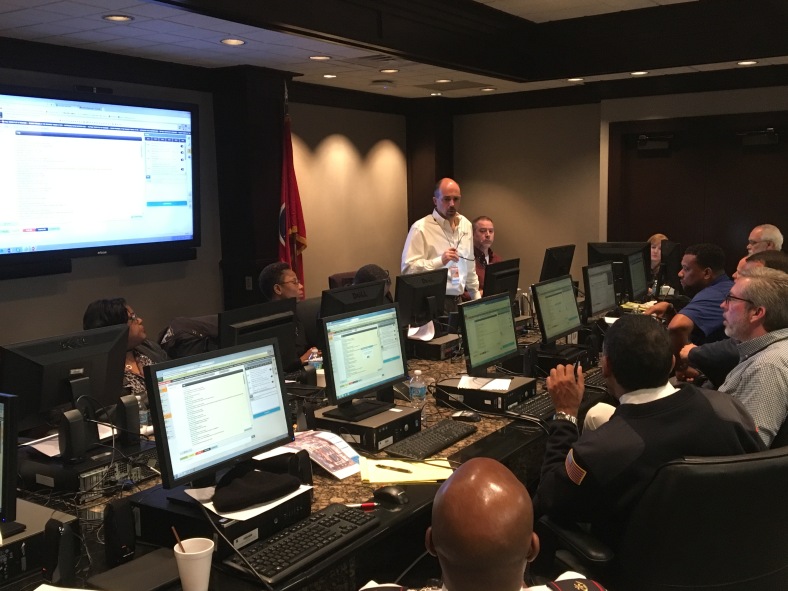
IMG_3226Over the past several months I’ve seen an even greater variety of EOCs due to a broad range of consulting projects I’ve led for my company.  These projects have brought me to EOCs in states, cities, and airports across the nation.  While coordination is the commonality, there are a great deal of differences between and among these EOCs, not only in their physical space, but also in how they operate.  While all pay heed to the National Incident Management System (NIMS) in some fashion, some lean more heavily on the Incident Command System (ICS) than others, while some prefer the emergency support function (ESF) model, and others yet seem to be in limbo, searching for the best model.

It’s been over a year since the National Integration Center (NIC), charged with maintaining NIMS, released a draft for public comment of the NIMS Refresh, which included the Center Management System (CMS) concept.  CMS is/was intended as a model for organizing EOCs and other such incident support functions.  Despite promises, we have yet to see any of that come to fruition.  That said, there are certain expectations and activities that must still exist for an EOC to be successful and productive.

With tactics being managed by the Operations Section in the Incident Command Post (ICP), planning is really the focal point of an EOC.  The perspective of an EOC is generally much bigger picture than that of an ICP.  Assuming a traditional coordination and support role of an EOC, the Operations Section of an EOC is really geared toward pulling agencies together and facilitating strategic-level problem solving through proper coordination.  For an EOC to function properly, current information is just as important as the ability to anticipate future needs so that problems can be solved and resources obtained.  This information management and forecasting is the responsibility of the Planning Section in an ICS-centered model, or of a planning function in any other model.

Every agency that contributes to the EOC, regardless of the model, should be prepared to contribute time and potentially even staff to this planning function.  Often, the incident is ‘routine’ enough that the planning staff are familiar with the various facets of the incident to do proper information collection, analysis, and forecasting; but on occasion subject matter experts are needed to support each of these critical activities.  Those subject matter experts often come from the agencies or emergency support functions represented in the EOC.  As forecasting is performed, opportunities are identified for needs that may need to be supported.  This is where the forecasting loops back to Operations to coordinate the agencies/emergency support functions to solve these problems.

None of this actually means that an EOC doesn’t oversee tactics, even indirectly.  While an ICP, for most incidents, doesn’t report to the EOC, there may be ancillary organizations developed to address other matters which the ICP isn’t overseeing.  While the ICP is focused on immediate life-safety issues, the EOC may be coordinating evacuation, sheltering, or public health matters.  In each of these examples, or numerous others which could be contrived, someone has to be in charge of them.  If the incident commander’s attention is focused on the highest priorities, these other matters are likely to be run by the EOC.  Typically, these would be within the chain of command of the EOC’s Operations Section or through an ESF.

I love seeing how different EOCs address problems and manage their own functions.  I’m all for creativity, but there fundamentally should be some standardization to the organization and management structure.  What’s unfortunate, however, is that so many EOCs don’t have proper plans which identify these functions or how they will be managed.  Some simply insert the phrase ‘NIMS/ICS’ into their plan, and assume that’s enough (it’s not).  Others have no plan at all.  The enemy of coordination is chaos, and if you don’t have quality plans in place, which have been trained to and exercised, the EOC stands to add even more chaos to the incident at hand.

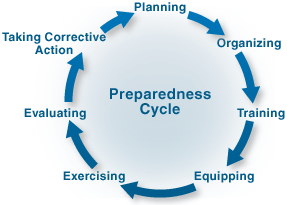
Put some thought into your EOC management structure and plans.    How would the EOC run if you or someone else who usually runs it weren’t there?  Are plans and procedures detailed enough for it to operate smoothly?  Are personnel from all agencies trained properly in their roles and responsibilities?  Have you exercised these plans recently?  If so, what lessons learned do you usually see and have you worked to address them?

Feedback is always welcome!

© 2017 – Timothy Riecker, CEDP

Emergency Preparedness Solutions, LLC

EPS – Celebrating Five Years!

Aside from a brief mention at the end of some posts, I don’t often promote our company on this blog.  While the intent of the blog has never been to directly promote our services, we have gained and maintained a number of professional relationships through it, including those with clients.  I do want to take advantage of the platform on this occasion to express gratitude and hope that you will join us in celebrating an important benchmark.

Emergency Preparedness Solutions (EPS) is excited to be celebrating five years of helping clients to enhance capabilities and improve performance in the areas of emergency management and homeland security.  We have worked with clients across the nation on assessments, planning, training, and exercises on a variety of unique projects.  More specifically, over the past five years we have taken on projects such as exercise design, conduct, and evaluation – including staff support to a state-wide Vigilant Guard exercise, and conduct of airport exercises around the nation.  We have developed, conducted, and evaluated training programs – including those on functional needs sheltering, hazardous materials response for EMS, and continuity of operations.  We have also conducted state-wide training needs assessments, plan evaluations, and have created multi-hazard plans.

EPS New logo

To help mark our five years, we are proud to release a new logo for EPS and an updated website.  The URL is still the same, but the look is totally different.  Please visit us at WWW.EPSLLC.BIZ and take a look around.  Our look is sharper, more contemporary, and mobile friendly.  We also have pictures from a variety of our projects featured throughout the site as well as a live feed of this blog.  Many thanks to Mohawk Valley GIS for their work on the website.  MVGIS is a small business local to us that provides outstanding Geographic Information Systems services and other work locally and afar.  Please be sure to check them out.

On our new website we are also happy to announce our support of Team Rubicon.  Team Rubicon is an outstanding organization that provides hands-on disaster relief services to communities struck by disaster across the nation and around the globe.  Team Rubicon accomplishes great things through the people that make up their organization, mostly military veterans.  You can show them support by direct financial contributions as well as purchasing items through their online store.

We certainly want to acknowledge the contributions of the people who have and continue to work for us on projects.  We often leverage talented people from around the country based on the skills required to meet the needs of clients.  These include active and retired public safety professionals and military veterans.

Like most small businesses, the support of friends and family, especially in the early years, are extremely important.  There are far too many to name, and I’d be likely to forget someone, but each of you have been so important to our success!

Lastly, we wouldn’t be in business if not for our clients.  There are a number of testimonials on our website from several of our clients and we are grateful for the opportunity to work with each of them.  We continue to take on new clients as well as engaging in new contracts with previous clients.  We look forward to continuing on with current clients and working with new ones far into the future!

Thanks for your continued support of this blog and of EPS!

Be safe!

Tim Riecker, CEDP

Awareness of Public Health Preparedness Requirements – CMS

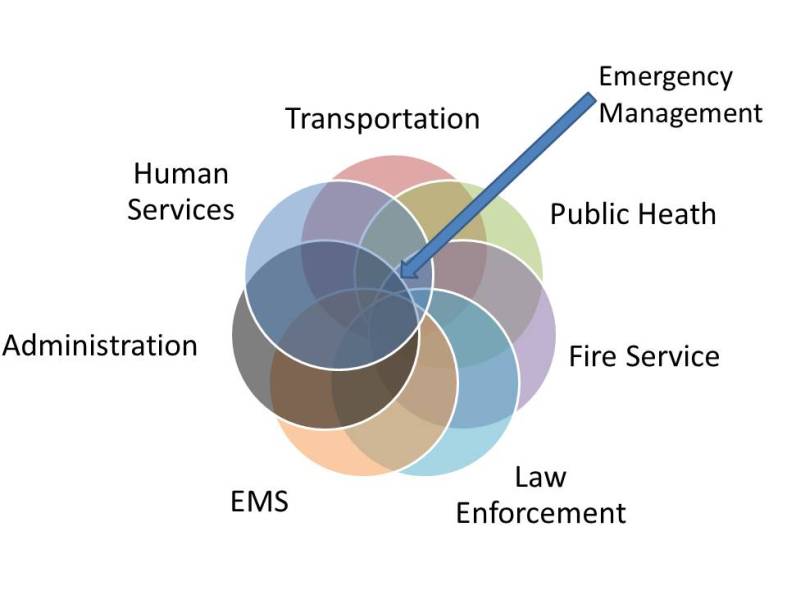
Emergency management and homeland security are collaborative spaces.  Think of these areas a Venn diagram, with overlapping rings.  Some of the related professions overlap with each other separately, but all of them overlap in the center.  This overlap represents the emergency management and homeland security space.  What’s important in this representation is the recognition that emergency managers and homeland security professionals, regardless of what specific agency they may work for, need to have awareness of that shared space and the areas of responsibility of each contributing profession.  One of the biggest players in this shared space is public health.Presentation1

For nearly a year, public health professionals have been talking about new requirements from CMS, which stands for The Centers for Medicare and Medicaid Services.  How does Medicare and Medicaid impact emergency management?  CMS, part of the Department of Health and Human Services (HHS) covers over 100 million people across the US – far more than any private insurer.  As an arm of HHS and a significant funding stream within public health, they set standards.

The most relevant standard to us is the Final Rule on Emergency Preparedness Requirements for Medicare and Medicaid Participating Providers and Suppliers.  The rule establishes consistent emergency preparedness requirements across healthcare providers participating in Medicare and Medicaid with the goal of increasing patient safety during emergencies and establishing a more coordinated response to disasters.

The CMS rule incorporates a number of requirements, which include:

  • Emergency planning
  • Policies and procedures
  • Communications planning with external partners
  • Training and exercises

These are all things we would expect from any emergency management standard.  Given the different types of facilities and providers, however, the implementation of the CMS rule can be complex.  A new publication released by the HHS ASPR (Office of the Assistant Secretary for Preparedness and Response) through their TRACIE program (Technical Resources, Assistance Center, and Information Exchange), provides some streamlined references to the CMS rule.  It’s a good document to study up on and keep on hand to help keep you aware of the requirements of one of our biggest partners.

© 2017 – Timothy Riecker, CEDP

Emergency Preparedness Solutions, LLC

Public Area Security National Framework

The Transportation Security Administration (TSA) recently released this report in cooperation with a variety of stakeholders which provides information and guidance on preparedness, prevention, and response activities to strengthen the public spaces of transportation venues.  While the focus of the document is on airports, the information in the document is great not only across all transportation venues, but other public spaces as well.  I think there are great takeaways for other areas of vulnerability, such as malls, convention centers, event spaces, and others.

To be honest, there is nothing particularly earthshattering in this document.  The document is brief and identifies a number of best practices across emergency management and homeland security which will help agencies and organizations prevent, protect, prepare, and respond to threats, particularly attacks.  That said, the document does accomplish providing concise information in one document on key activities that absolutely should be considered by entities which control public-access spaces.  I would also suggest that this document is still 100% relevant to those which have some access controls or entry screenings.

Information in the document is segmented into three key tenets: Information Sharing, Attack Prevention, and Infrastructure and Public Protection.  Within these tenets are found recommendations such as relationship building, communication strategies, vulnerability assessments, operations centers, planning, training, and exercises.  Most of the recommendations provide examples or leading best practices (although no links or sources of additional information, which is a bit disappointing).

The framework is worth a look and can probably serve as an early foundation of activity for those who haven’t yet done much to prepare their spaces for an attack.

© 2017 – Timothy Riecker, CEDP

Emergency Preparedness Solutions, LLC

Can we Require Preparedness?

The City of Pittsburgh recently lost an effort to require emergency preparedness training for security officers and building service employees.  The Commonwealth Court ruled that the City did not have the authority to require such an ordinance.  This is just another example we’ve seen with difficulties across the US with requirements for preparedness measures.  Why is it so challenging?  It often comes down to the legality of the requirement.

When it comes to the interface of local jurisdictions with states, we often see the concept of home rule providing one of the greatest challenges.  Some interpretations of home rule laws identify that states can’t require local (often to include county) jurisdictions to conduct certain activities, such as have certain plans, attend training, or conduct exercises.  In some states, we see law or regulation that states that if a jurisdiction is to have an emergency plan, then there is a required format of said plan.  But if there is no stick, there is often a carrot.

If requirements can’t be established, then incentives are often the best alternative.  Again, in the local/state relationship, states have grant allocations which can be provided to local governments.  Grant rules can be established that identify certain requirements as conditions of funding.  This tends to be highly effective, especially when funding is expected to continue year after year, and the grants continue to reinforce sustained maintenance on these requirements, such as periodic updates to emergency plans.  Generally, I see no down side to this alternative, so long as the required initiatives are well thought out and realistic given the amount of funds the jurisdiction is receiving.  To ensure effectiveness, however, there must be accountability and quality control measures in place to monitor execution of these requirements; such as reviewing plans, After Action Reports, and auditing training programs. This same methodology is typically how DHS/FEMA is able to get states and funded urban areas (UASIs) to comply with their wishes for various initiatives.

Outside of government, requirements can still be difficult.  While regulations may be put into place for certain industries and under certain conditions, we often have to rely on other, more practical, means of getting businesses, industry, and even not for profits on board.  This often comes with certifications.  An example would be ISO certifications, which some businesses and industry need to compete in certain markets.  Yes, there is even an ISO standard for emergency management.

Unfortunately, many entities, be they public, private, or even individuals, don’t want to be bothered with preparedness.  Most will agree that it’s a good idea, but it takes time, money, and effort.  It’s long been said that you can’t legislate preparedness, and that is often true.  Even if a requirement is able to be established, the extent of implementation can range widely, depending on the internal motivations and resources available to the entity.  Establish whatever requirements you want, but I guarantee there are some that will barely meet those requirements, and in doing so likely not meet the actual intent of the requirement; while others who are believe in the requirement and have available resources, will exceed the requirement.  Largely, organizations are motivated by funding and certification standards.

I’m interested in the perspectives you have on requiring preparedness, both in the US as well as other nations.

© 2017 – Timothy Riecker, CEDP

Emergency Preparedness Solutions, LLC

Supporting a Public Safety Training Program

Today happens to be National Teacher’s Day.  Be sure to show some appreciation for the teachers and professors who have influenced you and provide quality experiences for your kids.  Also consider expanding the definition of ‘teacher’.  In the public safety professions, we do a lot of training.  Some of us have structured academies, and while others may not, there are a lot of training opportunities provided locally, state-wide, and nationally.  Depending on the size and scope of your agency, you may run your own training program for internal, and potentially external stakeholders.

For a few years, I ran the training and exercise program of a state emergency management agency.  We delivered training programs state-wide to a variety of stakeholders.  We also developed some training programs to address needs which curricula from FEMA or other national providers could not meet.  Fundamentally, delivering training is easy, but properly managing a training program can have challenges.  Some thoughts…

  • Find the right people for the job. While we hired some personnel full time to be trainers, we also used people from elsewhere in the agency, as well as personnel from partner agencies, and hired some as 1099 employees.  There are a lot of highly qualified individuals in public safety – if you don’t know any, just ask, and they will be sure to tell you!  Assuming their qualifications are valid, are the most experienced and knowledgeable people always the best instructors?  Absolutely not.  While they may be subject matter experts, it doesn’t mean they have good presentation skills, much less comfort in doing so.  On the flip side, you might also have someone with little experience who has great delivery skills.  That might be a person to develop.
  • Quality control. When people are delivering training, peek in once in a while.  I traveled around the state regularly, and once in a while would see if one of our courses was being held somewhere along my route.  If I had the time, I would stop in and see how things were going.  While the visit was a surprise, our instructors knew this is something that might happen.  There are a few things this accomplishes.  First of all, it gives you an opportunity to observe and provide feedback.  Everyone can improve, and hopefully they can handle some constructive feedback.  Evaluation, formal or informal, is positive for the instructor and the program.  Look for consistency of practice (see the next bullet point) and professionalism.  On one of my surprise visits, I found an instructor wearing jeans and a sweatshirt.  When I discussed it with him, his response was that he was ‘retired’ (teaching for the agency was a retirement job for him) and that he could do whatever he wanted to.  After that discussion was happy to retire him further. Stopping in also shows support for your instructors and for the program as a whole.  Weather traveling across the state or down the hall, instructors want to know they are being supported.  A big part of support is simply being present.
  • Consistency counts. Training programs should be consistent.  While we might change around some examples or in-class scenarios, training delivered in one location by instructor a should largely match the training delivered another day, in a different location by instructor b.  Coming up through the ranks as a field trainer, I was part of a group that wanted to heavily modify the courses we delivered.  As I rose to management, I realized how detrimental this was.  If improvements are warranted, work with your instructors to integrate those improvements into the course.  Make sure that improvements are in line with best practices, not only in instructional design (remember: content must match objectives), but also with the subject matter.  Consistency not only ensures that all your learners are provided the same information, but also makes your curriculum and instructors more legally sound.  Too often we see instructors ‘going rogue’, thinking that they know a better way.
  • Programs need systems. A big part of building and maintaining a program is having adequate systems in place.  Systems require policies, procedures, and tools.  This is largely the behind the scenes stuff of a training program.  This includes annual curriculum reviews, performance reviews of instructors, selection/hiring and firing of instructors, maintaining instructors (see the next bullet), ordering course materials, maintaining training records, posting a course, course registrations, course cancellations, and so much more.  While it sounds bureaucratic, there should be a piece of paper that covers every major activity, identifying how it’s done, by who, with what approvals, and at what time.  Systems make sure that things aren’t missed, give you a basis of performance to evaluate the system and to train new staff, and help ensure consistency.  Systems contribute to your professionalism and are also good practices for business continuity.  Lots of credit to Cindy who was highly dedicated to establishing systems!
  • Keep instructors engaged. With either a large or small training shop, it’s important to maintain contact with your instructors.  Not just in handing them assignments and shuffling paperwork, but to really engage them.  We established twice a year ‘instructor workshops’, bringing our instructors together for two days.  From a management and administrative perspective, we used some of this time to express appreciation for their work, and provide information on curriculum updates and other information.  We encouraged much of the workshop agenda to be developed by the instructors themselves, with professional development provided by their peers.  This could include instructor development, after action reviews of incidents, case studies, and a variety of other activities and information.

Those are just a few tips and lessons learned.  I’m sure you may also have some to add to the list – and please do!

© 2017 – Timothy Riecker, CEDP

Emergency Preparedness Solutions, LLC

Emergency Alerting – A Case Study

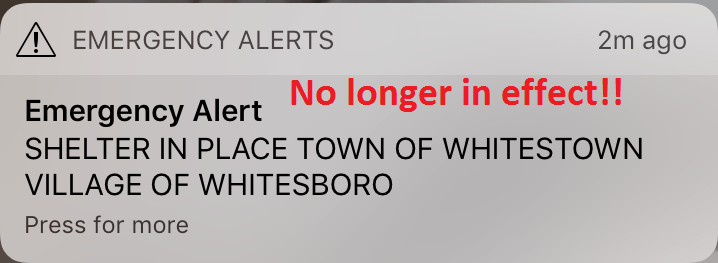
Two days ago, much of the northeast was subject to a powerful storm front, which brought high winds, torrential rains, lightning, and several yet to be confirmed tornadoes.  Corresponding with these threats, areas saw a variety of National Weather Service warnings and watches.  Needless to say, when this emergency alert came up on my phone in the midst of these storms, I assumed the shelter in place order was weather related.  Well, you know what they say about assuming things… and of course I should have known better.

While the area of the alert didn’t impact me, Whitestown is just a couple of towns over, so after a few minutes I figured I should do a bit of research to see if whatever prompted the alert might eventually impact my area.  Unfortunately, ‘pressing for more’, as the alert message indicates, gave no further information.  News media in my area is notoriously slow and uninformative for a period of time, something that held true with this event as well.  Approximately 20 minutes later, a local news outlet Tweeted a message about law enforcement activity in that area related to an armed suspect.

Public information and warning is a big deal.  When we don’t communicate clearly and concisely with the public, we can suffer unintended consequences. While I’m not aware of any severe unintended consequences from the lack of any additional information from this emergency alert, officials must understand that the public (and other public safety professionals) want additional information.  They may also need it so they can make better decisions.

This particular example certainly should have included some brief context as to why the alert was issued.  Given the standing tornado watch which was in place at the time, I’m sure there were plenty of others who assumed this was for a tornado or other storm activity.  Such an occurrence would give me cause to gather my family in the basement for safety, rather than locking my doors, closing my blinds, and ensure that no family members left the house.  Shelter in place can mean a lot of things to different people and adding context could have assisted with ensuring better public safety.  There was also no follow up to this alert lifting the shelter in place message.  (Note: the ‘No longer in effect’ tag is my own, as an effort to be responsible with the image)

While I applaud the use of public alerting tools, issues such as this are seen far too often.  Jurisdictions should have public information and warning components to their emergency operations plans, with specific procedures outlined for not only how to activate an alert, but the proper messaging which should be included to maximize message effectiveness.  Sure, you do it, but do you do it well?

What do you do to ensure effectiveness of your messaging?

© 2017 – Timothy Riecker, CEDP

Emergency Preparedness Solutions, LLC

What’s in a Title?

The most recent issue of Domestic Preparedness Journal includes an article by Chas Eby titled Emergency Management – A Misnomer. In his article, Mr. Eby posits that the title of emergency manager does not adequately describe the discipline or represent the skill sets of practitioners.  While I agree with many of the points Mr. Eby makes, particularly in regard to the huge variety of knowledge, skills, and abilities (KSAs) leveraged by most emergency managers which are largely taken for granted, I disagree wholeheartedly that the term or title of emergency manager is limiting, as his conclusion states.

Functionally, we absolutely see emergency managers, at various levels, conducting a variety of activities.  They may be support staff or executives, decision makers or operators.  They may specialize in any single or multiple facets of the profession.  They must have an ability to coordinate and collaborate, work with grants and budgets, and handle daily administrative matters as well as emergency conditions.  They may specialize in one or more specific applications, such as hazard mitigation, disaster recovery, operations, or preparedness (to include planning, training, or exercises).

Does the title of Chef fully define all the duties of managing a restaurant kitchen including staff, developing a menu, ordering food, establishing processes and systems, and maintaining quality control?  No… because titles that are sentences long are impractical.  People within the profession, and some outside the profession, should be aware of what these titles mean and the KSAs and responsibilities that go along with them.

Sometimes I feel that those fighting for emergency management to become a more ‘established’ profession do more harm than good.  My point is, many skill sets don’t define a profession.  A vast array of professions require the ability to use a copy machine and make critical decisions all in the same breath.  It’s the context in which we apply those skill sets that makes the difference.  Yes, I agree that the skill sets of many emergency managers are taken for granted – but often by emergency managers themselves.

© 2017 – Timothy Riecker, CEDP

Emergency Preparedness Solutions, LLC

2017 Health Security Index

The 2017 National Health Security Preparedness Index has been released by the Robert Wood Johnson Foundation.  The Index provides measures of data nationally and for each state in the US across six public health domains, which include:

  1. Health security surveillance
  2. Community planning and engagement
  3. Information and incident management
  4. Healthcare delivery
  5. Countermeasure management
  6. Environmental and occupational health

The documents found on the website indicate a continued trend of improvement across the nation, but progress is slow, with some states lagging behind significantly according to the study, particularly in the deep south and mountain west regions.

The report identifies the following factors as having the greatest influence on the increase and intensity of US and global health threats:

  • Newly emerging and resurgent infectious diseases like Zika, MERS, and Ebola.
  • Growing antibiotic resistance among infectious agents.
  • Incomplete vaccination coverage.
  • Globalization in travel and trade patterns.
  • Political instability, violence and terrorism risks.
  • Aging infrastructure for transportation, housing, food, water, and energy systems.
  • Extreme weather events including storms, fires, floods, droughts, and temperature extremes.
  • Cyber-security vulnerabilities.

I think it’s important to note that while some of the factors listed above are distinctly within the public health realm, others are more universal in nature.  So not only are the findings of this study relevant to everyone, because public health is relevant to everyone, but many of the factors that influence the threats fall within areas of responsibility of broader emergency management and homeland security.

Public health matters are near the top of my list of greatest concern.  This report clearly shows that while we have made great strides in public health preparedness, we have a long way to go.  There is also no end game.  We don’t get to say we won after playing four quarters, three periods, or nine innings.  These are efforts in which we must persist, and not only with today’s tools and capabilities, but we must constantly look toward new tools.  However, as we do this, new threats will emerge.  It may seem intimidating, but it’s essential.

What are you doing to further public health preparedness capabilities?

© 2017 – Timothy Riecker, CEDP

Emergency Preparedness Solutions, LLC