The Human Aspect of ICS and Overcoming Transitional Incidents

Most often when we consider the Incident Command System (ICS), we think of boxes in an organization chart, forms to be completed, and specific processes to be followed.  True, these are, in essence, aspects of ICS, but they alone will not pave the way to success.  What we must remember is that ICS is conducted by people.

Typically the most difficult aspect of a complex incident is the transition from what we normally do and how we normally respond to elevating our response to a more appropriate level given the scope of the incident.  The groundwork for this transition lies in our initial response, which many experienced responders know can set the tone for the entire operation.  This initial response is based largely on the decisions we make with the information we have.  While there are policies, plans, procedures, play books, checklists, and myriad training that help to inform us, it all comes down to the human factor.  People make decisions based upon the stimuli they are presented with and their own experiences.

Chief Cynthia Renaud in her paper The Missing Piece of NIMS: Teaching Incident Commanders How to Function in the Edge of Chaos discusses approaches to initial response as an oft forgotten aspect of how we teach ICS.  While we know that responders conduct initial responses all the time, there is a significant difference in scope between a routine incident and a complex incident.  This difference in scope requires a different and more open mindset.  While our size up actions may generally be the same, we need to think bigger and this kind of thinking is difficult to train.

The implementation of the ‘bigger’ (i.e. beyond what is routinely used) aspects of ICS is also a challenging mindset for responders.  These aspects of ICS, such as the initial delegation of other organizational aspects and the need for a written Incident Action Plan, do not come easily when they are not practiced.  The fact of the matter is that the implementation of ICS requires a conscious, deliberate decision accompanied by people with knowledge and skilled intent to guide its expansion suitable to the incident at hand.  It also requires a bigger picture mindset recognizing the need to expand the management of the response proportionate to the complexity of the incident and the resources required to address it.  When is it needed?  How do we do it?

One problem is that most of the people we count on to manage these initial responses are trained to manage tactics, not large incidents.  They excel at managing a handful of resources in a rapid deployment and resolving an incident quickly.  This is exactly what they are needed for and they do it well.  Chief Renaud indicates a need to train these first level supervisors to recognize complex incidents for what they are and give them the tools (and authority) to implement broader measures, including an expanded implementation of ICS.

I’m a firm believer in ICS, but I know that people have to drive it.  It’s not something we can put on autopilot and expect it to bring us to our destination.  It has to be consciously and deliberately implemented.  When people criticize ICS, I often find that their criticism is due to false expectations and inappropriate implementation.  With that, I firmly believe we need to do a better job at training to address these issues and help responders better understand the system and demystify its use.

How do we make our training better for the average (non Incident Management Team) responder?  How do we help bridge this gap between the routine and the complex?

© 2015 – Timothy Riecker

Emergency Preparedness Solutions, LLC

www.epsllc.biz 

Emergency Managers Need to be More Like Engineers and Less Like Shopkeepers

I was inspired by this short (~1 minute) video from TrainingJournal.com.  In the presenter’s brief but pointed message, he describes many trainers as being akin to shopkeepers, providing organizations often times with rote solutions just as a shopkeeper will pull a product off their shelves. He goes on to say that this these solutions are usually effective, but only for a limited duration.  He offers, instead, that trainers need to be more like engineers, examining every facet of a problem and constructing lasting solutions.  As an experienced trainer and proponent of a detailed root cause analysis, I couldn’t agree more, but as I readied myself to write a post about the implications of this on training, my mind carried this metaphor to many of our practices in emergency management.

Consider how often we quickly dismiss identified gaps with an assumed solution.  Write a plan, conduct a training, install a bigger culvert.  Those are usually our solutions to an identified problem.  Are they wrong?  No – we’re correct more often than not.  Are these lasting solutions?  Rarely!  How often does the problem rear its head again within a relatively short span of time?  How do we address the re-occurrence?  As shop keepers we simply pull another solution off the shelf.  Can we do better?

The things we do in emergency management are often based upon best and current practices.  We address problems through the prevalent way of dealing with such things industry-wide.  Emergency management has a great community of practice.  I’ve mentioned in several previous blog posts the spirit of sharing we have and the benefits we see come of that.  It doesn’t seem often, though, that we engage in an industry-wide groupthink to solve various problems.  We use and adapt ideas of individuals and small groups, we see a steady and determined progression of the practices within our progression, but we rarely see ‘game changing’ ideas that revolutionize how prevent, prepare for, respond to, or recover from disasters.  Why is this?

Perhaps we need a greater collective voice locally, where practitioners are dealing with the problems directly?  Our methods of practice in emergency management are generally driven by the federal government (THIRA, NIMS, HSEEP, etc.).  I’m not saying any of these are bad – in fact they are excellent standards that we need to continue to refine and apply, but it’s generally not the federal government that is dealing directly with the constant flow of issues being dealt with at a state, and even more so, a local level.  We need to follow that metaphor of being engineers to apply more permanent solutions to these problems.  We need to create, innovate, and problem solve. Or do we?

Necessity, as they say, is the mother of invention.  We often miss the necessity of improving because we have current, functional solutions – we have things that work.  So why fix it if it’s not broken?  I say we can do better.  The realization of the need for lasting solutions is the necessity we need.  If the solutions we have on the shelf don’t work for us 100%, let’s figure out a better way.

I don’t know what or how, but I’m sure that as a community we can identify needs and prioritize what must be addressed.  Given the right people, time, and maybe a bit of money, we can be innovative and effect some lasting change.

I’d love to hear what others think on this topic.

© 2015 – Timothy Riecker

Emergency Preparedness Solutions, LLC

www.epsllc.biz

Do You Have an Emergency Management Committee?

Comprehensive emergency and disaster management, effectively done, cannot be done by one person alone.  The best emergency management and homeland security practices are performed by teams.  The practices of emergency management and homeland security are so ubiquitous and multifaceted that we rely on the participation and input of persons in related professions, and in fact professions generally not seen as related, to be successful.  Because of this, both government entities and corporations alike often embrace a team approach to emergency management.  Do you?

Division of Responsibility – Unity of Effort

Aside from the chief elected official or chief executive officer, no one person has the direct ability to ‘command’ the forces of a jurisdiction or corporation.  The trouble with this is that these CEOs are generally not experts in disaster management.  Effective organizations learn the necessity of delegation early on which, while the CEO is still ultimately responsible, those delegated to are functionally responsible for their respective areas.  Laws and regulations often make these delegations mandatory for both jurisdictions and corporations.  While each of these delegations has their own functional responsibilities, they still operate as part of a greater organization and must work well together achieve maximum effectiveness.

The ability of these stakeholders to work together in a unity of effort is certainly important during a disaster, but it’s not the only time they should get together to talk about disasters.  Yes, many of these individuals will see each other during (hopefully) regular staff meetings, but these meetings typically involve briefing the CEO on current or upcoming activities, discussions on hiring and budgets, or being briefed on new policy.  While these are all important discussions they usually leave little room to discuss topics on emergency management and homeland security.

EM/HS certainly warrants its own meetings and workshops to accomplish important tasks such as a periodic threat and hazard identification, plan creation and updates, exercise planning meetings, and discussions on training, grants, and preparedness investments.  This group should also be making policy recommendations to the CEO and ensuring that preparedness efforts are permeating the entire jurisdiction or organization.  Their work together in preparedness efforts will strengthen their relationships and increase their knowledge of each other’s functional responsibilities and capabilities.

Who Should Participate?

In any of the mission areas of emergency management and homeland security (Prevention, Protection, Mitigation, Response, and Recovery – or in activities related to preparedness for any of these) there are often related or even overlapping interests amongst department heads.  The emergency manager, fire, police, EMS, and public works/highway are often at the forefront; but other departments and positions such as parks and recreation, clerk, human resources, finance/treasurer, and zoning can all (and should) have some degree of input.  Larger jurisdictions may have their own health and human services departments which are also important participants.  There are similar positions within corporate organizations that have the same interactions and hold the same importance in this regard to these organizations.  Also be sure to consider external partners such as utilities, major employers, and not for profits and social groups?  Perhaps your EMS provider is a third party or your law enforcement is provided for by a Sheriff’s Department or State Police – be sure to include them as well.

This ‘whole community’ list can grow very quickly and often times not all members are needed for the group to function effectively.  The best practice in emergency management committees is to take a tiered approach – with a core group addressing most matters but with the support and augmentation of an expanded group to include other departments and organizations whose participation is called upon when needed.

Emergency management and homeland security are team efforts which require the active participation and input of all stakeholders to be effective.  Don’t just rely on your emergency manager to get the job done.  They need support from the entire organization to ensure that your jurisdiction or corporation is prepared to address the worst, save lives, and minimize losses.  Some emergency managers view such committees as ‘oversight’ or an unnecessary bureaucracy, but success lies in collaboration.

What’s your approach?

© 2015 – Timothy Riecker

Emergency Preparedness Solutions, LLC

www.epsllc.biz

Book Review – Next-Generation Homeland Security by John Fass Morton

I’m a firm believer that professionals need to keep current on trends and major discussions in their field of practice.  Homeland security and emergency management are no different, which is why I spend a great deal of time reading – books, blogs, newsletters, etc.

A book I finished in recent months was Next-Generation Homeland Security by John Fass Morton.  The book offers a great history of the roots of emergency management and homeland security, insights into the politics involved in the evolution of the two related fields, and thoughts on how preparedness agendas of the federal government and preparedness needs of local and state governments can be better merged moving forward.

Mr. Morton provides a highly detailed history of EM/HS – the most detail I’ve ever seen published anywhere.  This history doesn’t just cover new laws and changes in agency names, but also identifies key players and influencers, missteps, and practices along the way.  His detail of EM/HS over the past two decades is even greater as he has been able to obtain information and insights from his own experiences and those of his colleagues and contemporaries.  These details include all of our current programs such as NIMS, EMAC, and others – including many of the predecessors of those programs.  If you have interests in history or politics, much of the book will be very interesting to you simply based on this content.

Much of the book’s focus is on all-hazard preparedness, so you won’t find a great deal of information on DHS member agencies and their mission areas.  The book primarily follows the evolution of emergency management and its relationship with homeland security, while also providing some insight into the roots of homeland security which well predate 9/11.  Mr. Morton’s research certainly demonstrates how cyclic these evolutions have been.

Mr. Morton offers some interesting perspectives on our current state of preparedness and offers thoughts on organizational models which can enhance the coordination between the federal government and state and local authorities through strengthening of the FEMA/DHS regional offices, particularly the regional preparedness staff.  It’s apparent that there often conflicts between the federal government and state and local governments in regard to EM/HS priorities across all mission areas.  Mr. Morton’s perspectives offer a viable solution.

As I read I marked a lot of pages in the book for future reference, particularly in the second half (about 200 pages).  If you don’t have much interest in the histories Mr. Morton provides, as they are quite detailed, the second half of the book is where there will still be great value to you as this is where more contemporary practices, policies, and organizations are detailed as well as Mr. Morton’s thoughts on the further evolutions of our practice including the Federal regional approach and other topics such as professional development.  This is an excellent book for the dedicated practitioner who is looking for not only a detailed history but also thought provoking insight, not just a regurgitation of doctrine.  I believe it would also serve as an excellent book for graduate level academics, as it not only provides a great deal of information but can certainly stimulate quite a bit of discussion.  I hope to see some of Mr. Morton’s ideas get discussed broadly for the benefit of our profession.

Best Practices for the New Year – Resolve to be Responsible, Realistic, and Resourceful

As I work with jurisdictions and discuss their capabilities I find a broad range of perception among emergency managers about their jurisdictions’ capabilities and limitations.  Some overestimate their capability, thinking that they can handle anything and don’t need any outside assistance.  Others underestimate their capabilities, with their emergency plans defaulting to calling for help or making someone else responsible for nearly every scenario.  Fortunately some jurisdictions are spot on and have an informed and realistic perception of their capabilities.  Having the wrong awareness of what your jurisdiction can and cannot do can be dangerous.

Be Responsible

First of all, jurisdictions need to be responsible for their people.  Far too often I see an automatic assumption that someone else will handle an incident or a certain aspect of an incident, apparently abrogating the jurisdiction of all responsibility.  One of the more common occurrences of this is with sheltering where I rather often hear ‘The Red Cross will take care of that.’ with no further discussion even considered on the subject.  With no slight intended toward the Red Cross, relying on one entity to provide an absolutely critical capability is simply foolish.  If the Red Cross or any other outside entity is for some reason unable to provide these services for the jurisdiction, the jurisdiction is still left with the responsibility to provide this care for its citizens.  A jurisdiction without a plan to address this need is not being responsible for the welfare of its citizens.

The primary goal of a jurisdiction is to provide for its citizens.  Take this seriously and remember that you can’t assign this responsibility to others.

Be Realistic

Know your capabilities and your capacity.  In other words, know what you can and can’t do; and for what you can do, know how well and how long you can do it for.  Know what your limitations and dependencies are.  If your jurisdiction’s ability to provide advanced life support (ALS) care is dependent upon the only paramedic you have as a member of your ambulance service, you have very little capacity and quite a bit of vulnerability.

A good start to having a realistic view of your jurisdiction’s capabilities is conducting and regularly updating a comprehensive threat and hazard identification and risk assessment (THIRA).  THIRA is an in depth assessment which combines a traditional hazard analysis with a reference to DHS’ 31 Core Capabilities in the context of the threats specific to a jurisdiction.  I strongly suggest that a jurisdiction conducting a THIRA extend this assessment into an analysis of five key elements (Planning, Organizing, Equipping, Training, and Exercising – POETE) for each of their capabilities.  Go here for my post on the POETE analysis which explains the benefits and the process a little more.

A good THIRA helps jurisdictions identify not only their hazards but also the potential worst-case scenario impacts of these hazards.  It then provides an opportunity for the stakeholders of the jurisdiction to take an honest look at their capabilities and their ability to leverage these capabilities against those impacts.  Being honest in this assessment will help jurisdictions see what can hurt them most and identify the gaps and limitations they have in their capabilities.

Bottom line – be realistic in what you can do, how well, and how long you can do it.

Be Resourceful

The ability to endure the impacts of a disaster and, at a minimum, address the critical objectives of life safety, incident stabilization, and property conservation can require a jurisdiction to be creative and resourceful.  This is a key aspect of resiliency.  While assistance may still be needed from outside sources, a jurisdiction’s ability to survive and provide lifeline services for its citizens in the interim is extremely important.  Being resourceful can help a jurisdiction shore up its capabilities in times of need.  Key to being resourceful are good contacts and connections within the whole community.  Religious groups and social organizations, private companies, and even individual citizens can all provide services which can aid a jurisdiction in shoring up capabilities – at least in the short term.  Incorporate these as options within your emergency plans.  While these entities may have issues and commitments of their own during a disaster, they may also be able to help.

Use all available resources to get the job done and to sustain for as long as you can.  It can absolutely be the difference between life and death.

Best Practices for the New Year – Standards in Emergency Management Programs

Going into the New Year I’m endeavoring to write a few posts on best practices in emergency management.  The New Year is a great opportunity for us to take a broad look at our emergency management programs to identify needs and develop and implement some strategies to improve.  Instead of looking back in a rather cliché “year in review”, let’s look ahead toward improvement!

I also wanted to express appreciation to all of my blog readers.  Some of you find me directly through my blog’s home at WordPress, some through LinkedIn or Twitter (@triecker or @epsllc), and some through my company’s website – Emergency Preparedness Solutions, LLC.  If you like my blog please share it with others.  Comments are always welcome.

On to our topic… Standards in Emergency Management Programs

All emergency management programs – government, private sector, and not-for-profit – should strive for their programs to meet accepted industry standards.  The two most significant standards in the United States are the National Fire Protection Association (NFPA) 1600: Standard on Disaster/Emergency Management and Business Continuity Programs and the Emergency Management Accreditation Program (EMAP).  The two standards are very similar in content and in fact complimentary, with the most significant difference being that EMAP offers an actual accreditation process.  Both programs offer copies of their standards free of charge, which is reflective of the spirit of sharing and improvement that exists in emergency management.

The NFPA offers the most recent previous version of their standard as a free download from their website.  The NFPA 1600 standard is quite detailed and can be initially overwhelming but really should be referenced piecemeal.  The free EMAP standards are published in a bit less detail, but they provide a very detailed assessment tool for those who initiate the formal accreditation process.  Because neither standard references specific laws or FEMA documents, they are also great references for governments, private sector, and not-for-profits outside the US.

How should you review the standards? 

They both essentially serve as checklists for what is programmatically needed for successful emergency management programs.  They are both organized by functions, such as planning, training, exercises, and logistics allowing a program to see what activities within each area are needed.  Neither standard will tell you how to meet any particular section of their standard, as they don’t want to be seen as favoring any particular published processes or products and want to encourage innovation and resourcefulness.  This also lends itself well to either/both standards being applicable and achievable by large and small organizations alike.

Examining your own emergency management program through the lens of either of these standards provides a great opportunity to see where you stand.  Examine your functions piece by piece, function by function.  Check off what areas you feel meet the standards and highlight those which you feel do not.  Use these areas as a point of reference for improvements.  Conduct a bit of a needs assessment in these areas to identify exactly what needs to be done to improve and meet the standard then create an improvement plan to make it happen.

Having helped organizations with both NFPA 1600 compliance as well as EMAP accreditation, I’ll attest that much of it simply comes down to paperwork and good systems management.  Many of the standards can be addressed through creating and applying polices and solid practices and procedures.  Organized and thorough record keeping is very important for these matters.

What if you don’t have a specific emergency management function or certain activities are conducted by someone else?

Of course you probably should have a specific emergency management function within your community, company, or organization; but many do not.  Needs are often met in these circumstances through an amalgamation of functions found throughout the rest of the jurisdiction, company, or organization.  Hopefully you at least have an emergency management committee (or one which can serve this purpose such as a safety committee) which has representation from these various entities.  Such a committee is an ideal group to review these standards.  An emergency management program isn’t necessarily a specific agency or office; it’s really the entire system.  These standards should be examined through the entire jurisdiction, company, or organization as responsibilities and functions may be spread around.

What advantages do these standards offer for emergency management programs?

There is certainly a piece of mind knowing that your program meets these standards which are based upon industry best practices, even more so if you took advantage of EMAP’s accreditation.  These standards also provide documented justification for grants, budget allocations, resources, and activities which will contribute to a thriving emergency management program.  Overall, however, you will find that your program will be more professional and more responsive to the emergency and disaster needs of your constituency – be it a community, company, or organization.

Meeting these standards is an investment, but mostly of time and effort.  Sure, there are ways you can meet certain standards better by purchasing some cutting edge software or hiring six more people, but these standards are not intended to serve only the most fortunate and affluent emergency management programs.  A program run by a part time emergency manager with minimal funding can still successfully meet these standards.

Maintaining compliance with these standards is important and is an ongoing effort – it’s quite easy to fall off the carnival ride, especially when distracted by our daily routines and changing priorities.  Set a schedule to conduct an annual review of the standards, incorporate your compliance efforts into strategic plans, and regularly refer back to the standards to keep them fresh in your head.

Of course help is available!  Emergency Preparedness Solutions can help your jurisdiction, company, or not-for-profit conduct a Standards Assessment to determine what standards are met, what standards need to be met, and develop a strategic plan to meet these standards.  Through our full range of preparedness services we can also help you meet these standards and develop a maintenance plan for your program.

If you have questions please contact me at tim@epsllc.biz.

Have a wonderful, safe, and productive New Year!

@ 2014 – Timothy Riecker

Dig Deeper – Ask ‘Why?’ Five Times

Be an archaeologist and DIG DEEPER!

Be an archaeologist and DIG DEEPER!

An old boss of mine once told me that to find the real root of any problem you should ask ‘Why?’ five times.  This sage Yoda-like advice has served me well ever since.  Of course it’s not always necessary to ask it the full five times; in fact you often find the foundational cause sooner.  Nonetheless, this approach will inevitably guide you toward discovering what needs to be fixed.

Those who follow my blog know that I post mostly within two thematic areas – emergency management or training.  The ‘ask why’ methodology applies to both of these areas and darn near anything else I can think of.  My thoughts are below on both themes.  Of course training in the field of emergency management is a combination of the two!

In Emergency Management

I’ve posted numerous times on topics such as hazard analysis, Threat and Hazard Identification and Risk Assessment (THIRA), and other similar topics in emergency management.  It is so incredibly necessary for us to identify needs and vulnerabilities, and to understand our community’s capabilities in order to properly prepare for future disasters and emergencies.  I’ve learned that in public safety, when asking a question, you often get a story and that story is often related to a past incident.  While the story may be elaborate, it usually gives you little substance.  Anecdotes aren’t enough.  You need to dig deeper.

As a culture within public safety we are still trying to drive practitioners to be more analytical.  Quality after action reports are a big step in the right direction.  The benefits of after action reports for incidents, not just exercises, are huge.  After action reports should lead to improvement plans, but without identifying the real reason behind what went wrong we can’t fix the problems.  After action reports require an analysis to dig deeper into the observed action to discover what really needs to be addressed.

In Training

In November I published an article in Training Magazine titled The Importance of Analysis to Identify Root Cause.  While I didn’t reference the ‘ask why’ methodology directly, the subject matter of the article lends itself to this approach.  As a trainer, when a problem is presented to you to ‘fix with training’, you need to figure out what the real issues are so that 1) you can confirm that it is in fact a training issue, and 2) you can determine what the objectives and methodologies of the training need to be.  Without properly identifying and defining the needs you are doomed to fail and will likely be putting forth a lot of effort with little gain.  While the results may put some people on the defensive, they can point the organization in the right direction to address inefficiencies and performance problems.

In any needs assessment, don’t simply accept the first answer given to you – dig deeper!  It’s amazing what you will find!

© 2014 – Timothy Riecker

Emergency Management Manuals from Australia

One of the greatest aspects about the field of emergency management is the community of practice we share.  It’s recognized throughout the entire profession that we improve as a practice not only through our own lessons learned buy by sharing and learning from everyone.

The following website provides links to a multitude of manuals on various emergency management related topics from Australia.  http://www.em.gov.au/Publications/Australianemergencymanualseries/Pages/default.aspx  The Aussies deal with all the same hazards we do – with wild fire, flood, and typhoon topping off the list for much of the continent.  Take a few minutes to look through what they have shared – you just might learn something, I know I did!

© 2014 – Timothy Riecker

Preparing for Ebola – and Whatever Else May Come

Unless you’ve been living under a rock lately, you should be quite aware of the headlining threat in public health and public safety – Ebola hemorrhagic fever.  Ebola has been in existence for quite a while, but the current outbreak of this deadly virus in western Africa has garnered much attention.  Thus far, beyond western Africa, infected persons have been identified in Spain and the United States.  The ease and frequency of air travel, combined with the virulence of Ebola have led to a frenzied reaction by politicians, the media, and our health care system.  While we are at a stage in the US where only a handful of infected persons have been identified, this virus is quite dangerous and could easily and rapidly spread.

While I’m not a public health expert, preparedness is universal.  Public health is at the tip of the spear for this fight and must be supported by other professions within public safety and beyond – that’s what emergency management is all about.  That said, this is proving to be quite a test for our public health partners.  The consequences of failure could be devastating.

Considering the five mission areas, we are most strongly functioning within Prevention, Protection, and Response for Ebola.  Certainly the three common Core Capabilities of Planning, Operational Coordination, and Public Information and Warning are all fully engaged across the three mission areas.  Additionally, we are seeing a great deal of work within in the Intelligence and Information Sharing; Screening, Search, and Detection; Public Health and Medical; and Situational Assessment Core Capabilities; along with some work in other capabilities to a lesser degree.  Why is it important to recognize the mission areas and Core Capabilities?  It helps to keep us focused and prompts us to examine the critical activities for each.

In which mission areas and Core Capabilities does your agency fit in?

What are you responsible for?

Are you doing it?

Do you have all the information you need to do it safely and effectively or are you waiting for public health to call and tell you what to do?  I’m betting you haven’t gotten that phone call.

In a situation like this, we are seeing a lot of activity and emphasis at the Federal level through US Health and Human Services and the Centers for Disease Control.  Their focus is on solving the problem in front of them.  While they have people engaged in getting messages out and engaging partners, they have a lot to accomplish and likely haven’t gotten to all the stakeholders.  We will hopefully see some more aggressive messaging given the circumstances that have been described at the Texas hospital where Ebola patients have been treated.  So what should you do?  Hopefully your agency is already in contact with your local health department to discuss both your role in the public safety system and the potential exposures and vulnerabilities you may have to Ebola.  If your local health department doesn’t seem to have much information, reach up to your state health department.  Don’t wait to get a call… by then it could be too late.

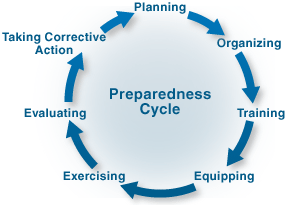
Very simply, we are looking at preparations for your agency’s role.  These preparations, although slightly different based on the agency, apply to all agencies; from first responder agencies, to local government, K-12 and higher education schools, hospitals, private sector, and not for profits.  Let’s break this down with the Preparedness Cycle:

The Preparedness Cycle - FEMA

The Preparedness Cycle – FEMA

Plans, policies, procedures – do you have them in place and up to date?  Depending on the role and function of your agency you can have several of the following – emergency operations plan, emergency procedures, infection control plan and procedures, public health plan, communicable disease or pandemic influenza plan.  You should engage with public health experts to ensure that your plans, policies, and procedures address everything known about Ebola.  You may need to create some procedures specifically addressing issues pertaining to Ebola and your agency’s role.  Do your plans, policies, and procedures link up to your agency’s critical activities for each Core Capability you are engaged in?  What agencies do you need to coordinate with to be effective?

Organizing – depending on your agency’s role, you may need to make some internal changes or designations within your organization to better streamline your activities.

Training – train everyone who has anything to do with any component of the plan in what they need to do.  This is a great opportunity to ensure that everyone is trained up in their role of the emergency operations plan.  If your agency has physical contact with the public, training in personal protective equipment (PPE), identification of signs and symptoms, and patient care are extremely important.  Given the detail of the activities and the just-in-time training, job aids will be a great help to your staff to ensure that they follow the procedures you provide for them.  Don’t get caught short… communicate to your staff in what is going on, what your agency is or may be responsible for, and what they will be called upon to do.

Equipping – your staff need the right equipment for the job.  Not only PPE, but the forms and databases used to record information, decontamination equipment, etc.  It is extremely important that staff are trained not only in how to use equipment but to prevent contamination of equipment and prevention of cross contamination.  Do you have all the equipment you need?  If not, who does?

Exercising – Conduct table top exercises to talk through policies and higher levels plans to validate and become familiar with them.  Identify shortfalls and correct them immediately.  Conduct drills to test the skills of staff for specific activities and larger exercises – functional or full scale – to test multiple functions and plans.

Evaluating – Evaluation is a constant throughout all of the preparedness cycle.  We need to evaluate every step within the preparedness cycle and make adjustments and improvements as needed.  Embrace best practices and fix shortfalls.  This leads directly to the next step…

Taking Corrective Action – Some corrective actions are quick and easy fixes while others can take a while or cost money above budget to address.  A corrective action plan (aka improvement plan) will help you keep track of what needs to be fixed, the priority it holds, who is responsible for making it happen, and a strategy to make it happen – it’s a living document.

The preparedness cycle can be applied to any hazard, be it Ebola or a flood.  With all this attention on Ebola, it’s a great opportunity to pull plans off the shelf and have discussions with internal and external stakeholders on these preparedness steps.

© 2014 – Timothy Riecker

Exercising Foundational Skills with Unorthodox Scenarios

Does the scenario of an exercise activity really matter?  Can we use a zombie scenario to exercise evacuation and sheltering?  Can we use a holiday food distribution to the needy to practice our POD (point of distribution) plan?  Do scenarios always have to be realistic or related to our jurisdiction’s hazards?

I’m a foodie.  As such I find myself occasionally watching shows like Cutthroat Kitchen and Chopped.  These are fun shows that strike a balance of cooking with game shows, including the cash prize in the end.  The competitors are legitimate cooks, some trained in culinary schools, some successful in their careers and earning the title of ‘chef’.  The competitors are given, on the spot, either a dish to create (Cutthroat Kitchen) or a box full of ingredients which must all be incorporated into a dish (Chopped), using a kitchen and pantry generally unfamiliar to them, within a relatively short amount of time – and make it better than their competitors.  Is competing on these shows anything like running a professional kitchen?  Hell no.  Does it make them better cooks?  From interviews I’ve heard, the answer is yes.

Can we recreate this in emergency management?  Of course we can, and we should.  How would this help emergency managers and other public safety professionals?  Recall that within the exercise design component of the HSEEP process the Core Capabilities to be focused on and the objectives to be tested are selected prior to determining the scenario.  This tells us that the activities to be performed are more important than the scenario in which they will be performed.  In these cooking competitions, the participants must fall back on their foundational skills to be successful.  It’s those foundational skills and the activities which they foster that we evaluate in our exercises.

Certainly a scenario has some importance.  It provides context, allowing the participants to get their head into what they are doing.  A scenario can be different, even a bit silly or fantastical (alien invasion, anyone?), but it still has to correlate to the objectives of the exercise; i.e. there must be a compelling reason to perform mass prophylaxis or to evacuate an area.  That said, the scenario is simply a vehicle to get our participants to perform what we intend to test.  Don’t we always tell our participants to not fight the scenario?  Well if it’s something they’ve never before experienced, they have little ground to stand on.

Another benefit to using an unfamiliar or alternate scenario is getting participants to break from the routine and face unexpected and new challenges.  What if digital communications fail?  What if they have to relocate to an alternate EOC? What if that alternate facility is likewise compromised?  Consider using the scenario to remove a critical resource from use.  How will the participants overcome this new problem?  In Cutthroat Kitchen, participants are faced with unseemly injects to their food preparation, such as replacing all cooking utensils with a Swiss Army knife or only being able to cook using a microwave.  Some of your participants may balk at such occurrences, but emergency management is about managing the unknown, the unfortunate, and the unexpected.

Regardless of the measure of reality we choose to base our exercises on, the scenarios we develop are really another level of fiction to help facilitate exercise participation.  Yes, often times we want to test hazard specific plans (a zombie apocalypse exercise can not replace the need of a hurricane exercise), but if the scenario itself doesn’t matter, consider using something ‘outside the box’.  Routine makes us complacent and complacency is very dangerous in emergency management.  We must always expect the unexpected and continually have the mindset to improvise, adapt, and overcome.

© 2014 – Timothy Riecker