ICS: Who doesn’t need it?

In a recent discussion thread, someone shared some material for a new program that promotes resiliency for disaster housing.  While the intent of the program is good, there was one thing that struck me – it stated that it was based on the incident command system (ICS).  My question – why?

ICS is a great system.  It’s proven to be effective WHEN APPLIED PROPERLY.  That’s the catch, though, isn’t it?  A great many after action reports (AARs) identify areas for improvement relative to various facets of ICS after incidents, events, and exercises.  The organizations that the AARs are usually focused on are professional response organizations – fire, police, EMS, public works, public health, emergency management, etc.  These are organizations that generally get LOTS OF PRACTICE in applying ICS.  So what’s the problem?

The problem is that most organizations that do use ICS don’t get enough practice in applying ICS beyond smaller incidents.  So if responders, who are using ICS, have difficulty with expanded application despite some practice and more advanced training, how are organizations who don’t use it all expected to be able to remember it much less apply it properly on even the most basic of incidents?  (More on my issues with ICS training here, in case you’ve missed posts over the last year or so.)

So back to the main topic of this post – who doesn’t need ICS training?  I would suggest that those persons and organizations that don’t fit the broad definition of responders DON’T NEED IT.  While this may be blasphemous to some, consider the time and effort wasted on getting people trained to understand ICS who will NEVER USE IT.  “But what if they do need it?” you ask?

I’m challenged to really find that need.  Why does the management of an apartment complex need to know or understand ICS?  I find the thought of that foolish and wasteful.  Sure, they can be a partner in disaster preparedness, response, and recovery.  Does that make them a responder?  No. Will they become part of the ICS organization?  NO!  Is there any reason why they would need to use ICS to manage their own organization?  NO!!! They manage their organization every day through what should be a very effective model for them.  Why the hell do we want to change that?  We need to stop pushing our complex shit on other people who don’t need it.

I’m of two thoughts on this… One, there are people who are so gung-ho over including everyone under the sun into emergency management that they feel compelled to bring them into the profession.  News flash people – if they wanted to be emergency managers, they would.  There is no practical reason for them to be trained in the vast complexities of emergency management.  Two, there are people who don’t really understand the applications of emergency management themselves, and therefore try to make adaptations of the system for every variety of stakeholder out there.  This is something I’ve struggled with very often as people try to adapt ICS to their organization and, in doing so, change the foundational principles of ICS (span of control, terminology, organizational structure, etc.).  Further, every organization thinks they have an INCIDENT COMMANDER.  STOP!!!

ICS is not for everyone.  I’m not being elitist or exclusionary, I’m being practical.  That’s not to say that certain stakeholders shouldn’t at least be familiar with what it is, but still not every stakeholder or partner, and they certainly don’t need to know how to actually apply it.  For many, simply having a point of contact with certain departments or through the 911 center is enough.  Certainly if some have an interest in it they can ask, or take a class either in person or online.  (I would never withhold a training opportunity from anyone.)  This should certainly give them enough to satisfy their curiosity.

Along with my crusade to make better ICS training for responders (even non-traditional ones), I would suggest that we need to do a better job of advising other organizations about how they interact with the system.  Simply throwing ICS training at them DOESN’T WORK.  It creates false expectations and generates more confusion.

So please, fire away with your thoughts.  Who do you think shouldn’t have ICS training?  What would you change about the current ICS training model/requirements? 

Shameless plug time: Need ICS training or training in other areas of emergency management?  How about meaningful and practical emergency plans you can actually implement?  Exercises to test those plans and give staff an opportunity to practice implementing plans?  Emergency Preparedness Solutions can help!  Link to info below!

© 2016 – Timothy Riecker

Emergency Preparedness Solutions, LLC

Emergency Management: Coordinating a System of Systems

Emergency management, by nature, is at the nexus of a number of other practices and professions, focusing them on solving the problems of emergencies and disasters.  It’s like a Venn diagram, with many entities, including emergency management, having some overlapping interests and responsibilities, but each of them having an overlap in the center of the diagram, the place where coordination of emergency management resides. That’s what makes the profession of emergency management fairly complex – we are not only addressing needs inherent in our own profession, we are often times doing it through the application of the capabilities of others.  It’s like being the conductor of an orchestra or a show runner for a television show. It doesn’t necessarily put emergency management ‘in charge’, but they do become the coordination point for the capabilities needed.

Presentation1


This high degree of coordination depends on the functioning and often integration of a variety of systems.  What is a ‘system’?  Merriam-Webster offers that a system is a “regularly interacting or interdependent group of items forming a unified whole.”  Each agency and organization that participates in emergency management has its own systems.  I’d suggest that these broadly include policies, plans, procedures, and the people and technologies that facilitate them – and not just in response, but across all phases or mission areas.  Like the Venn diagram, many of these systems interact to (hopefully) facilitate emergency management.

There are systems we have in many nations that are used to facilitate components of emergency management, such as the National Incident Management System (NIMS), the Incident Command System (ICS) (or other incident management systems), and Multi-Agency Coordination Systems (MACS).  These systems have broad reach, working to provide some standardization and common ground through which we can manage incidents by coordinating multiple organizations and each of their systems.  As you can find indicated in the NIMS doctrine, though, NIMS (and the other systems mentioned) is not a plan.  While NIMS provides us with an operational model and some guidance, we need plans.

Emergency Operations Plans (EOPs) help us accomplish a coordination of systems for response, particularly when written to encompass all agencies and organizations, all hazards, and all capabilities.  Likewise, Hazard Mitigation Plans do the same for mitigation activities and priorities.  Many jurisdictions have smartly written disaster recovery plans to address matters post-response.  We also have training and exercise plans which help address some preparedness measures (although generally not well enough).  While each of these plans helps to coordinate a number of systems, themselves becoming systems of systems, we are still left with several plans which also need to be coordinated as we know from experience that the lines between these activities are, at best, grey and fuzzy (and not in the cuddly kitten kind of way).

The best approach to coordinating each of these plans is to create a higher level plan.  This would be a comprehensive emergency management plan (CEMP).  Those of you from New York State (and other areas) are familiar with this concept as it is required by law.  However, I’ve come to realize that how the law is often implemented simply doesn’t work. Most CEMPs I’ve seen try to create an operational plan (i.e. an EOP) within the CEMP, and do very little to actually address or coordinate other planning areas, such as the hazard mitigation plan, recovery plans, or preparedness plans.

To be successful, we MUST have each of those component plans in place to address the needs they set out to do so.  Otherwise, we simply don’t have plans that are implementation-ready at an operational level.  Still, there is a synchronicity that must be accomplished between these plans (for those of you who have experienced the awkward transition between response and recovery, you know why).  The CEMP should serve as an umbrella plan, identifying and coordinating the goals, capabilities, and resources of each of the component plans.  While a CEMP is generally not operational, it does help identify, mostly from a policy perspective, what planning components must come into play and when and how they interrelate to each other.  A CEMP should be the plan that all others are built from.

Presentation2

I’m curious about how many follow this model and the success (or difficulty) you have found with it.

As always, if you are looking for an experienced consulting firm to assist in preparing plans or any other preparedness activities, Emergency Preparedness Solutions is here to help!

© 2016 – Timothy Riecker

Emergency Preparedness Solutions, LLC

Continuity of Government – Preservation of Records and Data

A common but often low priority issue in emergency management is the loss of physical records and electronic data from a disaster.  To be honest, I ignored the issue for much of my career.  It wasn’t until working on a contract in the northeast and meeting with a lot of local governments did my eyes really open to the importance of the issue.  While this article focuses on preservation of records for governments, it can certainly apply to businesses, not for profits, and even individuals.

Many of the local governments we interfaced with on a completely unrelated contract, were talking about their experiences with Tropical Storm Irene.  Town officials told of their efforts hauling boxes of town records either to a higher floor of town offices or removing them offsite, with water to their knees or even waist high.  Needless to say, many records were lost.

While some of these offices were in known floodplains, others simply suffered from an extraordinary event and the fault of a place where we commonly store things – the basement.  Towns (and other municipal offices) often store physical copies of tax maps and records, property deeds, permits, flood insurance information (ironic, isn’t it?), human resources data for town employees, town financial records, court records, birth certificates, death certificates, marriage certificates, divorce certificates, and other information.  The loss of this information can have an impact, not only historically, but also on current government operations.

Continuity of government and continuity of operations plans should identify those records which are most important.  These are called vital records.  Vital records should have the highest degree of protection.  The National Archives offers some guidance on the protection of vital records.  While the guidance applies to federal agencies, there is still plenty of valuable information which can be applied to other organizations.

Every municipality should examine records storage as part of their continuity of operations and continuity of government planning.  It’s not to say that records can’t be stored in the basement of a building, but mitigation efforts must be made to flood proof the building as much as possible, including water alarms and sump pumps connected to emergency power systems.  Paper and water don’t mix – so get your records off the floor and consider waterproof storage solutions.  Ventilation is also important to prevent molding.

If mitigation is too costly, then you need to consider relocating the records.  Regardless of where your records are, you should have a component of your continuity of operations plan that addresses emergency relocation of records – when, how, to where, and who.  Digital storage is obviously a great solution.  Some towns I spoke with had decided after the storm to scan their records.  Catching up to a hundred plus years of records can be pretty time consuming and practically unsurmountable for most municipal offices.  This is a service that can be hired out.  Be sure to follow sound data protection standards for both storage and access to ensure the continuity of these records.

In the event that records do get wet, all is not necessarily lost.  The Preservation Directorate of the US Library of Congress has a lot of information on preservation of records, including a variety of resources and training opportunities.  There are also companies that specialize in document preservation and recovery after a disaster.  While it’s probably a good idea to identify who you might reach out to in the event of such a loss, know that this is expensive and it’s generally far more cost effective to mitigate against the risk.

Need assistance with government continuity or continuity of operations planning?  EPS can help!  consultants@epsllc.biz.

© 2016 – Timothy Riecker

Emergency Preparedness Solutions, LLC

Emergency Management – Who Knows About Your Plans?

In emergency management and homeland security we put a lot of emphasis on planning.  Plans are important, afterall.  We need to take the time to identify what our likely hazards are and how we will address them.  But what happens when the plan is complete?  We congratulate members of the planning team and send them final copies.  Those copies get filed electronically or end up on a shelf, a trophy of our accomplishment and hard work.  Congratulations!

So… that’s it?  Is that all?

NO!  Of course not!  People need to be trained to the plan.  “Trained?” you ask.  Yes – trained.  Not just sent a copy and told to review it.  Let’s be honest, here.  Even assuming the highest degree of dedication and professionalism, many people simply won’t give it the time and attention it needs.  Very quickly the plan will get buried on their desks or the email will become one of dozens or hundreds in the inbox.  Even if they do give it a look through, most will only give a quick pass through the pages between meetings (or during a meeting!), not giving much attention to the details in the plan.

How effective do you expect people to be?

Sports analogy – when a coach creates new plays, do they simply give them to the players to become familiar with and expect proficiency?  No.  Of course not.  We’re all familiar with the classic, if not cliché, setting of the coach reviewing plays on a chalk board with the players in a locker room.  That’s training.  Then after that training, they go out in the field and practice the plays.

Back to our reality… The first real step of making people familiar with the plan is to review it with them.  This usually doesn’t need to be a sleep inducing line-for-line review of the plan (unless it is a detailed procedure), but a review of the concepts and key roles and responsibilities.  In fact, that’s who you invite to the training – those who are identified in the plan.  This is likely to include people in your own agency as well as people in other agencies (emergency management, after all, is a collaborative effort).  In states with strong county governments, we often see county-level emergency management offices creating plans that dictate or describe the activities of local governments and departments.  Most often, the local departments have no awareness of these plans, much less receive any training on them.  I’m guessing that plan won’t work.

Once you’ve trained these key stakeholders, be sure to conduct exercises on various aspects of the plan.  Exercises serve not only to validate plans, but to also help further familiarize stakeholders with the plan, their roles, and expectations of others.  When we plan, we tend to make many assumptions which exercises help to work through.  Through exercising we also identify other needs we may have.

Need help with planning? Training? Exercises?  EPS can do it!  Link below.

© 2016 – Timothy Riecker

Emergency Preparedness Solutions, LLC 


Updating ICS Training: Identification of Core Competencies

The crusade continues.  ICS training still sucks.  Let’s get enough attention on the subject to get it changed and make it more effective.

If you are a new reader of my blog, or you happened to miss it, check out this post from last June which should give you some context: Incident Command System Training Sucks.

As mentioned in earlier posts on the topic, the ICS-100 and ICS-200 courses are largely OK as they current exist.  Although they could benefit from a bit of refinement, they accomplish their intent.  The ICS-300 course is where we rapidly fall apart, though.  Much of the ICS-300 is focused on the PLANNING PROCESS, which is extremely important (I’ve worked a lot as an ICS Planning Section Chief), however, there is knowledge that course participants (chief and supervisor level responders) need to know well before diving into the planning process.

First responders and other associated emergency management partners do a great job EVERY DAY of successfully responding to and resolving incidents.  The vast majority of these incidents are fairly routine and of short duration.  In NIMS lingo we refer to these as Type IV and Type V incidents.  The lack of complexity doesn’t require a large organization, and most of that organization is dedicated to getting the job done (operations).  More complex incidents – those that take longer to resolve (perhaps days) and require a lot more resources, often ones we usually don’t deal with regularly – are referred to as Type III incidents.  Type III incidents, such as regional flooding or most tornados, are localized disasters.  I like to think of Type III incidents as GATEWAY INCIDENTS.  Certainly far more complex than the average motor vehicle accident, yet not hurricane-level.  The knowledge, skills, and abilities applied in a Type III, however, can be directly applied to Type II and Type I incidents (the big ones).

It’s not to say that what is done in a car accident, conceptually, isn’t done for a hurricane, but there is so much more to address.  While the planning process certainly facilitates a proactive and ongoing management of the incident, there are other things to first be applied.  With all that said, in any re-writing and restructuring of the ICS curriculum, we need to consider what the CORE COMPETENCIES of incident management are.

What are core competencies?  One of the most comprehensive descriptions I found of core competencies comes from the University of Nebraska – Lincoln, which I summarized below.  While their description is largely for a standing organization (theirs), these concepts easily apply to an ad-hoc organization such as those we establish for incident management.

Competency: The combination of observable and measurable knowledge, skills, abilities and personal attributes that contribute to enhanced employee performance and ultimately result in organizational success. To understand competencies, it is important to define the various components of competencies.

  • Knowledge is the cognizance of facts, truths and principles gained from formal training and/or experience. Application and sharing of one’s knowledge base is critical to individual and organizational success.
  • A skill is a developed proficiency or dexterity in mental operations or physical processes that is often acquired through specialized training; the execution of these skills results in successful performance.
  • Ability is the power or aptitude to perform physical or mental activities that are often affiliated with a particular profession or trade such as computer programming, plumbing, calculus, and so forth. Although organizations may be adept at measuring results, skills and knowledge regarding one’s performance, they are often remiss in recognizing employees’ abilities or aptitudes, especially those outside of the traditional job design.

When utilizing competencies, it is important to keep the following in mind:

  • Competencies do not establish baseline performance levels
  • Competencies support and facilitate an organization’s mission 
  • Competencies reflect the organization’s strategy; that is, they are aligned to short- and long-term missions and goals.
  • Competencies focus on how results are achieved rather than merely the end result. 
  • Competencies close skill gaps within the organization.
  • Competency data can be used for employee development, compensation, promotion, training and new hire selection decisions.

So what are the CORE COMPETENCIES OF INCIDENT MANAGEMENT?  What are the knowledge, skills, and abilities (KSAs) that drive organizational success in managing and resolving an incident?  Particularly for this application, we need to focus on WHAT CAN BE TRAINED.  I would offer that knowledge can be imparted through training, and skills can be learned and honed through training and exercises; but abilities are innate, therefore we can’t weigh them too heavily when considering core competencies for training purposes.

All in all, the current ICS curriculum, although in need of severe restructuring, seems to cover the knowledge component pretty well – at least in terms of ICS ‘doctrine’.  More knowledge needs to be imparted, however, in areas that are tangential to the ICS doctrine, such as emergency management systems, management of people in the midst of chaos, and other topics.  The application of knowledge is where skill comes in. That is where we see a significant shortfall in the current ICS curriculum.  We need to introduce more SCENARIO-BASED LEARNING to really impart skill-based competencies and get participants functioning at the appropriate level of Bloom’s Taxonomy.

Aside from the key concepts of ICS (span of control, transfer of command, etc.), what core competencies do you feel need to be trained to for the average management/supervisor level responder (not an IMT member)?  What knowledge and skills do you feel they need to gain from training?  What do we need a new ICS curriculum to address?

(hint: this is the interactive part!  Feedback and comments welcome!)

As always, thanks to my fellow crusaders for reading.

© 2016 – Timothy Riecker

Emergency Preparedness Solutions, LLC

Thinking Back and Looking Ahead – A Blogging Year in Review

Here it is, the close of one year and the dawn of another.  As with most of you, I’m taking some time to reflect on the past and look ahead to the future.  2015 was my best blogging year yet, doubling last year’s readership, for which I am thankful.  I’ve been humbled in getting readers from around the globe – 127 nations in all.  While most came from the US, I have a great number of readers in Canada and Australia.  Based on who commented, my readers include public safety and business continuity professionals, academics and scholars, and those simply curious about what we do and how we do it.  My thanks to you all!

2015

In case you may have missed them, below are my five most popular posts:

Incident Command System Training Sucks (June)  This post prompted a lot of discussion directly on my blog site as well as in numerous LinkedIn discussion forums.  I received phone calls, emails, and had several in person conversations about the need to revamp ICS training to make it more effective.  While sadly I’ve received no feedback directly from the National Integration Center, I will continue the crusade to get better and more effective ICS training for stakeholders.

ICS Training Sucks… So Let’s Fix It (September)  Riding the coat-tails of Incident Command System Training Sucks, this post reflected a bit more on what needed to be done to improve the curriculum.  I received lots of feedback on this post as well.

The Need for Practical Incident Command Training (March)  This post preceded Incident Command System Training Sucks, and marked my mental progression from an earlier post (which is listed next) to this piece’s most popular successor in the ad-hoc series.

Preparedness – ICS Is Not Enough (January)  This piece reflected mostly on ICS as a component of preparedness, identifying that many agencies think they are prepared simply because their staff have taken some ICS courses and they include the terms in their plans.  In this we see the danger of the requirements of NIMS, which often mean compliance to many people.

The Death of ADDIE? (November 2012)  Yes, this one was written back in my first year of blogging.  This piece still holds strong and I see many search terms about ADDIE and the Successive Approximation Model (SAM) which bring people to the post.  While I’m still an avid user and advocate of ADDIE, the emergence of SAM shows there is more than one way to skin the proverbial cat.

Looking ahead:

Clearly the topic of ICS training is an important one to those in emergency management and homeland security.  As mentioned, I will continue my crusade to advocate for better and more effective training in ICS for our personnel.

I also had the pleasure of co-authoring a post this year with Mr. Ralph Fisk of Fisk Consultants.  Prior to the release of the new Star Wars film, The Force Awakens, we wrote about public safety interests for jurisdictions, law enforcement, theater management, and the general public.  Fortunately there were no shootings or other similar violent incidents that arose during the first couple weeks of showing this blockbuster film.  It was fun collaborating with Ralph and we have already discussed some possible topics for collaboration in 2016.  I hope to do the same with others as well as hosting guest posts from other experts in public safety.

I hope all of you enjoy reading these posts as much as I like writing them.  Each post provides an opportunity for me to learn and to share what I have learned.  It has become a great networking tool and marketing tool for my consulting practice.  Together I hope we can improve the important work we do in emergency management, homeland security, business continuity, and public safety as a whole.  The thoughts you share on posts are greatly appreciated and I look forward to interacting with you all in 2016.

Health, wealth, and happiness in the New Year!

© 2015 – Timothy Riecker

Emergency Preparedness Solutions, LLC


Understanding and Using the Core Capabilities

One of the great features of WordPress (my blogging platform) is that it identifies various statistics and sets of data for me.  One of those bits of data is search terms used to find my blog.  Yesterday there were three that caught my eye:

  • Which of the 31 core capabilities are useless
  • How many of the 31 core capabilities do we really need
  • Are there any of the 31 core capabilities that we can do without

Obviously there is some interest in the Core Capabilities.  These searches are so similar they are very likely from the same person or a group of people, such as college students.  As a side, I have been flattered to find that many of my blog posts have been cited in college papers.  It’s quite an honor.

On to the Core Capabilities.  First of all, with the release of the second edition of the National Preparedness Goal, there are now 32 Core Capabilities.  The Core Capabilities can be viewed as key areas of activity.  Mass Care Services, for example, involves a broad array of activities including sheltering, feeding, hydration, mental and spiritual care, and others.  Each of the 32 Core Capabilities have applicability, although that applicability will vary from location to location.

32 Core Capabilities

NPG 32 Core Capabilities

My company recently completed a state-wide homeland security and emergency management assessment for a client.  This assessment was based upon the Core Capabilities, as they provide consistent definitions of these activity areas and are comprehensive, incorporating all key activities in all phases of emergency management and homeland security and are generally not hazard-specific.

We met face to face with a number of jurisdictions, large and small, to gather input on each Core Capability.  It was no surprise that certain Core Capabilities, specifically Planning, Operational Coordination, and Public Information and Warning were consistently identified as top concerns for stakeholders.  These three Core Capabilities, by the way, are applicable across all five Mission Areas identified in the National Preparedness Goal.

In our study, there were other Core Capabilities which we found to be important to some, but not to others.  Many smaller jurisdictions, especially those without their own law enforcement, saw little applicability to them of those Core Capabilities which are contained within the Prevention and Protection Mission Areas.  As these two Mission Areas are generally focused on criminal and homeland security issues, we found that those not in law enforcement tended to be dismissive of their importance.  Even some law enforcement professionals, at least in the state we were working in, viewed some of these Core Capabilities as being a responsibility of the State Police and generally not a local police activity.

Potential application of the Core Capabilities is quite broad with many possibilities.  Unfortunately, FEMA doesn’t seem to be marketing their applicability very well, which makes the questions about their usefullness quite understandable.  Going back about ten years, FEMA provided us with the predecessor to the Core Capabilities – these were the Target Capabilities.  The Target Capabilities were a good start, albeit a bit complex and unrefined.  The Core Capabilities are a great evolution of the same concept.  When the Target Capabilities were released, there was a big push for their integration into all aspects of preparedness.  FEMA encouraged their consideration in planning efforts, they encouraged training courses to identify what Target Capabilities were being trained to, and for exercises to identify what Target Capabilities were being exercised.  While much of that encouragement has seemed to disappear, there is no reason why we can’t still do it with the Core Capabilities.  And we should.

The most direct application of the Core Capabilities is in the THIRA process.  THIRA stands for Threat and Hazard Identification and Risk Assessment.  Many discussions on THIRA can be found here.  The annual completion of a THIRA is required of every state, territory, and Urban Area Security Initiative (UASI) funded program.  The THIRA is essentially a very thorough and in-depth hazard analysis that other jurisdictions should consider conducting.  The insights revealed from the process and the end product are widely applicable and can fully change the basis for an emergency management program.  The THIRA process centers on the Core Capabilities.

Other preparedness efforts can certainly reference the Core Capabilities, and easily so.  The greatest benefit of the Core Capabilities, from my experience, is consistency.  They provide a concise definition of these key activities.  The definition is broad enough to find applicability to any jurisdiction, which then uses that definition to identify their own capability targets.  Capability targets define how the jurisdiction is going to accomplish each Core Capability.  That is the brilliance of the system – national-level definitions for key activity areas which are then refined by each jurisdiction to identify how they will best apply them.  While the creation of capability targets is part of the THIRA process, any jurisdiction can do it.  These targets help define what they want to accomplish in their emergency management programs.

As with the Target Capabilities, the Core Capabilities can be referenced in planning, training, exercises, assessments, and other activities.  Many of the Core Capabilities may warrant their own planning efforts for many jurisdictions.  Things like Mass Care Services, Fatality Management, Situational Assessment, and Housing can all be planning annexes to a more comprehensive emergency management planning effort.  The HSEEP process still calls for the identification of Core Capabilities early in the exercise design process.  This identification, along with the creation of good exercise objectives, helps define the scope of the exercise and maintain focus.  The same application works for training programs.  From a program management perspective, Core Capabilities should be used to identify areas of focus in a Training and Exercise Plan (TEP).

The definitions that Core Capabilities provide, along with the benefit of jurisdiction-specific capability targets, can help broadly identify what emergency management and homeland security programs are focused on.  The consistency allows for increased understanding, prioritization, and connectivity between activities and programs.  Integrating the Core Capabilities into EM and HS programs is relatively easy and scalable, it just simply requires a slightly different perspective.

Questions?  Comments?

Thanks, as always, to my readers.  As mentioned, my company, Emergency Preparedness Solutions, has great experience using the Core Capabilities and applying them to all areas of preparedness.  Need help?  Give us a call!

© 2015 – Timothy Riecker

Emergency Preparedness Solutions, LLC

Planning for an Active Shooter Incident

Yesterday’s email from Campus Safety magazine highlighted this article on planning for an active shooter incident.  Since this is Campus Safety magazine, the focus is on campus environments, such as colleges and hospitals, but the points in the article are applicable to any jurisdiction or organization.

Their main points, I’m happy to see, are reflective of our usual planning efforts.  (their points are listed below)

  • Engaging leadership in the process
  • Developing a collaborative effort
  • Allocating resources most effectively
  • Considering all possible hazards/threats
  • Determining the best course of action
  • Establishing a threat assessment team
  • Adopting and exercising the plan

Create an account with Campus Safety and you can download the entire document.  I was very pleased that the document indicates early on that an active shooter plan is a component of a more comprehensive emergency operations plan.  I can’t stress this enough!  I’ve seen campuses and other entities have a handfull of hazard-specific plans yet no central plan, which provides overall response information and can be referenced for all hazards, even those you may not have a specific plan for.

This is good information that ties in well with what I expect to be my next post, which is my first co-authored article and centers on an upcoming high profile event which will be experienced around the world.

© 2015 – Timothy Riecker

Emergency Preparedness Solutions, LLC

If You Aren’t Assessing Hazards, What Are You Basing Your Preparedness On?

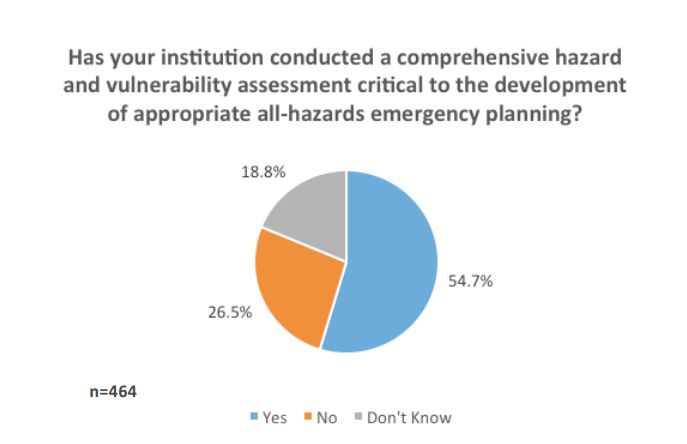
I just read an article from Campus Safety Magazine which cited a report on college campus preparedness.  Some of the numbers are a bit disturbing.  To me, the most serious numbers are from this graphic, which came from the Margolis Healy 2015 Campus Safety Survey:

Hazard_Assessment_Margolis_Healy_2015

According to this graphic, 26.5% of college campuses surveyed have not conducted a hazard and vulnerability assessment and 18.8% do not know if they have conducted an assessment.  Given that this study identified that 86% of colleges have an emergency operations plan, there is a significant number within this study who have what I would consider baseless plans.

Given these statistics, I’m left wondering WHY these campuses haven’t conducted a hazard analysis.  Potential reasons?

  • Didn’t know they needed to
  • Didn’t want to
  • Assumed they were aware of the hazards, impacts, etc.

I’m sure there are some other potential reasons for why they didn’t conduct a hazard analysis, but these are bound to be the big ones.  Regardless of the reason, I’m left assuming that, besides the plan being based upon no actual hazard information, the rest of the plan is BASELESS, INEFFECTUAL CRAP.

Forgive me for being blunt (you don’t have to), but if you aren’t assessing hazards, what are you basing your preparedness on?  Just as planning is the cornerstone of preparedness, a hazard analysis is the foundation of planning.  Therefore no (or a poor) hazard analysis will very likely result in a poor plan, and a poor plan will very likely result in poor preparedness efforts overall.

I’m not just picking on college campuses.  While this study targeted institutions of higher education, this same concern (likely with similar statistics) applies to EVERYONE – jurisdictions and government agencies, the private sector, and not for profits.

So what are we dealing with?  The parties responsible for creating these emergency plans are either UNINFORMED, LAZY, or UNDERFUNDED/UNDERSTAFFED.  To me, none of these are valid excuses.

  • Uninformed? Study up!  It’s not difficult to find out what the planning standards are.  (see the next paragraph)
  • LAZY? QUIT YOUR JOB! – you shouldn’t be in public safety.
  • Underfunded or understaffed? Welcome to public safety.  What could possibly help justify more funding or staff than a solid assessment?

If you need information on planning standards, check out these posts.  I talk about CPG-101, which is the foundation for emergency planning in the US; and a variety of other planning and hazard analysis related topics.

Need help?  It just so happens that I’m a well-qualified consultant.  Our website is linked below.

© 2015 – Timothy Riecker

Emergency Preparedness Solutions, LLC

Step up! Soft Target Resiliency.

Readers: please check out this post by Ralph Fisk on the need to take a realistic perspective on the vulnerabilities of soft targets in our communities.

As I had commented on Ralph’s post, this is the most realistic and pragmatic perspective I’ve seen on this topic.  We need to open our eyes to the reality of these threats and prepare, protect, and prevent the best ways possible.

-TR