Gauging Return on Investment in Preparedness: Training

This is my fourth article in a series examining how organizations can gauge their return on investment for various emergency management and homeland security preparedness projects.  These were inspired by an original article I wrote called Measuring Return on Investment in Emergency Management and Homeland Security: Improving State Preparedness Reports.  The POETE model (Planning, Organizing, Equipping, Training, Exercising) helps us to identify all activities related to preparedness.  Thus far, we have covered:

Planning

Organizing

Equipping

If you haven’t already reviewed these articles, check them out for additional context and information.  Within each, I outline the general activities within the preparedness element, and identify the potential costs and benefits of these activities to the organization.  While some costs and benefits are direct (meaning we can readily identify them in terms of currency), most are not, and require some measure of analysis.

We put a lot of money (and faith) into training as a central preparedness activity.  And why shouldn’t we?  Training, by definition, is a transfer of learning.  We have a lot of information to communicate to our staff and other stakeholders, with the goal of that information collectively becoming a body of knowledge, and a vision of these people applying what they have learned to future circumstances.

In emergency management and homeland security we train quite a bit, with some training being required by organizational, local, state, national, international, or federal standards; while other training will help develop and advance staff.  We include HR-required training; soft skills like communication, leadership, decision making, and the like; as well as technical skills such as emergency planning, exercise design, and incident management.  Emergency management and homeland security are broad fields of practice, which intersect public safety, public health, and other essential government and social functions.  Most emergency management and homeland security practitioners have roots in one or more of these fields and typically continue receiving training relative to those as well.

Training comes from a variety of sources including our home organizations, local and county governments, state government, private and not for profit entities, and the federal government.  Particularly for training that is sponsored by a government entity, most training is ‘free’.  In the US, federal training entities, such as FEMA’s Emergency Management Institute, also reimburse travel expenses and provide lodging for all levels of government employees.  On the surface, the cost of most emergency management and homeland security training is fairly low.

Of course depending on perspective, the cost of training can vary.  As a former state training officer who managed all emergency management related training delivered across my state, I could identify our agency’s cost of training.  This would include our staff admin time for course prep and record keeping, the cost of duplicating participant manuals, any costs associated with the hosting facility (although we usually utilized no cost facilities), the cost of paying our instructors for their time and travel, and, if applicable, any lodging and/or meal costs for participants who may have traveled a distance.  These costs, however, are only part of the picture.

What about the cost to the organization that is sending people to be trained?  Directly, this is salary time in which little to no work is actually being accomplished for the organization.  The organization may also be footing the bill for travel costs for their participants.  Depending on who is sponsoring the training, there may be a fee for the course.  Indirectly, what is the cost of that employee being away?  Who is doing their work?  This often depends on the organization and the position the individual holds in that organization.  Firefighters, police officers, health care professionals, and others may be covering shifts that will still need to be filled, especially if policies or union contracts require certain staffing levels.  Sometimes this backfilling isn’t as simple as changing schedules, as most employees are already scheduled at full time status.  Therefore, someone may need to be paid overtime to fill this position for the duration of the training.  Perhaps the learner themselves is being paid overtime to tend to priority tasks outside of training hours.  Maybe others can simply absorb some extra tasks while this person is gone, or the learner will be swamped for some period of time once they return from training.  Each of these mechanisms, all dealing with productivity, has a cost associated to it.

Training can get expensive, which is why it’s often one of the first activities cut when an organization’s budget gets tight.  We try to minimize the cost of training through a variety of practices such as shorter training days, online training, and local training.  These, however, have various impacts on the organization’s ability to obtain the training as well as the overall effectiveness of the training.  Sometimes we simply defer the training, but the organization may have little choice, particularly with mandated training.

So what benefits can training provide?  As mentioned, I have quite a bit of background as a trainer and training manager.  I’d love to tell you that training has the greatest of all benefits, but that would be a complete lie. Just like any other preparedness activity, it has to be properly applied.  Training won’t fix everything.  I’ve written a lot of pieces on training in my blog… just search for ‘training’ and you will find plenty of articles about how training should/shouldn’t be applied.  With that caveat, training can have great benefit.  Not only can it make people more effective and efficient in their jobs and related tasks, it can also help defer liability from the organization.  Training also has benefits which more directly apply to the learner vs the organization, such as providing background for advancement and/or promotion (which can be internal or external to the organization).  There are many practices in emergency management and homeland security for which training aids in health and safety, not only of the staff member who took the training, but also of others.  In training, the impacts can go pretty far… you just have to follow the bouncing ball.  As an example: Jane gets trained in how to write emergency plans.  The emergency plans she writes will help the organization respond more effectively in the event of a disaster.  When the organization responds more effectively, lives and property are protected.  While this is a great ideal outcome, it makes for some difficulty in determining the benefits in terms of currency.

Often, the most direct benefits from training are rooted in compliance and proficiency.  Organizations have a variety of compliance matters they have to meet.  These obligations may be HR driven, required by an executive, a higher level of government, an accreditation body, or a funding source.  Safety matters are also usually linked with a compliance matter.  I often try to associate training activities to these requirements.  Sometimes we can directly link a financial benefit to these compliance matters, while other times compliance is simply factually stated.  Second is proficiency.  People need to stay current in essential skills.  This might require regularly recurring training for staff, well as training for new staff.  Staff need to be proficient in new procedures, software, and equipment operation.  Certain staff may need to be trained to more advanced levels.  Gauging the benefit in financial terms for proficiency is generally more difficult, although the need for the training is apparent.  The benefit simply needs to be extrapolated.  For instance, if the training is in a new process, what is the time and/or quality difference between the old process and the new?

As mentioned earlier, it is often times not easy to determine the financial return on investment for many of our activities.  We need to dig deep and identify quantifiable metrics which can be examined before and after we apply our preparedness activity.  We must assign reasonable currency figures to those metrics to help us and other decision makers better understand our investment and the benefits it will potentially bring.

Soon I’ll be wrapping up this series with the last key preparedness activity – exercises.  As always I’m happy to hear your thoughts on how we can better identify the returns on our investments in preparedness activities.  As a resource, I’d encourage you to search Training Magazine (trainingmag.com), which often has articles on analyzing the return on investment in training.

© 2015 – Timothy Riecker

Emergency Preparedness Solutions, LLC

Musings of October – and the Crusade to End Bad ICS Courses

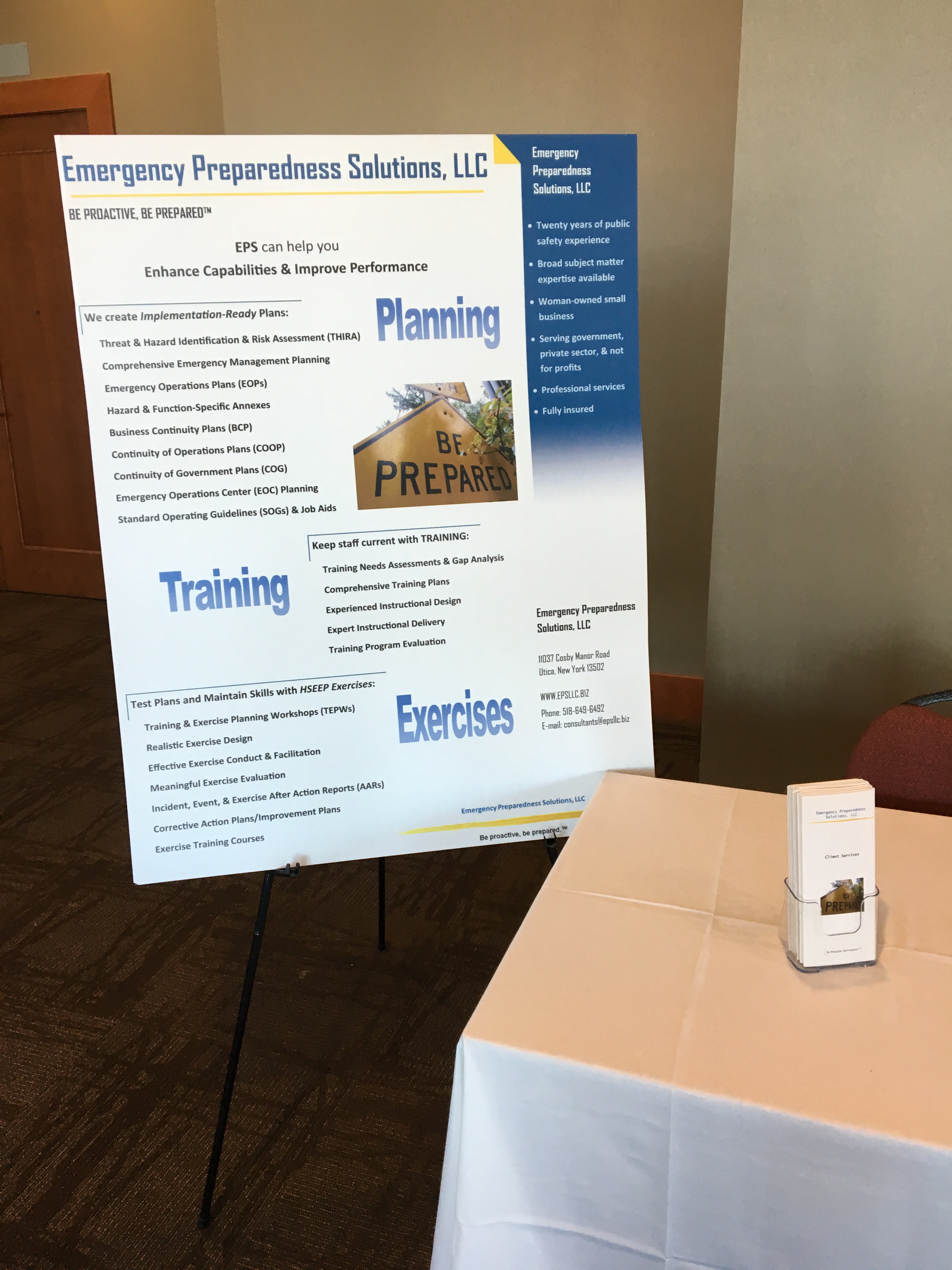
Last month sure was a busy one!  Much of the focus was on marketing for our company Emergency Preparedness Solutions.  I had the opportunity to meet a number of county and local government representatives in a reverse trade show in the Poconos and see some old and new faces at the Vermont Emergency Preparedness Conference.  Pictures of our booth are below.  I also had the opportunity to present with their State Training Officer on the State-Wide Emergency Management and Homeland Security Training Needs Assessment project we completed for the Vermont Division of Emergency Management and Homeland Security a few months ago.  We also need to congratulate Doug Babcock for being honored as Vermont’s Local Emergency Manager of the Year!

IMG_1205

IMG_1206

While those trips were great, the highlight of the month was a trip to Toronto.  The impetus for the trip was the Emergency Preparedness staff of Public Health Ontario, who, after reading my blog posts on the necessity for improvements in Incident Command System (ICS) training, extended an invitation for me to sit in on some training they offer that came about from just that need.  The course I attended was Public Health Emergency Preparedness – An IMS-based Workshop.  Fear not – this is not a reinvention of ICS (or Incident Management System – IMS – as they refer to it in Canada), rather this is an enhancement to the current curriculum.

The Canadian provinces have each adopted curricula for their IMS which are near 100% mirrors of the ICS courses we use here in the States.  While in Toronto, I also had the opportunity to sit in for a bit on an IMS-200 course being conducted by the Toronto Office of Emergency Management.  They were great hosts and have made excellent enhancements to the curriculum for a Toronto-based audience.  (Thank you Sherry and Sarah!) The course offered by Public Health Ontario is truly workshop based, with little lecture and a lot of group work to walk participants through concepts of IMS.  The workshop is positioned between IMS-100 (which most took online) and IMS-200, and is public health focused.

While I’m often weary of discipline-specific courses in emergency management, since the essence of emergency management is cooperative, this workshop absolutely made sense.  Why?  Two big themes built the foundation for this… First, practitioners must be comfortable with their own sand box before they can play with the neighborhood kids.  Second, this particular application works for public health (and several other disciplines) because most of the public health response occurs at the population level, not necessarily at an incident site.  Because of this, public health will almost always function (at least the higher echelons of their incident management structure) from an emergency operations center or departmental operations center.  As such, it pays to invest some training time on a homogeneous audience.  That said, the scenarios that drove the workshop were in no way introverted only to public health concerns and the instructors encouraged thought and discussion toward other activities and associated agencies which would be involved in an incident.

With the positioning of this training between IMS-100 and IMS-200, Public Health Ontario has armed participants with better knowledge and familiarity of the IMS, allowing those who will progress through further (and multi-disciplinary) training a better perspective of how IMS is applied by public health which allows for a better understanding of the system itself.  Not only does the workshop address some internal incident management training needs for public health, it also addresses some of the issues I’ve mentioned previously with ICS training as a whole.  The workshop is expertly designed by the Emergency Preparedness team at Public Health Ontario, and embraces concepts of adult educational methodology which we need to pay more attention to.  The high level of interaction lends to improved transfer of knowledge and better outcomes.  They included information such as the phases of emergency management and the need to reference deliberate planning efforts such as Emergency Operations Plans (EOPs) and Continuity of Operations Plans (COOPs).  This is certainly something we don’t have enough of in ICS courses yet is critically related.  Do you think the majority of our attendees know what these are, much less what is in theirs?  Guess again!

More information on this workshop can be found at https://www.publichealthontario.ca/en/About/Departments/Pages/Incident-Management-System-for-Public-Health.aspx.  Many thanks to Moira, Richard, and Evanna for the invite and the hospitality!

With my road trips complete, I am returning back to the normal pace of work and preparing for another graduate course which begins next month.  I’ve also considered the need to ramp up my concern on this matter of poor ICS curricula from an occasional rant to a crusade.  This is a matter of public safety – from a sociological perspective there is nothing more important than our ability to effectively respond to save lives, stabilize the incident, and preserve property.  Let’s make some changes!

As always, many thanks to my readers; and if you are with a government entity, not for profit, or private interest that is seeking consulting services in the areas of emergency and disaster planning, training, exercises, and anything in between, please feel free to contact me.

© Timothy Riecker

Emergency Preparedness Solutions, LLC
Gauging Return on Investment in Preparedness: Organizing

As a continuation of the Gauging Return on Investment in Preparedness series (read the first one on Planning here), this post’s focus is on the POETE element of Organizing.  There are a number of ‘organizing’ efforts we engage in through our preparedness endeavors.  Some are temporary, like establishing working groups to solve a certain problem; while some are intended to be long-term, like forming an incident response team.

Why organize?  Most organizational efforts are fueled by the need to capitalize on the power of many.  What one person can do, more people can do better.  Problem solving, responding, etc.  Often our organizational efforts are internal, but, particularly in public safety, we coordinate with other agencies.  We might be building a professional response organization, such as an Incident Management Team (IMT), or perhaps we are building a community organization, such as a Community Emergency Response Team (CERT).

What costs are associated with organizational activities?  Foundationally, it’s simply the staff time needed to prepare for, attend, and perform follow up work from meetings and other organizational efforts.  Depending on how complex our efforts are, however, and the intent of our organizational efforts, this can take on full time duties.  You also have to consider who is being drawn into these efforts and what the ‘replacement cost’ is of their time – meaning, what is the cost of someone else performing their work while they are involved in the meetings, etc.?  We also need to identify what costs might be associated with organizing?  The remaining POETE elements (Planning, Equipping, Training, and Exercising) can probably lead you to identifying these.

What are the benefits (value) of organizing?In order to identify the return on our investment, we need to be able to ascertain the benefits our organizational efforts bring – some may be tangible and relatable in dollar figures, others may be more intangible and amorphic.

As with many preparedness efforts, we find ourselves needing to make reasonable assumptions to identify cost savings or value.  We need to follow the bouncing ball of our efforts.  As an example… If we create a CERT team, citizens will be better able to tend to their own needs in the event of a disaster.  This leads to less immediate need of limited resources (first responders), allowing them to focus on more critical needs (i.e. saving lives and protecting infrastructure).   In this example we can make some assumptions about the types of infrastructure to be impacted by a certain incident and the costs associated with it becoming incapacitated.

In regard to saving lives, it’s difficult for us to attach a dollar value to that.  We often say that lives are priceless, and while that may be true, we sometimes need to make an educated guess.  Depending on who you are reporting figures to, they may be satisfied with a reasonable number of lives being saved… others may want to actually compare apples to apples (that is, dollars to dollars).  If you engage the use of your favorite internet search engine and search ‘what is the value of a life’, or something similar, you will find a number of results.  In perusing some of these results myself, I found that the dollar figure assigned to a life is obviously subjective and very much related to the industry in which the question is being asked.  This particular article makes for an interesting read on the subject.  Spoiler alert: they peg the value of a human life at $5M USD (2011).

In the end, organizational efforts need to have a purpose providing a net value.  Even in routine matters and daily business, we should examine the cost of organizational efforts – particularly meetings.  Meetings are one of my biggest bugaboos, as they are often too long, have little purpose, and the objectives can be met in a much more efficient manner.

What ideas do you have on determining the return on investment for organizational activities?

© 2015 – Timothy Riecker

Emergency Preparedness Solutions, LLC

www.epsllc.biz 

National Preparedness Goal: Second Edition Just Released

Today FEMA released the second edition of the National Preparedness Goal.  This document, which only has a few substantive changes from the original, provides a vision for preparedness across the nation.  It is best known for identifying the five mission areas of Prevention, Protection, Mitigation, Response, and Recovery; along with the Core Capabilities.  Many thanks to my colleague Jon who brought this release to my attention.  The updated National Preparedness Goal and associated documents can be found here.

There are not many changes in this update, and the changes that are included should be of little surprise if you reviewed the draft released for public comment several months back.  Up front, the update provides some editorial clarification on the definitions and relationships between the federal government and tribes as well as US territories.  It also provides more emphasis on the concept of whole community and the special populations within the whole community which may require additional protections and actions.

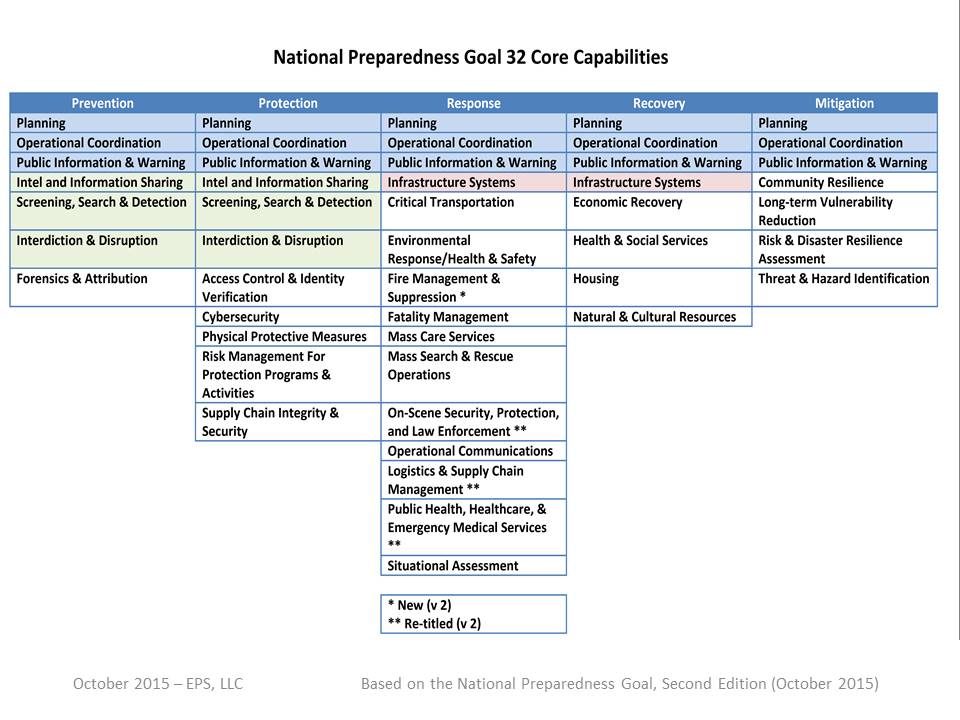
Perhaps the most significant changes are reflected in the Core Capabilities, of which there are now 32.  In the preamble to the Core Capabilities which discusses the concept of Risk, it is interesting to note that the Core Capability of Cybersecurity was specifically highlighted as having applicability across all Mission Areas – a concept which I fully agree with.  I’m left wondering, then, why it was not re-defined as a common Core Capability.

NPG 32 Core Capabilities

NPG 32 Core Capabilities

Other changes to the Core Capabilities include the renaming of the On-Scene Security and Protection Core Capability to On-Scene Security, Protection, and Law Enforcement; and the Public Health and Medical Services Core Capability to Public Health, Healthcare, and Emergency Medical Services.  Additionally, the Public and Private Services and Resources Core Capability was renamed to Logistics and Supply Chain Management, which seems to provide better recognition of the intent of that Core Capability.  Finally, a new Core Capability was added – Fire Management and Suppression.

Three of these changes seems to revolve around a stronger recognition and inclusion of the traditional first responder services of Law Enforcement, Fire Service, and Emergency Medical Services; all of which seemed to get lost in the bigger picture of the earlier capability discussions.  I’m hopeful these changes will help bring these services to the table in more communities when capabilities are discussed.  I’m a firm believer that the Core Capabilities provide a consistent, scalable, foundation for discussion of preparedness for every community.

© 2015 – Timothy Riecker

Emergency Preparedness Solutions, LLC
WWW.EPSLLC.BIZ 

Facilities Management and ICS

Earlier in the year I posted a video (something I need to get back into doing) on the positioning of care facilities within the ICS structure (Operations, not Logistics).  I’m currently reviewing some standard operating guidelines created by a county government on the management of such a facility and have made some critical observations….

The biggest observation is that the management of the facility does not have to mirror the ICS organization.  What I mean here is that it really shouldn’t have its own Operations Section, Logistics Section, Planning Section, Finance/Admin Section, PIO, Safety Office, and Liaison Officer.  While I commend the folks who developed this SOG for trying to stick with ICS, I think they are trying too hard.  While the application of this type of organization CAN assist with management of a facility, it’s typically too much.  Yes, ICS is flexible and allows us to activate only the elements needed, but often people feel compelled to utilize the organization to its fullest extent – which in this case can mean the creation of positions which are not needed.  The application of ICS elements to the management of a facility can also be redundant and confusing.  Besides, most jurisdictions don’t have access to multiple Planning Section Chiefs (or persons qualified in other positions) to staff all these areas.

Let’s start at the top… Facilities, per ICS definition, are overseen by Managers.  Not directors or other such titles.  Most facilities have very specific functional activities which should drive their organization.  Yes, most of these would be considered ‘Operations’, and the support of these can be considered ‘Logistics’.  But we really need to look at the responsibilities of the facility and the relationship to the rest of the incident organization to help guide us in the development of how we organize our facility management.  Managers, in ICS, can have assistants, which may be all that’s needed to help address management-level issues that people may be associating with ICS positions.

Does a facility need a Public Information Office (PIO)?  Probably not.  ICS guidelines prescribe one PIO per incident to help ensure coordination and integrity of public information.  If the facility has a need to communicate information to the pubic, they should be working through THE incident PIO.  If the scope of the facilities operations are complicated enough, perhaps that function may have a designated assistant PIO to ensure proper handling of the information, but they are not the incident PIO.

Certainly facilities can have safety issues.  Does they mean they should have a Safety Officer?  Again, ICS prescribes that we have one incident Safety Officer.  Typically the facility manager (or perhaps an assistant facility manager) will have safety included as an additional duty, in coordination with the incident Safety Officer to ensure adherence to all applicable safety standards.  As with the PIO matter, if the facility for some reason has some serious safety concerns, it may warrant the placement of an assistant safety officer by the incident Safety Officer.

The function of a Liaison Officer is fairly high level, with the primary intent of supporting the Incident Commander with the coordination of various organizations involved in the response.  Of course many facilities are likely to be supported by several organizations, but the participation of these organizations has already been addressed by Command, likely with the assistance of the Liaison Officer.  An added Liaison Officer is simply redundant and confusing.

Logistics – while there are certainly support matters that need to be tended to in facilities – such as security, parking, sanitation, etc., this doesn’t warrant a position in the capacity of a Logistics Section Chief.  Yes, they do require some oversight which may be beyond the span of control of the Facility Manager to provide.  This is a good opportunity to assign a Support Services Leader or some other similarly titled position who reports to the Facility Manager.  Additionally, most facilities should not be the ordering point for resources.  If they need resources, the request should be sent up to the incident Logistics Section.  Similarly, there is no need for a facility to have its own Finance/Admin section.

Having an incident action plan is always a critical element of organization.  A care facility should certainly be included in the Incident Action Plan; reflected in objectives and organization, and tasked in a form ICS 204.  That said, I certainly acknowledge that some facilities can be rather complex, with a multitude of personnel and activities and thus can benefit from having more than just an ICS 204 to run by.  Select elements of an IAP can be very helpful, but a full blown IAP is generally not needed.  The development of such a document for a facility generally won’t require a full time position, much less an actual Planning Section Chief.  This is another opportunity to use an assistant facility manager.  The check in function should be coordinated with the incident Planning Section who will either assign someone or the task will be addressed internally by the Facility Manager.

As with most things, there are always exceptions to the rule.  Very large facilities with extensive operations can certainly benefit from having an overhead team.  I’ve seen ‘short teams’ (these are compact versions of Incident Management Teams) assigned to manage everything from staging areas to family assistance centers in very large (Type 1) incidents.  As such this is not something I would generally plan for since it would be an exception to the rule.  Organizationally, a short team/overhead team would become a layer between the facility manager and the task leads/unit leaders to better allow them to focus on their functional jobs while the overhead team addressed the broader management and coordination matters.  If introduced to the organization of the facility, the overhead team must have a carefully defined scope of operations to ensure they were not redundant to functions of the incident’s actual management team.  Also, an overhead team such as this would likely not have a PIO or Liaison Officer.

While we try to introduce ‘hard and fast’ rules to incident management, the reality is that these things are quite fluid and determined by need.  While our general preparedness should support a credible worst-case scenario, we also need to be careful with our planning assumptions.  Otherwise a full-blown plan for a small community could call for a need for a dozen Liaison Officers, which we aren’t likely to get under most any circumstance.  Yes, ICS is flexible, but we need to have a realistic approach.  Similarly, we can use that flexibility of ICS to introduce elements into our organization that might not have been addressed in the plan with a fair amount of ease.  We’re looking at the difference between a shelter in an average high school vs a shelter in a large sports stadium.  All that said, if your catastrophic plan identifies the use of the large sports stadium as a shelter, you should certainly include the provision in that plan for an overhead team to assist in the management of that shelter.

Of course I’m interested in your thoughts on this.

© 2015 – Timothy Riecker

Emergency Preparedness Solutions, LLC
WWW.EPSLLC.BIZ

Measuring Return on Investment in Emergency Management and Homeland Security: Improving State Preparedness Reports

A lot of money is spent within the emergency management and homeland security enterprise.  Looking just at the last couple of years of annual Homeland Security Grant Program (HSGP) (this is the annual grant provided by the US Federal government to states and urban areas), $1.044 billion was allocated in FFY 2015 and $1.043 billion allocated in FFY 2014.  These billions of dollars only account for a portion of spending within EM/HS.  There are other federal initiatives as well as state, tribal, territorial, and locally funded efforts.  Businesses and NGOs also invest significantly in emergency management, homeland security, and business continuity activities.  But where does it all get us?

Through the past decade or so there have been a few efforts by DHS/FEMA to try to measure preparedness, ideally to identify improvements in our preparedness as the result of the billions of dollars invested.  None of these efforts have really provided obvious and tangible results.  The current measure is through annual State Preparedness Reports (SPRs), which utilize the THIRA process (Threat and Hazard Identification and Risk Assessment) outlined in Comprehensive Preparedness Guide (CPG) 201 as a foundation, but with the POETE analysis (Planning, Organizing, Equipping, Training, and Exercising) for each of the 31 Core Capabilities.  (You can find articles I’ve written on the utility and application of POETE here.) The SPR is a good methodology for identifying the current condition of preparedness for each state as viewed through the 31 Core Capabilities.  The POETE analysis helps to identify the strengths and weaknesses within each Core Capability.

The SPR, however, still falls short.  How can we improve it?

1. Include historical data for trend analysis. The SPR largely provides only a snapshot of current conditions.  The format of the SPR does not provide for any analysis of historical data to identify trends (i.e. improvements or otherwise) in the state’s assessed condition of its 31 Core Capabilities.  FEMA regional offices, upon receipt of an SPR, do provide a brief feedback report of the current SPR with a passing mention of the previous year’s submission, but the report provides so little information it could hardly be called an analysis.

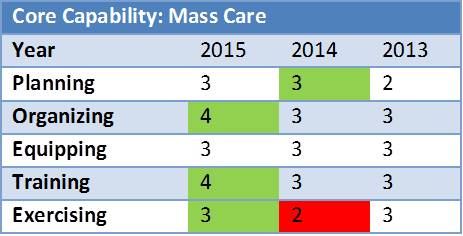
A rudimentary table identifying trends for a selected Core Capability is below.  For those not familiar, higher scores rate a higher measure of capability.  In this table, I’ve identified POETE elements which have trended lower from year to year with a RED highlight, and those which have trended higher with a GREEN highlight.  A simple analysis such as this give an at-a-glance comparison.  To make this analysis more comprehensive, I would suggest the addition of narrative for each trend (higher or lower) which explains what has changed to warrant the new ranking.

Historical Comparison of a Core Capability

2. Include a financial analysis for the current year to identify return on investment. An identification and summary of key program area investments for the year will lay the groundwork for a return on investment (ROI) analysis.  ROI will help identify how much bang for the buck you are getting in certain areas.  It’s easy to lose sight through the year from a program management perspective on how much money was spent on certain programs and activities – especially for larger agencies with a layered bureaucracy.  Incorporating this analysis into an SPR is not only good financial and program management, but provides an opportunity to identify where money was spent and to measure, at least on a broader scale, what the results were.  Certainly we have to fund continued operations to simply sustain our capabilities, but we should also be funding, where possible, programs to enhance our high priority capabilities and those needing the most improvement.

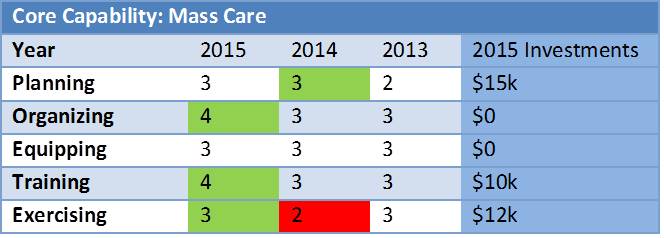
Again, as a rudimentary example, we can build on the table provided earlier to identify where funds were spent to see if they made a difference in our level of preparedness.  As with the earlier example, a narrative should be provided for each investment to identify what it was and assess the impact.  This also provides an excellent opportunity to review the investment justification written for grants to determine if the investment met the intended objectives (which should have been to maintain or enhance some aspect of the capability).  Historic investment data can also be included for each year.  This all leads directly to identifying the return on investment – did the investment make a difference and to what extent?

Historical Analysis of a Core Capability with Identified Investments


Ultimately this added data and analysis requires more work, potentially the involvement of more people, and likely more time to complete the SPR.  However, this new process will also result in a positive return on investment itself by helping to identify trends and outcomes.  Financial information is regularly reported to DHS (for those grants that originate with them) in the form of progress reports, but that information is stovepiped and usually not associated with a more comprehensive assessment such as the THIRA/SPR.  Bringing this data together paints a much more accurate picture.

The concept of preparedness is difficult to put in a box.  It’s amorphic and challenging to identify, yet people often ask the question ‘Are we prepared?’  States, locals, DHS, and Congress often have difficulties measuring preparedness and advances in preparedness, especially relative to the dollars spent on it.  The GAO has regularly recommended efforts to better identify return on investment, yet we haven’t gotten there.  The recommendations identified here can bring us much closer to nailing down where we are and where we need to be.  Armed with this knowledge, we can make better decisions for future investments and activities.

Moving forward, I expect to write a bit on each POETE element, with my thoughts on how we can identify return on investment for each.  As always, I’m very much interested in your thoughts on the approach I identified above and how we can better identify return on investment in the realm of emergency management and homeland security.

If you are interested in utilizing this approach to better identify your return on investment for local, state, tribal, territorial, or organizational preparedness efforts (whether or not you do a State Preparedness Report), Emergency Preparedness Solutions is here to help!  Check out our website at www.epsllc.biz or contact me directly to discuss what we can do for you.

© 2015 – Timothy Riecker

Emergency Preparedness Solutions, LLC
WWW.EPSLLC.BIZ

Community-driven Preparedness

As many of you know, September is National Preparedness Month.  The website offers a number of resources, mostly for governments, to engage citizens and community groups in preparedness.  Higher level engagement of citizens is extremely important to better enable to them to care for themselves for a period of time so they are less dependent upon government and emergency services in the event of a disaster, freeing up these services to address matters of high impact and high importance.

National Preparedness Month is a great opportunity to get information out to everyone!  Consider every facet of your community.

  • Schools and day cares
  • colleges and universities
  • nursing homes, assisted living facilities, retirement homes
  • business and industry
  • community organizations, service organizations, labor unions
  • religious organizations
  • government offices
  • travel and tourism offices and entertainment venues

What will you do to get the word out?  I’d suggest a multi-pronged approach… static information on your website is a good central point to direct people to.  Pamphlets and handouts are great to get information into people’s hands, especially at gatherings.  Social media is a great outreach tool that should be used often.  (and if you think you are OK just having a Facebook account, you really need to take a social media class!).  With organized groups, invest time to meet with them and present to them.

One of my biggest tips is to actually give people something to do, give them a mission.  Don’t just direct them to preparedness information and count on them to do something with it.  Busy people (and even non-busy ones) aren’t wired that way.  ENGAGE them!  Don’t just speak at them.  Challenge them to be prepared and give them benchmarks.  Tell them how important it is for them to be prepared, not just for themselves, but for their families, their neighbors, and their communities.

Target your message to the specific groups you are speaking to.  A senior citizens organization should be getting a vastly different message than the Chamber of Commerce.  Organizations at all levels can be encouraged to join a VOAD (if you don’t have one – form one!) or other coalition to provide services before and after disasters.  There is no longer any mission for the community that is just for one organization any more.  The demands are too high for that.  Sheltering can’t be handled by the Red Cross alone and the local humane society or ASPCA can’t handle all pets in a disaster on their own.  I’m betting even your health department could use a hand with points of distribution.

Businesses can help, too.  Along with becoming a community partner, they also need to be prepared.  The SBA, through Agility Recovery, is offering a number of webinars this month which can be found here.

Yes, all this campaigning takes some serious time and effort.  Engage others to help you, establish a strategy and a message, and get out there.  Community preparedness pays dividends.

As with most things I write about, Emergency Preparedness Solutions can help you with community messaging and engagement – any time of year!  Info below.

© 2015 – Timothy Riecker

Emergency Preparedness Solutions, LLC

WWW.EPSLLC.BIZ 

Rebranding

As this blog approaches its three year anniversary, I’m feeling that it’s time for a face lift.  Over the last three years I’ve posted a total of 235 blog posts which have received over 31,000 views from nearly 19,000 visitors from 110 nations around the world (these are the WordPress stats and don’t reflect numbers of views on LinkedIn or other sites).  I’m very thankful for my followers and all viewers and especially thankful for those who have taken the time to comment on posts.

The blog has become a great platform for me to learn and grow as a professional.  It has also turned into a great communication platform for my company, Emergency Preparedness Solutions. As such, the name of blog has been changed from ‘Tim’s Thoughts’ to ‘On Emergency Management and Homeland Security’.  We wanted to make the content more obvious from the title.  The content isn’t going to change – we will continue publishing topical articles, news, and opinion pieces on emergency management and homeland security topics.  We also hope to have some guest posts from colleagues in the EM/HS field.

We hope you like the new name and the new look.  Thank you, as always, for reading.  If you like what you read, follow us and pass the site on to colleagues.

TR

What is the Top Sector at Risk for Cyberattacks?

3D Electric powerlines over sunrise

According to this article in the Insurance Business America magazine, it’s the energy sector.  This is no surprise, even without the statistics provided in the article; although the statistics are pretty staggering.  The article states that according to DHS “more than 50% of investigated cyber incidents from October 2012 to May 2013 occurred within the energy sector”.  The advice in the article is pretty sound and coincides well with what I’ve suggested many times in this blog… be prepared!  Not only do power utilities need to have their own cybersecurity experts and the policies, plans, and infrastructure to prevent cyberattacks, they also need to be prepared for the potential success of the attackers.  They need to know who to notify (and how), and what actions to take.  Further, those that depend on electricity should have an alternate means of obtaining electricity to meet essential needs.

Threats to our infrastructure show just how interconnected we are and how interconnected our critical infrastructure is.  This is the primary reason why our energy infrastructure, which touches every other sector, is so essential.  We must ensure that we have in place prevention and protection plans, such as cybersecurity plans; hazard mitigation plans to lessen the impacts; response plans to address critical issues; and recovery plans to return to operations.  Business continuity is also an essential component of this – even if you are an NGO or government entity (continuity of government).

Along with proper planning, training, and exercises, we need to continue to promote legislation which requires measures for cybersecurity and protection of our critical infrastructure.

What are your major critical infrastructure concerns?

© 2015 – Timothy Riecker

EMERGENCY PREPAREDNESS SOLUTIONS, LLC

WWW.EPSLLC.BIZ

When is Consolidation of Public Safety Agencies a Good Idea?

A recent effort for the consolidation of three fire departments near our office in Central New York failed.  The consolidation, discussed in earnest for nearly a year with positions both for and against, narrowly lost in a public referendum.  News article here: http://www.uticaod.com/article/20150818/NEWS/150819437.

Having worked in public safety for nearly 20 years, I’ve seen quite a few consolidation efforts.  Some successful, most voted down before they even had a chance.  Most efforts have been related to fire departments, some with EMS agencies, and a few related to law enforcement.  While I’ve seen some early in my career, it seems there has been an increase in consolidation proposals in recent years.  Why?

It seems the most significant factor in these proposals is economic.  Despite the slow upturn in the economy, government budgets are still struggling.  The need to spread the burden of common administrative costs, like insurance; ensure appropriate staffing coverage; and to address equipment issues, such as standardization for interoperability; are the top items of discussion.  In some cases there is also a need to reduce the personnel costs through consolidation by reducing the overall number of executive-level officers and support staff, and to reduce real estate costs by reducing the number of stations.  While not all of these reasons are applied all the time, these are quite commonly identified as reasons for consolidation.  The bottom line for consolidation is that it saves money while, ideally, not increasing response times or public access to services.

As for the reasons against consolidation… there are many who don’t seem to trust the promise of savings.  Certainly there have been a great number of failed attempts by government or other organizations to restructure in the name of cost savings and come nowhere near reaching their target.  Others are afraid of the loss of jobs and access to services.  Some, in my opinion, are just being territorial.

Obviously consolidation, or any change in government structure or services, needs to be carefully studied, reviewed, and if decided upon, implemented in accordance with a carefully designed plan and a watchful eye.  This especially holds true for public safety.  Just like any idea out there, it can work if carefully implemented, but it may not be suitable for everyone.

Where do you stand on public safety consolidations?  What success stories do you have?  How about failures?

© 2015 – Timothy Riecker

Emergency Preparedness Solutions, LLC

WWW.EPSLLC.BIZ