Rebranding

As this blog approaches its three year anniversary, I’m feeling that it’s time for a face lift.  Over the last three years I’ve posted a total of 235 blog posts which have received over 31,000 views from nearly 19,000 visitors from 110 nations around the world (these are the WordPress stats and don’t reflect numbers of views on LinkedIn or other sites).  I’m very thankful for my followers and all viewers and especially thankful for those who have taken the time to comment on posts.

The blog has become a great platform for me to learn and grow as a professional.  It has also turned into a great communication platform for my company, Emergency Preparedness Solutions. As such, the name of blog has been changed from ‘Tim’s Thoughts’ to ‘On Emergency Management and Homeland Security’.  We wanted to make the content more obvious from the title.  The content isn’t going to change – we will continue publishing topical articles, news, and opinion pieces on emergency management and homeland security topics.  We also hope to have some guest posts from colleagues in the EM/HS field.

We hope you like the new name and the new look.  Thank you, as always, for reading.  If you like what you read, follow us and pass the site on to colleagues.

TR

What is the Top Sector at Risk for Cyberattacks?

3D Electric powerlines over sunrise

According to this article in the Insurance Business America magazine, it’s the energy sector.  This is no surprise, even without the statistics provided in the article; although the statistics are pretty staggering.  The article states that according to DHS “more than 50% of investigated cyber incidents from October 2012 to May 2013 occurred within the energy sector”.  The advice in the article is pretty sound and coincides well with what I’ve suggested many times in this blog… be prepared!  Not only do power utilities need to have their own cybersecurity experts and the policies, plans, and infrastructure to prevent cyberattacks, they also need to be prepared for the potential success of the attackers.  They need to know who to notify (and how), and what actions to take.  Further, those that depend on electricity should have an alternate means of obtaining electricity to meet essential needs.

Threats to our infrastructure show just how interconnected we are and how interconnected our critical infrastructure is.  This is the primary reason why our energy infrastructure, which touches every other sector, is so essential.  We must ensure that we have in place prevention and protection plans, such as cybersecurity plans; hazard mitigation plans to lessen the impacts; response plans to address critical issues; and recovery plans to return to operations.  Business continuity is also an essential component of this – even if you are an NGO or government entity (continuity of government).

Along with proper planning, training, and exercises, we need to continue to promote legislation which requires measures for cybersecurity and protection of our critical infrastructure.

What are your major critical infrastructure concerns?

© 2015 – Timothy Riecker

EMERGENCY PREPAREDNESS SOLUTIONS, LLC

WWW.EPSLLC.BIZ

When is Consolidation of Public Safety Agencies a Good Idea?

A recent effort for the consolidation of three fire departments near our office in Central New York failed.  The consolidation, discussed in earnest for nearly a year with positions both for and against, narrowly lost in a public referendum.  News article here: http://www.uticaod.com/article/20150818/NEWS/150819437.

Having worked in public safety for nearly 20 years, I’ve seen quite a few consolidation efforts.  Some successful, most voted down before they even had a chance.  Most efforts have been related to fire departments, some with EMS agencies, and a few related to law enforcement.  While I’ve seen some early in my career, it seems there has been an increase in consolidation proposals in recent years.  Why?

It seems the most significant factor in these proposals is economic.  Despite the slow upturn in the economy, government budgets are still struggling.  The need to spread the burden of common administrative costs, like insurance; ensure appropriate staffing coverage; and to address equipment issues, such as standardization for interoperability; are the top items of discussion.  In some cases there is also a need to reduce the personnel costs through consolidation by reducing the overall number of executive-level officers and support staff, and to reduce real estate costs by reducing the number of stations.  While not all of these reasons are applied all the time, these are quite commonly identified as reasons for consolidation.  The bottom line for consolidation is that it saves money while, ideally, not increasing response times or public access to services.

As for the reasons against consolidation… there are many who don’t seem to trust the promise of savings.  Certainly there have been a great number of failed attempts by government or other organizations to restructure in the name of cost savings and come nowhere near reaching their target.  Others are afraid of the loss of jobs and access to services.  Some, in my opinion, are just being territorial.

Obviously consolidation, or any change in government structure or services, needs to be carefully studied, reviewed, and if decided upon, implemented in accordance with a carefully designed plan and a watchful eye.  This especially holds true for public safety.  Just like any idea out there, it can work if carefully implemented, but it may not be suitable for everyone.

Where do you stand on public safety consolidations?  What success stories do you have?  How about failures?

© 2015 – Timothy Riecker

Emergency Preparedness Solutions, LLC

WWW.EPSLLC.BIZ

Firearms in Emergency Kits?

Cannon Beach, Oregon, a community in the Cascadia subduction zone, has an interesting program in which they store the preparedness kits of residents for them.  A link to the city’s program is here: http://ci.cannon-beach.or.us/community/cachecontainer.html.  In summary, the city provides the opportunity for residents (for a small fee) to store containers (provided by the city) of emergency supplies within city-owned cache locations.  They offer 5 gallon pails (with lids), 30 gallon drums, and 55 gallon drums.  These kits are stored securely in shipping containers at the predesignated locations.

I’m a bit ambivalent about the concept.  While it certainly encourages and enables people and families to have kits that perhaps otherwise wouldn’t, it does remove these kits from their possession.  Not having the kits in your possession limits the ability to add to/maintain the kit and certainly makes them ineffective during a shelter in place scenario.  I, for one, would rather have my kit readily available to me and all family members without having to address:

1) potentially unsafe travel,

2) the ability to access the container (will someone be there to let me in?),

3) a potential state of unrest in the vicinity of the container,

4) will the container still be there (we’ve seen these things easily moved by mother nature).

Note that the informational material on their website does encourage people to also have go-bags for a combination approach, which is a good idea.

Now that I’ve warmed you up with some background – off to the main topic…  I was first alerted to Cannon Beach’s concept via a news article about someone storing a firearm in their kit.  http://www.opb.org/news/article/should-your-emergency-preparedness-kit-include-a-firearm/.  The article states that an individual kept a firearm in their kit, which was stored by the city in a storage container which was broken into and stolen.  Firearms, by the way, are not permitted per the city’s guidance.  But should firearms (Cannon Beach’s program aside) be included in emergency kits?

Up front, I’d never recommend that firearms be kept in an emergency kit simply based upon liability.  That said, it’s an individual decision but could be a good idea.  Certainly anyone who chooses to do so should ensure that it is done legally and safely.  One must also consider why they want to have a firearm in their kit.  Is it for personal protection or for hunting?  Or both?  In the case of the article I referenced, it was a handgun, which could really only be used effectively for personal protection.

While we see very limited violence and looting during disasters, it certainly could be possible.  I would never suggest that someone not have the ability to protect themselves or their family.  I would suggest, however, that anything in your kit should have as many purposes as possible.  A handgun is less than ideal for hunting.  However, including a firearm for hunting (rifle or shotgun) will likely exceeded the physical space of your kit, so this needs to be considered.

I would also suggest that, again just like anything else in your kit, you be proficient in using it. Among the few who keep and maintain preparedness kits, many buy things and just stick them in there.  They never read the instructions or become familiar with their use.  Consider a water purifier for example.  Any brand that I’m familiar with needs to be submerged and backwashed prior to use to remove smaller particulates from the carbon filter.  If someone is keeping something as dangerous as a firearm, they had better be proficient in its use!

The bottom line is that we are not likely to see a scenario out of The Walking Dead.  While we have seen some devastating incidents, such as Hurricane Katrina, which had limited the effectiveness of law enforcement for a time, this is not the norm within disasters.  Some may be considering an extreme, perhaps apocalyptic, scenario, and wanting to protect themselves, which is fine.  Just be smart about it.

What are your thoughts on firearms in emergency kits?  How about the municipal storage of kits like Cannon Beach’s program?

Lots of food for thought…

© 2015 – Timothy Riecker

Emergency Preparedness Solutions, LLC
WWW.EPSLLC.BIZ

Deadly Explosions

By now I’m sure you’ve all heard of the two horrible explosions that took place over the last 24 hours – one in Tianjin, China; the other in Baghdad, Iraq.  The explosion in the port city of Tianjin occurred soon after fellow consultant Ralph Fisk and I had both separately published posts about the dangers of human caused disasters.  The explosion in Baghdad, the result of a terror attack, occurred less than 12 hours ago.

The explosions in Tianjin occurred in the port area of the city and originated as fires among shipping containers.  The origin of the fires is yet unknown or released to the public by the Chinese government.  Chemicals and explosives were within some of the containers, with reports of chemical odors still lingering there hours after the explosions occurred.  At this point, according to CNN, 50 persons are confirmed dead with more than 500 hospitalized.  Among the dead are 12 firefighters.  Many more people are missing, including dozens more firefighters.  If you’ve not seen any of video of the explosions, it is grimly spectacular.  CNN has obtained several videos from people who were recording the fire turned explosion.  http://www.cnn.com/2015/08/13/asia/china-tianjin-explosions/index.html.  This will certainly be a continuing story to keep an eye on.

In Baghdad, ISIS has reportedly claimed responsibility for a truck bomb which was detonated in in a busy market, killing dozens and injuring nearly 100 people.  Sadly we have become practically desensitized to occurrences of violence in the Middle East.  While each of them is horrible, this incident is particularly tragic with the loss of this many lives.

I rarely post about current disasters or incidents as there is plenty of commentary already out there from the media and quasi-media.  The tragedy of these, however, underscores our need to be aware of the potential for these incidents to occur and what we need to do to prepare for and respond to them.  We also need to be prepared to address the cascading impacts of these incidents – mass care, mass casualty, and mass fatality issues are certainly paramount, but we also need to consider matters such as business and government continuity.

Foundationally, it helps to know something about explosives.  For my readers who are US citizens, be sure to check out the first responder training available from the New Mexico Tech Energetic Materials Research and Testing Center (EMRTC).  They run DHS sponsored training programs such as Incident Response to Terrorist Bombings (IRTB).  These courses are intensive and greatly valuable, diving into the physics and chemistry of different explosive types and classes, terrorist methodologies, and plenty of show and tell in their range.  The course gives a solid appreciation for what explosives can do and gives you a relative awareness of how much explosive it takes to cause a certain amount of damage.  For those who are not US citizens, I believe they do work with the US State Department to review applications on a case by case basis.  I’m curious as to what type of similar training is available in other countries to domestic responders.

We are truly lucky to not suffer incidents such as these as often as other nations do.  Understand, though, that this is only due to safety and security measures that we have in place.  Accidents, however, are inevitable, as are the successful efforts of those who wish to do us harm.  We must continue to do what we can to prevent these types of incidents but also be ready for when they do occur.

© 2015 – Timothy Riecker

Emergency Preparedness Solutions, LLC

WWW.EPSLLC.BIZ

At what point are we FEAR-MONGERING?

By now we’ve all read or at least heard of the piece in The New Yorker about the impending doom that shall be wrought by the Cascadia subduction zone.  It brings about some interesting thoughts.  Certainly the foundational premise of the article is based in some measure of science.  There IS a Cascadia subduction zone and a major quake here COULD certainly be devastating.  This article has sparked a few pieces by others which took their bit of sensationalism to a much higher level.  Keep in mind, however, that sensationalism sells.

The situation begs some questions of our own profession, though.  Where is that line for emergency management and homeland security?  Of course we endeavor to be factual, but we also want to be convincing and COMPELLING.  We want people to take action.  How far do we have to go to get our point across that there are hazards which people need to prepare for?  How far do we have to go to describe the situations which people need to prepare for?  At what point are we SENSATIONALIZING?  At what point are we FEAR-MONGERING?  What kind of moral obligation do we have?

This post and these questions were actually inspired by this morning’s blog post from author Chuck Wendig titled “Fear is Fucking Us All Up”.  Mr. Wendig’s blog is raw, humorous, and insightful on a variety of topics.  I highly recommend giving it a look.  Reader beware – Chuck Wendig uses more than a bit of profanity (in case you couldn’t tell from the title of his post).  If you are offended, don’t read it!

© 2015 – Timothy Riecker

EMERGENCY PREPAREDNESS SOLUTIONS, LLC

WWW.EPSLLC.BIZ

We need to talk MORE about Emergency Management

My company is currently finishing a contract which involved almost two dozen site visits to local government entities (cities and towns) to meet with local officials (emergency management, police, fire, EMS, schools, elected officials, public works/highway, etc.) to discuss certain emergency management and homeland security needs they may have.  The topics we needed to address were set in conjunction with our client and the meeting times were capped at 4 hours.  Based on the discussion generated by those we met with, discussions took anywhere between an hour and a half to all four hours.  At the end of most of these meetings, many people who we met with thanked us for bringing them the opportunity to discuss emergency management with such depth.

At first I was a bit puzzled about this gratitude… the meeting was intended for us to gather information from them, so it was us who thanked them for their time and input.  Why would they thank us?  They could talk about this stuff any time they wanted to, right?  In theory, yes.  In practice, NO.

Looking back at the project in retrospect we saw the value in the opportunity we provided these local stakeholders.  Absent a recent disaster or a specific issue of concern, it’s a rare occasion that local leadership takes the time to convene and discuss emergency management and homeland security matters.  We, rather serendipitously, provided them with an opportunity to do talk about many facets of EM/HS, to share thoughts and ideas, and to identify needs.

In many local government meetings (town/village/city council, selectboard, etc.) the topic of emergency management (or anything related to it) is generally not on the agenda.  Some may have a formal briefing by department heads, which would include the fire department or police department (if they have one), but these are usually fairly general statements.  Because of the depth of discussion that can take place, I don’t even think that these monthly governance meetings are the right venue for most discussion.  I would suggest that jurisdictions have a separate meeting, at least quarterly, to discuss emergency management in depth, with all department heads, elected officials, and others present and participating.  Preparedness should be discussed across the spectrum of all mission areas.

Many of the jurisdictions we met with had seen tropical storm impacts within the last few years – and that was the last time, for many of them, that the impacts and lessons learned were discussed.  What of their corrective actions?  Aside from a few largely individual efforts, little progress had been made.  Stakeholders self identified this gap, some commenting directly about the necessity to meet more often.  Many brought up gaps that were identified after the tropical storm, or even more recently, which were never addressed.

Along with the success of our intended project, we hope that at least some of those jurisdictions were able to get energized and organized to revisit some of those past concerns and move forward to make some progress with preparedness and mitigation efforts.

What do you do in your jurisdiction to prompt more discussion about EM/HS?

© 2015 – Timothy Riecker

Emergency Preparedness Solutions, LLC

WWW.EPSLLC.BIZ

The Need for More Scenario-Based Learning

Think back through all the courses you’ve taken.  It’s a lot – I know.  What ones stand out the most?  I’m willing to be they are the ones that were the most engaging.  Not only did you enjoy them, but you learned a lot from them and still remember quite a bit of it.

It’s no secret that training adults can be challenging.  Training professionals in emergency services is certainly no different.  The challenges are even greater as the number of required training courses continually increase, requiring more and more ass-in-chair time every year for responders and other professions.  A great deal of training programs we see out there still seem to be holding out for the sake of traditional delivery styles, much to the detriment of our learners.  Why?  Designing traditional lecture-based learning is easy to do!  Figure out what people need to learn, develop content, slap together some PowerPoint, and voila!  Hell, even I’m guilty.

The fact of the matter is that we all know this is wrong.  Yes, it’s easy to do on our end, but the value and impact of the learning is pretty low.  People don’t want to be lectured to for hours on end.  We know that learning is most effective when we mix things up and when we increase interaction.  One of the best ways of engaging learners effectively is through scenario-based learning.

Now I’m not just talking about using a scenario at the end of the course to see if people can apply what they’ve learned over the past two days.  Yes, scenarios can be used as a test of sorts, but they are most effective for actual learning.  So when should you use scenarios?  Why not start the course with one?  It immediately gets people thinking, which is a good thing especially with an 8 am start time to the course.   If you use a lot of scenarios in a course, can they all be related?  Sure.  Maybe.  Maybe not.  It all depends on what the purpose of the scenario is.  In training responders, threading a common scenario through a course is usually helpful.  Scenarios can get complicated when we need to establish a common understanding of what is going on, where it is, what resources are available, etc.  As such, it helps to use the same foundational scenario throughout the course (or at least regularly revisit it), and continue to introduce new problems or a different focus based upon the path of the training.  Using a common foundational scenario saves time so you don’t have to start anew introducing all new information each time and it keeps learners comfortable.  That said, it may occasionally be valuable to change things up a bit.

Do you need to use HSEEP to develop course scenarios?  No.  While these aren’t exercises in the strictest sense, we can benefit considerably from many of the principles and concepts of HSEEP.  Develop what you need to give learners the information they need to participate and the information you and/or other instructors need to properly facilitate and evaluate.

Adult learners like to be challenged.  Lecturing them for hours on end will only challenge their ability to not fall asleep – which may only be accomplished by their challenge for a new high score on the new app they just put on their phone.  The best way to challenge adult learners is to give them problems to solve.  A well written scenario will help introduce these problems in a framework which is both familiar and challenging to them.  Depending on how the scenario is provided, such as a compelling background story or use of video, learners will establish an emotional connection to the scenario which prompts a visceral desire to solve these problems.  Even one scenario is powerful and can prompt a lot of interaction.  It can prompt individual responses to questions, group discussions, and group collaborations.

Finally, don’t forget to evaluate both your learners and the scenario itself.  At the conclusion of each scenario conduct a hotwash and feedback session with learners to discuss what they accomplished and possible areas for improvement.  Also be sure to gain feedback from them and other instructors on how well the scenario worked and what can be improved upon.

Just like any other aspect of instructional design, the integration of scenarios can be time consuming but it’s an investment that will pay off.  To capitalize on the value of your scenarios, make sure the activities and expected outcomes of each scenario are associated with the learning objectives of the course and engage learners to the proper degree (i.e. the proper level of Bloom’s Taxonomy).  Yes, scenarios also take a fair amount of class time to execute.  That time needs to be well accounted for in your instructional design and course planning.  However, if properly designed, learners can learn just as much content if not more through interactive scenarios as compared to lecture-based training.

What types of scenarios have you integrated into courses?  How did learners respond to them?  How can we do a better job of integrating more scenario-based learning into our courses?

Need help designing scenario-based learning?  Let EPS help!

© 2015 – Timothy Riecker

Emergency Preparedness Solutions, LLC

WWW.EPSLLC.BIZ

Effectiveness and Efficiency in Incident Management – Resource Tracking

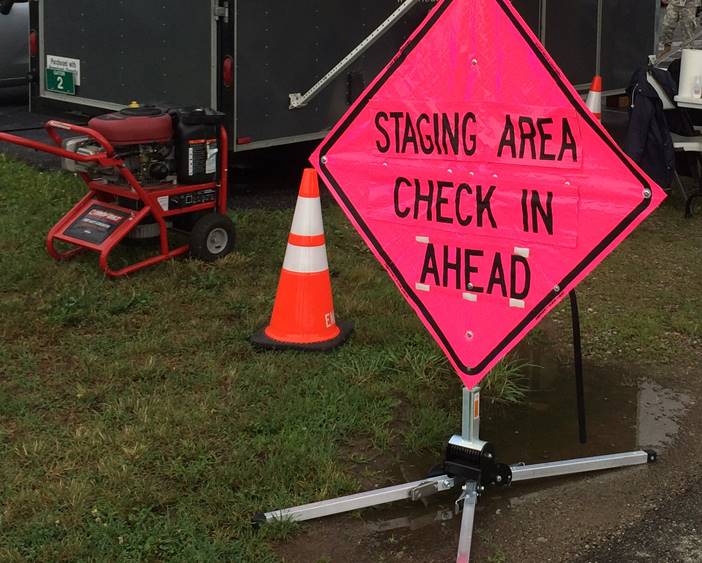
Incident Check In

Incident Check In

I recently took part in the management of an exercise in which a Type 3 incident management team (IMT) was among the players.  As part of their initial set up they immediately recognized the importance of checking in and tracking resources.  This is an activity which is often overlooked at the onset of an incident and is a royal pain to catch up on once the need is realized.  There were a few things which they could have improved upon, though, which seriously impacted their effectiveness and efficiency.

  1. They spent time checking in each vehicle as equipment. Not every vehicle needs to be tracked in an incident.  Generally, the sedan, pick up, or SUV you come in on isn’t special enough that it requires tracking.  Huge waste of time, people, and effort.  Consider the nature and capability of the equipment that is coming through your access point.  Is it a specialized resource?  Will it be applied tactically?  Will it be supporting logistical needs?  Is it rented or leased?  These are the conditions that should be considered when deciding what equipment to track.
  2. They marked equipment using bottled shoe polish. Not a bad idea, except it rained all week, and within hours of application most of the markings couldn’t be read.  Windshield markers, similar to what car dealerships use, are cost effective, waterproof, and clean off easily with mild window cleaners.
  3. Equipment that was checked in was never logged in detail. What’s the difference between E-01234 and E-01235?  We will never know as no descriptions were entered into their tracking system.
  4. As vehicles flowed in to the staging area, people will directed to check in at the command post. This is obviously excellent, except to get to the command post people had to pass by the main access to the incident site.  This meant that many people did not check in as directed.  They got distracted by the incident and associated response activity and never made it to the command post to check in.  This severely impacted the effectiveness of accountability.

Sometimes people would try to explain these things away by saying “It’s just an exercise”, but exercises are an opportunity to do things the right way, not skimp and cut corners.  While their intent was good, their process and results were quite poor.  If we are supposed to train the way we fight, as they say, this team has a ways to go to be more effective with resource accountability.  On the surface resource tracking looks easy… but it’s not.  There is a lot of complexity, variables, and attention to detail that must all work together well in order to be successful.  The Resource Unit Leader has one of the hardest jobs in the Incident Command System.

Being who I am, I’m left wondering why this all happened.  I have little choice but to blame poor planning and training.  Planning is to blame for a lack of clear procedures, guidance, and decision models.  The training which people receive tends to be just as vague.  By now, most, if not all of you are familiar with my opinions on the current ICS training.  While the referenced article does not go into the IMT/position training curricula, from what I recall of the courses I’ve taken, there are certain things taken for granted.  It’s easy to put an item on a checklist that says ‘Establish check in’.  OK… how?  Where?  When?  What?  Why?  The answer to those questions, or guidance to help answer those questions, should be provided through training.  Let’s tell people not only why check in is important, but what people and resources should be checked in, where to establish check in (what to look for and what to avoid), etc.  Once we’ve trained people on it, let’s provide job aids… not just the ICS forms, but job aids that will actually help people do their jobs.  While it may seem like minutia and unnecessary detail, keep in mind that we are training people to operate in austere and chaotic environments which they are trying to establish order over and only do these activities on rare occasion.  Those conditions signal the need for detailed training and job aids to support sustained performance and limit the degradation of the training they received.

Bottom line – let’s take a step back, fix what we have to based upon what we’ve learned, and proceed forward so we can operate more effectively and efficiently.

Thoughts and comments are always appreciated.  What have you learned or observed from incidents or exercises that needs to be addressed foundationally?

© 2015 – Timothy Riecker

Emergency Preparedness Solutions, LLC

WWW.EPSLLC.BIZ

What is Your Emergency Management Agenda?

We often hear, usually through the media, the term ‘agenda’ thrown around, usually in relation to political parties, corporations, and the like.  I think it’s time that we each have an emergency management agenda.

First of all, this isn’t exclusive.  Everyone can have their own – local, county, state, and federal emergency management agencies, and emergency managers with private and not for profit entities.  I’d also argue that we need a national emergency management agenda – every nation should.  And perhaps even a global emergency management agenda.  Why?  We need deliberate, purpose driven direction.  Too often we are scattered, doing some recovery from the past few disasters, and some mitigation and preparedness projects then WHAM! we get hit with another disaster.  After the disruption from that disaster, we usually fall back into the same groove or make up a bunch of new things we think will solve all of our problems.  So much of what we do is knee-jerk, despite the planning efforts we spend so much time on.  I really think we can do much better.

Part of doing better is having some longer-term goals and implementations to achieve those goals.  That’s really what a programmatic agenda is all about.  Much of this parallels a strategic plan, but people often roll their eyes at strategic planning, either because they have no time for a complex process or they have been through enough cheesy group think strategic planning sessions in their careers.  Strategic planning may also not be practical for many emergency management shops which are one or two person entities, especially at a local or county level or within a small corporation or not for profit.  I’m not knocking strategic planning, it has a lot of value (if followed through), but formulating an agenda is generally simpler by necessity.

Let’s consider components of an agenda:

  • Purpose/goal – what is the big picture of what you want to accomplish? This is also your elevator pitch.  It should simply state what you want to accomplish, in realistic terms.  This is not lofty like your corporate mission or vision statement, this is a programmatic goal.
  • Who will participate – who are your internal and external stakeholders and partners? Consider all the people and entities you need cooperation from to make this happen.
  • Expected outcomes – what benchmarks do we want to achieve? Write these like objectives – remember SMART: Specific, measurable, attainable, realistic, and timely.
  • Timeline – what is the timeline for each expected outcome and the goal itself? Set realistic timeframes.
  • Obstacles – what stands in our way of success internally and externally? Things like funding and personnel issues are obvious, but reach further while still being realistic.  Recognize that local disasters can be setbacks but can also create opportunity; and that many national-level disasters tend to result in politicians hitting a giant national reset button, changing the way we have been doing things (for better or worse) and stalling our momentum.

Of course this can all be revisited and adjusted as needed, but this agenda will help you lay the groundwork for future activities, giving you a path to follow instead of a series of ad-hoc activities.  Get it on paper and post it on the wall in your office where you will see it every day and can easily reflect on it, what it contains, and your progress in moving through it.

With that all said, I’m curious to know what the emergency management agenda is for the US (and every nation).  Yes, FEMA has a strategic plan, and while they are at the pointy end of the emergency management stick, they do not embody all that is emergency management.  Where do we, as professionals, see emergency management in this nation evolving to?  What do we (broadly) need to accomplish?  We tend to know the agendas of political parties and the politicians that are part of them, yet we don’t have a solid grasp on the direction of the emergency management enterprise.  Does this give you reason for concern?

© 2015 – Timothy Riecker

Emergency Preparedness Solutions, LLC

WWW.EPSLLC.BIZ