Finally – an Emergency Management Podcast Worth Listening To!

I’m a bit of a podcast addict.  I listen to them all the time – at the gym, mowing the lawn, long drives, etc.  There are podcasts out there for all interests.  I’ve struggled, however, these last few years, with finding a good emergency management podcast.  Sure, I’ve found a few, but I find them to generally have limited relevancy and also to be boring as hell.  Yes, I want to learn, but I also want to be entertained.  Last week, after seeing a tweet from Brandon Greenburg about guesting on a podcast, I was immediately intrigued.

First off, if you aren’t familiar with Brandon, you should be.  He blogs regularly about disasters and technology, usually together, and has great thoughts and ideas.  Brandon is not only a practitioner, but also an academic, currently pursuing a Ph.D. from GWU in technology and disaster management.  Brandon is one of those colleagues who I’ve never met, yet correspond with via our blogging and social media platforms.  Since he knows EM and he knows tech and social media, anything Brandon would be on immediately gives me cause to pay attention.  For more on Brandon, visit www.disasternet.co or on Twitter @disasternet.

Getting to the podcast, the name is the Dukes of Hazards, hosted by Mitch Stripling and Andrew McMahan.  From their website, the podcast is “… an irreverent (but useful) podcast about disaster response, emergency management, mobilization culture, community resilience, and life in emergency operations.  Also, drones.  Research.  Movie reviews.  Jokes.”  It really is all of that.  And a clever name!

Mitch and Andrew have clearly cracked the secret code of podcasting – talk about any subject (even one that is serious, like emergency management) and make it both informative and entertaining.  They clearly have a good time recording (the beer and cookies probably help with that), they are experienced in EM, and they continue to stay current in the practice.  Their discussion topics are interesting and relevant, and they fully use dialogue – with each other, guests, and written listener feedback – to help you feel engaged in their discussion.

Dukes of Hazards looks at current events in EM, new practices and ideas, and discusses the future direction of different facets of our field.  They even occasionally poke fun at some of our idiosyncrasies and common personality traits, which is a breath of fresh air! There are also some occasional pop culture references like Star Wars and The Walking Dead that make me quite happy.

Bottom line – informative, entertaining, beer and cookies.  Need I say more?

Check out Dukes of Hazards at www.hazardspodcast.com for more info.  You can listen to their podcasts from the website, iTunes, and other outlets.  They can also be found on Twitter at @hazardspodcast. You won’t be sorry.

© 2015 – Timothy Riecker

Emergency Preparedness Solutions, LLC

WWW.EPSLLC.BIZ

@EPS_LLC

The Aussie Model of Disaster Recovery

I had recently found a reference to the Emergency Management Victoria Disaster Recovery Toolkit for Local Government.  I’m always curious to see how other nations approach emergency management and even more curious to see the tools and resources they develop to accomplish their goals.  While there is a great deal of consistency between the US model of Disaster Recovery (documented primarily through the National Disaster Recovery Framework), one of the more interesting differences was in the focus areas of each.  While our National Disaster Recovery Framework identifies six recovery support functions (RSFs): Community Planning and Capacity Building, Health and Social Services, Infrastructure Systems, Economic, Housing, and Natural and Cultural Resources; the Aussie model identifies five environments of wellbeing: Natural Environment, Agricultural Environment, Social Environment, Economic Environment, and the Built Environment.

Australian Five Environments of Wellbeing

Australian Five Environments of Wellbeing

While there are certainly commonalities between the two models, each offers a unique perspective on the focus of disaster recovery and what is needed to support communities.  The Disaster Recovery Toolkit for Local Governments, referenced earlier, identifies that local governments are required through legislation to ensure wellbeing to be maintained in each community through each of these environments.

What interesting perspectives have you discovered looking at emergency management globally?

© 2015 – Timothy Riecker

Emergency Preparedness Solutions, LLC

WWW.EPSLLC.BIZ

EM, HS, and Politics

As the mechanizations of election season warm up their engines, let’s be sure to identify the standing of candidates in regard to emergency management and homeland security policies.  While we will never get a fully accurate picture of their intentions in these programs this early on (I’m sure few candidates are even thinking about EM/HS policy aside from immigration), we can get some indication of what their thoughts are and, once primary season is over, who the final candidates might be considering to head important agencies such as DHS and FEMA.

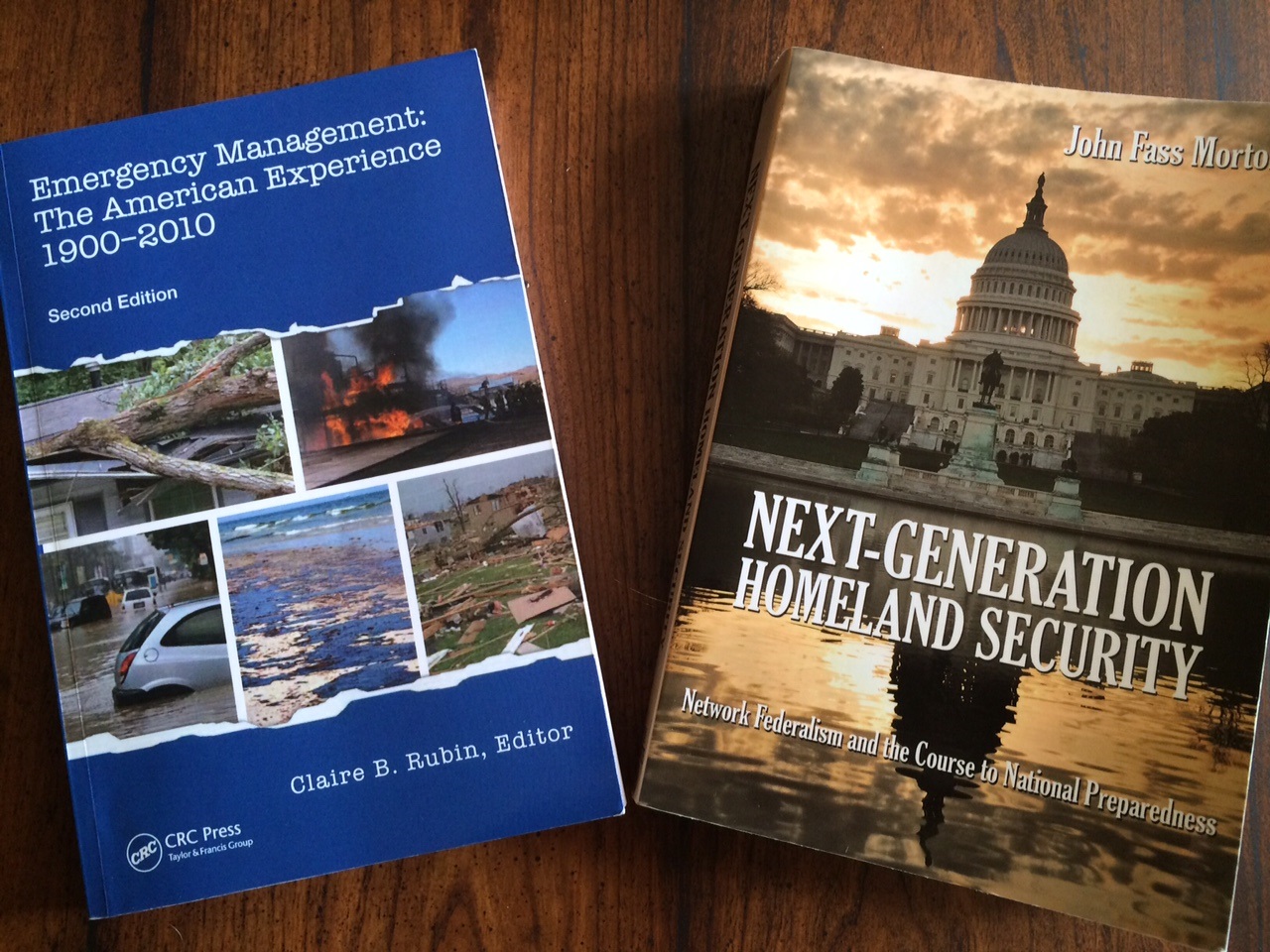
Any examination of this history of emergency management shows that politics seem to shape the direction of what we do as much as significant disasters do.  If you are interested in reading up on this, there are two great sources I’d recommend – Emergency Management: The American Experience 1900-2010 (Rubin. 2012.) provides good summaries of benchmark disasters and legislation through the years; and Next-Generation Homeland Security: Network Federalism and the Course to National Preparedness (Morton. 2012.) provides an in-depth look at this history with detailed references to the administrations, agencies, and people involved.

Rubin and Morton References

Rubin and Morton References

While we have certainly seen an overall positive trend of progress in emergency management (which is heavily influenced and sometimes dictated by federal policy), this has come despite some political actions which have either slowed progress or sometimes fully did away with positive and effective programs.  Having major changes in policy and programs every few years has become unsustainable for our practice, especially at the local level where EM/HS programs are often coordinated by one person.  Change isn’t always bad, but changes should be put in place only after being thought-through and reviewed by professionals to ensure they are effective and sustainable – not just politically motivated.  FEMA has been doing a great job in the last several years by providing public comment periods on new and major changes to guidance.  I hope this continues.

© 2015 – Timothy Riecker

Emergency Preparedness Solutions, LLC

WWW.EPSLLC.BIZ 
News in Emergency Management

Regrettably I’ve not posted in a few weeks due to a very busy schedule.  While that hasn’t broken, I did want to take some time to ensure that my readers have seen some recent news that has been circulating in emergency management as of late.

First, the FEMA mobile app has updated and is now providing the ability for users to receive weather alerts from up to five locations across the nation.  This is a particularly handy feature for those who have family and friends in other states or those who travel frequently to different areas.  With hazardous weather season upon us, be sure that you use the FEMA mobile app or other state or local alerting service to ensure that you, your family, and organization receive alerts.

Second, DHS has provided an update on the status of the LLIS (Lessons Learned Information Sharing) Libarary.  From the release I received this morning…

Dear LLIS.gov User,

This spring, the Lessons Learned Information Sharing (LLIS) program will make a significant change. The LLIS.gov website will cease independent operations and will consolidate its content with the Naval Postgraduate School’s Homeland Security Digital Library (HSDL.org) and FEMA.gov.

One of the advantages of this move is that LLIS.gov content such as lessons learned, innovative practices, after-action reports, plans, templates, guides, and other materials will be consolidated with the already substantial database on HSDL.org. This change will allow the homeland security and emergency management communities to find relevant information in one place. FEMA’s LLIS program will continue to produce trend analyses, case studies on the use of FEMA preparedness grants, and webinars relevant to the whole community. These products will be available to the public on FEMA.gov.
They don’t give any timeframe for this migration aside from stating that they will provide updates in the coming weeks.  Personally, I think this is a move that makes sense by consolidating some great sources of information.  I’m also happy to hear that FEMA will continue providing some data and trend analysis, although I’m hopeful that the information they provide is of greater value than what I have seen in the past.  I’m also curious if this will be somehow integrated into the new Data.gov site.  It’s unfortunate that LLIS has been pulled down for so long while they have sorted all this out.

Lastly, good news for coastal communities and those who have suffered inland tropical storm damages in the last few years – the prediction for the 2015 hurricane season is that we will have lower than average activity.  A link to the annual predictive analysis can be found here.

That’s all for now.  Stay safe.

© 2015 – Timothy Riecker

Emergency Preparedness Solutions, LLC

www.epsllc.biz 

Dispatch Transition to EOC Operations

Within the LinkedIn discussion thread of one of my recent posts on applications of ICS, I was prompted to consider that one more awkward element for an EOC operation can be the transition or integration of dispatch with the EOC.  Consider that during ‘routine’ operations, it is dispatch who is supporting field operations and tracking critical actions.  Many jurisdictions encounter a difficulty when activating an EOC locally to support a growing response – what to do with dispatch?

The EOC’s traditional role as ‘expanded dispatch’ aids a field response by providing a greater level of coordination far beyond the tools normally available to most dispatchers by facilitating direct access to agency representatives who are dedicated to supporting the needs of the incident.  Under routine operations, Command (or Logistics) is contacting dispatch directly (usually via radio) to request resources.  Upon activation of an EOC, these requests must be routed to the EOC.  In some jurisdictions, EOCs are co-located with dispatch (at least in the same building), making this transition a bit easier in regard to technology and people, but some jurisdictions have these buildings separated.

How do you solve this awkward dilemma of ICS/EOC interface?  First of all, it needs to be thought through and planned PRIOR to an incident!  This is when we can do our best work, ideally bringing all relevant stakeholders to the table, mapping out processes and procedures, and identifying equipment and technology issues needed to support it.  With everyone together, talk through what you want to do given the circumstances you have.  Each idea likely has pros and cons that have to be weighed.

Some possibilities… Keep all resource orders going through dispatch. In doing so, you are not interrupting the ‘normal’ communications link with field operations.  In this circumstance, though, you need to consider how the dispatcher will transfer the resource request to EOC Logistics.  Since you likely do not want Logistics to be accessing the PSAP system, the dispatcher will likely have to enter the request into another system, such as EOC management software (something they likely don’t use often).  This can be time consuming so it will likely require the dispatcher to be solely dedicated to this incident.  The scope of resources (or ideally missions) is also beyond what a dispatcher usually deals with (thus the reason for activating the EOC), so it would likely require some additional training and use of dispatchers with greater experience.

Another option is to bring the dispatcher into the EOC.  Sometimes physical separation, despite technology, can make things awkward.  If the jurisdiction has the technological ability to bring a dispatcher into the EOC as part of the Communications Unit, they can interact with field operations and facilitate communication better.  The need to enter the resource/mission request into a formal system which is assignable and trackable still exists.

Another option is to pull dispatch out of the incident.  This can cause significant disruption to the incident but is manageable if pre-planned, trained, and exercised.  At this point in an expanded incident the need to use radio communications beyond field operations may be exceeded.  Field Logistics can interface directly with EOC Logistics via phone or other technology to communicate resource requests.  This methodology gets the request directly to EOC Logistics for them to handle.

There are certainly other models and possibilities that exist.  What experiences do you have?  What have you seen work?  What have you seen fail?

© 2015 – Timothy Riecker

Emergency Preparedness Solutions, LLC

WWW.EPSLLC.BIZ 

Flooding – ’tis the Season

In central New York we have experienced 50+ degree (F) weather for the first time in months.  With the warmer weather has come the melting of a fair amount of snow which accumulated through the winter.  Winter temperatures rarely reaching above freezing up here resulting in little melting of snow through the season, so it’s all occurring now. Coupled with spring rains and storms, flood watches and warnings have been issued here and in other locations around the nation.  If you haven’t already, now is the time to prepare for flooding!

Aside from the measures that homeowners, business owners, and facility managers can take (sump pumps, doorway dams, sand bags, and flood barriers), jurisdictions need to be prepared for the impacts of flooding.  If electronic gauges don’t exist in your streams and rivers, be sure to have someone periodically measure and report their depth and progression toward flood stages.  Ensure that culverts are clean and open for the flow of water, and have personnel, equipment, signage, and barriers ready to deploy to address trouble spots and close roads.

Ironically, water and wastewater systems have a significant vulnerability to flooding.  The EPA has issued Flood Resilience: A Basic Guide for Water and Wastewater Utilities that includes worksheets, videos, and flood maps to guide water and wastewater system operators through identifying their flood risk and vulnerability and mitigation options available to them.  Along with that effort, they have issued a Flooding Incident Action Checklist.

Most importantly, make sure that flood awareness is not a unilateral effort.  Involve emergency managers, elected officials, and first response organizations.  Review plans, policies, and procedures and ensure they are up to date.  Consider related actions, such as notification and warning, evacuation, and flood fighting measures.  Preemptive messaging to property owners/residents and business owners to help them be aware and prepared for flooding is also crucial; and make sure everyone knows how to receive local weather alerts so they are aware of any imminent flooding dangers.

Stay dry!

© 2015 – Timothy Riecker

Emergency Preparedness Solutions, LLC

www.epsllc.biz

The Need for Practical Incident Command Training

I’ve written a couple of articles in past few months (See: Preparedness – ICS is Not Enough; and Training EOC Personnel – ICS is Not Enough) where I’ve been a little rough on the Incident Command System (ICS), or rather the trust that people put in it as a magic pill to cure all their incident management ills.  As it turns out, there is no apologia; rather I’m going to continue challenging the status quo, this time as it relates to how ICS training is conducted.

The driving force behind this is the realization of a gap that exists in ICS training and the ability of learners to apply what they have learned to a reasonable degree within an emergency response environment.  The foundational ICS courses (ICS 100 – 400) provide learners with a progressive understanding of the concepts, terms, organizational elements, and primary processes within ICS, but provide little opportunity to practically apply what they have learned.  Progressive instructional design methods through course revisions have added more hands-on activities within these courses to enhance learning, but these courses still fall short of providing the kind of practical exercising needed for learners to have any degree of confidence or proficiency.  That said, these courses accomplish exactly what they are intended to.  They are not designed to provide much practical application.

To the other side of the ICS training spectrum is training for Incident Management Teams (IMTs), which provides intensive and in depth training, mostly focused on the individual positions within an incident command organization, and the key activities and responsibilities of those positions.  IMT training also includes capstone courses in which IMTs complete a combination of didactic and hands-on instruction in a team environment.  Much of this training is coordinated by FEMA and the US Fire Administration through the NIMS ICS All-Hazards Position Specific Training Program with their focus primarily on building capability at the Type III (extended operations) level, with training at the higher (Type II and I) levels available through appropriately intensive efforts.  While some training is available for Type IV and V IMTs, this is often not taken advantage of because rural areas may not be able to assemble enough personnel for a functional team.  The training is also still fairly intensive, even at this level, and requires a number of courses, each with a team of instructors.  This comes at a high cost of time and dollars.  The need for local personnel to function within an incident command structure at the local level still exists, but goes largely unaddressed with performance level training being focused on IMTs.

Certainly exercises can provide an opportunity for individuals to work together as an ad-hoc team to resolve an incident.  While exercises provide for great practice, instructive feedback usually doesn’t occur at all, with usually only a few out of context comments coming until well after the experience by way of an After Action Report.  Structured learning environments which provide a series of simulations where individuals can practice what they have learned are ideal, particularly when immediate hotwashes are provided after each scenario, allowing learners to grow and apply what they have learned in the next scenario.

Of the learning opportunities that current exist, the Enhanced All-Hazards Incident Management/Unified Command course (MGT 314) from TEEX comes closest to this type of experience.  I have direct experience taking this course at the TEEX location several years ago and found it to be a great experience.  Because of the technology used to facilitate the course it is only offered as a resident program at TEEX and seats fill quickly.  While this is a great program, we need more like it and an ability to reach down to small local governments where there is an urgent need for this type of practical training.

Several years ago colleagues and I developed a course called the ‘IAP Workshop’, which is a daylong scenario-driven training where students practice working the ICS planning process and ultimately developing an IAP.  Through the day of training, participants go through this process several times in a crawl-walk-run progression with feedback provided by facilitators.  Participants are required to have completed the ICS 300 course as a prerequisite.  This course has proven successful, despite naysayers and traditionalists who default to the ICS curriculum fulfilling all ICS training needs.  That said, there is more to ICS and ICS application than the planning process.

Practical training in any subject, particularly the Incident Command System, builds confidence and improved application of knowledge and skills.  Since most incidents are best managed locally, we need to invest in better training to enhance local capabilities.  The foundational ICS courses are just that – foundational.  IMT training may simply not be the best solution to meet this need.  Let’s talk about the ICS training gap and find some solutions.

What ICS training gaps have you identified?  Have you discovered or designed any solutions?

© 2015 – Timothy Riecker

Emergency Preparedness Solutions, LLC

www.epsllc.biz

Do You Have an Emergency Management Committee?

Comprehensive emergency and disaster management, effectively done, cannot be done by one person alone.  The best emergency management and homeland security practices are performed by teams.  The practices of emergency management and homeland security are so ubiquitous and multifaceted that we rely on the participation and input of persons in related professions, and in fact professions generally not seen as related, to be successful.  Because of this, both government entities and corporations alike often embrace a team approach to emergency management.  Do you?

Division of Responsibility – Unity of Effort

Aside from the chief elected official or chief executive officer, no one person has the direct ability to ‘command’ the forces of a jurisdiction or corporation.  The trouble with this is that these CEOs are generally not experts in disaster management.  Effective organizations learn the necessity of delegation early on which, while the CEO is still ultimately responsible, those delegated to are functionally responsible for their respective areas.  Laws and regulations often make these delegations mandatory for both jurisdictions and corporations.  While each of these delegations has their own functional responsibilities, they still operate as part of a greater organization and must work well together achieve maximum effectiveness.

The ability of these stakeholders to work together in a unity of effort is certainly important during a disaster, but it’s not the only time they should get together to talk about disasters.  Yes, many of these individuals will see each other during (hopefully) regular staff meetings, but these meetings typically involve briefing the CEO on current or upcoming activities, discussions on hiring and budgets, or being briefed on new policy.  While these are all important discussions they usually leave little room to discuss topics on emergency management and homeland security.

EM/HS certainly warrants its own meetings and workshops to accomplish important tasks such as a periodic threat and hazard identification, plan creation and updates, exercise planning meetings, and discussions on training, grants, and preparedness investments.  This group should also be making policy recommendations to the CEO and ensuring that preparedness efforts are permeating the entire jurisdiction or organization.  Their work together in preparedness efforts will strengthen their relationships and increase their knowledge of each other’s functional responsibilities and capabilities.

Who Should Participate?

In any of the mission areas of emergency management and homeland security (Prevention, Protection, Mitigation, Response, and Recovery – or in activities related to preparedness for any of these) there are often related or even overlapping interests amongst department heads.  The emergency manager, fire, police, EMS, and public works/highway are often at the forefront; but other departments and positions such as parks and recreation, clerk, human resources, finance/treasurer, and zoning can all (and should) have some degree of input.  Larger jurisdictions may have their own health and human services departments which are also important participants.  There are similar positions within corporate organizations that have the same interactions and hold the same importance in this regard to these organizations.  Also be sure to consider external partners such as utilities, major employers, and not for profits and social groups?  Perhaps your EMS provider is a third party or your law enforcement is provided for by a Sheriff’s Department or State Police – be sure to include them as well.

This ‘whole community’ list can grow very quickly and often times not all members are needed for the group to function effectively.  The best practice in emergency management committees is to take a tiered approach – with a core group addressing most matters but with the support and augmentation of an expanded group to include other departments and organizations whose participation is called upon when needed.

Emergency management and homeland security are team efforts which require the active participation and input of all stakeholders to be effective.  Don’t just rely on your emergency manager to get the job done.  They need support from the entire organization to ensure that your jurisdiction or corporation is prepared to address the worst, save lives, and minimize losses.  Some emergency managers view such committees as ‘oversight’ or an unnecessary bureaucracy, but success lies in collaboration.

What’s your approach?

© 2015 – Timothy Riecker

Emergency Preparedness Solutions, LLC

www.epsllc.biz

H7N9 Bird Flu Confirmed in Canada

In another bit of news regarding bird flu (aka avian influenza), the H7N9 strain of the virus has infected a citizen of British Columbia who recently traveled to China.  This release comes just a few days after H5N1 had been confirmed in a duck in northern Washington.  Certainly coincidence, but the discovery of the presence of both strains in North America – both for the first time – is daunting.

© 2015 – Timothy Riecker

Emergency Preparedness Solutions, LLC

www.epsllc.biz

H5N1 Confirmed in the US

In news released by the media this morning, the presence of H5N1 (aka bird flu or avian influenza) has been confirmed in the US.  While many dusted off communicable disease plans with last year’s (and continuing) Ebola threat, we need to ensure that we take into account the wildlife and agricultural implications of H5N1 along with the threat to human life.  While one positive finding certainly does not make an epidemic, the confirmed presence should be putting certain actions into place for many public safety partners, including federal and state agricultural and fish and game offices.  Hunters, farmers, and veterinarians need to be aware of signs and symptoms just as much as our health care providers.

Be on the lookout for more information from authorities on this.  Consider the implications it can have within your area of responsibility and be sure to think broadly and consider cascading impacts.

© 2015 – Timothy Riecker

Emergency Preparedness Solutions, LLC

www.epsllc.biz