EM, HS, and Politics

As the mechanizations of election season warm up their engines, let’s be sure to identify the standing of candidates in regard to emergency management and homeland security policies.  While we will never get a fully accurate picture of their intentions in these programs this early on (I’m sure few candidates are even thinking about EM/HS policy aside from immigration), we can get some indication of what their thoughts are and, once primary season is over, who the final candidates might be considering to head important agencies such as DHS and FEMA.

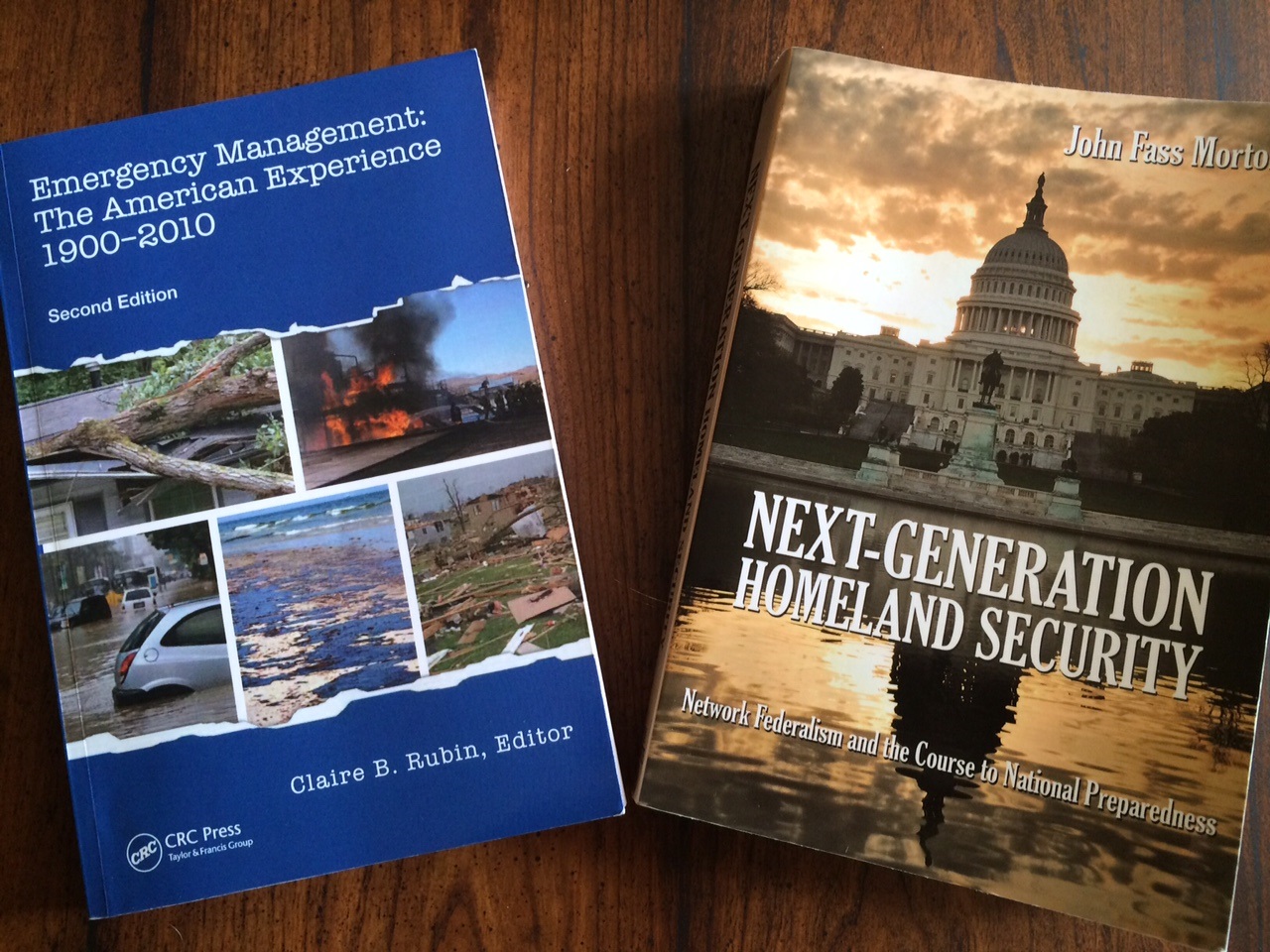
Any examination of this history of emergency management shows that politics seem to shape the direction of what we do as much as significant disasters do.  If you are interested in reading up on this, there are two great sources I’d recommend – Emergency Management: The American Experience 1900-2010 (Rubin. 2012.) provides good summaries of benchmark disasters and legislation through the years; and Next-Generation Homeland Security: Network Federalism and the Course to National Preparedness (Morton. 2012.) provides an in-depth look at this history with detailed references to the administrations, agencies, and people involved.

Rubin and Morton References

Rubin and Morton References

While we have certainly seen an overall positive trend of progress in emergency management (which is heavily influenced and sometimes dictated by federal policy), this has come despite some political actions which have either slowed progress or sometimes fully did away with positive and effective programs.  Having major changes in policy and programs every few years has become unsustainable for our practice, especially at the local level where EM/HS programs are often coordinated by one person.  Change isn’t always bad, but changes should be put in place only after being thought-through and reviewed by professionals to ensure they are effective and sustainable – not just politically motivated.  FEMA has been doing a great job in the last several years by providing public comment periods on new and major changes to guidance.  I hope this continues.

© 2015 – Timothy Riecker

Emergency Preparedness Solutions, LLC

WWW.EPSLLC.BIZ 

News in Emergency Management

Regrettably I’ve not posted in a few weeks due to a very busy schedule.  While that hasn’t broken, I did want to take some time to ensure that my readers have seen some recent news that has been circulating in emergency management as of late.

First, the FEMA mobile app has updated and is now providing the ability for users to receive weather alerts from up to five locations across the nation.  This is a particularly handy feature for those who have family and friends in other states or those who travel frequently to different areas.  With hazardous weather season upon us, be sure that you use the FEMA mobile app or other state or local alerting service to ensure that you, your family, and organization receive alerts.

Second, DHS has provided an update on the status of the LLIS (Lessons Learned Information Sharing) Libarary.  From the release I received this morning…

Dear LLIS.gov User,

This spring, the Lessons Learned Information Sharing (LLIS) program will make a significant change. The LLIS.gov website will cease independent operations and will consolidate its content with the Naval Postgraduate School’s Homeland Security Digital Library (HSDL.org) and FEMA.gov.

One of the advantages of this move is that LLIS.gov content such as lessons learned, innovative practices, after-action reports, plans, templates, guides, and other materials will be consolidated with the already substantial database on HSDL.org. This change will allow the homeland security and emergency management communities to find relevant information in one place. FEMA’s LLIS program will continue to produce trend analyses, case studies on the use of FEMA preparedness grants, and webinars relevant to the whole community. These products will be available to the public on FEMA.gov.
They don’t give any timeframe for this migration aside from stating that they will provide updates in the coming weeks.  Personally, I think this is a move that makes sense by consolidating some great sources of information.  I’m also happy to hear that FEMA will continue providing some data and trend analysis, although I’m hopeful that the information they provide is of greater value than what I have seen in the past.  I’m also curious if this will be somehow integrated into the new Data.gov site.  It’s unfortunate that LLIS has been pulled down for so long while they have sorted all this out.

Lastly, good news for coastal communities and those who have suffered inland tropical storm damages in the last few years – the prediction for the 2015 hurricane season is that we will have lower than average activity.  A link to the annual predictive analysis can be found here.

That’s all for now.  Stay safe.

© 2015 – Timothy Riecker

Emergency Preparedness Solutions, LLC

www.epsllc.biz 

Dispatch Transition to EOC Operations

Within the LinkedIn discussion thread of one of my recent posts on applications of ICS, I was prompted to consider that one more awkward element for an EOC operation can be the transition or integration of dispatch with the EOC.  Consider that during ‘routine’ operations, it is dispatch who is supporting field operations and tracking critical actions.  Many jurisdictions encounter a difficulty when activating an EOC locally to support a growing response – what to do with dispatch?

The EOC’s traditional role as ‘expanded dispatch’ aids a field response by providing a greater level of coordination far beyond the tools normally available to most dispatchers by facilitating direct access to agency representatives who are dedicated to supporting the needs of the incident.  Under routine operations, Command (or Logistics) is contacting dispatch directly (usually via radio) to request resources.  Upon activation of an EOC, these requests must be routed to the EOC.  In some jurisdictions, EOCs are co-located with dispatch (at least in the same building), making this transition a bit easier in regard to technology and people, but some jurisdictions have these buildings separated.

How do you solve this awkward dilemma of ICS/EOC interface?  First of all, it needs to be thought through and planned PRIOR to an incident!  This is when we can do our best work, ideally bringing all relevant stakeholders to the table, mapping out processes and procedures, and identifying equipment and technology issues needed to support it.  With everyone together, talk through what you want to do given the circumstances you have.  Each idea likely has pros and cons that have to be weighed.

Some possibilities… Keep all resource orders going through dispatch. In doing so, you are not interrupting the ‘normal’ communications link with field operations.  In this circumstance, though, you need to consider how the dispatcher will transfer the resource request to EOC Logistics.  Since you likely do not want Logistics to be accessing the PSAP system, the dispatcher will likely have to enter the request into another system, such as EOC management software (something they likely don’t use often).  This can be time consuming so it will likely require the dispatcher to be solely dedicated to this incident.  The scope of resources (or ideally missions) is also beyond what a dispatcher usually deals with (thus the reason for activating the EOC), so it would likely require some additional training and use of dispatchers with greater experience.

Another option is to bring the dispatcher into the EOC.  Sometimes physical separation, despite technology, can make things awkward.  If the jurisdiction has the technological ability to bring a dispatcher into the EOC as part of the Communications Unit, they can interact with field operations and facilitate communication better.  The need to enter the resource/mission request into a formal system which is assignable and trackable still exists.

Another option is to pull dispatch out of the incident.  This can cause significant disruption to the incident but is manageable if pre-planned, trained, and exercised.  At this point in an expanded incident the need to use radio communications beyond field operations may be exceeded.  Field Logistics can interface directly with EOC Logistics via phone or other technology to communicate resource requests.  This methodology gets the request directly to EOC Logistics for them to handle.

There are certainly other models and possibilities that exist.  What experiences do you have?  What have you seen work?  What have you seen fail?

© 2015 – Timothy Riecker

Emergency Preparedness Solutions, LLC

WWW.EPSLLC.BIZ 

Flooding – ’tis the Season

In central New York we have experienced 50+ degree (F) weather for the first time in months.  With the warmer weather has come the melting of a fair amount of snow which accumulated through the winter.  Winter temperatures rarely reaching above freezing up here resulting in little melting of snow through the season, so it’s all occurring now. Coupled with spring rains and storms, flood watches and warnings have been issued here and in other locations around the nation.  If you haven’t already, now is the time to prepare for flooding!

Aside from the measures that homeowners, business owners, and facility managers can take (sump pumps, doorway dams, sand bags, and flood barriers), jurisdictions need to be prepared for the impacts of flooding.  If electronic gauges don’t exist in your streams and rivers, be sure to have someone periodically measure and report their depth and progression toward flood stages.  Ensure that culverts are clean and open for the flow of water, and have personnel, equipment, signage, and barriers ready to deploy to address trouble spots and close roads.

Ironically, water and wastewater systems have a significant vulnerability to flooding.  The EPA has issued Flood Resilience: A Basic Guide for Water and Wastewater Utilities that includes worksheets, videos, and flood maps to guide water and wastewater system operators through identifying their flood risk and vulnerability and mitigation options available to them.  Along with that effort, they have issued a Flooding Incident Action Checklist.

Most importantly, make sure that flood awareness is not a unilateral effort.  Involve emergency managers, elected officials, and first response organizations.  Review plans, policies, and procedures and ensure they are up to date.  Consider related actions, such as notification and warning, evacuation, and flood fighting measures.  Preemptive messaging to property owners/residents and business owners to help them be aware and prepared for flooding is also crucial; and make sure everyone knows how to receive local weather alerts so they are aware of any imminent flooding dangers.

Stay dry!

© 2015 – Timothy Riecker

Emergency Preparedness Solutions, LLC

www.epsllc.biz

The Need for Practical Incident Command Training

I’ve written a couple of articles in past few months (See: Preparedness – ICS is Not Enough; and Training EOC Personnel – ICS is Not Enough) where I’ve been a little rough on the Incident Command System (ICS), or rather the trust that people put in it as a magic pill to cure all their incident management ills.  As it turns out, there is no apologia; rather I’m going to continue challenging the status quo, this time as it relates to how ICS training is conducted.

The driving force behind this is the realization of a gap that exists in ICS training and the ability of learners to apply what they have learned to a reasonable degree within an emergency response environment.  The foundational ICS courses (ICS 100 – 400) provide learners with a progressive understanding of the concepts, terms, organizational elements, and primary processes within ICS, but provide little opportunity to practically apply what they have learned.  Progressive instructional design methods through course revisions have added more hands-on activities within these courses to enhance learning, but these courses still fall short of providing the kind of practical exercising needed for learners to have any degree of confidence or proficiency.  That said, these courses accomplish exactly what they are intended to.  They are not designed to provide much practical application.

To the other side of the ICS training spectrum is training for Incident Management Teams (IMTs), which provides intensive and in depth training, mostly focused on the individual positions within an incident command organization, and the key activities and responsibilities of those positions.  IMT training also includes capstone courses in which IMTs complete a combination of didactic and hands-on instruction in a team environment.  Much of this training is coordinated by FEMA and the US Fire Administration through the NIMS ICS All-Hazards Position Specific Training Program with their focus primarily on building capability at the Type III (extended operations) level, with training at the higher (Type II and I) levels available through appropriately intensive efforts.  While some training is available for Type IV and V IMTs, this is often not taken advantage of because rural areas may not be able to assemble enough personnel for a functional team.  The training is also still fairly intensive, even at this level, and requires a number of courses, each with a team of instructors.  This comes at a high cost of time and dollars.  The need for local personnel to function within an incident command structure at the local level still exists, but goes largely unaddressed with performance level training being focused on IMTs.

Certainly exercises can provide an opportunity for individuals to work together as an ad-hoc team to resolve an incident.  While exercises provide for great practice, instructive feedback usually doesn’t occur at all, with usually only a few out of context comments coming until well after the experience by way of an After Action Report.  Structured learning environments which provide a series of simulations where individuals can practice what they have learned are ideal, particularly when immediate hotwashes are provided after each scenario, allowing learners to grow and apply what they have learned in the next scenario.

Of the learning opportunities that current exist, the Enhanced All-Hazards Incident Management/Unified Command course (MGT 314) from TEEX comes closest to this type of experience.  I have direct experience taking this course at the TEEX location several years ago and found it to be a great experience.  Because of the technology used to facilitate the course it is only offered as a resident program at TEEX and seats fill quickly.  While this is a great program, we need more like it and an ability to reach down to small local governments where there is an urgent need for this type of practical training.

Several years ago colleagues and I developed a course called the ‘IAP Workshop’, which is a daylong scenario-driven training where students practice working the ICS planning process and ultimately developing an IAP.  Through the day of training, participants go through this process several times in a crawl-walk-run progression with feedback provided by facilitators.  Participants are required to have completed the ICS 300 course as a prerequisite.  This course has proven successful, despite naysayers and traditionalists who default to the ICS curriculum fulfilling all ICS training needs.  That said, there is more to ICS and ICS application than the planning process.

Practical training in any subject, particularly the Incident Command System, builds confidence and improved application of knowledge and skills.  Since most incidents are best managed locally, we need to invest in better training to enhance local capabilities.  The foundational ICS courses are just that – foundational.  IMT training may simply not be the best solution to meet this need.  Let’s talk about the ICS training gap and find some solutions.

What ICS training gaps have you identified?  Have you discovered or designed any solutions?

© 2015 – Timothy Riecker

Emergency Preparedness Solutions, LLC

www.epsllc.biz

Do You Have an Emergency Management Committee?

Comprehensive emergency and disaster management, effectively done, cannot be done by one person alone.  The best emergency management and homeland security practices are performed by teams.  The practices of emergency management and homeland security are so ubiquitous and multifaceted that we rely on the participation and input of persons in related professions, and in fact professions generally not seen as related, to be successful.  Because of this, both government entities and corporations alike often embrace a team approach to emergency management.  Do you?

Division of Responsibility – Unity of Effort

Aside from the chief elected official or chief executive officer, no one person has the direct ability to ‘command’ the forces of a jurisdiction or corporation.  The trouble with this is that these CEOs are generally not experts in disaster management.  Effective organizations learn the necessity of delegation early on which, while the CEO is still ultimately responsible, those delegated to are functionally responsible for their respective areas.  Laws and regulations often make these delegations mandatory for both jurisdictions and corporations.  While each of these delegations has their own functional responsibilities, they still operate as part of a greater organization and must work well together achieve maximum effectiveness.

The ability of these stakeholders to work together in a unity of effort is certainly important during a disaster, but it’s not the only time they should get together to talk about disasters.  Yes, many of these individuals will see each other during (hopefully) regular staff meetings, but these meetings typically involve briefing the CEO on current or upcoming activities, discussions on hiring and budgets, or being briefed on new policy.  While these are all important discussions they usually leave little room to discuss topics on emergency management and homeland security.

EM/HS certainly warrants its own meetings and workshops to accomplish important tasks such as a periodic threat and hazard identification, plan creation and updates, exercise planning meetings, and discussions on training, grants, and preparedness investments.  This group should also be making policy recommendations to the CEO and ensuring that preparedness efforts are permeating the entire jurisdiction or organization.  Their work together in preparedness efforts will strengthen their relationships and increase their knowledge of each other’s functional responsibilities and capabilities.

Who Should Participate?

In any of the mission areas of emergency management and homeland security (Prevention, Protection, Mitigation, Response, and Recovery – or in activities related to preparedness for any of these) there are often related or even overlapping interests amongst department heads.  The emergency manager, fire, police, EMS, and public works/highway are often at the forefront; but other departments and positions such as parks and recreation, clerk, human resources, finance/treasurer, and zoning can all (and should) have some degree of input.  Larger jurisdictions may have their own health and human services departments which are also important participants.  There are similar positions within corporate organizations that have the same interactions and hold the same importance in this regard to these organizations.  Also be sure to consider external partners such as utilities, major employers, and not for profits and social groups?  Perhaps your EMS provider is a third party or your law enforcement is provided for by a Sheriff’s Department or State Police – be sure to include them as well.

This ‘whole community’ list can grow very quickly and often times not all members are needed for the group to function effectively.  The best practice in emergency management committees is to take a tiered approach – with a core group addressing most matters but with the support and augmentation of an expanded group to include other departments and organizations whose participation is called upon when needed.

Emergency management and homeland security are team efforts which require the active participation and input of all stakeholders to be effective.  Don’t just rely on your emergency manager to get the job done.  They need support from the entire organization to ensure that your jurisdiction or corporation is prepared to address the worst, save lives, and minimize losses.  Some emergency managers view such committees as ‘oversight’ or an unnecessary bureaucracy, but success lies in collaboration.

What’s your approach?

© 2015 – Timothy Riecker

Emergency Preparedness Solutions, LLC

www.epsllc.biz

H7N9 Bird Flu Confirmed in Canada

In another bit of news regarding bird flu (aka avian influenza), the H7N9 strain of the virus has infected a citizen of British Columbia who recently traveled to China.  This release comes just a few days after H5N1 had been confirmed in a duck in northern Washington.  Certainly coincidence, but the discovery of the presence of both strains in North America – both for the first time – is daunting.

© 2015 – Timothy Riecker

Emergency Preparedness Solutions, LLC

www.epsllc.biz

H5N1 Confirmed in the US

In news released by the media this morning, the presence of H5N1 (aka bird flu or avian influenza) has been confirmed in the US.  While many dusted off communicable disease plans with last year’s (and continuing) Ebola threat, we need to ensure that we take into account the wildlife and agricultural implications of H5N1 along with the threat to human life.  While one positive finding certainly does not make an epidemic, the confirmed presence should be putting certain actions into place for many public safety partners, including federal and state agricultural and fish and game offices.  Hunters, farmers, and veterinarians need to be aware of signs and symptoms just as much as our health care providers.

Be on the lookout for more information from authorities on this.  Consider the implications it can have within your area of responsibility and be sure to think broadly and consider cascading impacts.

© 2015 – Timothy Riecker

Emergency Preparedness Solutions, LLC

www.epsllc.biz 

Best Practices for the New Year – Situation Reporting

Situation reports or SitReps have a great deal of importance in conveying information on an incident or event to a variety of stakeholders.  Having worked for many years as a Planning Section Chief in a State EOC and county and local EOCs and command posts on a variety of incidents and events; well structured, well written, and relevant SitReps have become a bugaboo of mine.  SitReps are intended to provide a snapshot of a common operating picture for stakeholders involved in the incident or event.  Creation of a SitRep should be viewed as a process, similar to incident action planning.

The information contained in a SitRep provides them with the information they need to know to perform their duties in support of the incident.  Keep in mind that stakeholders may not be involved in the operations or support of an incident but still need to have awareness as they may be impacted.  A series of SitReps can also contribute greatly to the historical record of the incident or event.

Looking into the New Year and toward your next incident and event, I’ve provided some things I’ve learned along the way which can bake your situation reporting more effective and meaningful.

Defining the Audience

In the first step to building a benchmark SitRep, regular readers of my blog will recognize one of my common themes – identifying needs.  Just as we do in training, we need to be aware of who are audience is what their needs are.  The primary purpose of a SitRep is to meet the information needs of your audience.

Who are the stakeholders that see your SitReps?  Are they operators, decision makers, or executives?  Generally, based on these three categories, here is the information they need:

Operators.  These are the folks who are ‘boots on ground’ getting the work done.  While they might love to see detail of what is going on throughout the incident or event, they don’t NEED this information as it can, in fact, be simply distracting to them.  Very rarely are SitReps geared toward this audience as you want them tactically focused on the tasks they are assigned to. Usually a brief incident summary satisfies their limited need to have a bigger picture of what is occurring.  Those who are managing them should be providing them with the information they need to know.

Decision makers.  Decision makers are found at many levels throughout an incident structure.  They may be task force or strike team leaders, division or group supervisors, facility managers, branch directors, section chiefs, functional managers of agencies or departments, or others functioning in similar capacities.  Decision makers have the greatest functional information need.  The information being provided to this group strongly supports their role in the incident, the planning and management of the incident, and the safety of personnel.  The information provided to them should have some degree of operational detail and should include information on hazards and safety issues as well as potential problem areas.

Executives.  This category includes chief elected officials, high level appointed officials, and organizations with ancillary involvement.  Executives are of course decision makers in their own right, but aren’t often involved at the level of detail of the decision makers discussed above.  Generally executives don’t require a great degree of operational detail, but they do like numbers and statistics.  Like the decision makers, they also need to be aware of potential pitfalls on the horizon as they need the information to make high level decisions to address the problem or be prepared to deal with the outcomes politically.  You may have to be the most aware and response of the needs of this audience as they may have different information needs during an incident.

Where the Information Comes From

We know from communications training that information we convey must be timely, relevant, and accurate – this must be the litmus test by which you judge all SitRep content.  The Planning Section should be obtaining information from all relevant stakeholders.  They need an overview of what has, is, and will be happening operationally (and the outcomes/impacts of these operations) as well as all support activities and external influences (such as weather, crowd activities, etc.).  Information from field operations should come, ideally, from individuals functioning in the field for the sole purpose of obtaining and providing information (field observers).  Often times, however, we don’t have this luxury and have to obtain information directly from field-level managers themselves.  Caution should be exercised with the information you receive from them, or anyone really, as some will alter information based upon their own agendas or bias.  Information should also be obtained from support services, usually found through your Logistics section.

In an EOC environment we will also usually obtain information from the agencies and functions represented there.  These agencies are also audiences for the SitRep so they get to see first-hand how their situational awareness contributes to a common operating picture.  You may also be obtaining a lot of raw data.  If it’s relevant, track this data and report on it, ensuring that it is meaningful to your audience.  Leverage the talents of GIS to display this information in usable and meaningful formats.  As the years have progressed, I’ve seen SitReps with less narrative and more GIS.

In obtaining information, I’ve found that a form or script can be of the greatest help.  It ensures not only consistency in the information being gathered but it also ensures that nothing is missed.  Often those reporting information will have a particular perspective which will be the focus of their reporting.  Asking additional questions encourages them to think more broadly.  Be sure to get your information sources on a firm schedule so you are not waiting on their information.  Late information from your sources will result in a late or incomplete SitRep.  Personnel may need regular reminders to compile and submit their situational information.  Also be sure to give GIS plenty of time to do their work.  Set a publication time and work backwards to establish reporting and work schedules for everyone involved.

Remember – timely, relevant, and accurate.  While a short summary of previous actions may be important to provide context, it is not necessary to provide a long historical narrative.  Be sure to report on the outcomes or effectiveness of actions.  This detail of progress is important for a situation report.  As far as accuracy, work to verify information to the greatest practical extent, especially any information that is speculative.  Inaccurate information can be career ending.

Organizing the Information

Typically you only have time to assemble one SitRep, despite having to serve multiple audiences.  Inclusion of an executive summary is then a very appropriate means of providing an area within the SitRep for those audiences which need a shorter overview.  After the executive summary you have a great deal of flexibility on the structure and formatting of the document, but keep things organized and largely consistent from report to report.  Often times SitReps are organized the way we organize the incident – have you organized functionally or geographically?  It may be a mix of the two, so organize your SitRep based upon that.  Simply find a format that makes sense.  I like to arrange information that applies to everyone first, such as a weather forecast.  You may have information such as statistical tables or GIS products which are best provided as attachments so they don’t interrupt the flow of the narrative.

Keep in mind that this is NOT a document providing operational direction – that comes from an Incident Action Plan (IAP).  Therefore, all associated operational information such as safety matters, communication plans, etc. should be included in the IAP and generally not replicated in the SitRep.  Those who need access to that operational information should be also receiving copies of the IAP.  A short synapsis of the SitRep can be provided in the IAP to add context and to provide information for operators but should not be replicated to any great extent.

Conclusion

Creating a situation report takes a lot of time and patience and is not something to be hurried, but their publication is something counted on so they must adhere to a schedule.  It is very much a ‘garbage in – garbage out’ activity, so the quality of the information coming in is extremely important.  A large incident or event may require a largely staffed Situation Unit to collect and organize information.  SitReps should always be reviewed before being finalized.  It is a professional report so attention should be paid to things like grammar and spelling.

So what have you learned from your experiences in assembling situation reports?

Need help building SitRep templates and standard operating guidelines?  Emergency Preparedness Solutions can help!  www.epsllc.biz

© 2015 – Timothy Riecker
Best Practices for the New Year – Standards in Emergency Management Programs

Going into the New Year I’m endeavoring to write a few posts on best practices in emergency management.  The New Year is a great opportunity for us to take a broad look at our emergency management programs to identify needs and develop and implement some strategies to improve.  Instead of looking back in a rather cliché “year in review”, let’s look ahead toward improvement!

I also wanted to express appreciation to all of my blog readers.  Some of you find me directly through my blog’s home at WordPress, some through LinkedIn or Twitter (@triecker or @epsllc), and some through my company’s website – Emergency Preparedness Solutions, LLC.  If you like my blog please share it with others.  Comments are always welcome.

On to our topic… Standards in Emergency Management Programs

All emergency management programs – government, private sector, and not-for-profit – should strive for their programs to meet accepted industry standards.  The two most significant standards in the United States are the National Fire Protection Association (NFPA) 1600: Standard on Disaster/Emergency Management and Business Continuity Programs and the Emergency Management Accreditation Program (EMAP).  The two standards are very similar in content and in fact complimentary, with the most significant difference being that EMAP offers an actual accreditation process.  Both programs offer copies of their standards free of charge, which is reflective of the spirit of sharing and improvement that exists in emergency management.

The NFPA offers the most recent previous version of their standard as a free download from their website.  The NFPA 1600 standard is quite detailed and can be initially overwhelming but really should be referenced piecemeal.  The free EMAP standards are published in a bit less detail, but they provide a very detailed assessment tool for those who initiate the formal accreditation process.  Because neither standard references specific laws or FEMA documents, they are also great references for governments, private sector, and not-for-profits outside the US.

How should you review the standards? 

They both essentially serve as checklists for what is programmatically needed for successful emergency management programs.  They are both organized by functions, such as planning, training, exercises, and logistics allowing a program to see what activities within each area are needed.  Neither standard will tell you how to meet any particular section of their standard, as they don’t want to be seen as favoring any particular published processes or products and want to encourage innovation and resourcefulness.  This also lends itself well to either/both standards being applicable and achievable by large and small organizations alike.

Examining your own emergency management program through the lens of either of these standards provides a great opportunity to see where you stand.  Examine your functions piece by piece, function by function.  Check off what areas you feel meet the standards and highlight those which you feel do not.  Use these areas as a point of reference for improvements.  Conduct a bit of a needs assessment in these areas to identify exactly what needs to be done to improve and meet the standard then create an improvement plan to make it happen.

Having helped organizations with both NFPA 1600 compliance as well as EMAP accreditation, I’ll attest that much of it simply comes down to paperwork and good systems management.  Many of the standards can be addressed through creating and applying polices and solid practices and procedures.  Organized and thorough record keeping is very important for these matters.

What if you don’t have a specific emergency management function or certain activities are conducted by someone else?

Of course you probably should have a specific emergency management function within your community, company, or organization; but many do not.  Needs are often met in these circumstances through an amalgamation of functions found throughout the rest of the jurisdiction, company, or organization.  Hopefully you at least have an emergency management committee (or one which can serve this purpose such as a safety committee) which has representation from these various entities.  Such a committee is an ideal group to review these standards.  An emergency management program isn’t necessarily a specific agency or office; it’s really the entire system.  These standards should be examined through the entire jurisdiction, company, or organization as responsibilities and functions may be spread around.

What advantages do these standards offer for emergency management programs?

There is certainly a piece of mind knowing that your program meets these standards which are based upon industry best practices, even more so if you took advantage of EMAP’s accreditation.  These standards also provide documented justification for grants, budget allocations, resources, and activities which will contribute to a thriving emergency management program.  Overall, however, you will find that your program will be more professional and more responsive to the emergency and disaster needs of your constituency – be it a community, company, or organization.

Meeting these standards is an investment, but mostly of time and effort.  Sure, there are ways you can meet certain standards better by purchasing some cutting edge software or hiring six more people, but these standards are not intended to serve only the most fortunate and affluent emergency management programs.  A program run by a part time emergency manager with minimal funding can still successfully meet these standards.

Maintaining compliance with these standards is important and is an ongoing effort – it’s quite easy to fall off the carnival ride, especially when distracted by our daily routines and changing priorities.  Set a schedule to conduct an annual review of the standards, incorporate your compliance efforts into strategic plans, and regularly refer back to the standards to keep them fresh in your head.

Of course help is available!  Emergency Preparedness Solutions can help your jurisdiction, company, or not-for-profit conduct a Standards Assessment to determine what standards are met, what standards need to be met, and develop a strategic plan to meet these standards.  Through our full range of preparedness services we can also help you meet these standards and develop a maintenance plan for your program.

If you have questions please contact me at tim@epsllc.biz.

Have a wonderful, safe, and productive New Year!

@ 2014 – Timothy Riecker