Thoughts on How to Improve the Planning Standard

I hope everyone is settling into the new year nicely.  One of the things I started off this year doing was going through CPG 101 and providing input to FEMA for the update of this foundational document.  (note: if you haven’t yet, get your comments in now as the deadline is soon approaching!)  CPG 101, and its predecessors, are time tested and well honed in the guidance provided on the process used for planning.  While it’s frustrating to see and hear that some people still don’t use it, that’s no fault of the document itself, but rather one of human implementation, or lack thereof.

I thought I’d share some of the feedback I sent along to FEMA on what I would like to see in the CPG 101 update.  Looking over my submission, there were two main themes I followed:

  1. Integration of other doctrine and standards
  2. Development of job aids to support use and implementation

I feel that integration of other relevant doctrine and standards into CPG 101 is incredibly important.  We know that preparedness covers an array of activities, but planning is the foundational activity, which all other activities reflect upon.  In past articles I’ve addressed the need to identify these various standards collectively, to show that while these are individual activities with their own outputs, identifying how they can and should be interconnected, offering greater value if used together.  Things like Community Lifelines, THIRA/SPR, HSEEP, and Core Capabilities need to not only be mentioned often, but with examples of how they interconnect and support planning and even each other.

Job aids are tools that support implementation.  I think job aids can and should be developed and included in the updated CPG 101 for each step of the planning process.  While some of us write plans fairly often, there are many who don’t or are going into it for the first time.  These are essentially the ideal conditions for job aids.  They help guide people through the key activities, provide them with reminders, and ultimately support better outcomes. Not only would I like to see job aids, such as check lists and work sheets, for each step, I’d also think that something that covers the whole process comprehensively, essentially a project management perspective, would be incredibly helpful to many people.

There were a couple of one-off suggestions that might not fit the categories mentioned above.  One of which was having more emphasis on the value of data from the jurisdiction’s hazard mitigation plan.  The hazard analysis conducted for hazard mitigation planning is considerably thorough, and can provide great information to support a hazard analysis (or even a THIRA for those brave enough) for purposes of emergency planning.  To be honest, this was something I didn’t really learn until about ten years into my career.  Many of the people I learned from in Emergency Management often leaned so far into response that they disregarded the value of things like mitigation or recovery.  I still find this a lot in our profession.  Once I finally took the time to go through a hazard mitigation plan, I realized the incredible amount of information contained within.  In many cases, there is more information than what is needed for the hazard analysis of an emergency plan, as the narrative and analysis in a hazard mitigation plan often goes into a measure of scientific detail, but this, too, can certainly have value for emergency planning.  Similarly, I also suggested that FP 104-009-2 (the Public Assistance Program and Policy Guide) be included as a reference in CPG 101.  Jurisdictions will strongly benefit from having plans, such as those on debris management, meeting FEMA’s reimbursement guidelines.

Lastly, I encouraged FEMA to include any content that will support plan writers in developing plans that are simply more useful.  So many plans are just a lot of boilerplate narrative, that in the end don’t tell me WHO is responsible for WHAT and HOW things will get done.  It’s so easy for us to be dismissive of action steps when writing a plan, assuming that people will know who has the authority to issue a public alert or the steps involved in activating an EOC.  CPG 101 should reinforce the need for plans to define processes and actions, identify authority, and assign responsibility.  Flow charts, decision trees, maps, charts, and other graphics and job aids are incredibly helpful to ensure that a plan is thorough while also being useful.

That’s the feedback I provided to FEMA, along with a bit of narrative as to why those things are important for inclusion in an updated CPG 101.  I’m curious to hear about the feedback that others provided.  We all tackle these documents from different perspectives, and that’s why I truly appreciate the efforts FEMA makes in these public calls for comment when they are updating certain key documents.

© 2020 – Timothy Riecker, CEDP

Emergency Preparedness Solutions, LLC®℠


A New National Response Framework

Yesterday FEMA announced the release of an updated National Response Framework (the fourth edition).  The most notable changes in this version of the NRF are the inclusion of Community Lifelines and a change to Emergency Support Function (ESF) #14.  Previously, ESF #14 was Long-Term Community Recovery.  With efforts to further engage and coordinate with the private sector in disaster response, ESF #14 has been changed to Cross-Sector Business and Infrastructure.

So what of Long-Term Community Recovery?  The National Disaster Recovery Framework (2016) outlines Recovery Support Functions (RSFs), which, at the federal level, are organized as coordinating structures along with the ESFs.  There are six RSFs, which generally align with the Core Capabilities for the Recovery Mission Area.  For anyone who has worked with FEMA in disaster recovery operations, you know these can be massive organizations, so why create an even large organization?  This structure should support the ESFs in focusing on immediate needs, while the RSFs can address long-term recovery.  When the Federal disaster response organization is initially set up for a disaster, the ESFs are immediately put to work to support state and local emergency needs.  In this phase, the RSFs are able to organize, gather data, and plan for eventually being the lead players as response transitions to recovery.  Recovery is very much a data-driven operation.  As this transition occurs, with the RSFs taking over, many of the ESF resources can be demobilized or tasked to the RSFs.

What does this mean for states and locals?  Fundamentally, nothing.  States simply need to have an appropriate interface with the new ESF #14.  Do states and locals need to mirror this organization?  No, and in fact most of the time when I see an organization centered around ESFs, I tend to cringe.  The ESF/RSF system works for the federal government because of the multitude of federal agencies that have responsibility or involvement in any given function.  Fundamentally, ESFs/RSFs are task forces.  Recall the ICS definition of a task force, being a combination of resources of varying kind and type.

Certainly, most local governments, aside from perhaps the largest of cities, simply don’t have this measure of complexity and bureaucracy.  It can work for some state governments, but for many it may not make sense.  Let’s consider ESF #1 – Transportation.  How many state agencies do you have that have responsibility and assets related to transportation?  In some states, like New York, there are many, ranging from State DOT, NYS Parks, the Thruway Authority, and the multitude of other bridge, road, and transit authorities in the State. Smaller states may only have a State DOT.  One agency doesn’t make a task force.  There are other options for how you organize your emergency operations plan and your EOC that can make more sense and be far more effective.  Essentially what I’m saying is to not mirror the way the feds organize because you think you have to.  All plans must be customized to YOUR needs.

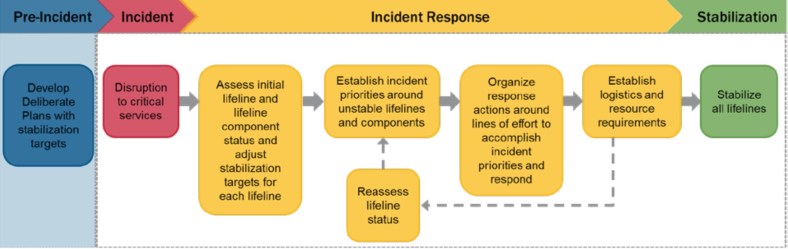
On to the integration of community lifelines.  The goal of the new ESF #14 is to not only engage the private sector, but also coordinate cross-sector operations for stabilizing community lifelines.  I’m interested to see how this plays out, since the community lifelines are already addressed by other ESFs, so I suspect that once the new framework is tested, there may be some supplemental materials that come out to balance this.  That said, the integration of community lifelines is a good thing and I’m glad to see this gaining more traction and truly being integrated rather than existing as a good idea that’s never actually tasked.  Integration of community lifelines is something that every state and local government can at least track, if not take action on, depending on their capability and resources.  The updated NRF added some additional context to community lifelines, with information that supports integrating this concept into planning, response, and recovery.  I happen to appreciate this community lifeline focused timeline that is in the NRF.

While the focus of the NRF is on how the federal government will response, it is intended to be reflective of a whole community response.  It doesn’t necessarily provide guidance (nor should it) on planning, but it certainly serves as a reference.  Since it seems the feds are going all in on the community lifeline concept, I urge state, local, tribal, and territorial governments to examine how they can integrate them into your operations.  That all starts with planning.  It may begin as a function of situational awareness, but then what actions should a jurisdiction take when lifelines are impacted?  Even if a jurisdiction doesn’t have the capabilities to address the root cause, they still need to address the affects.

What thoughts do you have on the NRF update?

© 2019 – Timothy Riecker, CEDP

Emergency Preparedness Solutions, LLC

A New Vision for ICS Training

Yep, I’m still at it.  It seems with every post about the condition of Incident Command System training as we know it, I’m able to draw more people into our cause (aka the Crusade).  While I’ve never espoused there to be an easy solution, the training that we currently provide for ICS falls well short of doing us any favors.  People walk out of each subsequent training course with a marginally increased understanding of the system and how to use it.  And that’s really the fundamental problem, isn’t it?

Perhaps at some point, someone had the idea of developing ICS 100-400 to be knowledge-based courses, with position-specific training to be more about application.  Unfortunately, that’s a significant disservice to responders and the populations they serve, which was further exacerbated by the NIMS training requirements, creating a type of a false sense of security in which people believed that they have ‘been trained in ICS’, therefore all is well in the world.  Responders, in the broadest sense, at supervisory levels within every community should be trained not only in what ICS is but also how to implement it.  Not every community, for a variety of reasons, has reasonable access to position-specific training, so the core ICS curriculum absolutely MUST do a better job in teaching them how to implement the system.

This also goes further than just training.  ICS, like so many other things, is a knowledgebase that tends to degrade over time.  Without practice, you tend to lose the skills.  This is how people who are on Incident Management Teams or those who work regularly in an ICS-based Emergency Operations Center are so well practiced in the system.  In the absence (hopefully!) of actual incidents, planned events and exercises go a long way to keeping skills sharp.  Even those, however, can get costly and time-consuming to design and conduct.  Enter the hybridization of scenario-based training, which is something I’ve written on in the past.  Not only do we need to include more scenario-based training in everything, we need to include a scenario-based ICS skills refresher course as part of the core ICS curriculum.

While I continue to have various thoughts on what there is to be done with the ICS curriculum as a whole, here is my current vision…

ICS-100: (What is ICS?)  Pretty much keep this as is, with options for on-line and classroom delivery.  The purpose of this course is to serve as an introduction to ICS concepts for those who are likely to come into contact with it and work in lower levels within the system.  This is levels one (knowledge) and two (comprehension) of Bloom’s taxonomy.  It shall serve as a prerequisite to further ICS classes as it provides much of the fundamental terminology.

ICS-200: (How do I work within the system?)  Tear down/burn down/nuke the on-line version and never look back.  Simply making it ‘more accessible’ doesn’t mean that it’s good (it’s not).  The purpose of this course is to expand on knowledge and begin to approach functionality.  I expect content to reach deeper than what is currently within the course.  Without looking at specific content areas, I envision this course to be mostly level two (comprehension) of Bloom’s taxonomy with some touches on level three (application).  Perhaps the only level one content that should be introduced in this course are some fundamentals of emergency management.  Some of the content areas currently in the ICS 300 absolutely need to be moved into the ICS 200 to not only make the ICS 200 more impactful, but to also set up the ICS 300 as being fully focused on implementation of the system.  Expanded content may mean taking this course to a duration of up to three days (it even feels taboo writing it!). ICS 100 (taken within six months) is a prerequisite.

ICS-300: (How do I manage the system?) The most recent update of the ICS 300 course begins to approach the vision for what we need, but more work needs to be done.  This course needs to be much less about the system and more about how to IMPLEMENT and MANAGE the system.  This course is firmly rooted in level three (application) of Bloom’s taxonomy, with perhaps some level four objectives, which gets into analysis (troubleshooting and creative solutions… because that’s what emergency management is really all about!).  Much of this course is scenario-based learning centered on implementation and management of an incident through the use of ICS.  Less instruction, more guidance.  And because, at this point, ICS isn’t the only thing at play in real life, concepts of broader incident management are also applied.  ICS 200 is naturally a prerequisite, and should have been taken within a year.

ICS Implementation Refresher Course: This would be designed as a post- ICS 300 course, taken every year or two.  Reasonably, this can be accomplished in a day of intensive scenario-based training.

ICS-400: (A prerequisite for position-specific training).  Eliminate this from the core curriculum.  Seriously.  Most of the current content of this course is not needed in the core ICS curriculum.  Time is better spent in a more intensive ICS 300 course than teaching people about some (largely) obscure applications of ICS which are usually only ever performed by incident management teams.  The current content is largely fine, it just has such little impact on local implementation of ICS and is really rather awkward within the continuity of the curriculum.

Thoughts and feedback are always appreciated.  If we are to succeed and build a better mouse trap, it will be through dialogue and sharing of ideas.

© 2019 – Timothy Riecker, CEDP

Emergency Preparedness Solutions, LLC®

Spreading the Word

Some of you may have noticed that Lucien Canton, who writes the monthly Emergency Management Solutions newsletter, has featured some of my articles over the past few months.  (Thanks Lu!)

While Lu and I have never met, we have periodically corresponded over the past several years.  He is a highly experienced emergency manager and consultant, speaker, and author in the field, who, like me, has a passion for writing.  He covers a variety of topics in his newsletters and articles, from emergency management, to business acumen, and more.  Lately, he has been kind enough, in the collaborative nature of emergency management, to feature other bloggers, such as me, in his newsletter as well.

You can check out his current and past newsletters and featured articles here, along with other services and materials he offers.  Be sure to subscribe to this newsletter, which has great information every month!

-TR

Teaching ICS – We’re not there yet

Over the past week I’ve been neck deep in the updated ICS-300 and ICS-400 curriculum as I prepare to deliver these courses for a client.  While these courses, especially the ICS-300, have made some significant improvements from past versions, I’ve found what I perceive to be another challenge, perhaps a gap, in our collective approach to teaching incident management.

While ICS training should obviously focus on ICS, it seems we are missing an opportunity to provide some critical knowledge on emergency management (at least the response functions of EM) and incident management as an overall concept, especially when we get to the level of ICS-300.  I’m betting that most people taking the ICS-300 class know very little about emergency management and even less about the overall concepts of incident management.  While the ICS-300 is a good and worthwhile course for a great many supervisors within the ranks of public safety, it seems the requirement for ICS training puts a lot of this out of context.

While this might be fine for the ‘typical’ tactician, or even most unit leaders operating within an ICS organization, knowledge of what emergency management is and does, as well as the underlying concepts of incident management, will improve the ability of the response organization as a whole to function.  I echo this same sentiment for the EOC courses that have been developed.

While we strive to have the growth of many public safety professionals to include ICS position-specific training, we also have to be realistic in recognizing that most jurisdictions simply don’t have the capacity to make this happen.  Instead, they rely on a more ad-hoc incident management approach, which will generally serve them well.  Of course, the most challenging time is transitioning from the more ‘routine’ type 5 and 4 incidents into the larger extended response operations of a type 3 incident.  This is when people need to think beyond the normal approach of a largely tactics-focused response, to a system which still necessarily includes tactics, but builds a response organization meant to support and sustain those tactical operations.  What they learn from the ICS-300 may be the most amount of training they have outside of tactical applications.

In such an ad-hoc system, someone put into Logistics, or even more specifically the Supply Unit Leader, may be left wondering how to obtain resources when the answer to that question has always been dispatch.  It may not readily dawn on them to open the phone book (digitally or physically) or to contact the emergency management office to find the resources they need.  It seems silly, but in the context of incident management, dispatch may be all they know.  Similarly, someone assigned as the Situation Unit Leader may be re-creating the wheel when it comes to identifying what information is needed, where to get it from, what analysis needs to take place, and how to tie it all together.  Why?  Because they may not have been made aware of the greater system they function within. Their mental default is the job they usually do for the agency or department they work for.

On a whim, I did some key word searches within the new ICS-300 course student manual.  The term ‘incident management’ comes up with a few hits, mostly centered around NIMS-oriented content or included in the broader term of ‘incident management team’.  Very little explanation is really given on what incident management is.  Rather, the term is just put out there, seemingly with the expectation that the student knows what it is.   A search for the term ‘emergency management’ only comes up with two hits, one being part of ‘Emergency Management Assistance Compact (EMAC)’ (note: no context is given for what this is), and the other use is a rather throwaway use when discussing demobilization.  Emergency management as a function is actually never discussed.

The Reader’s Digest version of all this is that we aren’t including critical contextual information about the systems ICS functions within when we teach more advanced ICS courses.  This inadvertently can close people’s minds to opportunities to improve incident management by extending their thinking beyond tactics and beyond the scope of their home agency.  A podiatrist must still learn about the systems of the whole body before they focus on the foot.  Teaching people, especially at the threshold of ICS-300, about the system of emergency management and the concepts of incident management are critical before we start teaching them the specifics of a particular tool.  Doing so will make their understanding and use of this tool far more effective.

Some may wonder if I will ever be happy with how we teach ICS (really, incident management as a whole).  That day may yet come, but to get there I think we first need to reassess the actual learning needs of practitioners, and do so with fresh eyes instead of trying to mark up the same materials.  I know over the years of my criticisms of ICS training I’ve stimulated a lot of discussion, not only nationally, but internationally.  Many have been hugely supportive of the ideas I’ve put forward, and some have contributed to the dialogue.  Of course, there are some who have been resistant and defensive.  I’m thankful to those who have been receptive and I’m happy to have contributed to the energy behind changes that have been made, and will continue to do so until we, as a collective, are satisfied that the best possible training is being made available.  Change is often times progressive and incremental. It doesn’t happen overnight.

As usual, I’m happy to receive any comments and feedback you might have on these ideas.  Please spread the word and encourage feedback from those who might not be aware.  Emergency management is an ever-evolving practice.  Though we may not have answers, we must continue asking questions.

©2019 – Timothy Riecker, CEDP

Emergency Preparedness Solutions, LLC℠®


Improv in Emergency Management

In emergency management we put a lot of emphasis on planning and training, and rightfully so.  Deliberate planning establishes a foundation for our actions, thought out well ahead of any incident or disaster we might deal with.  Further, most training we receive is necessarily sterile.  We are trained how to respond to, organize, and manage incidents and the various facets of them.  To learn the elements and procedures being taught, we must first learn them in their most raw form, free of other distractions.  We also know that in reality, our plans and training only get us so far.

I’ve recently been reading American Dunkirk: The Waterborne Evacuation of Manhattan on 9/11 by James Kendra and Tricia Wachtendorf.  This is an incredible book, the story of which I only knew small pieces of.  It tells of boat operators and waterfront workers who supported the mass evacuation of people from Manhattan as well as the delivery of responders, equipment, relief supplies, and services proximate to ground zero.  This book is well researched and supported by a multitude of interviews and other accounts of the heroism and actions taken following the attacks.

One of the themes that struck me early in the book was that of improvisation.  For over a year now, I’ve been taking improv classes and doing some performances.  We have an outstanding group of people and I’ve learned a lot, not only on the stage, but skills that I can apply across various aspects of my life, from work and podcasting to social situations.  While I’ve always intuitively known that our emergency plans only get us so far and then we basically have to make things up, I never actually labeled it as ‘improv’.

Kendra and Wachtendorf state “Since it is difficult to anticipate everything, communities need to be able to improvise as well as plan ahead.” They further elaborate that “Theatrical improvisers exercise skills that allow them to perform skits and routines spontaneously.  They are making things up as they go, but they know which principles to pull together.  They know how to make use of props and cues and the environment closest to them.  Instead of following a scripted plan, improv performers match what they know and what they have at hand.”  Consider this in the context of emergency management.  Does it sound familiar?  It certainly should.

We use our plans as a foundation.  We should continue to endeavor to make those plans as solid as possible without being unwieldy, while still recognizing that for a period of time, certainly early in the incident and very likely at other periodic times throughout, chaos rules.  Circumstances take us away from the pages of the plan, but that doesn’t mean that we have lost control, it simply means that we need to improvise to bring the incident back into line with our assumptions, or, if it’s not possible, we are developing a new plan in the moment.  Even if we have deviated from the plan, the principles contained within the plan still hold incredible value.  They become touchstones for us, reminding us what must be accomplished and what our principles for managing the disaster are.

Collectively, I challenge everyone to flex some improv muscles.  This can tie to several things.  First, take some improv classes.  Many larger urban areas have them available.  Don’t be afraid to try something different.  Next, find opportunities where you can use your plans as a foundation, but with scenarios that may deviate from the plan.  Even if it’s a zombie attack scenario, which may sound silly, but when you break it down to many of the fundamental impacts (infrastructure, public health, mass care, civil unrest, etc.) many jurisdictions already have a lot of the planning in place.  Some creativity with a scenario like this or another, forces people to think outside the box and work together to solve problems, which is what improv is all about.

As always, I’m interested in hearing your thoughts on the topic.

© 2019 Timothy Riecker, CEDP

Emergency Preparedness Solutions, LLC ℠®

Reviewing FEMA’s New ELG 2300 EOC Intermediate Course

A couple weeks ago I wrote about the new EOC training courses released by FEMA.  Last week I acquired some additional information on these through a webinar conducted by the course managers from FEMA’s Emergency Management Institute (EMI).  In this webinar, they covered the updated ELG 191 (ICS EOC Interface), G 402 (NIMS Overview for Officials), IS 2200 (Basic EOC Operations), and ELG 2300 (Intermediate EOC Operations).  Similar to the rollouts for the new ICS courses, they walked us through comparisons for these new/updated courses (where they exist) and gave some information on the course structure and general content areas.  They also provided plans of instruction, which, for those of you who aren’t instructional designers, are documents foundational to the instructional design process, laying out everything from course objectives, target audience, and materials needed, as well as outlining the content areas for each unit within the course.

First, it’s important to note that EMI stressed these courses being part of a new EOC training track, intended as an analog to the foundational ICS courses, with the vision being that, depending on what the assignment of personnel might be, they may be better suited to take one or the other.  Of course there are some staff that would certainly benefit from both.  I think this is a great move by EMI.  For decades we have been using ICS courses supplemented by home grown courses to produce meaningful training.  Depending on the structure and processes of the EOC, we often had to tell people to ignore parts of the ICS training they had because of how differently the EOC operates.  That said, while these new courses build a much better foundation for EOC training, there will still be a need for some locally developed training to address the specifics of your own EOC.  This is incredibly important… don’t be lazy about this.

The course I had greatest interest in during this webinar was the ELG 2300 – EOC Intermediate course.  This course actually replaces the G 775 EOC course, which I wouldn’t say is equivalent to the new course, but in creating these new courses, the old courses are being fully demobilized.  The course runs for three full days in the classroom, covering EOC skillsets, incident planning, situational awareness, resource management, and the ever-awkward transition to recovery.  Pilot offerings of the course have demonstrated it to be a very full three days, with didactic material reinforced by activities.

From reviewing the Plan of Instruction, here are the items I appreciate in this course:

  • They address an EOC as a nexus of activity within the greater context of emergency management, covering topics such as incident management teams, potential roles, multi-agency coordination, preparedness, and maintaining readiness.
  • Developing EOC plans and standard operating procedures
  • A lot of emphasis on situational awareness
  • They accept the challenge of discussing the different possible EOC organizational models within major topic areas
  • The importance of structured recovery operations and the role of the EOC in these

There are two things I see through the lens of the plan of instruction that I’m not a fan of.  First of all, the first few units seem to have reiterative content.  While it may be with a different focus, topics such as the ICS/EOC interface don’t need to be explained over and over again in each unit.

The second item is a big one, and this brings me back a few years to my first critical piece on ICS training.  This issue is that the course objectives simply don’t line up with what the course needs to be.  Each of the terminal learning objectives of the course center on explain or identify, which reflect a low domain of learning in Bloom’s Taxonomy.  Yet the ‘overall course objective’ as stated in the plan of instruction is for students to ‘demonstrate the managerial and operational roles of the modern-day EOC’.  Demonstrate is a higher, application-level domain within the taxonomy, which is absolutely where we should be for a three-day intermediate level course.  The course terminal objectives, however, don’t reflect this higher domain.  Not seeing the actual course material, I’m not able to ascertain if this is a reflection of poor instructional design (not properly aligning the objectives with appropriate course content) or if the content is actually written in accordance with the terminal objectives, thus not meeting the intent of the ‘overall course objective’.

I’m a big proponent of the need for the courses in series to be developmental; with foundational, rote information provided in a basic or awareness level course and a progression to more practical learning occurring at intermediate and advanced levels.  While this course, as I see it, certainly comes a long way to improve our collective preparedness for emergency operations centers, most jurisdictions are not going to commit to sending their staff to three days of training just so they can do a better job of talking about what an EOC is and should do.  They should be coming back with an increased ability to perform.   Given the range of skills and ideal learning outcomes we are really striving for, perhaps we need to transcend the basic-intermediate-advanced training levels and examine the role-based model of awareness-operations-technician-management/command-planning.  This allows for better targeting of learning outcomes based upon what people need.  Just a thought.

Despite my misgivings, we needed to start somewhere with a jumpstarted EOC training program.  This is a great start and I’m sure as this course gets some exercise, there will be some identification of opportunities to improve and better meet the needs of the variety of audiences out there.  I’m looking forward to seeing the course material sometime in the near future.

As always, I look forward to your thoughts and feedback.

©2019 Timothy Riecker, CEDP

Emergency Preparedness Solutions, LLC℠®

New FEMA EOC Training Courses Announced

Last night FEMA issued a NIMS Alert (13-19) announcing the release of some new and revised Emergency Operations Center (EOC) training courses.  These include:

E/L/G 191 – Emergency Operations Center/Incident Command System Interface

IS 2200 – Basic Emergency Operations Center Functions

E/L/G 2300 – Intermediate Emergency Operations Center Functions

This is also including an updated G 402 NIMS Overview for Senior Officials.

FEMA is hosting a series of webinars on these courses next week.  Information can be found at the bottom of this post.

First, a bit of background on the nomenclature, for those who might not be familiar.

  • E-coded courses are those offered ‘in residence’ by FEMA, typically at the Emergency Management Institute (EMI)
  • L-coded courses are those delivered by FEMA at various locations, typically at the request of state and local governments
  • G-coded courses are those able to be delivered by state emergency management offices
  • IS-coded courses are independent study courses available from training.fema.gov

Providing a bit of context to these courses.  First, the E/L/G 191 course.  This course has been in dire need of a re-write for a very long time.  While FEMA/EMI certainly have a challenge of developing courses that are applicable to most jurisdictions, I’ve long found the 191 course to be inadequate for most.  Interestingly enough, I found the content of the new IS 2200 course alone to be far superior to any previous content of the 191 course.  That said, I’m interested in seeing what the redesign has brought for the 191 course, hopefully increasing the utility of this course to participants.

Speaking of the IS 2200 course, I just completed this course on EMI’s Independent Study website.  Overall, I found the course to be solid, addressing all the foundational information needed by stakeholders to understand what an EOC is a does, in general terms, how it might be organized, and what it’s primary tasks are.  The course has heavy reference to NIMS, as expected, and provides several hyperlinks to additional resources of relevant interest.  While the course does reflect much of the EOC content from the updated NIMS document, the materials were thoughtfully organized with a fair amount of supplement and context, examples, and even small scenario-driven activities to support a better understanding of EOCS.  As indicated previous, it has a fair amount of information on the concepts of the ICS/EOC interface, which I think are of significant value to people who are new to the world of EOCs.  The course also stresses the value of emergency operations plans, something that had been missing from ICS courses for years prior to an earlier update.

There are some areas where I find the IS 2200 course to be lacking.  First of all, there were some typos and grammatical errors in the product.  While this might not seem like a big deal to some, quality counts.  Similarly, many of the photos used in the course are recycled from many years back of training and are of poor quality and resolution.  Granted, photos from EOCs are generally not exciting or sexy, but higher quality and updated hair styles do contribute to quality.  The traditional Planning P was referenced quite a bit in the course, with the caveat that the EOC should develop its own planning cycle.  I found this to be a bit lazy and would have liked to see some guidance on an EOC-oriented Planning P.  Lastly, I would have liked to see some material on departmental EOCs (DOCs) as well as the interface between a dispatch/public safety answering point (PSAP) and a local EOC.  Perhaps we will see this latter topic addressed in either the 191 course or the Intermediate EOC course.

E/L/G 2300 is the Intermediate EOC course.  I’m very curious to learn more about this course when I sit in on one of next week’s webinars.  The biggest challenge that FEMA has in this course, as I see it, is that there are several organizational models which can be used by EOCs, including the ICS-based model, the incident support model, the departmental model, and the emergency support function model.  This variety, which I think is good to have to help jurisdictions and agencies manage in the way that is most comfortable for them, does create significant difficulty to teach how, in any significant detail, an EOC should function.  While I would love for this course to dive into the EOC’s planning process and key in on roles and responsibilities of positions similar to the ICS 300 course, I think that detail might need to be reserved for a customized course, which I’ve built for various entities through my career.  That said, I’ll be sure to report out following the webinars on my thoughts on the information we are provided.


Additional information is available on these offerings through a series of webinars hosted by FEMA.  The dates and times of the webinars:

  • May 28, 2019 at 11:00 am (EST)
  • May 28, 2019 at 3:00 pm (EST)
  • May 30, 2019 at 11:00 am (EST)
  • May 30, 2019 at 3:00 pm (EST)

 The webinars will be presented through their NIMS ICS Training Forum – Adobe Connect platform here:

The Adobe Connect platform is for displaying visuals and for chatroom only. Audio will be provided using the following conference call line and pin #:

  • Conference Telephone #: 800-320-4330
  • Pin #: 884976

© 2019 Timothy Riecker, CEDP

Emergency Preparedness Solutions, LLC®℠


FEMA’s Forgotten Civil Defense Role

A recent article posted to the Homeland Security Affairs Journal of the Naval Postgraduate School’s Center for Homeland Defense and Security is quite thought provoking.  The author, Quin Lucie, an attorney with FEMA and former Marine Corps Judge Advocate, posits in his article, How FEMA Could Lose America’s Next Great War, that FEMA’s legal responsibilities for civil defense have been all but forgotten, potentially endangering the welfare of our citizens and our ability to sufficiently mobilize our industrial war complex in the event of a substantial war.

The article has a lot of great depth on the history of civil defense, FEMA, and its predecessor agencies, and the movement of FEMA away from that role, first in favor of work aligned to various mission areas associated with natural hazards, then eventually including human-caused disasters and terrorism.  The author certainly isn’t wrong that civil defense is a ‘hazard’ that we have left out of our all hazards lexicon.

There are arguments that can be made supporting FEMA’s persistence in their civil defense role, with much of the capability they have developed for their own mission and supported for others being truly applicable to all hazards, including civil defense.  We can name myriad programs and capabilities, such as continuity of operations/continuity of government, incident management teams, preparedness standards, and specialized response teams.  Each of these would absolutely have a role in supporting civil defense.  It seems one of the biggest gaps, however, is in planning, where there is little meaningful inclusion of specific civil defense missions, activities, and capabilities; as well as the association of established capabilities and authorities to civil defense missions.

I applaud the author for mentioning that our ways and means of conducting civil defense as we had in the 50s and 60s is not necessarily something to fall back on, as times, needs, and technology have changed.  These factors necessitate even more meaningful analysis, exploration, and deliberation of the role of emergency management as a whole (not just FEMA’s legal responsibilities) in civil defense, especially considering that most, if not all states, have laws on the books for civil defense activity and authority.

As FEMA goes, so does the rest of emergency management, so it’s not a stretch to ascertain that states and localities need to consider this inclusion as well.  At the federal level, laws and executive orders may need to be amended to change with the times and expectations of such activity, followed by frameworks, strategies, and plans, as well as other preparedness measures to support implementation.  Following federal changes, guidance will need to be formulated for states, suggesting any legislative changes they should make to appropriately update to the new vision and synchronize with any changes in federal laws, as well as guidance for state-level planning, which will likely be accompanied by grant funding for this and related activities.

The important perspective with all this is that we are not to be taking a step backwards, but instead re-assessing needs and associated capabilities of an obligation that seems to have been left in the wake of a seemingly forgotten era.  While many of our current capabilities can be leveraged to support civil defense activity, the arrangement and application of such capabilities, as well as the specific laws governing these capabilities, is unique enough to warrant plans exclusive to this function.  We need to look ahead at the challenges we might face in such a situation to ensure our preparedness.   Some have argued that homeland security is the new civil defense, and even I have mentioned that some of these concepts have come full-circle.  While some of that is true, there are also needs and capabilities we haven’t examined since the era of civil defense, which are largely not included in our terrorism preparedness/homeland security efforts.

As always, I’m interested in the thoughts of readers on this topic.  Also, please be sure to read Mr. Lucie’s article referenced at the beginning of this post.

© 2019 – Timothy Riecker, CEDP

Emergency Preparedness Solutions, LLC℠®

Preparedness: Integrating Community Lifeline Considerations

Much of preparedness is about getting us ready to conduct situational assessment and prioritization of actions.  We train people and develop resources, such as drones, field-deployed apps, and geographic information systems (GIS) to support situational assessment.  The information we obtain from these assessments help in the development and maintenance of situational awareness and, when shared across disciplines, agencies, and jurisdictions, a common operating picture.  Based upon this information, leaders at all levels make decisions.  These decisions often involve the prioritization of our response and recovery actions.  Ideally, we should have plans in place that establish standards for how we collect, analyze, and share information, and also to support the decision making we must do in prioritizing our actions.  Exercises, of course, help us to validate those plans and practice associated tasks.

One significant hurdle for us is how overwhelming disasters can be.  With just slight increases in the complexity of a disaster, we experience factors such as large geography, extensive damages, high numbers of lives at risk, hazardous materials, and others.  Certainly, we know from Incident Command System training that our broad priorities are life safety, incident stabilization, and property conservation – but with all that’s happening, where do we start?

One thing that can help us both assessment and prioritization are community lifelines.  From FEMA: “Community lifelines reframe incident information to provide decision-makers with impact statements and root causes.”  By changing how we frame our data collection, analysis, thinking, and decision-making, we can maximize the effectiveness of our efforts.  This shouldn’t necessitate a change in our processes, but we should incorporate community lifelines into our preparedness activities.

The community lifelines, as identified by FEMA, are:

  • Safety and Security
  • Food, Water, and Sheltering
  • Health and Medical
  • Energy
  • Communications
  • Transportation
  • Hazardous Materials

If this is your first time looking at community lifelines, they certainly shouldn’t be so foreign to you.  In many ways, these are identified components of our critical infrastructure.  By focusing our attention on this list of items, we can affect a more concerted response and recovery.

FEMA guidance goes on to identify components we should be examining for each community lifeline.  For example, the lifeline of Health and Medical includes the components of:

  • Medical Care
  • Patient Movement
  • Public Health
  • Fatality Management
  • Health Care Supply Chain

Each component is then broken down into sub-components. Continuing the example, within the component of Fatality Management, you can examine sub-components such as:

  • Mortuary and post-mortuary services
  • Transportation, storage, and disposal resources
  • Body recovery and processing
  • Family assistance

Of course, you can dig even deeper when analyzing any of these sub-components to identify the status and root cause of failure, which will then support the prioritization of actions to address the identified failures.  First we seek to stabilize, then restore. The organization of situation reports, particularly those shared with the media, public, and other external partners might benefit from being organized by community lifelines.  These are concepts that are generally tangible to many people, and highlight many of the top factors we examine in emergency management.

Back in March of this year, FEMA released the Community Lifelines Implementation Toolkit, which provides some great information on the lifelines and some information on how to integrate them into your preparedness.  These can go a long way, but I’d also like to see some more direct application as an addendum to CPG-101 to demonstrate how community lifelines can be integrated into planning.  Further, while I understanding that FEMA is using the community lifeline concept for its own assessments and reporting, the community aspect of these should be better emphasized, and as such identifying some of the very FEMA- and IMAT-centric materials on this page as being mostly for federal application.

Has your jurisdiction already integrated community lifelines into your preparedness?  What best practices have you identified?

© 2019 – Timothy Riecker, CEDP

Emergency Preparedness Solutions, LLC℠®