Speculation on the Upcoming Role of Local Governments in Pandemic Recovery

Last night I remotely facilitated a session with the senior leadership of a mid-sized city discussing multi-agency coordination, incident management, and other concepts, mostly within the context of the coronavirus pandemic.  We spoke at great lengths about the role of local government in this, especially when they do not have their own health department, and what expectations there might be of them in the future.  In this discussion I had the realization of a potential scenario that seems to hold a fair amount of probability, and it’s one that is grounded in prior practice.

A bit of a disclaimer up front.  My regular readers know that I usually avoid speculation.  In the wrong context, speculation can cause undue stress or unnecessary effort.  Obviously, that is not my goal.  My goal is, as is typical of most of my articles, to promote thought and discussion on preparedness activities which are grounded in reality.  As I’ve said to people many times over the past several weeks, it’s not too late to prepare.  There are still plenty of things that we need to be preparing for in the midst of our response, including contingency plans for other potential hazards, and obviously continued operational needs.  The best emergency managers think ahead.  What I’m writing is not a call to action, but rather a call to thought. 

When it comes to vaccination (once a vaccine is developed), it’s apparent that everyone will need to be vaccinated.  While there are some factors which will force us to deploy vaccines in phases, including the supply of vaccine and the need to provide for fragile and critical populations first, there will eventually come a time when the population at-large will need to be vaccinated.  Obviously, our public health system is not equipped to administer inoculations for everyone in every jurisdiction in a timely fashion.  As such, there will be considerable reliance on local governments and advanced EMS providers, among others, to make this happen. 

First off, addressing the use of advanced EMS providers – this is not without precedent.  Advanced EMTs and paramedics have been used for a while now to support public health in mass inoculation needs, which have included H1N1, Hepatitis A outbreaks, and other viruses.  I expect that we will see these personnel used again to support the eventual vaccination of the global population against Coronavirus.  Because of the sheer volume needed, it is probable that we will see other medical practitioners likewise engaged.  When the time comes, state health departments and state EMS agencies will need to develop or update (if they have them already) protocols and just-in-time training for personnel on the proper administration of the vaccine.  Agreements in regard to paid third-party EMS service providers will also need to be addressed.  Overall, EMS will be a significant and necessary augmentation of our public health system in this regard. 

So what’s the role of local government that I expect?  Most public health outbreaks we deal with are fairly localized, allowing public health officials to establish and manage vaccination points of distribution where they are needed.  In a ‘typical’ outbreak, they can mobilize the resources needed, supported by state health departments and mutual aid from other public health offices.  The activities for these points of distribution include the development of protocol and record keeping standards and mechanism, identifying the population, securing suitable facilities, equipping those facilities (tables, chairs, internet, privacy screens, etc.), notifying the public, coordinating with local officials for control of traffic and movement of people, delivery and administration of the vaccine, securing of sharps and biological waste, and clean up; among other things.  In the scope of the coronavirus outbreak our public health offices doesn’t have the resources to do all this for every jurisdiction.  I suspect that along with providing the serum and supplies to administer it, public health will only be able to establish standards and provide guidance, but I don’t think it’s unreasonable to expect that jurisdictions will be asked to provide significant support in the non-clinical aspects of setting up and managing these points of distribution. 

What does this mean for local governments?  As I’m not a government official nor do I have an ability to definitively see the future, I certainly would not advise local governments to engage in any detailed efforts now to prepare for this scenario unless they have been advised by a public health entity to do so.  That said, it may be wise to pull together some stakeholders and at least outline a framework for how this can be done.  I’m confident that at least some of what is identified will be of use in the future of this pandemic.  Some jurisdictions may have already developed plans for points of distribution, which will be a good reference, but will likely be found to have inadequacies given current information on planning assumptions, the increased role of local governments I predict, and sheer numbers to be vaccinated. 

Who else has considered this future need?  I’m interested in hearing from others about their thoughts on these possibilities. 

Be smart, stay safe, stay healthy, and make a difference. 

© 2020 Timothy Riecker, CEDP

Emergency Preparedness Solutions, LLC

It’s Not Too Late To Prepare

The phrase I’ve been using lately when I speak to people has been “It’s not too late to prepare”.  Many people perceive that in the middle of a disaster we are unable to prepare.  Quite the contrary, we have the potential to integrate all of our preparedness steps into a response.  Because we have problems in front of us that need to be addressed, we have an opportunity to continuously improve, ensuring that organizationally we are offering the very best we can. 

There is a reason why there isn’t a mission area for preparedness in the National Preparedness Goal.  This is because preparedness is ongoing.  It’s not a separate or distinct activity.  Rather it is comprised of activities that support all mission areas, no matter when they are actioned.  Preparedness is continuous.

Assessment

Assessment is a key activity within preparedness.  In fact, assessment is foundational in understanding what’s going on.  During a disaster, good management practices dictate that we should be monitoring our response and adjusting as needed.  What exactly should we be monitoring?  Similar to evaluating an exercise, consider the following:

  • What was the effectiveness of deliberate planning efforts? 
    • Were planning assumptions correct?
    • Was the concept of operations adequate in scope and detail? 
    • What was lacking?
    • What worked well?
  • What was the effectiveness of plan implementation?
    • If aspects of plan implementation need improvement, what was the reason for the shortfall?
      • A poor plan
      • Lack of job aids
      • Lack of/poor/infrequent training
      • Lack of practice
      • Lack of the proper resources or capabilities
      • The plan wasn’t followed
  • Did resources and capabilities meet needs?  If not, why?

Planning

While some planning gaps will require a longer time period to address, I’m aware of many jurisdictions and organizations which have been developing plans in the midst of the pandemic.  They recognized a need to have a plan and convened people to develop those plans.  While some of the planning is incident-specific, many of the plans can be utilized in the future we as well, either in the form they were written or adjusted to make them more generally applicable without the specific details of this pandemic.  I’d certainly suggest that any plans developed during the pandemic are reviewed afterwards to identify the same points listed above under ‘assessment’ before they are potentially included in your organization’s catalogue of plans. Also consider that we should be planning for contingencies, as other incidents are practically inevitable.

Training

Training is another fairly easy and often essential preparedness activity which can performed in the midst of a disaster.  Many years ago FEMA embraced the concept of training during disasters.  FEMA Joint Field Offices mobilize with training personnel.  These personnel not only provide just in time training for new personnel or to introduce new systems and processes, but they provide continuing training a variety of topics throughout response and recovery, providing a more knowledgeable workforce.  I’ve seen some EOCs around the country do the same.  Recently, my firm has been contracted to provide remote training for the senior leadership of a jurisdiction on topics such as continuity of operations and multi-agency coordination, which are timely matters for them as they continue to address needs related to the pandemic. 

Exercises

While assessments, planning, and training are certainly activities that may take place during a disaster, exercises are probably less likely, but may, if properly scoped and conducted, still have a place.  Consider that the military will constantly conduct what they call battle drills, even in active theaters of war, to ensure that everyone is familiar with plans and protocols and practiced in their implementation.  Thinking back on new plans that are being written in the midst of the pandemic, it’s a good idea to validate that plan with a tabletop exercise.  We know that even the best written plans will still have gaps that during a blue-sky day we would often identify through an exercise.  Plans written in haste during a crisis are even more prone to have gaps simply because we probably don’t have the opportunity to think everything through and be as methodical and meticulous as we would like.  A tabletop exercise doesn’t have to be complex or long, but it’s good to do a talk through of the plan.  Depending on the scope of the plan and the depth of detail (such as a new procedure, conducting a walk-through of major movements of that plan (that’s a drill) can help ensure validity of the plan and identify any issues in implementation.  While you aren’t likely to go the extent of developing an ExPlan, an evaluator handbook, or exercise evaluation guides (yes, that’s totally OK), it’s still good to lay out a page of essential information to include objectives and methodology since taking the time to write these things down is one more step to ensure that you are doing everything you need for the validation to be effective.  Documentation is still important, and while it can be abbreviated, it shouldn’t be cut out entirely.  It’s also extremely important to isolate the exercise, ensuring that everyone is aware that what is being performed or discussed is not yet part of the response activity.  Evaluators should still give you written observations and documented feedback from participants.  You probably don’t need a full AAR, especially since the observations are going to be put into an immediate modification of the plan in question, but the documentation should still be kept together as there may still be some observations to record for further consideration. 

Evaluation and After Action

Lastly, incident evaluation is something we shouldn’t be missing.  We learn a lot about incident evaluation from exercise evaluation.   I’ve written on it before, which I encourage you to look at, but the fundamentals are ensuring that all actions and decisions are documented, that a hotwash is conducted (or multiple hotwashes to capture larger numbers of people or people who were engaged in very different functions), and that an after action report is developed.   Any incident should provide a lot of lessons learned for your organization, but the circumstances of a pandemic amplify that considerably.  Ensure that everyone in your organization, at all levels, is capturing observations and lessons learned daily.  Ensure that they are providing context to their observations as well, since once this is over, they may not recall the details needed for a recommendation. You may want to consider putting together a short form for people to capture and organize these observations – essentially identifying the issue, providing context, and putting forth a recommendation to address the issue. Don’t forget to encourage people to also identify best practices.  In the end, remember that if lessons learned aren’t actually applied, nothing will change. 

I welcome any insight on how we can continue to apply preparedness in the midst of a disaster. 

Be smart, stay safe, stay healthy, and be good to each other. 

©2020 Timothy Riecker, CEDP

Emergency Preparedness Solutions, LLC

8 Predicted Changes to Emergency Management Post-Pandemic

In public safety we learn from every incident we deal with.  Some incidents bring about more change than others.  This change comes not just from lessons learned, but an effort to apply change based upon those lessons. In recent history, we’ve seen significant changes in emergency management practice come from disasters like the 9/11 terrorist attacks and Hurricane Katrina, with many of the changes so significant that they are actually codified and have led to new doctrine and new practices at the highest levels.  What changes can we expect from the Coronavirus pandemic?

Of course, it’s difficult to predict the future.  We’re also still in the middle of this, so my thoughts may change a month or two into the future.  Any speculation will begin with idealism, but this must be balanced with pragmatism.  Given that, the items I discuss here are perhaps more along the lines of changes I would like to see which I think have a decent chance of actually happening. 

  1. Legislation.  Similar to the aforementioned major disasters, this too will spawn legislation from which doctrine and programs will be derived.  We are always hopeful that it’s not politicians who pen the actual legislation, but subject matter experts and visionaries with no political agendas other than advancing public health preparedness and related matters. 
  2. More public health resources. This one, I think, is pretty obvious.  We need more resources to support public health preparedness, prevention, and detection efforts.  Of course, this begins with funding which will typically be spawned from the legislation mentioned previous.  Public health preparedness is an investment, though like most preparedness efforts, it’s an investment that will dwindle over time if it’s not properly maintained and advanced to address emerging threats and best practices.  Funding must address needs, programs to address those needs, and the resources to implement those programs. 
  3. Further integration of public health into emergency management.  Emergency management is a team sport.  Regardless of the hazard or the primary agencies involved, disasters impact everyone and many organizations and practices are stakeholders in its resolution and can contribute resources to support the resolution of primary impacts and cascading effects.  Despite some gains following 9/11, public health preparedness has still been treated like an acquaintance from another neighborhood. The legislation, doctrine, programs, and resources that we see MUST support an integrated and comprehensive response.  No longer can we allow public health to be such an unfamiliar entity to the rest of the emergency management community (to be clear – the fault to date lies with everyone). 
  4. Improved emergency management preparedness.  Pulling back to look at emergency management as a whole, we have certainly identified gaps in preparedness comprehensively.  Plans that were lacking or didn’t exist at all.  Equipment and systems that were lacking or didn’t exist at all.  People who didn’t know what to do.  Organizations that weren’t flexible or responsible enough.  Processes that took too long.  Poor assumptions on what impacts would be. We can and must do better.
  5. An increase in operational continuity preparedness.  We’ve been preaching continuity of operations/government for decades, yet so few have listened. The Coronavirus pandemic has shown us so many organizations jumping through their asses as they figure it all out for the first time.  By necessity they have figured it out, some better than others.  My hope here is that they learned from their experience and will embrace the concepts of operational continuity and identify a need to leverage what they have learned and use that as a basis for planning, training, exercises, and other preparedness efforts to support future continuity events. 
  6. Further expansion of understanding of community lifelines and interdependencies of critical infrastructure.  This pandemic gave us real world demonstrations of how connected we are, how vulnerable some of our critical infrastructure is, and what metrics (essential elements of information) we should be monitoring when a disaster strikes.  I expect we will see some updated documents from DHS and FEMA addressing much of this. 
  7. More/better public-private partnerships.  The private sector stepped up in this disaster more than they previously ever had. Sure, some mistakes were made, but the private sector has been incredibly responsive and they continue to do so.  They have supported their communities, customers, and governments to address needs they identified independently as well as responding to requests from government.  They changed production.  Increased capacity.  Distributed crisis messages.  Changed operations to address safety matters.  Some were stretched to capacity, despite having to change their business models.  Many companies have also been providing free or discounted products to organizations, professionals, and the public.  We need to continue seeing this kind of awareness and responsiveness.  I also don’t want to dismiss those businesses, and their employees, that took a severe financial hit.  Economic stabilization will be a big issue to address in recovery from this disaster, and I’m hopeful that our collective efforts can help mitigate this in the future. 
  8. An improved preparedness mindset for individuals and families.  Despite the panic buying we saw, much of the public has finally seemed to grasp the preparedness messaging we have been pushing out for decades.  These are lessons I hope they don’t forget. Emergency management, collectively, absolutely must capitalize on the shared experience of the public to encourage (proper) preparedness efforts moving forward and to keep it regularly in their minds. 

In all, we want to see lasting changes – a new normal, not just knee-jerk reactions or short-lived programs, that will see us eventually sliding backwards.  I’m sure I’ll add more to this list as time goes on, but these are the big items that I am confident can and (hopefully) will happen.  I’m interested in your take on these and what you might add to the list.

Be smart, stay safe, stay healthy, and be good to each other. 

© 2020 Timothy Riecker, CEDP

Emergency Preparedness Solutions, LLC

Properly Leveraging the EOC Safety Officer

One of my Twitter connections tweeted over the weekend about the importance of the Safety Officer in the Emergency Operations Center (EOC) during the pandemic response.  This is absolutely true, but it’s not the only time the EOC Safety Officer should be engaged.  There is a significant role for them in many EOC activations, but they are historically underutilized, often relegated to monitoring for trip hazards in the EOC and making sure that no one hits their head on the desk when they fall asleep on those long wind-down shifts. 

While the Safety Officer in an Incident Command Post has a great deal of work to do, monitoring tactical hazards and implementing mitigative measures, we often think that with the EOC’s hands-off approach to tactics (something else that is also a myth in incident management) that there is little for an EOC Safety Officer to do.  Obviously, the potential of an EOC Safety Officer depends on the specific circumstances of the incident and the scope of support being provided by the EOC, especially if it’s staffed with the proper personnel. 

Remember that the Safety Officer is a member of the Command (or EOC Management) staff, and therefore can have assistants to support technical needs as well as a volume of work.  While ideally we want people trained as Safety Officers (in accordance with the NIMS position-specific curriculum), let’s face it – most of pool of position-trained personnel come from the fire service.  While on the surface there is obviously nothing wrong with that – fireground safety applications are incredibly detailed and require a very specific know-how – we need to leverage people with the proper background based on the incident we are dealing with.  That could be someone with a fire background, but, for example, a public health incident likely requires a Safety Officer (or advising assistant Safety Officer) to have a public health background; just as an emergency bridge replacement likely requires someone with an engineering background to be the Safety Officer. 

Through my experience, I’ve found that occupational health and safety personnel (either OSHA-proper from the US Dept of Labor or State/Local Occupational Health and Safety personnel) are great for this position, and even better if they have the proper ICS training.  On one hand, I’d call them generalists, because you can utilize them for darn near any incident, but calling them generalists almost feels insulting, as their knowledge of laws, regulations, and guidelines is often very extensive, and if they don’t know, they know where to find the information.  They also work well with hazard-specific specialists who can be integrated as assistants.  They can also call upon a small army of other OSHA-types to support field monitoring of safety matters. 

I will mention a word on using ‘regulators’ as Safety Officers.  Some may be reluctant to do so.  Reflecting again on my experience, I’ll say that Federal/State/Local OSHA-types are great to work with in this regard.  They are often willing to be flexible, developing and implementing an incident safety plan that can be phased, with safety personnel initially providing guidance and correction (when appropriate) and enforcing later. 

In looking at the scope of responsibility for an EOC Safety Officer, we do need to consider the scope of responsibility for any Safety Officers working from Incident Command Posts to ensure the work is complimentary, with minimal duplication of effort, but enough overlap for continuity.  The Safety Officers in an ICP will be primarily focused on the operating area of their ICP.  They are less likely to be concerned with safety matters off-site. 

For an ‘intangible’ incident, such as the current pandemic, we are more apt to find EOCs running the show vs incident command posts.  Obviously, this greatly expands the responsibility of the Safety Officer – in a jurisdiction’s primary EOC, as well as the Safety Officers in departmental operations centers (DOCs) – as many tactical operations are truly being managed from the EOC.  Considerations such as Personal Protective Equipment (PPE) and operating guidelines for all areas of operation and all tactics are likely to be coming from the EOC Safety Officer.  If DOCs or other incident management facilities are involved, the Safety Officer of the jurisdiction’s primary EOC may be collaborating with the Safety Officers from these other facilities to ensure a common operating picture in regard to safety, a unified safety plan, and consistent monitoring and enforcement.  A Safety Officer operating in this capacity needs to be comprehensive in their scope, not just looking at the hazards associated with the primary issue (i.e. an infectious disease), but examining all tactics and considerations, ranging from people operating equipment, to emerging weather hazards.

For an incident with more traditional EOC involvement, a Safety Officer still has a full range of responsibilities, though the actual range of these are still dictated by the scope of the incident.  If an EOC is primarily serving as a resource ordering point, the EOC Safety Officer should be communicating with the Safety Officer at the ICP to ensure an understanding of the hazards in general operating area as well as the specific hazards and PPE needs of the application each resource will be assigned to.  The EOC Safety Officer should be ensuring that responding resources are aware of these safety requirements, as well as potential safety concerns while in transit.  The EOC Safety Officer may be providing the ICP Safety Officer with specialized safety support, analysis, and resources, including supplies and equipment (in coordination with EOC Logistics). 

An EOC supporting multiple ICPs (and even coordinating with several DOCs) should have a more involved and proactive Safety Officer, as they need to be coordinating safety matters across each of these incident management structures.  This includes ensuring a common operating picture in regard to safety, a unified safety plan, and consistent monitoring and enforcement.  They are also likely to be involved in working with EOC Logistics to ensure the proper supplies and equipment.  They should be watching for tactical applications or resource movements of each incident management structure to ensure there are no conflicts or impacts in regard to safety. 

An EOC more significantly engaged is likely to be providing mission support (a topic I’ll be writing about in the near future).  In summary, EOC mission support are generally tactical applications which are developed and managed by an EOC to address matters that are beyond the scope of the ICP or those which the Incident Commander can’t presently deal with.  EOC mission support could include things like sheltering, points of distribution, or a family assistance center.  Once up and running, each of these examples should have their own management structure including a Safety Officer to address their specific needs, but the EOC Safety Officer should be heavily involved in the planning and development stages of these missions, as well as coordinating and supporting safety matters to each of them, similar to what has been mentioned previously. 

Lastly, I’ll suggest that an EOC Safety Officer may also be working with third parties, to include non-government organizations, the private sector, and the public.  Depending on the activity of any of these, the EOC Safety Officer should be keeping tabs on what the safety issues are and communicating with these parties.  The role of the EOC Safety Officer could even include public education.  A great example of this was the October 2006 snowstorm in Erie County, NY.  The Safety Officer from the County EOC (staffed by US DOL/OSHA) coordinated several chainsaw safety courses for the public, knowing that despite the number of safety messages distributed via the Public Information Officer, homeowners, who perhaps never used a chainsaw or hadn’t used one in years, would be out in their yards clearing debris from fallen trees.  These courses were incredibly effective and appreciated by the public. 

To be honest, I’m in favor of breaking tradition within EOCs and designating EOC safety matters, such as trip hazards and signage for mopped floors, to those who are managing EOC facility needs (i.e. the Center Support Section if you are using the Incident Support Model).  This assignment more appropriately corresponds with the focus of the Center Support Section and allows the EOC Safety Officer to maintain focus on what’s going on outside the EOC. 

So there is some food for thought on how to properly use an EOC Safety Officer.  Don’t continue to let it be a lame position as so many have in the past.  It has incredible importance when properly utilized and staffed.  I’m interested in hearing about how you have leveraged EOC Safety Officers, or if you are a Safety Officer, what activities you have performed from an EOC. 

Be safe out there. 

© 2020 Timothy Riecker, CEDP

Emergency Preparedness Solutions, LLC

Responding to Coronavirus & a Second Major Incident

Springtime is practically upon us.  Trees are budding, asparagus is growing (yes, I mentioned asparagus), birds are chirping, and snow is melting.  And it’s raining.  Some people call it spring, others call it the first flood season of the year.  Flooding isn’t the only hazard we face right now.  It’s still early enough for the threat of snow and ice storms, and we’ve already seen tornado activity in the US.  Oh, and by the way, we’re dealing with a pandemic.  EDIT: In the midst of writing this post and also exchanging emails re Coronavirus with a client in Utah, he exclaimed in one of his responses that a 5.7 earthquake had just struck with an epicenter just outside Salt Lake City.  As one of my old bosses used to say, you can’t make this stuff up. 

So often we are used to dealing with one disaster at a time.  Yes, sometimes we get hit with a one-two punch, or other times the same incident, such as a hurricane, persists, but these are typically localized, not a nation-wide concern, much less global.  When our resources are already strained from dealing with Coronavirus, it can be a challenge to respond to another significant incident, especially when there is little mutual aid to be had.  I often think back to an example I use back from my days in EMS, and that’s the multi-trauma patient.  Most EMS instructors, following the standard curriculum, will teach you how to treat lacerations, fractures, burns, and the like.  But rarely do we learn about how to deal with those things when they all happen at once. I remember back when I was a young pup EMT, my first multi-trauma patient was a victim of a motor vehicle accident (as it probably was for most EMTs).  I recall having a brief moment of panic because that’s not what we were taught to handle.  My brain quickly reset, and I went back to my ABCs, assessing and stabilizing the patient in priority order. 

Another personal example I have is the crash of American Airlines Flight 587 on November 12, 2001 – two months and one day after 9/11.  The plane crashed in Queens borough of New York City as the result of a critical structural failure.  260 souls on board, plus 5 on the ground died.  This occurred in the midst of the response to one of the most impactful disasters in US history.  In a way we ‘lucked out’ that the incident occurred in New York City.  On a normal day, the City of New York can leverage more resources in a response than some US states and even nations.  November 2001 was anything but ‘normal’ with a massive amount of additional resources still rotating into the City to support 9/11 activities.  While at this point, two months following 9/11, things were reasonably stable in and around ground zero, the crash of Flight 587 still required a significant change in operations.  From my recollection, in the State EOC in Albany, we actually split some of our staff for a brief period of time (within the same chain of command), with some staying focused on 9/11 activity while others were focused on the crash.  We didn’t create a new organization, but there were people in Operations and Planning committed specifically to monitoring and supporting the new incident.  Like a Venn diagram, there were some different needs in the initial response with some overlapping needs between the two incidents.  As the two circles moved closer together, creating more overlap, we re-integrated our staff to track and support both incidents collectively.  I recall the reintegration occurring after only a few operational periods. 

So what to do when an incident occurs during our current pandemic?  There are a few concerns, some related to incident management, others related to our tactical responses and humanitarian needs.  While our general response times are likely to be improved, many resources are already strained.  We are likely in an operational continuity mode already, currently working with or ready to work with fewer staff as Coronavirus impacts our people and their families.  It’s incredibly important to be rotating your emergency staff, keeping people as rested as possible.  We can also leverage the lead agency status that is presently at play in most jurisdictions, with public health having the lead, and emergency management agencies and others supporting them.  If something occurs other than a second public health event, the emergency management agency may be able to pivot to be the lead coordinating agency for the new incident while still supporting public health.  (Of course, I say this fully recognizing that the vast majority of emergency management offices are one-person shops.)  If you are able to split off some staff within your Coronavirus organization (really speaking in terms of your EOC) similar to my Flight 587 example, that may be a workable strategy.  Another strategy could be the reverse of that, where most of your organization is focused on the new incident, since that is in its critical early stages, leaving a few other staff to continue supporting Coronavirus needs.  I generally wouldn’t consider creating parallel organizations as most jurisdictions simply don’t have the capacity for that, plus EOCs are intended to be able to support multiple incidents.  The splitting off of staff is generally only for the early response to ensure that we are gathering information and providing the support that is needed.  We can still leverage the organization as a whole (you probably don’t have a need to dedicate anyone in Logistics or Finance specifically to the new incident, though expenses should be tracked separately), and the chain of command still remains intact.  Your planning process, likewise, should accommodate both incidents. Depending on the scope of the new incident, certain subject matter experts may need to be brought in to address specific response and disaster recovery needs for the new incident.  Overall, flexibility is key.  I’ll also say that all this can be done while still adhering to organization tenants of ICS (even if your EOC doesn’t purely use ICS). 

From a more tactical perspective, the main concerns are staffing and safety.  Staffing, as mentioned before, may be a challenge as we progress through the most infectious stages of this pandemic.  Your continuity plans must absolutely address this.  I mention safety not only in regard to whatever hazards the new incident brings about, but also the continued safety measures we need to maintain for Coronavirus.  The most prominent of these safety measures are those involving an expanded circle of exposures for responders and the public; dealing with large numbers of victims, perhaps displaced from a building who may need shelter and other care.  Mass care is a big concern. Certainly, for smaller numbers of victims, hotels may be more appropriate than a shelter, but we know that we need to prepare for a credible worst-case scenario.  How?

  • We must ensure that our responders, VOAD, and social services agencies are prepared to address needs. 
  • With so many facilities being closed, we need to ensure that we still have access to identified shelters and the people and resources necessary to support them. 
  • Many of the VOAD organizations and social services agencies may have limited operations due to Coronavirus, with staff working from home.  Do they have the resources and equipment at-hand to support a response or do they need to retrieve these from their offices? 
  • Do they have an ability to recall staff? 
  • Is there any change in their capability and capacity? 
  • Are the supply chains we use for shelter food and supplies still viable?    
  • What needs to be done to support social distancing and limit exposure within a shelter environment?
  • How will you address isolation needs for those who may have been exposed or are symptomatic?
  • Are their activation and notification procedures impacted by Coronavirus? 

Now is the time to convene your VOAD and social services agencies (by tele/video conference, of course) to answer these questions and ensure that a written plan (an amendment to your standing sheltering/human needs plan) is developed and circulated for common understanding. 

Regardless of the circumstances, we cannot allow ourselves to become so focused on Coronavirus that we forsake the challenges we would face should another major incident strike, the changes to our capability and capacity, and the continued preparedness we need to maintain.  Remember, preparedness doesn’t stop simply because we are in the midst of a disaster. I’ll also mention that I’m certainly not the first to consider this issue.  Over the past few days, several people, including Ralph Fisk and Dr. Samantha Montano have posted their concerns about our ability to respond to other disasters in the midst of the Coronavirus response and impacts.  It’s something that shouldn’t just be on our minds, it’s something we need to be prepared for.  Developing a contingency plan for your EOC operations and other related support is something that should absolutely be taking place sooner rather than later.

I’m sure I didn’t cover all possibilities or considerations on this topic (I rarely do on any topic), but my intent is to get your mental juices flowing and to plant some ideas.  Please be sure to share any ideas or considerations you have in your contingency preparedness. 

Be smart, stay safe, stay healthy, and be good to each other. 

© 2020 Timothy Riecker, CEDP

Emergency Preparedness Solutions, LLC

Improving the HSEEP Templates

For years it has bothered me that the templates provided for the Homeland Security Exercise and Evaluation Program (HSEEP) are lacking.  The way the documents are formatted and the lack of some important content areas simply don’t do us any favors.  These templates go back to the origination of HSEEP in the early 2000s and they have seen little change since then.  It gives me concern that the people who developed these have struggled with concepts of document structuring and don’t understand the utility of these documents. 

I firmly believe that the documents we use in exercise design, conduct, and evaluation should be standardized.  Many of the benefits of standardization that we (should) practice in the Incident Command System (ICS) certainly apply to the world of exercises, especially when we have a variety of different people involved in each of these key phases of exercises and entering at different times.  Much like an incident, some people develop documents while others are users.  Both should count on a measure of standardization so they don’t have to figure out what they are looking at and how to navigate it before actually diving into the content.  That doesn’t mean, however, that standards can’t evolve to increase utility and function. 

I’ve written in the past about the dangers of templates.  While they are great guides and reminders of certain information that is needed and give us an established, consistent format in which to organize it, I still see too many people not applying some thinking to templates.  They get lost in plugging their information into the highlighted text areas and lose all sense of practicality about why the document is being developed, who the target audience for the document is, and the information they need to convey. 

Some of my bigger gripes…

  • Larger documents, such as ExPlans, SitMans, Controller/Evaluator Handbooks, and After-Action Reports MUST have a table of contents.  These documents can get lengthy and a TOC simply saves time in finding the section you are looking for. 
  • Some exercises are complex and nuanced.  As such, key documents such as ExPlans, SitMans, and Controller/Evaluation Handbooks must have designated space for identifying and explaining those situations.  This could be matters of multiple exercise sites and site-specific information such as different scopes of play for those sites, limited scopes of participation for some agencies, statements on the flow and execution of the exercise, and others.
  • Recognize that the first section of an EEG (Objective, Core Capability, Capability Target, Critical Tasks, and sources) is the only beneficial part of that document.  The next section for ‘observation notes’ is crap.  Evaluators should be writing up observation statements, an analysis of each observation, and recommendations associated with each observation.  The information provided by evaluators should be easily moved into the AAR.  The EEG simply does not facilitate capturing this information or transmitting it to whomever is writing the AAR. 
  • The AAR template, specifically, is riddled with issues. The structure of the document and hierarchy of headings is horrible.  The template only calls for documenting observations associated with observed strengths.  That doesn’t fly with me.  There should similarly be an analysis of each observed strength, as well as recommendations.  Yes, strengths can still be improved upon, or at least sustained.  Big missed opportunity to not include recommendations for strengths.  Further, the narrative space for areas of improvement don’t include space for recommendations.  I think a narrative of corrective actions is incredibly important, especially given the very limited space in the improvement plan; plus the improvement plan is simply intended to be an implementation tool of the AAR, so if recommendations aren’t included in the body of the AAR, a lot is missing for those who want to take a deeper dive and see specifically what recommendations correlate to which observations and with an analysis to support them. 

Fortunately, strict adherence to the HSEEP templates is not required, so some people do make modifications to accommodate greater function.  So long as the intent of each document and general organization remains the same, I applaud the effort.  We can achieve better execution while also staying reasonably close to the standardization of the templates.  But why settle for sub-par templates?  I’m hopeful that FEMA’s National Exercise Division will soon take a look at these valuable documents and obtain insight from benchmark practitioners on how to improve them.  Fundamentally, these are good templates and they have helped further standardization and quality implementation of exercises across the nation.  We should never get so comfortable, though, as to let tools such as these become stagnant, as obsolesce is a regular concern. 

I’m interested in hearing what you have done to increase the value and utility of HSEEP templates.  How would you improve these?  What are your pet peeves? 

© 2020 Timothy Riecker, CEDP

Emergency Preparedness Solutions, LLC®

Operational Readiness in Emergency Management

Back in 2017 I wrote a piece on defining operational readiness.  It’s a topic, which, after some recent discussion with a colleague, I think bears revisiting and expanding upon.  Specifically, how we apply it in emergency management, or not.  Readiness is really a final comprehensive perspective of preparedness.  That is, once you have reached a certain level of preparedness, you can be ready, but being prepared doesn’t necessarily make you ready.  Preparedness is generally perceived as an ongoing process, though a state of readiness is typically a snapshot in time.

It struck me that the military tends to have more of a focus on readiness, while emergency management has a focus on preparedness.  While you will find both concepts within the doctrine of emergency management and military, the actual applications are considerably skewed.  After my discussion, I began to wonder why there this difference exists and what we can learn from it.

Having worked a considerable amount with various National Guard elements, I’ve come to highly respect their processes and their endeavor for readiness.  Not that we don’t have similar rigor in emergency management, but the focus seems to be more on the processes of preparedness rather than a state of operational readiness.  Sometimes the differences are so subtle that I have to sit back and think them through, but they are certainly there, and they are meaningful.  Given the military’s focus on operational readiness, they serve as a good source of information, though it needs to be properly filtered for application to emergency management.

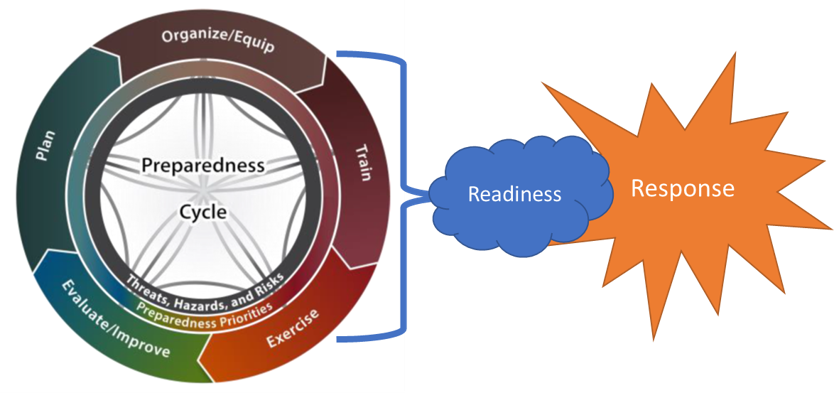
As I’ve applied more thought to this, I’ve assembled a refined definition of readiness as it applies to emergency management, that being:

[Readiness is the nexus of benchmark outcomes of preparedness matched with the needs of a specific kind and type of response. A state of operational readiness is achieved when all applicable preparedness benchmarks are met and the organization is willing and able to adequately leverage the resulting capabilities against a corresponding threat or hazard.]

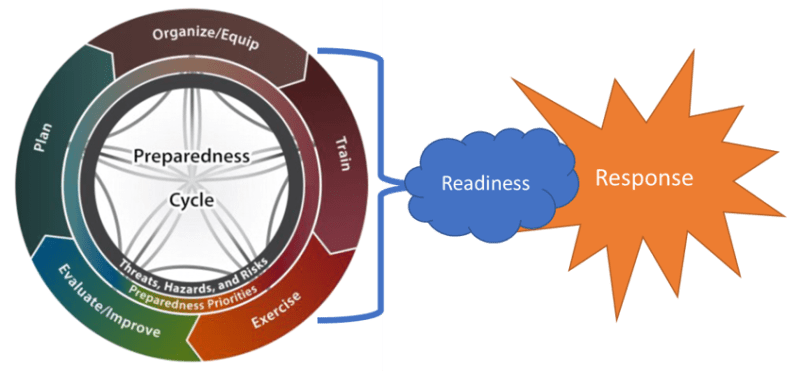
I’ve put together a graphic I think reasonably represents this relationship below.  Readiness is represented by a cloud because, as I explore further in this writing, it is itself rather amorphic and complex.
Readiness

To explain the components of my definition…  Readiness comes from a culmination of outcomes from preparedness activities, but only when each of these outcomes achieves a specific benchmark state.  The achievement of benchmarked preparedness activities define a measure of capability.  These capabilities are associated with a specific threat(s) or hazard(s).  As such, that state of readiness is only applicable to a specific kind (threat or hazard) and type (size and complexity) incident.  To help illustrate my points, here are a couple of examples using field response scenarios:

We can assume that a volunteer fire department is prepared to handle a room and contents fire.  They should have all the elements needed to do so, and in fact, these elements have standards (benchmarks) defined by the NFPA and state fire marshals.  Does this mean they have achieved readiness?  Hopefully yes, but perhaps not.  Given the rather extensive crisis of low membership in volunteer fire departments, the department in question may not have adequate staff to respond to this fire if it occurs, for example, in the middle of a week day.  This gives them a measure of degraded, or even negligible readiness.

Similarly, if we take the same fire department, having accomplished the benchmarks of preparedness for response to a room and contents fire, and even given adequate staff to do so, they may not have a state of readiness to fully address a hazardous materials incident.  While many of the elements of preparedness apply to both types of incidents, there are some critical differences which they would have to overcome to establish a state of readiness for a different type of incident.  Likewise, we could revert back to the room and contents fire and make it bigger – say a fully involved structure fire. While the department might have operational readiness to address the room and contents fire, they may not have the operational readiness to address a structure fire.

I think it’s fair to say that we can be prepared for something without having operational readiness for it.  Years ago, when there was a planetary ‘near miss’ by a meteor, a news outlet contacted our state OEM PIO.  They asked if we had a plan for a meteor strike.  The PIO acknowledged that we didn’t have a plan specific to that, but we did have a comprehensive emergency management plan, through which, and supported by various functional annexes, we were prepared to respond to such an incident and its effects should it occur.  Was the PIO wrong?  Not at all.  Assuming the other elements of preparedness were reasonably in place (and they were), it would be fair to say we were generally ‘prepared for anything’.  Were we ready, however?  Absolutely not.  The operational readiness needs for such an extraordinary, high impact incident are near-impossible to achieve.

When we examine this, it’s important to identify that a state of readiness can wax and wane, based on our ability to apply the identified preparedness measures to the incident in question. Considering the first example of the fire department and the room and contents fire, the department has a state of operational readiness when, as included in the definition I gave, all the preparedness benchmarks are met and they are willing and able to adequately leverage the resulting capabilities against a corresponding threat or hazard.  Changes in capability and/or the willingness or ability to apply those capabilities will result in degradation of readiness.  Depending on the factor in question, it may fully disqualify their readiness, or it may decrease their readiness by some measure.

So why is readiness important?  Readiness is the green light.  If we accomplish a state of operational readiness, we increase our chances of success in addressing the threat or hazard in question.  If we haven’t achieved readiness, we still can obviously be successful, but that success may come at a greater cost, longer period of time, and/or increased error.

How do we achieve readiness?  The current approach we have in emergency management certainly isn’t enough.  While some efforts may culminate in operational readiness, there is, as a whole, a significant lack of focus on operational readiness.  This seems to largely be a cultural issue to overcome.  In general, we seem to have the attitude that preparedness equates to readiness, and that preparedness itself is an end state. Even though we intuitively, and doctrinally, know that preparedness is a cycle, we seem to take comfort in ‘completing’ certain tasks among the preparedness elements – planning, organizing, equipping, training, exercises, and improvement – and then assuming readiness.  Readiness itself is actually the end state, though it is a dynamic end state; one that we can easily lose and must constantly strive to maintain.  To accomplish and maintain operational readiness, it is imperative that we aggressively and rigorously pursue activity in each of the elements of preparedness.  We must also continually monitor our ability to execute the capabilities we are preparing.  That ability, ultimately, is our measure of readiness.

The scale and unit of measuring readiness is something I’m not exploring in depth here (it really warrants its own deliberate effort), but expect to revisit in the future.  I surmise that the factors may be different based upon the various capabilities, and types and kinds of threats/hazards we are trying to address.  We need to examine capability requirements at a granular (task) level to truly assess our current state of readiness and identify what we need to address to increase our readiness.  I also assume that there is a somewhat intangible factor to readiness, one that likely revolves around the human factor. Things like leadership, decision-making, confidence, and ability to improvise. The measure of readiness may also involve certain external factors, such as weather.  The measurement of readiness certainly is complex and involves numerous factors.

I do know that practice is a significant factor in operational readiness.  Earlier I mentioned my experience with the National Guard.  Much of that revolves around exercises, which is one of the best (though not the only) measures of readiness.  Operational military units seem to constantly exercise.  Sometimes small scale, sometimes large.  They exercise different aspects, different scenarios, and different approaches.  It’s the regular repetition that builds competence and confidence, along with identifying shortfalls within the capability such as planning gaps, equipment failures, and the need to anticipate and prepare for certain contingencies.  While we exercise a fair amount in emergency management, we still don’t exercise enough.  I see a lot of people in emergency management leadership develop a complacency and virtually declare that ‘close enough is enough’.  It’s absolutely not enough to exercise a plan or capability once a year, which is something we often see (and often at best).

Preparedness is not something we achieve, it’s something we do; but through it we strive to achieve and maintain readiness.

It’s interesting to note that at the level of federal doctrine, we have a National Preparedness Goal.  We need to recognize that preparedness isn’t the goal – Readiness is.  A possible starting point for change would be the assembly of a blue-ribbon panel, likely by FEMA, to explore this topic and provide recommendations on a unified way ahead for emergency management to recognize the need for operational readiness, including purposeful changes in doctrine and culture to emphasize this desired end state.  We need a solid definition, means of measurement, guidelines for implementation, and an identification of the barriers to success with recommendations on how to overcome them (yep, I already know money and staff are the big ones).

I hope I’ve given some food for thought in regard to readiness.  The simple act of writing this and the bit of associated reading and thinking I’ve done on the topic certainly has me thinking about things differently.  As always, I’m curious to hear your thoughts on operational readiness, what it means to you, and what we can do to achieve it.

© 2020 Timothy Riecker, CEDP

Emergency Preparedness Solutions, LLC®


NEW: 2020 HSEEP Revision

Earlier today FEMA dropped the latest version of the Homeland Security Exercise and Evaluation Program (HSEEP) doctrine.  Doing a quick comparison between this new version and the previous (2013) version, I’ve identified the following significant changes:

  • They replaced the ‘Elected and Appointed Officials’ mentions within the document with ‘Senior Leaders’. This makes sense, since often the elected and appointed officials simply aren’t involved in many of these activities.  The previous terminology is also exclusionary of the private sector and NGOs.
  • The document specifically references the Preparedness Toolkit as a go-to resource.
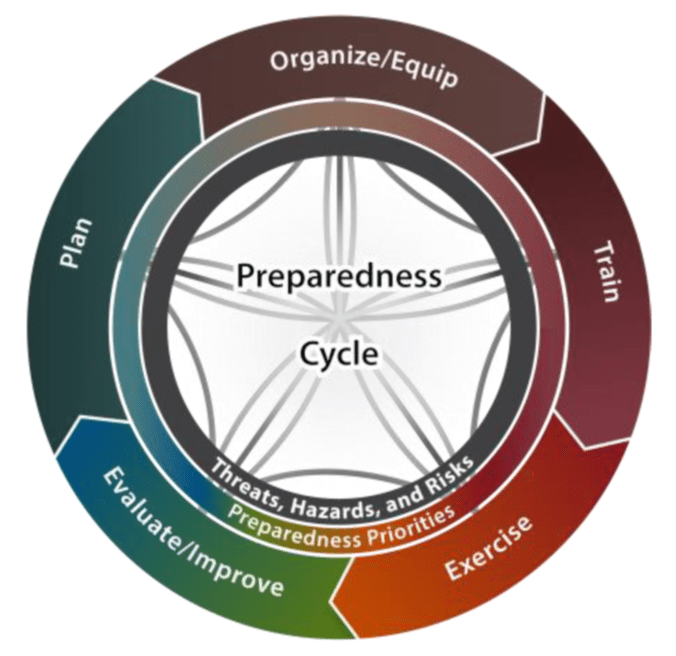
  • A big emphasis through the document is on the Integrated Preparedness Cycle (see the graphic with this post). The Integrated Preparedness Cycle covers all POETE (Planning, Organizing, Equipping, Training, and Exercising) elements plus Evaluate/Improve.  The graphic also eludes to these activities not necessarily happening in a specific order, as well as the consideration of Preparedness Priorities and Threats, Hazards, and Risks.  Developing a preparedness plan is something I wrote about back in 2016.
  • Integrated Preparedness Cycle
    • Going along with the Integrated Preparedness Cycle, they have done away with the Training and Exercise Plan (TEP) and replaced it with the Integrated Preparedness Plan (IPP), which is developed through input obtained during an Integrated Preparedness Planning Workshop (IPPW). I serious HOPE this shift is successful, as I’ve mentioned in the past how often the training aspect of the TEP was ignored or phoned in.  This approach also does a lot to integrate planning, organizing, and equipping (but ESPECIALLY planning) into the effort.  This is all tied together even more if a jurisdiction has completed a THIRA.  The Integrated Preparedness Cycle and IPP are the things I’m happiest about with the updated document.
  • The new document provides easier to find and read layouts for information associated with exercise types and each of the planning meetings.
  • For years, HSEEP doctrine has suggested (though thankfully not required) an ICS-based organization for exercise planning. I’ve never used this as I found it awkward at best (though I know others often use it and have success in doing so).  The update provides a different suggestion (better, in my opinion) of a functionally organized planning team organization.  Consider that this is still a suggestion, and that you can use it, or a version of it, or an ICS-based one, or anything else you desire.
  • The update provides better delineation between the planning and conduct needs of discussion-based exercises vs those of operations-based exercises. Those of us who have been doing it for a while know, but for those who are new to exercises this should be very helpful.
  • Lastly, the document suggests making corrective actions SMART, as these are really objectives.

FEMA is hosting a series of webinars (listed on the HSEEP website) to discuss these changes.

I’m very happy with the changes made to the doctrine.  It’s a great continued evolution of HSEEP and preparedness as a whole.  For as much as I’m a champion of the Integrated Preparedness Plan, though, having it (thus far) only included in the HSEEP doctrine makes it easy to miss or dismiss by some.  I’m hopeful broader promotion of this concept, perhaps even including it as an emergency management performance grant requirement, will help adoption of this concept.

What are your thoughts?

© 2020 Timothy Riecker, CEDP

Emergency Preparedness Solutions, LLC®

ICS Training Sucks: A Revival

It’s sad to say that in the past four and a half years of stumping for changes in ICS training, we have seen little progress.  I was recently sent a response org chart developed by an agency that completely tore apart ICS and rebuilt it in a fundamentally different image.  ICS is a standard.  It shouldn’t be changed.  Once you change it, especially at fundamental levels, you no longer have a standard.  It has innate flexibility, but those are applied without changing the fundamentals.  I vented some of my frustration about this last night on Twitter, to a mix of celebration and naysayers, as expected.  Some of those naysayers think the system simply doesn’t work. Others think the system simply can’t accommodate their type of agency.

(note that I’m using the word ‘agency’ here to mean any type of government, non-government, or private sector organization.  I decided to use it since I’m also heavily using the term ‘organization’ in regard to the structure we apply for a response)

So let’s back up a bit.  Why is this happening?  It starts with people having some knowledge of ICS and, with good intentions, wanting to adapt it to their agency and their circumstances.  But there is simply no reason to do any adaptation.  The functions outlined in ICS are all you need in a field-level response.  I’ve heard all the excuses – “We need to make it work for us.”  “FEMA needs to build an ICS for our type of agency.”  “It’s not you, it’s me.” I’ve worked with a lot of stakeholders across a lot of sectors across the whole country, and I have yet to find a field-level response that I can’t organize without violating the fundamentals of ICS.

I’m sure I’ve said this before, but adhering to the standard is important because if we don’t adhere to a standard, we are out of the loop.  If enough people don’t adhere to a standard, it’s no longer a standard.  Either way, the benefits of having a standard are crumpled up and thrown away.

One problem is that a lot of entities, particularly large agencies with multiple components, like to ensure that every function or department within their static structure is represented in an ICS model.  This isn’t what ICS is built for.  If you are seeking specific representation, you can assign agency representatives to the ICP or the EOC, or use a department-based EOC model, but the foundational ICS structure itself isn’t intended to reflect your static organization.  You have an animal control officer.  Do they need to be represented in your pre-planned ICS org chart?  No, they are brought in as a resource if needed, likely in Operations.  You have an IT department.  Do they need to be represented in your pre-planned ICS org chart?  Not as a department. But their capability is identified, likely for assignment within Logistics.  It’s not about recreating ICS to fit your static organization.  It’s about knowing the capabilities of your static organization and applying them within the established ICS structure when and how they are needed. 

Let’s put this out there… ICS isn’t just for you, it’s for everyone.  What I mean is that the greatest benefit of ICS (the prime reason it was actually devised) is for multi-agency operations.  In a local incident of any significance, your agency is likely to be part of a multi-agency response.  Depending on the type of incident, scope, location, and other factors, certain positions will be staffed with personnel selected from the agencies with primary responsibility and, hopefully, with qualified staff.  So that carefully crafted org chart you have developed for your agency’s response is largely irrelevant in a multi-agency operation.  Yes, your agency certainly should have a go-to model for single-agency responses, but consider that a single-agency response probably isn’t going to need a full-blown org chart.

There is a difference, though… and that’s for EOCs, or more specifically departmental emergency operations centers.  These are, by definition, not multi-agency, and established to support your own agency’s needs for deployment, sustainment, internal coordination, and matters that may not be addressed at the field-level.  EOCs have a variety of organizational models available to them, which don’t necessarily need to be ICS.   A problem I often see is agencies trying to accomplish everything in one org chart.  They are trying to fit executive level positions in with field response.  Stop.  Take a breath and figure out what you are trying to accomplish.  It’s OK (and perhaps necessary) for your agency to have two organizational models to accomplish what you need, depending, of course, on your agency’s role, responsibilities, and capabilities.  You may need a field-level organization that addresses a tactical response (this is ICS-based) and an EOC organization that supports that response and the needs of your agency as a whole in regard to the incident (again, lots of options for the EOC organization).  Also consider, depending on your agency, that a policy group may be necessary to guide things.  A policy group is non-operational and they essentially exist to make the broad-reaching decisions on behalf of the organization.

Why are we seeing such extensive mis-applications of ICS?  First, people still don’t understand ICS.  Second, they aren’t truly considering the needs of their agencies.  The irony is that many of the people doing this DO think they understand ICS and that they are making changes to it to better serve the needs of their agencies.  So… we’re still maintaining that ICS Training Sucks.  Do I have a total solution to that problem?  No. But in the articles you find in that link, I certainly have some ideas.  I’ve also found a great many kindred spirits in this whole crusade that agree with the need for change in how we train people in ICS.

What I do know is that the solution isn’t as straight forward as we would like it to be.  Considerations:

First, we are considerably tainted by our knowledge of current and past ICS curricula.  When talking with people about how to fix ICS training, I have to regularly remind myself to push that knowledge aside and look at the problem with fresh eyes.  Lessons learned aside; we can’t move forward when we are still planting ourselves in what is in use now.

Second, we need to consider that there may not be a single solution that fits all needs.  I still think we may need a curriculum structure similar to that used for HazMat training, which addresses the needs of different user groups (i.e. Awareness, Operations, Technician, Planner, Commander).

Third, we need to actually teach people how to apply ICS.  At present, with only a bit of exception, true application of ICS isn’t deliberately instructed until someone takes position-specific and incident management team training.  This in no way meets the needs of most agencies, many of which are volunteer, and have limited availability to go away for several weeks to get the training they need.

Fourth, recognize that if you aren’t using ICS regularly (and I mean at a large scale), your knowledge and skill degrades.  Refresher training should be required and scenario-based learning should be incorporated across the curriculum.

Fifth, stop trying to re-develop ICS.  Trust me, all the needed capabilities of your agency for a field-level response fit within an ICS org chart.  It’s not about your static organization, it’s about capabilities.  Identify and assign capabilities.

I love the continued dialog and attention this topic gets.  The only way we will see positive change is by continuing that dialog.  Please share these blogs and your ideas with colleagues.  Let’s keep spreading this and striving for change.

© 2020 Timothy Riecker, CEPD

Emergency Preparedness Solutions, LLC

~~

In memoriam: I humbly dedicate this post to a friend and colleague who recently lost a battle with cancer.  Phil Politano is known by many for his good nature, his gregarious laugh, and his incredible knowledge as a Public Information Officer.  I’ve known Phil since about 2002, and had worked with him on incidents, taught classes with him, and learned a lot from him.  Phil eventually left Central NY and moved his family a bit south, taking a job with FEMA’s Emergency Management Institute.  There, his talents were applied to their greatest extent.  He reshaped PIO training, spread that gospel to people from all around the world, and supported large scale responses with his knowledge, skills, and abilities.  He was a master in his craft and shared his mastery with anyone who wanted to learn.  He was an incredible practitioner, a great friend, and a wonderful person.  He made us all better simply by knowing him.   He is missed by so many.  Rest well.


Public-Private Partnerships Should be a Two-Way Relationship

Public-private partnerships are not a new concept to emergency management.  There are municipalities, regional areas, and states that have formed committees and strategized how the private sector can provide support during a disaster.  Certainly we have seen a lot of support, on both a large scale and locally, from the ‘big box’ stores, such as Wal-Mart, Lowes, and Home Depot.  Tide’s Loads of Hope program, something so simple but extraordinarily impactful, provides a means for disaster victims to have clean clothing.  Insurance companies have established a response capability to expedite their assessments and services to their clients.  Private sector partners know that these things are not just good public relations, but that they have a means of supporting communities that government and relief organizations may not.

There is another aspect to public-private partnerships that doesn’t seem to be widely addressed, and that’s the community business.  How can they help the community in a disaster?  First, business continuity is essential, since they may also be impacted by the disaster.  Small businesses don’t have the level of capability to leverage that large companies do.  Yes, the SBA can help them with long-term recovery, but the ability of some small businesses to get back to operations quickly can directly help a community recover.  I work with a lot of small communities, many of them serviced by small shops and independent grocers.  There are no big box stores for many, many miles.  For grocers, power outages result in spoiled food.  Road closures result in crippling supply chain problems.  While we’d like all businesses to have mitigation measures and preparedness for disasters, many small businesses simply don’t have the capitol to invest in things like generators and they obviously can’t control road closures.

What’s to be done?  Local municipalities absolutely need to bring these small business owners to the table, establish relationships, identify their needs, and consider identifying them as part of the community’s critical infrastructure.  The resilience of small grocers, lumber companies, and other purveyors is essential to the resilience and recovery of so many small towns.  The impacts are easy to see… if a store can keep running, they are not only providing essential goods and services to the community, they are also supporting the economy by keeping their employees working. What do they need?  Things like power and access, obviously, but tangential things like the availability of child care is huge.  Following disasters schools usually close and often become community shelters. Many parents work when their kids are in school.  If school is closed, they need access to child care.

How far can government go in supporting the private sector?  Many governments tend to avoid supporting the private sector as if it were some kind of disease.  It took many months to convince FEMA in the aftermath of Sandy to make dredging of private marinas eligible for disaster cost recovery.  These marinas (mostly small businesses themselves) support capabilities of fire and police watercraft, recreation (which has economic impact), and a significant fishing and crabbing industry, which is the livelihood of many off and on shore.  Obviously, FEMA needs to maintain accountability of funds and ensure they are being spent appropriately, but a big part of this was resistance to the idea of government providing direct support to the private sector.

While I agree that there are many nuances to this situation, it seems that in many cases the impact of small, local businesses in short-term recovery are disregarded, especially by state and federal governments, and that there exists a one-way door for business participation, where in this ‘partnership’ they are asked to provide goods and services, but how is government contributing to that partnership?  With the big box stores and other large companies, local governments certainly help with some permit expediting and perhaps physical space to set up and access to utilities, there is typically not much support required beyond that.  Small businesses may need more direct support to recover.  They may need help clearing their private access road or parking lot.  They may need the public road they are located on to be cleared for traffic sooner.  They may need a generator that can power their building.  They may need quantities of potable water brought on-site.  Their employees may need child care or public transportation.  These are things they either can’t immediately afford or simply don’t have access to. Local government may have better access to these resources, though, and with the justification of these small businesses providing essential goods and services to the community, the choice is easy.

Does this open government to potential criticism?  Absolutely.  Some business owners may claim discriminatory practices of government supporting some businesses and not others.  Some tax payers may even complain about the use of tax dollars in such a fashion.  While people may always complain, legal consequences and public relations problems should certainly be mitigated.  The road to addressing this is preparedness.  Engage your local attorney and the legal council for the state’s emergency management agency.  Municipal laws and state laws regarding authorities that can be enacted during a state of emergency need to be explored to not only make sure that local government has the legal ability to provide this support, but the conditions and procedures required for doing so.  The legal sources and procedures and standards for providing this support should be documented and made part of the local emergency plan. The municipality should have a criteria for determining what types of businesses could be included in such direct support (what is regarded as the municipality’s privately owned critical infrastructure?), and even outline requirements for those businesses, such as having a business continuity plan, implementing certain resiliency measures, or participating in coordination activities prior to a disaster.  Memoranda of understanding may be required, or other legal tools to identify the terms and conditions of support.

While this type of support from government to the private sector isn’t common, there are some municipalities who do it well.  I’m certainly interested in hearing what you’ve implemented and what best practices you’ve identified.

© 2020 Timothy Riecker, CEDP

Emergency Preparedness Solutions, LLC®℠