A National Disaster Safety Board

You’ve heard of the National Transportation Safety Board (NTSB), right? If not, the nitty gritty of it is that they are an independent federal accident investigation agency. They determine probable cause of the full range of major transportation incidents, typically putting forward safety recommendations. They are granted some specific authorities related to these investigations, such as being the lead federal agency to investigate them (absent criminal aspects) and they maintain a schedule of deployment-ready teams for this purpose.  They can conduct investigative hearings (ever see the film Sully?) and publish public reports on these matters. Overall, I’ve had positive interactions with NTSB representatives and have found their work to be highly effective.

While certainly related to emergency management, the main purpose for my quick review of the NTSB in this post is to provide a starting point of understanding for Congressional legislation urging the formation of a National Disaster Safety Board (NDSB). The draft bill for discussion can be found here. This bill has been put forth with bi-partisan sponsors in both the US Senate and the House of Representatives.

The purpose of the NDSB, per this bill, is:

  1. To reduce future losses by learning from incidents, including underlying factors.
  2. Provide lessons learned on a national scale.
  3. Review, analyze, and recommend without placing blame.
  4. Identify and make recommendations to address systemic causes of incidents and loss from incidents.
  5. Prioritize efforts that focus on life safety and injury prevention, especially in regard to disproportionately impacted communities.

To execute this mission, the bill provides that the NDSB will have the authority to review incidents with 10 or more fatalities; may self-determine the need for board review of an incident; and shall have the full ability to investigate, review, and report on incidents.

The bill directs the NDSB to coordinate with all levels of government to identify and adopt standard methods of measuring impacts of disasters to provide for consistent trend analysis and comparisons, and to ensure that these standards are uniformly applied. The bill requires the NDSB to coordinate with all levels of government in their investigations during incident responses, and to participate in the incident command system for coordination of efforts as well as investigative purposes. Affected authorities shall have an opportunity to review the NDSB report 30 days prior to publication.

The NDSB will be comprised of seven board members, selected by the President from a slate of candidates provided by both houses of Congress, with no more than four board members having affiliation with the same political party, and with all members having technical and/or professional qualifications in emergency management, fire management, EMS, public health, engineering, or social and behavioral sciences.

There is a lot of other legalese and detail in the bill, but I’m happy to find that the language supports coordination among and with federal agencies, including FEMA, NIST, NTSB, and others; and also has an emphasis on investigating impacts to disproportionately impacted communities. The bill also charges the NDSB with conducting special studies as they see fit and providing technical support for the implementation of recommendations.

I’m thrilled with this effort and I’m hopeful the bill progresses to law. We have had a history of outstanding research from academic institutions and after action reports from government entities, which should all still continue, but it’s incredibly substantial that the NDSB will establish standards and consistency in how we examine disasters over time. We’ve seen how impactful the NTSB has been since its inception in 1967, and I feel the NDSB could have an even greater impact examining a broader spectrum of disasters. This is an effort which has been long encouraged by various emergency management related groups. The NDSB, I suspect, will also support a stronger and more defined FEMA, as well as strengthening all aspects of emergency management at all levels.

What thoughts do you have on the NDSB? What do you hope will come of it?

© 2020 Timothy Riecker, CEDP

Emergency Preparedness Solutions, LLC

COVID-19 Vaccine Administration Preparedness

On September 16, the CDC released the COVID-19 Vaccination Program Interim Playbook for Jurisdiction Operations. This document lays out some fairly realistic expectations of jurisdictions (mostly states) in their distribution, administration, and tracking of COVID-19 vaccinations. That said, even though there continue to be many unknowns about the vaccines to be utilized, dosages, timetable of availability, and how and where vaccines will be delivered to states, there are reasonable assumptions that could be made and high probability strategies identified, which the CDC failed to do. Instead, as is a hallmark of many poor managers, they provided a punch list of considerably detailed demands but not the very essential information and parameters needed to support good planning. Information is everything.

Garbage in/garbage out is a pretty simple concept of utilizing poor or lacking information to inform a process, which will result in similar outputs. After reviewing New York State’s COVID-19 Vaccination Plan, that concept is fully demonstrated. Most sections of New York State’s plan are vague at best, saying what they will do but not how they will do it. They do identify some roles and responsibilities, but without delineating the boundaries between functionaries. For example: they will utilize pharmacies, local health departments, and state-run facilities, among others, to accomplish public vaccination. This is a solid and expected strategy, but the responsibilities for each are poorly defined for their own operations, much less how they will or won’t work together. Many concepts in the plan are vague at best, and even lacking more defined federal guidance, should have better detail. A big component of vaccination will be community delivery through local health departments, yet this is barely acknowledged. I would have expected this plan to provide guidance and outline preparedness requirements for local health departments, even if they were communicated separately. I acknowledge this is intended to be a strategic level plan, but it doesn’t seem to even consistently provide that measure of detail. I’m left with a lot of questions. And while it may be petty, the document itself is poorly written and published – I expect better from state government.

I’ve not looked at the plans of other states, but if this is indicative of the general state of things, the term ‘shit show’ is the phrase that comes to mind. While we will no doubt improve, there is a long way to go and I think jurisdictions will find themselves in a bind, being poorly prepared when they receive notice of an imminent delivery of vaccines with no detailed plan or assigned resources to get the job done. If anything, we have had plenty of time to prepare for vaccination efforts. There are clearly failures at all levels. While communication between and among federal, state, and local jurisdictions has certainly taken place beyond these documents, the standards and measures need to be more apparent.

We need to do better and be better. Reflecting a bit on the piece I wrote yesterday, we need to be thorough and imaginative in our preparedness efforts without excluding possibilities. Local jurisdictions must be prepared to support vaccinations in their communities. As I’ve written before, most health departments simply don’t have the capacity to do this. Jurisdictions need to engage with their health departments for the best guidance possible and work from that. An 80% solution now is better than a 20% solution later. As with any disaster, local communities are the first stakeholder and the last.

What are you seeing from your states? What do you think is missing in our overall efforts?

© 2020 Timothy Riecker, CEDP

Emergency Preparedness Solutions, LLC®

Don’t Plan Yourself into a Corner

I’ve long been an advocate for detailed planning. Plans should identify who (by position or title) are decision-makers, who are action agents, and how things are to be done. Without identifying these responsible parties and the processes necessary to execute planned actions, plans will generally lack the ability to be successfully implemented. Context is also important. To address this, plans have a preamble that identifies the scope and objectives of the plan. All of this tells us what circumstances the plan is intended to apply to and what it expects to accomplish. Details matter. That said, making plans too specific can also spell trouble.

(I figured putting up the cover Michael McCaul’s Failures of Imagination was suitable for this post, as it’s all about emergency management suffering from a lack of imagination.)

In terms of context, only some plans need to be very precise about when and how they are used. Give yourself some wiggle room. If you don’t provide a proper and wide enough scope and objectives to the plan, you are already poisoning the well. Case in point – a lot of entities have realized that their pandemic plans have failed them, and as such are re-writing their plans. I’m hearing of many totally scrapping their old pandemic plans and writing the new ones as if all future infectious disease outbreaks will behave exactly as Coronavirus has. The old plans largely failed not necessarily because our assumptions were wrong, but because they were too narrow. Don’t make the same mistake. A proper scope and objectives will help properly define what you want to address. If these are too focused or narrow, you leave out a lot of possibilities.

When it comes to strategies and procedures, plans often fail because they don’t have enough detail. But plans can also fail if they are too restrictive or if the strategies and procedures don’t align with the scope and objectives. Restrictive plans define rigid circumstances under which approaches are taken, and/or those approaches are so rigidly defined that they will only work under certain circumstances or with all the right personnel and resources. You’ve been through disasters, right? You realize that disasters impose extreme circumstances upon us; impacting health, safety, and infrastructure; and we rarely ever have all the resources we would like to have in resolving that disaster. In fact, I’d argue that if disasters only impacted us the way we want them to, it would be more of an inconvenience rather than a disaster.

So unless you expect your title to change to Inconvenience Manager, remember that all preparedness starts with planning. Do your research and know your hazards, threats, and vulnerabilities, but don’t be totally encumbered by them either. Broaden your planning assumptions where you can, which will open your scope. Ensure that your planning objectives truly define what you intend for the plan to accomplish. Plan with greater detail and fewer restrictions. Ensure that succession and chain of command are addressed, so it’s not just a certain title or position that has authority over certain actions. Ensure that people are cross trained and that both people and plans are exercised with a certain extent of random factors in scenarios. Our plans and our resources must be agile to be successful.

Sure, we can improvise and get out of a corner that our plans back us into or don’t address, but we are better prepared if we can acknowledge the possibility of other scenarios. This is why planning teams contribute to successful plans. It’s the different perspectives they bring, with a lot of ‘what ifs’ and different viewpoints. Open your eyes and look around. One of the biggest enemies of emergency management is tradition. Is it any wonder why the same corrective actions keep rising to the surface?  Do better. Be better.

Thoughts?

© 2020 Timothy Riecker, CEDP

Emergency Preparedness Solutions, LLC®

Incident Management Advisors

It’s frustrating to see poor incident management practices. For years I’ve reviewed plans that have wild org charts supposedly based on the Incident Command System (ICS); have conducted advanced-level training with seasoned professionals that still don’t grasp the basic concepts; have conducted and evaluated exercises and participated in incident responses in which people clearly don’t understand how to implement the most foundational aspects of ICS. On a regular basis, especially since people know my focus on the subject, I’m told of incident management practices that range from sad to ridiculous.

Certainly not everyone gets it wrong. I’ve seen plans, met people, and witnessed exercises and incidents in which people clearly understand the concepts of ICS and know how to put it into action. ICS is a machine, but it takes deliberate and constant action to make it work. It has no cruise control or auto pilot, either. Sometimes just getting the incident management organization to stay the course is a job unto itself.

If you are new here, I’ve written plenty on the topic. Here’s a few things to get you pointed in the right direction if you want to read more.

ICS Training Sucks. There are a series of related posts that serve as a key stone to so much that I write about.

The Human Factor of Incident Management. This bunch of related articles is about how ICS isn’t the problem, it’s how people try to implement it.  

As I’ve mentioned in other posts, it’s unrealistic for us to expect most local jurisdictions to assemble and maintain anything close to a formal incident management team. We need, instead, to focus on improving implementation of foundational ICS concepts at the local level, which means we need to have better training and related preparedness activities to promote this. Further, we also know that from good management practices as well as long-standing practices of incident management teams, that mentoring is a highly effective means of guiding people down the right path. In many ways, I see that as an underlying responsibility of mine as a consultant. Sometimes clients don’t have the time to get a job done, but often they don’t have the in-house talent. While some consultants may baulk at the mere thought of building capability for a client (they are near sighted enough to think it will put them out of work), the better ones truly have the interests of their clients and the practice of emergency management as a whole in mind.

So what and how do we mentor in this capacity? First of all, relative to incident management, I’d encourage FEMA to develop a position in the National Qualification System for Incident Management Advisors. Not only should these people be knowledgeable in implementations of ICS and EOC management, but also practiced in broader incident management issues. Perhaps an incident doesn’t need a full incident management team, but instead just one or two people to help the local team get a system and battle rhythm established and maintained. One responsibility I had when recently supporting a jurisdiction for the pandemic was mentoring staff in their roles and advising the organization on incident management in a broader sense. They had some people who handled things quite well, but there was a lot of agreement in having someone focus on implementation. I also did this remotely, demonstrating that it doesn’t have to be in person.

In preparedness, I think there is similar room for an incident management advisor. Aside from training issues, which I’ve written at length about over the years (of course there will be more!), I think a lot of support is needed in the realm of planning. Perhaps a consultant isn’t needed to write an entire plan, but rather an advisor to ensure that the incident management practices identified in planning documents are sound and consistent with best practices, meet expectations, and can be actually implemented. So much of what I see in planning in regard to incident management has one or more of these errors:

  1. Little mention of incident management beyond the obligatory statement of using NIMS/ICS.
  2. No identification of how the system is activated and/or maintained.
  3. As an extension of #2, no inclusion of guidance or job aids on establishing a battle rhythm, incident management priorities, etc.
  4. An obvious mis-understanding or mis-application of incident management concepts/ICS, such as creating unnecessary or redundant organizational elements or titles, or trying to force concepts that simply don’t apply or make sense.
  5. No thought toward implementation and how the plan will actually be operationalized, not only in practice, but also the training and guidance needed to support it.

In addition to planning, we need to do better at identifying incident management issues during exercises, formulating remedies to address areas for improvement, and actually implementing and following up on those actions. I see far too many After Action Reports (AARs) that softball incident management shortfalls or don’t go into enough detail to actually identify the problem and root cause. The same can be said for many incident AARs.

When it comes to emergency management, and specifically incident management, we can’t expect to improve without being more direct about what needs to be addressed and committing to corrective actions. We can do better. We MUST do better.

New polling function in WordPress… Let’s give it a try.

©2020 Timothy Riecker, CEDP

Emergency Preparedness Solutions, LLC®

How BC is Acing the Pandemic Test (Guest Post)

I’m excited and honored to promote a new blog being written by Alison Poste. Alison has led major disaster response and recovery efforts in Alberta, Canada, including the 2013 floods and the Fort McMurray wildfires, and currently works as a consultant specializing in business continuity, emergency management, and crisis communications. Her new blog, The Afterburn – Emergency Management Lessons from Off the Shelf, takes a critical look at lessons learned and how they are applied.

I’ve pasted her first post below, but also be sure to click the link above to follow her blog. I’m really excited about the insight Alison will be providing!

– TR

~~

The pandemic has upended how those in the emergency management field have seen traditional response frameworks. Lessons learned from the pandemic response will be useful to governments and the private sector alike in the coming years.

The ICS framework for emergency response is well equipped to address the unique needs of any disaster, including a global pandemic. The rapid scalability of the structure allows the response to move faster than the speed of government. It provides the framework for standardized emergency response in British Columbia (B.C.).

The B.C. provincial government response to the coronavirus pandemic, led by Dr. Bonnie Henry, the Provincial Health Officer (PHO) has received international acclaim. It is useful therefore to learn from the best practises instituted early on in the pandemic to inform future events. 

In February 2020, the Province of B.C. published a comprehensive update to the British Columbia Pandemic Provincial Coordination Plan outlining the provincial strategy for cross-ministry coordination, communications and business continuity measures in place to address the pandemic. Based on ICS, the B.C. emergency response framework facilitates effective coordination by ensuring the information shared is consistent and effective. The Province of B.C. has provided a daily briefing by Dr. Henry and Adrian Dix, the B.C. Minister of Health as a way to ensure B.C. residents receive up to date information from an authoritative source.

While we may consider the COVID-19 pandemic to be a unique event, a number of studies have provided guidance to emergency response practitioners of today. The decisive action taken by the B.C. PHO on COVID-19, has focused on the twin pillars of containment and contact tracing. Early studies regarding the effect of contract tracing on transmission rates have seen promising results, however the tracing remains a logistical burden. As studies indicate, these logistical challenges have the potential to overwhelm the healthcare system should travel restrictions be relaxed, leading to the possible ‘importation’ of new infections. 

B.C. has instituted robust contract tracing mechanisms to reduce the spread of COVID-19 in alignment with best practises in other jurisdictions. When instituted methodically, contact tracing, consistent communication, and Dr. Henry’s mantra to “Be calm. Be kind. Be safe.” remain critical tools to ensure limited spread, a well-informed and socially cohesive population.

How has your organization helped to slow the spread of COVID-19?  As always, I welcome your feedback and suggestions for how to improve the blog.

Preparedness in the Pandemic Age

Planning, training, and exercises, as the foundational activities of preparedness, shouldn’t be stopping because of the pandemic. Preparedness is an ongoing activity which needs to forge ahead with little disruption – and there is always plenty to do! What must we do, though, to accommodate necessary precautions in the age of the Pandemic?

Let’s talk about planning first. The biggest relevant issue for planning is the conduct of stakeholder meetings. These may be larger group meetings to discuss and get buy-in on broader topics, or detailed small-group meetings to discuss very specific topics. Information, sometimes sensitive, is exchanged, presentations are given, and documents are reviewed. I’ve mentioned in various posts through the years the importance of properly preparing for meetings. Even for traditional in-person meetings, there are important things to consider, such as:

  1. Do you really need a meeting?
  2. Developing an agenda
  3. Having the right people in attendance
  4. Ensuring that all speakers and presenters are prepared
  5. Ensuring that all attendees are prepared to discuss the subject matter
  6. An adequate meeting space and support (technology, dry erase boards, etc)

All of these rules still apply in a virtual world, perhaps with even more emphasis. While we’ve obviously had video meeting technology for a long time, we’ve discovered this year that many people haven’t used it much or at all until earlier this year. The surge in use has also brought attention to the plethora of tools which can be facilitated through video conference platforms. While the simple sharing of video supports most of our meeting needs, we can share screens, conduct presentations, and use collaborative tools such as whiteboards and shared documents. Pretty much everything we do in an in-person meeting can be accomplished through video conference platforms – but those who arrange the calls need to take the time to become familiar with the tools and functionality; and if there is anything that needs to be done by participants (some of which are likely to be less tech-savvy) you need to be able to coach them through it. Some of these tools require integrations of other technology, such as cloud document storage or various apps. Remember that meetings should be interactive, so encourage people to use chatrooms to help queue up questions for presenters. If any documents or information are sensitive, be sure you are taking the appropriate precautions with how the meeting is set up, how participants are invited, and how documents are shared.

My tip… read reviews to determine which platform will best suit your needs and watch some tutorials on YouTube.

When it comes to remote training, so much of what I mentioned for stakeholder meetings will apply here. Being interactive is still incredibly important, as is the ability to integrate other technologies, such as videos, PowerPoint, and shared documents. When designing training that will be delivered remotely, if it helps, don’t think about the platform first – think about how you would do the training in person. Would you have breakout sessions for group work? That can be easily accomplished on video conference platforms, but it takes some preparation. Would you put things on a white board or chart paper? That can also be accomplished. Giving an exam? Having participants complete a survey or feedback form? Yes and yes. It can all be done, but preparation is key. Some instructors, especially in public safety, have gotten too used to simply showing up and delivering their material – not because they are lazy, but because they have done it dozens or hundreds of times. They have a routine. If you want participants to get a similar, or perhaps even better learning experience, some deliberate thought and preparation is required. Also, make sure you simply don’t become a talking head. Break things up and be dynamic. It’s easy for our own demeanor to elevate disinterest. I often stand (using a variable height standing desk) when giving presentations and conducting training. Being on my feet helps me push more energy into what I’m doing.

Tip… remember to give people breaks, just as you would in face-to-face training.

Lastly, exercises. A lot of this is a combination of the information I gave for planning and training. Exercise planning meetings need to be conducted, and every exercise has some extent of presentations, with discussion-based exercises having more emphasis on this obviously. To answer the big question – yes, most exercise can be conducted remotely! Obviously, discussion-based exercises are generally the lower-hanging fruit, so they can and should be happening remotely. Remember that exercises are supposed to be interactive experiences, so your exercise design absolutely must account for identifying the means and methods of engagement in the virtual environment. All the things I’ve mentioned already are prime options for this, such as breakout groups, shared documents, live polling, etc. Facilitators and evaluators can be assigned to specific breakout rooms or have access to all of them, allowing them to float from room to room.

What about operations-based exercises? Yes, there are options for conducting operations-based exercises remotely. First, we do need to acknowledge the obvious challenges associated with conducting drills and full-scale exercises via remote environments. Is it impossible? No, but it depends on what the focus of the exercise is. Something like a cyber-security or intelligence exercise may be more naturally brought into a virtual environment, depending on the exercise objectives or tasks. Games may be fully integrated into digital platforms already, which helps, but if they aren’t, these may need to be re-imagined and developed in a virtual environment. This can get expensive, so it really needs to be a properly thought through. Functional exercises, such as the typical command post exercise or emergency operations center (EOC) exercise, can absolutely be performed virtually. Many jurisdictions successfully ran their EOCs virtually during the height of the pandemic (many still are). If the actual activity can be performed virtually, it can (and should!) be exercised virtually. Again, preparation is key to ensuring that participants can do what they would normally do, while controllers and evaluators still have full access and visibility. Simulation Cells can be virtually integrated and most EOC management platforms are web-based. With some thought, we can bring most exercises into a virtual environment and still make them effective experiences while also meeting all HSEEP requirements.

Tip… For a virtual functional exercise, unless the time period of your exercise is set after the initial response, consider including an objective for the participants (and the tech support of their agencies, as needed) to set up everything that is needed in real time during the exercise – just like they would in real life. This would include all their video, file share, data tracking, etc. That set up is a considerable challenge of running a virtual EOC. If you didn’t want that activity to distract from your exercise, it’s also a great drill. Don’t let it just be tech support personnel, though, as EOC personnel should be expressing their needs.

Remote work environments have helped many organizations overcome challenges associated with the pandemic. Some organizations were better prepared than others to make it happen, but most seem to have achieved effective operational continuity. Hopefully your preparedness programs haven’t stalled out because people feel these activities can’t be done in a virtual environment. We also can’t use the excuse that we’re too busy because of the pandemic to not be preparing. While some niche organizations might still be quite busy, the pandemic response, for most, has become an integrated job duty for the medium term. We can’t let things fall to the wayside or we will never get back on track. The time is now!

I’d love to hear how you are using tech platforms to support preparedness efforts.

©2020 Timothy Riecker, CEDP

Emergency Preparedness Solutions, LLC

The Universal Adversary Mindset

Some of you are probably familiar with the concept of the Universal Adversary (UA). From previous Homeland Security Exercise and Evaluation Program (HSEEP) doctrine, UA is “a fictionalized adversary created by compiling known terrorist modifications, doctrine, tactics, techniques, and procedures in live, virtual, and constructive simulations. The UA is based on real realistic threats … providing participants with a realistic, capabilities-based opponent.” UA is often executed by a Red Team, which serves as an exercise-controlled opposing force for participants.

Over the past few years, I’ve heard less and less of the Universal Adversary concept. DHS used to have a UA Program supporting terrorism-based prevention and responses exercises, dating back to the early 2000s, but lately I’ve neither seen or heard anything about the continuation of the program or capability. (can any readers confirm the life or death of this capability?)

Regardless, the concept of UA offers a fair amount of opportunity, not only within the Prevention Mission Area, but across all of exercise design and perhaps other areas of preparedness – yes, even across all hazards. Of course, I recognize the difference between human perpetrators and other hazards, but just stick with me on this journey.

The fact of the matter is that we so often seem to have, as the 9/11 Commission Report made the phrase infamous, a failure of imagination in our preparedness. I’m not saying we need to go wild and crazy, but we do need to think bigger and a bit more creatively – not only in the hazards that threaten us, but also in our strategies to address them.

The UA concept is applied based on a set of known parameters, though even that gives me some concern. In the Prevention world, this means that a Red Team will portray a known force, such as ISIS, based upon real intel and past actions. We all know from seeing mutual fund commercials on TV that past performance does not predict future results. While humans (perpetrators and defenders alike) gravitate toward patterns, these rules can always and at any time be broken. The same can be said for instances of human error or negligence (see the recent and terrible explosion in the Port of Beirut), or in regard to someone who we have a love-hate relationship with… Mother Nature. We need to be ever vigilant of something different occurring.

There is the ever-prolific debate of scenario-based preparedness vs capability-based preparedness. In my opinion, both are wrong and both are right. The two aren’t and shouldn’t be set against each other as if they can’t coexist. That’s one mindset we need to move away from as we venture further into this. We need to continue with thinking about credible worst-case scenarios, which will still be informed by previous occurrences of a hazard, where applicable, but we need to keep our minds open and thinking creatively. Fundamentally, as the UA concept exists to foil and outthink exercise participants, we need to challenge and outthink ourselves across all areas of preparedness and all hazards.

A great example of how we were foiled, yet again, by our traditional thinking is the current Coronavirus pandemic. Practically every pandemic response plan I’ve read got it wrong. Why? Because most pandemic plans were based upon established guidance which emergency managers, public health officials, and the like got in line and followed to the letter, most without thinking twice about it. I’m not being critical of experts who tried to predict the next pandemic – they fell into the same trap most of us do in a hazard analysis – but the guidance for many years has remained fairly rigid. That said, I think the pandemic plans that exist shouldn’t be sent through the shredder completely. The scenarios those plans were based upon are still potentially valid, but Coronavirus, unfortunately, started playing the game in another ball field. We should have been able to anticipate that – especially after the 2003 SARS outbreak, which we pretty much walked away from with ignorant bliss.

It’s not to say that we can anticipate everything and anything thrown at us, but a bit of creativity can go a long way. Re-think and re-frame your hazards. Find a thread and pull it; see where it leads you. Be a little paranoid. Loosen up a bit. Brainstorm. Freeform. Improv. Have a hazard analysis party! (I come darn close to suggesting an adult beverage – take that as you will). We can apply the same concepts when designing exercises. Consider that in the world of natural hazards, Mother Nature is a Universal Adversary. Any time we hope to have out-thought her, she proves us wrong, and with considerable embarrassment. We also try to out-think the oft stupidity and negligence of our fellow humans… clearly, we’ve not been able to crack that nut yet.

“Think smarter, not harder” is such an easy thing to say, but difficult, often times, to do. So much of what we do in emergency management is based on traditional practices, most of which have valid roots, but so often we seem reluctant to think beyond those practices. When the media reports that a disaster was unexpected, why the hell wasn’t it expected? Consider that many of our worst disasters are the ones we never thought of. Challenge yourself. Challenge others. It is not in the best interests of this profession or for the people we serve to stay stuck in the same modes of thinking. Be progressive. Break the mold. Do better.

© 2020 Timothy Riecker, CEDP

Emergency Preparedness Solutions, LLC®

The Future of NFPA 1600

NFPA 1600: Standard on Continuity, Emergency, and Crisis Management is a standard I often reference. The contents of the standard, applicable to all organizations including government, non-profit, and private sector; compliments other standards and doctrine well, and is regularly updated to integrate new practices. The latest editions have gained even more value with what can be collectively referred to as implementation notes, which really help support putting the standard into action. The NFPA has also been releasing ‘Handbook’ editions of their standards, with even more professional commentary to support implementation. There is news, though… NFPA 1600 is going away – but don’t worry!

Last year, the NFPA announced the Emergency Response and Responder Safety Document Consolidation Plan. This is part of a larger movement within the NFPA to pull together a variety of similar codes and standards. NFPA 1600 will be combined into a new consolidated standard, NFPA 1660. NFPA 1660 will consist of the present NFPA 1600, NFPA 1616 (Standard on Mass Evacuation, Sheltering, and Re-Entry Programs), and NFPA 1620 (Standard for Pre-Incident Planning). The respective scopes of each of these documents are very complimentary and it absolutely makes sense for them to be in a combined edition. I appreciate that the combined editions will better allow readers to connect the dots of the continuity of activity.

The new NFPA 1660: Standard on Community Risk Assessment, Pre-Incident Planning, Mass Evacuation, Sheltering, and Re-entry Programs is in a public input period for the first draft through November 13, 2020; with a second draft scheduled for release in 2021; and a final draft by the end of 2022. So, don’t worry, NFPA 1600, or the other two standards it is being combined with, are not yet ‘obsolete’, but these standards on their own will no longer be updated.

For many years, NFPA 1600 has been available free digitally. I’m hoping the new combined standard will also be available for free as it will be an even more valuable resource and reference for a very broad range of emergency management and business continuity professionals, as well as students of these professions. I certainly expect the new NFPA 1660 to include new or modified standards as the result of lessons learned from the Coronavirus pandemic.

Is there anything you would like to see in the new standard?

©2020 Timothy Riecker, CEDP

Emergency Preparedness Solutions, LLC®

NIMS Guidance – Resource Management Preparedness

Last week FEMA issued a national engagement period for updated NIMS guidance on resource management preparedness. This is the first version of such a document, with most material on the subject matter, to date, being included in the NIMS doctrine and a few other locations. I regularly participate in the national engagement periods and encourage others to do so as I think it’s a great opportunity for practitioners and subject matter experts to provide input.

Some observations:

  1. The footer of the document states that it’s not for public distribution. I’m guessing that was an error.
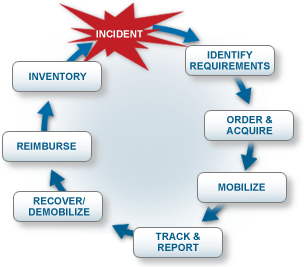
  2. The phrase of ‘resource management preparedness’ rubs me the wrong way. While I understand that there are resource management activities that take place within the preparedness phase of emergency management, we’re not preparing to manage resources. All the activities outlined in the document are actually part of resource management. If they want to put a time stamp on this set of activities, they can refer to them as ‘pre-incident’, but inventorying, typing, etc. are all actually part of the resource management cycle.
  3. I’d prefer to see a comprehensive NIMS Resource Management guide that addresses all aspects of resource management. Considering that resource management is a cycle, let’s actually cover the entire cycle. I think there will be far more value in that. Hopefully that’s eventually where this will go.
  4. The document is too stuck in NIMS. What do I mean by this? It seems that more and more people seem to forget that NIMS is a doctrinal component of incident management. While the document is focused on NIMS, it would have greater value if it addressed pre-incident resource management activities that might not found in the NIMS doctrine (though some are), but are none-the-less best practices in resource management. Many of these practices begin pre-incident.
  • One of the biggest things is resource tracking. Yes, resource tracking is a concept found in NIMS, but it’s not at all addressed here. How many jurisdictions struggle to figure out how to track resources in the middle of an incident (answer: most of them). The best time to figure out the means and methods of tracking resources is before an incident ever occurs. Resource tracking has a fair amount of complexity, involving the identification of what will be tracked, how, and by who; as well as how changes is resource status are communicated. Data visualization and dashboarding is also big. People want to see maps of where major resources are, charts that depict utilization, and summaries of resource status. All things best determined before an incident.
  • Resource inventories should identify operating requirements, such as maintenance and service. This is vaguely referenced in the guidance, but not well. Before any resource is deployed, you damn well better have the ability to operate and support that resource, otherwise it’s nothing more than a really large expensive paperweight. Do you only have one operator for that piece of equipment? That’s a severe limitation. All things to figure out before an incident.
  • How will resource utilization be tracked? This is important for cost controls and FEMA reimbursement. Figure that one out now.
  • What consumables are stockpiled or will be needed? What is the burn rate on those under various scenarios? (We’ve learned a lot about this in the pandemic)
  • What about resource security? When it’s not being used where and how will it be secured? What if the resource is left unattended? I have a great anecdote I often tell about a portable generator used in the aftermath of a devastating snow storm to power the traffic lights at a critical intersection. The maintenance crew doing their rounds found it to be missing, with the chain cut. Luckily the state’s stockpile manager had GPS trackers on all of them. It was located and re-acquired in little time, and the perpetrators charged. This success was due to pre-incident activity.
  • Resource ordering processes must also be established. What are the similarities and differences in the process between mutual aid, rental, leasing, or purchasing? What are your emergency procurement regulations and how are they implemented? How are the various steps in the ordering process assigned and tracked? This is highly complex and needs to be figured out before an incident.
  1. Resource typing. I honestly think this is the biggest push in emergency management that isn’t happening (maybe perhaps second to credentialing). Resource typing has been around for a long time, yet very very few jurisdictions I’ve worked with or otherwise interacted with have done it and done it well. I find that most have either not done it at all, started and gave up, or have done it rather poorly. I’ve been involved in resource typing efforts. It’s tough and tedious. I’ve done it for resources that we’re yet typed at the national level, leaving agencies and jurisdictions to define their own typing scheme. This literally can devolve into some heated discussions, particularly fueled by the volume of rather heavy customization we tend to do with resources as technology evolves, giving resources that may fundamentally appear to have similar capability to in reality be quite different. I’ve also done it for resources that have been typed at the national level. This certainly helps, as you aren’t first having to figure out your own thresholds, but it can still be challenging to pigeon hole resources that, again, may be heavily customized and don’t cleanly fit within a certain pre-defined category. It’s even more frustrating to have developed your own typing scheme in the absence of a national one, only to have national guidance issued a couple years later and needing to go back to those discussions.

I’m not saying resource typing is bad, in fact the benefits, both internally and externally, can be incredibly helpful. That said, it’s a time-consuming effort that, in the broader sense of limited time and other assets available to most emergency managers, is perceived to pay a lesser dividend than other activities such as developing and updating plans, training people on the implementation of those plans, and exercising those plans. It also can be difficult convincing agencies that it should be done. I can’t tell you how many times I get the response of ‘We know what we have’. I know that’s not the point, but that’s how the effort of typing resources is perceived. Even after some explanation of the benefits, most agencies (and I think rightfully so) would rather invest their time and effort into preparedness activities are that are seen as more beneficial. It leaves me wondering… is there a better way?

While it’s good to see information on the topic of early resource management steps being collated into one document, along with some resources and references that I’ve not seen before, this document is missing a lot. I just wrote last night about emergency managers being our own worst enemy. If we are just focused on implementing NIMS, we will absolutely fail. NIMS is not the end all/be all of incident management, but it is fundamentally promoted as such. Yes, the concepts of NIMS are all incredibly important, brought about from lessons learned and identified best practices of incident management through decades of experience. But the documents related to NIMS seem to pick and choose what they will focus on, while leaving out things that are highly critical. Perhaps some of these will be covered in future editions of resource management guidance, but they aren’t doing anyone any favors by omitting them from a document on pre-incident activity. We need to think broader and more comprehensive. We need to do better.

What are your observations on this document? What feedback do you have on my observations?

© 2020 Timothy Riecker, CEDP

Emergency Preparedness Solutions, LLC®

EOC Mission Planning

I’ve been wrong. I used to teach and otherwise espouse that emergency operations centers didn’t actually do operations. I was bought in to the traditional perspective that EOCs ONLY provided resource support and information coordination. I’m not sure how or why I bought into this when on incidents I was actually involved in planning and directing certain operations. This mentality goes back, for me, about 15 years. It’s important to break this myth and acknowledge the role that EOCs can and should play in incident management.  

EOCs being involved in directing field operations is certainly nothing new. If you don’t want to take my word for it, it’s also doctrinal. Check out the EOC section of the NIMS document. “EOC staff may share the load with on-scene incident personnel by managing certain operations, such as emergency shelters or points of distribution. When on-scene incident command is not established, such as in a snow emergency, staff in EOCs may direct tactical operations.”

This post has been in the works for a while. Several months ago, I was developing structured guidance on EOC mission planning for a client and realized it would be a good topic to write about. I recently made some social media posts on the topic, with responses encouraging me to write more. So, it was clearly time to do so.

As I had posted on social media, if you don’t think an EOC actually does operations, I’d suggest that the EOCs you are familiar with either haven’t had the opportunity to properly apply mission support or they are doing something wrong. Certainly not every incident will require an EOC to provide mission support, but EOCs should be ready to do so.

EOC missions are typically initiated one of three ways:

  1. A request by incident command to handle a matter which is outside their present area of responsibility or capability,
  2. EOC personnel recognize an operational need that isn’t being addressed, or
  3. The EOC is directed to take certain action from an executive level.

As the NIMS doctrine states, operations that are prime candidates for EOC-directed missions could be emergency shelters or points of distribution. Other operations, such as debris management, or (something recently experienced by many jurisdictions) isolation and quarantine operations are also often EOC-directed.

What makes these EOC-directed missions? Typically, they are planned, executed, and managed by an EOC. This could be a multi-agency EOC or a departmental operations center. Of course, there are ‘field’ personnel involved to execute the missions, but unlike tactical activity under the command of an Incident Commander, the chain of command for EOC-directed missions goes to the EOC (typically the EOC’s Operations Section or equivalent).

Ideally, jurisdictions or agencies should be developing deliberate plans for EOC-directed missions. Many do, yet still don’t realize that execution of the plans is managed from the EOC. These are often functional or specifically emergency support function (ESF) plans or components of those plans. For context, consider a debris management plan. As with many deliberate plans, those plans typically need to be operationalized, meaning that the specific circumstances of the incident they are being applied to must be accounted for, typically through what I refer to as a mission plan. In developing a mission plan, with or without the existence of a deliberate plan, I encourage EOCs to use the 6-step planning process outlined in CPG-101. As a refresher:

  1. Form a planning team
  2. Understand the situation and intent of the plan
  3. Determine goals and objectives of the plan
  4. Develop the plan
  5. Plan review and approval
  6. Plan implementation

The planning team for an EOC-driven mission should consist, at the very least, of personnel in the EOC with responsibility for planning and operations. If several mission plans are expected to be developed, the EOC’s Planning Section may consider developing a ‘Mission Planning Unit’ or something similar. Depending on the technical aspects of the mission, technical specialists may be brought into the planning team, and it’s likely that personnel with responsibility for logistics, finance, and safety, may need to be consulted as well.

If a deliberate plan is already in place, that plan should help support the intent, goals, and objectives of the mission plan, with a need to apply specific situational information and context to develop the mission plan.

Developing the plan must be comprehensive to account for all personnel, facilities, resources, operational parameters, safety, support, reporting, documentation, and chain of command. These may need to be highly detailed to support implementation. The mission may be organized at whatever organizational level is appropriate to the incident. This is likely to be a group within EOC Operations (or equivalent). Obviously having a deliberate plan in place can help address a fair amount of this proactively. Outlining processes and position descriptions, and providing job aids will support implementation considerably.

Plan review often seems an easy thing to do, but this needs to be more than an editorial review. The review should be comprehensive, considering the operations from every possible perspective. Consider various scenarios, notionally walking through processes, and even using a red team concept to validate the plan. While this is likely going into immediate implementation, it’s best to spend some time validating it in the review stages instead of having it fail in implementation. Approval will come at whatever level is appropriate within your organization.

Plan implementation should certainly include an operational briefing for the staff executing the plan, and it should ideally be supported through an incident action plan (IAP) or EOC action plan, or a part thereof. As with any implementation, it needs to be properly managed, meaning that progress must be monitored and feedback provided to ensure that the mission is being executed according to plan and that the plan itself is effective. Understand that complex missions, especially those of longer duration, may need to be adjusted as lessons are learned during implementation.

As is typically said in ICS courses, we should begin demobilization planning as early as possible. Missions may have a completion in whole, where the entire mission is demobilized at once, or there may be a phased demobilization. Many EOCs aren’t used to developing tactical-level demobilization plans, so they need to be prepared for this.

As with any operation, identifying and documenting lessons learned is important. Deliberate plans should be updated to reflect lessons learned (and even a copy of the mission plan as a template or sample), or if a deliberate plan didn’t exist prior to the mission, one should be developed based upon the implementation.

EOCs can, in fact, run operations. I’m sure a lot of you have seen this if you have been involved in responses such as the current Coronavirus pandemic, a hurricane response, and more. Sometimes in emergency management we aren’t good at actually acknowledging what’s going on, for better or for worse. We get stuck with old definitions and don’t realize that we need to evolve, or even already have evolved; or we don’t recognize that current ways of doing things simply don’t work as intended. We seem, sometimes, to be our own worst enemy.

How does your EOC execute mission planning?

© 2020 Timothy Riecker, CEDP

Emergency Preparedness Solutions, LLC®