Private Sector Logistics Support for Disasters, aka. To Stockpile or Not to Stockpile

I recently had an article brought to my attention by my friend Keri.  The article is titled Home Depot or Homeland Security and is written by Max Brooks. Before I dive into some commentary on the article and related matters, I want to give a bit of an introduction of Max Brooks.  While many of you may not know of him, you might know of his work; and I’m quite sure you know of his father and his father’s work.  What seems so unlikely is that this article, and others, have been written by Max for West Point’s Modern War Institute.

Max Brooks is the author of, among other books, the New York Times best seller World War Z.  His father is Mel Brooks, who, in my opinion, is the greatest comedic writer and director of all cinema.  Max is a non-resident fellow at the Modern War Institute (MWI).  He has published three zombie-themed books: World War Z, the Zombie Survival Guide, and The Zombie Survival Guide: Recorded Attacks.  I’ve written in the past about the perspective that unorthodox scenarios can bring to homeland security and emergency management.  Max’s writings inspire just that, bringing him to be recognized by the MWI and Naval War College.  You can check out his biography and other information about him here.

As a fellow of the MWI, Max Brooks has been working on a series of lectures and papers.  The one I’m discussing here was posted about a year ago by the MWI.  In his paper, he briefly outlines the role of the Defense Logistics Agency and the importance of the private sector in supporting disaster response and recovery as well as the military.  He smartly identifies this as a potential vulnerability, but I’ve also seen first-hand the reality behind it.

During the 9/11 response, a representative from Grainger sat in the Logistics Section of the NYS Emergency Operations Center.  While the State of New York owns a lot of resources, the availability of those resources, the practicality of moving those resources, and the timeliness of getting those resources to where they were needed (generally the metro-NYC area) sometimes wasn’t workable, despite the nature of the emergency – especially when those resources are more in the nature of supplies and small equipment, and needed in mass quantity.  With several warehouses in and around the metro-NYC area, Grainger could have orders processed and delivered quickly and efficiently.  The same holds true for other companies, which were also leveraged during this response.

Stockpiling is a smart practice, but it needs to be looked at from a practical and fiscal perspective.  The Civil Defense era saw a lot of stockpiling.  Food, water, cots, blankets, radiological detection equipment, fuel, and other supplies.  Most of this went unused for years until officials saw the utility of drawing on these stockpiles in times of natural disaster.  Still, food and water have a shelf life, as does fuel.  Stocks had to be rotated to ensure viability.  Rodents, insects, and water damage goods like cots and blankets.  Mechanical equipment needs to be maintained, even in dis-use.  The physical space, money, and people needed to manage these rarely used stockpiles have a limited return.

Still, stockpiling is a good thing.  You just have to be smart about what you stockpile and where you position it.  Many states maintain several emergency equipment stockpiles.  The purpose of the stockpiles is to support local governments in extended life-safety activities.  Generators, chain saws, and potable water distribution are among the equipment available.  These do, indeed take up space and require regular maintenance.  The prevalence of floods and storms in the northeast, however, make these high demand items by local governments.  The positioning of the stockpiles helps ensure a timely delivery, often with the support of other state agencies.

There are limits, though, to the ability of a government agency to store, maintain, and distribute supplies and equipment.  Some aren’t often requested, so don’t make sense to stockpile.  Others have such a short shelf life or require expensive maintenance that don’t make financial sense.  Still others may very often be available locally, albeit by the private sector.

Emergency management agencies in recent years have not only looked to private vendors to support supply needs, they have also looked to the private sector to model the management of logistics and resource tracking.  Companies like FedEx or UPS, despite leaving my packages at the wrong door, do an unparalleled job of moving and tracking goods.  Companies like WalMart and Target, who are often victims of local disaster impacts themselves, have a presence in disaster areas to not only restore their own operations, but to also provide as much as they can to communities in need.  Lowes and Home Depot have been better able to meet demands prior to and following disasters with tarps, building materials, generators, and sump pumps.  Despite improvements, the bureaucracy of government simply doesn’t have the capability or capacity to move the quantity of goods needed.

While I acknowledge that there is some vulnerability, as Max Brooks points out, in having a third party as a critical component of your supply chain, we also have strength and efficiency through these partnerships.  Emergency management must continue working with private sector partners, locally, nationally, and internationally to strengthen these partnerships and support the private sector in supporting response and recovery endeavors.

What are your thoughts on the depth of involvement of the private sector in supporting response and recovery?  Do we rely on them too much?  If so, what’s our alternative?

© 2017 – Timothy Riecker, CEDP

Emergency Preparedness Solutions, LLC


Taking Care of Your Staff After a Disaster

We are slowly seeing Continuity of Operations (COOP) Plans becoming more popular for organizations ranging from government, private sector, and not for profit.  There are numerous lessons learned that promote the benefits of these efforts to reduce the impacts from an incident on your organization, decrease down time, and increase the overall chances of your organization surviving a disaster.  Most COOP plans, however, are focused on organizational operations and mission essential functions, which is great, but organizations must remember that none of these can be performed without staff.

The ability of an organization to care for its staff, to the greatest extent possible, will not only support the organization’s recovery, it’s also the right thing to do.  Consider that taking care of staff also includes taking care of their families.  It’s difficult for a staff member to come to work focused on your mission when they have family members endangered by a disaster.

What can you do?  I don’t think anyone expects their employer to take care of all needs, but a bit of support and understanding go a long way.  If your organization has a direct role in emergency or disaster response or recovery, the support you provide your staff is even more critical.  While I have a number of tips and lessons learned from my own experiences on this, I came across a paper recently published by the US Department of Health and Human Services (HHS) Office of the Assistant Secretary for Preparedness and Response (ASPR).  While ASPR’s mission is to support hospitals and other healthcare facilities, this four-page document provides great information for all organizations.

Remember – the time to prepare is now!

© 2017 – Timothy Riecker, CEDP

Emergency Preparedness Solutions, LLC

Congressional Primer on Responding to Major Disasters and Emergencies

I believe the Congressional Research Service (CRS), which is a research arm of the Library of Congress, publishes an updated version of this document for each Congress.  While the primary audience is Congressional representatives, it provides a good overview of disaster response fundamentals and the relationship between the federal and state/territorial/tribal governments which can be a good reference for many, including practitioners, students, state and local officials, and members of the media.

Give it a look and pass it on to others.

https://www.hsdl.org/?abstract&did=804217

– TR

Nationwide EAS Test Scheduled

From FEMA~

Mandatory Nationwide Test of the Emergency Alert System to be Conducted September 27

The Federal Emergency Management Agency (FEMA), in coordination with the Federal Communications Commission (FCC), will conduct a mandatory nationwide test of the Emergency Alert System (EAS) on September 27, 2017 at 2:20 pm EDT. The test will assess the readiness for distribution of the national level test message, as well as verify its delivery.

The EAS test is made available to radio, television, cable, and direct broadcast satellite systems, and is scheduled to last approximately one minute. The test’s message will be similar to the regular monthly test message of the EAS with which the public is familiar, only inserting the word “national.” “This is a national test of the Emergency Alert System. This is only a test.”

Significant coordination and regional testing has been conducted with the broadcast community and emergency managers in preparation for this EAS national test. The test is intended to ensure public safety officials have the methods and systems that will deliver urgent alerts and warnings to the public in times of an emergency or disaster. Periodic testing of public alert and warning systems is also a way to assess the operational readiness of the infrastructure required for the distribution of a national message and determine whether technological improvements are needed.

Conducting the test following Hurricanes Harvey, Irma, Jose, and Maria will provide insight into the resiliency of our national-level alerting capabilities in impacted areas. The test will also provide valuable data into how the Integrated Public Alerts and Warning System performs during and following a variety of conditions. With two major hurricanes already making landfall, and a potential for two more impacting our nation, we need to have the ability to maintain the continuity of critical infrastructure under various conditions.

Receiving preparedness tips and timely information about weather conditions or other emergency events can make all the difference in knowing when to take action to be safe. FEMA and our partners are working to ensure alerts and warnings are received quickly through several different technologies, no matter whether an individual is at home, at school, at work, or out in the community. The FEMA App, which can be downloaded on both Android and Apple devices, is one way to ensure receipt of both preparedness tips and weather alerts. The FEMA App can be downloaded at https://www.fema.gov/mobile-app.

The back-up date for the test is October 4, 2017, at 2:20 pm EDT, in case the September 27 test is cancelled. More information on the IPAWS and Wireless Emergency Alerts is available at https://www.ready.gov/alerts.

This is the third mandatory nationwide test of the EAS. The first test was conducted in November 2011, in collaboration with the FCC, broadcasters, and emergency management officials. The second mandatory test was conducted in September 2016. You can also access a video, FEMA Accessible Emergency Alert System IPAWS Test Message, in American Sign Language.

In 2007, FEMA began modernizing the nation’s public alert and warning system by integrating new technologies into the existing alert systems. The new system, known as IPAWS became operational in 2011. Today, IPAWS supports more than 900 local, state, tribal, and federal users through a standardized message format. IPAWS enables public safety alerting authorities such as emergency managers, police, and fire departments to send the same alert and warning message over multiple communication pathways at the same time to citizens in harm’s way, helping to save lives. For more information on FEMA’s IPAWS, go to: www.fema.gov/ipaws. For more preparedness information, go to www.ready.gov.

Is New Media Really Journalism?

This is a concept I’ve been struggling with for a while.  I see bloggers, podcasters, and YouTubers portray themselves as journalists quite often.  But are they?

The more traditional part of me wants to laugh at their pipe dream, considering that newspapers, TV and radio, and magazines fit into the definition of media and journalism that I’ve had most of my life.  But times, they are a changin’.  The term ‘new media’ isn’t new anymore.  Bloggers, podcasters, and YouTubers, as a whole, are mainstream and it appears they are here to stay.

While I’ve seen this on occasion in governmental and emergency management media relations, I see this most often in another facet of my life – pop culture.  Along with being a blogger on emergency management and homeland security matters, I’m also a co-host on several pop-culture and entertainment related podcasts.  Looking at things like fan conventions (think ComicCon and similar events), dozens and even hundreds of media badges are given to bloggers, podcasters, and YouTubers.  While some media credentials go to more traditional media outlets, the proportion is rather staggering.  In entertainment and pop culture this makes sense to a great extent.  Many who pay heed to pop culture also seem likely to consume blogs, podcasts, and YouTube content.  It’s also not necessarily location-bound (i.e. following a new media provider because they are local to you and report on local things – although some do).  The free media badges given out by convention organizers turns into free promotion of the goings-on of their events – so it makes sense, but what are the limits?  The sheer number of people applying for media badges for these events is staggering, and many are denied.

Why is new media so popular?  On the provider end, the barriers to entry are insanely low.  Generally, you need a computer, an internet connection, and an account to whatever portal you want to push your content through.  There are a few other resources needed depending on the actual medium, such as cameras and microphones, editing software, etc., but good quality in all of these can be found at very reasonable prices.  You can also go really lean and do it all from your smart phone.  Certainly there are the intangibles such as talent, good ideas, and persistence, which all tends to cull the herd.

On the consumer end, people crave new media content to read, hear, or see more about the things that entertain and interest them.  Despite things said about people’s attention spans, most blogs I read (as well as my own) have a reasonable length to them.  Most podcasts run 30-90 minutes.  YouTube videos tend to be shorter, but obviously tend to have a higher production value.  There is also a huge variety of new media available, with differing opinions and formats, and generally something for everyone.

But the question still remains, is new media actually journalism?  Obviously, I haven’t missed the irony in this.  Despite having and maintaining a blog for several years as well as my involvement in podcasts, I don’t consider myself a journalist.  At best, I’m an op-ed writer on the blogging side; and whatever the equivalent is on the podcasting side.  I appreciate that people value the content and opinions I put out there, but I’m no Walter Cronkite (really who is, but Walter himself?).

At the risk of taking heavy fire from my fellow bloggers and podcasters, I’m reluctant to broadly categorize much of new media as journalism.  It just seems there needs to be something that qualifies you to use the title.  I’m not saying a certification or anything bureaucratic like that, but honestly I don’t know what it should be.  When any person on any given day with little investment can suddenly announce that they are a journalist (or honestly anything), that tends to not sit well with me.  There needs to be a demonstration of commitment and professionalism.

There are some bloggers, podcasters, and YouTubers that I would consider journalists because of their longevity, their professionalism, and their following, but these are few.  I think most new media folks are entertainers.  Some are informers, yet still not journalists.  But there are some that are journalists, and they should be respected as such.

On the event management side of this (both in regard to pop culture as well as emergency management), where does the paradigm sit and does it need to change? How do you determine who you will give a media badge to?  In emergency management and government as a whole, it’s long been a best practice to maintain positive relationships with media outlets.  What kind of relationships, if any, are you maintaining with bloggers, podcasters, and YouTubers?  Do you need to?

I’m interested in thoughts and opinions on this – from everyone.  Are you a producer of new media – Do you consider yourself a journalist?  Are you a traditional journalist – what’s your take on this?  On the government and emergency management side – are you involved in media relations, and if so, what are your ideas?  Are you not involved in either, but have an opinion?  Please share it!

© 2017 – Timothy Riecker, CEDP

Emergency Preparedness Solutions, LLC


Exercises: Simple is Usually Better

I find often that people want to run exercises they aren’t quite ready for.  Sometimes those exercises are too complex, or they simply aren’t the appropriate type.  Most often, we run exercises to test plans, policy, and procedures; but sometimes those plans, policies, and procedures aren’t quite ready to be tested.  Last year I advised a client to run a workshop instead of a tabletop exercise.  The initial goal of the tabletop was to validate a new plan, but this plan wasn’t ready to be validated.  The problem was that many stakeholders hadn’t yet seen the plan, and the review of that plan by our team in preparedness for the exercise wasn’t favorable.  The plan had much of the needed content, but it was disjointed and didn’t have any logical flow.  By conducting a scenario-based workshop, we were able to identify not only the ideal flow of the plan by flagging benchmark activities, but we were also able to discuss expectations of and for each stakeholder agency in the plan.  The client was then able to apply the results of the workshop to restructure their plan and make some needed substantive changes.

Similarly, I’ve encouraged a current client to conduct a workshop instead of a tabletop.  The initial goal of this tabletop was to identify how a new group of stakeholders could integrate into an existing plan.  In this situation, the tabletop would have been less than effective as the new stakeholder group isn’t yet identified in the plan.  The outcome of the workshop will be to identify how this integration can occur.

I think that sometimes people gravitate to certain exercises simply because they are more popular in a certain application.  That preconceived notion might be too complex or simply a poor choice for what you really need to accomplish.  When it comes to discussion-based exercises, most people default to a tabletop.  With operations-based exercises, it can vary.  Drills are often used for tactical applications, but we don’t see them as much in EOCs.  Drills certainly have a place in an EOC if you are looking to test a very specific function or activity.  While full-scale exercises are fun and sexy, I’ve been to the site of plenty that are total chaos because the fundamental premise of certain plans hasn’t been worked out (or some stakeholders aren’t familiar with them), which perhaps should have been done through a discussion-based exercise or a drill or functional exercise first.  Running a drill to test and familiarize the process of setting up key equipment prior to doing it for the first time in a full scale will pay a lot of benefits, and certainly prevent dozens or hundreds of other people being held up in a full scale.

Another issue I often see with exercises is very long and complex Master Scenario Events Lists (MSELs).  The MSEL is essentially the timeline or script of the exercise.  Along with listing all injects, it also identifies all benchmarks in the management of the exercise, such as StartEx and EndEx, and the introduction of new elements or transition to a different segment.  While there is no particular rule of thumb for how many injects are needed for different exercise types, everything needs to associate back to the objectives of the exercise.  I hate injects that are crafted simply for ‘noise’ (unless it’s an intel exercise), or injects intended to just give someone something to do.  Arguably, if the participants take an exercise seriously, such as a functional exercise, and play out the situation as they would in real life, you can engage an entire EOC for a few hours with even ten well-crafted injects.  While some functions are very focused, consider that the vast majority of what we do in emergency management requires coordination among a variety of elements and functions.  Capitalize on that.  One inject may engage multiple agencies or functions because of the need to coordinate and problem solve.  It’s not enough to identify a solution to the problem, but work through where the resources will come from, how they will get to where they need to go, and what support is needed for them and how long.  That’s a lot of problems to solve and will often transcend every function within the incident command system.  Exercises don’t need to be complex to be effective.  Create a handful of objectives and make sure everything relates back to them.  Simplicity can work.

My last recommendation is to keep your exercise planning team a manageable size.  I’ve been the lead planner for some very large exercises.  These exercises, largely due to their sponsors, ended up involving massive exercise planning teams – and by massive I mean over five or six dozen people – or more.  These are just sheer insanity.  Not every agency or organization involved in the exercise needs to be directly represented, nor does each organization need to send a small army of people.  What you do need is consensus from those organizations on the objectives and their scope of play.  That doesn’t mean they have to be involved in every aspect of planning the exercise.  Just like any other meeting or group project, a large exercise planning team can be cumbersome and management by committee is never efficient.  If need be, stakeholder groups can be developed based upon function.  For example, a fire service exercise planning team would develop their contributions to the exercise.  Just make sure that these groups are well coordinated and the overall exercise planning effort is unified, otherwise you’ll end with a disjointed exercise effort.

In the end, simplicity rules.  As you begin planning your exercise, consider, in every step if it can or should be simplified.  Always refer back to your intent and your objectives.  Chances are you can create a simpler exercise that is just as impactful, or perhaps more impactful.  When our inclination is to make things overly complicated, we often miss the point entirely.

© 2017 – Timothy Riecker, CEDP

Emergency Preparedness Solutions, LLC


Awareness of Public Health Preparedness Requirements – CMS

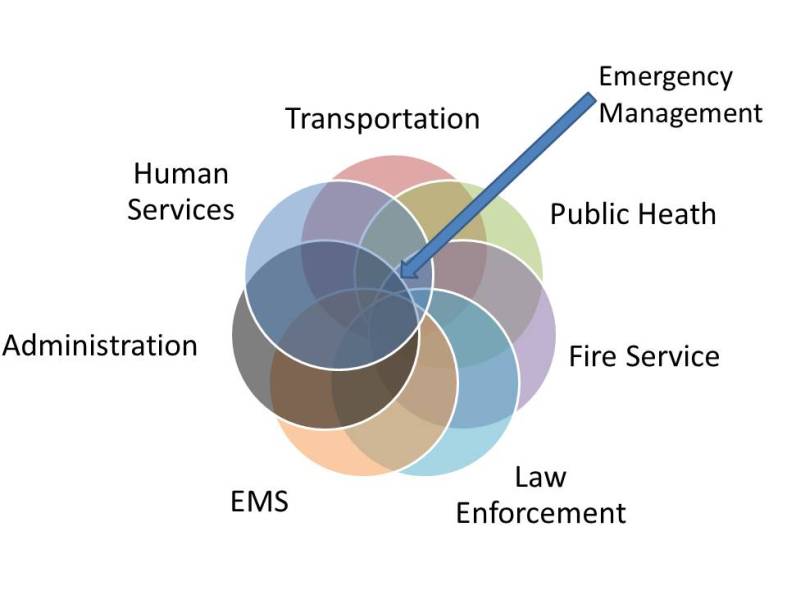
Emergency management and homeland security are collaborative spaces.  Think of these areas a Venn diagram, with overlapping rings.  Some of the related professions overlap with each other separately, but all of them overlap in the center.  This overlap represents the emergency management and homeland security space.  What’s important in this representation is the recognition that emergency managers and homeland security professionals, regardless of what specific agency they may work for, need to have awareness of that shared space and the areas of responsibility of each contributing profession.  One of the biggest players in this shared space is public health.Presentation1

For nearly a year, public health professionals have been talking about new requirements from CMS, which stands for The Centers for Medicare and Medicaid Services.  How does Medicare and Medicaid impact emergency management?  CMS, part of the Department of Health and Human Services (HHS) covers over 100 million people across the US – far more than any private insurer.  As an arm of HHS and a significant funding stream within public health, they set standards.

The most relevant standard to us is the Final Rule on Emergency Preparedness Requirements for Medicare and Medicaid Participating Providers and Suppliers.  The rule establishes consistent emergency preparedness requirements across healthcare providers participating in Medicare and Medicaid with the goal of increasing patient safety during emergencies and establishing a more coordinated response to disasters.

The CMS rule incorporates a number of requirements, which include:

  • Emergency planning
  • Policies and procedures
  • Communications planning with external partners
  • Training and exercises

These are all things we would expect from any emergency management standard.  Given the different types of facilities and providers, however, the implementation of the CMS rule can be complex.  A new publication released by the HHS ASPR (Office of the Assistant Secretary for Preparedness and Response) through their TRACIE program (Technical Resources, Assistance Center, and Information Exchange), provides some streamlined references to the CMS rule.  It’s a good document to study up on and keep on hand to help keep you aware of the requirements of one of our biggest partners.

© 2017 – Timothy Riecker, CEDP

Emergency Preparedness Solutions, LLC

Public Area Security National Framework

The Transportation Security Administration (TSA) recently released this report in cooperation with a variety of stakeholders which provides information and guidance on preparedness, prevention, and response activities to strengthen the public spaces of transportation venues.  While the focus of the document is on airports, the information in the document is great not only across all transportation venues, but other public spaces as well.  I think there are great takeaways for other areas of vulnerability, such as malls, convention centers, event spaces, and others.

To be honest, there is nothing particularly earthshattering in this document.  The document is brief and identifies a number of best practices across emergency management and homeland security which will help agencies and organizations prevent, protect, prepare, and respond to threats, particularly attacks.  That said, the document does accomplish providing concise information in one document on key activities that absolutely should be considered by entities which control public-access spaces.  I would also suggest that this document is still 100% relevant to those which have some access controls or entry screenings.

Information in the document is segmented into three key tenets: Information Sharing, Attack Prevention, and Infrastructure and Public Protection.  Within these tenets are found recommendations such as relationship building, communication strategies, vulnerability assessments, operations centers, planning, training, and exercises.  Most of the recommendations provide examples or leading best practices (although no links or sources of additional information, which is a bit disappointing).

The framework is worth a look and can probably serve as an early foundation of activity for those who haven’t yet done much to prepare their spaces for an attack.

© 2017 – Timothy Riecker, CEDP

Emergency Preparedness Solutions, LLC

Can we Require Preparedness?

The City of Pittsburgh recently lost an effort to require emergency preparedness training for security officers and building service employees.  The Commonwealth Court ruled that the City did not have the authority to require such an ordinance.  This is just another example we’ve seen with difficulties across the US with requirements for preparedness measures.  Why is it so challenging?  It often comes down to the legality of the requirement.

When it comes to the interface of local jurisdictions with states, we often see the concept of home rule providing one of the greatest challenges.  Some interpretations of home rule laws identify that states can’t require local (often to include county) jurisdictions to conduct certain activities, such as have certain plans, attend training, or conduct exercises.  In some states, we see law or regulation that states that if a jurisdiction is to have an emergency plan, then there is a required format of said plan.  But if there is no stick, there is often a carrot.

If requirements can’t be established, then incentives are often the best alternative.  Again, in the local/state relationship, states have grant allocations which can be provided to local governments.  Grant rules can be established that identify certain requirements as conditions of funding.  This tends to be highly effective, especially when funding is expected to continue year after year, and the grants continue to reinforce sustained maintenance on these requirements, such as periodic updates to emergency plans.  Generally, I see no down side to this alternative, so long as the required initiatives are well thought out and realistic given the amount of funds the jurisdiction is receiving.  To ensure effectiveness, however, there must be accountability and quality control measures in place to monitor execution of these requirements; such as reviewing plans, After Action Reports, and auditing training programs. This same methodology is typically how DHS/FEMA is able to get states and funded urban areas (UASIs) to comply with their wishes for various initiatives.

Outside of government, requirements can still be difficult.  While regulations may be put into place for certain industries and under certain conditions, we often have to rely on other, more practical, means of getting businesses, industry, and even not for profits on board.  This often comes with certifications.  An example would be ISO certifications, which some businesses and industry need to compete in certain markets.  Yes, there is even an ISO standard for emergency management.

Unfortunately, many entities, be they public, private, or even individuals, don’t want to be bothered with preparedness.  Most will agree that it’s a good idea, but it takes time, money, and effort.  It’s long been said that you can’t legislate preparedness, and that is often true.  Even if a requirement is able to be established, the extent of implementation can range widely, depending on the internal motivations and resources available to the entity.  Establish whatever requirements you want, but I guarantee there are some that will barely meet those requirements, and in doing so likely not meet the actual intent of the requirement; while others who are believe in the requirement and have available resources, will exceed the requirement.  Largely, organizations are motivated by funding and certification standards.

I’m interested in the perspectives you have on requiring preparedness, both in the US as well as other nations.

© 2017 – Timothy Riecker, CEDP

Emergency Preparedness Solutions, LLC