Supporting a Public Safety Training Program

Today happens to be National Teacher’s Day.  Be sure to show some appreciation for the teachers and professors who have influenced you and provide quality experiences for your kids.  Also consider expanding the definition of ‘teacher’.  In the public safety professions, we do a lot of training.  Some of us have structured academies, and while others may not, there are a lot of training opportunities provided locally, state-wide, and nationally.  Depending on the size and scope of your agency, you may run your own training program for internal, and potentially external stakeholders.

For a few years, I ran the training and exercise program of a state emergency management agency.  We delivered training programs state-wide to a variety of stakeholders.  We also developed some training programs to address needs which curricula from FEMA or other national providers could not meet.  Fundamentally, delivering training is easy, but properly managing a training program can have challenges.  Some thoughts…

  • Find the right people for the job. While we hired some personnel full time to be trainers, we also used people from elsewhere in the agency, as well as personnel from partner agencies, and hired some as 1099 employees.  There are a lot of highly qualified individuals in public safety – if you don’t know any, just ask, and they will be sure to tell you!  Assuming their qualifications are valid, are the most experienced and knowledgeable people always the best instructors?  Absolutely not.  While they may be subject matter experts, it doesn’t mean they have good presentation skills, much less comfort in doing so.  On the flip side, you might also have someone with little experience who has great delivery skills.  That might be a person to develop.
  • Quality control. When people are delivering training, peek in once in a while.  I traveled around the state regularly, and once in a while would see if one of our courses was being held somewhere along my route.  If I had the time, I would stop in and see how things were going.  While the visit was a surprise, our instructors knew this is something that might happen.  There are a few things this accomplishes.  First of all, it gives you an opportunity to observe and provide feedback.  Everyone can improve, and hopefully they can handle some constructive feedback.  Evaluation, formal or informal, is positive for the instructor and the program.  Look for consistency of practice (see the next bullet point) and professionalism.  On one of my surprise visits, I found an instructor wearing jeans and a sweatshirt.  When I discussed it with him, his response was that he was ‘retired’ (teaching for the agency was a retirement job for him) and that he could do whatever he wanted to.  After that discussion was happy to retire him further. Stopping in also shows support for your instructors and for the program as a whole.  Weather traveling across the state or down the hall, instructors want to know they are being supported.  A big part of support is simply being present.
  • Consistency counts. Training programs should be consistent.  While we might change around some examples or in-class scenarios, training delivered in one location by instructor a should largely match the training delivered another day, in a different location by instructor b.  Coming up through the ranks as a field trainer, I was part of a group that wanted to heavily modify the courses we delivered.  As I rose to management, I realized how detrimental this was.  If improvements are warranted, work with your instructors to integrate those improvements into the course.  Make sure that improvements are in line with best practices, not only in instructional design (remember: content must match objectives), but also with the subject matter.  Consistency not only ensures that all your learners are provided the same information, but also makes your curriculum and instructors more legally sound.  Too often we see instructors ‘going rogue’, thinking that they know a better way.
  • Programs need systems. A big part of building and maintaining a program is having adequate systems in place.  Systems require policies, procedures, and tools.  This is largely the behind the scenes stuff of a training program.  This includes annual curriculum reviews, performance reviews of instructors, selection/hiring and firing of instructors, maintaining instructors (see the next bullet), ordering course materials, maintaining training records, posting a course, course registrations, course cancellations, and so much more.  While it sounds bureaucratic, there should be a piece of paper that covers every major activity, identifying how it’s done, by who, with what approvals, and at what time.  Systems make sure that things aren’t missed, give you a basis of performance to evaluate the system and to train new staff, and help ensure consistency.  Systems contribute to your professionalism and are also good practices for business continuity.  Lots of credit to Cindy who was highly dedicated to establishing systems!
  • Keep instructors engaged. With either a large or small training shop, it’s important to maintain contact with your instructors.  Not just in handing them assignments and shuffling paperwork, but to really engage them.  We established twice a year ‘instructor workshops’, bringing our instructors together for two days.  From a management and administrative perspective, we used some of this time to express appreciation for their work, and provide information on curriculum updates and other information.  We encouraged much of the workshop agenda to be developed by the instructors themselves, with professional development provided by their peers.  This could include instructor development, after action reviews of incidents, case studies, and a variety of other activities and information.

Those are just a few tips and lessons learned.  I’m sure you may also have some to add to the list – and please do!

© 2017 – Timothy Riecker, CEDP

Emergency Preparedness Solutions, LLC

Emergency Alerting – A Case Study

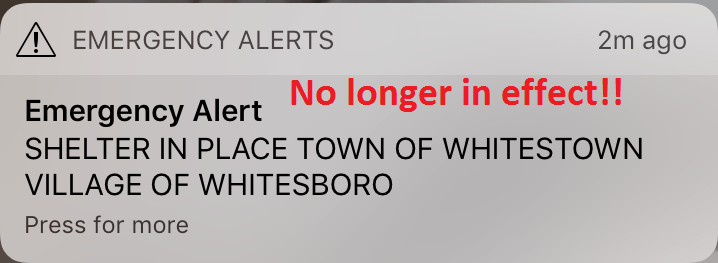
Two days ago, much of the northeast was subject to a powerful storm front, which brought high winds, torrential rains, lightning, and several yet to be confirmed tornadoes.  Corresponding with these threats, areas saw a variety of National Weather Service warnings and watches.  Needless to say, when this emergency alert came up on my phone in the midst of these storms, I assumed the shelter in place order was weather related.  Well, you know what they say about assuming things… and of course I should have known better.

While the area of the alert didn’t impact me, Whitestown is just a couple of towns over, so after a few minutes I figured I should do a bit of research to see if whatever prompted the alert might eventually impact my area.  Unfortunately, ‘pressing for more’, as the alert message indicates, gave no further information.  News media in my area is notoriously slow and uninformative for a period of time, something that held true with this event as well.  Approximately 20 minutes later, a local news outlet Tweeted a message about law enforcement activity in that area related to an armed suspect.

Public information and warning is a big deal.  When we don’t communicate clearly and concisely with the public, we can suffer unintended consequences. While I’m not aware of any severe unintended consequences from the lack of any additional information from this emergency alert, officials must understand that the public (and other public safety professionals) want additional information.  They may also need it so they can make better decisions.

This particular example certainly should have included some brief context as to why the alert was issued.  Given the standing tornado watch which was in place at the time, I’m sure there were plenty of others who assumed this was for a tornado or other storm activity.  Such an occurrence would give me cause to gather my family in the basement for safety, rather than locking my doors, closing my blinds, and ensure that no family members left the house.  Shelter in place can mean a lot of things to different people and adding context could have assisted with ensuring better public safety.  There was also no follow up to this alert lifting the shelter in place message.  (Note: the ‘No longer in effect’ tag is my own, as an effort to be responsible with the image)

While I applaud the use of public alerting tools, issues such as this are seen far too often.  Jurisdictions should have public information and warning components to their emergency operations plans, with specific procedures outlined for not only how to activate an alert, but the proper messaging which should be included to maximize message effectiveness.  Sure, you do it, but do you do it well?

What do you do to ensure effectiveness of your messaging?

© 2017 – Timothy Riecker, CEDP

Emergency Preparedness Solutions, LLC

A New Standard for Emergency Management Programs

Over two years ago I wrote on the two primary standards for emergency management programs in the United States – the Emergency Management Accreditation Program (EMAP) and the National Fire Protection Association (NFPA) 1600: Standard on Disaster/Emergency Management and Business Continuity Programs.  These two standards are voluntary in their adoption and provide common sense guidelines on proven effectiveness and best practices for emergency management programs.  EMAP goes the additional step in offering accreditation for jurisdictions and/or programs based upon compliance with their standards.

Recently, New York’s Governor Cuomo announced what is apparently the nation’s first state-coordinated local emergency management accreditation program.  New York’s program is based upon 21 standards, created and maintained by a committee co-chaired by the NYS Emergency Management Association and the NYS Office of Emergency Management.  The accreditation process identified by NYS’ program guidance is fairly similar to EMAP’s, with application, preparation, a site visit, and committee review.

On the plus side, New York’s system is a further encouragement of the use and application of standards and has enough similarity to EMAP which puts the two accreditations on a close enough path that a jurisdiction can pursue both with little deviation.  The processes of preparation, an on-site review, and final accreditation council review are very similar. Further, agencies accredited through the New York State program are granted the ability to display the accreditation program logo, similar to EMAP, as a matter of pride and recognition.  New York’s system also requires a periodic reaccreditation, which encourages jurisdictions to maintain their accreditation standards.

Where New York’s program differs from EMAP…

  • EMAP accreditation is available to any entity, whereas New York’s appears to be specifically designed for local/county emergency management offices, although it does acknowledge the need for a whole community approach to emergency management
  • EMAP standards identify what components must be in place, not the means and methods used to accomplish those components. This is a significant difference from New York State’s program, which rather heavy handedly dictates means and methods, including mandatory completion of New York State’s emergency management and certification training by key staff, completion of the State’s County Emergency Preparedness Assessment (CEPA) program, and active use of the NY Responds system.  While fundamentally, I agree with promoting these as standards across the state, requiring them for accreditation can lead to a stagnated or stalled program if better training or systems are made available and the standard is not able to be kept current.  Required means and methods also stall innovation, which is another reason by NFPA 1600 and EMAP shy away from this practice.  That said, the aforementioned means and methods are the standard of practice in New York State, so this is a good opportunity to reinforce use of those standards.

New York’s new standard provides a solid exploration into the new territory of state-coordinated accreditation.  I’m a big proponent of states’ rights, and firmly believe this to be a good practice, especially when such accreditations reflect the principles of nationally recognized standards such as EMAP and NFPA 1600.  I don’t view New York’s system as being competitive with EMAP, rather it is quite complimentary.  With additional interests in standards, I’m hopeful that all standards will remain contemporary and cutting edge, constantly encouraging excellence and striving for improvements.

As always, I’m interested in your thoughts on state-coordinated accreditation and emergency management standards in general.

© 2017 – Timothy Riecker, CEDP

Emergency Preparedness Solutions, LLC

Thinking Beyond the Active Shooter

While there is obviously a great deal of attention placed on preparing for, preventing, and responding to active shooter events, is that where the focus really needs to be?  Yes, active shooter incidents are devastating, but they aren’t taking into consideration the full potential of we might be facing.  The DHS definition of ‘active shooter’ actually allows room for additional potential, but the term is still misleading and indicates the presence of only one perpetrator.  (DHS definition: “Active shooter is an individual actively engaging in killing or attempting to kill people in a confined and populated area.”)

First, let’s consider that more than one person could be perpetrating the incident.  Second, let’s consider that the perpetrator/perpetrators might be using something other than or in addition to firearms.  This could include edged weapons, blunt weapons, improvised explosives, or other threats.  Third, let’s consider an increased complexity, including synchronized attacks conducted by one or more independent teams occurring at multiple locations sequentially or in close succession.

To address these potentials, we’ve heard the terms ‘Active Assailant’, which certainly addresses individual(s) using any form of weapon(s) in their attack methodology.  This can also address the more highly complex incident type, which is commonly referred to as a ‘Complex Coordinated Attack’ or ‘Complex Coordinated Terrorist Attack’.  In essence, we are talking about the same conceptual incident, with varying complexity.  But what’s the difference?

The difference is that we should be preparing for a credible worst-case scenario.  While a single shooter is more likely to occur in most places, we’ve seen incidents of knife attacks such as those in recent months in London and Japan.  We’ve also seen motor vehicle attacks in Berlin and NiceThe Columbine High School attack involved firearms, knives, and improvised explosive devices, although the latter weren’t successfully detonated.  For their own reasons, none of these seem to match up with the impression most have with the term ‘Active Shooter’.  ‘Active Assailant’ might be better a better term generally for these kinds of incidents.   More specifically, by current standards, Columbine would likely meet the definition of ‘Complex Coordinated Attack’.  A complex coordinated attack doesn’t necessarily require a high value target or an international terrorist group to perpetrate.

When a jurisdiction plans for a flood, they generally don’t prepare for a couple of road washouts that might occur with a hard rain storm.  They should be preparing for the sudden destructive power of flash floods and the slower but equally devastating potential of areal flooding.   If the jurisdiction is prepared for the credible worst-case scenario, their preparations should be able to address flooding of a lower magnitude.  I’d argue the same for the range of active assailant incidents.  Active shooter incidents are one specific type of active assailant incident, but are not what our preparedness activities should be focused on, as these kinds of incidents can be much more complex and devastating.  Preparedness efforts should, instead, focus on the complex coordinated attack, which is arguably the most multifaceted and impactful type of this incident.  Preparing for the credible worst-case scenario will help ensure our preparedness across the entire spectrum of this kind of incident.

As always, feedback is appreciated.

© 2017 – Timothy Riecker, CEDP

Emergency Preparedness Solutions, LLC

Reviewing Health Care and Public Health Capabilities

Most in emergency management and homeland security are aware of the National Preparedness Goal’s 32 Core Capabilities, but are you aware of the Health Care and Public Health capabilities promulgated and published by the HHS/ASPR and the CDC?

Recently updated, the 2017-2022 Health Care Preparedness and Response Capabilities are assembled by the US Department of Health and Human Services (HHS) Assistant Secretary for Preparedness and Response (ASPR).  According to ASPR, these capabilities are intended to ‘describe what the health care delivery system must do to effectively prepare for and respond to emergencies that impact the public’s health’.  The health care delivery system includes health care coalitions (HCCs), hospitals, and EMS.  These consist of four capabilities:

  1. Foundation for Health Care and Medical Readiness
  2. Health Care and Medical Response Coordination
  3. Continuity of Health Care Service Delivery
  4. Medical Surge

The Centers for Disease Control and Prevention (CDC) (also part of HHS) publishes the Public Health Preparedness Capabilities.  The current version of the Public Health capabilities is dated 2011, with the CDC being anticipated to begin updating the document in late summer of 2017.  The CDC’s Public Health Preparedness Capabilities help to establish standards for state and local public health preparedness through 15 capabilities, which are:

  1. Community Preparedness
  2. Community Recovery
  3. Emergency Operations Coordination
  4. Emergency Public Information and Warning
  5. Fatality Management
  6. Information Sharing
  7. Mass Care
  8. Medical Countermeasure Dispensing
  9. Medical Material Management and Distribution
  10. Medical Surge
  11. Non-Pharmaceutical Interventions
  12. Public Health Laboratory Testing
  13. Public Health Surveillance and Epidemiological Investigation
  14. Responder Safety and Health
  15. Volunteer Management

Similar to the use of the Core Capabilities in emergency management and homeland security broadly, I see the ASPR and CDC sets of capabilities as providing an opportunity to identify capabilities which are functionally focused.  Aside from the three common Core Capabilities (Planning, Public Information and Warning, and Operational Coordination), there is only one public health/health care-specific Core Capability: Public Health, Health Care, and Emergency Medical Services.  It makes sense for these areas to need to further identify and refine their own capabilities.  It might be interesting to see other sub-sets of public safety, such as fire and law enforcement do the same relative to the Core Capabilities they each heavily participate in.  Or it might send us down a rabbit hole we don’t need to jump down…

That said, I always champion opportunities for synergy and streamlining of existing systems and doctrine, and I’m rather disappointed that has not been done.  There is clearly overlap between the ASPR and CDC capabilities as compared to the Core Capabilities; that being apparent in even the titles of some of these capabilities addressing topics such as operational coordination, mass care, and public information and warning.

Corresponding to the recent release of ASPR’s updated Health Care Preparedness and Response Capabilities, I sat through a webinar that reviewed the update.  The webinar gave an opportunity for me to ask if there was any consideration given to structuring these more similarly to the National Preparedness Goal’s Core Capabilities.  In response, ASPR representatives stated they are working with the Emergency Preparedness Grant Coordination Working Group, which consists of ASPR, CDC, Health Resources and Services Administration, DHS/FEMA, US DOT, and the National Highway Traffic Safety Administration.  This working group has developed an interim crosswalk, applicable to the current documents, and expected to be updated with the CDC’s update to the Public Health Preparedness Capabilities.  While a crosswalk helps, it still acknowledges that each are operating within their own silos instead of fully coordinating and aligning with the National Preparedness Goal.  The world of preparedness is dynamic and made even more complex when efforts aren’t aligned.

Regardless of the lack of alignment, these are great tools.  Even if you aren’t in public health and health care, you should become familiar with these documents, as they represent important standards in these fields.  Similar to the Core Capabilities, grants and preparedness activities are structured around them.  If you interface with public health and health care, you have even more reason to become familiar with these – as they are likely referenced in multi-agency discussions and you should be aware of the similarities and differences between these and the Core Capabilities.

© 2017 – Timothy Riecker, CEDP

Emergency Preparedness Solutions, LLC

Measuring Preparedness – An Executive Academy Perspective

A recent class of FEMA’s Emergency Management Executive Academy published a paper titled Are We Prepared Yet? in the latest issue of the Domestic Preparedness Journal.  It’s a solid read, and I encourage everyone to look it over.

First off, I wasn’t aware of the scope of work conducted in the Executive Academy.  I think that having groups publish papers is an extremely important element.  Given that the participants of the Executive Academy function, presently or in the near future, at the executive level in emergency management and/or homeland security, giving others the opportunity to learn from their insight on topics discussed in their sessions is quite valuable.  I need to do some poking around to see if papers written by other groups can be found.

As most of my readers are familiar, the emphasis of my career has always been in the realm of preparedness.  As such, it’s an important topic to me and I tend to gravitate to publications and ideas I can find on the topic.  The authors of this paper bring up some excellent points, many of which I’ve covered in articles past.  They indicate a variety of sources, including literature reviews and interviews, which I wish they would have cited more completely.

Some points of discussion…

THIRA

The authors discuss the THIRA and SPR – two related processes/products which I find to be extremely valuable.  They indicate that many believe the THIRA to be complex and challenging.  This I would fully agree with, however I posit that there are few things in the world that are both simple and comprehensive in nature.  In particular regard to emergency management and homeland security, the inputs that inform and influence our decisions and actions are so varied, yet so relevant, that to ignore most of them would put us at a significant disadvantage.  While I believe that anything can be improved upon, THIRA and SPR included, this is something we can’t afford to overly simplify.

What was most disappointing in this topic area was their finding that only a scant majority of people they surveyed felt that THIRA provided useful or actionable information.  This leaves me scratching my head.  A properly done THIRA provides a plethora of useful information – especially when coupled with the SPR (POETE) process.  Regardless, the findings of the authors suggest that we need to take another look at THIRA and SPR to see what can be improved upon, both in process and result.

Moving forward within the discussion of THIRA and SPR, the authors include discussion of something they highlight as a best practice, that being New York State’s County Emergency Preparedness Assessment (CEPA).  The intent behind the CEPA is sound – a simplified version of the THIRA which is faster and easier to do for local governments throughout the state.  The CEPA includes foundational information, such as a factual overview of the jurisdiction, and a hazard analysis which ranks hazards based upon likelihood and consequence.  It then analyses a set of capabilities based upon the POETE elements.  While I love their inclusion of POETE (you all know I’m a huge fan), the capabilities they use are a mix of the current Core Capabilities (ref: National Preparedness Goal) and the old Target Capabilities, along with a few not consistent with either and a number of Core Capabilities left out.  This is where the CEPA falls apart for me.  It is this inconsistency with the National Preparedness Goal that turns me off.  Any local governments looking to do work in accordance with the NPG and related elements, including grants, then need to cross walk this data, as does the state in their roll-up of this information to their THIRA and SPR.

The CEPA continues with an examination of response capacity, along the lines of their response-oriented capabilities.  This is a valuable analysis and I expect it becomes quite a reality check for many jurisdictions.  This is coupled with information not only on immediate response, but also sustained response over longer periods of time.  Overall, while I think the CEPA is a great effort to make the THIRA and POETE analysis more palatable for local jurisdictions, it leaves me with some concerns in regard to the capabilities they use.  It’s certainly a step in the right direction, though.  Important to note, the CEPA was largely developed by one of the authors of the paper, who was a former colleague of mine working with the State of New York.

The Process of Preparedness

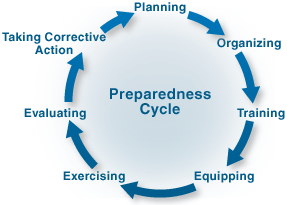
There are a few topic areas within their paper that I’m lumping together under this discussion topic.  The authors make some excellent points about our collective work in preparedness that I think all readers will nod their heads about, because we know when intuitively, but sometimes they need to be reinforced – not only to us as practitioners, but also to other stakeholders, including the public.  First off, preparedness is never complete.  The cycle of preparedness – largely involving assessment, planning, organizing, equipping, training, and exercising – is just that – a cycle.  It’s endless.  While we do a great deal of work in each of these, our accomplishments are really only temporary.

The authors also mention that our information is not always precise.  We base a lot of what we do in preparedness on information, such as a hazard analysis.  While there are some inputs that are factual and supported by science, there are many that are based on speculation and anecdote.  This is a reality of our work that we must always acknowledge.  As is other of their points – there is no silver bullet.  There is no universal solution to all our woes.  We must constantly have our head in the game and consider actions that we may not have ever considered before.

ICS Improvement Officer

The authors briefly discuss a conceptual position within the ICS Command Staff they call the ICS Improvement Officer.  The concept of this fascinating, if not a bit out of place in this paper given other topics of discussion.  Essentially, as they describe this position, it is someone at the Command Staff level who is responsible for providing quality control to the incident management processes and implementations of the organization.  While I’ve just recently read this paper and haven’t had a lot of time to digest the concept, I really can’t find any fault with the concept.  While the planning process itself is supposed to provide some measure of a feedback loop, there isn’t anyone designated in the organization to shepherd that process beginning to end and ultimately provide the quality control measures necessary.  In practice, I’ve seen this happen collaboratively, among members of the Command and General Staff of a well-staffed structure, as well as by the individual who has the best overall ICS insight and experience in an organization – often the Planning Section Chief.  The authors elude to this position also feeding an AAR process, which contributes to overall preparedness.  I like this idea and I hope it is explored more, either formally or informally.

Conclusion

There are a number of other topic areas of this paper which I haven’t covered here, but I encourage everyone to read on their own.  As mentioned earlier, I’d like to see more of the research papers that come from FEMA’s Emergency Management Executive Academy available for public review.  Agree or disagree with their perspectives, I think their discussions on various topics are absolutely worth looking at.  It’s these discussions like these which will ultimately drive bigger discussions which will continue to advance public safety.

I’m always interested in the perspectives of my readers.  Have you read the paper?  What do you think of the discussion topics they presented?

© 2017 – Timothy M Riecker, CEDP

Emergency Preparedness Solutions, LLC
 

Preparedness Exercises – The Building Block Concept Can Be Misleading

If you’ve been doing emergency management and homeland security exercises for even a little while, you are probably familiar with this graphic.  It’s included in a great many exercise training courses and other materials that talk about the different types of exercises out there.  This graphic looks correct at first glance.  It seems to make sense.  Intuitively, we assume that full-scale exercises are the most complex exercise type and that they test capabilities to the greatest extent.  When we put more thought into that, though, we realize that it can be wrong.

I’m happy to note that the most recent document on the Homeland Security Exercise and Evaluation Program (HSEEP) (April 2013) does NOT include this graphic.  They include a couple of paragraphs on using a ‘progressive approach’ to a multi-year exercise program, recommending that “each successive exercise building upon the previous one until mastery is achieved” is the path forward.  While I’m not too crazy about this statement, either, it’s not as misleading as the legacy ‘building block’ graphic.

Here’s the problem with the graphic – It assumes too much.  While in some instances this graphic can be correct, it shouldn’t be regarded as even occasional guidance.  I’ve witnessed, managed, designed, evaluated, or otherwise participated in a number of workshops, tabletops, drill, and functional exercises that are far more complex than some full-scale exercises I’ve likewise been involved in.  Similarly, I can attest to some ‘lower level’ exercises testing capabilities to a greater extent than the ‘higher level’ exercises.  The hierarchal structure is simply misleading.  The problem this can create is people being dismissive of the relevance, necessity, and value of conducting exercises other than functional and full-scale.

Making a training comparison, exercise types don’t really stick to a scaled taxonomy.  (Check out this article for a small introduction to Bloom’s Taxonomy which is used in instructional design.) While we can state that an awareness level course is more about knowing and understanding, and an operations-level course is more about applying, we can’t say the same for exercises as a spectrum generalization.  Consider that seminars are certainly geared toward orienting people with information, while workshops, on the other hand, require creation of a product, by definition.  Tabletop exercises can (and should) be incredibly in-depth, analyzing plans and policy, while drills are more about application.

So what exercise type should you choose?  It goes back to the foundations of exercise design – consider your objectives, then consider what exercise type best fits what was identified that you want to accomplish.  Reflecting, now, back on the progressive approach mentioned in the HSEEP document, it’s true that you probably don’t want to jump into a full-scale right away.  That has less to do with the perceived complexity of the exercise and more to do with how plans are properly tested – which is the main reason why we exercise.  First, we need to talk through aspects of our plans, policies, and procedures.  We need to make sure that our foundational assumptions are sound and that broader decisions and actions are in line with the documents created.  This is typically the reasoning behind conducting a table top exercise before any type of operations-based exercise.  Once we have established that the foundational premise and supporting policies of the plan is sound, then it can make sense to progress to a selection of operations-based exercises to test various tactile aspects of the plan and associated procedures.

That said, some procedures are so tactile that really the only way to test them is through an operations-based exercise.  Perhaps they are first built in a workshop-type of environment, then go straight to a drill for testing.  That might be all that’s needed.  Yes, they could be further integrated into a functional or full-scale later, if you choose to integrate them into other activities.

The bottom line here is that while the building-block approach to exercises makes sense at a glance, it is really quite more complex than the graphic eludes to.  Yes, it still has some relevance, but it should not be viewed as the rule.  Just as in training and emergency response, objectives drive everything in exercises.

© 2017 – Timothy M Riecker

Emergency Preparedness Solutions, LLC

 

Incident Evaluation

I’ve written at length about the importance of quality evaluation of exercises.  Essentially, if we don’t evaluate exercises, and do it well, the benefits of the exercises are quite limited.  Generally, we don’t see a benefit to incidents.  By their very nature, incidents threaten and impact life, property, and environment – things we don’t view as being beneficial.  However, benefits are often a product of opportunity; and we absolutely should take the opportunity to evaluate our responses.

Many incidents do get evaluated, but through research after the fact.  We retrace our steps, review incident documents (such as incident action plans), interview personnel, and examine dispatch logs.  These efforts usually paint a decent picture of intent and result (things that are often different), but often miss the delta – the difference between the two – as well as other nuances.  When we evaluate an exercise, we do so in real time.  Th evaluation effort is best done with preparation.  Our evaluation plans, methodologies, and personnel are identified in the design phase of the exercise.  Just as we develop emergency operations plans and train personnel to respond, we can develop incident evaluation plans and train personnel to evaluate incident responses.

Understandably, a hurdle we might have is the availability of personnel to dedicate solely to evaluation, especially on larger incidents – but don’t be afraid of asking for mutual aid just to support incident evaluation (just be sure to include them in your preparedness efforts).  Just as regional exercise teams should be developed to provide cooperative efforts in exercise design, conduct, and evaluation; incident evaluation teams should be developed regionally.  To me, it makes sense for many of these personnel to be the same, as they are already familiar with how to evaluate and write up evaluations.

In exercises, we often use Exercise Evaluation Guides (EEGs) to help focus our evaluation efforts.  These are developed based upon identified Core Capabilities and objectives, which are determined early in the exercise design process.  While we don’t know the specific objectives we might use in an incident, we can identify these in general, based upon past experiences and our preparedness efforts for future incidents.  Similarly, our emergency planning efforts should be based around certain Core Capabilities, which can help inform our incident evaluation preparedness efforts.  Job aids similar to EEGs, let’s call them incident evaluation guides (IAGs), can be drafted to prepare for incident evaluation, with adjustments made as necessary when an incident occurs.

Evaluating an incident, in practice, is rather similar to how we would evaluate an exercise, which is why the training for these activities is relatively portable.  Evaluation efforts should avoid evaluating individuals, instead focusing on the evaluation of functions and processes.  Don’t reinvent the wheel – evaluate based upon documented (hopefully!) plans and procedures and use the Homeland Security Exercise and Evaluation Program (HSEEP) standards to guide your process. Incident evaluation must be managed to ensure that evaluation gaps are minimized and that evaluation progresses as it should.  Observations should be recorded and, just as we would for an exercise, prepared for and eventually recorded in an after action report (AAR).

I favor honest after action reports.  I’ve seen plenty of after action reports pull punches, not wanting the document to reflect poorly on people.  Candidly, this is bullshit.  I’ve also heard many legal councils advise against the publication of an after action report at all. Similarly, this is bullshit.  If our actions and the need to sustain or improve certain actions or preparations is not properly recorded, necessary changes are much less likely to happen.  If an AAR isn’t developed, a corrective action plan certainly won’t be – which gives us no trackable means of managing our improvements and disavows our intent to do so.

As a profession, public safety must always strive to improve.  We have plenty of opportunity to assess our performance, not just through exercises, which are valuable, but also through the rigors of incident responses.  Prepare for incident evaluation and identify triggers in your emergency plans for when evaluation will be employed, how, and who is involved.  Begin evaluation as early as possible in an incident – there are plenty of lessons learned in the early, and often most critical moments of our incident response.  Finally, be sure to document lessons learned in an AAR, which will contribute to your overall continuous improvement strategy.

How does your agency accomplish incident evaluation?  If you don’t, why?

Need help with the evaluation of incidents?  We are happy to help!

© 2017 – Timothy Riecker, CEDP

Emergency Preparedness Solutions, LLC
Embracing the Playbook in Emergency Management

This morning I suggested to a client the possible use of a playbook as a training supplement for their duty officer program.  A playbook is a job aid, but more than just a check list or a chart.  Ideally, a playbook is a structured collection of job aids, broken down by situation for easy reference by whomever needs the information.

Playbooks are best known to be most extensively used in American football.  They contain a variety of strategies for accomplishing certain objectives (short yardage gain, long yardage gain, end zone scoring, kick return, etc.), with each strategy often accompanied by one or more diagrams of Xs (the opposition) and Os (your team), with lines showing movement and action by certain positions.  Playbooks are tested, practiced, and memorized by players before the season begins, but are constantly referenced every game by coaches and players alike.

playbook-diagram

Fundamentally, the play book exists because there are so many situations the team needs to respond to and several different ways in which they can respond.  While some of their plays are fairly routine, others are rarely, if ever, used.  Just like emergency management, however, it’s good to have the plan available if we need it.

Assembling a playbook for emergency management purposes doesn’t have any set standard, but as with any other tool or plan we assemble, we must first identify the purpose and the audience.  Play books can be assembled for elected officials and executives, duty officers and middle management, or dispatchers and first responders – it all depends on what is needed.  One thing that should be stressed, though… playbooks are NOT plans, nor should they be treated as a replacement for training.  Playbooks should be based upon established policy, plans, and procedures; and training still should be conducted on those policies, plans, and procedures.  A playbook is the collection of job aids which will help us to navigate the things people may not routinely do – which makes them excellent for emergency management applications.

Consider that the content of the playbook won’t (and probably shouldn’t) try to map out an incident from inception to completion.  The playbook is intended to address critical actions within an early timeframe of the incident.  Following this, a team should be assembled and striving to manage the incident using the planning process and referencing the foundational plans and policies.  There may be a few nuanced circumstances and activities within the playbook that are still relevant in the extended response, but these should be few.

The organization and content of the playbook should depend on the objectives and audience of the tool.  It should not be heavy in narrative and doesn’t require a lot of background as a plan might.  For emergency management purposes, most playbooks are organized by hazard and/or impact, with topics such as Mass Shooting, Severe Storm, or Power Outage.  For each topic, the essential elements of response can be identified, perhaps in check-list format.  Additional job aids such as decision tables, flow charts, and references can also be incorporated.  While I’m a big fan of keeping things digital, playbooks and similar references are better in hard copy, as this helps to ensure the information is always accessible.  Bind it (a three ring binder is best, so content can be updated as needed) and insert tabs for easy reference.  Be sure to give all users their own copy.

When creating the playbook, consider what information needs to be conveyed.  While some repetition may be necessary from topic to topic, reduce the amount of in-document references (i.e. See page 19 for additional information), as the purpose of the document is to help keep people organized.  Always keep the user in mind, ensuring that they understand each step and that they have the ability, resources, and authority to perform the identified actions.  Ensure that the playbook is a proper reflection of established policy and procedure and be sure to test it for effectiveness.  Train people in its content and use, and be sure to provide regular training and content updates and to incorporate its use into exercises.

I’m interested in hearing your thoughts on playbooks and if you have created and/or used them.  Of course, if your jurisdiction or organization is looking for assistance in developing a playbook for your critical activities, let us know!

© 2016 – Timothy M. Riecker

Emergency Preparedness Solutions, LLCYour Partner in Preparedness


Must Read – Evaluating Preparedness at Different Levels of Analysis by Brandon Greenberg

In the past I’ve made references to the DisasterNet blog written by Brandon Greenberg.  If you aren’t reading his blog, you certainly should be, as he routinely posts great material.  Yesterday’s post was no exception.

Brandon has been doing some research on evaluating preparedness, which is a topic I’ve also written about in the past and I feel is of great importance to continued improvements in emergency management.  His article, Evaluating Preparedness at Different Levels of Analysis provides a number of insightful thoughts and information which are certainly going down the right path.  With all hope, Brandon’s continued work may help us find better ways to evaluate preparedness.

-TR