Crowdsourced Weather

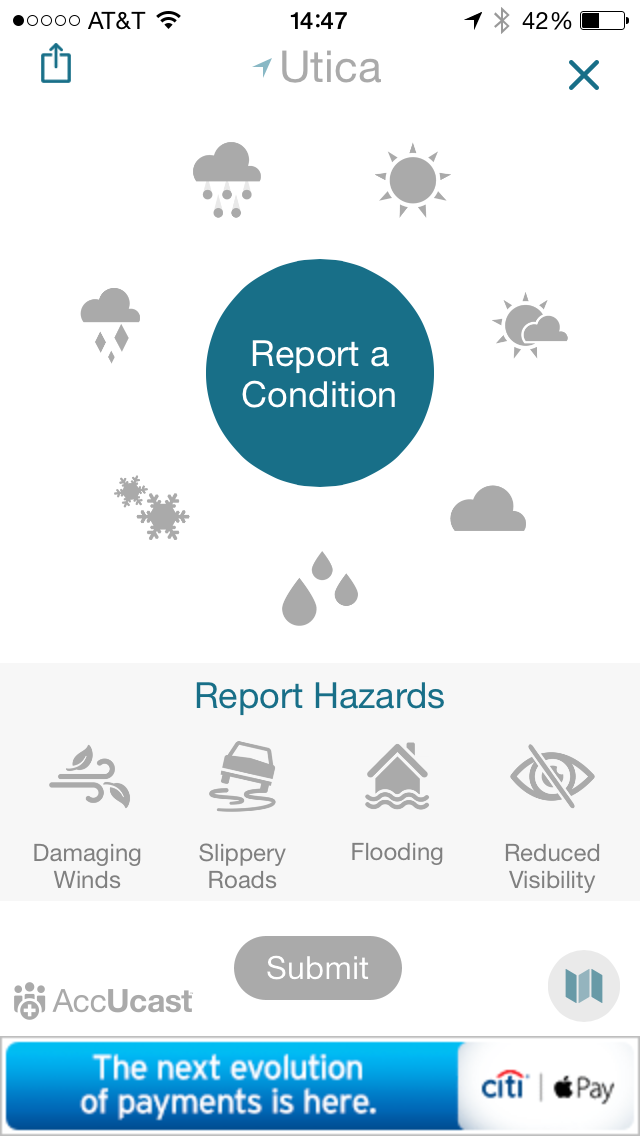
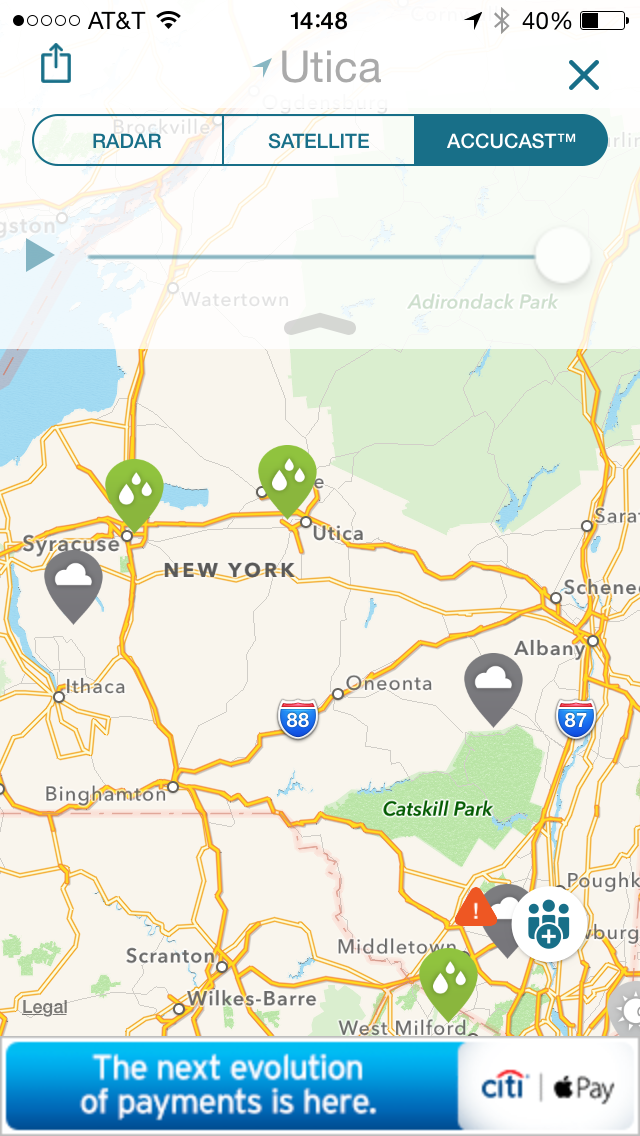
Now this is cool… Back in July, AccuWeather’s iOS app incorporated a crowdsourcing feature called AccuCast which allows users to report weather and weather related hazards where they are.  This data is then available as an option in the weather map displays accessible in the app.

Screen images included below.  More information available from http://www.accuweather.com/en/press/50601069.

AccuWeather AccuCast Screen Shots

AccuWeather AccuCast Screen Shots

AccuWeather2

TR

Firearms in Emergency Kits?

Cannon Beach, Oregon, a community in the Cascadia subduction zone, has an interesting program in which they store the preparedness kits of residents for them.  A link to the city’s program is here: http://ci.cannon-beach.or.us/community/cachecontainer.html.  In summary, the city provides the opportunity for residents (for a small fee) to store containers (provided by the city) of emergency supplies within city-owned cache locations.  They offer 5 gallon pails (with lids), 30 gallon drums, and 55 gallon drums.  These kits are stored securely in shipping containers at the predesignated locations.

I’m a bit ambivalent about the concept.  While it certainly encourages and enables people and families to have kits that perhaps otherwise wouldn’t, it does remove these kits from their possession.  Not having the kits in your possession limits the ability to add to/maintain the kit and certainly makes them ineffective during a shelter in place scenario.  I, for one, would rather have my kit readily available to me and all family members without having to address:

1) potentially unsafe travel,

2) the ability to access the container (will someone be there to let me in?),

3) a potential state of unrest in the vicinity of the container,

4) will the container still be there (we’ve seen these things easily moved by mother nature).

Note that the informational material on their website does encourage people to also have go-bags for a combination approach, which is a good idea.

Now that I’ve warmed you up with some background – off to the main topic…  I was first alerted to Cannon Beach’s concept via a news article about someone storing a firearm in their kit.  http://www.opb.org/news/article/should-your-emergency-preparedness-kit-include-a-firearm/.  The article states that an individual kept a firearm in their kit, which was stored by the city in a storage container which was broken into and stolen.  Firearms, by the way, are not permitted per the city’s guidance.  But should firearms (Cannon Beach’s program aside) be included in emergency kits?

Up front, I’d never recommend that firearms be kept in an emergency kit simply based upon liability.  That said, it’s an individual decision but could be a good idea.  Certainly anyone who chooses to do so should ensure that it is done legally and safely.  One must also consider why they want to have a firearm in their kit.  Is it for personal protection or for hunting?  Or both?  In the case of the article I referenced, it was a handgun, which could really only be used effectively for personal protection.

While we see very limited violence and looting during disasters, it certainly could be possible.  I would never suggest that someone not have the ability to protect themselves or their family.  I would suggest, however, that anything in your kit should have as many purposes as possible.  A handgun is less than ideal for hunting.  However, including a firearm for hunting (rifle or shotgun) will likely exceeded the physical space of your kit, so this needs to be considered.

I would also suggest that, again just like anything else in your kit, you be proficient in using it. Among the few who keep and maintain preparedness kits, many buy things and just stick them in there.  They never read the instructions or become familiar with their use.  Consider a water purifier for example.  Any brand that I’m familiar with needs to be submerged and backwashed prior to use to remove smaller particulates from the carbon filter.  If someone is keeping something as dangerous as a firearm, they had better be proficient in its use!

The bottom line is that we are not likely to see a scenario out of The Walking Dead.  While we have seen some devastating incidents, such as Hurricane Katrina, which had limited the effectiveness of law enforcement for a time, this is not the norm within disasters.  Some may be considering an extreme, perhaps apocalyptic, scenario, and wanting to protect themselves, which is fine.  Just be smart about it.

What are your thoughts on firearms in emergency kits?  How about the municipal storage of kits like Cannon Beach’s program?

Lots of food for thought…

© 2015 – Timothy Riecker

Emergency Preparedness Solutions, LLC

WWW.EPSLLC.BIZ
Most Disasters are NOT Extraordinary Occurrences – OR Crowdsourcing Volunteers

I listen to A LOT of podcasts.  While some are focused on emergency management and homeland security, most are pop culture related and have nothing at all to do with EM/HS.  At least not directly.

Listening to a recent podcast, it struck me how often the hosts mention disaster-related occurrences.  During this podcast there were several mentions of disaster related issues including the Louisiana theater shooting (which was breaking news while they were recording) and the Tom Selleck legal drama in California over stolen water (which ultimately relates back to their drought issues).  The same podcasters (one of which is in New England, the other in the National Capital Region) often comment through the year on weather-related incidents which impact them and others including winter storms, flooding, and warmer weather storm damages.

The point is that most disasters are not extraordinary occurrences.  Routine incidents aside, some measure of disaster occurs fairy regularly, certainly around the world and even just within any of our nations.  Turn on the news tonight and see for yourself.  So WHY, I ask, is there such a mentality with the general public (and maybe even with us public safety types) about disasters being out of the ordinary occurrences?  Sure they don’t happen within our own jurisdiction every day, but they happen somewhere EVERY DAY.  I’m not saying we have to be paranoid about it, but I see the COMPLACENCY getting WORSE.  We discuss preparedness often, and the aspect of getting the public better engaged in preparedness almost as much, yet we have yet to see real, meaningful success in this.

We’ve recently seen a bit of a paradigm shift in how we deal with climate change (insert groaning sound here).  For many years we tried to prevent it, as if we could.  The reality is that part of it is influenced by the actions of humanity and part of it by the natural cycle of our planet.  There are things we simply shouldn’t be doing and we still need to work on those, but we have also come to grips with the inevitability of the impacts.  We have realized that they will happen no matter what we do and we have decided that we need to ADAPT in order to survive.

Adaptation is an important realization for us (I’m now speaking in generality – not just climate change issues).  If there are things that we pound our heads against the wall over in futility, such as public engagement, maybe we are doing it all wrong?  I’m not saying that we stop trying to engage the public.  There are certainly successes we have seen, but I don’t think we are seeing the return on investment we should be.

Let’s look at society today.  People seem to have less time ability interest in volunteering or committing to efforts ahead of time.  We have to understand and acknowledge that first and foremost.  Have we turned into soulless uncaring creatures?  No, of course not.  We have just seen a shift in culture.  Trying to fight this culture is foolish.  Instead, we need to adapt.  How do we adapt?

Social media is the greatest embodiment of our need for instantaneous information and feedback.  It doesn’t take much preparation (download some apps, create accounts, find friends).  The vast majority of the information that rolls across the screen is crap, but every once in a while there is a worthwhile nugget that will garner some responses.  Sometimes (usually disasters or a new statement by Donald Trump) information that comes across garners a great deal of attention and people want to take action.  Do they know how to take meaningful action?  Often not.  But they will follow along with the good ideas of others.  (aka leaders).

Let’s broaden this concept within public engagement.  What this essentially comes down to is managing spontaneous volunteers – a concept we have seen much need for in EM for years.  I think we need to emphasize this more than ever.  We also need to update the way we think about it.  These spontaneous volunteers will not only show up at town hall, the fire house, local diner, or house of worship; they will show up online via Twitter and Facebook.  They will be locals, they will be from out of state, across the country, or across the planet.   ALL of them can be engaged.  Let’s crowdsource volunteers in emergency management.  We just need to identify how to engage them.  Identify gaps and figure out how these good natured people can fill those gaps with little no upfront investment of time or effort on their part.  Build plans that address spontaneous volunteer engagement – both in the physical aspect as well as virtual.  Train to these plans and test these plans.  Let’s stop struggling against old ways of thinking.  Improvise, adapt, and overcome.

As always, I’d love to hear your thoughts on this.

I do want to take a moment to thank my followers and readers – something I don’t do enough of.  Your support and comments are greatly appreciated.  Also, if you like my blog, spread the word.  Please feel free to forward/repost/retweet to friends, family, colleagues, and complete strangers.

©2015 – Timothy Riecker

EMERGENCY PREPAREDNESS SOLUTIONS, LLC

WWW.EPSLLC.BIZ

We need to talk MORE about Emergency Management

My company is currently finishing a contract which involved almost two dozen site visits to local government entities (cities and towns) to meet with local officials (emergency management, police, fire, EMS, schools, elected officials, public works/highway, etc.) to discuss certain emergency management and homeland security needs they may have.  The topics we needed to address were set in conjunction with our client and the meeting times were capped at 4 hours.  Based on the discussion generated by those we met with, discussions took anywhere between an hour and a half to all four hours.  At the end of most of these meetings, many people who we met with thanked us for bringing them the opportunity to discuss emergency management with such depth.

At first I was a bit puzzled about this gratitude… the meeting was intended for us to gather information from them, so it was us who thanked them for their time and input.  Why would they thank us?  They could talk about this stuff any time they wanted to, right?  In theory, yes.  In practice, NO.

Looking back at the project in retrospect we saw the value in the opportunity we provided these local stakeholders.  Absent a recent disaster or a specific issue of concern, it’s a rare occasion that local leadership takes the time to convene and discuss emergency management and homeland security matters.  We, rather serendipitously, provided them with an opportunity to do talk about many facets of EM/HS, to share thoughts and ideas, and to identify needs.

In many local government meetings (town/village/city council, selectboard, etc.) the topic of emergency management (or anything related to it) is generally not on the agenda.  Some may have a formal briefing by department heads, which would include the fire department or police department (if they have one), but these are usually fairly general statements.  Because of the depth of discussion that can take place, I don’t even think that these monthly governance meetings are the right venue for most discussion.  I would suggest that jurisdictions have a separate meeting, at least quarterly, to discuss emergency management in depth, with all department heads, elected officials, and others present and participating.  Preparedness should be discussed across the spectrum of all mission areas.

Many of the jurisdictions we met with had seen tropical storm impacts within the last few years – and that was the last time, for many of them, that the impacts and lessons learned were discussed.  What of their corrective actions?  Aside from a few largely individual efforts, little progress had been made.  Stakeholders self identified this gap, some commenting directly about the necessity to meet more often.  Many brought up gaps that were identified after the tropical storm, or even more recently, which were never addressed.

Along with the success of our intended project, we hope that at least some of those jurisdictions were able to get energized and organized to revisit some of those past concerns and move forward to make some progress with preparedness and mitigation efforts.

What do you do in your jurisdiction to prompt more discussion about EM/HS?

© 2015 – Timothy Riecker

Emergency Preparedness Solutions, LLC

WWW.EPSLLC.BIZ
Incorporating Social Media Into Your Exercises

Incorporating Social Media Into Your Exercises, a post within the idisaster.wordpress.com blog.

This blog was first brought to my attention through the most recent DHS Capacity Building Webinar Series episode called Innovating with Disaster Drills and Exercises (also available on iTunes, which is how I usually listen to them).  The blog’s primary writer, Kim Stephens, is very well spoken and well versed in using social media in emergency management (#smem).  Claire Rubin, who I’ve referenced several times before, also guest posts on the idisaster blog.  I’ve spent some time looking through the blog and find it to be well written and very informative – they certainly gained a new follower!

Be sure to check out both idisaster.wordpress.com and the DHS Capacity Building Webinar Series.

– TR

FEMA Releases a Consolidated Online Training Course Catalog for First Responder Training

This is a great resource I discovered last week that has just been officially announced this week. It is comprehensive and easy to use. Check it out and see what’s out there! – TR 

(Official release follows)

FEMA released a consolidated online training catalog for the First Responder Training System, including courses available through the Emergency Management Institute (EMI), the Center for Domestic Preparedness (CDP), the National Domestic Preparedness Consortium (NDPC) and the Continuing Training Grant (CTG) program. The site was developed in response to customer requests and is known as the “National Training & Education Online Course Catalog.” It allows users to search for all FEMA preparedness training initiatives in one location.  

The main entry page of the combined catalog briefly describes each training organization—EMI, CDP, and the National Training and Education Division—while providing a list of training courses in each catalog, along with links for scheduling and individual websites for each training organization. First responders can access the consolidated course catalog by clicking directly at www.firstrespondertraining.gov/NTE

The catalog itself is searchable and can be viewed in full or by the individual NTE training entities. Users are able to filter by organization and/or training provider, delivery type, discipline, core capability and mission area at www.firstrespondertraining.gov/ntecatalog.

Course catalog feedback can be sent to firstrespondertraining@fema.dhs.gov.

Emergency planning – A linear approach or ‘choose your own adventure’?

When creating deliberate emergency operations plans, and especially the associated standard operating procedures/guidelines (SOPs/SOGs) that accompany them (you do develop these, right?) there is always a consideration for how to progress through the written plan – chronologically or topically.  There are pros and cons to both approaches you should be aware of.

Chronological progression of your planning efforts assume that an incident starts at A and progresses to Z, in a particular order.  At a glance, this is a lot of structure for emergency management, but an analysis of most incidents will show that they generally tend to progress in this fashion.  It’s human nature for us to like order and to try to put things into a logical progression.  There are, of course, the outliers – those incidents which have tangential or cascading impacts which don’t necessarily have a linear progression.  It’s these unknown factors that make us stumble a bit.  How do we account for these disruptions of our orderly progression?  We have to skip around in the plan.  If our plan isn’t designed for skipping around, it can be rather awkward and not easy to use.

A Choose Your Own Adventure book

A Choose Your Own Adventure book

The other side of the coin argues that if you are likely to skip around in the plan anyway, why not build a topical, or ‘choose your own adventure’ style, plan?  Remember choose your own adventure books?  The story always starts the same, building a foundation for the adventure you will face, but you, the reader, eventually get to decide what the main character will do.  At some point, you will be faced with a choice.  Should your hero take the left tunnel or the right?  If you take the left, go to page X, if you go right, turn to page Y.

Non-linear planning will chunk the content of your plan so individual sections focus on each potential impact and major activity – be it hazard-specific or function-specific – with reference back to a core plan, kind of a hub and spoke approach.  (By the way, ‘chunking’ is an actual term.  We use it primarily in instructional design).  It can make for some flipping around through the plan, and sometimes a bit of redundancy if each section starts with the same concept of operations (thus the need to reference back to a core plan), but it more easily accommodates the unknowns of an incident by looking at separate impacts or major activities as individual components related to a central response.

What are your thoughts?  Do we try to keep things orderly, or do we give in to a modular, ‘choose your own adventure’ approach?  Which do you think is more complex?  Which do you think is more effective?

© 2015 – Timothy Riecker

Emergency Preparedness Solutions, LLC

WWW.EPSLLC.BIZ

Finally – an Emergency Management Podcast Worth Listening To!

I’m a bit of a podcast addict.  I listen to them all the time – at the gym, mowing the lawn, long drives, etc.  There are podcasts out there for all interests.  I’ve struggled, however, these last few years, with finding a good emergency management podcast.  Sure, I’ve found a few, but I find them to generally have limited relevancy and also to be boring as hell.  Yes, I want to learn, but I also want to be entertained.  Last week, after seeing a tweet from Brandon Greenburg about guesting on a podcast, I was immediately intrigued.

First off, if you aren’t familiar with Brandon, you should be.  He blogs regularly about disasters and technology, usually together, and has great thoughts and ideas.  Brandon is not only a practitioner, but also an academic, currently pursuing a Ph.D. from GWU in technology and disaster management.  Brandon is one of those colleagues who I’ve never met, yet correspond with via our blogging and social media platforms.  Since he knows EM and he knows tech and social media, anything Brandon would be on immediately gives me cause to pay attention.  For more on Brandon, visit www.disasternet.co or on Twitter @disasternet.

Getting to the podcast, the name is the Dukes of Hazards, hosted by Mitch Stripling and Andrew McMahan.  From their website, the podcast is “… an irreverent (but useful) podcast about disaster response, emergency management, mobilization culture, community resilience, and life in emergency operations.  Also, drones.  Research.  Movie reviews.  Jokes.”  It really is all of that.  And a clever name!

Mitch and Andrew have clearly cracked the secret code of podcasting – talk about any subject (even one that is serious, like emergency management) and make it both informative and entertaining.  They clearly have a good time recording (the beer and cookies probably help with that), they are experienced in EM, and they continue to stay current in the practice.  Their discussion topics are interesting and relevant, and they fully use dialogue – with each other, guests, and written listener feedback – to help you feel engaged in their discussion.

Dukes of Hazards looks at current events in EM, new practices and ideas, and discusses the future direction of different facets of our field.  They even occasionally poke fun at some of our idiosyncrasies and common personality traits, which is a breath of fresh air! There are also some occasional pop culture references like Star Wars and The Walking Dead that make me quite happy.

Bottom line – informative, entertaining, beer and cookies.  Need I say more?

Check out Dukes of Hazards at www.hazardspodcast.com for more info.  You can listen to their podcasts from the website, iTunes, and other outlets.  They can also be found on Twitter at @hazardspodcast. You won’t be sorry.

© 2015 – Timothy Riecker

Emergency Preparedness Solutions, LLC

WWW.EPSLLC.BIZ

@EPS_LLC

H5N1 Confirmed in the US

In news released by the media this morning, the presence of H5N1 (aka bird flu or avian influenza) has been confirmed in the US.  While many dusted off communicable disease plans with last year’s (and continuing) Ebola threat, we need to ensure that we take into account the wildlife and agricultural implications of H5N1 along with the threat to human life.  While one positive finding certainly does not make an epidemic, the confirmed presence should be putting certain actions into place for many public safety partners, including federal and state agricultural and fish and game offices.  Hunters, farmers, and veterinarians need to be aware of signs and symptoms just as much as our health care providers.

Be on the lookout for more information from authorities on this.  Consider the implications it can have within your area of responsibility and be sure to think broadly and consider cascading impacts.

© 2015 – Timothy Riecker

Emergency Preparedness Solutions, LLC

www.epsllc.biz