Best Practices for the New Year – Resolve to be Responsible, Realistic, and Resourceful

As I work with jurisdictions and discuss their capabilities I find a broad range of perception among emergency managers about their jurisdictions’ capabilities and limitations.  Some overestimate their capability, thinking that they can handle anything and don’t need any outside assistance.  Others underestimate their capabilities, with their emergency plans defaulting to calling for help or making someone else responsible for nearly every scenario.  Fortunately some jurisdictions are spot on and have an informed and realistic perception of their capabilities.  Having the wrong awareness of what your jurisdiction can and cannot do can be dangerous.

Be Responsible

First of all, jurisdictions need to be responsible for their people.  Far too often I see an automatic assumption that someone else will handle an incident or a certain aspect of an incident, apparently abrogating the jurisdiction of all responsibility.  One of the more common occurrences of this is with sheltering where I rather often hear ‘The Red Cross will take care of that.’ with no further discussion even considered on the subject.  With no slight intended toward the Red Cross, relying on one entity to provide an absolutely critical capability is simply foolish.  If the Red Cross or any other outside entity is for some reason unable to provide these services for the jurisdiction, the jurisdiction is still left with the responsibility to provide this care for its citizens.  A jurisdiction without a plan to address this need is not being responsible for the welfare of its citizens.

The primary goal of a jurisdiction is to provide for its citizens.  Take this seriously and remember that you can’t assign this responsibility to others.

Be Realistic

Know your capabilities and your capacity.  In other words, know what you can and can’t do; and for what you can do, know how well and how long you can do it for.  Know what your limitations and dependencies are.  If your jurisdiction’s ability to provide advanced life support (ALS) care is dependent upon the only paramedic you have as a member of your ambulance service, you have very little capacity and quite a bit of vulnerability.

A good start to having a realistic view of your jurisdiction’s capabilities is conducting and regularly updating a comprehensive threat and hazard identification and risk assessment (THIRA).  THIRA is an in depth assessment which combines a traditional hazard analysis with a reference to DHS’ 31 Core Capabilities in the context of the threats specific to a jurisdiction.  I strongly suggest that a jurisdiction conducting a THIRA extend this assessment into an analysis of five key elements (Planning, Organizing, Equipping, Training, and Exercising – POETE) for each of their capabilities.  Go here for my post on the POETE analysis which explains the benefits and the process a little more.

A good THIRA helps jurisdictions identify not only their hazards but also the potential worst-case scenario impacts of these hazards.  It then provides an opportunity for the stakeholders of the jurisdiction to take an honest look at their capabilities and their ability to leverage these capabilities against those impacts.  Being honest in this assessment will help jurisdictions see what can hurt them most and identify the gaps and limitations they have in their capabilities.

Bottom line – be realistic in what you can do, how well, and how long you can do it.

Be Resourceful

The ability to endure the impacts of a disaster and, at a minimum, address the critical objectives of life safety, incident stabilization, and property conservation can require a jurisdiction to be creative and resourceful.  This is a key aspect of resiliency.  While assistance may still be needed from outside sources, a jurisdiction’s ability to survive and provide lifeline services for its citizens in the interim is extremely important.  Being resourceful can help a jurisdiction shore up its capabilities in times of need.  Key to being resourceful are good contacts and connections within the whole community.  Religious groups and social organizations, private companies, and even individual citizens can all provide services which can aid a jurisdiction in shoring up capabilities – at least in the short term.  Incorporate these as options within your emergency plans.  While these entities may have issues and commitments of their own during a disaster, they may also be able to help.

Use all available resources to get the job done and to sustain for as long as you can.  It can absolutely be the difference between life and death.

Best Practices for the New Year – Standards in Emergency Management Programs

Going into the New Year I’m endeavoring to write a few posts on best practices in emergency management.  The New Year is a great opportunity for us to take a broad look at our emergency management programs to identify needs and develop and implement some strategies to improve.  Instead of looking back in a rather cliché “year in review”, let’s look ahead toward improvement!

I also wanted to express appreciation to all of my blog readers.  Some of you find me directly through my blog’s home at WordPress, some through LinkedIn or Twitter (@triecker or @epsllc), and some through my company’s website – Emergency Preparedness Solutions, LLC.  If you like my blog please share it with others.  Comments are always welcome.

On to our topic… Standards in Emergency Management Programs

All emergency management programs – government, private sector, and not-for-profit – should strive for their programs to meet accepted industry standards.  The two most significant standards in the United States are the National Fire Protection Association (NFPA) 1600: Standard on Disaster/Emergency Management and Business Continuity Programs and the Emergency Management Accreditation Program (EMAP).  The two standards are very similar in content and in fact complimentary, with the most significant difference being that EMAP offers an actual accreditation process.  Both programs offer copies of their standards free of charge, which is reflective of the spirit of sharing and improvement that exists in emergency management.

The NFPA offers the most recent previous version of their standard as a free download from their website.  The NFPA 1600 standard is quite detailed and can be initially overwhelming but really should be referenced piecemeal.  The free EMAP standards are published in a bit less detail, but they provide a very detailed assessment tool for those who initiate the formal accreditation process.  Because neither standard references specific laws or FEMA documents, they are also great references for governments, private sector, and not-for-profits outside the US.

How should you review the standards? 

They both essentially serve as checklists for what is programmatically needed for successful emergency management programs.  They are both organized by functions, such as planning, training, exercises, and logistics allowing a program to see what activities within each area are needed.  Neither standard will tell you how to meet any particular section of their standard, as they don’t want to be seen as favoring any particular published processes or products and want to encourage innovation and resourcefulness.  This also lends itself well to either/both standards being applicable and achievable by large and small organizations alike.

Examining your own emergency management program through the lens of either of these standards provides a great opportunity to see where you stand.  Examine your functions piece by piece, function by function.  Check off what areas you feel meet the standards and highlight those which you feel do not.  Use these areas as a point of reference for improvements.  Conduct a bit of a needs assessment in these areas to identify exactly what needs to be done to improve and meet the standard then create an improvement plan to make it happen.

Having helped organizations with both NFPA 1600 compliance as well as EMAP accreditation, I’ll attest that much of it simply comes down to paperwork and good systems management.  Many of the standards can be addressed through creating and applying polices and solid practices and procedures.  Organized and thorough record keeping is very important for these matters.

What if you don’t have a specific emergency management function or certain activities are conducted by someone else?

Of course you probably should have a specific emergency management function within your community, company, or organization; but many do not.  Needs are often met in these circumstances through an amalgamation of functions found throughout the rest of the jurisdiction, company, or organization.  Hopefully you at least have an emergency management committee (or one which can serve this purpose such as a safety committee) which has representation from these various entities.  Such a committee is an ideal group to review these standards.  An emergency management program isn’t necessarily a specific agency or office; it’s really the entire system.  These standards should be examined through the entire jurisdiction, company, or organization as responsibilities and functions may be spread around.

What advantages do these standards offer for emergency management programs?

There is certainly a piece of mind knowing that your program meets these standards which are based upon industry best practices, even more so if you took advantage of EMAP’s accreditation.  These standards also provide documented justification for grants, budget allocations, resources, and activities which will contribute to a thriving emergency management program.  Overall, however, you will find that your program will be more professional and more responsive to the emergency and disaster needs of your constituency – be it a community, company, or organization.

Meeting these standards is an investment, but mostly of time and effort.  Sure, there are ways you can meet certain standards better by purchasing some cutting edge software or hiring six more people, but these standards are not intended to serve only the most fortunate and affluent emergency management programs.  A program run by a part time emergency manager with minimal funding can still successfully meet these standards.

Maintaining compliance with these standards is important and is an ongoing effort – it’s quite easy to fall off the carnival ride, especially when distracted by our daily routines and changing priorities.  Set a schedule to conduct an annual review of the standards, incorporate your compliance efforts into strategic plans, and regularly refer back to the standards to keep them fresh in your head.

Of course help is available!  Emergency Preparedness Solutions can help your jurisdiction, company, or not-for-profit conduct a Standards Assessment to determine what standards are met, what standards need to be met, and develop a strategic plan to meet these standards.  Through our full range of preparedness services we can also help you meet these standards and develop a maintenance plan for your program.

If you have questions please contact me at tim@epsllc.biz.

Have a wonderful, safe, and productive New Year!

@ 2014 – Timothy Riecker

Emergency Management Manuals from Australia

One of the greatest aspects about the field of emergency management is the community of practice we share.  It’s recognized throughout the entire profession that we improve as a practice not only through our own lessons learned buy by sharing and learning from everyone.

The following website provides links to a multitude of manuals on various emergency management related topics from Australia.  http://www.em.gov.au/Publications/Australianemergencymanualseries/Pages/default.aspx  The Aussies deal with all the same hazards we do – with wild fire, flood, and typhoon topping off the list for much of the continent.  Take a few minutes to look through what they have shared – you just might learn something, I know I did!

© 2014 – Timothy Riecker

Capability Prioritization

The THIRA (Threat and Hazard Identification and Risk Assessment) process is the most comprehensive hazard analysis in emergency management and homeland security.  It provides more information than the traditional hazard analysis by examining each hazard through the lens of each of the 31 Core Capabilities which have been specifically defined by the stakeholders of the jurisdiction.  The end result of the THIRA is a snapshot of the hazards a jurisdiction faces and the identification of what is needed to handle that hazard within each of the five mission areas (Prevention, Protection, Response, Recovery, and Mitigation).  It can be a complex process, but well worth the investment of time for a jurisdiction.  More, however, can be learned and the THIRA should inform more than just your plans.

For states and UASIs (Urban Area Security Initiative jurisdictions), the process continues in the form of the SPR (State Preparedness Report).  The SPR uses the THIRA data and applies a POETE (Planning, Organizing, Equipping, Training, and Exercising) analysis to each capability.  The POETE analysis drills deeper into each capability, allowing the jurisdiction to better understand their strengths and weaknesses within each capability.  This is extremely valuable information and clearly there are benefits to more than just states and UASIs conducting a POETE analysis.  The SPR process also prompts jurisdictions to assign a priority to each capability – High, Medium, or Low.  All in all, this provides a depth of data, but what does it all mean?

While the SPR process expands on the THIRA foundation by prompting a more in-depth analysis of each capability, the end result is a multitude of data points.  Taken individually, a jurisdiction can examine details of a specific capability, but further analysis needs to be undertaken to see the big picture.  Many jurisdictions rate quite a few of the 31 Core Capabilities as a High priority.  So what do you focus on?  If everything is a priority then nothing is a priority!

In response to this, Emergency Preparedness Solutions, LLC has developed a proprietary Capability Prioritization which incorporates stakeholder-assigned priorities while also considering the ratings provided in the POETE analysis.  The results of the Capability Prioritization provide a relative priority ranking of the Core Capabilities for the jurisdiction which can give the jurisdiction a better view of the overall priorities for continued development of preparedness strategies across the POETE spectrum, policy issues, investment justification, and resource allocation.

Emergency Preparedness Solutions, LLC is skilled and experienced in conducting THIRAs and POETE Analysis – plus we equip your jurisdiction with usable data and recommendations based on our findings.  Contact us today to jumpstart and focus your preparedness efforts.  The investment will pay off!  Be Proactive, Be Prepared! ™

logo w tagline


© 2014 – Timothy Riecker

Preparing for Ebola – and Whatever Else May Come

Unless you’ve been living under a rock lately, you should be quite aware of the headlining threat in public health and public safety – Ebola hemorrhagic fever.  Ebola has been in existence for quite a while, but the current outbreak of this deadly virus in western Africa has garnered much attention.  Thus far, beyond western Africa, infected persons have been identified in Spain and the United States.  The ease and frequency of air travel, combined with the virulence of Ebola have led to a frenzied reaction by politicians, the media, and our health care system.  While we are at a stage in the US where only a handful of infected persons have been identified, this virus is quite dangerous and could easily and rapidly spread.

While I’m not a public health expert, preparedness is universal.  Public health is at the tip of the spear for this fight and must be supported by other professions within public safety and beyond – that’s what emergency management is all about.  That said, this is proving to be quite a test for our public health partners.  The consequences of failure could be devastating.

Considering the five mission areas, we are most strongly functioning within Prevention, Protection, and Response for Ebola.  Certainly the three common Core Capabilities of Planning, Operational Coordination, and Public Information and Warning are all fully engaged across the three mission areas.  Additionally, we are seeing a great deal of work within in the Intelligence and Information Sharing; Screening, Search, and Detection; Public Health and Medical; and Situational Assessment Core Capabilities; along with some work in other capabilities to a lesser degree.  Why is it important to recognize the mission areas and Core Capabilities?  It helps to keep us focused and prompts us to examine the critical activities for each.

In which mission areas and Core Capabilities does your agency fit in?

What are you responsible for?

Are you doing it?

Do you have all the information you need to do it safely and effectively or are you waiting for public health to call and tell you what to do?  I’m betting you haven’t gotten that phone call.

In a situation like this, we are seeing a lot of activity and emphasis at the Federal level through US Health and Human Services and the Centers for Disease Control.  Their focus is on solving the problem in front of them.  While they have people engaged in getting messages out and engaging partners, they have a lot to accomplish and likely haven’t gotten to all the stakeholders.  We will hopefully see some more aggressive messaging given the circumstances that have been described at the Texas hospital where Ebola patients have been treated.  So what should you do?  Hopefully your agency is already in contact with your local health department to discuss both your role in the public safety system and the potential exposures and vulnerabilities you may have to Ebola.  If your local health department doesn’t seem to have much information, reach up to your state health department.  Don’t wait to get a call… by then it could be too late.

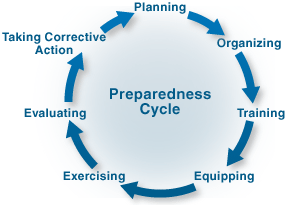
Very simply, we are looking at preparations for your agency’s role.  These preparations, although slightly different based on the agency, apply to all agencies; from first responder agencies, to local government, K-12 and higher education schools, hospitals, private sector, and not for profits.  Let’s break this down with the Preparedness Cycle:

The Preparedness Cycle - FEMA

The Preparedness Cycle – FEMA

Plans, policies, procedures – do you have them in place and up to date?  Depending on the role and function of your agency you can have several of the following – emergency operations plan, emergency procedures, infection control plan and procedures, public health plan, communicable disease or pandemic influenza plan.  You should engage with public health experts to ensure that your plans, policies, and procedures address everything known about Ebola.  You may need to create some procedures specifically addressing issues pertaining to Ebola and your agency’s role.  Do your plans, policies, and procedures link up to your agency’s critical activities for each Core Capability you are engaged in?  What agencies do you need to coordinate with to be effective?

Organizing – depending on your agency’s role, you may need to make some internal changes or designations within your organization to better streamline your activities.

Training – train everyone who has anything to do with any component of the plan in what they need to do.  This is a great opportunity to ensure that everyone is trained up in their role of the emergency operations plan.  If your agency has physical contact with the public, training in personal protective equipment (PPE), identification of signs and symptoms, and patient care are extremely important.  Given the detail of the activities and the just-in-time training, job aids will be a great help to your staff to ensure that they follow the procedures you provide for them.  Don’t get caught short… communicate to your staff in what is going on, what your agency is or may be responsible for, and what they will be called upon to do.

Equipping – your staff need the right equipment for the job.  Not only PPE, but the forms and databases used to record information, decontamination equipment, etc.  It is extremely important that staff are trained not only in how to use equipment but to prevent contamination of equipment and prevention of cross contamination.  Do you have all the equipment you need?  If not, who does?

Exercising – Conduct table top exercises to talk through policies and higher levels plans to validate and become familiar with them.  Identify shortfalls and correct them immediately.  Conduct drills to test the skills of staff for specific activities and larger exercises – functional or full scale – to test multiple functions and plans.

Evaluating – Evaluation is a constant throughout all of the preparedness cycle.  We need to evaluate every step within the preparedness cycle and make adjustments and improvements as needed.  Embrace best practices and fix shortfalls.  This leads directly to the next step…

Taking Corrective Action – Some corrective actions are quick and easy fixes while others can take a while or cost money above budget to address.  A corrective action plan (aka improvement plan) will help you keep track of what needs to be fixed, the priority it holds, who is responsible for making it happen, and a strategy to make it happen – it’s a living document.

The preparedness cycle can be applied to any hazard, be it Ebola or a flood.  With all this attention on Ebola, it’s a great opportunity to pull plans off the shelf and have discussions with internal and external stakeholders on these preparedness steps.

© 2014 – Timothy Riecker

Preparedness is a Marathon

Logo of the 2014 Utica Boilermaker

Logo of the 2014 Utica Boilermaker

Today marked the 37th running of the Boilermaker, a 15k road race hosted by the City of Utica (New York) for over 17,000 runners from around the world.  The race is a matter of pride for area residents, even those who do not run.

I considered this morning that there are many similarities between a marathon (yes, I’m aware the Boilermaker is in fact not a marathon at just over a third the distance of an actual marathon – work with me on this one) and what an organization, specifically a jurisdiction, must endure for preparedness.

First, preparedness is not a one-off activity, rather it is a culmination of activities.  While the Boilermaker highlights its 15k road race, they have a number of very successful related events including a 5k road race, a three-mile walk, a wheelchair race, and a health and fitness expo.

Preparedness has an ebb and flow of activities just as a marathon has a variety of stretches, turns, and hills.  Both marathons and preparedness should have a high degree of community engagement.  The Boilermaker has a variety of corporate and local business sponsors, engages all services of the City of Utica and many assisting/mutual aid agencies, has a high degree of media coordination, and sees hundreds of volunteers aiding in everything from registration, pre- and post- race clean up, to providing water to athletes along the course.  Our preparedness efforts should also follow this model of whole community engagement.

The most significant difference, however, is that marathons have an end while preparedness is cyclical.

The Preparedness Cycle - FEMA

The Preparedness Cycle – FEMA

The Preparedness Cycle must be worked on all the time and does not end.  To keep morale high and to keep the whole community interested remember to celebrate the accomplishment of each activity just as runners and the community celebrate the completion of their race.  That said, Utica is already preparing for next year’s race.

Congratulations to all of this year’s runners, and congratulations to jurisdictions and organizations beginning their marathon of preparedness.

© 2014 Timothy Riecker

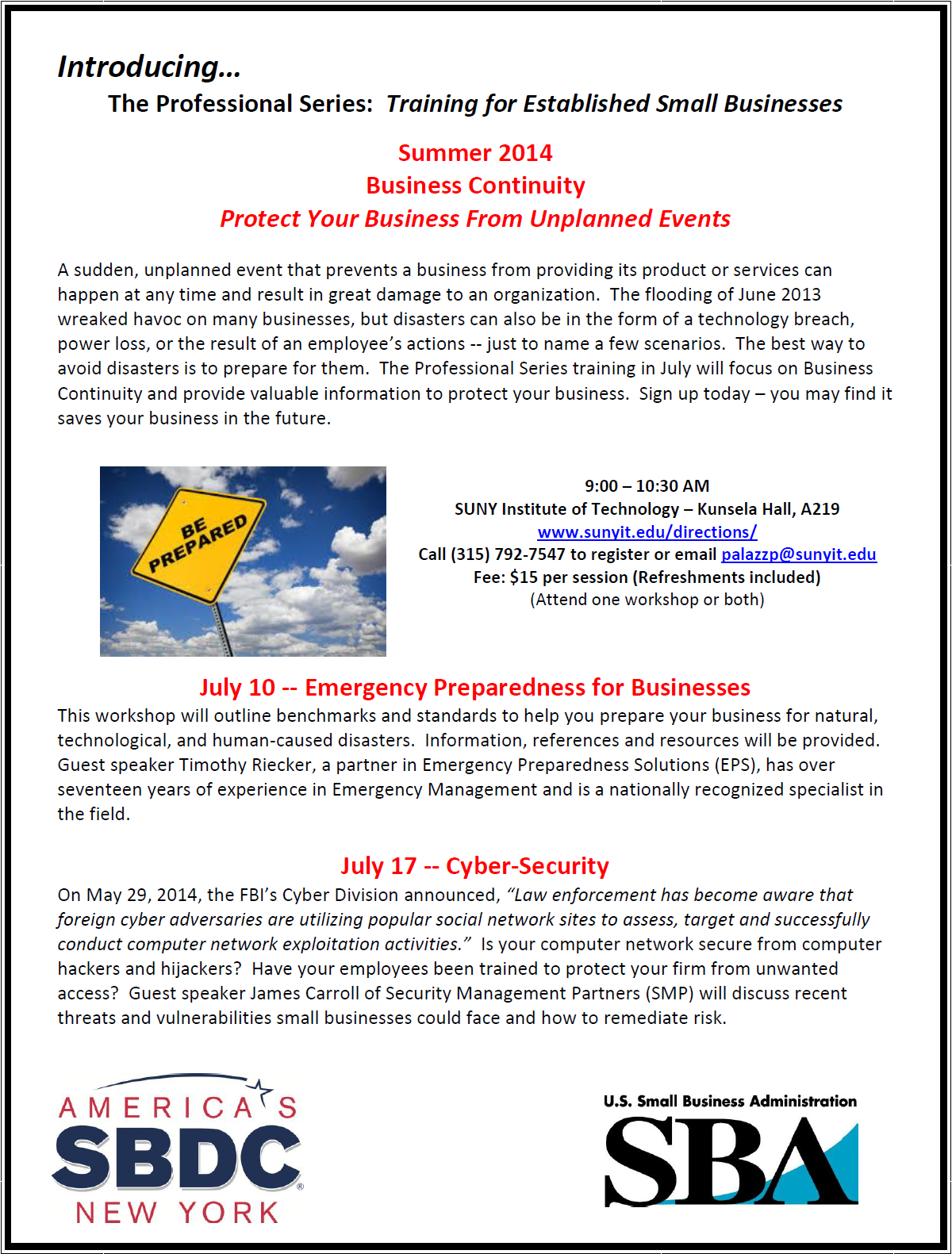
Business Continuity Training in the Mohawk Valley

I’m very pleased to be working with the Mohawk Valley Small Business Development Center (SBDC) in Utica, NY to present a seminar for small business owners and others who may be interested in how to prepare their businesses for disaster.  I’ll be providing information and resources on the steps you should take to prepare your business and your employees.  The seminar will be held on Thursday July 10 at the SBDC offices at SUNY IT from 9:00 – 10:30 am.  To register please call 315-792-7547 or email palazzp@sunyit.edu.  The workshop fee is $15.

There will also be a presentation on July 17 on Cyber Security conducted by Mr. James Carroll of Security Management Partners.  Registration and fee information is the same.

I hope to see you there!

MV Business Continuity Flyer

MV Business Continuity Flyer

Creating Operational Emergency Plans

I was inspired for this article from an email I received earlier today from Lu Canton, a rather prolific emergency management consultant who has branched a bit into consulting consultants.  His email today (a forward from his blog) was about making emergency plans ‘real’.  His point was that many planners focus on checking the boxes of the list of planning requirements (those prescribed by law, regulation, etc.) rather than focusing on ensuring that you have a plan that can actually be implemented.  He conducted a webinar over a year ago which I had blogged about.

Planning requirements are important, as they largely stem from lessons learned from earlier incidents.  Granted, some of these requirements come about being translated through the eyes and ears of politicians whose staffers write the legislation and don’t understand emergency management at all – resulting in convoluted, contradictory, and poorly focused requirements.  Requirements lead to standards, helping to ensure that emergency managers are addressing the needs of their jurisdiction and best practices in the industry.  To help guide us through this, many higher level agencies provide templates.  I’ve pontificated in the past about the danger of templates, which have a place in reminding us of these requirements and help us with format and flow, but are often misused by individuals who simply seek to fill in the blank with the name of the jurisdiction and claim they have a finalized plan.

How do we avoid falling into this trap?  Follow the planning process!  FEMA’s Comprehensive Preparedness Guide (CPG) 101 provides an overview of this process for creating emergency operations plans.  The two initial steps – forming a planning team and conducting a hazard analysis – are absolutely critical to the integrity of the process and ensuring a quality plan that meets the needs of your jurisdiction by addressing your threats and hazards.  Planning teams then need to consider these threats and hazards, make reasonable assumptions about their impacts (using a credible worst case scenario), then identify resources and strategies the jurisdiction will undertake to solve the problems they will face.

Does all this mean that a plan needs to be written from scratch?  Of course not!  In fact I strongly encourage people against it.  It’s practically guaranteed that you will forget a critical element.  One of the greatest things in the emergency management community is how we learn from each other.  You can reference templates you find, examine plans of your neighboring jurisdictions or jurisdictions similar to you, check out what is on LLIS.  There is plenty of great content you can examine and apply for your own use.  Just ensure that you carefully review and consider how it applies to you.

As you write the plan, think the details through.  This will help ensure that your plan is operational, not just meeting requirements.  Discuss with your planning team what is expected of each assisting and cooperating agency for each incident type.  Who will be in charge?  What resources will be necessary and where will you get them from?  What would the objectives be and what processes and decision points must be conducted to accomplish those objectives.  As you create the plan, map out these processes and ensure that you’ve considered the who, what, where, when, and how of each step in each process.  Recall that you are planning at a strategic level, not a tactical level.  Planning at a tactical level is nearly impossible with a pre-incident (aka ‘deliberate’) plan.  Tactics will be addressed during the actual response, hopefully referencing the EOP/CEMP you are writing now, and implemented through an incident action plan (IAP).

Remember, though, the proof is in the pudding, as they say.  Your plan needs to be tested to ensure viability.  Use a table top exercise to test policy and decisions, then a functional exercise to test the implementation of the plan and higher level tactics.  Full scale exercises and drills can test the tactical implementation of plans.  Good evaluation of the exercises will lead to planning improvements.  For insight on the exercise process, you can check out my exercise management series of posts referenced here.

Remember: when it comes to planning – keep it real!

Tim Riecker

Alan Weiss’ Weekly Morning Memo

From Dr. Weiss’ weekly e-mail to members…

This week’s focus point: The Boston tragedy demonstrated more than anything the basic goodness in people. Strangers helped others without hesitation. The requests of the authorities were accepted without whining or demands for exceptions. The capacity that we all possess to support, assist, and help others is extraordinary. Sometimes it takes trauma to highlight it, but the potential is there every day. It may be appropriate this week to think about donating time or money to a charity, coaching someone who needs help, or even giving someone a break trying to turn across traffic. We shouldn’t need catastrophe to bring out our true character.

Some great words to consider.

To my readers – sorry for my absence these last few weeks – I’ve been (and continue to be) on a disaster deployment. More to come!

Disaster Brokers

A brilliant and insightful blog post! A must read.

chrisrecovers's avatarRecovers

BCLC’s Richard Crespin writes about challenges in post-disaster corporate giving and local organizational efforts. Read the original article here. 

In eighth grade I had to pick an independent study project. It was the ’80s, the dawn of the Reagan Revolution, and it was cool to emulate Family Ties’ Alex P. Keaton (ok, maybe not cool, but cool enough for me), so I picked investing. This was before online brokers, before E-Trade, even before the Internet, so my dad took me down to the local Sears. That’s right. Sears. For some reason Sears had decided to offer financial services, so the local office of Dean Witter was squeezed between the lay-away desk and the lawn mowers.

iStock_000013843783Large

As I sat there, a kindly man in shirtsleeves and a tie explained capital markets. Brokers like him earned their money by knowing who wanted something (the buyer) and who had it (the seller). He served not only…

View original post 1,560 more words