A Disasterous Trend: Cuts in Preparedness Funding

This post was initially inspired by an article from CBS News on funding cuts to disaster preparedness programs.  These cuts go further and deeper than the current sequester cuts we are now seeing.  These cuts are a dangerous and disastrous trend.  To quote the article…

“In fiscal year 2010, Congress appropriated $3.05 billion to FEMA for preparedness grants designed to strengthen “our nation’s ability to prevent, protect, respond to, and recover from terrorist attacks, major disasters and other emergencies, …. In fiscal year 2012, that appropriation was less than half that figure – $1.35 billion. The same trend could be seen in FEMA pre-disaster mitigation grants, which fell from $100 million in 2010 to $35.5 million two years later.”

Have all the terrorists gone away?  Has Mother Nature stopped having temper tantrums?  Have stupid people stopped doing stupid things?  I don’t think so!  So why the cuts?

Let’s put some things in perspective… On one hand, we do need to have a bit of fiscal prudence and restraint.  GAO reports have repeatedly shown that many state and local governments are simply not spending down the grant funds they have been allocated.  DHS grants are backed up several grant years with unspent funds.  That said, as we peel back the layers of the onion, there are certain facts that need to be mentioned.  Why aren’t they spending the money they have been given?  First, grant periods have generally been too short.  The most significant reason for this is the inefficiency of bureaucracy we live in.  Follow this trail… The federal fiscal year begins October 1st.  The budget gets passed at some undermined point around that.  DHS, along with all the other agencies, get their allocations.  They then need time to formulate their grant guidance for the funds going to states and locals.  By the time states see this grant guidance and their respective allocations it’s usually close to the end of the second quarter of the federal fiscal year.  States then have to formulate their own grant guidance as they pass through funds to locals.  All this bureaucracy delays the grant year about six months.  Recognizing that nothing could be done about the bureaucracy, DHS finally extended grant years only recently, giving folks a more reasonable amount of time to spend the money.

Another reason why grant funds are slow to spend is that in most cases the grantees don’t actually ask for the money, therefore they don’t have a budget prepared beforehand.  DHS distributes funds based upon a formula.  While an application exists, it’s nothing more than an afterthought and formality.  That leaves states and locals with a pile of cash and no plan on how to spend it.  Here lies the beginning of the breakdown in accountability.  Now most folks will say that it’s easy to spend money.  In government, not so much.  Especially when you consider a few factors: 1) every level of government has spending rules (accountability is a good thing, but that can get in the way of efficiency when RFPs have to be issued for darn near everything); 2) a great deal of equipment was purchased in the big push of funds immediately surrounding 9/11 – what else do we need?; and 3) grants are restricting what funds can be spent on (i.e. there are limits on personnel (salary) expenses, and the purchase of disposables and maintenance costs of equipment – which are of particular importance for exercises).

So governments don’t have a lot of time to spend the money and face a few obstacles in getting the money spent.  But how is this a factor of cuts?  One reason for these cuts is that Congress is seeing that states and locals have a lot of money left over going back several grant years.  Failing to realize the whys and wherefores of it all, they are simply giving less money (because, to them, it’s not needed – but nothing could be further from the truth!).  They are also looking to reduce spending overall, as the article cites, and that’s a hit that will impact nearly everyone.

Taking a look at the grantees, however, there are a few criticisms.  Better and more proactive fiscal planning needs to be implemented.  Costs should be forecasted out several years to better anticipate needs.  They may, sadly, have to trim programs and streamline operations (although most emergency management programs certainly are not living in the lap of luxury).  They also need to be more creative with the declining funds they receive, especially through partnerships and regionalization.  An area doesn’t need to be regarded as a UASI or Catastrophic Planning Zone to work cooperatively as a region, which should include some pooling of funds for collective projects.

What can be approached regionally?  Most preparedness efforts fit well into that category: planning, training, and exercising.  Think about it, you work with your neighbors all the time and disasters don’t seem to stop at the county line, so why not make your cooperation more effective and efficient?  In the absence of regional catastrophic planning, which most areas don’t need to do, consider planning for some credible worst case scenarios and cascading impacts such as flooding and mass care.  Obviously regional mutual aid planning is essential.  How about working with your public health partners?  What about the private sector – how can you strengthen your relationships with them?  Regional planning conferences are a good start!  Regionalized training is obviously a no-brainer and regional exercises are essential making sure that the planning and training are effective and to give folks an opportunity to practice what they have learned.  Lastly, speaking as someone who has experience working for government and as a consultant, in many cases it’s actually more cost-effective and easier to coordinate regional preparedness activities by hiring a consulting firm, some of which have proven experience and expertise in working with the multiple stakeholders that a regional effort would include.

As we face reduced funding, we have to be more creative, cooperative, and communicate specific needs on a regular basis up the chain of government.  If you are with county or local government, let the state know what your needs are.  And don’t just tell them once – be sure to repeat yourself – not in an annoying wintertime house fly kind of way, but when the appropriate opportunity presents itself.  Make sure that you show justification for your needs through after action reports and documented strategies and plans.  Ask the State to take these needs up to federal partners – and when you have the opportunity to speak with these federal partners directly, take advantage of it; be they representatives of FEMA or your local representative of Congress or US Senator.  Remember to be specific and cite the need.  Don’t complain but be direct.  With funding that emergency management programs simply receive without asking being on the decline, we need to be proactive about receiving funds.

Emergency management and, to a greater degree homeland security, have been fortunate to have a good deal of funding over the last decade.  There has been so much money, though, with such short time lines, that things haven’t been done as well as they should have.  Now is the time to re-tool and reexamine how we do business.  Conduct needs assessments to determine what should be focused on and build upon community partnerships.  Consider what the community as a whole – the citizens – are willing to help in preparedness; as well as the private sector.  Whole-community partnerships have perhaps never been so important as they are now.

How to Replace Five Common Vital Records

I was sent the following from USA.gov on Friday.  It’s a good reminder to keep copies of these documents so you at least have a starting point and can reference the registration numbers of each.  I also keep copies of my driver’s license and credit cards (all front and back).

From a business perspective, you should also consider what documents you maintain copies of.  What records are vital to you?  Are the copies up to date?  Are they stored off-site?


How to Replace Five Common Vital Records

Vital records, like birth and marriage certificates and military service records are often necessary to access a variety of government benefits and services. But sometimes life happens and those vital records go missing. Maybe they were misplaced in a move, were stolen or got damaged in a fire.

USA.gov has information to help you find copies and replacements of your vital records so you can apply for whatever benefits and services you need.

Birth, Marriage and Death Certificates

These records come from the states. To find a copy, you’ll have to contact that state office where the life event occurred. Find the contact information for state and territory offices that can help you.

Passport

Report lost or stolen passports to the State Department right away by calling 1-877-487-2778. To report and replace the lost or stolen passport, you’ll have to submit forms DS-11 and DS- 64 in person at a passport agency or acceptance facility. If you lose a passport, and then find it again, you won’t be able to use it to travel. You should return the lost passport and request a new one.

Military Service Records

You often need copies of military service records to apply for a variety of government programs available for veterans, like health care, retirement or education benefits. The National Archives keeps copies of all veterans’ services records, and you can apply online to receive a copy of yours or an immediate family member’s if they are deceased. If you prefer to mail or fax a request for your records, you can download form SF-180. You can also find out how to replace lost military medals and awards.

Social Security Card

If you can’t find your Social Security card, you may not actually need to replace it. As long as you know your Social Security number, you will still be able to collect Social Security benefits, get a job and apply for many government benefits and services. However, if you do want to replace the card, you’ll need to gather documents proving your identity and citizenship to mail or take to a local Social Security office.

Green Card

If you have a U.S. Permanent Resident (Green) Card, you may need to replace it if it was lost, stolen or damaged or if your name or other biographical information has legally changed since it was issued. You can easily request a new one online. If you’re outside the United States and have lost your green card, you should contact the nearest U.S. consulate or immigrations office before you apply online for a new card.

If you need help getting copies of other vital records like tax returns or school records, you can find the information you need to replace them at USA.gov.


Managing an Exercise Program – Part 8: Preparing Support, Personnel, & Logistical Requirements

This post is part of a 10-part series on Managing an Exercise Program. In this series I provide some of my own lessons learned in the program and project management aspects of managing, designing, conducting, and evaluating Homeland Security Exercise and Evaluation Program (HSEEP) exercises. Your feedback is appreciated!

Managing an Exercise Program – Part 1

Managing an Exercise Program – Part 2: Develop a Preparedness Strategy

Managing an Exercise Program – Part 3: Identify Program Resources and Funding

Managing an Exercise Program – Part 4: Conduct an Annual Training & Exercise Planning Workshop.

Managing an Exercise Program – Part 5: Securing Project Funding

Managing an Exercise Program – Part 6: Conducting Exercise Planning Conferences

Managing an Exercise Program – Part 7: Develop Exercise Documentation

Managing an Exercise Program – Part 8: Preparing Support, Personnel, & Logistical Requirements

Managing an Exercise Program – Part 9: Conducting an Exercise

Managing an Exercise Program – Part 10: Evaluation and Improvement Planning

As I forge ahead in this series on Managing an Exercise Program (thank you all for reading!!), I expect the revised Homeland Security Exercise and Evaluation Program (HSEEP) foundation document to be released soon from the US Department of Homeland Security (DHS).  Once that document is released, I’ll be sure to include a summary update in my blog.  Having been a reviewer of the draft document about a year ago, I don’t expect a lot of changes, but what does change will have some bits of significance on how we do business in the design, conduct, and evaluation of preparedness exercises.

This installment of Managing an Exercise Program gets us two steps away from actually conducting the exercise.  As you can see, putting an exercise together is no small feat.  I find that this particular step: Preparing Support, Personnel, and Logistical Requirements, is the one most often glossed over in documents and training.  As an example, HSEEP Volume I dedicates only one paragraph to exercise logistical support.  As Volume I states in its single paragraph, logistical elements ‘can make the difference between a smooth, seamless exercise and one that is confusing and ineffective.’  Let’s break down our considerations:

The location of the exercise is of significant concern.  Often times we are examining facilities, but some exercises are conducted outdoors with no use of facilities at all.  If outdoors, you still need to ensure the proper environment and support services, such as restrooms, being available.  If your exercise requires water for fire suppression, then proximity to hydrants is essential, unless you are looking to incorporate tanker operations into your exercise.  We’re looking for a location that is minimally disruptive to the surrounding area, including traffic and ensuring citizen safety.  Consider the need for public messaging, such as static displays, variable message signs (you can get these from your public works connections), and media releases to inform the public of the exercise.  Doing so will help satisfy their curiosity, will give you some positive media exposure, and will help you minimize disruption.  As an example, I’ll cite an urban search and rescue (USAR) component of the Vigilant Guard New York exercise which I led.

Working with local officials, our USAR specialist and a representative of the New York National Guard exercise team were able to select an appropriate cite for their activities.  Set up was extensive, involving multiple loads of building demolition debris and a few cars to be hauled in and specifically placed with the use of heavy equipment.  On one side of this lot were a number of three-story apartment buildings, which we sought to minimize impact to.  All hauling and set up operations took place during the day while exercise activities, which were 24 hour operations for several days, were minimized during the night.  USAR folks come with a lot of equipment… and I’m not just talking a few boxes of stuff, either.  Many have tractor trailers and cargo containers to transport their gear.  They set up tents where they can unload and unpack much of their gear and provide areas for briefing and down time for personnel.  This exercise brought in first responder and National Guard USAR assets from around the state, other states, and Canada.  An eating area needed to be on site as well as sanitation.  Obviously all these areas needed to be well out-of-the-way of operational areas of the exercise to ensure safety and allow room for the rescue activities.  Portable diesel-generated light towers were set up to support night-time operations.  A media time was scheduled to allow media to catch some of the action during the week as well.  Since some teams were only coming in to exercise for a day, a schedule needed to be established to ensure that they could be accommodated and a traffic plan had to be established to get them to the site.  The exercise, which included multiple venues, covered a period of time which included Election Day.  With caravans of first responder and National Guard equipment rolling through the area during this time period, we were sure to schedule movements off rush hour and I even had a conversation with the County Board of Elections.  In this conversation I briefed them on the locations and activity of the exercise to ensure that it didn’t interfere with their polling locations and provided them with my cell number which I told them to call if there was even the slightest hint of a problem or complaint.

Indoor exercises require the same measure of preparation.  You have to ensure that the spaces you use are safe and large enough to accommodate participants.  You may have a need for one or more break out rooms or meeting rooms, both for exercise management staff and for players.  Unless players are responsible for setting everything up themselves, ensure that power, internet, and telephonic communications are available for them… and can support their needs.  Back to Vigilant Guard, the EOC component of the exercise was significant.  Based on anticipated use, we actually brought in state emergency management capability for satellite digital communications to support the simcell with internet with phone so we wouldn’t draw on and degrade the in-house capability for players in the EOC.  Similar to an outdoor venue, you need to pay heed to needs for parking, restrooms, and food service.  It’s also a good media opportunity, so be sure to schedule that well in advance with the media and some VIPs.

In regard to personnel, we’ve touched upon the need for controllers, evaluators, and simulators in previous posts, mostly in regard to planning these needs and ensuring that they are covered with the necessary documents to help with their tasks, such as exercise evaluation guides (EEGs), controller/ evaluator plan, master scenario events list (MSEL), and Exercise Plan.  Identify the exercise leadership early – the exercise director, simcell and MSEL managers, and lead controller and evaluator.  These individuals, and the supporting staff for them, including simulators, controllers, and evaluators, are likely to come from your exercise planning team.  Some may have experience in these tasks, while others may not… something to keep in mind for development of the documents as well as the briefings you conduct for them just prior to the start of the exercise (that’ll be the next part of this series).  Don’t just assign folks randomly to positions, draw on their experience.  If someone has a strong EMS background, assign them to be controllers, simulators, or evaluators for that area of practice.  Be sure that your simulators also have some local experience as well if you are conducting this exercise for an area outside your own.  Local flavor brings realism and context to an exercise for the players.  Consider radios for controllers and evaluators, especially in large exercise areas.  This will allow the exercise director to speak with them and for them to interact with the simcell, letting them know if they need to speed up or slow down.  Also consider providing the exercise director with an assistant on large exercises.  Often times I’ve found the need for someone to aid me directly in resolving problems, gathering people, and handling miscellaneous tasks that are too much for any one person to handle.  It’s also a great learning experience for someone who wants to advance.

Overall, be sure to plan early for all logistical, support, and personnel needs.  Plan early for food contracts, ensure that all participants have the necessary supplies to conduct their jobs.  Plan ahead for safety as well, ensuring a safe work environment proactively and a good plan and personnel who can react to situations should they arise.  Be ready on-the-fly for changes and little or no-notice occurrences, as they almost always happen!  Make sure the players have everything they need for the exercise – if not, that lack of preparedness will be what they remember.

What experiences or ideas do you have with supporting an exercise?

Emergency Management and Considerations for Visiting Populations

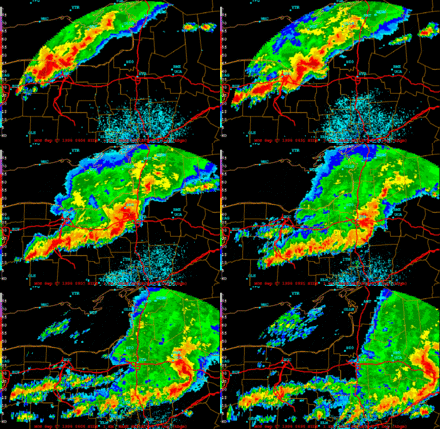
Radar loop, Labor Day 1998 Upstate New York.  This storm impacted the New York State Fair.

Radar loop, Labor Day 1998 Upstate New York. This storm impacted the New York State Fair.

The inspiration for this blog was a paper posted to LLIS by Dr. Susanne Becken, Professor of Sustainable Tourism at Griffith University (Australia) and Lincoln University (New Zealand).  The paper is titled The Christchurch Earthquake and the Visitor Sector, which is also available from this link if you don’t have LLIS access.

Dr. Becken highlights the Christchurch earthquake of February 22, 2011, which killed 185 people from more than 20 nations, 80 of which were listed as visiting, rather than residing in, Christchurch.  She states that as a result of this M 7.1 earthquake infrastructure was badly damaged, accommodation capacity was reduced by half, and the number of international visitors dropped by almost 30 percent in the aftermath.  Dr. Becken identifies many of the challenges visitors had, including loss of travel documentation and other important items, and the value of the tourism industry in the area to assist response efforts (such as providing lodging for displaced citizens as well as responders from out of the area).

This paper brings to mind the vast amounts of visitors and transient populations that are found in many communities across the nation.  When visiting an attraction such as an amusement park, where tens of thousands of people congregate on any given summer day, take a look around.  Many of the amusement parks I know of are in fairly rural areas.  These towns are likely to have small volunteer fire departments and may not even have their own police services, instead relying on a county Sheriff’s Department or State Police.  How about a small city that has popular attractions at certain times of the year, such as horse tracks or other sporting events?  These events will also draw tens of thousands of people from near and far, staying in hotels, motels, and campgrounds.  Sure, these small cities might have a 24-hour staffed fire department, and probably even a small police force.  But how prepared are these types of areas for an incident that can cause mass casualties and fatalities?

Incidents such as this underscore the need for our preparedness to be through and needs-based.  As part of our Threat and Hazard Identification and Assessment (THIRA), which is the latest evolution of the traditional hazard analysis (see CPG-201), we must be sure to recognize visitors and transient populations and the events that bring them to our areas.  We should consider tourist attractions, field days, concerts and performances, large conventions, sporting events, and even college populations.  The potential impacts, in the event of a disaster, are certainly greater with these populations given that they are likely to be unfamiliar with the area, don’t reside locally and probably have no local contacts, and aren’t familiar with the threats.  Given the nature of the event they are attending, they may very well be consuming alcohol, as well.  All this makes for a rather fragile and dependent population in the event of disaster.

Planning on the macro (community) level should consider the specifics mentioned above.  With this information you can estimate the resources needed for certain scenarios (this is part of your THIRA), which will lead you determine gaps which you then plan to address.  Take some time to examine the demographics of the visiting populations.  These demographics will help determine their level of need in the event of a disaster and some areas of support you may need to provide.  Your local chamber of commerce and/or tourism authority can be an important planning partner for this information and other purposes.  Certainly consider the nature of the events and the age range of the attendees.  Are there language or cultural issues that should be prepared for?  Much of this specific information can be obtained event by event, looking at the micro (event-specific) level of planning for these events.  In New York State, a mass gathering permit is supposed to be issued for any event estimating attendance over a certain number.  The primary purpose of these permits is to ensure that officials are aware of the event and that potable water and sanitation is appropriately available, as well as other caveats.  Most states have a similar type of permitting requirement.  Become familiar with it and use it to your advantage.

In any of these events, how will you handle alert and notification in the event of a disaster?  You may have sirens in place, but would a visitor know what it means?  Given that such a high percentage of people have cell phones, use of area blast messaging may be an appropriate consideration.

A lesson learned from airline crashes can and should be brought into your planning: family assistance centers.  Family assistance centers were brought about in the aftermath of the crash of TWA Flight 800, realizing the importance of providing support and information to the families and loved ones of victims.  This concept has been applied as a standard to other mass fatality incidents since then and has proven to be beneficial to all parties.

Be sure to conduct preparedness exercises on these plans, and include members of your local hospitality and tourism industry as they will certainly be involved in some aspect of the greater response should an incident occur.

Sometimes local communities view visiting populations as a hassle, particularly when they don’t have the care for the host community that the locals do.  These populations are usually important to the economy of the local area and, depending in the event, will be back year after year.  No matter what your take is on that argument, you must consider the safety of any visitors or tourists as if they were your own citizens.  Be prepared through regular planning, training, and exercising activities and be sure to include your local chamber of commerce, tourism and hospitality industry as they are not only stakeholders, but they have a great deal of support and information to provide.  Most importantly, remember that all good preparedness efforts begin with a solid needs assessment.  Conduct a THIRA for your community, you might be surprised with what you discover!

What experiences do you have with planning for visiting populations?

Lucien Canton Webinar Recording: Are Your Emergency Operations Plans Realistic?

Last week EM Forum hosted one of the better webinars I’ve attended recently.  The presenter was Lucien Canton, CEM, a fellow Emergency Management Consultant.  His topic was “Are your emergency operations plans realistic?  A group discussion on planning assumptions”.  This presentation was in obvious response to his excellent blog article, Paper Plans and Fantasy Documents, which I blogged about a few weeks ago.  In both his article and the webinar, Lu talks about the need to ensure that plans make sense and can actually be implemented, not just cover legal requirements.

For ease, I’ve pasted the EMForum follow up email here, which provides a link to the webinar recording in various formats.  Highly recommended if you didn’t catch the original airing!


The Webinar recording of the February 13th EMForum.org program, “Are Your Emergency Operations Plans Realistic? A Group Discussion on Planning Assumptions,” with emergency management consultant, Lucien G. Canton CEM®, is now available. This is a large file and requires Windows Media Player or Windows Media Components for QuickTime or a similar product to view. The recording is also available in MP4 format for mobile users. The TranscriptAudio Podcast, as well as Ratings and Comments are available from the Background Page. The Audio Podcast and MP4 recordings are also available from the iTunes Store.

Collegiate Emergency Management

Ever since attending college at SUNY Oswego and serving as chief of our campus ambulance (the first and longest-serving all student-run college ambulance – SAVAC) I’ve had a completely different perspective than most students on the community that is a college campus.  This experience resonated with me through my emergency management career.  As a result, I’ve paid special attention to colleges and universities; helping university police, college public safety entities, and other campus partners to be better prepared by providing training, supporting exercises, and reviewing plans.  I’m fortunate to have friends and colleagues around the nation who are emergency managers for their colleges as well as those who are involved in emergency management degree programs which further the professionalism of our field.  All these folks have worked hard to enhance their colleges’ preparedness through efforts not only targeting college faculty and staff, but also students – which can be a challenge with this regularly changing population.  I’ve seen training offered to students ranging from CPR and First Aid courses, to Campus CERT (community emergency response team), to EMT training.  These types of courses, offered to students, are certainly an investment, but one that can pay off not only for the campus community but beyond the campus when these students graduate.

Colleges and universities have a tremendous amount of resources.  These resources allow a certain measure of self-sufficiency.  I was reminded of this by a recent article about Tufts University working to keep their campus operational after Nemo.  Campuses are truly communities, with hundreds or thousands of residents, hundreds of commuters, and an infrastructure to support it all including roads, facilities, healthcare, and food.  Not only must they have emergency plans in place, but also business continuity plans.  Largely, their number one hazard is fire – and colleges take fire safety very seriously – but they all have their own unique hazard profile which they must address just like any other community.

I have always encouraged colleges to work with their local communities and vice-versa.  There are a number of case studies out there, certainly of local communities aiding campuses during fires, shootings, and other emergencies and disasters.  But there are also instances of colleges helping the local communities.  Not only do campuses have public safety resources (these encompass the entire range of law enforcement – from security guards, to peace officers, to police), but they also have some public works resources, and a vast number of potential volunteers that can all be deployed to aid a local community.  Depending on the education the college provides, these volunteers can range from general labor, to those being trained as social workers, medical providers, veterinarians, and other professions which can provide direct assistance under the supervision of an experienced professional.  This is not only a huge force multiplier to aid the community but also provides real, hands-on experience to the students.  Likely an experience they will never forget.  We’ve also seen colleges and universities provide assistance to local communities on-campus.  Campuses have served as shelters (both in dorms and other facilities, such as gymnasiums) and feeding facilities through their dining halls.  When off term, campuses have massive potential to serve as incident bases, supporting the needs of a larger incident by providing services for incident personnel and resources (remember your ICS training?) through their lodging and feeding capability, medical facilities, loading docks, garages and maintenance facilities, and even just their open spaces.

Colleges and universities have to ensure their own preparedness just like any other community, but they should also work with their local communities and even their county emergency manager on cooperative emergency management relationships.  Local responders should be familiar with the campus, its hazards, facilities, and the people who operate it.  The campus can further relationships by hosting training programs for area responders and emergency managers and should include area responders in any preparedness exercises they conduct.  Engaging the student population in preparedness efforts will have great impact on the campus’s emergency program and will provide skills that the students will carry with them forever.

The Leading Edge of CyberSecurity… Where is it?

Tim RieckerI finally had a chance to read through Homeland Security Today’s publication of The Leading Edge Today.  The January edition was focused on cyber security.  The Producer’s Corner article (i.e. letter from the editor), cites a study and report compiled by Verizon and other entities from around the globe, including the US Secret Service.  This report, called the 2012 Verizon Data Breach Investigations Report, is staggering.  They cite 855 confirmed cases of enterprise data loss and say that most entities that are hacked aren’t aware of it for weeks or months – and are usually notified by someone else of the incident (i.e. law enforcement or an enterprise internet security firm).  The remainder of the publication offers some good information and insight on trends and prevention activities in the realm of cyber security.

Obviously The Leading Edge Today was published prior to the President’s signing of the cyber security executive order just a couple of days ago.  All reports so far indicate that the executive order really has no teeth.  It’s not law and only provides recommendations, although it does call for the establishment of a Cyber Security Framework (perhaps to parallel the National Response Framework?) and calls for the NIST to establish the standards of this framework.  DHS is charged with sector-specific outreach to engage the private sector.  It’s not the full package of what our nation needs, but it’s a start.  It’s apparently a political throwing-down of the glove to challenge Congress to promulgate and pass a cyber security bill.

I’ve not had the chance to do any research on it, but what are other nations doing?  I imagine that there must be countries out there who have not dragged their feet as much as we have on this matter; and hopefully they have been able to implement not only strategic plans that outline progress, but have also implemented tighter defenses.  This may also be an opportunity for a global defense against cyber crimes – particularly in consideration of the perpetrators and the victims often times being from around the world.  In my eyes, this cyber terrorism needs to be viewed as an attack on our sovereignty, on our economy, and on our personal and corporate privacies.  To fight it is to wage war against those who perform it and those nations who sponsor it – just like any other act of terrorism.