Active Shooter Info from DHS

Good active shooter info from DHS.

Bruce Harman's avatarThe Security Takeaway

The tragedy in Newtown, Conn.  raised awareness of the Active Shooter threat. Listed below please find links to a number of reference and training resources which highlight response to the Active Shooter threat.

DHS Reference Materials:

DHS, Active Shooter – Booklet:   How to Respond www.dhs.gov/xlibrary/assets/active_shooter_booklet.pdf

 FEMA Online Courses:

Active Shooter:  What You Can Do http://training.fema.gov/EMIWeb/IS/IS907.asp


View original post

10 Myths About Mass Shootings

Last night I came across a blog by James Alan Fox, a Professor of Criminology, Law, and Public Policy at Northeastern University.  The blog was posted in the Chronicle of Higher Education and provides some interesting information relative to mass shootings.  Sadly, it doesn’t provide us with any conclusions or solutions, but does dispel some of the concepts and information that are out there about mass shootings.  Information like this will hopefully prevent us from diving into knee-jerk reactions.

The worst part of all this is that there is often times not actionable intelligence that law enforcement can follow-up on to prevent these types of incidents.  It’s not anything like an organized terrorist effort that involves a great deal of communication between conspirators.  The result is that mass shootings can occur literally anywhere and at any time.  Schools, movie theaters, community centers, malls, restaurants, and post offices are all among the places we go and expect to be safe.  We all wish we had an answer.

Here’s Professor Fox’s blog…

Top 10 Myths About Mass Shootings

December 18, 2012, 2:42 pm

By James Alan Fox

Even before the death toll in last Friday’s school massacre in Newtown, Conn., was determined, politicians, pundits, and professors of varied disciplines were all over the news, pushing their proposals for change. Some talked about the role of guns, others about mental-health services, and still more about the need for better security in schools and other public places. Whatever their agenda and the passion behind it, those advocates made certain explicit or implied assumptions about patterns in mass murder and the profile of the assailants. Unfortunately, those assumptions do not always align with the facts.

Myth: Mass shootings are on the rise. Reality: Over the past three decades, there has been an average of 20 mass shootings a year in the United States, each with at least four victims killed by gunfire. Occasionally, and mostly by sheer coincidence, several episodes have been clustered closely in time. Over all, however, there has not been an upward trajectory. To the contrary, the real growth has been in the style and pervasiveness of news-media coverage, thanks in large part to technological advances in reporting.

Myth: Mass murderers snap and kill indiscriminately. Reality: Mass murderers typically plan their assaults for days, weeks, or months. They are deliberate in preparing their missions and determined to follow through, no matter what impediments are placed in their path.

Myth: Enhanced background checks will keep dangerous weapons out of the hands of these madmen. Reality: Most mass murderers do not have criminal records or a history of psychiatric hospitalization. They would not be disqualified from purchasing their weapons legally. Certainly, people cannot be denied their Second Amendment rights just because they look strange or act in an odd manner. Besides, mass killers could always find an alternative way of securing the needed weaponry, even if they had to steal from family members or friends.

Myth: Restoring the federal ban on assault weapons will prevent these horrible crimes. Reality: The overwhelming majority of mass murderers use firearms that would not be restricted by an assault-weapons ban. In fact, semiautomatic handguns are far more prevalent in mass shootings. Of course, limiting the size of ammunition clips would at least force a gunman to pause to reload or switch weapons.

Myth: Greater attention and response to the telltale warning signs will allow us to identify would-be mass killers before they act. Reality: While there are some common features in the profile of a mass murderer (depression, resentment, social isolation, tendency to blame others for their misfortunes, fascination with violence, and interest in weaponry), those characteristics are all fairly prevalent in the general population. Any attempt to predict would produce many false positives. Actually, the telltale warning signs come into clear focus only after the deadly deed.

Myth: Widening the availability of mental-health services and reducing the stigma associated with mental illness will allow unstable individuals to get the treatment they need. Reality: With their tendency to externalize blame and see themselves as victims of mistreatment, mass murderers perceive the problem to be in others, not themselves. They would generally resist attempts to encourage them to seek help. And, besides, our constant references to mass murderers as “wackos” or “sickos” don’t do much to destigmatize the mentally ill.

Myth: Increasing security in schools and other places will deter mass murder. Reality: Most security measures will serve only as a minor inconvenience for those who are dead set on mass murder. If anything, excessive security and a fortress-like environment serve as a constant reminder of danger and vulnerability.

Myth: Students need to be prepared for the worst by participating in lockdown drills. Reality: Lockdown drills can be very traumatizing, especially for young children. Also, it is questionable whether they would recall those lessons amid the hysteria associated with an actual shooting. The faculty and staff need to be adequately trained, and the kids just advised to listen to instructions. Schools should take the same low-key approach to the unlikely event of a shooting as the airlines do to the unlikely event of a crash. Passengers aren’t drilled in evacuation procedures but can assume the crew is sufficiently trained.

Myth: Expanding “right to carry” provisions will deter mass killers or at least stop them in their tracks and reduce the body counts. Reality: Mass killers are often described by surviving witnesses as being relaxed and calm during their rampages, owing to their level of planning. In contrast, the rest of us are taken by surprise and respond frantically. A sudden and wild shootout involving the assailant and citizens armed with concealed weapons would potentially catch countless innocent victims in the crossfire.

Myth: We just need to enforce existing gun laws as well as increase the threat of the death penalty. Reality: Mass killers typically expect to die, usually by their own hand or else by first responders. Nothing in the way of prosecution or punishment would divert them from their missions. They are ready to leave their miserable existence, but want some payback first.

In the immediate aftermath of the Newtown school shootings, there seems to be great momentum to establish policies and procedures designed to make us all safer. Sensible gun laws, affordable mental-health care, and reasonable security measures are all worthwhile, and would enhance the well-being of millions of Americans. We shouldn’t, however, expect such efforts to take a big bite out of mass murder. Of course, a nibble or two would be reason enough.

Managing An Exercise Program – Part 2: Developing the Preparedness Strategy

This post is part of a 10-part series on Managing an Exercise Program. In this series I provide some of my own lessons learned in the program and project management aspects of managing, designing, conducting, and evaluating Homeland Security Exercise and Evaluation Program (HSEEP) exercises. Your feedback is appreciated!

Managing an Exercise Program – Part 1

Managing an Exercise Program – Part 2: Develop a Preparedness Strategy

Managing an Exercise Program – Part 3: Identify Program Resources and Funding

Managing an Exercise Program – Part 4: Conduct an Annual Training & Exercise Planning Workshop.

Managing an Exercise Program – Part 5: Securing Project Funding

Managing an Exercise Program – Part 6: Conducting Exercise Planning Conferences

Managing an Exercise Program – Part 7: Develop Exercise Documentation

Managing an Exercise Program – Part 8: Preparing Support, Personnel, & Logistical Requirements

Managing an Exercise Program – Part 9: Conducting an Exercise

Managing an Exercise Program – Part 10: Evaluation and Improvement Planning


In my last post, I outlined the initial needs of managing a preparedness exercise program, including sources of information for a preparedness assessment.  Recognized as a best practice, I’m following the model of the Homeland Security Exercise and Evaluation Program (HSEEP).  The next step of program management is developing a preparedness strategy.

HSEEP Cycle

HSEEP Cycle

The development of a preparedness strategy is an activity that will involve the highest levels of your organization.  Drawing upon the data collected in the last step (the preparedness assessment), the preparedness strategy will address overcoming the identified gaps in your preparedness.  The mnemonic to remember here is POETE or Planning, Organization, Equipment, Training, and Exercises.  The gaps you identified in your assessment should fall into one of these categories.

Once you have catalogued your gaps, you must develop strategies to overcome each gap.  Here are some helpful hints in strategic planning:

1) Define the gap and identify the underlying cause(s).

2) Create objectives to overcome each gap.  Remember that objectives must be SMART (Specific, Measurable, Attainable, Realistic, and Time-oriented).

3) Establish priorities.  Some gaps may have a higher priority to accomplish based on the vulnerability they pose, legal or regulatory requirements, or other matters.  Additionally, some objectives may need to be accomplished prior to others for many of the same reasons, as well as practical flow of processes.

4) Assign required actions – identify specific actions required to accomplish each objective (there may be several).  Identify who will be responsible for each action and who will be responsible for supporting their work.  Establish a realistic deadline.  NOTE: some gaps may take a long time (years) to overcome.  As such, do the best you can to outline objectives and keep in mind that strategic plans are ‘living documents’.  Early on, you may not be assigning tasks to overcoming certain gaps, but someone will be responsible for monitoring related issues.

5) Marry needed resources to each action item established above.  This may be personnel, funding, facilities, etc.

6) As work is being done to accomplish these tasks, continual monitoring and assessment is necessary to ensure that everyone is staying on track and that the strategic plan continues to reflect the direction and priorities of today.

There are many references out there for strategic planning.  With a bit of insight you can translate this guidance into something useful for these purposes.  The end goal of this step is to have a document in hand that identifies what your organization needs to accomplish to be better prepared.  From this, you will soon develop exercise goals which will be the cornerstone of your exercise program.

What successes have you found from your strategic planning experience?

Coming soon – Managing an Exercise Program Part 3: Identifying Program Resources and Funding.

Managing an Exercise Program – Part 1

This post is part of a 10-part series on Managing an Exercise Program. In this series I provide some of my own lessons learned in the program and project management aspects of managing, designing, conducting, and evaluating Homeland Security Exercise and Evaluation Program (HSEEP) exercises. Your feedback is appreciated!

Managing an Exercise Program – Part 1

Managing an Exercise Program – Part 2: Develop a Preparedness Strategy

Managing an Exercise Program – Part 3: Identify Program Resources and Funding

Managing an Exercise Program – Part 4: Conduct an Annual Training & Exercise Planning Workshop.

Managing an Exercise Program – Part 5: Securing Project Funding

Managing an Exercise Program – Part 6: Conducting Exercise Planning Conferences

Managing an Exercise Program – Part 7: Develop Exercise Documentation

Managing an Exercise Program – Part 8: Preparing Support, Personnel, & Logistical Requirements

Managing an Exercise Program – Part 9: Conducting an Exercise

Managing an Exercise Program – Part 10: Evaluation and Improvement Planning


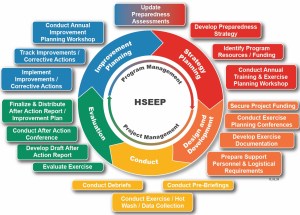
From inception to improvement planning, I think preparedness exercises provide great value to the jurisdictions, companies, and organizations that do them.  From a seminar to a full-scale exercise, there is much to be learned by participants as well as the strengths and areas for improvement identified from emergency plans.  I’ve been inspired to write a series of blog posts on each of the phases within the Homeland Security Exercise Evaluation Program (HSEEP) cycle.  The cycle, shown below, encompasses not just the steps in executing an exercise (project management), it includes exercise program management as well, which I think is often neglected.  Doings exercises is great, but to ensure continuity, quality, and continuous improvement, any entity that does exercises should have an exercise program.  Having a structured exercise program will ensure that your organization capitalizes on your exercise investments to the greatest degree possible.  Just like any other functional program, it needs to be managed.
HSEEP Cycle

Each blog post will give some insight and lessons learned from my own experiences with exercises large and small and I will reflect on exercise program management responsibilities throughout the cycle.  For more in-depth information on exercise program management, I refer you to HSEEP Volume I.  I will also have an update on this HSEEP volume in the near future as DHS will soon release a revision.

The first thing I want to cover is exercise program management as a general concept.  As stated in HSEEP Volume I, “Exercise program management is directed toward achieving the objectives established during the multi-year planning process…”.  As an exercise program grows, so should the responsibilities of managing it.  Most organizations don’t need a full-time exercise program manager, but they will require someone with the flexibility to vary how much time they spend on the exercise program.  The planning and conduct of an exercise can take up a considerable amount of time, and the program manager needs to shepherd this process.  In small organizations, the exercise program manager may be one of the few people involved in these activities as well.

Obviously the person in charge of an exercise program needs to be knowledgeable and experienced in exercises.  As with the oversight of any program, you need to have the right person in place.  Some caution should be used here, however – there are plenty of folks with LOTS of exercise experience… BUT the vast majority of experience out there is as a player.  Players, as a general rule, don’t experience all the machinations behind putting an exercise together.  Someone may have been a player in the largest exercise known to human kind, but that doesn’t make them adept at exercises.  There is plenty of training out there addressing various areas of exercises: the HSEEP training course, Exercise Design, Exercise Evaluation, and others.  These are great – but the world is full of ‘trained’ people.  Do they have the experience to do the job?  It doesn’t take a lot of experience, in fact, in my opinion, a little experience can go a long way – especially if it’s the right experience and they were taught the right way to do it from someone with a lot of experience.  I’ve fully immersed interns in many of the areas of exercise program management and would be fully confident in their ability to run a program for an organization.

As mentioned above, exercise program management centers on the multi-year training and exercise plan (MYTEP), which makes sense as this document will outline requirements, goals, and benchmarks for the program.  Building this plan is not the first, though.  We know that before we can write a plan, we need to do an analysis or an assessment of where we stand.  This is why the first step in the HSEEP cycle (above) is Updating Preparedness Assessments.  As much of a fan as I am of the HSEEP documents, they do fall rather short on providing guidance relative to this step.  It can be broken down easily enough, though.

A preparedness assessment, to me, would identify where we stand and where we want to be in terms of preparedness.  The resultant gap would then feed the second step in the HSEEP cycle – developing a preparedness strategy.  Let’s define preparedness: traditionally, it involves planning, training, and exercising; we can build from this to give us the data we need.  An absolute priority is identifying and assessing risk.  Hopefully your jurisdiction has a recent hazard analysis or THIRA, or your company or organization has a recent business impact analysis (BIA).  Having a recent hazard analysis done will identify the threats you need to be prepared for.  If you don’t have a recent one of these, I would suggest that you are way ahead of yourself with exercises and need to take a step back in emergency management to do one of these and build a plan.  Based upon the results of your hazard analysis, do you have the necessary plans (and are they up to date?) to address the hazards?

The second assessment should be a capabilities assessment.  You can reference FEMA‘s list of core capabilities to ensure that you are examining everything you need to.  Keep in mind that not everyone needs to have every capability.  You may not have a need for certain capabilities or it may not be feasible for you to have it based upon costs – so long as you can obtain that capability from someone else in times of disaster.  However, there are certain capabilities, based upon your hazards, that you want to ensure that you have.  If you don’t have them, they need to be developed.  That’s a gap.

A third assessment, related to the second, would be to identify needs to develop personnel capabilities – specifically through the means of training.  Yep, a Training Needs Assessment.  I’ve blogged previously about this.  Your identified needs become another gap to include in your preparedness assessment.

Lastly, you should do an assessment of exercises and real life events to date.  While you are just starting to formalize your exercise program, I still think an assessment of exercise progress to date is important.  While you may not have had a formal program, you have likely done some exercises or at least participated in someone else’s.  What plans have been tested with these exercises?  How long ago were they conducted?  Do you have After Action Reports?  (Read my article in Emergency Management Magazine on the importance of AARs and implementing corrective actions).  How about lessons learned and after action reports from actual incidents?  What gaps from these still need to be addressed?

All of this data and these documents can be pulled together and referenced in a simple, cohesive document outlining your preparedness needs.  It seems like a lot of work, but without identifying our needs, we can’t move forward with an effective exercise program.

What are your thoughts on identifying preparedness needs?  Is there anything I’ve missed?

Thanks for reading and be on the lookout for part two of Managing an Exercise Program where I will outline the development of a preparedness strategy.


 

The Emergence of Whole Community Planning

FEMA has contracted the development of a national Whole Community disaster training program.  This should result in some of the best planning guidance ever put forward by FEMA since CPG-101.  What is ‘Whole Community’ planning?  Whole Community planning takes into account everything in your community, not just the hazards, but also the vulnerable populations, as well the community’s resources – all of them, to include the private sector.  This is smart planning!

Timothy RieckerI don’t know what the final guidance will look like, but I’m imagining a process, imbedded within our existing planning process, which is similar to a SWOT analysis (strengths, weaknesses, opportunities, and threats) which has long been used as a business analysis tools.  Strengths and weaknesses are internal reflections, while opportunities and threats have you looking to the outside.  From the perspective of an emergency planner for a community, strengths and weaknesses would reference their innate government-based capabilities (remember capabilities-based planning?  I’m still a big fan); while opportunities and weaknesses would reference what is brought to the table by the rest of the community (i.e. private sector, NGO, and even the citizens themselves – such as a neighborhood watch or CERT).

In many ways, good planners and emergency managers have already been doing this.  They have been capitalizing on relationships with the private sector and NGOs and building plan annexes based upon these relationships – such as human services oriented plans and logistics plans.  Moving forward as a ‘branded’ concept, Whole Community planning will become the standard, not just a best practice, and will evolve as more people do it and make it better.  This concerted effort will ensure that the entire community is moving forward in a coordinated fashion and with common goals in the response to and recovery from an incident.  I’m also hopeful that this Whole Community guidance will give some input on community preparedness as well.

The project will be released in phases over the next three years, so be looking out for it.

10 Years of the Department of Homeland Security

A few days ago I looked at four different links related to the 10 year anniversary of the US Department of Homeland Security (DHS).  Every one of these links (here’s one of them) called for the abolishment of the department and decried everything they have done and stand for.  Being the relative moderate that I am, I take a slightly different view on this – let’s make some changes, but in the end DHS will still stand – albeit a different agency.

On November 25, 2002 President George W. Bush signed into law the Homeland Security Act of 2002, which authorized the largest governmental reorganization in the US since the creation of the Department of Defense.  The goal was to bring, in whole or in part, 22 US agencies which were chartered in some way with domestic terrorism protections under one agency umbrella.  Interestingly enough, two agencies who took a lot of heat for perceived intelligence and coordination  failures prior to the 9/11 attacks – the FBI and CIA – were not included in this reorganization… thankfully!  It seems that over the last decade, nearly every entity brought into DHS has suffered in some way.

Looking back, there absolutely was a need for increased coordination amongst federal agencies when it came to intelligence.  The US Intelligence Community is significant, with a multitude of agencies all playing a necessary role.  In my humble opinion, there should have been a strengthening of the role and powers relative to intelligence coordination of the Director of National Intelligence.  Perhaps even some agencies could have been merged, in whole or in part, to streamline missions.

Relative to the agencies brought into the fold of DHS, intelligence is a secondary or tertiary function to many of them (I speak of the function, not mental capacity).  Similar to streamlining missions amongst intelligence agencies, certainly there could have been some mergers, again in whole or in part, amongst these 22 DHS-bound agencies to help streamline the response, training, and critical infrastructure missions that many of them touch upon.  This would have had a much greater (positive) impact to the public safety and emergency management community than stuffing them all into one house and hoping they would get along.  Despite intelligence not being a primary function of these agencies, DHS has jumped head first into the deep end of intelligence as a knee jerk reaction instead of going about it the right way.  In this haste, we see some big mistakes with fusion centers, grabbing a lot of media attention.  In government there tends to be a desire to over-legislate things.  When we see a problem we create a bill and pass a law.  That law creates a new agency or charges an existing agency to do something different.  Often times, an existing agency is already doing what needs to be done or has the resources available to do it – which would be the easy fix.  Instead we see something called mission creep, where agencies will wander into mission areas already occupied by someone else, and using some legal charter to justify the action.  The creation of the US Department of Homeland security was the worst possible amalgamation of these circumstances, forcing changes in command structure and hierarchy of 22 different agencies – even taking away the cabinet-level position held by one of those agencies (FEMA) – a move that was realized as a significant mistake when Hurricane Katrina struck.  The Washington Times even reports that President Bush was resistant to the concept, not seeing a need for such a large agency.

DHS became a massive bureaucracy, not only through the merging of these 22 agencies, but through the creation of a substantial overhead organization.  That overhead organization does little to provide shared services for those 22 agencies such as HR, payroll, purchasing, finance, etc. – which would be an ideal use.  Instead, things grew so complex that for several years of the last decade, KPMG – one of the largest audit firms in the nation – was unable to complete an audit of the agency.  Hundreds of billions of dollars have been budgeted to DHS over the last decade – dollar amounts far in excess of the value to the American public.  Even their grants, which have benefitted many state, county, and local governments, have gone overboard and lack proper accountability.  Some of the grant rules are so cumbersome that many jurisdictions haven’t been able to spend grant funds going back several years.

But should we get rid of DHS?  I say no.  The Department of Homeland Security, originally created as the Office of Homeland Security (prior to the Homeland Security Act) was charged with developing a national strategy to secure our nation from terrorist attacks to include the coordination of detection, preparation, prevention, response, and recovery efforts.  The creation of DHS should have been a modest and conservative reflection of this original charter, drawing in the necessary agencies and resources to accomplish this mission.  It should not have swallowed agencies that have their own distinct missions, those that functionally don’t belong under another agency (i.e. emergency management as a function of homeland security) or those who best function with cabinet-level representation (i.e. FEMA).  Yes, I do stand in obvious defense of FEMA, but 21 other agencies were also impacted significantly by this.

It’s not too late to make the necessary changes.  As I’ve said in the past – let’s be smart and use some common sense.

Electric Grid Vulnerabilities

Government Security News (GSN) just published an article (http://www.gsnmagazine.com/node/27833?c=infrastructure_protection) about the recent declassification of documents identifying that our electric grid is still vulnerable to terrorist attacks.  Really?  I’m not sure there needed to be a classified document in the first place.  The vulnerability of our grid should be pretty obvious.

The report was focused on the vulnerabilities to terrorist attacks – but thankfully did at least acknowledge that impacts can be caused by natural disasters (by the way, the lights are still out on Long Island).  Terrorist vulnerabilities absolutely do exist, though.  Our energy infrastructure is very open, physically and virtually.  Generally, power generation facilities have decent security – particularly nuclear power plants.  Security does drop notably with other facilities, especially hydro-generation plants, which should have the same measure of security as nuclear power plants as most of them are associated with a dam, which, if breached not only knocks out power generation but also is bound to impact a population catastrophically.

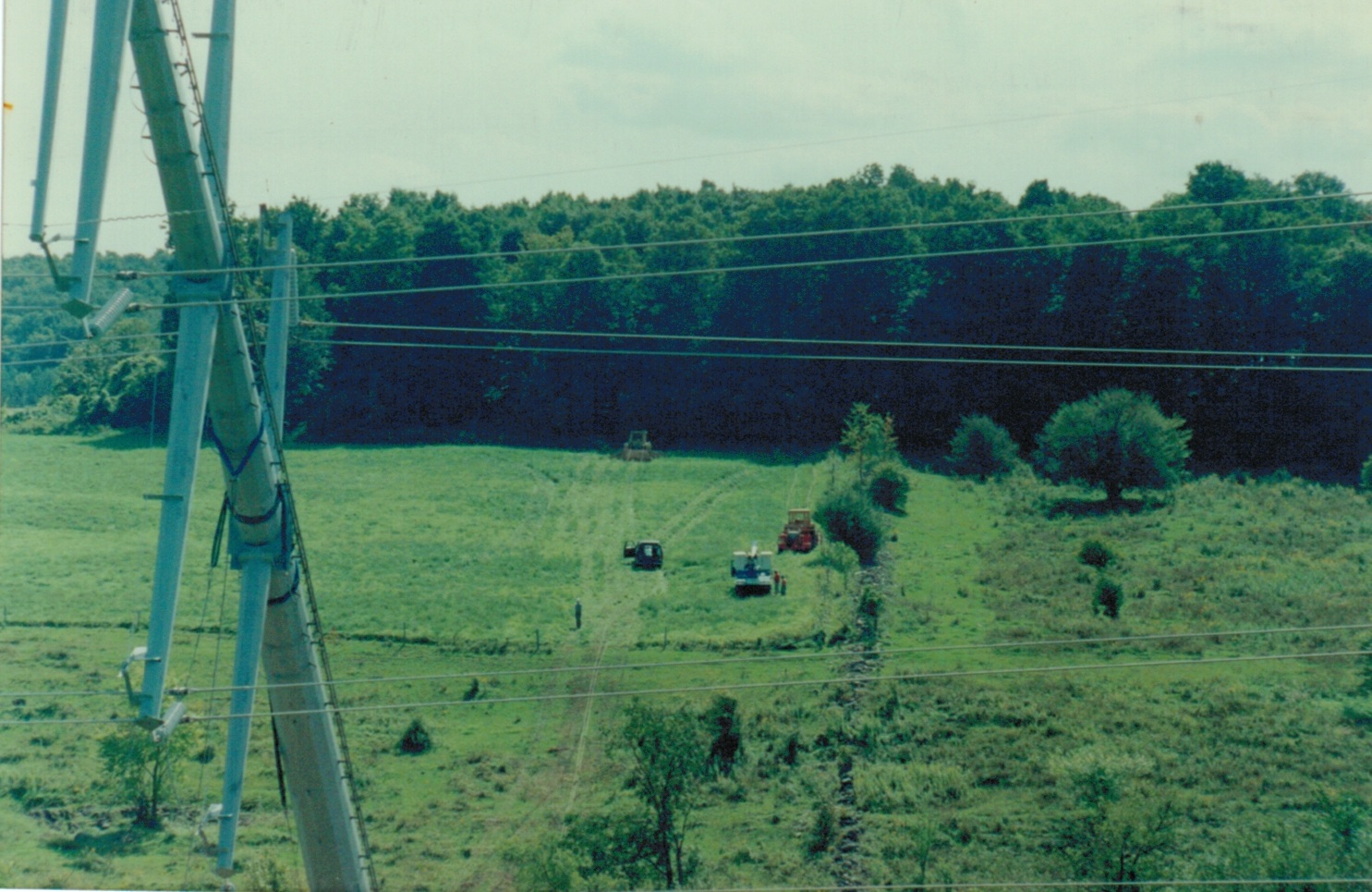
Most energy sub-stations are not staffed, and while there is passive security in place, such as fencing, these can obviously be overcome easily.  Utility lines stretch across our nation above and below ground – generally accessible with little trouble to people with malicious intent.  Remember that acts interrupting our grid may not necessarily come from Al-Qaeda, but can come from disgruntled locals as well.  Take a look at the pictures below.  These were actually taken by my father who worked for a utility company in New York State.  Shortly after these high power transmission lines were put up over 25 years ago, a local, in protest over these lines going through their land, actually unbolted the tower from the base.  They never caught the person who did it – but this is a federal crime – and taken very seriously by prosecutors and law enforcement, including security personnel of the utility companies.  This same transmission line passes through my property and my family and I have made several calls through the years to the security office of the utility company when we see people loitering around and taking pictures or notes on these towers.


In consideration of cyber attacks – guess what – they happen EVERY DAY!  Most, fortunately, are pretty weak and stopped well short of their goal.  Some do have some measure of success, penetrating fire walls and other defenses.  Some come from individuals domestically, but many are known to come from the likes of China, North Korea, and Iran – all of which ‘officially’ deny sponsoring such acts of terrorism.  Practically everything is controlled by a computer, and practically every computer is networked and accessible from the outside world by people who know how to do so.  Energy plants can be shut down, overloaded, or have safety protocols circumvented.  Scary stuff.

So what’s the result of all this?  Much more than the inconvenience of a short-term power outage, I can assure you of that.  Our energy grid is the most critical of our infrastructure.  Without it nothing works.  We’ve only scratched the surface of examples from the areas that were hit by Hurricane Sandy and still don’t yet have power.  It impacts our other critical infrastructures such as communications, hospitals, the economy, and others.  It breaks beyond discomfort and inconvenience when it endangers lives during periods of temperature extremes.  All in all we have an aging infrastructure in our nation, but not only do we need to work on replacing and improving it, we need to protect it.

Looking Ahead – Hazards of Concern in the US

A multi-agency/discipline group called the National Homeland Security Consortium has released a white paper – Protecting Americans in the 21st Century: Priorities for 2012 and Beyond.  The paper highlights eight areas of concern requiring a national focus.

Sidebar – The entity called the National HOMELAND SECURITY Consortium has assembled a document that is clearly meant for the EMERGENCY MANAGEMENT community (a concept much broader and far-reaching than homeland security).  I really wish they would get this straightened out… and now back to your regularly scheduled blog…

The eight areas are as follows:

  • Cyber Hazards
  • Climate Change
  • Demands on Global Resources
  • Changing Demographics
  • Emerging Technologies
  • Violent Extremist Ideologies
  • WMD Proliferation
  • Mega-Hazards and Catastrophic Cascading Consequences

The Consortium has recognized and stresses in their white paper the hazard that is larger than any of these individually, and that is the potential for any of these hazards to interact or influence each other – an observation and warning that I feel is long overdue.  They are also not encouraging us to lose focus on the more immediate hazards we may have at hand, but are encouraging stakeholders and relevant parties to give some attention to these emerging hazards and consider how we will prepare for, mitigate against, respond to, and recover from their impacts.

I won’t comment on each of these items now, but reserve the right to do so in the near future.  I do, however, leave you with this… consider what impacts these hazards may have on you.

A different approach against terrorism

I was watching another TED talk yesterday by Jason McCue titled Terrorism is a failed brand.  McCue is an attorney by trade, who has found a rather distinctive niche litigating against terrorists.  Certainly a noble job and not at all one I would want to try.  I hope he has a great home security system and a solid kidnap and ransom insurance policy.

This Ted talk is one of the longer, 20 minute presentations, but well worth the time.  McCue outlines ways to defeat terrorism by taking away their power to influence.  By doing so, they won’t be supported financially or ideologically and will have trouble recruiting.  He is a rather compelling speaker with a great approach to his ideas.  Throughout his talk he provides a few case studies where such approaches have led to success and even draws a parallel between terrorism and commercial branding – proposing that a strong marketing campaign against terrorism be implemented.  I think he makes a great argument for it overall.  I do, however, have some difficulties accepting this as an approach for all forms of terrorism.  It seems his approach would work well against IRA-style terrorism, where the collateral damage is directly impacting the ones that the cause purports to defend and support.  In fact, the greatest part of McCue’s experience lends itself to IRA litigation.  On the other hand, there is al-Qaeda, who I don’t think would be affected as much by this type of tactic.  We might be able to strike against some of their financial backing and perhaps some of their recruitment, but I don’t see where we will strike much sympathy within the ranks of al-Qaeda from the death, destruction, and dismemberment caused by their suicide bombers and other attacks – which is a tactic McCue identified as a success against the IRA.

While McCue doesn’t identify his tactics as the only solution, I would certainly say that it would not be, especially against al-Qaeda type entities.  I believe strongly that military actions against their leaders and training camps must certainly continue, as should political and legal pressures against their supporters – be they nations or sponsor terrorism or investors funding these acts, as well as counter terrorism and intelligence operations.  It is only with a multi-pronged approach that we will win against terrorism.  Note, however, that I say ‘win’, not ‘defeat’.  I don’t think terrorists, whatever ilk they may be of, will ever be truly defeated.  We can’t stop people from having opinions, nor would we want to.  The problem is when those opinions go to an extreme of causing harm upon others to coerce a population.