Updated NIMS and ICS Courses

Be sure to head over to https://training.fema.gov/is/ to check out the updated IS-100.c (Introduction to the Incident Command System) and IS-700.b (Introduction to the National Incident Management System).  These courses have been updated to reflect the ‘refreshed’ NIMS doctrine, which includes some information on EOC structures, among other things.  For my review of the NIMS refresh, check out this article.

©2018 – Timothy Riecker, CEDP

Emergency Preparedness Solutions, LLC ™

NIMS Implementation Objectives and A Shot of Reality

Happy 2018 to all my readers!  Thanks for your patience while I took an extended holiday break.  A minor surgery and the flu had sidelined me for a bit, but I’m happy to be back.

This morning, FEMA issued NIMS Alert 01-18: National Engagement for Draft NIMS Implementation Objectives.  NIMS Implementation Objectives were last released in 2009, covering a period of FY 2009-FY2017.  With the release of the updated NIMS last year, FEMA is updating the implementation objectives and has established a national engagement period for their review.

So first, a bit of commentary on this document…

The new objectives are broken out by major content area of the updated NIMS document, including: Resource Management, Command and Coordination, and Communication and Information Management; as well as a General category to cover issues more related to management and administration of the NIMS program.  What we also see with these updated objectives are implementation indicators, which are intended to help ground each objective.  Overall, the number of objectives in this update has been cut in half from the 2009 version (28 objectives vs 14 objectives).

All in all, these objectives appear to be consistent with the current state of NIMS implementation across the nation.  They are certainly suitable for most matters in regard to the oversight of implementing NIMS and it’s various components.  The biggest sticking point for me is that this document is intended for use by states, tribal governments, and territories.  If the goal is to have a cohesive national approach to implementation, I’d like to know what the implementation objectives are for FEMA/DHS and how they compliment those included in this document.

Objectives 8 through 11 are really the crux of this document.  They are intended to examine the application of NIMS in an incident.  These objectives and their corresponding indicators (which are largely shared among these objectives) are the measure by which success will ultimately be determined.  While it’s a good start for these to exist, jurisdictions must be more open to criticism in their implementations of NIMS and ICS.  In addition, there should be an improved mechanism for assessing the application of NIMS and ICS.  While formal evaluations occur for exercises under the HSEEP model, we tend to see inconsistent application of the feedback and improvement activities to correct deficiencies.  Proper evaluations of incidents, especially at the local level, are often not performed or performed well. For those that are, the same issue of feedback and improvement often stands.

Extending this discussion into reality…

The reality is that many responders are still getting it wrong.  Last year my company conducted and evaluated dozens of exercises.  Rarely did we see consistently good performance as far as NIMS and ICS are concerned.  There are several links in this chain that have to hold firm.  Here’s how I view it:

First, the right people need to be identified for key roles.  Not everyone is suited for a job in public safety or emergency management in the broadest sense.  Organizations need to not set up individuals and their own organization for failure by putting the wrong person in a job.  If a certain job is expected to have an emergency response role, there must be certain additional qualifications and expectations that are met.  Further, if someone is expected to take on a leadership role in an ICS modeled organization during an incident, there are additional expectations.

Next, quality training is needed.  I wrote a couple years ago about how ICS Training Sucks.  It still does.  Nothing has changed.  We can’t expect people to perform if they have been poorly trained.  That training extends from the classroom into implementation, so we can’t expect someone to perform to standards immediately following a training course.  There is simply too much going on during a disaster for a newbie to process.  People need to be mentored.  Yes, there is a formal system for Qualification and Certification in ICS, but this is for proper incident management teams, something most local jurisdictions aren’t able to put together.

Related to this last point, I think we need a new brand of exercise.  One that more instructional where trainees are mentored and provided immediate and relevant feedback instead of having to wait for an AAR which likely won’t provide them with feedback at the individual level anyway.  The exercise methodology we usually see applied calls for players to do their thing: right, wrong, or otherwise; then read about it weeks later in an AAR.  There isn’t much learning that takes place.  In fact, when players are allowed to do something incorrectly and aren’t corrected on the spot, this is a form of negative reinforcement – not just for that individual, but also for others; especially with how interrelated the roles and responsibilities within an ICS organization are.

While I’m all for allowing performers to discover their own mistakes and I certainly recognize that there exist multiple ways to skin the proverbial cat (no animals were harmed in the writing of this blog), this is really done best at a higher taxonomy level.  Many people I see implementing portions of ICS simply aren’t there yet.  They don’t have the experience to help them recognize when something is wrong.

As I’ve said before, this isn’t a school yard game of kickball.  Lives are at stake.  We can do better.  We MUST do better.

As always, thoughts are certainly appreciated.

© 2018 – Timothy Riecker, CEDP

Emergency Preparedness Solutions, LLC SM


2017 National Preparedness Report – A Review

With my travel schedule, I missed the (late) release of the 2017 National Preparedness Report (NPR) in mid-October.  Foundationally, the findings of the 2017 report show little change from the 2016 report.  If you are interested in comparing, you can find my review of the 2016 NPR here.

The 2017 NPR, on the positive side, provided more data and more meaningful data than its predecessor.  It appeared to me there was more time and effort spent in analysis of this data.  If you aren’t familiar with the premise of the NPR, the report is a compilation of data obtained from State Preparedness Reports (SPRs) submitted by states, territories, and UASI-funded regions; so the NPR, fundamentally, should be a reflection of what was submitted by these jurisdictions and regions – for the better or worse of it.  The SPR asks jurisdictions to provide an honest analysis of each of the core capabilities through the POETE capability elements (Planning, Organizing, Equipping, Training, and Exercising).

From the perspective of the jurisdictions, no one wants to look bad.  Not to say that any jurisdiction has lied, but certainly agendas can sway subjective assessments.  Jurisdictions want to show that grant money is being spent effectively (with the hopes of obtaining more), but not with such terrific results that anyone would think they don’t need more.  Over the past few years the SPRs, I believe, have started to normalize and better reflect reality.  I think the authors of the NPR have also come to look at the data they receive a little more carefully and word the NPR to reflect this reality.

The 2017 NPR (which evaluates 2016 data from jurisdictions) identified five core capabilities the nation needs to sustain.  These are:

  • Environmental Response/Health and Safety
  • Intelligence and Information Sharing
  • Operational Communications
  • Operational Coordination
  • Planning

I’m reasonably comfortable with the first two, although they both deal with hazards and details that change regularly, so keeping on top of them is critical.  Its interesting that Operational Communication is rated so high, yet is so commonly seen as a top area for improvement on after-action reports of exercises, events, and incidents.  To me, the evidence doesn’t support the conclusion in regard to this core capability.  Operational Coordination and Planning both give me some significant concern.

First, in regard to Operational Coordination, I continue to have a great deal of concern in the ability of responders (in the broadest definitions) to effectively implement the Incident Command System (ICS).  While the implementation of ICS doesn’t comprise all of this core capability, it certainly is a great deal of it.  I think there is more room for improvement than the NPR would indicate.  For example, in a recent exercise I supported, the local emergency manager determined there would be a unified command with him holding ‘overall command’.  Unfortunately, these false interpretations of ICS are endemic.

I believe the Planning core capability is in a similar state inadequacy.  Preparedness lies, fundamentally, on proper planning and the assessments that support it. While I’ve pontificated at length about the inadequacy of ICS training, I’ve seen far too many plans with gaps that you could drive a truck through.  I’ve recently exercised a college emergency response plan that provided no details or guidance on critical tasks, such as evacuation of a dormitory and support of the evacuated students.  The plan did a great job of identifying who should be in the EOC, but gave no information on what they should be doing or how they should do it.  The lack of plans that can be operationalized and implemented is staggering.

The NPR identified the top core capabilities to be improved.  There are no surprises in this list:

  • Cybersecurity
  • Economic Recovery
  • Housing
  • Infrastructure Systems
  • Natural and Cultural Resources
  • Supply Chain Integrity and Security

Fortunately, I’m seeing some (but not all) of these core capabilities getting some needed attention, but clearly not enough.  These don’t have simple solutions, so they will take some time.

Page 10 of the NPR provides a graph showing the distribution of FEMA preparedness (non-disaster) grants by core capability for fiscal year 2015.  Planning (approx. $350m) and Operational Coordination (approx. $280m) lead the pack by far.  I’m curious as to what specific activities these dollars are actually being spent on, because my experience shows that it’s not working as well as is being reported.  Certainly there has been some positive direction, but I’m guessing that dollars are being spent on activities that either have negligible impact or actually have a negative impact, such as funding the development of some of the bad plans we’re seeing out there.

I’m curious as to what readers are seeing out in real life.  What capabilities concern you the most?  What capabilities do you see successes in?  Overall, I think everyone agrees that we can do better.  We can also get better and more meaningful reports.  This NPR was a step in the right direction from last year’s, but we need to continue forward progress.

© 2017 – Timothy Riecker, CEDP

Emergency Preparedness Solutions, LLC

Incident Management & Proper Demobilization Planning

A fair amount of courses, especially those oriented toward the Incident Command System (ICS), mention demobilization, but that mention is usually fairly gratuitous.  Even the core ICS courses generally only offer a couple of paragraphs or a handful of bullet points.  The ICS 300, since it does focus more on incident planning, does contain some good additional material, but it’s still quite brief.  Demobilization is a best practice of incident management, along with staging areas, that are rarely done properly.  It’s not a surprise, though… there isn’t a lot of emphasis on them in ICS and related training, and generally what is out there is pretty poor quality.  This has been further emphasized through nine separate functional exercises I’ve conducted over the past couple of months where it was easily identified that most participants weren’t really familiar with what demobilization meant to them and their organizations. This is no slight on them… it comes down to training.

There is certainly room for improvement when it comes to the ICS National Training Curriculum.  In case you aren’t familiar, I’ve written pretty extensively on it in the past.  And yes, I still believe that ICS Training Sucks (click here to check out a few articles I’ve written on the topic).  In regard to demobilization, much of what is out there (including the ICS curriculum and otherwise), in addition to the couple of paragraphs or handful of bullet points, also puts a lot of emphasis on the Demobilization Check-Out (ICS form 221).  By all means, STOP THAT.  Throwing another form in front of people without proper context simply serves to confuse them further.  I’m not saying we need to train everyone to be a Demobilization Unit Leader (there is a specific course for that… and it’s less than great), but shoving another form in front of someone for seven seconds doesn’t do a damn bit of good… and in fact it probably does some measure of harm – especially for building the case made by some that ICS is nothing but a bunch of bureaucracy.  We need to actually show purpose.

Largely, those bits of prose contained in courses do a decent job in explaining why we need to demobilize.  Simply put, we don’t want people and other resources standing around for hours before they are told they can go home.  Along with this is usually the book answer of when we begin to plan for demobilization – that’s as soon as we order the resource.  In reality, I’ll give that a ‘kind of’ instead of a resounding agreement.  Most of the time, no, we’re not considering that, especially at the onset of an incident.  But we do need to start considering it early on, especially when we no longer need a lot of resources at the end of the first phase of an incident.  Further down the road, we also tend to have a lot of expensive resources and teams that need to be disengaged and dismantled from our incident organization and the operating area rather carefully before they can be sent home.  These deliberate actions are another good reason for proper demobilization planning.

Demobilization planning?  Yes, planning.  NOT the ICS 221.  That form is nothing more than an accountability sheet.  It is NOT a plan.  First off, demobilization planning is a team effort.  There needs to be involvement and input across much of the command and general staff of your incident management structure (be it a formal incident management team or otherwise).  It’s a planning effort, so it should be centered within your Planning Section.  For a larger incident, certainly designate a Demobilization Unit to do coordinate this.

How do we even make this happen?  First, the concept needs to be sold to command.  They will initially say no.  Expect it.  Many Incident Commanders not well practiced in formal demobilization think that even discussion of the term must be reserved for late in the game.  It might take a couple of attempts and a need to make your case.  Demob doesn’t signal an end to the entire operation, and in fact additional resources may be flowing into the incident as others are being demobilized.  Once command is sold on it, then it needs to be discussed with the entire command and general staff.  Everyone has input.  Most of the resources belong to ops, so they should be able to identify when certain resources will complete their operations and will no longer be needed.  The logistics organization may have a fair amount of resources in place largely to support operations, therefore, as certain operations are demobilized, logistics may also be able to demobilize some of their resources.  They may also want certain things returned and accounted for, such as radios.  And if any hazardous material was present, the Medical Unit within logistics may be arranging long-term medical monitoring, which needs to become part of demobilization.  The Liaison Officer may be getting pressured by outside agencies or organizations to release resources and/or may have to explain to certain assisting agencies why their resources are no longer needed.  Finance/Administration is aware of how much certain resources are costing the responsible party, both in direct costs as well as maintenance costs.  There may be others with input as well.

As this discussion occurs, Planning/Demobilization should be keeping good notes as these comments, concerns, and priorities may become part of the demobilization plan.  The plan itself consists of five standard sections:

  1. General information – what does this plan pertain to and generally, what’s it about (it’s an overview).
  2. Responsibilities – This identifies, within the ICS structure, who is responsible for what in regard to demobilization
  3. Release Priorities – These are the agreed upon priorities identified by command and general staff.
  4. Release Procedures – This should have the most detail, starting with identification, authorization, and notification of the resource of their impending demobilization status. How far ahead of the demobilization are they advised?  Who do they have to talk to along the way?  What equipment should be returned?  Do they need to submit any reports or paperwork?  Who do they actually sign out with?  How and when do they return home?  Based on the nature of the incident, consider a mandatory overnight before they can travel, medical monitoring, and a debrief.  And always require resources to confirm that they have arrived safely back to their home station.  This, by the way, is where you reference the ICS 221 form, which will maintain accountability of the demobilization process.  Certainly customize this form to match your procedures.
  5. Reference Information – This can include travel information, contact information for key personnel (such as the Demobilization Unit Leader), maps, schedules, reminders, and other info.

Like the majority of implementations of ICS, demobilization planning is generally accomplished in the head of the IC and perhaps other staff.  That’s likely fine for more routine type 5 incidents, and even some type 4 incidents.  There may be some type 4 incidents that have enough complexity and disparity of resources, that a written plan is a good idea.  Certainly anything more complex should have a written plan.  Just as we should be writing incident action plans for planned events, demobilization plans should also be used.  If anything, it makes for good practice.  For the same argument, it’s also great for exercises (not only for the players, but also for exercise management).

Looking for a demobilization plan template?  Here’s one.  I’m not familiar with the authors, but it’s a fairly standard template for such a plan.  I’m generally wary of templates, but this is pretty basic.  If you might find yourself in the position of organizing incident demobilization for your agency or jurisdiction, save it and start modifying it now.  There are likely a set of standard priorities and procedures which you can identify now that you can include in the plan.  Be sure to have an ICS 221 that you can modify for implementation as well.  Just be sure to not ‘finalize’ either one of these… just like an IAP, they are documents developed specifically for an incident, event, or exercise.

So there you have it, a bit of demobilization planning advice from someone who is trained and experienced in actually doing it.  I hope this was helpful.  Of course I’m happy to provide some direct advice as well as happy to hear from others who are experienced themselves in demobilization.  What best practices have you identified?

© 2017 – Timothy Riecker, CEDP

Emergency Preparedness Solutions, LLC


ICS and the Human Factor

A number of my articles have mentioned the unpredictable human factor in executing emergency plans and managing incidents, particularly for complex incidents.  We can build great plans and have a great management system to facilitate the incident management process, but the human factor – that largely intangible level of unpredictability of human behavior – can steer even the best emergency plan astray or derail an incident management process.

An article published in the Domestic Preparedness Journal yesterday, written by Eric McNulty, reflects on this.  Mr. McNulty cites several human factors which have relevance within incident management and encourages leaders to understand these factors within themselves and others to bring about more effective leadership.  The introductory paragraph of his article suggests the need for integrating behavior training into ICS training to ‘improve performance and outcomes’.  Given the impact of behavior factors on how we respond, this is a concept I can certainly endorse for a much-needed rewrite of the ICS curriculum.

I’ve heavily referenced Chief Cynthia Renaud’s paper, The Missing Piece of NIMS: Teaching Incident Commanders How to Function in The Edge of Chaos, in the past and continue to hold her piece relevant, especially in this discussion.  Chief Renaud’s suggestions draw lines parallel to behavioral factors, which suggest to me that we certainly need to integrate leadership training into ICS training.  The current ICS 200 course attempts to do so, but the content simply panders to the topic and doesn’t address it seriously enough.  We need to go beyond the leadership basics and explore leadership training done around the world to see what is the most effective.

Incident management is life and death – not a pick-up game of stick ball.  Let’s start taking it more seriously and prepare people better for this responsibility.

© 2016 – Timothy Riecker, CEDP

Emergency Preparedness Solutions, LLCYour Partner in Preparedness

Don’t Just Take It From Me – There are Issues with ICS Training

The February 2016 edition of the Domestic Preparedness Journal highlighted, among other things, some concerns with ICS training in the United States.  First off, if you aren’t subscribed to the DPJ, you should be.  It’s free and they offer good content, with few extraneous emails beyond the journals.  Check them out at www.domesticpreparedness.com.

The specific article in this issue I’m referencing is Incident Command System: Perishable if Not Practiced, by Stephen Grainer. Mr. Grainer is the Chief of Incident Management Systems for the Virginia Department of Fire Programs.  Steve has a significant depth in ICS and understands all the nuances of preparedness and application.  I first met him when serving on the national NIMS steering committee with him several years back.

The title of the article is a bit deceptive – it’s not just focused on the issue of the training being perishable.  Right up front, Mr. Grainer, who is a longtime supporter and advocate of ICS, outlines a few shortcomings and constraints related to the application of ICS and ICS training.  He states that “little attention has been given to developing the students’ ability to recognize an evolving situation in which more formalized implementation of the ICS should be undertaken”.  This underscores one of my main points on the failings of the ICS curriculum.  We teach people all about what ICS is, but very little of how to use it.

After giving a few case studies that reflect on the shortcomings he highlighted, Mr. Grainer expresses his support for continued training, refresher training (something not currently required), and opportunities to apply ICS in ways that public safety and emergency management don’t do on a regular basis.  He summarizes by stating that not only does training need to continue to address succession and bench depth, but also the need to address how to maintain competencies and address misunderstandings in NIMS/ICS.

Yes, training does need to continue, but it must be the RIGHT training!  We continue doing a disservice by promoting the current ICS courses which fall well short of what needs to be accomplished.  Mr. Grainer’s mention of the need for our training to address better implementation of ICS, particularly beyond the routine, is perhaps a bit understated, but nonetheless present.  Refresher training also needs to be incorporated into a new curriculum, as these skills are absolutely perishable – particularly the aspects of ICS typically reserved for more complex incidents.

In the event you aren’t familiar with my earlier posts on ICS and my crusade for a better curriculum, check out these posts.  As I’ve said before, this isn’t a pick-up kickball game… this is public safety.  We can do better.

Shameless plug:  Assessments, Planning, Training, Exercises.  Emergency Preparedness Solutions does it all.  Contact us to find out how our experience can benefit your jurisdiction’s or organization’s emergency and disaster preparedness.  We are your partner in preparedness.  www.epsllc.biz.

© 2016 – Timothy Riecker

Emergency Preparedness Solutions, LLC
Thinking Back and Looking Ahead – A Blogging Year in Review

Here it is, the close of one year and the dawn of another.  As with most of you, I’m taking some time to reflect on the past and look ahead to the future.  2015 was my best blogging year yet, doubling last year’s readership, for which I am thankful.  I’ve been humbled in getting readers from around the globe – 127 nations in all.  While most came from the US, I have a great number of readers in Canada and Australia.  Based on who commented, my readers include public safety and business continuity professionals, academics and scholars, and those simply curious about what we do and how we do it.  My thanks to you all!

2015

In case you may have missed them, below are my five most popular posts:

Incident Command System Training Sucks (June)  This post prompted a lot of discussion directly on my blog site as well as in numerous LinkedIn discussion forums.  I received phone calls, emails, and had several in person conversations about the need to revamp ICS training to make it more effective.  While sadly I’ve received no feedback directly from the National Integration Center, I will continue the crusade to get better and more effective ICS training for stakeholders.

ICS Training Sucks… So Let’s Fix It (September)  Riding the coat-tails of Incident Command System Training Sucks, this post reflected a bit more on what needed to be done to improve the curriculum.  I received lots of feedback on this post as well.

The Need for Practical Incident Command Training (March)  This post preceded Incident Command System Training Sucks, and marked my mental progression from an earlier post (which is listed next) to this piece’s most popular successor in the ad-hoc series.

Preparedness – ICS Is Not Enough (January)  This piece reflected mostly on ICS as a component of preparedness, identifying that many agencies think they are prepared simply because their staff have taken some ICS courses and they include the terms in their plans.  In this we see the danger of the requirements of NIMS, which often mean compliance to many people.

The Death of ADDIE? (November 2012)  Yes, this one was written back in my first year of blogging.  This piece still holds strong and I see many search terms about ADDIE and the Successive Approximation Model (SAM) which bring people to the post.  While I’m still an avid user and advocate of ADDIE, the emergence of SAM shows there is more than one way to skin the proverbial cat.

Looking ahead:

Clearly the topic of ICS training is an important one to those in emergency management and homeland security.  As mentioned, I will continue my crusade to advocate for better and more effective training in ICS for our personnel.

I also had the pleasure of co-authoring a post this year with Mr. Ralph Fisk of Fisk Consultants.  Prior to the release of the new Star Wars film, The Force Awakens, we wrote about public safety interests for jurisdictions, law enforcement, theater management, and the general public.  Fortunately there were no shootings or other similar violent incidents that arose during the first couple weeks of showing this blockbuster film.  It was fun collaborating with Ralph and we have already discussed some possible topics for collaboration in 2016.  I hope to do the same with others as well as hosting guest posts from other experts in public safety.

I hope all of you enjoy reading these posts as much as I like writing them.  Each post provides an opportunity for me to learn and to share what I have learned.  It has become a great networking tool and marketing tool for my consulting practice.  Together I hope we can improve the important work we do in emergency management, homeland security, business continuity, and public safety as a whole.  The thoughts you share on posts are greatly appreciated and I look forward to interacting with you all in 2016.

Health, wealth, and happiness in the New Year!

© 2015 – Timothy Riecker

Emergency Preparedness Solutions, LLC


Musings of October – and the Crusade to End Bad ICS Courses

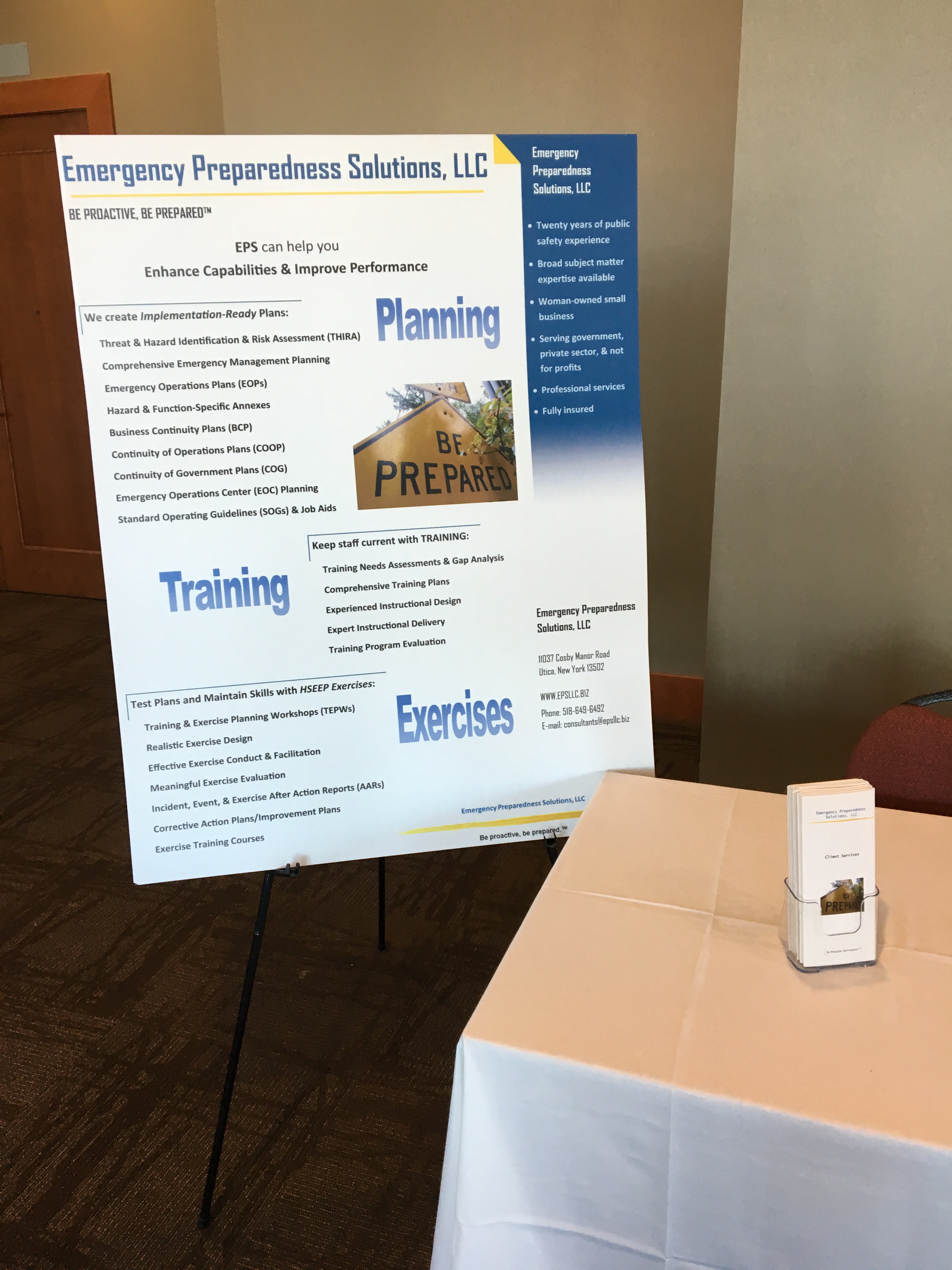
Last month sure was a busy one!  Much of the focus was on marketing for our company Emergency Preparedness Solutions.  I had the opportunity to meet a number of county and local government representatives in a reverse trade show in the Poconos and see some old and new faces at the Vermont Emergency Preparedness Conference.  Pictures of our booth are below.  I also had the opportunity to present with their State Training Officer on the State-Wide Emergency Management and Homeland Security Training Needs Assessment project we completed for the Vermont Division of Emergency Management and Homeland Security a few months ago.  We also need to congratulate Doug Babcock for being honored as Vermont’s Local Emergency Manager of the Year!

IMG_1205

IMG_1206

While those trips were great, the highlight of the month was a trip to Toronto.  The impetus for the trip was the Emergency Preparedness staff of Public Health Ontario, who, after reading my blog posts on the necessity for improvements in Incident Command System (ICS) training, extended an invitation for me to sit in on some training they offer that came about from just that need.  The course I attended was Public Health Emergency Preparedness – An IMS-based Workshop.  Fear not – this is not a reinvention of ICS (or Incident Management System – IMS – as they refer to it in Canada), rather this is an enhancement to the current curriculum.

The Canadian provinces have each adopted curricula for their IMS which are near 100% mirrors of the ICS courses we use here in the States.  While in Toronto, I also had the opportunity to sit in for a bit on an IMS-200 course being conducted by the Toronto Office of Emergency Management.  They were great hosts and have made excellent enhancements to the curriculum for a Toronto-based audience.  (Thank you Sherry and Sarah!) The course offered by Public Health Ontario is truly workshop based, with little lecture and a lot of group work to walk participants through concepts of IMS.  The workshop is positioned between IMS-100 (which most took online) and IMS-200, and is public health focused.

While I’m often weary of discipline-specific courses in emergency management, since the essence of emergency management is cooperative, this workshop absolutely made sense.  Why?  Two big themes built the foundation for this… First, practitioners must be comfortable with their own sand box before they can play with the neighborhood kids.  Second, this particular application works for public health (and several other disciplines) because most of the public health response occurs at the population level, not necessarily at an incident site.  Because of this, public health will almost always function (at least the higher echelons of their incident management structure) from an emergency operations center or departmental operations center.  As such, it pays to invest some training time on a homogeneous audience.  That said, the scenarios that drove the workshop were in no way introverted only to public health concerns and the instructors encouraged thought and discussion toward other activities and associated agencies which would be involved in an incident.

With the positioning of this training between IMS-100 and IMS-200, Public Health Ontario has armed participants with better knowledge and familiarity of the IMS, allowing those who will progress through further (and multi-disciplinary) training a better perspective of how IMS is applied by public health which allows for a better understanding of the system itself.  Not only does the workshop address some internal incident management training needs for public health, it also addresses some of the issues I’ve mentioned previously with ICS training as a whole.  The workshop is expertly designed by the Emergency Preparedness team at Public Health Ontario, and embraces concepts of adult educational methodology which we need to pay more attention to.  The high level of interaction lends to improved transfer of knowledge and better outcomes.  They included information such as the phases of emergency management and the need to reference deliberate planning efforts such as Emergency Operations Plans (EOPs) and Continuity of Operations Plans (COOPs).  This is certainly something we don’t have enough of in ICS courses yet is critically related.  Do you think the majority of our attendees know what these are, much less what is in theirs?  Guess again!

More information on this workshop can be found at https://www.publichealthontario.ca/en/About/Departments/Pages/Incident-Management-System-for-Public-Health.aspx.  Many thanks to Moira, Richard, and Evanna for the invite and the hospitality!

With my road trips complete, I am returning back to the normal pace of work and preparing for another graduate course which begins next month.  I’ve also considered the need to ramp up my concern on this matter of poor ICS curricula from an occasional rant to a crusade.  This is a matter of public safety – from a sociological perspective there is nothing more important than our ability to effectively respond to save lives, stabilize the incident, and preserve property.  Let’s make some changes!

As always, many thanks to my readers; and if you are with a government entity, not for profit, or private interest that is seeking consulting services in the areas of emergency and disaster planning, training, exercises, and anything in between, please feel free to contact me.

© Timothy Riecker

Emergency Preparedness Solutions, LLC

ICS Training Sucks… So Let’s Fix It

A great many of you are familiar with the piece I wrote in June called Incident Command System Training Sucks.  In it, I identify that the foundational ICS courses (ICS-100 through ICS-400 – but especially ICS-300 and ICS-400) simply do not provide the skills training that emergency managers across all disciplines require to utilize the system efficiently, effectively, and comfortably.  ICS Training Sucks turned out to be a popular piece which had a great deal of support from the first responder and emergency management community – which I am very grateful for.  The amount of comments and feedback was indicative to me that I was on the right track and that I need to revisit the topic and explore more.

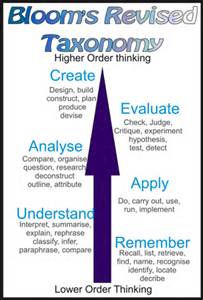
At the center of my argument stands Bloom’s Taxonomy.  Bloom’s is a learning hierarchy which helps to identify the depth of instruction and learning.  Here is Bloom’s Revised Taxonomy.  We’ll be referencing it a bit in the examples I provide.

Bloom's Revised Taxonomy

Bloom’s Revised Taxonomy

Take a moment to read through the descriptions of each of the ‘orders of thinking’ in Bloom’s.  Go ahead, I’ll wait…

Done?  Good.  Most would agree that courses such as ICS-300 and ICS-400 should attempt to convey learning at the Apply level, correct?  Unfortunately, that perception, while wildly popular, is wrong.  Most of the learning objectives of the two courses (objectives are our reference points for this) are at the Understand and Remember levels.  Yeah, I was a bit surprised, too.

In ICS Training Sucks, I provided a greater detail of the background analysis (it summarized the narrative of a Master’s research paper I wrote), so if you want more, simply go back and check it out.  While I make a few broad recommendations in that piece, there has been a need to examine our path to fixing this more closely.

In the development of curriculum, there exist several models.  The most commonly used model is the ADDIE model, which stands for Analysis, Design, Development, Implementation, and Evaluation.  The first step, Analysis, is really the most important, although often the most ignored or cut short.  People think they know what the need is, but often don’t really understand it.  If you are interested, I’ve written a piece on the topic of Analysis for Training Magazine last year.

Even though we are suggesting a re-write of the ICS curriculum, or parts thereof, Analysis is extremely important.  The roots of the current curriculum we use goes back to circa 1970s wildfire ICS courses.  These are good courses, and while I’m not sure if they fully met the need then (although they did advance us quite a bit), their evolved versions certainly DO NOT now.  There is no sense in repackaging the same product, so let’s first figure out what people need to know to do their jobs effectively.  Essentially, this leads us to identifying a list of key core competencies in ICS.  Core competencies will define the level of competence needed in a particular job or activity.  We can easily use the levels of Bloom’s as our reference point to establish common definitions for the levels of competence.  What am I talking about?

Let’s pick one key activity in ICS to examine.  Resource Management is a great example as it shows the disparity between what exists and where we need to be.  Resource Management is discussed in Unit 6 of the ICS-300 course.  I think most would agree that we expect most every jurisdiction to be able to implement sound resource management practices.  Implement is the key word.  Implementation is indicative of the Apply level of Bloom’s Taxonomy.  When looking at unit objectives in the ICS-300 course for unit 6, the key words are identify and describe.  Identify is indicative of the Remember level of Bloom’s Taxonomy, while describe is indicative of the Understand level.  Both fall short of application.  While we aren’t looking for this curriculum to create incident management teams, we still expect most jurisdictions to be able to manage resources, which is certainly a core competency of incident management.

I think the NIMS doctrine provides a good starting point for identifying core competencies.  In an effective study, there may be other competencies identified – perhaps topics such as leadership, that may not necessarily be found in a revised ICS curricula, but can be obtained through other training courses.  This could lead to an important differentiation between core competencies (those that MUST be included in ICS training) and associated competencies which can be sourced elsewhere.

Further, we can capitalize on what we have learned through implementation of the current ICS curriculum and previous iterations.  We know that multidisciplinary training is most effective since larger incidents are multidisciplinary.  We also know that training must be interactive and maximize hands-on time.  The past few updates to the ICS courses have done a great job of encouraging this, but we need more.

Making more detailed recommendations on fixing ICS training will take time and effort, as a solid Analysis must first be done.  Once core competencies can be identified and defined, then a strategy for revamping ICS training can be developed.  As mentioned in ICS Training Sucks, this approach should be multi-faceted, using both new and (good) existing courses to support it. Let’s not be bound by what currently exists.  We don’t necessarily have to create a ‘new’ ICS-300 or ICS-400 course.  Let’s create courses within a broader program that meets the needs of the emergency management community.  They may no longer be called ICS-300 and ICS-400.  Perhaps these two will be replaced by four smaller courses?  Who knows where this path will take us? The bottom line is that we need to be responsive to the needs of the learners, not bound by “the way we’ve always done it.”

As always, feedback is appreciated.  Perhaps there exists an institution that has the desire and funding to pursue this further?  I’m fully onboard!

© 2015 – Timothy Riecker

Emergency Preparedness Solutions, LLC
WWW.EPSLLC.BIZ

Training EOC Personnel – ICS is not Enough!

A consistent misconception is that if an emergency operations plan calls for an Emergency Operations Center (EOC) to utilize the Incident Command System (ICS), then EOC personnel only require ICS training to be successful in their jobs.  ICS training, however, only gets personnel part way to success.

Regular readers of my blog know that I am a big advocate of conducting needs assessments.  Often times, agencies don’t know how to conduct a needs assessment, don’t think it’s important enough to conduct one, don’t think that conducting one is necessary, or simply don’t even consider conducting a needs assessment.  The result is creating training or using existing training that does not meet the real needs.  Certainly if an EOC is using the foundations of ICS to define its organizational structure and processes, then ICS training is absolutely important.  Consider, however, the multitude of other processes that take place in an operational EOC that are not included (in whole or in part) in ICS training.  Processes including financial management and procurement, situation reporting, and use of EOC management and resource tracking software are so diverse and can very from jurisdiction to jurisdiction.

The unique application of Multi-Agency Coordination Systems (MACS), an element of the National Incident Management System (NIMS), just like ICS, by each jurisdiction also has to be considered.  While there are numerous best practices in MACS, their interface with ICS – often implemented through an EOC – is influenced significantly by governmental structure, statutory responsibilities, and politics more than can be addressed by any training curriculum. Consider simply the differences between a state EOC, a county EOC, and a local government EOC and their unique roles and needs. For as much standardization NIMS encourages, there will still be different ways of implementing these systems.  In the end, the challenge remains the same – how do we train people to function in EOCs?

First, do conduct that needs assessment.  What do people have to know and what skills must they have to be successful in an EOC?  At this point, I speak foundationally, as additional and more in-depth training can be explored based on position and responsibility.  Certainly ICS – with sufficient detail in positions of the organization and the planning process.    What else do they need to know?  ICS training does not address in detail what an EOC is or does – an important understand for people to have.  What processes must they be familiar with?  What tools or methodologies does the EOC use that must be trained on?  Are there specific organizational elements that require unique interactions with the greater organization (such as emergency support functions <ESFs>)?  Look through your jurisdiction’s EOC Standard Operating Procedures/Guidelines (you do have one, right?) to help you identify some of these needs.

Second, identify how to address these training needs.  ICS organization and the planning process are covered in the ICS-300 course, so that will meet some of your needs.  Unfortunately, since so many of the other needs are unique to your jurisdiction, you will have to build custom training to meet these needs.  Yes, FEMA does have available a course called EOC Management and Operations (IS/G – 775).  While some material in this course may or may help meet your training needs, chances are the course in its entirety will not.  First, it dedicates time discussing ideal facilities for an EOC (not really necessary if you already have such a facility), and second, while it provides an outline for general EOC operations it still won’t address all of your specific needs, although course materials can be used as a resource to inform your instructional design.

Third, build staying power into your training.  Much of what is learned is quickly forgotten, especially when people don’t practice it often.  There are a few strategies to combat this knowledge loss… 1) offer refresher training, 2) conduct regular exercises, 3) create job aids.  ICS is big on job aids – that’s very simply what the ICS forms are.  There are a multitude of additional job aids that you can create for your EOC.  Practically every position and process can have checklists and flow charts which help remind staff of what they need to do and in what order to do it in.

This can all be a lot of work, but it will pay off next time you have to activate your EOC.  Remember, there is always help available.  My consulting firm, Emergency Preparedness Solutions, has a great deal of experience working in a variety of EOCs across the country.  We have developed plans, procedures, job aids, training, and exercises unique to each EOC.  We can help you!  Check out our website at www.epsllc.biz or contact us at consultants@epsllc.biz.  Be Proactive, Be Prepared!™

© 2014 – Timothy Riecker