Customization of ICS

Even since before the National Incident Management System (NIMS), I’ve seen individuals and organizations have a desire to customize the Incident Command System (ICS).  This has always been troubling to me, as customization is fully contradictory to using a standardized system.

ICS offers an abundance of flexibility.  If you are familiar enough with the system, its foundational features, and the intent of the roles and responsibilities within the system, you can meet practically every need utilizing these functions and features.  Is ICS perfect?  No.  Is it the best we have?  Yep, it sure is.  Having many years as a practitioner, trainer, and evaluator of ICS, I’m confident that it can meet 95% of needs that an organization will have.

Generally, I find the argument that many organizations who insist on customization put forward is that the rigidity of ICS does not accommodate their needs, structure, and culture. On the occasion that I’ve had to sit down with the organization’s personnel and ask questions about what they are trying to accomplish, it becomes quite clear that they simply don’t have a good understanding of ICS.  Some can be fairly obvious, such as moving the Safety Officer position to Operations.  Others require a bit more analysis, such as creating an element in the Operations Section to address security needs of their own facility.  Security of your own facility is actually a responsibility of the Facilities Unit within Logistics, not an Operations responsibility.

Foundationally, let’s consider the main purpose of ICS – interagency coordination.  ICS is a standardized system which supports integration, cooperation, and unity of effort between and among multiple organizations.  One of the main reasons I see organizations struggling to fit elements into an ICS organization chart is because some simply don’t belong there.  If you have functions internal to your own agency, even if they are used during emergency operations, but don’t interact with others, I honestly couldn’t care if you organize them within ICS, so long as they are accounted for within your own organization’s own chain of command.  There is no doctrine or best practice that requires organizations to account for every internal function within an ICS org chart.

The other reason, which I eluded to earlier, for organizations trying to customize ICS for their purposes, is a lack of understanding of ICS.  While I’m aware that some people who have done this might only have taken ICS 100, giving them only a scratched surface of ICS knowledge, which they easily misapply since they don’t have a good understanding of the fundamental concepts of ICS.  However, I’m aware of plenty of individuals who have taken ICS 300 and possibly ICS 400 who still fall into this trap.  I feel this situation stems from a result of misapplied learning, which ultimately comes from poor ICS curriculum.  (If you want to read more on my opinions on how ICS Training Sucks ⇐visit here).

ICS training should not only provide learning to support operational implementation of ICS concepts, but also adequate preparedness activities, such as integrating ICS into plans, policy, and procedures.  Current training leaves many people feeling they know enough about ICS to integrate it into these important documents, but they feel compelled to be creative, when not only is creativity generally not required, it flies in the face of a standardized system.  ICS has an abundance of flexibility which can accommodate a multitude of functions; one just has to relate these to the fundamental features of ICS to identify where they might go.  I’m not opposed to creating a new organizational element, just make sure that it fits appropriately, without duplicating efforts, usurping responsibility from another standard element, or violating span of control.

Consider this: will your organization chart integrate with others?  If so, how?  Is there operational integration or is it through an agency representative?  If the answer is the latter, there is less concern, but if there is an expectation for operational integration or shared functions, such as Planning or Logistics, sticking to the standards is even more important.

I’m interested to hear your thoughts on ICS customization, the reasons behind it, and the ramifications of it.  Fire away!

© 2017 – Timothy Riecker, CEDP

Emergency Preparedness Solutions, LLC

Measuring Preparedness – An Executive Academy Perspective

A recent class of FEMA’s Emergency Management Executive Academy published a paper titled Are We Prepared Yet? in the latest issue of the Domestic Preparedness Journal.  It’s a solid read, and I encourage everyone to look it over.

First off, I wasn’t aware of the scope of work conducted in the Executive Academy.  I think that having groups publish papers is an extremely important element.  Given that the participants of the Executive Academy function, presently or in the near future, at the executive level in emergency management and/or homeland security, giving others the opportunity to learn from their insight on topics discussed in their sessions is quite valuable.  I need to do some poking around to see if papers written by other groups can be found.

As most of my readers are familiar, the emphasis of my career has always been in the realm of preparedness.  As such, it’s an important topic to me and I tend to gravitate to publications and ideas I can find on the topic.  The authors of this paper bring up some excellent points, many of which I’ve covered in articles past.  They indicate a variety of sources, including literature reviews and interviews, which I wish they would have cited more completely.

Some points of discussion…

THIRA

The authors discuss the THIRA and SPR – two related processes/products which I find to be extremely valuable.  They indicate that many believe the THIRA to be complex and challenging.  This I would fully agree with, however I posit that there are few things in the world that are both simple and comprehensive in nature.  In particular regard to emergency management and homeland security, the inputs that inform and influence our decisions and actions are so varied, yet so relevant, that to ignore most of them would put us at a significant disadvantage.  While I believe that anything can be improved upon, THIRA and SPR included, this is something we can’t afford to overly simplify.

What was most disappointing in this topic area was their finding that only a scant majority of people they surveyed felt that THIRA provided useful or actionable information.  This leaves me scratching my head.  A properly done THIRA provides a plethora of useful information – especially when coupled with the SPR (POETE) process.  Regardless, the findings of the authors suggest that we need to take another look at THIRA and SPR to see what can be improved upon, both in process and result.

Moving forward within the discussion of THIRA and SPR, the authors include discussion of something they highlight as a best practice, that being New York State’s County Emergency Preparedness Assessment (CEPA).  The intent behind the CEPA is sound – a simplified version of the THIRA which is faster and easier to do for local governments throughout the state.  The CEPA includes foundational information, such as a factual overview of the jurisdiction, and a hazard analysis which ranks hazards based upon likelihood and consequence.  It then analyses a set of capabilities based upon the POETE elements.  While I love their inclusion of POETE (you all know I’m a huge fan), the capabilities they use are a mix of the current Core Capabilities (ref: National Preparedness Goal) and the old Target Capabilities, along with a few not consistent with either and a number of Core Capabilities left out.  This is where the CEPA falls apart for me.  It is this inconsistency with the National Preparedness Goal that turns me off.  Any local governments looking to do work in accordance with the NPG and related elements, including grants, then need to cross walk this data, as does the state in their roll-up of this information to their THIRA and SPR.

The CEPA continues with an examination of response capacity, along the lines of their response-oriented capabilities.  This is a valuable analysis and I expect it becomes quite a reality check for many jurisdictions.  This is coupled with information not only on immediate response, but also sustained response over longer periods of time.  Overall, while I think the CEPA is a great effort to make the THIRA and POETE analysis more palatable for local jurisdictions, it leaves me with some concerns in regard to the capabilities they use.  It’s certainly a step in the right direction, though.  Important to note, the CEPA was largely developed by one of the authors of the paper, who was a former colleague of mine working with the State of New York.

The Process of Preparedness

There are a few topic areas within their paper that I’m lumping together under this discussion topic.  The authors make some excellent points about our collective work in preparedness that I think all readers will nod their heads about, because we know when intuitively, but sometimes they need to be reinforced – not only to us as practitioners, but also to other stakeholders, including the public.  First off, preparedness is never complete.  The cycle of preparedness – largely involving assessment, planning, organizing, equipping, training, and exercising – is just that – a cycle.  It’s endless.  While we do a great deal of work in each of these, our accomplishments are really only temporary.

The authors also mention that our information is not always precise.  We base a lot of what we do in preparedness on information, such as a hazard analysis.  While there are some inputs that are factual and supported by science, there are many that are based on speculation and anecdote.  This is a reality of our work that we must always acknowledge.  As is other of their points – there is no silver bullet.  There is no universal solution to all our woes.  We must constantly have our head in the game and consider actions that we may not have ever considered before.

ICS Improvement Officer

The authors briefly discuss a conceptual position within the ICS Command Staff they call the ICS Improvement Officer.  The concept of this fascinating, if not a bit out of place in this paper given other topics of discussion.  Essentially, as they describe this position, it is someone at the Command Staff level who is responsible for providing quality control to the incident management processes and implementations of the organization.  While I’ve just recently read this paper and haven’t had a lot of time to digest the concept, I really can’t find any fault with the concept.  While the planning process itself is supposed to provide some measure of a feedback loop, there isn’t anyone designated in the organization to shepherd that process beginning to end and ultimately provide the quality control measures necessary.  In practice, I’ve seen this happen collaboratively, among members of the Command and General Staff of a well-staffed structure, as well as by the individual who has the best overall ICS insight and experience in an organization – often the Planning Section Chief.  The authors elude to this position also feeding an AAR process, which contributes to overall preparedness.  I like this idea and I hope it is explored more, either formally or informally.

Conclusion

There are a number of other topic areas of this paper which I haven’t covered here, but I encourage everyone to read on their own.  As mentioned earlier, I’d like to see more of the research papers that come from FEMA’s Emergency Management Executive Academy available for public review.  Agree or disagree with their perspectives, I think their discussions on various topics are absolutely worth looking at.  It’s these discussions like these which will ultimately drive bigger discussions which will continue to advance public safety.

I’m always interested in the perspectives of my readers.  Have you read the paper?  What do you think of the discussion topics they presented?

© 2017 – Timothy M Riecker, CEDP

Emergency Preparedness Solutions, LLC


Don’t Just Take It From Me – There are Issues with ICS Training

The February 2016 edition of the Domestic Preparedness Journal highlighted, among other things, some concerns with ICS training in the United States.  First off, if you aren’t subscribed to the DPJ, you should be.  It’s free and they offer good content, with few extraneous emails beyond the journals.  Check them out at www.domesticpreparedness.com.

The specific article in this issue I’m referencing is Incident Command System: Perishable if Not Practiced, by Stephen Grainer. Mr. Grainer is the Chief of Incident Management Systems for the Virginia Department of Fire Programs.  Steve has a significant depth in ICS and understands all the nuances of preparedness and application.  I first met him when serving on the national NIMS steering committee with him several years back.

The title of the article is a bit deceptive – it’s not just focused on the issue of the training being perishable.  Right up front, Mr. Grainer, who is a longtime supporter and advocate of ICS, outlines a few shortcomings and constraints related to the application of ICS and ICS training.  He states that “little attention has been given to developing the students’ ability to recognize an evolving situation in which more formalized implementation of the ICS should be undertaken”.  This underscores one of my main points on the failings of the ICS curriculum.  We teach people all about what ICS is, but very little of how to use it.

After giving a few case studies that reflect on the shortcomings he highlighted, Mr. Grainer expresses his support for continued training, refresher training (something not currently required), and opportunities to apply ICS in ways that public safety and emergency management don’t do on a regular basis.  He summarizes by stating that not only does training need to continue to address succession and bench depth, but also the need to address how to maintain competencies and address misunderstandings in NIMS/ICS.

Yes, training does need to continue, but it must be the RIGHT training!  We continue doing a disservice by promoting the current ICS courses which fall well short of what needs to be accomplished.  Mr. Grainer’s mention of the need for our training to address better implementation of ICS, particularly beyond the routine, is perhaps a bit understated, but nonetheless present.  Refresher training also needs to be incorporated into a new curriculum, as these skills are absolutely perishable – particularly the aspects of ICS typically reserved for more complex incidents.

In the event you aren’t familiar with my earlier posts on ICS and my crusade for a better curriculum, check out these posts.  As I’ve said before, this isn’t a pick-up kickball game… this is public safety.  We can do better.

Shameless plug:  Assessments, Planning, Training, Exercises.  Emergency Preparedness Solutions does it all.  Contact us to find out how our experience can benefit your jurisdiction’s or organization’s emergency and disaster preparedness.  We are your partner in preparedness.  www.epsllc.biz.

© 2016 – Timothy Riecker

Emergency Preparedness Solutions, LLC

Failed Attempts to Measure NIMS Compliance – How can we get it right?

Yesterday the US Government Accountability Office (GAO) released a report titled Federal Emergency Management Agency: Strengthening Regional Coordination Could Enhance Preparedness Efforts.  I’ve been waiting for a while for the release of this report as I am proud to have been interviewed for it as a subject matter expert.  It’s the second GAO report on emergency management I’ve been involved in through my career.

The end game of this report shows an emphasis for a stronger role of the FEMA regional offices.  The GAO came to this conclusion through two primary discussions, one on grants management, the other on assessing NIMS implementation efforts.  The discussion on how NIMS implementation has thus far been historically measured shows the failures of that system.

When the National Incident Management System (NIMS) was first created as a nation-wide standard in the US via President Bush’s Homeland Security Presidential Directive (HSPD) 5 in 2003, the NIMS Integration Center (NIC) was established to make this happen.  This was a daunting, but not impossible task, involving development of a standard (lucky much of this already existed through similar systems), the creation of a training plan and curricula (again, much of this already existed), and encouraging something called ‘NIMS implementation’ by every level of government and other stakeholders across the nation.  This last part was the really difficult one.

As identified in the GAO report: “HSPD-5 calls for FEMA to (1) establish a mechanism for ensuring ongoing management and maintenance of the NIMS, including regular consultation with other federal departments and agencies and with state and local governments, and (2) develop standards and guidelines for determining whether a state or local entity has adopted NIMS.”

While there was generally no funding directly allocated to NIMS compliance activities for state and local governments, FEMA/DHS associated NIMS compliance as a required activity to be eligible for many of its grant programs.  (So let’s get this straight… If my jurisdiction is struggling to be compliant with NIMS, you will take away the funds which would help me to do so????)  (the actual act of denying funds is something I heard few rumors about, but none actually confirmed).

NIMS compliance was (and continues to be) a self-certification, with little to no effort at the federal level to actually assess compliance.  Annually, each jurisdiction would complete an online assessment tool called NIMSCAST (the NIMS Compliance Assistant Support Tool).  NIMSCAST ran until 2013.

NIMSCAST was a mix of survey type questions… some yes/no, some with qualified answers, and most simply looking for numbers – usually numbers of people trained in each of the ICS courses.  From FEMA’s NIMS website: “The purpose of the NIMS is to provide a common approach for managing incidents.”  How effective do you think the NIMSCAST survey was at gauging progress toward this?  The answer: not very well.  People are good at being busy but not actually accomplishing anything.  It’s not to say that many jurisdictions didn’t make good faith efforts in complying with the NIMS requirements (and thus were dedicated to accomplishing better incident management), but many were pressured and intimidated, ‘pencil whipping’ certain answers, fearing a loss of federal funding.   Even for those will good faith efforts, churning a bunch of people through training courses does not necessarily mean they will implement the system they are trained in.  Implementation of such a system required INTEGRATION through all realms of preparedness and response.  While NIMSCAST certainly provided some measurable results, particularly in terms of the number of people completing ICS courses, that really doesn’t tell us anything about IMPLEMENTATION.  Are jurisdictions actually using NIMS and, if so, how well?  NIMSCAST was a much a show of being busy while not accomplishing anything as some of the activities it measured.  It’s unfortunate that numbers game lasted almost ten years.

In 2014, the NIC (which now stands for the National Integration Center) incorporated NIMS compliance questions into the Unified Reporting Tool (URT), including about a dozen questions into every state’s THIRA and State Preparedness Report submission.  Jurisdictions below states (unless they are Urban Area Security Initiative grant recipients) no longer need to provide any type of certification about their NIMS compliance (unless required by the state).  The questions asked in the URT, which simply check for a NIMS pulse, are even less effective at measuring any type of compliance than NIMSCAST was.

While I am certainly being critical of these efforts, I have and continue to acknowledge how difficult this particular task is.  But there must be a more effective way.  Falling back to my roots in curriculum development, we must identify how we will evaluate learning early in the design process.  The same principal applies here.  If the goal of NIMS is to “provide a common approach to managing incidents”, then how do we measure that?  The only acceptable methodology toward measuring NIMS compliance is one that actually identifies if NIMS has been integrated and implemented.  How do we do that?

The GAO report recommends the evaluation of after action reports (AARs) from incidents, events, and exercises as the ideal methodology for assessing NIMS compliance.  It’s a good idea.  Really, it is.  Did I mention that they interviewed me?

AARs (at least those well written) provide the kinds of information we are looking for.  Does it easily correlate into numbers and metrics?  No.  That’s one of the biggest challenges with using AARs, which are full of narrative.  Another barrier to consider is how AARs are written.  The HSEEP standard for AARs is to focus on core capabilities.  The issue: there is no NIMS core capability.  Reason being that NIMS/ICS encompasses a number of key activities that we accomplish during an incident.  The GAO identified the core capabilities of operational coordination, operational communication, and public information and warning to be the three that have the most association to NIMS activities.

The GAO recommends the assessment of NIMS compliance is best situated with FEMA’s regional offices.  This same recommendation comes from John Fass Morton who authored Next-Generation Homeland Security (follow the link for my review of this book).  Given the depth of analysis these assessments would take to review AAR narratives, the people who are doing these assessments absolutely must have some public safety and/or emergency management experience.  To better enable this measurement (which will help states and local jurisdictions, by the way), there may need to be some modification to the core capabilities and how we write AARs to help us better draw out some of the specific NIMS-related activities.  This, of course, would require several areas within FEMA/DHS to work together… which is something they are becoming better at, so I have faith.

There is plenty of additional discussion to be had regarding the details of all this, but its best we not get ahead of ourselves.  Let’s actually see what will be done to improve how NIMS implementation is assessed.  And don’t forget the crusade to improve ICS training!

What are your thoughts on how best to measure NIMS implementation?  Do you think the evaluation of AARs can assist in this?  At what level do you think this should be done – State, FEMA Regional, or FEMA HQ?

As always, thanks for reading!

© 2016 – Timothy Riecker

Preparing to Use the Incident Command System

For a bit of context, if you haven’t already read them, please take a look at these other ICS related articles I’ve posted:

Incident Command System Training Sucks

ICS Training Sucks… So Let’s Fix It

Preparedness – ICS is Not Enough

The crusade to improve ICS training and implementation continues…

We invest a lot of time and effort into training people in the use of the Incident Command System (ICS).  However, as a broad statement, the training we provide is massively inadequate.  We don’t actually train people to do anything – we simply tell them about ICS through an increasingly repetitive and complex series of courses.  At the risk of being repetitive myself, I refer you to the articles linked above for many of my foundational thoughts on the current state of ICS training.

The ICS core training curriculum aside, we – as both individuals and organizations – need to be better prepared to actually use ICS.  The thought that people are able to use ICS the minute they walk out of an ICS course is totally and completely false.  By ‘use ICS’, I don’t mean to simply function within an organizational chain of command that uses ICS, I’m referring to being a driving force within the system itself.  ICS isn’t something that happens automatically, it requires deliberate and constant actions.  This typically involves functioning at the Command or General Staff levels, but also within many of the subordinate positions which are absolutely critical to managing a complex incident and driving the system.

So how do we prepare to use ICS?  I often refer to the preparedness capability elements of POETE (Planning, Organizing, Equipping, Training, and Exercising) when I’m talking about preparedness activities.  These same concepts apply here.  We need to remember that planning is the foundation of all preparedness efforts.  If it’s not documented, then why are we doing it?  So we have to have plans, polies, and procedures which call for the implementation of ICS and direct us in the nuances of how we will manage an incident.  I’m sure everyone’s plan has taken a page from the NIMS Doctrine and includes language about the requirement to use NIMS and ICS.  That’s all well and good, but like many things in our plans, we don’t reinforce these things enough.

I’m not talking about simply giving NIMS and ICS lip service.  I’m talking about procedure level integration of these concepts.  This begins with good planning, which means plans that are implementation-ready.  Would you consider your plans implementation-ready?  Do they describe how to use the ICS structure and concepts to actually implement the plan?  Maybe yes, maybe no.   If not, your team has some plan updating to do.

Your organization must be ready to respond using ICS.  That means that everyone is familiar with their assigned roles and responsibilities.  Often ICS training falls short of this.  This article: Training EOC Personnel – ICS is Not Enough, details many of the reasons why, at least for an EOC environment.  Many of the points made in the article, however, can be reasonably applied to other environments and organizations.  While ICS provides us with overall concepts, the application of those concepts will differ for various organizations and locations.  Every location, county, region, and state have different protocols which must be integrated into incident management practices.  (Refer back to planning).  Our organizations, both those that are static as well as those which are ad-hoc (assembled for the response to a particular incident or event) need to be ready to act.  This means familiarity not only with ICS or our specific applications of it, but also with our plans.  How often do ICS courses actually talk about the implementation of emergency plans?  Rarely.  Yet that’s what we are actually doing.  Do you have people assigned to ICS roles?  Are they ready to take on the responsibilities within these roles?  Do you have backups to these positions?  I’m not necessarily talking about a formal incident management team (IMT), although that may be suitable and appropriate.  Absent an IMT, the responders within a jurisdiction or organization should have a reasonable expectation of the role/roles they will play.  This helps them and your organization to be better prepared.

The implementation of ICS generally doesn’t take much equipping, but there are some basics.  Responders love radios and we use them often.  How about people who aren’t traditional responders, but may be called on to function with your ICS organization?  Do they know how to use a radio?  Do you have a standing communication plan to help you implement their use?  How do you track incident resources?  I didn’t just ask about fire service resources – I mean all resources.  Do you have a system for this?  T-Cards are great, but take training and practice to use them – plus they require that all responders know their responsibilities for accountability.  The same goes with a computer-based solution.  For whatever equipment or systems you plan on using, you must ensure that they are planned through and that people are very familiar with how to use them.

Training… I think I’ve talked about the need for better ICS training quite a bit, so I’m not going to continue with that point here.  What I will mention is a need for refresher training and jurisdiction-specific training on incident management.  This isn’t necessarily ICS focused, but it is ICS based.  For many years now, FEMA has believed that by including three slides on NIMS in every training program that they are helping with NIMS compliance.  Nothing could be further from the truth.  You have to actually talk about how these concepts are key to implementing plans.  Responders need to be familiar with the emergency management system they are working within.  Train people to the plans and procedures.  Let them know who is in charge of what and when, who the decision makers are, and any other training needs identified in the earlier POETE activities.  Prepare them to implement ICS!

Lastly, exercises.  Incident management should be something that is practiced and tested in almost every exercise.  Applying these concepts is not something we do on a regular basis, therefore knowledge and skills erode over time.  Certainly we have to be familiar with the system, not just at an awareness level but at a functional and operational level.  Regardless of the state of the current curriculum, that involves practice.  Exercises don’t have to be elaborate, remember that they can range from discussion-based to operations-based.  Table top exercises are great to talk things through, drills are good for focused activities, and even full-scale exercises can be small and contained.  So long as the exercise is designed, conducted, and evaluated well, that’s what counts.  Don’t forget that evaluation piece.  The feedback to the entire system (plans, organization, equipment and systems, and training) is extremely important to continued improvement.

This is public safety, not a pick-up kick ball game.  We can do better.

Thanks for listening… what are your thoughts?

Does your organization or jurisdiction need help preparing to implement ICS?  Emergency Preparedness Solutions can help!

© 2015 – Timothy Riecker

Emergency Preparedness Solutions, LLC

ICS Training Sucks… So Let’s Fix It

A great many of you are familiar with the piece I wrote in June called Incident Command System Training Sucks.  In it, I identify that the foundational ICS courses (ICS-100 through ICS-400 – but especially ICS-300 and ICS-400) simply do not provide the skills training that emergency managers across all disciplines require to utilize the system efficiently, effectively, and comfortably.  ICS Training Sucks turned out to be a popular piece which had a great deal of support from the first responder and emergency management community – which I am very grateful for.  The amount of comments and feedback was indicative to me that I was on the right track and that I need to revisit the topic and explore more.

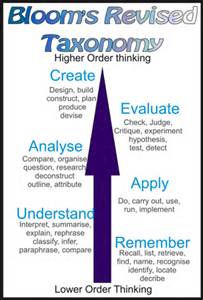
At the center of my argument stands Bloom’s Taxonomy.  Bloom’s is a learning hierarchy which helps to identify the depth of instruction and learning.  Here is Bloom’s Revised Taxonomy.  We’ll be referencing it a bit in the examples I provide.

Bloom's Revised Taxonomy

Bloom’s Revised Taxonomy

Take a moment to read through the descriptions of each of the ‘orders of thinking’ in Bloom’s.  Go ahead, I’ll wait…

Done?  Good.  Most would agree that courses such as ICS-300 and ICS-400 should attempt to convey learning at the Apply level, correct?  Unfortunately, that perception, while wildly popular, is wrong.  Most of the learning objectives of the two courses (objectives are our reference points for this) are at the Understand and Remember levels.  Yeah, I was a bit surprised, too.

In ICS Training Sucks, I provided a greater detail of the background analysis (it summarized the narrative of a Master’s research paper I wrote), so if you want more, simply go back and check it out.  While I make a few broad recommendations in that piece, there has been a need to examine our path to fixing this more closely.

In the development of curriculum, there exist several models.  The most commonly used model is the ADDIE model, which stands for Analysis, Design, Development, Implementation, and Evaluation.  The first step, Analysis, is really the most important, although often the most ignored or cut short.  People think they know what the need is, but often don’t really understand it.  If you are interested, I’ve written a piece on the topic of Analysis for Training Magazine last year.

Even though we are suggesting a re-write of the ICS curriculum, or parts thereof, Analysis is extremely important.  The roots of the current curriculum we use goes back to circa 1970s wildfire ICS courses.  These are good courses, and while I’m not sure if they fully met the need then (although they did advance us quite a bit), their evolved versions certainly DO NOT now.  There is no sense in repackaging the same product, so let’s first figure out what people need to know to do their jobs effectively.  Essentially, this leads us to identifying a list of key core competencies in ICS.  Core competencies will define the level of competence needed in a particular job or activity.  We can easily use the levels of Bloom’s as our reference point to establish common definitions for the levels of competence.  What am I talking about?

Let’s pick one key activity in ICS to examine.  Resource Management is a great example as it shows the disparity between what exists and where we need to be.  Resource Management is discussed in Unit 6 of the ICS-300 course.  I think most would agree that we expect most every jurisdiction to be able to implement sound resource management practices.  Implement is the key word.  Implementation is indicative of the Apply level of Bloom’s Taxonomy.  When looking at unit objectives in the ICS-300 course for unit 6, the key words are identify and describe.  Identify is indicative of the Remember level of Bloom’s Taxonomy, while describe is indicative of the Understand level.  Both fall short of application.  While we aren’t looking for this curriculum to create incident management teams, we still expect most jurisdictions to be able to manage resources, which is certainly a core competency of incident management.

I think the NIMS doctrine provides a good starting point for identifying core competencies.  In an effective study, there may be other competencies identified – perhaps topics such as leadership, that may not necessarily be found in a revised ICS curricula, but can be obtained through other training courses.  This could lead to an important differentiation between core competencies (those that MUST be included in ICS training) and associated competencies which can be sourced elsewhere.

Further, we can capitalize on what we have learned through implementation of the current ICS curriculum and previous iterations.  We know that multidisciplinary training is most effective since larger incidents are multidisciplinary.  We also know that training must be interactive and maximize hands-on time.  The past few updates to the ICS courses have done a great job of encouraging this, but we need more.

Making more detailed recommendations on fixing ICS training will take time and effort, as a solid Analysis must first be done.  Once core competencies can be identified and defined, then a strategy for revamping ICS training can be developed.  As mentioned in ICS Training Sucks, this approach should be multi-faceted, using both new and (good) existing courses to support it. Let’s not be bound by what currently exists.  We don’t necessarily have to create a ‘new’ ICS-300 or ICS-400 course.  Let’s create courses within a broader program that meets the needs of the emergency management community.  They may no longer be called ICS-300 and ICS-400.  Perhaps these two will be replaced by four smaller courses?  Who knows where this path will take us? The bottom line is that we need to be responsive to the needs of the learners, not bound by “the way we’ve always done it.”

As always, feedback is appreciated.  Perhaps there exists an institution that has the desire and funding to pursue this further?  I’m fully onboard!

© 2015 – Timothy Riecker

Emergency Preparedness Solutions, LLC

WWW.EPSLLC.BIZ

Training EOC Personnel – ICS is not Enough!

A consistent misconception is that if an emergency operations plan calls for an Emergency Operations Center (EOC) to utilize the Incident Command System (ICS), then EOC personnel only require ICS training to be successful in their jobs.  ICS training, however, only gets personnel part way to success.

Regular readers of my blog know that I am a big advocate of conducting needs assessments.  Often times, agencies don’t know how to conduct a needs assessment, don’t think it’s important enough to conduct one, don’t think that conducting one is necessary, or simply don’t even consider conducting a needs assessment.  The result is creating training or using existing training that does not meet the real needs.  Certainly if an EOC is using the foundations of ICS to define its organizational structure and processes, then ICS training is absolutely important.  Consider, however, the multitude of other processes that take place in an operational EOC that are not included (in whole or in part) in ICS training.  Processes including financial management and procurement, situation reporting, and use of EOC management and resource tracking software are so diverse and can very from jurisdiction to jurisdiction.

The unique application of Multi-Agency Coordination Systems (MACS), an element of the National Incident Management System (NIMS), just like ICS, by each jurisdiction also has to be considered.  While there are numerous best practices in MACS, their interface with ICS – often implemented through an EOC – is influenced significantly by governmental structure, statutory responsibilities, and politics more than can be addressed by any training curriculum. Consider simply the differences between a state EOC, a county EOC, and a local government EOC and their unique roles and needs. For as much standardization NIMS encourages, there will still be different ways of implementing these systems.  In the end, the challenge remains the same – how do we train people to function in EOCs?

First, do conduct that needs assessment.  What do people have to know and what skills must they have to be successful in an EOC?  At this point, I speak foundationally, as additional and more in-depth training can be explored based on position and responsibility.  Certainly ICS – with sufficient detail in positions of the organization and the planning process.    What else do they need to know?  ICS training does not address in detail what an EOC is or does – an important understand for people to have.  What processes must they be familiar with?  What tools or methodologies does the EOC use that must be trained on?  Are there specific organizational elements that require unique interactions with the greater organization (such as emergency support functions <ESFs>)?  Look through your jurisdiction’s EOC Standard Operating Procedures/Guidelines (you do have one, right?) to help you identify some of these needs.

Second, identify how to address these training needs.  ICS organization and the planning process are covered in the ICS-300 course, so that will meet some of your needs.  Unfortunately, since so many of the other needs are unique to your jurisdiction, you will have to build custom training to meet these needs.  Yes, FEMA does have available a course called EOC Management and Operations (IS/G – 775).  While some material in this course may or may help meet your training needs, chances are the course in its entirety will not.  First, it dedicates time discussing ideal facilities for an EOC (not really necessary if you already have such a facility), and second, while it provides an outline for general EOC operations it still won’t address all of your specific needs, although course materials can be used as a resource to inform your instructional design.

Third, build staying power into your training.  Much of what is learned is quickly forgotten, especially when people don’t practice it often.  There are a few strategies to combat this knowledge loss… 1) offer refresher training, 2) conduct regular exercises, 3) create job aids.  ICS is big on job aids – that’s very simply what the ICS forms are.  There are a multitude of additional job aids that you can create for your EOC.  Practically every position and process can have checklists and flow charts which help remind staff of what they need to do and in what order to do it in.

This can all be a lot of work, but it will pay off next time you have to activate your EOC.  Remember, there is always help available.  My consulting firm, Emergency Preparedness Solutions, has a great deal of experience working in a variety of EOCs across the country.  We have developed plans, procedures, job aids, training, and exercises unique to each EOC.  We can help you!  Check out our website at www.epsllc.biz or contact us at consultants@epsllc.biz.  Be Proactive, Be Prepared!™

© 2014 – Timothy Riecker