
The Emergency Management Support Act

First off, I certainly must acknowledge that it’s been a while since I’ve posted. I’m fortunate to have been and continue to be extremely busy managing and growing my firm, with a ton of great clients and projects around the country. I appreciate those who have reached out in the past couple of months expressing how much they have missed my blog posts. Fear not! There is plenty more to come.

I felt this post was rather timely to get out as I just heard about The Emergency Management Support Act (HR 3626), which amends the Post-Katrina Emergency Management Reform Act (PKEMRA) of 2006. This bill seeks to, among other items, set training requirements for local emergency managers. The bill was just introduced yesterday and has been referred to the House Committee on Transportation and Infrastructure.

As of the authoring of this post, the full language of the bill is not yet available on Congress.gov, though a summary is available here. In the summary, there are three components identified:

  1. Direct States, through the Emergency Management Performance Grant (EMPG), to require local emergency management directors to complete emergency management training within one year after the enactment of the bill
  2. Require local emergency management directors to complete recurrent training with certifications to be submitted to FEMA annually
  3. Require FEMA to report to Congress on compliance with this Act

My commentary:

Superficially, this proposal makes sense. We want emergency managers to be trained, right? Before I even get into the three components, I want to look at the premise of the bill.

The summary points to the 2017 Hurricane Season FEMA After-Action Report (AAR) as the driving force behind the bill, citing an actually rather obscure comment on the twelfth page of the report that states “pre-disaster training and exercises proved to be critical in Florida’s ability to efficiently execute mutual aid agreements”. This quote is pretty isolated within the report, with the context of that particular section being gaps in Threat and Hazard Identification and Risk Assessment (THIRA) data. In fact, none of the recommendations for that section of the AAR mention anything about training, though you could stretch to a possible connection of an obscure mention of the creation of ‘preparedness products’. Second, the AAR quote’s specific mention of the execution of mutual aid agreements may or may not be a very niche topic, depending on how it’s being defined. Unfortunately, there is nothing in the AAR that provides any citation or context to this line. It makes me wonder why this one line is so specifically being referenced as it clearly was not a major point of the AAR.

Now, let’s get into the three components. For the first, requiring states to require local emergency management directors to complete emergency management training. OK, but on what topics? To what level of proficiency? There are no specifics provided. A multitude of state emergency management offices have created training requirements for local emergency managers which range from a single training course to several. Many are even tied to local EMPG allocations. It’s certainly an effective practice, but I still question this bill establishing an ill-defined requirement.

The second component requires recurrent training, with certifications to be submitted to FEMA annually. This little statement is loaded with landmines. Again, I must ask the question – recurrent training on what topics? My second comment is the use of the term ‘certifications’. I have an entire post on the significant difference between certificate and certification. Is this second component calling now for not just training but a certification? That’s a very different thing. And most certifications do not require annual refresher training, though they do often require some kind of continuing education. My last comment on this component is about the submission of said ‘certifications’ to FEMA annually. This is not something FEMA is set up to receive and manage. While they have a learning management system or content management system that works behind the scenes of their independent study program and also tracks completions of other courses delivered by their Emergency Management Institute (and other partner programs), they do not track third party training for emergency managers across the nation. It could be that the ‘certification’ they refer to here is an attestation by state emergency management offices that local emergency management directors are meeting training requirements. If such is the case, this would certainly be easier and could be accomplished within state EMPG reporting back to FEMA.

As with most legislation in emergency management (and I imagine other technical fields), this is ill informed and ill constructed (though I say this only from seeing the summary and not the bill itself). While the intentions are good, this could cause states to have to restructure their established training requirements for local emergency management directors, and, depending on the mechanism for receiving and managing this information, could put an unnecessary administrative burden on FEMA. I really do wish lawmakers would rely more on subject matter experts to identify needs for and crafting of legislation instead of the good idea fairy.

Thanks, as always, for reading.

TR

Tim Riecker, CEDP
Emergency Preparedness Solutions, LLC®

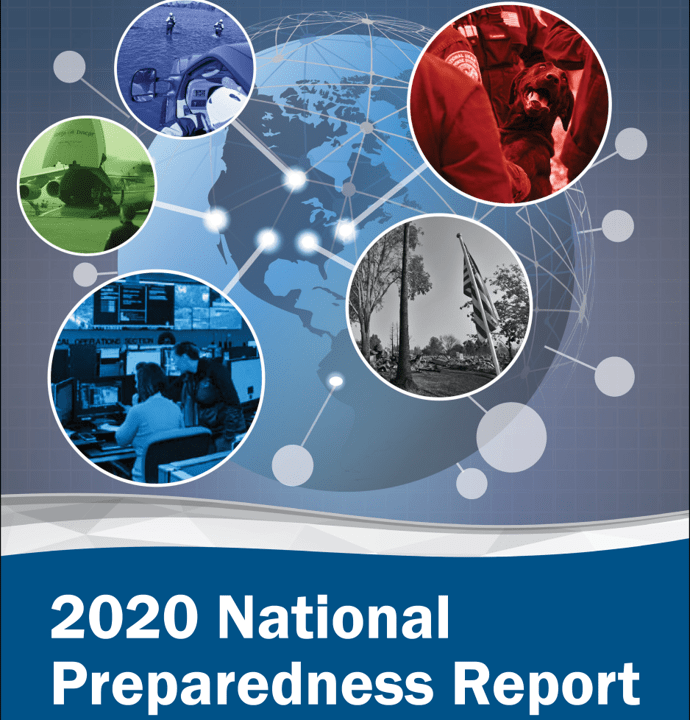
FEMA’s 2020 National Preparedness Report – A Review

It seems an annual tradition for me to be reviewing the National Preparedness Report. I’ve endeavored to provide constructive criticism of these documents, which are compilations of data from state and federal agencies, national-level responses, and other sources.

This year’s National Preparedness Report emphasizes that it is based on data from the 2019 calendar year. In looking back on past reports (note: they are no longer on the FEMA site – I was able to find them in the Homeland Security Digital Library) this has been the past practice. Perhaps I never realized it before, but a report talking about data from practically a full year ago seems to hold even less relevance. That means that enacting changes on a national level based on this data may not even begin to occur until two years have passed. Even taking into consideration that states and UASIs are compiling their reports early in a year for the previous year, it still seems a long time to wait for the national level report. This extent of lag is further emphasized by the document’s foreword, written by the FEMA Administrator, which makes many references to COVID-19 and how much different next year’s report will be, while not really speaking at all about the current report. This speaks a lot to how much we, as a practice, are attracted by the shiny objects dangled in front of us, seemingly ignoring all else.

My first pass of the 2020 report brought two primary impressions: 1) The instructive content of the document is some of the best I’ve seen out of FEMA, and 2) There is a considerable lack of data, with a low value for much of what they have included.

In regard to my first impression, the discussion of concepts such as risk (including emerging risk and systemic risk), capabilities, cascading impacts, community lifelines, public-private partnerships, and vulnerable populations has the perfect level of depth and detail. Not only do they discuss each of these concepts, but they also identify how they each connect to each other. This is EXACTLY the kind of consolidation of information we have needed for a long time. This lends itself to truly integrated preparedness and the kinds of information I’ve mentioned many times as being needed, including in the next version of CPG-101. I’m truly impressed with this content, the examples they provide, and how they demonstrate the interconnectedness of it all. I’ll certainly be using this document as a great source of this consolidated information. Now that I’ve extolled my love and adoration for that content, I’m left wondering why it’s in the National Preparedness Report. It’s great content for instructional material and doctrinal material on integrated preparedness, but it really has no place, at least to this extent of detail in the National Preparedness Report. Aside from the few examples they use, there isn’t much value in this format as a report.

This brings me to my next early observation: that of very little actual data contained in the report. Given the extent to which states, territories, UASIs, and other stakeholders provide data to FEMA each year by way of their Threat and Hazard Identification and Risk Assessments (THIRAs) and Stakeholder Preparedness Reviews (SPRs), along with various other sources of data, this document doesn’t contain a fraction of what is being reported. There are two map products contained in the entire report, one showing the number of federal disaster declarations for the year, the other showing low-income housing availability across the nation. Given the wide array of information provided by state and UASI, and compiled by FEMA region, surely there must be some really insightful trends and other analysis to provide. There are a few other data sets included in the report showing either raw numbers or percentages – nothing I would really consider analytics. Much of the data is also presented as a snapshot in time, without any comparison to previous years.

Any attempt to view this document as a timely, meaningful, and relevant report on the current state of preparedness in the nation, much less an examination of preparedness over time, is simply an exercise in frustration. The previous year’s report at least had a section titled ‘findings’, even though any real analysis of data there was largely non-existent. This year’s report doesn’t even feign providing a section on findings. To draw on one consistently frustrating example, I’ll use the Core Capability of housing. While this report dances around doctrine and concepts, and even has a section on housing, it’s not addressing why so little preparedness funding or even moderate effort is directed toward addressing the issue of emergency housing, which has arguably been the biggest preparedness gap for time eternal in every state of the nation. Looking broadly at all Core Capabilities, this year’s report provides a chart similar to what we’ve seen in previous years’ reports, identifying how much preparedness funding has gone toward each Core Capability. In relative numbers, very little has changed; even though we know that issues like housing, long-term vulnerability reduction, infrastructure systems, and supply chains have huge gaps. All these reports are telling me is that we’re doing the same things over and over again with little meaningful change.

So there it is… while I really am thoroughly impressed with some of the content of the report, much of that content really doesn’t have a place in this report (at least to such an extent), and for what little data is provided in the report, most of it has very little value. The introduction to the document states that “this year’s report is the product of rigorous research, analysis, and input from stakeholders”. To be blunt, I call bullshit on this statement. I expect a report to have data and various analysis of that data, not only telling us what is, but examining why it is. We aren’t getting that. The National Preparedness Report is an annual requirement per the Post Katrina Emergency Management Reform Act. I challenge that FEMA is not meeting the intent of that law with the reports they have been providing. How can we be expected, as a nation, to improve our state of readiness when we aren’t provided with the data needed to support and justify those improvements?

© 2020 Timothy Riecker, CEDP

Emergency Preparedness Solutions, LLC®

Reviewing The 2018 National Preparedness Report

The 2018 National Preparedness Report was released last week.  For the past few years, I’ve provided my own critical review of these annual reports (see 2017’s report here).  For those not familiar with the National Preparedness Report (NPR), it is mandated by the Post-Katrina Emergency Management Reform Act (PKEMRA).  The information is compiled by FEMA from the State Preparedness Reports (SPR), including the Threat and Hazard Identification and Risk Assessment (THIRA) data submitted by states, territories, and Urban Area Security Initiative (UASI) – funded regions.  The data presented is for the year prior.  The SPRs and NPR examine the condition of our preparedness relative to the 32 Core Capabilities identified in the National Preparedness Goal.

Overall, the NPR provides little information, certainly nothing that is really shocking if you pay attention to the top issues in emergency management.  Disappointingly, the report only covers those Core Capabilities identified for sustainment or improvement, with no more than a graphic summary of the other Core Capabilities.

Core Capabilities to Sustain

Operational Coordination was identified as the sole Core Capability to sustain in this year’s report.  I’ve got some issues with this right off.  First of all, they summarize their methodology for selecting Core Capabilities to sustain: ‘To be a capability to sustain, the Nation must show proficiency in executing that core capability, but there must also be indications of a potentially growing gap between the future demand for, and the performance of, that capability.’  To me, what this boils down to is ‘you do it well, but you are going to have to do it better’.  I think most EM professionals could add to this list significantly, with Core Capabilities such as Planning; Public Information and Warning; Public Health, Healthcare, and EMS; Situational Assessment; and others.  Distilling it down to only Operational Coordination shows to me, a severe lack of understanding in where we presently are and the demands that will be put on our systems in the future.

Further, the review provided in the report relative to Operational Coordination is pretty soft.  Part of it is self-congratulatory, highlighting advances in the Core Capability made last year, with the rest of the section identifying challenges but proving little analysis.  Statements such as ‘Local governments reported challenges with incident command and coordination during the 2017 hurricane season’ are put out there, yet their single paragraph on corrective actions for the section boils down to the statement of ‘we’re looking at it’.  Not acceptable.

Core Capabilities to Improve

The 2018 report identifies four Core Capabilities to improve:

  • Infrastructure Systems
  • Housing
  • Economic Recovery
  • Cybersecurity

These fall under the category of NO KIDDING.  The writeups within the NPR for each of these superficially identifies the need, but doesn’t have much depth of analysis.  I find it interesting that the Core Capability to sustain has a paragraph on corrective actions, yet the Core Capabilities to Improve doesn’t.  They do, instead, identify key findings, which outline some efforts to address the problems, but are very soft and offer little detail.  Some of these include programs which have been in place for quite some time which are clearly having limited impact on addressing the issues.

What really jumped out at me is the data provided on page 9, which charts the distribution of FEMA Preparedness grants by Core Capability for the past year.  The scale of their chart doesn’t allow for any exact amounts, but we can make some estimates.  Let’s look at four of these in particular:

  • Infrastructure Systems – scantly a few million dollars
  • Housing – None
  • Economic Recovery – Less than Infrastructure Systems
  • Cybersecurity – ~$25 million

With over $2.3 billion in preparedness funding provided in 2017 by FEMA, it’s no wonder these are Core Capabilities that need to be improved when so few funds were invested at the state/territory/UASI level.  The sad thing is that this isn’t news.  These Core Capabilities have been identified as needing improvement for years, and I’ll concede they are all challenging, but the lack of substantial movement should anger all emergency managers.

I will agree that Housing and Cybersecurity require a significant and consolidated national effort to address.  That doesn’t mean they are solely a federal responsibility, but there is clear need for significant assistance at the federal level to implement improvements, provide guidance to states and locals, and support local implementations.  That said, we can’t continue to say that these areas are priorities when little funding or activity is demonstrated to support improvement efforts.  While certain areas may certainly take years to make acceptable improvements, we are seeing a dangerous pattern relative to these four Core Capabilities, which continue to wallow at the bottom of the list for so many years.

The Path Forward

The report concludes with a two-paragraph section titled ‘The Path Forward’, which simply speaks to refining the THIRA and SPR methodology, while saying nothing of how the nation needs to address the identified shortcomings.  Clearly this is not acceptable.

~~

As for my own conclusion, while I saw last year’s NPR as an improvement from years previous, I see this one as a severe backslide.  It provides little useful information and shows negligible change in the state of our preparedness over the past year.  The recommendations provided, at least of those that do exist, are translucent at best, and this report leaves the reader with more questions and frustration.  We need more substance beginning with root cause analysis and including substantial, tangible, actionable recommendations.  While I suppose it’s not the fault of the report itself that little improvement is being made in these Core Capabilities, the content of the report shows a lack of priority to address these needs.

I’m actually surprised that a separate executive summary of this report was published, as the report itself holds so little substance, that it could serve as the executive summary.  Having been involved in the completion of THIRAs and SPRs, I know there is information generated that is simply not being analyzed for the NPR.  Particularly with each participating jurisdiction completing a POETE analysis of each Core Capability, I would like to see a more substantial NPR which does some examination of the capability elements in aggregate for each Core Capability, perhaps identifying trends and areas of focus to better support preparedness.

As always, I’m interested in your thoughts.  Was there anything you thought to be useful in the National Preparedness Report?

© 2018 – Timothy Riecker, CEDP

Emergency Preparedness Solutions, LLC

Learning From a 10-Year-Old Report

I’ll admit that I’m often dismissive of information, especially in the field of emergency management and homeland security, if it’s over 10 years old.  There is a lot that’s changed in the past 10 years, after all.  But, realistically, for as much as we’ve changed, things have stayed the same.  Arguably, the first decade of this millennium saw much more change in EM/HS than the second decade has, at least so far.  The first decade saw events like 9/11 and Hurricane Katrina.  Yes, there certainly have been major events in this second decade, but none, it seems, were as influential to our field of practice than those in the first decade.

It’s important to reflect upon lessons observed and to examine what lessons we’ve actually learned.  How far have we come in implementing improvements from the 9/11 Report?  What still needs to be accomplished to meet the intent of the Post-Katrina Emergency Management Reform Act (PKEMRA)?  Perhaps when I have some time to devote I’ll review those documents again and look on them reflectively and provide my thoughts here.

Yesterday I received the latest email from DomesticPreparedness.com.  I refer often to their work in my articles.  This weekly brief included an article from one of my favorite authors in this field, John Morton.  I’ve referenced his work in a few of my past articles.  This article, titled The What If Possibility: A Chilling Report, talks about planning for a rogue nuclear attack, the likely lead role the federal government would have to take in response to such an attack (versus a locally-led response), and what the situation would be the day after.  With the threat of North Korean nuclear weapons capability looming, this article was an interesting read and spot-on.  I noticed a problem, though… It referenced Ash Carter as an assistant secretary of defense in the Clinton administration.  While this was true, Carter’s highest office was SecDef under President Obama.  Surely John Morton, with his incredible attention to detail that I’ve come to recognize couldn’t have made this error.

Nope.  No error on his part.  I looked at the date of the article.  June 27, 2007 – over a decade old.  Incredibly, this article is still highly relevant today.  The article does reference the drafting of certain federal plans for nuclear attack.  Plans which I am not privy to, but that must assuredly exist today.  I’m curious as to the model these plans follow, what has been learned from exercising them, and how we might be able to apply elements of these plans to other catastrophic occurrences.

Despite change, so much seems to stay the same. Of course a decade isn’t that long.  Given that emergency management and homeland security are primarily government roles, we have to acknowledge that the (usually necessary) bureaucracy simply doesn’t move that quickly.  Unfortunately, there are things we are far too slow to adopt, not just from a government perspective, but socially.  As a lover of history and sociology, I see lessons observed from the 1900 Galveston hurricane as well as the eruption of Mt Vesuvius in 79 CE.  There is much that history can teach us, if we are willing to listen. Lessons observed, but not learned.

© 2017 – Timothy Riecker

Emergency Preparedness Solutions, LLC