Gauging Return on Investment in Preparedness: Training

This is my fourth article in a series examining how organizations can gauge their return on investment for various emergency management and homeland security preparedness projects.  These were inspired by an original article I wrote called Measuring Return on Investment in Emergency Management and Homeland Security: Improving State Preparedness Reports.  The POETE model (Planning, Organizing, Equipping, Training, Exercising) helps us to identify all activities related to preparedness.  Thus far, we have covered:

Planning

Organizing

Equipping

If you haven’t already reviewed these articles, check them out for additional context and information.  Within each, I outline the general activities within the preparedness element, and identify the potential costs and benefits of these activities to the organization.  While some costs and benefits are direct (meaning we can readily identify them in terms of currency), most are not, and require some measure of analysis.

We put a lot of money (and faith) into training as a central preparedness activity.  And why shouldn’t we?  Training, by definition, is a transfer of learning.  We have a lot of information to communicate to our staff and other stakeholders, with the goal of that information collectively becoming a body of knowledge, and a vision of these people applying what they have learned to future circumstances.

In emergency management and homeland security we train quite a bit, with some training being required by organizational, local, state, national, international, or federal standards; while other training will help develop and advance staff.  We include HR-required training; soft skills like communication, leadership, decision making, and the like; as well as technical skills such as emergency planning, exercise design, and incident management.  Emergency management and homeland security are broad fields of practice, which intersect public safety, public health, and other essential government and social functions.  Most emergency management and homeland security practitioners have roots in one or more of these fields and typically continue receiving training relative to those as well.

Training comes from a variety of sources including our home organizations, local and county governments, state government, private and not for profit entities, and the federal government.  Particularly for training that is sponsored by a government entity, most training is ‘free’.  In the US, federal training entities, such as FEMA’s Emergency Management Institute, also reimburse travel expenses and provide lodging for all levels of government employees.  On the surface, the cost of most emergency management and homeland security training is fairly low.

Of course depending on perspective, the cost of training can vary.  As a former state training officer who managed all emergency management related training delivered across my state, I could identify our agency’s cost of training.  This would include our staff admin time for course prep and record keeping, the cost of duplicating participant manuals, any costs associated with the hosting facility (although we usually utilized no cost facilities), the cost of paying our instructors for their time and travel, and, if applicable, any lodging and/or meal costs for participants who may have traveled a distance.  These costs, however, are only part of the picture.

What about the cost to the organization that is sending people to be trained?  Directly, this is salary time in which little to no work is actually being accomplished for the organization.  The organization may also be footing the bill for travel costs for their participants.  Depending on who is sponsoring the training, there may be a fee for the course.  Indirectly, what is the cost of that employee being away?  Who is doing their work?  This often depends on the organization and the position the individual holds in that organization.  Firefighters, police officers, health care professionals, and others may be covering shifts that will still need to be filled, especially if policies or union contracts require certain staffing levels.  Sometimes this backfilling isn’t as simple as changing schedules, as most employees are already scheduled at full time status.  Therefore, someone may need to be paid overtime to fill this position for the duration of the training.  Perhaps the learner themselves is being paid overtime to tend to priority tasks outside of training hours.  Maybe others can simply absorb some extra tasks while this person is gone, or the learner will be swamped for some period of time once they return from training.  Each of these mechanisms, all dealing with productivity, has a cost associated to it.

Training can get expensive, which is why it’s often one of the first activities cut when an organization’s budget gets tight.  We try to minimize the cost of training through a variety of practices such as shorter training days, online training, and local training.  These, however, have various impacts on the organization’s ability to obtain the training as well as the overall effectiveness of the training.  Sometimes we simply defer the training, but the organization may have little choice, particularly with mandated training.

So what benefits can training provide?  As mentioned, I have quite a bit of background as a trainer and training manager.  I’d love to tell you that training has the greatest of all benefits, but that would be a complete lie. Just like any other preparedness activity, it has to be properly applied.  Training won’t fix everything.  I’ve written a lot of pieces on training in my blog… just search for ‘training’ and you will find plenty of articles about how training should/shouldn’t be applied.  With that caveat, training can have great benefit.  Not only can it make people more effective and efficient in their jobs and related tasks, it can also help defer liability from the organization.  Training also has benefits which more directly apply to the learner vs the organization, such as providing background for advancement and/or promotion (which can be internal or external to the organization).  There are many practices in emergency management and homeland security for which training aids in health and safety, not only of the staff member who took the training, but also of others.  In training, the impacts can go pretty far… you just have to follow the bouncing ball.  As an example: Jane gets trained in how to write emergency plans.  The emergency plans she writes will help the organization respond more effectively in the event of a disaster.  When the organization responds more effectively, lives and property are protected.  While this is a great ideal outcome, it makes for some difficulty in determining the benefits in terms of currency.

Often, the most direct benefits from training are rooted in compliance and proficiency.  Organizations have a variety of compliance matters they have to meet.  These obligations may be HR driven, required by an executive, a higher level of government, an accreditation body, or a funding source.  Safety matters are also usually linked with a compliance matter.  I often try to associate training activities to these requirements.  Sometimes we can directly link a financial benefit to these compliance matters, while other times compliance is simply factually stated.  Second is proficiency.  People need to stay current in essential skills.  This might require regularly recurring training for staff, well as training for new staff.  Staff need to be proficient in new procedures, software, and equipment operation.  Certain staff may need to be trained to more advanced levels.  Gauging the benefit in financial terms for proficiency is generally more difficult, although the need for the training is apparent.  The benefit simply needs to be extrapolated.  For instance, if the training is in a new process, what is the time and/or quality difference between the old process and the new?

As mentioned earlier, it is often times not easy to determine the financial return on investment for many of our activities.  We need to dig deep and identify quantifiable metrics which can be examined before and after we apply our preparedness activity.  We must assign reasonable currency figures to those metrics to help us and other decision makers better understand our investment and the benefits it will potentially bring.

Soon I’ll be wrapping up this series with the last key preparedness activity – exercises.  As always I’m happy to hear your thoughts on how we can better identify the returns on our investments in preparedness activities.  As a resource, I’d encourage you to search Training Magazine (trainingmag.com), which often has articles on analyzing the return on investment in training.

© 2015 – Timothy Riecker
Emergency Preparedness Solutions, LLC

Gauging Return on Investment in Preparedness: Equipping

I’ve written previous posts on our preparedness investments and how we can gauge our return on those investments.  Following the POETE model (planning, organizing, equipping, training, and exercises), I’ve so far covered some considerations for Planning and Organizing.  This piece will focus on identifying our return on investment for Equipping.  Equipment can be anything from a new fire engine, to a generator, a UAV/drone, a radiological detection device, or incident management software.

Equipping is generally a preparedness activity in which we can more easily identify what our actual investment is.  Unlike Planning, which requires varying amounts of time from a number of people, or Organizational efforts which sometimes have rather esoteric costs, when we purchase or maintain equipment, we usually have a receipt in hand.

Functioning in the bureaucracies we do, however, we tend to add complexities.  We form committees to find the best equipment we can, we leverage our own staff time to keep it maintained, and we often have other associated costs, which reflect back on the other POETE elements… at least we should.  In addition to the cost of the equipment itself, let’s look at what the associated costs could be.

Every significant equipment purchase, first of all, should stem from an identified need.  Maybe it’s a critical element of a process, it’s called for in a plan, or the need was identified in an after action report.  Perhaps you are upgrading or expanding application of a certain piece of equipment?  Regardless, your organization must invest some time to ensure the equipment will meet your needs and how it will impact your operations.  This activity, generally referred to as Assessment, if often rolled into the Planning element.  Once we do obtain the equipment, we also need to plan.  We need to ensure the use of the equipment is accounted for in our plans.  Perhaps it’s as simple as adding it to a resource inventory, or as complex as creating processes or procedures that address its use.

Organizationally, you may need to task an individual or even assemble a team which will be responsible for the care and operation of the equipment.  This, logically, leads to Training.  People need to be properly trained in not only the use of the standard use of the equipment, but also the circumstances which it will be used as well as any processes or procedures for use which are unique to your organization.  Consider what degree of proficiency these individuals may need in the operation of the equipment.  Is it just basic operation, or is there a need for something more advanced?  Will recurring training be needed to maintain proficiency or to train additional people in the future?  Will anyone be trained in higher level maintenance of the equipment?

Exercising the equipment, its effectiveness, and the ability of your resources to use the equipment is essential.  Lastly, we often don’t consider the costs of maintaining and storing the equipment.  It may need replacement parts or regular servicing, which even done in-house, has an associated cost.  It may have certain storage requirements to ensure the safety and readiness of the equipment.

Now that we’ve outlined potential costs or investments, how do we know those investments have made a difference for your organization?  To determine this, we must first look at the original need.  What actually defined the need for the equipment?  Was it to replace something older and less reliable?  Was it to enhance response time?  Was it because of safety?  Did the need identify inefficiencies in previous practices and systems?  Did the new equipment meet that need?

To dig further, what was the value of that need?  To identify this, we should look at the metrics associated with that need.  If the new equipment replaced something aging, we can look at the maintenance costs and down time over a certain period of time for the older equipment.  If it was to shorten response time to get a certain capability on-scene, we should be able to identify the time metrics as well as the difference that equipment makes once it is on scene (eg. a fire department which previously had to call mutual aid to get jaws of life on scene, vs purchasing a set of jaws and having them on scene much faster).  We can associate a dollar-value cost to many of these metrics.

Was there any additional value which the equipment brought your organization?  Perhaps the added capability decreased your insurance rates or made you eligible for a particular industry certification?  Are there any indirect cost savings because of the new equipment?  Does the new equipment somehow aid in generating income?

There are many considerations when it comes to any of our investments to ensure that they are sound, responsible, and reasonable.  Often we need to identify the value of an investment before it is made, but we should certainly keep track of that value after the investment as well.

Need help with planning?  Gap analysis?  Resource inventories?  Maybe with the training or exercising associated with new equipment or other preparedness needs? Contact EPS!

© 2015 – Timothy Riecker

Emergency Preparedness Solutions, LLC 

Gauging Return on Investment in Preparedness: Organizing

As a continuation of the Gauging Return on Investment in Preparedness series (read the first one on Planning here), this post’s focus is on the POETE element of Organizing.  There are a number of ‘organizing’ efforts we engage in through our preparedness endeavors.  Some are temporary, like establishing working groups to solve a certain problem; while some are intended to be long-term, like forming an incident response team.

Why organize?  Most organizational efforts are fueled by the need to capitalize on the power of many.  What one person can do, more people can do better.  Problem solving, responding, etc.  Often our organizational efforts are internal, but, particularly in public safety, we coordinate with other agencies.  We might be building a professional response organization, such as an Incident Management Team (IMT), or perhaps we are building a community organization, such as a Community Emergency Response Team (CERT).

What costs are associated with organizational activities?  Foundationally, it’s simply the staff time needed to prepare for, attend, and perform follow up work from meetings and other organizational efforts.  Depending on how complex our efforts are, however, and the intent of our organizational efforts, this can take on full time duties.  You also have to consider who is being drawn into these efforts and what the ‘replacement cost’ is of their time – meaning, what is the cost of someone else performing their work while they are involved in the meetings, etc.?  We also need to identify what costs might be associated with organizing?  The remaining POETE elements (Planning, Equipping, Training, and Exercising) can probably lead you to identifying these.

What are the benefits (value) of organizing?In order to identify the return on our investment, we need to be able to ascertain the benefits our organizational efforts bring – some may be tangible and relatable in dollar figures, others may be more intangible and amorphic.

As with many preparedness efforts, we find ourselves needing to make reasonable assumptions to identify cost savings or value.  We need to follow the bouncing ball of our efforts.  As an example… If we create a CERT team, citizens will be better able to tend to their own needs in the event of a disaster.  This leads to less immediate need of limited resources (first responders), allowing them to focus on more critical needs (i.e. saving lives and protecting infrastructure).   In this example we can make some assumptions about the types of infrastructure to be impacted by a certain incident and the costs associated with it becoming incapacitated.

In regard to saving lives, it’s difficult for us to attach a dollar value to that.  We often say that lives are priceless, and while that may be true, we sometimes need to make an educated guess.  Depending on who you are reporting figures to, they may be satisfied with a reasonable number of lives being saved… others may want to actually compare apples to apples (that is, dollars to dollars).  If you engage the use of your favorite internet search engine and search ‘what is the value of a life’, or something similar, you will find a number of results.  In perusing some of these results myself, I found that the dollar figure assigned to a life is obviously subjective and very much related to the industry in which the question is being asked.  This particular article makes for an interesting read on the subject.  Spoiler alert: they peg the value of a human life at $5M USD (2011).

In the end, organizational efforts need to have a purpose providing a net value.  Even in routine matters and daily business, we should examine the cost of organizational efforts – particularly meetings.  Meetings are one of my biggest bugaboos, as they are often too long, have little purpose, and the objectives can be met in a much more efficient manner.

What ideas do you have on determining the return on investment for organizational activities?

© 2015 – Timothy Riecker

Emergency Preparedness Solutions, LLC

www.epsllc.biz 

Gauging Return on Investment in Preparedness: Planning

Inspired a bit by my previous post Measuring Return on Investment in Emergency Management and Homeland Security: Improving State Preparedness Reports, I’ve decided upon writing a series of posts picking apart our primary activities in emergency management and homeland security preparedness to identify ways to gauge our Return on Investment (ROI).  To encapsulate our primary activities, I’m using the five POETE capability elements:

  • Planning
  • Organizing
  • Equipping
  • Training
  • Exercises

Most preparedness activities within emergency management and homeland security fall within one or more of the POETE capability elements.  The capability element of Planning is the foundational activity on which all preparedness is built and will be the topic of this post.  Here’s what I’m covering:

  • What is Return on Investment?
  • What planning efforts are involved in preparedness?
  • What organizational investments are involved in Planning?
  • Does the planning effort comply with applicable standards?
  • Can the plan be implemented?
  • What will exercises tell you?
  • Is there a need to maintain plans?

Return on Investment, or ROI, is a business term used to identify the profitability of certain investments or actions.  While preparedness is certainly done to protect against losses, for public and private sector alike, we generally don’t see preparedness activities as generating revenue.  However, when most entities INVEST time, money, and other resources into preparedness activities, they often want a reasonable assurance that their investment has paid off.  How do we gauge ROI for planning efforts?

First off, what planning efforts might we see in public or private organizations?  Obviously emergency and disaster plans are the big ones.  These plans are designed to identify key processes, such as alert and notification, response organization and incident management, and others which are intended to save lives and protect property.  These plans are likely to have annexes and appendices which address uniqueness of certain hazards, response circumstances, and support activities.  Continuity plans – usually business continuity or government continuity – identify how the organization will survive as an entity in the face of disaster.  Planning activities also involve the creation, review, and maintenance of policies and procedures.  We also create plans for hazard mitigation, long term recovery, specific events, and other needs.

What investments are involved in planning activities?  Organizations can and should allocate staff time and physical space and infrastructure to planning efforts.  The dedication of staff (full or part time) and/or consultants is often required, especially when planning efforts are viewed as a continual process and a critical part of preparedness.  The organization itself must make a commitment to the planning effort.  This commitment isn’t just in concept, but also practical involvement of staff throughout the organization, access to information, and even an involvement of third parties.

Certainly a first step in assessing return on investment of planning is to evaluate compliance with applicable rules, regulations, and guidelines.  These requirements can be hard (legally binding) or soft (general guidance) and can differ from industry to industry, nation to nation, and state to state.  Here in the US, FEMA provides guidance on emergency planning through Comprehensive Preparedness Guide (CPG) 101.  Some states may have requirements for emergency planning, such as New York State’s Executive Law Article 2-bNFPA 1600: The Standard on Disaster/Emergency Management and Business Continuity Programs is often referenced by public and private entities alike, while the International Standards Organization (ISO), has many industry-specific requirements for emergency planning.  If grant funding is being used for the planning effort, the grant may also have specific requirements.  Regardless of what the requirements are, planning efforts, plans, and associated documents should be audited to ensure that requirements are met.

Compliance, however, isn’t necessarily indicative of a good planning effort.  I’ve seen many plans which may meet requirements but the content itself was severely lacking.  Far too often planners get caught up in the world of checking boxes and fail to consider implementation.  If a plan cannot be implemented, it is useless to the organization.  Many plans exist now that meet applicable requirements but are still yet vacant of any meaningful direction or guidance in the event of an emergency.  These types of ‘plans’ are really better seen as policy documents.  A plan should identify what will be done, when, how, and by who.  If your ‘plan’ simply contains a statement on the requirement to use NIMS/ICS, but doesn’t provide detail on who will be in charge of what, when, and how; it is a policy document, not a plan.  Plans and their associated documents (i.e. procedures, guidelines, and job aids) need to chase down the lifespan of each critical step, especially early in a response.  They must identify who is responsible to make key decisions, who will be notified (how and by who), and who will take what actions.  A logical review of planning documents by the planning committee or perhaps even a third party is another good means of assessing your return on investment.

Does the plan work?  This is, perhaps, the ultimate factor in determining return on investment.  Usually our best means for identifying if a plan works is to exercise it.  Exercises provide a controlled and focused environment for testing plans or components of plans.  They will also help us in identifying if the plan can truly be implemented.  I’ve written a lot on exercises: articles can be found here.  (I also anticipate writing about assessing ROI for exercises as part of this series).  Generally, an incremental exercise program is usually recommended, beginning with discussion-based exercises – such as table tops and workshops – and progressing to operations-based (hands on) exercises.  A well written and honestly evaluated exercise will go a long way toward identifying the return on investment of your planning efforts.

Are we there yet?  Nope.  Planning, like all other preparedness efforts, requires maintenance.  If you create a plan then walk away, even if it’s a good plan, your plan’s value will diminish over time – and we’re talking months, not decades.  Think about how often something changes in your organization.  Staffing.  Equipment.  Technology.  Procedures.  Insurance policies.  All of these things, and more, influence your plans in some way.  Over time these changes not only occur, but also compound and move the present reality of your organization further from the assumptions of your planning efforts.  This is why plans must be maintained and updated on a regular basis.

Is there some mathematical formula for identifying the return on investment of preparedness efforts?  Given all the factors involved and their fluidity, I don’t think so.  It’s not cut and dry like a traditional business investment.  As you can see, though, there are a number of steps we can take to assess the utility of our investment.  I’ve seen organizations pay a lot for bad plans, and others pay much less for great plans.  Not only do organizations need to ensure that their planners know what they are doing, but the organization itself needs to have a commitment to success.  Without it, the planning effort is doomed to fail.

As always, feedback is appreciated.  What are your thoughts on assessing the return on investment of planning efforts?  What do you think is a good measure?

Does your organization need a new plan or need to update a plan?  Do you need help with the planning process or evaluating your organization’s preparedness?  How about exercises?  Emergency Preparedness Solutions can help!  Email to consultants@epsllc.biz or visit www.epsllc.biz.

© 2015 – Timothy Riecker

Emergency Preparedness Solutions, LLC

WWW.EPSLLC.BIZ

Measuring Return on Investment in Emergency Management and Homeland Security: Improving State Preparedness Reports

A lot of money is spent within the emergency management and homeland security enterprise.  Looking just at the last couple of years of annual Homeland Security Grant Program (HSGP) (this is the annual grant provided by the US Federal government to states and urban areas), $1.044 billion was allocated in FFY 2015 and $1.043 billion allocated in FFY 2014.  These billions of dollars only account for a portion of spending within EM/HS.  There are other federal initiatives as well as state, tribal, territorial, and locally funded efforts.  Businesses and NGOs also invest significantly in emergency management, homeland security, and business continuity activities.  But where does it all get us?

Through the past decade or so there have been a few efforts by DHS/FEMA to try to measure preparedness, ideally to identify improvements in our preparedness as the result of the billions of dollars invested.  None of these efforts have really provided obvious and tangible results.  The current measure is through annual State Preparedness Reports (SPRs), which utilize the THIRA process (Threat and Hazard Identification and Risk Assessment) outlined in Comprehensive Preparedness Guide (CPG) 201 as a foundation, but with the POETE analysis (Planning, Organizing, Equipping, Training, and Exercising) for each of the 31 Core Capabilities.  (You can find articles I’ve written on the utility and application of POETE here.) The SPR is a good methodology for identifying the current condition of preparedness for each state as viewed through the 31 Core Capabilities.  The POETE analysis helps to identify the strengths and weaknesses within each Core Capability.

The SPR, however, still falls short.  How can we improve it?

1. Include historical data for trend analysis. The SPR largely provides only a snapshot of current conditions.  The format of the SPR does not provide for any analysis of historical data to identify trends (i.e. improvements or otherwise) in the state’s assessed condition of its 31 Core Capabilities.  FEMA regional offices, upon receipt of an SPR, do provide a brief feedback report of the current SPR with a passing mention of the previous year’s submission, but the report provides so little information it could hardly be called an analysis.

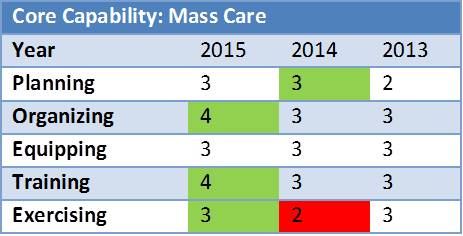
A rudimentary table identifying trends for a selected Core Capability is below.  For those not familiar, higher scores rate a higher measure of capability.  In this table, I’ve identified POETE elements which have trended lower from year to year with a RED highlight, and those which have trended higher with a GREEN highlight.  A simple analysis such as this give an at-a-glance comparison.  To make this analysis more comprehensive, I would suggest the addition of narrative for each trend (higher or lower) which explains what has changed to warrant the new ranking.

Historical Comparison of a Core Capability

2. Include a financial analysis for the current year to identify return on investment. An identification and summary of key program area investments for the year will lay the groundwork for a return on investment (ROI) analysis.  ROI will help identify how much bang for the buck you are getting in certain areas.  It’s easy to lose sight through the year from a program management perspective on how much money was spent on certain programs and activities – especially for larger agencies with a layered bureaucracy.  Incorporating this analysis into an SPR is not only good financial and program management, but provides an opportunity to identify where money was spent and to measure, at least on a broader scale, what the results were.  Certainly we have to fund continued operations to simply sustain our capabilities, but we should also be funding, where possible, programs to enhance our high priority capabilities and those needing the most improvement.

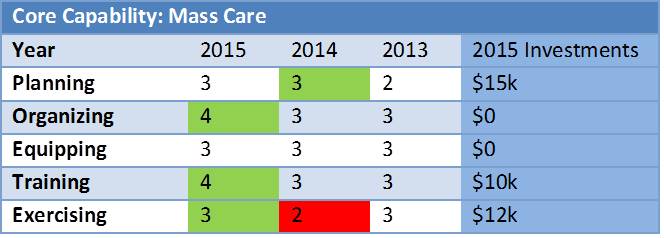
Again, as a rudimentary example, we can build on the table provided earlier to identify where funds were spent to see if they made a difference in our level of preparedness.  As with the earlier example, a narrative should be provided for each investment to identify what it was and assess the impact.  This also provides an excellent opportunity to review the investment justification written for grants to determine if the investment met the intended objectives (which should have been to maintain or enhance some aspect of the capability).  Historic investment data can also be included for each year.  This all leads directly to identifying the return on investment – did the investment make a difference and to what extent?

Historical Analysis of a Core Capability with Identified Investments


Ultimately this added data and analysis requires more work, potentially the involvement of more people, and likely more time to complete the SPR.  However, this new process will also result in a positive return on investment itself by helping to identify trends and outcomes.  Financial information is regularly reported to DHS (for those grants that originate with them) in the form of progress reports, but that information is stovepiped and usually not associated with a more comprehensive assessment such as the THIRA/SPR.  Bringing this data together paints a much more accurate picture.

The concept of preparedness is difficult to put in a box.  It’s amorphic and challenging to identify, yet people often ask the question ‘Are we prepared?’  States, locals, DHS, and Congress often have difficulties measuring preparedness and advances in preparedness, especially relative to the dollars spent on it.  The GAO has regularly recommended efforts to better identify return on investment, yet we haven’t gotten there.  The recommendations identified here can bring us much closer to nailing down where we are and where we need to be.  Armed with this knowledge, we can make better decisions for future investments and activities.

Moving forward, I expect to write a bit on each POETE element, with my thoughts on how we can identify return on investment for each.  As always, I’m very much interested in your thoughts on the approach I identified above and how we can better identify return on investment in the realm of emergency management and homeland security.

If you are interested in utilizing this approach to better identify your return on investment for local, state, tribal, territorial, or organizational preparedness efforts (whether or not you do a State Preparedness Report), Emergency Preparedness Solutions is here to help!  Check out our website at www.epsllc.biz or contact me directly to discuss what we can do for you.

© 2015 – Timothy Riecker

Emergency Preparedness Solutions, LLC

WWW.EPSLLC.BIZ

Preparedness – ICS is Not Enough

Back in October I wrote a post about ICS training not being enough for EOC personnel.  You can give it a read to see my reasons, which essentially boil down to the specific role of the EOC (Emergency Operations Center) in the incident management structure and the unique processes which take place in an EOC both not being addressed in ICS (Incident Command System) training.

As I continue to work in various jurisdictions to enhance their preparedness, I am expanding my thoughts on ICS training not being enough – this time for all of preparedness.  In meeting with jurisdictions and discussing their current state of preparedness, many believe they are well prepared to respond to any incident simply because their personnel have received ICS training.  Why am I concerned by this?

Folks, in the grand scheme of things, ICS training alone does not teach you to do very much except how to function within a system.  First off, I’m a huge believer in ICS and the success it can help facilitate in incidents and events.  Not only have I seen it work, but I use it and advocate for it as a chief practice of emergency management.  I’ve been teaching ICS courses since 2001 and have led hundreds of course deliveries amongst the various levels.  That said, in seeing the faith that people are putting in ICS as their savior from disaster, I think that faith has become exaggerated and misplaced.  While ICS gives us guidance on structure, processes, and standards, it still doesn’t tell us HOW to manage the incident and its impacts – and it never well.

The structure, processes, and other standards that ICS provides – when properly applied – are greatly beneficial to our ability to manage a disaster.  Let’s not forget, though, everything else that is needed to be successful.  There is an abundance of training available for personnel to address identified needs to make them better at what they do and thus enhance the capabilities of the jurisdiction or entity.  Some of this may certainly include higher level and more functional training in ICS (i.e. position-specific and incident management team training), but we can’t forget that we must focus on our needs and developing to meet those needs.  More on identifying training needs here and here.

The best way of identifying those needs, comprehensively, is through our plans.  Planning is the cornerstone of preparedness and serves as the foundation of our response.  Planning to appropriate depth is not often performed and always needs to be enhanced (more training in the activities of planning is certainly an identified need!).  Once plans are in place, we need to train all stakeholders on the contents of those plans and of course exercise them.  The process of planning and the exercises we conduct will identify other gaps in preparedness efforts that the jurisdiction or entity should address.  These gaps are most easily analyzed through through five key elements – Planning, Organizing, Equipping, Training, and Exercising (POETE).  More on POETE analysis here.

When a plan is being written or reviewed, we need to follow the bouncing ball for each of the identified activities.  Is it enough for the plan to say that certain stakeholders will be contacted when an incident occurs?  Of course not – we need to identify WHO will contact them, HOW they will be contacted, specifically WHEN they will contact and what is the trigger event, and WHAT they will be told.  Also, what happens if someone is unreachable?  What actions are they expected to take?  Do they then need to make any notifications?  If they are doing nothing with the information, WHY are we even contacting them?  This simple task requires planning (process and decision mapping as well as a specific procedure), organizing (identifying specific personnel and alternates to do this), equipping (the equipment needed for them to make contact; including access, maintenance, operation, and redundancies), training (training and job aids in the procedures and equipment), and exercising (to ensure that all the previous elements function appropriately).

The example above is simple, but shows how far-reaching and complex a seemingly simple activity can be.  ICS training won’t address this.  While ICS practices should be penetrating the deepest aspects of our incident response organization, ICS as a concept is fairly high-level and conceptual.  While it helps structure our tactical resources, ICS itself is not a tactical application – it is simply the structure we perform in.  The processes it provides are not tactical processes, they are incident management processes, but we still need to know about the incident and what to do – ICS will not provide those answers.  ICS is a great tool, but just like a carpenter we must have a variety of tools to do the job properly.

What needs have you identified?

If you need assistance with your preparedness – planning, training, exercising, or needs assessments – reach out to Emergency Preparedness Solutions!

© 2015 – Timothy Riecker

Emergency Preparedness Solutions, LLC

www.epsllc.biz  

Best Practices for the New Year – Resolve to be Responsible, Realistic, and Resourceful

As I work with jurisdictions and discuss their capabilities I find a broad range of perception among emergency managers about their jurisdictions’ capabilities and limitations.  Some overestimate their capability, thinking that they can handle anything and don’t need any outside assistance.  Others underestimate their capabilities, with their emergency plans defaulting to calling for help or making someone else responsible for nearly every scenario.  Fortunately some jurisdictions are spot on and have an informed and realistic perception of their capabilities.  Having the wrong awareness of what your jurisdiction can and cannot do can be dangerous.

Be Responsible

First of all, jurisdictions need to be responsible for their people.  Far too often I see an automatic assumption that someone else will handle an incident or a certain aspect of an incident, apparently abrogating the jurisdiction of all responsibility.  One of the more common occurrences of this is with sheltering where I rather often hear ‘The Red Cross will take care of that.’ with no further discussion even considered on the subject.  With no slight intended toward the Red Cross, relying on one entity to provide an absolutely critical capability is simply foolish.  If the Red Cross or any other outside entity is for some reason unable to provide these services for the jurisdiction, the jurisdiction is still left with the responsibility to provide this care for its citizens.  A jurisdiction without a plan to address this need is not being responsible for the welfare of its citizens.

The primary goal of a jurisdiction is to provide for its citizens.  Take this seriously and remember that you can’t assign this responsibility to others.

Be Realistic

Know your capabilities and your capacity.  In other words, know what you can and can’t do; and for what you can do, know how well and how long you can do it for.  Know what your limitations and dependencies are.  If your jurisdiction’s ability to provide advanced life support (ALS) care is dependent upon the only paramedic you have as a member of your ambulance service, you have very little capacity and quite a bit of vulnerability.

A good start to having a realistic view of your jurisdiction’s capabilities is conducting and regularly updating a comprehensive threat and hazard identification and risk assessment (THIRA).  THIRA is an in depth assessment which combines a traditional hazard analysis with a reference to DHS’ 31 Core Capabilities in the context of the threats specific to a jurisdiction.  I strongly suggest that a jurisdiction conducting a THIRA extend this assessment into an analysis of five key elements (Planning, Organizing, Equipping, Training, and Exercising – POETE) for each of their capabilities.  Go here for my post on the POETE analysis which explains the benefits and the process a little more.

A good THIRA helps jurisdictions identify not only their hazards but also the potential worst-case scenario impacts of these hazards.  It then provides an opportunity for the stakeholders of the jurisdiction to take an honest look at their capabilities and their ability to leverage these capabilities against those impacts.  Being honest in this assessment will help jurisdictions see what can hurt them most and identify the gaps and limitations they have in their capabilities.

Bottom line – be realistic in what you can do, how well, and how long you can do it.

Be Resourceful

The ability to endure the impacts of a disaster and, at a minimum, address the critical objectives of life safety, incident stabilization, and property conservation can require a jurisdiction to be creative and resourceful.  This is a key aspect of resiliency.  While assistance may still be needed from outside sources, a jurisdiction’s ability to survive and provide lifeline services for its citizens in the interim is extremely important.  Being resourceful can help a jurisdiction shore up its capabilities in times of need.  Key to being resourceful are good contacts and connections within the whole community.  Religious groups and social organizations, private companies, and even individual citizens can all provide services which can aid a jurisdiction in shoring up capabilities – at least in the short term.  Incorporate these as options within your emergency plans.  While these entities may have issues and commitments of their own during a disaster, they may also be able to help.

Use all available resources to get the job done and to sustain for as long as you can.  It can absolutely be the difference between life and death.

Emergency Management Grants – Promoting Planning Standards

We know that good emergency plans are the cornerstone of preparedness.  Often times it is local governments that have difficulty putting quality plans in place because they don’t have knowledgeable personnel or funds available to make this happen.  This gap is critical since we know that all disasters begin and end locally, so quality local plans are an imperative.

States provide financial assistance to local governments through a local allocation of the Emergency Management Performance Grant (EMPG), which is an annual grant program through FEMA/DHS as a component of the Homeland Security Grant Program (HSGP).  While there is always some variance in the goals or focus of EMPG, the overall concept and allowable costs are fairly static and the emphasis is always on preparedness.

Preparedness, however, encompasses a lot of activities.  The best breakdown is POETE – Planning, Organizing, Equipping, Training, and Exercising.  Just from this we can see a lot of opportunity to spend money on a lot of needed activities.  Planning, however, regularly needs to be revisited.  While funding the other activities may be important, they mean very little without a quality, up to date plan.  All preparedness activities should relate somehow back to the plan, such as equipment and training efforts to shore up capabilities identified for need through the planning process.  This applies to everyone by the way – federal, state, and local governments; private sector; and not for profits.

How can states (or any other grant or budget managers) continue to emphasize the importance of planning?  I’ve recently seen a best practice by the State of New Hampshire which is similar to the federal administration of the Community Development Block Grant (CDBG) programs.  First, they make funds available for, and only for, planning.  This includes new plans and plan updates.  Once plans have been developed that meet their standards, then additional funds can be requested for supporting preparedness activities.  This building block preparedness approach helps provide targeted funds solely for plan improvements while helping to ensure that subsequent funds are provided for activities that associate with the plan and addressing or identifying (by way of exercises) gaps.  While it can be a bit cumbersome, I think it’s a great model for promoting preparedness the right way.

Thoughts?

©2014 – Timothy Riecker

Capability Prioritization

The THIRA (Threat and Hazard Identification and Risk Assessment) process is the most comprehensive hazard analysis in emergency management and homeland security.  It provides more information than the traditional hazard analysis by examining each hazard through the lens of each of the 31 Core Capabilities which have been specifically defined by the stakeholders of the jurisdiction.  The end result of the THIRA is a snapshot of the hazards a jurisdiction faces and the identification of what is needed to handle that hazard within each of the five mission areas (Prevention, Protection, Response, Recovery, and Mitigation).  It can be a complex process, but well worth the investment of time for a jurisdiction.  More, however, can be learned and the THIRA should inform more than just your plans.

For states and UASIs (Urban Area Security Initiative jurisdictions), the process continues in the form of the SPR (State Preparedness Report).  The SPR uses the THIRA data and applies a POETE (Planning, Organizing, Equipping, Training, and Exercising) analysis to each capability.  The POETE analysis drills deeper into each capability, allowing the jurisdiction to better understand their strengths and weaknesses within each capability.  This is extremely valuable information and clearly there are benefits to more than just states and UASIs conducting a POETE analysis.  The SPR process also prompts jurisdictions to assign a priority to each capability – High, Medium, or Low.  All in all, this provides a depth of data, but what does it all mean?

While the SPR process expands on the THIRA foundation by prompting a more in-depth analysis of each capability, the end result is a multitude of data points.  Taken individually, a jurisdiction can examine details of a specific capability, but further analysis needs to be undertaken to see the big picture.  Many jurisdictions rate quite a few of the 31 Core Capabilities as a High priority.  So what do you focus on?  If everything is a priority then nothing is a priority!

In response to this, Emergency Preparedness Solutions, LLC has developed a proprietary Capability Prioritization which incorporates stakeholder-assigned priorities while also considering the ratings provided in the POETE analysis.  The results of the Capability Prioritization provide a relative priority ranking of the Core Capabilities for the jurisdiction which can give the jurisdiction a better view of the overall priorities for continued development of preparedness strategies across the POETE spectrum, policy issues, investment justification, and resource allocation.

Emergency Preparedness Solutions, LLC is skilled and experienced in conducting THIRAs and POETE Analysis – plus we equip your jurisdiction with usable data and recommendations based on our findings.  Contact us today to jumpstart and focus your preparedness efforts.  The investment will pay off!  Be Proactive, Be Prepared! ™

logo w tagline


© 2014 – Timothy Riecker

What’s the (next) Big Idea in Emergency Management?

Innovation.  It seems to be what everyone clamors for.  In emergency management we see people striving for it across the board: in government and in education we try to build the better emergency management mouse trap.  We establish think tanks to find new solutions and the private sector looks for better ways to protect their investments.  But what is it that we are looking for?  What systemic problems do we still face in emergency management that require change? 

There is plenty out there that needs to be improved upon.  There always will be.  Until we can prepare for, prevent, and mitigate disasters to the point that little to no response is ever needed and no loss of life occurs we will continue to strive for better ways of doing things.  I’m guessing that day is a long way off, so we have plenty of work to do.  Before we can innovate, however, we must find cause.  Necessity, as they say, is the mother of invention.  So what needs exist that must be corrected? 

Certainly our after action reports (AARs) identify areas of needed change.  But those generally only show us gaps in local systems.  Threat and Hazard Identification and Risk Analysis (THIRA) likewise shows gaps in local systems.  Does this information ever get fed to higher levels?  Of course it does… in some measure but only some of the time.  States assemble State Preparedness Reports (SPRs) which, in current practice, conduct an analysis of each core capability through each of the POETE elements (planning, organizing, equipping, training, and exercising).  These in turn inform the National Preparedness Report (NPR).  The 2014 NPR was released by FEMA earlier this month, identifying areas for improvement in several of the core capabilities.  This is certainly a resource to help us identify needs, but none of these resources or mechanisms are perfect.  What is missing?  How do we improve them?

Interestingly enough, some opine that we aren’t examining the right data.  The Congressional Research Service suggests that we might need better measures of preparedness, according to their report and this article from FierceHomelandSecurity.com.  The report gives no answers, but poses several questions.  Overall, what can we do better?

Returning to innovation, where do the gaps truly exist?  How do we validate those gaps?  Can we address those gaps with current systems or do we need to create new systems (innovations)?  If it is with current systems, what are the barriers to getting the gaps addressed in the short term?  If it is not with current systems where does the innovation come from? 

Despite having worked in Emergency Management for over fifteen years and having seen, felt, and experienced the myriad changes which have occurred – especially since 9/11 – and with every administration subsequent to the attacks I really hadn’t sat and considered the changes that have occurred.  I’m about half way through an amazing book by John Fass Morton called Next-Generation Homeland Security: Network Federalism and the Course to National Preparedness.  The first 200 pages or so of the book provide a thorough review of civil defense/emergency management/homeland security through decades and over a dozen presidential administrations.  The gravity of it all has left my head spinning.  So many changes – and most simply for the sake of politics.  Much of it seems like wasted effort, but Mr. Morton connects the dots so brilliantly and identifies that D certainly could not have happened if not for A, B, and C… even though C and A were essentially the same.  IT seems that through these years so much has occurred, but so little has actually changed.  I would argue that the practice of emergency management is in a better place now than ever, but what will emergency management look like tomorrow?  Will our continued evolution be through measured change or through innovation?  What makes that determination? 

© 2014 – Timothy Riecker