Supporting a Public Safety Training Program

Today happens to be National Teacher’s Day.  Be sure to show some appreciation for the teachers and professors who have influenced you and provide quality experiences for your kids.  Also consider expanding the definition of ‘teacher’.  In the public safety professions, we do a lot of training.  Some of us have structured academies, and while others may not, there are a lot of training opportunities provided locally, state-wide, and nationally.  Depending on the size and scope of your agency, you may run your own training program for internal, and potentially external stakeholders.

For a few years, I ran the training and exercise program of a state emergency management agency.  We delivered training programs state-wide to a variety of stakeholders.  We also developed some training programs to address needs which curricula from FEMA or other national providers could not meet.  Fundamentally, delivering training is easy, but properly managing a training program can have challenges.  Some thoughts…

  • Find the right people for the job. While we hired some personnel full time to be trainers, we also used people from elsewhere in the agency, as well as personnel from partner agencies, and hired some as 1099 employees.  There are a lot of highly qualified individuals in public safety – if you don’t know any, just ask, and they will be sure to tell you!  Assuming their qualifications are valid, are the most experienced and knowledgeable people always the best instructors?  Absolutely not.  While they may be subject matter experts, it doesn’t mean they have good presentation skills, much less comfort in doing so.  On the flip side, you might also have someone with little experience who has great delivery skills.  That might be a person to develop.
  • Quality control. When people are delivering training, peek in once in a while.  I traveled around the state regularly, and once in a while would see if one of our courses was being held somewhere along my route.  If I had the time, I would stop in and see how things were going.  While the visit was a surprise, our instructors knew this is something that might happen.  There are a few things this accomplishes.  First of all, it gives you an opportunity to observe and provide feedback.  Everyone can improve, and hopefully they can handle some constructive feedback.  Evaluation, formal or informal, is positive for the instructor and the program.  Look for consistency of practice (see the next bullet point) and professionalism.  On one of my surprise visits, I found an instructor wearing jeans and a sweatshirt.  When I discussed it with him, his response was that he was ‘retired’ (teaching for the agency was a retirement job for him) and that he could do whatever he wanted to.  After that discussion was happy to retire him further. Stopping in also shows support for your instructors and for the program as a whole.  Weather traveling across the state or down the hall, instructors want to know they are being supported.  A big part of support is simply being present.
  • Consistency counts. Training programs should be consistent.  While we might change around some examples or in-class scenarios, training delivered in one location by instructor a should largely match the training delivered another day, in a different location by instructor b.  Coming up through the ranks as a field trainer, I was part of a group that wanted to heavily modify the courses we delivered.  As I rose to management, I realized how detrimental this was.  If improvements are warranted, work with your instructors to integrate those improvements into the course.  Make sure that improvements are in line with best practices, not only in instructional design (remember: content must match objectives), but also with the subject matter.  Consistency not only ensures that all your learners are provided the same information, but also makes your curriculum and instructors more legally sound.  Too often we see instructors ‘going rogue’, thinking that they know a better way.
  • Programs need systems. A big part of building and maintaining a program is having adequate systems in place.  Systems require policies, procedures, and tools.  This is largely the behind the scenes stuff of a training program.  This includes annual curriculum reviews, performance reviews of instructors, selection/hiring and firing of instructors, maintaining instructors (see the next bullet), ordering course materials, maintaining training records, posting a course, course registrations, course cancellations, and so much more.  While it sounds bureaucratic, there should be a piece of paper that covers every major activity, identifying how it’s done, by who, with what approvals, and at what time.  Systems make sure that things aren’t missed, give you a basis of performance to evaluate the system and to train new staff, and help ensure consistency.  Systems contribute to your professionalism and are also good practices for business continuity.  Lots of credit to Cindy who was highly dedicated to establishing systems!
  • Keep instructors engaged. With either a large or small training shop, it’s important to maintain contact with your instructors.  Not just in handing them assignments and shuffling paperwork, but to really engage them.  We established twice a year ‘instructor workshops’, bringing our instructors together for two days.  From a management and administrative perspective, we used some of this time to express appreciation for their work, and provide information on curriculum updates and other information.  We encouraged much of the workshop agenda to be developed by the instructors themselves, with professional development provided by their peers.  This could include instructor development, after action reviews of incidents, case studies, and a variety of other activities and information.

Those are just a few tips and lessons learned.  I’m sure you may also have some to add to the list – and please do!

© 2017 – Timothy Riecker, CEDP

Emergency Preparedness Solutions, LLC

2017 Health Security Index

The 2017 National Health Security Preparedness Index has been released by the Robert Wood Johnson Foundation.  The Index provides measures of data nationally and for each state in the US across six public health domains, which include:

  1. Health security surveillance
  2. Community planning and engagement
  3. Information and incident management
  4. Healthcare delivery
  5. Countermeasure management
  6. Environmental and occupational health

The documents found on the website indicate a continued trend of improvement across the nation, but progress is slow, with some states lagging behind significantly according to the study, particularly in the deep south and mountain west regions.

The report identifies the following factors as having the greatest influence on the increase and intensity of US and global health threats:

  • Newly emerging and resurgent infectious diseases like Zika, MERS, and Ebola.
  • Growing antibiotic resistance among infectious agents.
  • Incomplete vaccination coverage.
  • Globalization in travel and trade patterns.
  • Political instability, violence and terrorism risks.
  • Aging infrastructure for transportation, housing, food, water, and energy systems.
  • Extreme weather events including storms, fires, floods, droughts, and temperature extremes.
  • Cyber-security vulnerabilities.

I think it’s important to note that while some of the factors listed above are distinctly within the public health realm, others are more universal in nature.  So not only are the findings of this study relevant to everyone, because public health is relevant to everyone, but many of the factors that influence the threats fall within areas of responsibility of broader emergency management and homeland security.

Public health matters are near the top of my list of greatest concern.  This report clearly shows that while we have made great strides in public health preparedness, we have a long way to go.  There is also no end game.  We don’t get to say we won after playing four quarters, three periods, or nine innings.  These are efforts in which we must persist, and not only with today’s tools and capabilities, but we must constantly look toward new tools.  However, as we do this, new threats will emerge.  It may seem intimidating, but it’s essential.

What are you doing to further public health preparedness capabilities?

© 2017 – Timothy Riecker, CEDP

Emergency Preparedness Solutions, LLC

When in Doubt, Speak from Experience

Last week I had the pleasure of being invited to speak at a conference on incident management. This two-conference covered a variety of topics ranging from preparedness, response, and recovery; and while there was a lot of discussion on mass shootings, the conference covered all hazards.  There were a number of great presenters providing interesting insight and information.  Of course one of the most interesting and effective ways of learning, in public safety and other industries, is through lessons learned of actual incidents and events.  We had some detailed reviews of various incidents, including the Dallas shooting, the Aurora theater shooting, and the San Bernardino shooting.  These had extraordinary detail and discussion, driven by presenters who worked those incidents.

There was one presenter, however, who enjoyed telling stories of incidents which he had no involvement in.  Generally, most people who do such a thing have the common sense of keeping it to brief illustrative points based on specific factual information.  If someone is taking a scholarly approach, we would see more detail, but based upon their research and interviews.  This particular presenter, we’ll call him Bart (name changed), took neither approach.  He was a retired Sherriff’s deputy from a county in California.  He clearly had enough credentials to get himself invited to things, but if this was his general pattern of presenting, I’m guessing he rarely gets invited back.

Aside from his presentations not at all addressing the topic, he liked to tell stories, speaking at length about incidents and locations he has never been involved in.  He even admitted to not having any involvement, and instead citing ‘something he read’ as his source.  This would be sketchy on the surface, but it was even more frustrating when he told stories of NYC 9/11 and recent events in the National Capital Region with myself and a colleague seated at the front table… myself having worked a variety of aspects of 9/11 and my colleague who presently works in the National Capital Region.

Bart presented twice, once the first day, and again on the second day.  While we casted a couple of corrections his way on the first day, we were mostly shocked that he would venture into such territory, providing information that was at best 80% fact.  During his presentation the second morning, we were much less forgiving.  His continued anecdotes about these areas and incidents were relentless, and his lack of facts in the telling of these stories was simply unprofessional.  We called him out on it several times and it was clear from body language and general lack of interest that the room fully understood what was going on.

My general rule of thumb is to speak from experience.  Don’t tell someone else’s story.  That’s not to say you can’t speak about an incident or event you weren’t involved in, just make sure you stick to the facts and be respectful that you have ventured into someone else’s territory.  If you were involved in an incident, you may be inclined to be a bit more casual about your manner because you lived it, but if you weren’t at the incident, keep it formal, cite your fact, associate it with your point, and move on.  Don’t be Bart.

Needless to say, I had several conversations with the conference organizer, who had no prior experience with Bart and was rather appalled at his presentations.

When in doubt, speak from experience.  Don’t be Bart.

© 2017 – Timothy Riecker, CEDP

Emergency Preparedness Solutions, LLC

Operational Readiness – What is It?

A recent project I’ve been working on references ‘operational readiness’ as a key element of the training course.  We all know what operational readiness is, right?  We use the term all the time.  Surely, we must be able to find it defined in some key doctrine of FEMA.  Surprisingly not (and please, don’t call me Shirly).

Ah the internet… you’ll never find a more wretched hive of scum and villainy.  Searches for the definition of operational readiness reveal two different concepts.  The first is a corporate perspective on operational readiness, which focuses on an organization’s ability to do what it is supposed to do on a daily basis.  This definition also seems to be adopted by hospitals.  While tangential, the focus on daily operations isn’t really what we are looking at relative to emergency management.  The second is of military derivation.  Drawn akin to combat readiness, the definition speaks to the capability of a unit, system, or equipment to perform the function for which it was designed.  Yes, this gets a lot closer; such as operational readiness of an EOC to perform as intended when it is activated.  I find it interesting, however, that such a simple, yet powerful concept isn’t defined within our own area of practice.

Edit: A few days after publishing this article I did find a definition of operational readiness in the context of emergency management.  The source is Title 6 (Domestic Security) of the US Code § 741 (National Preparedness System).  Title 6 is essentially the codification of the Homeland Security Act of 2002.  The definition provided therein is largely akin to the definition provided previous of  military derivation, but at least we have something linked directly to emergency management.  See https://www.law.cornell.edu/uscode/text/6.  

If we examine the definitions of each word, there is a bit of redundancy.  One of the definitions of the word operational (an adjective), provided by Merriam-Webster, states ‘ready for or in condition to undertake a desired function’.  A definition provided by the same source for readiness (a noun) states ‘ready for immediate use’.  (weren’t we always taught to not use the word we were defining in the definition?).  Anyhow, this doesn’t seem particularly helpful to us.

Let’s consider what our expectations are of operational readiness in the context of emergency management and homeland security.  Fundamentally (and reinforced by what we covered in the previous paragraph), both words, operational and readiness, imply an ability to perform within defined parameters at any time.  Readiness is often seen as a synonym of preparedness, although I would suggest that in this context, readiness is achieved through preparedness.  If we don’t have each of our POETE elements in order, our state of readiness is likely to be severely diminished.

The context of the term operational readiness generally focuses on a goal we want to achieve and maintain.  We want units, systems, and equipment (reasonably drawn from the militarily-derived definition) to perform in an emergency response to accomplish intended results.  I like to emphasize a difference from the military definition in that last part.  While we have expectations of resources to perform as they were designed to, in emergency management we do on occasion call upon resources (units, systems, and equipment) to perform, not necessarily as they were designed or originally intended, but in creative ways, either pre-planned or ad-hoc.  I think that our definition of operational readiness must leave room for innovation – which is application (and thus readiness) at a higher taxonomy level.

All that aside, I’m not intending to create a definition for the term here, but largely wanted to raise awareness of the lack of a definition within our own area of practice and provide some consideration for what we expect the term to mean through our regular usage.  There is certainly discussion that can be had on measuring operational readiness, which is a separate topic that I’ve largely explored (although not using that particular phrasing) through posts on preparedness and POETE assessments (see the previous link provided).

What thoughts do you have on operational readiness as a term and a concept? Have you come across a definition in emergency management or homeland security doctrine that I might have missed?

© 2017 – Timothy Riecker, CEDP

Emergency Preparedness Solutions, LLC

ARFF Supports I-85 Fire

Great image from Fox 5 Atlanta, showing ARFF engines from Hartsfield-Jackson Atlanta International Airport assisting with the I-85 fire in Atlanta.  From what I’ve read, these resources are credited with containing the fire by use of fire suppression foam.  Airports can provide a variety of resources to the communities they are in. Joint preparedness activities can strengthen these relationships.

Thinking Beyond the Active Shooter

While there is obviously a great deal of attention placed on preparing for, preventing, and responding to active shooter events, is that where the focus really needs to be?  Yes, active shooter incidents are devastating, but they aren’t taking into consideration the full potential of we might be facing.  The DHS definition of ‘active shooter’ actually allows room for additional potential, but the term is still misleading and indicates the presence of only one perpetrator.  (DHS definition: “Active shooter is an individual actively engaging in killing or attempting to kill people in a confined and populated area.”)

First, let’s consider that more than one person could be perpetrating the incident.  Second, let’s consider that the perpetrator/perpetrators might be using something other than or in addition to firearms.  This could include edged weapons, blunt weapons, improvised explosives, or other threats.  Third, let’s consider an increased complexity, including synchronized attacks conducted by one or more independent teams occurring at multiple locations sequentially or in close succession.

To address these potentials, we’ve heard the terms ‘Active Assailant’, which certainly addresses individual(s) using any form of weapon(s) in their attack methodology.  This can also address the more highly complex incident type, which is commonly referred to as a ‘Complex Coordinated Attack’ or ‘Complex Coordinated Terrorist Attack’.  In essence, we are talking about the same conceptual incident, with varying complexity.  But what’s the difference?

The difference is that we should be preparing for a credible worst-case scenario.  While a single shooter is more likely to occur in most places, we’ve seen incidents of knife attacks such as those in recent months in London and Japan.  We’ve also seen motor vehicle attacks in Berlin and NiceThe Columbine High School attack involved firearms, knives, and improvised explosive devices, although the latter weren’t successfully detonated.  For their own reasons, none of these seem to match up with the impression most have with the term ‘Active Shooter’.  ‘Active Assailant’ might be better a better term generally for these kinds of incidents.   More specifically, by current standards, Columbine would likely meet the definition of ‘Complex Coordinated Attack’.  A complex coordinated attack doesn’t necessarily require a high value target or an international terrorist group to perpetrate.

When a jurisdiction plans for a flood, they generally don’t prepare for a couple of road washouts that might occur with a hard rain storm.  They should be preparing for the sudden destructive power of flash floods and the slower but equally devastating potential of areal flooding.   If the jurisdiction is prepared for the credible worst-case scenario, their preparations should be able to address flooding of a lower magnitude.  I’d argue the same for the range of active assailant incidents.  Active shooter incidents are one specific type of active assailant incident, but are not what our preparedness activities should be focused on, as these kinds of incidents can be much more complex and devastating.  Preparedness efforts should, instead, focus on the complex coordinated attack, which is arguably the most multifaceted and impactful type of this incident.  Preparing for the credible worst-case scenario will help ensure our preparedness across the entire spectrum of this kind of incident.

As always, feedback is appreciated.

© 2017 – Timothy Riecker, CEDP

Emergency Preparedness Solutions, LLC

Pre-Disaster Recovery Planning Guidance

So much of preparedness focuses on the Response mission area, which is necessary, given the need to protect life and property in the immediate aftermath of a disaster; but we should never leave disaster recovery by the way side.  I’ve blogged in the past about the significant lack of Recovery mission area exercises we typically see, but we shouldn’t forget that the foundation of preparedness is planning.  How does your pre-disaster recovery plan look?

If jurisdictions have a pre-disaster recovery plan at all (and I mean beyond two paragraphs in their comprehensive emergency management plan), it’s typically focused on debris management.  This isn’t without good cause.  Debris management is incredibly complex, has a lot of benchmarks to follow in terms of best practices, and must include all of FEMA’s requirements, which largely stem from lessons learned in debris management.  Having a debris management plan in place can also qualify a jurisdiction to receive a higher percentage of reimbursement.  That said, debris management isn’t the only aspect of recovery that must be planned for.

FEMA recently released the Pre-Disaster Recovery Planning Guide for State Governments (November 2016).  I’ll admit, the first thing I looked for in the document were references to CPG-101, which is FEMA’s established standard for planning.  I was thrilled to find that it’s not only mentioned, but much of the document is based upon CPG-101.  Found in the document’s early narrative are topics such as the importance of aligning disaster recovery with hazard mitigation, as well as aligning disaster recovery with response.  These are two important factors which make disaster recovery even more complex, as disaster recovery is clearly not only an end state itself, but also a bridge between response and mitigation.

The document also outlines the differences and similarities between pre-disaster recovery planning and post-disaster recovery planning.  Another important distinction.  Many give the excuse of not having a vigorous pre-disaster recovery plan because there are too many unknown variables to anticipate and plan for.  I usually throw my bullshit flag on this statement.  While there is some truth to the statement, it’s also a convenient excuse.  For the same reasons why we create emergency operations plans before a disaster ever strikes, we must develop recovery plans before a disaster strikes.  While there are unknowns, there are also many solid assumptions we can make for the foundation of our planning.  We can identify key activities, assign responsibility, and work toward identifying gaps and building capability and capacity.  Once a disaster does occur, we then pull people out of the response to begin drawing up more specific plans for disaster recovery, hopefully capitalizing on our pre-disaster planning efforts.

Much of the document is a breakdown of CPG-101 planning steps in the context of disaster recovery.  They give some great examples and references throughout the document.  From my quick review, this is a pretty solid document.  While the intended audience is state government, I see easy applicability of this document to most, if not all, local governments – so long as it’s approached with a scaled perspective.

I’m very pleased that FEMA continues to tie preparedness standards together, doing away with decades long practices of response-oriented preparedness tasks being handled one way, while the tasks of other mission areas are handled very differently.  Across the whole spectrum of preparedness, in consideration of every mission area and each of the POETE elements, we need to start identifying critical intersections which will help us capitalize on efforts.  We need to do away with the isolation and siloing of these, and begin working more collaboratively.  From this, we will see greater success.

Consume and ponder.  Feedback is always appreciated.

© 2017 – Timothy Riecker, CEDP

Emergency Preparedness Solutions, LLC

Do We Need Different Systems for Catastrophic Incidents?

We’ve long heard, albeit in small pockets, people proclaiming that emergency management and public safety need different systems for larger incidents vs smaller incidents.  For years, the Incident Command System (ICS) fought that stigma, with many saying that ICS is only used for hazardous materials incidents (specifically because of OSHA requirements) or for large incidents that required such a high degree of organization.  Following the release of HSPD-5 and the resultant requirements for everyone to use the National Incident Management System (NIMS), we finally seemed to transcend that mentality – although we are still seeing people apply ICS poorly, and often with the thought that it will all work out fine when a large incident occurs.

Since the mid-2000s, coupled with the push for ‘catastrophic planning’, I’ve been hearing people proclaiming that catastrophic incidents require different systems – be it for planning or management.  Recently, I’m hearing this mentioned again.  Yet, interestingly enough, none of the arguments identify specifically what it is about our current systems of preparedness or incident management that fail at the sight of a catastrophic incident.

While I’m a critic of various aspects of our current systems, I’m a believer in them overall.  Do we need a new system of planning?  No, we just need to do it better.  When we plan for a catastrophic level event, we must consider that NOTHING will work in the aftermath of such an incident.  I’m shocked that some people are still counting on the existence and functionality of critical infrastructure following a catastrophic event.  No roads, no communications, no life lines.  These surprised disclosures are revealed in the After Action Reports (AARs) of incidents and exercises that test catastrophic incidents, such as the recent Cascadia Rising exercise.

Fundamentally, are these losses all that different than what we experience in smaller disasters?  Not so much.  Smaller disasters still take out our roads and disable our communications systems – but such disasters are small enough that we can work around these issues.  So how is it a surprise that a large hurricane or earthquake will do even more damage?  It really shouldn’t be.  It’s essentially a matter of scale.

That said, I certainly acknowledge the difficulties that come with the combined impacts of a catastrophic disaster, coupled with the sheer magnitude of it all.  There are challenges offered that we don’t normally see, but a new system of planning is not the answer.  The current frameworks and standards, such as CPG-101 and NFPA 1600 are absolutely substantial.  The processes are not flawed.  The issue is a human one.  We can’t blame the standards.  We can’t blame the plans.  The responsibility lies with the people at the table crafting the plan.  The responsibility lies with them to fully understand the hazards and the potential impacts of those hazards.  Conducting a hazard analysis is the first step for a planning team to accomplish, and I think this is often taken for granted.  While the traditional hazard analysis has value, the current standard is the Threat and Hazard Identification and Risk Assessment (THIRA).  It is an exhausting and detailed process, but it is highly effective, with engaged teams, to reveal the nature and impacts of disasters that can impact a community.  Without a solid and realistic understanding of hazards, including those that can attain catastrophic levels, WE WILL FAIL.  It’s that simple.

As we progress through the planning process and identify strategies to accomplish objectives, alternate strategies must be developed to address full failures of infrastructure and lack of resources.  Assumptions are often made in plans that we will be able to apply the resources we have to fix problems; and if those resources are exhausted, we will ask for more, which will magically appear, thus solving our problems.  Yes, this works most of the time, but in a catastrophic incident, this is pure bullshit.  This assumption needs to be taken off the table when catastrophic incidents are concerned.  The scarcity of resources is an immediate factor that we need to address along with acknowledging that a severely damaged infrastructure forces us out of many of the technological and logistical comforts we have become accustomed to.  It doesn’t require a new system of planning – just a realistic mentality.

This all logically ties to our incident management system – ICS.  ICS is fully able to accommodate a catastrophic-level incident.  The difficulties we face are with how we apply it (another human factor) and integration of multiple ICS organizations and other incident management entities, such as EOCs.  The tenant in ICS is that one incident gets one incident command system structure.  This is obviously not a geo-political or practical reality for a catastrophic incident that can have a large footprint.  This, however, doesn’t mean that we throw ICS out the window.  This is a reality that we deal with even on smaller disasters, where different jurisdictions, agencies, organizations, and levels of government all have their own management system established during a disaster.  Through implementations such as unified command, multi-agency coordination, agency representatives and liaison officers, and good lines of communication we are able to make effective coordination happen.  (Side note: this is absolutely something I think we need to plan for and tighten up conceptually.  It’s often pulled together a bit too ad-hoc for my comfort).

While some time and effort needs to be applied to develop some solid solutions to the issues that exist, I’m confident that we DO NOT need to create alternate preparedness or response systems for addressing catastrophic incidents – we simply need to apply what we have better and with a more realistic perspective.  The answers won’t come easy and the solutions might be less than ideal, but that’s the nature of a catastrophic event.  We can’t expect it to be easy or convenient.

© 2016 – Timothy Riecker, CEDP

Emergency Preparedness Solutions, LLCYour Partner in Preparedness

Embracing the Playbook in Emergency Management

This morning I suggested to a client the possible use of a playbook as a training supplement for their duty officer program.  A playbook is a job aid, but more than just a check list or a chart.  Ideally, a playbook is a structured collection of job aids, broken down by situation for easy reference by whomever needs the information.

Playbooks are best known to be most extensively used in American football.  They contain a variety of strategies for accomplishing certain objectives (short yardage gain, long yardage gain, end zone scoring, kick return, etc.), with each strategy often accompanied by one or more diagrams of Xs (the opposition) and Os (your team), with lines showing movement and action by certain positions.  Playbooks are tested, practiced, and memorized by players before the season begins, but are constantly referenced every game by coaches and players alike.

playbook-diagram

Fundamentally, the play book exists because there are so many situations the team needs to respond to and several different ways in which they can respond.  While some of their plays are fairly routine, others are rarely, if ever, used.  Just like emergency management, however, it’s good to have the plan available if we need it.

Assembling a playbook for emergency management purposes doesn’t have any set standard, but as with any other tool or plan we assemble, we must first identify the purpose and the audience.  Play books can be assembled for elected officials and executives, duty officers and middle management, or dispatchers and first responders – it all depends on what is needed.  One thing that should be stressed, though… playbooks are NOT plans, nor should they be treated as a replacement for training.  Playbooks should be based upon established policy, plans, and procedures; and training still should be conducted on those policies, plans, and procedures.  A playbook is the collection of job aids which will help us to navigate the things people may not routinely do – which makes them excellent for emergency management applications.

Consider that the content of the playbook won’t (and probably shouldn’t) try to map out an incident from inception to completion.  The playbook is intended to address critical actions within an early timeframe of the incident.  Following this, a team should be assembled and striving to manage the incident using the planning process and referencing the foundational plans and policies.  There may be a few nuanced circumstances and activities within the playbook that are still relevant in the extended response, but these should be few.

The organization and content of the playbook should depend on the objectives and audience of the tool.  It should not be heavy in narrative and doesn’t require a lot of background as a plan might.  For emergency management purposes, most playbooks are organized by hazard and/or impact, with topics such as Mass Shooting, Severe Storm, or Power Outage.  For each topic, the essential elements of response can be identified, perhaps in check-list format.  Additional job aids such as decision tables, flow charts, and references can also be incorporated.  While I’m a big fan of keeping things digital, playbooks and similar references are better in hard copy, as this helps to ensure the information is always accessible.  Bind it (a three ring binder is best, so content can be updated as needed) and insert tabs for easy reference.  Be sure to give all users their own copy.

When creating the playbook, consider what information needs to be conveyed.  While some repetition may be necessary from topic to topic, reduce the amount of in-document references (i.e. See page 19 for additional information), as the purpose of the document is to help keep people organized.  Always keep the user in mind, ensuring that they understand each step and that they have the ability, resources, and authority to perform the identified actions.  Ensure that the playbook is a proper reflection of established policy and procedure and be sure to test it for effectiveness.  Train people in its content and use, and be sure to provide regular training and content updates and to incorporate its use into exercises.

I’m interested in hearing your thoughts on playbooks and if you have created and/or used them.  Of course, if your jurisdiction or organization is looking for assistance in developing a playbook for your critical activities, let us know!

© 2016 – Timothy M. Riecker

Emergency Preparedness Solutions, LLCYour Partner in Preparedness


Grading Preparedness Training

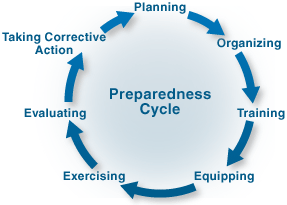
While there is an abundance of training available in public safety, emergency management, and homeland security, do we have enough training available on the foundational preparedness activities?  By which, I mean Planning, Organizing, Equipping, Training, and Exercising – or POETE.  There is a wide variety of training available on tactics and application of skills, which is certainly important to our preparedness, but what is available (in the United States, by necessity of focusing this article) to help bolster our foundational preparedness skills?  Let’s look at each.

Exercises

For purposes of making comparisons throughout each of these preparedness elements, I actually want to start at the end of the POETE acronym, with Exercises.  At a glance, there seems to be a significant number of courses available to teach people how to design, conduct, and evaluate exercises.  To begin, there are a variety of exercise training courses available from FEMA’s Independent Study program, both foundational as well as hazard or function specific, such as those for radiological exercises or continuity of operations.  Independent Study courses provide an excellent overview of topics, but, by nature of the medium, generally don’t allow for an in depth analysis of the information or interaction with an instructor or other students.  So if you’ve taken the Independent Study courses and you need more information, what’s next?

Basic-level classroom-based training in exercises have all but disappeared.  Most of these programs, such as Exercise Design or the Homeland Security Exercise and Evaluation Program (HSEEP) course were historically offered by the state emergency management offices, but are no longer listed by FEMA as available state-sponsored training, which is quite a shame since this is generally how the greatest needs are often met.  FEMA offers the new Exercise Design course, which is part of the Basic Emergency Management Academy, but is only offered directly through FEMA, either as a field delivered course or at the Emergency Management Institute.  FEMA also offers the HSEEP course as a ‘local delivery’, meaning that the course can be delivered at locations around the country, but this typically happens with much less frequency and volume than state-sponsored training, especially for a program that is so necessary to our preparedness efforts.  FEMA also offers the HSEEP course as an instructor-led webinar, which does help address some issues of accessibility and volume, but I feel misses the need for this being a classroom based course.  Some states are still conducting classroom versions of Exercise Design and HSEEP, along their own customized exercise-related training to meet needs which continue to exist in their states.  Technically they can, although FEMA isn’t supporting those courses with updated content.  There is also an issue with FEMA only permitting their own local or webinar-based deliveries of HSEEP to meet the prerequisite for the Master Exercise Practitioner (MEP) program.

MEP is designed to be an advanced program, with three week-long courses generally taken in-residence at FEMA’s Emergency Management Institute.  In full disclosure, I am not a MEP.  Not sure if I ever will be, but given the feedback I’ve received over the years about the program, I’m not likely to until it gets an overhaul.  While I’m sure the MEP is great for many who take it, the more experienced exercise practitioners I speak with have much concern about it not being advanced enough, mentioning that a lot of time is spent reviewing basics that should have been learned in courses prior.  And while many people mention that the out of class activities designing discussion-based and operations-based exercises are good, they do little to enhance learning for those who have been doing this for a while.  Granted, it’s understood that you can’t make everyone happy, and with an advanced class you always run the risk of people coming in who already have experience at the level of the course or higher.  That said, MEP has become an industry standard accomplishment, and I’d like to see the program exceed more people’s expectations.  Grade: B

Planning

Let’s now go back to the beginning of POETE with Planning.  There are a fair amount of courses out there that teach people how to plan.  Again, FEMA’s Independent Study program offers courses not only in foundational aspects of planning, but also those with consideration toward various hazards and functions.  At the next level, there are also quite a number of courses which are locally delivered, by state emergency management offices, FEMA, and other training partners such as TEEX or the Rural Domestic Preparedness Consortium; with courses cutting through various taxonomy levels and addressing foundational planning activities as well as those that are hazard and function specific.

There are courses available, both locally delivered, as well as in-residence at locations like EMI, CDP, or TEEX, to address a variety of planning related interests within the broad realm of public safety, emergency management, and homeland security.  A vast number of courses, which may not be specifically for planning, can certainly support planning efforts for certain populations, hazards, and functions.  Some states offer courses on emergency planning, either as self-sustained versions of the Emergency Planning course which is now only an Independent Study course and not supported by FEMA as a classroom delivery, or home grown courses.  Emergency planning is such an important and foundational topic that it must be more accessible.  While there are some courses on planning for recovery and mitigation, we need to support this as well – planning is not reserved solely for response.

The reason why I started the discussion of this post with Exercises is because they have the MEP program.  Regardless of the possibility of the program needing an overhaul, the concept of the MEP – that being an advanced level program – is certainly a best practice that should be reflected across these other preparedness elements.  I’ve heard a rumor of a Master Planner Program, similar to a MEP, being piloted within the last couple of years, but I’ve not seen anything official on it as of yet.  Overall, in regard to training courses for planning, I’d like to see a more cohesive approach, along with a ‘master level’ program.  Grade: B-

Organizing

Training on Organizing is not as direct of a topic as the others, but it is addressed, although I think this is another area that could be bolstered.  Most training on the topic of organization needs to dig not only into the foundational concepts of emergency management, which will aid in recognizing the resources and relationships that exist, but training in coordination, supervision, and management also need to better addressed.  FEMA does offer some very basic courses in their Professional Development Series which begin to address some of this.  There also exists the National Emergency Management Academies, but despite these being segregated into ‘Basic’, ‘Advanced’, and ‘Executive’, they are still largely offered only at EMI, which limits accessibility, especially at that area in the middle where most people need support.  We can also consider that the Incident Command System (ICS) provides us with some important support to the Organization capability element… take a look at my commentaries on available ICS training here.  Other training opportunities that support training for the organizational element can be found from non-emergency management sources, such as programs that address more traditional staff development and management concepts.  Often seen as ‘soft skills’, we shouldn’t ignore these training opportunities which help us to work within and understand organizations better.  Grade: C

Equipping

Training on Equipping is something else we don’t often seen as being offered by FEMA or the consortium entities.  Much of the training on equipment is and should be offered by the people who are specialists in the equipment or systems used.  This can range from the EOC management system you use to the interoperable communications equipment in your mobile unit.  The manufacturers and other subject matter experts should be delivering the initial training on this.  Ensure that training materials are provided so you can continue to train new staff or offer refresher training as needed.

If we look at the Equipping capability element in its broadest sense, however, we should consider the entire continuum of resource management.  This is an area where we see some training available from our traditional emergency management sources, including a few Independent Study courses and some classroom courses, including those addressing the responsibilities of the ICS Logistics Section.  It appears to me that there is a training gap here, as much of emergency management and incident management center on the resource management cycle, from preparedness through recovery.  While there exists an Independent Study course reviewing the concepts of resource management within NIMS, I have yet to see a solid, comprehensive, performance-level course on resource management that is practical for emergency management personnel.  Grade: D

Training

Training on Training… To my core, I’m a trainer, so I happen to have some strong feelings about how trainers and instructional designers (certainly different activities and not necessarily the same people) are trained and supported.  Broadly, in emergency services, the fire service has various levels of fire instructor courses and law enforcement has some courses available for instructor development.  Even in EMS we teach our instructors how to train.  Depending on the course, these programs can help refine platform delivery skills, or teach someone how to actually build curriculum (important note: a bunch of PowerPoint slides is NOT a training course… that’s a presentation).  In emergency management, there exists a state-delivered FEMA course on instructional presentation and evaluation skills, which is rarely seen delivered, but some states strongly use it to build and sustain their trainer cadre.  At a slightly more advanced level, FEMA offers the Trainer Program (formerly the Master Trainer Program).  Within this program are two tracks – the Basis Instructor Certificate and the Basic Instructional Design Certificate.

As a graduate of the Master Trainer Program, I was sad to see it go.  Despite some curriculum revisions and streamlining, the need wasn’t supported.  While I understand and somewhat agree with the initial intent of the course, the six courses that made up the program were a significant commitment.  The job of training also isn’t seen to be as sexy as exercises, so comparatively, the MEP program had fared better.  FEMA’s separation of instruction from instructional design was a wise move, as some jurisdictions don’t do much course development, but do need to develop platform instructors.  While advanced courses in training and instructional design are no longer available from FEMA, they can be obtained from sources like the Association for Talent Development (formerly the American Society for Training and Development), but at a not insignificant cost.  Grade: B-

Assessment

Just when you thought we might be done… I often like to include Assessment in with POETE.  I believe assessment is a necessary activity within preparedness to identify where we stand, where we need to be, and evaluate efforts on an ongoing basis.  Assessment is an interesting topic to identify training on.  Within the realm of emergency management training, there is really little that directly supports assessment, yet most courses can by providing us with better information on projects, concepts, and applications.  These provide us the context in which to assess, but there still isn’t much out there to tell us how to assess.  We need to assess our plans, our organization, equipment, training, and exercises.  Sometimes we find some guidance that can help us, such as broad planning standards in CPG 101 or specific checklists on evaluating hazard mitigation plans.  Guidance and job aids are great, but having a critical eye to assess programs and projects is something that must be trained.  Big gap here.  Grade: D

Where this leaves us…

Average Grade: C

While C is a passing grade, it’s not great.  It’s closer to failure than it is to excellence.  We have some great training programs out there, but there are certainly training gaps that exist in these key preparedness activities.  While standards have been established for some of these activities (standards should exist for all of them!), training must support this guidance to ensure that it is followed (historical perspective: some training programs took quite some time to incorporate standards, such as HSEEP).  Further, training must be kept current to ensure that best practices and improvements are embraced and communicated.  One-and-done training may not be suitable for these topics.  All of this informs training need, which we must constantly assess to identify what training is needed, for who, to what degree of expertise, and by what delivery method.  The bottom line is that for people to conduct these important preparedness activities, they need to know how to do it and they need to stay up to date on the standards of practice.  Those who set the standards and those funded to support implementation must always pay heed to the training needs surrounding them.  There must also be a balance in training… we need to minimize burdensome, extraneous training and instead maximize quality, practical training that will build capability.

Trends

A great deal of homeland security funds are spent on the development of training across the nation by state and local entities, resulting in some incredible and innovative courses (as well as some rather mundane ones) which meet local needs.  This is a great program and should certainly continue.  Things to watch out for, though…  Many of these courses can be utilized regionally or nationally to support needs, but they may require modifications.  Additionally, while I will rarely discourage any jurisdiction from meeting training needs they might have, we do run the risk of developing non-standardized training across the nation.

Over the past 15 years, we have certainly seen an increase in the variety and volume of courses available from FEMA and consortium entities.  The training they offer is generally fantastic, but now we are faced with the other side of standardization – some courses are too generic, as they need to be applied nation-wide.  Additionally, while scheduling of these courses, particularly the locally delivered ones, has become streamlined and easy through state training officers, many courses have a significant wait list, with some courses being scheduled out not just months, but years.  This significantly delays the progress of preparedness efforts in many areas across the nation.

Overall, the number of state-delivered courses supported by FEMA has appeared to steadily decrease over the past few years.  Certainly one reason for this is the lack of staff and staff time at FEMA’s Emergency Management Institute to support these courses and keep content relevant.  This is generally no fault of EMI, as their funding allocations have not supported staffing for these purposes as of late.  As a former state training officer, I suggest that states and regions are in the best position to identify and track training needs and to deliver a great deal of courses, certainly at the awareness and performance/operations level, and some at higher levels.  These programs, however, need to be supported with expertise, funds, and regional collaboration.

Interested to hear your thoughts…

© 2016 – Timothy Riecker, CEDP

Emergency Preparedness Solutions, LLC Your Partner in Preparedness