Gauging Return on Investment in Preparedness: Equipping

I’ve written previous posts on our preparedness investments and how we can gauge our return on those investments.  Following the POETE model (planning, organizing, equipping, training, and exercises), I’ve so far covered some considerations for Planning and Organizing.  This piece will focus on identifying our return on investment for Equipping.  Equipment can be anything from a new fire engine, to a generator, a UAV/drone, a radiological detection device, or incident management software.

Equipping is generally a preparedness activity in which we can more easily identify what our actual investment is.  Unlike Planning, which requires varying amounts of time from a number of people, or Organizational efforts which sometimes have rather esoteric costs, when we purchase or maintain equipment, we usually have a receipt in hand.

Functioning in the bureaucracies we do, however, we tend to add complexities.  We form committees to find the best equipment we can, we leverage our own staff time to keep it maintained, and we often have other associated costs, which reflect back on the other POETE elements… at least we should.  In addition to the cost of the equipment itself, let’s look at what the associated costs could be.

Every significant equipment purchase, first of all, should stem from an identified need.  Maybe it’s a critical element of a process, it’s called for in a plan, or the need was identified in an after action report.  Perhaps you are upgrading or expanding application of a certain piece of equipment?  Regardless, your organization must invest some time to ensure the equipment will meet your needs and how it will impact your operations.  This activity, generally referred to as Assessment, if often rolled into the Planning element.  Once we do obtain the equipment, we also need to plan.  We need to ensure the use of the equipment is accounted for in our plans.  Perhaps it’s as simple as adding it to a resource inventory, or as complex as creating processes or procedures that address its use.

Organizationally, you may need to task an individual or even assemble a team which will be responsible for the care and operation of the equipment.  This, logically, leads to Training.  People need to be properly trained in not only the use of the standard use of the equipment, but also the circumstances which it will be used as well as any processes or procedures for use which are unique to your organization.  Consider what degree of proficiency these individuals may need in the operation of the equipment.  Is it just basic operation, or is there a need for something more advanced?  Will recurring training be needed to maintain proficiency or to train additional people in the future?  Will anyone be trained in higher level maintenance of the equipment?

Exercising the equipment, its effectiveness, and the ability of your resources to use the equipment is essential.  Lastly, we often don’t consider the costs of maintaining and storing the equipment.  It may need replacement parts or regular servicing, which even done in-house, has an associated cost.  It may have certain storage requirements to ensure the safety and readiness of the equipment.

Now that we’ve outlined potential costs or investments, how do we know those investments have made a difference for your organization?  To determine this, we must first look at the original need.  What actually defined the need for the equipment?  Was it to replace something older and less reliable?  Was it to enhance response time?  Was it because of safety?  Did the need identify inefficiencies in previous practices and systems?  Did the new equipment meet that need?

To dig further, what was the value of that need?  To identify this, we should look at the metrics associated with that need.  If the new equipment replaced something aging, we can look at the maintenance costs and down time over a certain period of time for the older equipment.  If it was to shorten response time to get a certain capability on-scene, we should be able to identify the time metrics as well as the difference that equipment makes once it is on scene (eg. a fire department which previously had to call mutual aid to get jaws of life on scene, vs purchasing a set of jaws and having them on scene much faster).  We can associate a dollar-value cost to many of these metrics.

Was there any additional value which the equipment brought your organization?  Perhaps the added capability decreased your insurance rates or made you eligible for a particular industry certification?  Are there any indirect cost savings because of the new equipment?  Does the new equipment somehow aid in generating income?

There are many considerations when it comes to any of our investments to ensure that they are sound, responsible, and reasonable.  Often we need to identify the value of an investment before it is made, but we should certainly keep track of that value after the investment as well.

Need help with planning?  Gap analysis?  Resource inventories?  Maybe with the training or exercising associated with new equipment or other preparedness needs? Contact EPS!

© 2015 – Timothy Riecker

Emergency Preparedness Solutions, LLC 

Gauging Return on Investment in Preparedness: Organizing

As a continuation of the Gauging Return on Investment in Preparedness series (read the first one on Planning here), this post’s focus is on the POETE element of Organizing.  There are a number of ‘organizing’ efforts we engage in through our preparedness endeavors.  Some are temporary, like establishing working groups to solve a certain problem; while some are intended to be long-term, like forming an incident response team.

Why organize?  Most organizational efforts are fueled by the need to capitalize on the power of many.  What one person can do, more people can do better.  Problem solving, responding, etc.  Often our organizational efforts are internal, but, particularly in public safety, we coordinate with other agencies.  We might be building a professional response organization, such as an Incident Management Team (IMT), or perhaps we are building a community organization, such as a Community Emergency Response Team (CERT).

What costs are associated with organizational activities?  Foundationally, it’s simply the staff time needed to prepare for, attend, and perform follow up work from meetings and other organizational efforts.  Depending on how complex our efforts are, however, and the intent of our organizational efforts, this can take on full time duties.  You also have to consider who is being drawn into these efforts and what the ‘replacement cost’ is of their time – meaning, what is the cost of someone else performing their work while they are involved in the meetings, etc.?  We also need to identify what costs might be associated with organizing?  The remaining POETE elements (Planning, Equipping, Training, and Exercising) can probably lead you to identifying these.

What are the benefits (value) of organizing?In order to identify the return on our investment, we need to be able to ascertain the benefits our organizational efforts bring – some may be tangible and relatable in dollar figures, others may be more intangible and amorphic.

As with many preparedness efforts, we find ourselves needing to make reasonable assumptions to identify cost savings or value.  We need to follow the bouncing ball of our efforts.  As an example… If we create a CERT team, citizens will be better able to tend to their own needs in the event of a disaster.  This leads to less immediate need of limited resources (first responders), allowing them to focus on more critical needs (i.e. saving lives and protecting infrastructure).   In this example we can make some assumptions about the types of infrastructure to be impacted by a certain incident and the costs associated with it becoming incapacitated.

In regard to saving lives, it’s difficult for us to attach a dollar value to that.  We often say that lives are priceless, and while that may be true, we sometimes need to make an educated guess.  Depending on who you are reporting figures to, they may be satisfied with a reasonable number of lives being saved… others may want to actually compare apples to apples (that is, dollars to dollars).  If you engage the use of your favorite internet search engine and search ‘what is the value of a life’, or something similar, you will find a number of results.  In perusing some of these results myself, I found that the dollar figure assigned to a life is obviously subjective and very much related to the industry in which the question is being asked.  This particular article makes for an interesting read on the subject.  Spoiler alert: they peg the value of a human life at $5M USD (2011).

In the end, organizational efforts need to have a purpose providing a net value.  Even in routine matters and daily business, we should examine the cost of organizational efforts – particularly meetings.  Meetings are one of my biggest bugaboos, as they are often too long, have little purpose, and the objectives can be met in a much more efficient manner.

What ideas do you have on determining the return on investment for organizational activities?

© 2015 – Timothy Riecker

Emergency Preparedness Solutions, LLC

www.epsllc.biz 

Gauging Return on Investment in Preparedness: Planning

Inspired a bit by my previous post Measuring Return on Investment in Emergency Management and Homeland Security: Improving State Preparedness Reports, I’ve decided upon writing a series of posts picking apart our primary activities in emergency management and homeland security preparedness to identify ways to gauge our Return on Investment (ROI).  To encapsulate our primary activities, I’m using the five POETE capability elements:

  • Planning
  • Organizing
  • Equipping
  • Training
  • Exercises

Most preparedness activities within emergency management and homeland security fall within one or more of the POETE capability elements.  The capability element of Planning is the foundational activity on which all preparedness is built and will be the topic of this post.  Here’s what I’m covering:

  • What is Return on Investment?
  • What planning efforts are involved in preparedness?
  • What organizational investments are involved in Planning?
  • Does the planning effort comply with applicable standards?
  • Can the plan be implemented?
  • What will exercises tell you?
  • Is there a need to maintain plans?

Return on Investment, or ROI, is a business term used to identify the profitability of certain investments or actions.  While preparedness is certainly done to protect against losses, for public and private sector alike, we generally don’t see preparedness activities as generating revenue.  However, when most entities INVEST time, money, and other resources into preparedness activities, they often want a reasonable assurance that their investment has paid off.  How do we gauge ROI for planning efforts?

First off, what planning efforts might we see in public or private organizations?  Obviously emergency and disaster plans are the big ones.  These plans are designed to identify key processes, such as alert and notification, response organization and incident management, and others which are intended to save lives and protect property.  These plans are likely to have annexes and appendices which address uniqueness of certain hazards, response circumstances, and support activities.  Continuity plans – usually business continuity or government continuity – identify how the organization will survive as an entity in the face of disaster.  Planning activities also involve the creation, review, and maintenance of policies and procedures.  We also create plans for hazard mitigation, long term recovery, specific events, and other needs.

What investments are involved in planning activities?  Organizations can and should allocate staff time and physical space and infrastructure to planning efforts.  The dedication of staff (full or part time) and/or consultants is often required, especially when planning efforts are viewed as a continual process and a critical part of preparedness.  The organization itself must make a commitment to the planning effort.  This commitment isn’t just in concept, but also practical involvement of staff throughout the organization, access to information, and even an involvement of third parties.

Certainly a first step in assessing return on investment of planning is to evaluate compliance with applicable rules, regulations, and guidelines.  These requirements can be hard (legally binding) or soft (general guidance) and can differ from industry to industry, nation to nation, and state to state.  Here in the US, FEMA provides guidance on emergency planning through Comprehensive Preparedness Guide (CPG) 101.  Some states may have requirements for emergency planning, such as New York State’s Executive Law Article 2-bNFPA 1600: The Standard on Disaster/Emergency Management and Business Continuity Programs is often referenced by public and private entities alike, while the International Standards Organization (ISO), has many industry-specific requirements for emergency planning.  If grant funding is being used for the planning effort, the grant may also have specific requirements.  Regardless of what the requirements are, planning efforts, plans, and associated documents should be audited to ensure that requirements are met.

Compliance, however, isn’t necessarily indicative of a good planning effort.  I’ve seen many plans which may meet requirements but the content itself was severely lacking.  Far too often planners get caught up in the world of checking boxes and fail to consider implementation.  If a plan cannot be implemented, it is useless to the organization.  Many plans exist now that meet applicable requirements but are still yet vacant of any meaningful direction or guidance in the event of an emergency.  These types of ‘plans’ are really better seen as policy documents.  A plan should identify what will be done, when, how, and by who.  If your ‘plan’ simply contains a statement on the requirement to use NIMS/ICS, but doesn’t provide detail on who will be in charge of what, when, and how; it is a policy document, not a plan.  Plans and their associated documents (i.e. procedures, guidelines, and job aids) need to chase down the lifespan of each critical step, especially early in a response.  They must identify who is responsible to make key decisions, who will be notified (how and by who), and who will take what actions.  A logical review of planning documents by the planning committee or perhaps even a third party is another good means of assessing your return on investment.

Does the plan work?  This is, perhaps, the ultimate factor in determining return on investment.  Usually our best means for identifying if a plan works is to exercise it.  Exercises provide a controlled and focused environment for testing plans or components of plans.  They will also help us in identifying if the plan can truly be implemented.  I’ve written a lot on exercises: articles can be found here.  (I also anticipate writing about assessing ROI for exercises as part of this series).  Generally, an incremental exercise program is usually recommended, beginning with discussion-based exercises – such as table tops and workshops – and progressing to operations-based (hands on) exercises.  A well written and honestly evaluated exercise will go a long way toward identifying the return on investment of your planning efforts.

Are we there yet?  Nope.  Planning, like all other preparedness efforts, requires maintenance.  If you create a plan then walk away, even if it’s a good plan, your plan’s value will diminish over time – and we’re talking months, not decades.  Think about how often something changes in your organization.  Staffing.  Equipment.  Technology.  Procedures.  Insurance policies.  All of these things, and more, influence your plans in some way.  Over time these changes not only occur, but also compound and move the present reality of your organization further from the assumptions of your planning efforts.  This is why plans must be maintained and updated on a regular basis.

Is there some mathematical formula for identifying the return on investment of preparedness efforts?  Given all the factors involved and their fluidity, I don’t think so.  It’s not cut and dry like a traditional business investment.  As you can see, though, there are a number of steps we can take to assess the utility of our investment.  I’ve seen organizations pay a lot for bad plans, and others pay much less for great plans.  Not only do organizations need to ensure that their planners know what they are doing, but the organization itself needs to have a commitment to success.  Without it, the planning effort is doomed to fail.

As always, feedback is appreciated.  What are your thoughts on assessing the return on investment of planning efforts?  What do you think is a good measure?

Does your organization need a new plan or need to update a plan?  Do you need help with the planning process or evaluating your organization’s preparedness?  How about exercises?  Emergency Preparedness Solutions can help!  Email to consultants@epsllc.biz or visit www.epsllc.biz.

© 2015 – Timothy Riecker

Emergency Preparedness Solutions, LLC

WWW.EPSLLC.BIZ

Measuring Return on Investment in Emergency Management and Homeland Security: Improving State Preparedness Reports

A lot of money is spent within the emergency management and homeland security enterprise.  Looking just at the last couple of years of annual Homeland Security Grant Program (HSGP) (this is the annual grant provided by the US Federal government to states and urban areas), $1.044 billion was allocated in FFY 2015 and $1.043 billion allocated in FFY 2014.  These billions of dollars only account for a portion of spending within EM/HS.  There are other federal initiatives as well as state, tribal, territorial, and locally funded efforts.  Businesses and NGOs also invest significantly in emergency management, homeland security, and business continuity activities.  But where does it all get us?

Through the past decade or so there have been a few efforts by DHS/FEMA to try to measure preparedness, ideally to identify improvements in our preparedness as the result of the billions of dollars invested.  None of these efforts have really provided obvious and tangible results.  The current measure is through annual State Preparedness Reports (SPRs), which utilize the THIRA process (Threat and Hazard Identification and Risk Assessment) outlined in Comprehensive Preparedness Guide (CPG) 201 as a foundation, but with the POETE analysis (Planning, Organizing, Equipping, Training, and Exercising) for each of the 31 Core Capabilities.  (You can find articles I’ve written on the utility and application of POETE here.) The SPR is a good methodology for identifying the current condition of preparedness for each state as viewed through the 31 Core Capabilities.  The POETE analysis helps to identify the strengths and weaknesses within each Core Capability.

The SPR, however, still falls short.  How can we improve it?

1. Include historical data for trend analysis. The SPR largely provides only a snapshot of current conditions.  The format of the SPR does not provide for any analysis of historical data to identify trends (i.e. improvements or otherwise) in the state’s assessed condition of its 31 Core Capabilities.  FEMA regional offices, upon receipt of an SPR, do provide a brief feedback report of the current SPR with a passing mention of the previous year’s submission, but the report provides so little information it could hardly be called an analysis.

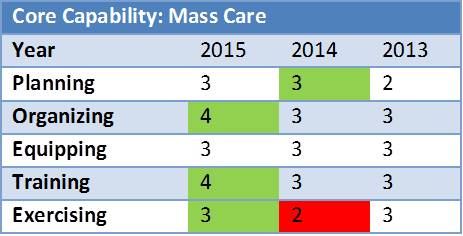
A rudimentary table identifying trends for a selected Core Capability is below.  For those not familiar, higher scores rate a higher measure of capability.  In this table, I’ve identified POETE elements which have trended lower from year to year with a RED highlight, and those which have trended higher with a GREEN highlight.  A simple analysis such as this give an at-a-glance comparison.  To make this analysis more comprehensive, I would suggest the addition of narrative for each trend (higher or lower) which explains what has changed to warrant the new ranking.

Historical Comparison of a Core Capability

2. Include a financial analysis for the current year to identify return on investment. An identification and summary of key program area investments for the year will lay the groundwork for a return on investment (ROI) analysis.  ROI will help identify how much bang for the buck you are getting in certain areas.  It’s easy to lose sight through the year from a program management perspective on how much money was spent on certain programs and activities – especially for larger agencies with a layered bureaucracy.  Incorporating this analysis into an SPR is not only good financial and program management, but provides an opportunity to identify where money was spent and to measure, at least on a broader scale, what the results were.  Certainly we have to fund continued operations to simply sustain our capabilities, but we should also be funding, where possible, programs to enhance our high priority capabilities and those needing the most improvement.

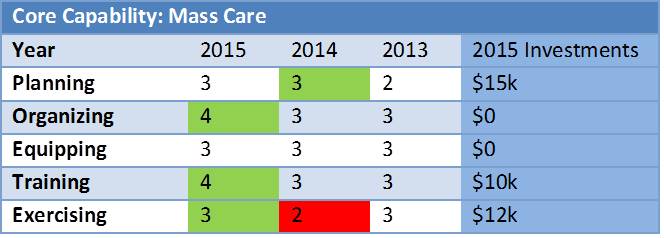
Again, as a rudimentary example, we can build on the table provided earlier to identify where funds were spent to see if they made a difference in our level of preparedness.  As with the earlier example, a narrative should be provided for each investment to identify what it was and assess the impact.  This also provides an excellent opportunity to review the investment justification written for grants to determine if the investment met the intended objectives (which should have been to maintain or enhance some aspect of the capability).  Historic investment data can also be included for each year.  This all leads directly to identifying the return on investment – did the investment make a difference and to what extent?

Historical Analysis of a Core Capability with Identified Investments


Ultimately this added data and analysis requires more work, potentially the involvement of more people, and likely more time to complete the SPR.  However, this new process will also result in a positive return on investment itself by helping to identify trends and outcomes.  Financial information is regularly reported to DHS (for those grants that originate with them) in the form of progress reports, but that information is stovepiped and usually not associated with a more comprehensive assessment such as the THIRA/SPR.  Bringing this data together paints a much more accurate picture.

The concept of preparedness is difficult to put in a box.  It’s amorphic and challenging to identify, yet people often ask the question ‘Are we prepared?’  States, locals, DHS, and Congress often have difficulties measuring preparedness and advances in preparedness, especially relative to the dollars spent on it.  The GAO has regularly recommended efforts to better identify return on investment, yet we haven’t gotten there.  The recommendations identified here can bring us much closer to nailing down where we are and where we need to be.  Armed with this knowledge, we can make better decisions for future investments and activities.

Moving forward, I expect to write a bit on each POETE element, with my thoughts on how we can identify return on investment for each.  As always, I’m very much interested in your thoughts on the approach I identified above and how we can better identify return on investment in the realm of emergency management and homeland security.

If you are interested in utilizing this approach to better identify your return on investment for local, state, tribal, territorial, or organizational preparedness efforts (whether or not you do a State Preparedness Report), Emergency Preparedness Solutions is here to help!  Check out our website at www.epsllc.biz or contact me directly to discuss what we can do for you.

© 2015 – Timothy Riecker

Emergency Preparedness Solutions, LLC

WWW.EPSLLC.BIZ

What is the Top Sector at Risk for Cyberattacks?

3D Electric powerlines over sunrise

According to this article in the Insurance Business America magazine, it’s the energy sector.  This is no surprise, even without the statistics provided in the article; although the statistics are pretty staggering.  The article states that according to DHS “more than 50% of investigated cyber incidents from October 2012 to May 2013 occurred within the energy sector”.  The advice in the article is pretty sound and coincides well with what I’ve suggested many times in this blog… be prepared!  Not only do power utilities need to have their own cybersecurity experts and the policies, plans, and infrastructure to prevent cyberattacks, they also need to be prepared for the potential success of the attackers.  They need to know who to notify (and how), and what actions to take.  Further, those that depend on electricity should have an alternate means of obtaining electricity to meet essential needs.

Threats to our infrastructure show just how interconnected we are and how interconnected our critical infrastructure is.  This is the primary reason why our energy infrastructure, which touches every other sector, is so essential.  We must ensure that we have in place prevention and protection plans, such as cybersecurity plans; hazard mitigation plans to lessen the impacts; response plans to address critical issues; and recovery plans to return to operations.  Business continuity is also an essential component of this – even if you are an NGO or government entity (continuity of government).

Along with proper planning, training, and exercises, we need to continue to promote legislation which requires measures for cybersecurity and protection of our critical infrastructure.

What are your major critical infrastructure concerns?

© 2015 – Timothy Riecker

EMERGENCY PREPAREDNESS SOLUTIONS, LLC

WWW.EPSLLC.BIZ

When is Consolidation of Public Safety Agencies a Good Idea?

A recent effort for the consolidation of three fire departments near our office in Central New York failed.  The consolidation, discussed in earnest for nearly a year with positions both for and against, narrowly lost in a public referendum.  News article here: http://www.uticaod.com/article/20150818/NEWS/150819437.

Having worked in public safety for nearly 20 years, I’ve seen quite a few consolidation efforts.  Some successful, most voted down before they even had a chance.  Most efforts have been related to fire departments, some with EMS agencies, and a few related to law enforcement.  While I’ve seen some early in my career, it seems there has been an increase in consolidation proposals in recent years.  Why?

It seems the most significant factor in these proposals is economic.  Despite the slow upturn in the economy, government budgets are still struggling.  The need to spread the burden of common administrative costs, like insurance; ensure appropriate staffing coverage; and to address equipment issues, such as standardization for interoperability; are the top items of discussion.  In some cases there is also a need to reduce the personnel costs through consolidation by reducing the overall number of executive-level officers and support staff, and to reduce real estate costs by reducing the number of stations.  While not all of these reasons are applied all the time, these are quite commonly identified as reasons for consolidation.  The bottom line for consolidation is that it saves money while, ideally, not increasing response times or public access to services.

As for the reasons against consolidation… there are many who don’t seem to trust the promise of savings.  Certainly there have been a great number of failed attempts by government or other organizations to restructure in the name of cost savings and come nowhere near reaching their target.  Others are afraid of the loss of jobs and access to services.  Some, in my opinion, are just being territorial.

Obviously consolidation, or any change in government structure or services, needs to be carefully studied, reviewed, and if decided upon, implemented in accordance with a carefully designed plan and a watchful eye.  This especially holds true for public safety.  Just like any idea out there, it can work if carefully implemented, but it may not be suitable for everyone.

Where do you stand on public safety consolidations?  What success stories do you have?  How about failures?

© 2015 – Timothy Riecker

Emergency Preparedness Solutions, LLC

WWW.EPSLLC.BIZ

Are You Really Considering All Hazards?

Natural hazards, such as flooding, tornados, wildfire, and earthquakes, bring about the greatest losses, calculated in nearly every metric possible, as compared to human-caused incidents.  Human-caused incidents, either accidental or intentional, still bring tremendous impact to communities world-wide on a daily basis.  While working to prepare for, mitigate, respond to, and recover from natural hazards will always continue to be important, it seems that many still often forget about human-caused incidents despite all the conversations out there.

Human-caused incidents include a variety of hazards such as infrastructure failure, transportation accidents, hazardous materials incidents, and intentional attacks.  These are all things which we can fit into our traditional model of Prepare, Mitigate, Respond, and Recover.  The National Planning Goal introduced the model of the five Mission Areas – Prevention, Protection, Mitigation, Response, and Recovery – to help address our many of our major functions (Core Capabilities) for human-caused incidents (note that Preparedness is now a higher level concept that applies to all Mission Areas).  While this Mission Area model has helped bring these key activities into the greater fold of what we do, it has also kept them largely isolated through the thought that many human-caused incidents are only addressed through Prevention and Protection Mission Area activities.

Nowhere, it seems, do we see this more than in the area of hazard mitigation.  The vast majority of hazard mitigation plans which exist only address natural hazards (even at the state level).  Since many readers view this blog for my opinion, here it is – this is archaic and dangerous thinking!  We have all seen hazard mitigation plans which claim they are ‘all hazards’, yet only list natural hazards.  That’s fine, if by some unbelievable circumstance, your jurisdiction is only impacted by natural hazards.  This is a circumstance which I am highly doubtful of.  Some mitigation plans get a little more realistic and will address human-caused hazards such as dam failure and/or hazardous materials release, which were likely the greatest human-caused threats they may have been vulnerable to in the previous century.  In today’s world this still doesn’t quite get us to where we need to be.  There are a great many mitigation activities which we can leverage against human-caused incidents.

How do we fix this?  It’s easy – start with conducting a hazard analysis.  A hazard analysis, be it as a stand-alone activity or part of the THIRA process, should review all possible hazards which your jurisdiction, company, or organization is vulnerable to.  It should be comprehensive, not just limited to the set of natural hazards.  Along with infrastructure failure and hazardous materials incidents (both in-transit and fixed site), consider hazards such as active shooters, cyber attacks, improvised explosives, and civil unrest.  This may require bringing some additional subject matter experts into the room for your hazard analysis – like your IT director.  In a hazard analysis, each hazard is ranked (at a minimum) by its likelihood to occur and its severity of impact should it occur.

A well conducted hazard analysis provides the basis for everything we do in emergency management and homeland security.  It not only informs our activities such as planning, training, and exercises, it also helps assign priority to those hazards which require the greatest focus and allocation of resources.

© 2015 – Timothy Riecker

Emergency Preparedness Solutions, LLC

WWW.EPSLLC.BIZ

Well OF COURSE Drones Can Be Used As WEAPONS

It’s rather insane that it took this long for the US Department of Homeland Security to issue a warning to law enforcement about the potential use of drones/UAVs as weapons or to further the criminal enterprise.  If you’re not familiar with the DHS bulletin, see this CBS News story.

For those of you who have been steady readers of mine, you can probably tell that I’m pro-drone.  However, just like anything else, someone is bound to adapt the technology for their own malicious purposes.  While we are still getting our act together in figuring out how to apply UAV technology for myriad good and purposeful things, there have been those out there trying to figure out how to use the same technology for advancing criminal and terrorist agendas.

Amazon and others want to use UAVs to deliver packages.  Well guess what –drug cartels will certainly be using them to deliver packages of drugs.  The US military uses UAVs to strike at terrorists in unfriendly territory.  Terrorists, criminals, or even your run-of-the-mill stupid people, can do the same.  Have you seen this article about a teen who mounted a handgun to a UAV?  UAVs are great for providing a birds-eye view of any situation, but when operating in a disaster environment they can’t impede responders as they did in the recent wildfires in California.

I have no doubts that terrorists somewhere, foreign or domestic, are playing with UAV electronics and explosives to determine how best to deliver those deadly packages.  As inevitable as it is, do we ban the use of UAVs?  Well we haven’t banned cars or moving vans, and both have been used to transport explosives.  The good outweighs the bad, so we have to figure out how best to deal with it.

The fact of the matter is that all well intended technology can be used for not so good purposes.  Does this mean we do away with the technology?  No.  Does this mean we do away with innovation?  No.  It does mean that we have to stay a step ahead of those who have ill intent or practice in stupidity.  Prevention, protection, and mitigation against these things is a constant challenge.  We now need to be aware of a new threat and address it.  It’s something we’ve done through time.  People built walls around their towns to protect themselves and their property from people and animals who would do them harm.  Attackers innovated and approached walls with ladders, so defenders built taller walls and other defensive technologies.  Today we use physical barriers to prevent vehicles from getting too close to buildings, locked doors to prevent entry, and cameras to monitor.  Perhaps the threat of an attack from the air will require other measures.

Has your company or jurisdiction considered the threat UAVs may pose to your interests?  What are your thoughts on deterring attacks?

© 2015 – Timothy Riecker

EMERGENCY PREPAREDNESS SOLUTIONS, LLC

WWW.EPSLLC.BIZ

The Need for More Scenario-Based Learning

Think back through all the courses you’ve taken.  It’s a lot – I know.  What ones stand out the most?  I’m willing to be they are the ones that were the most engaging.  Not only did you enjoy them, but you learned a lot from them and still remember quite a bit of it.

It’s no secret that training adults can be challenging.  Training professionals in emergency services is certainly no different.  The challenges are even greater as the number of required training courses continually increase, requiring more and more ass-in-chair time every year for responders and other professions.  A great deal of training programs we see out there still seem to be holding out for the sake of traditional delivery styles, much to the detriment of our learners.  Why?  Designing traditional lecture-based learning is easy to do!  Figure out what people need to learn, develop content, slap together some PowerPoint, and voila!  Hell, even I’m guilty.

The fact of the matter is that we all know this is wrong.  Yes, it’s easy to do on our end, but the value and impact of the learning is pretty low.  People don’t want to be lectured to for hours on end.  We know that learning is most effective when we mix things up and when we increase interaction.  One of the best ways of engaging learners effectively is through scenario-based learning.

Now I’m not just talking about using a scenario at the end of the course to see if people can apply what they’ve learned over the past two days.  Yes, scenarios can be used as a test of sorts, but they are most effective for actual learning.  So when should you use scenarios?  Why not start the course with one?  It immediately gets people thinking, which is a good thing especially with an 8 am start time to the course.   If you use a lot of scenarios in a course, can they all be related?  Sure.  Maybe.  Maybe not.  It all depends on what the purpose of the scenario is.  In training responders, threading a common scenario through a course is usually helpful.  Scenarios can get complicated when we need to establish a common understanding of what is going on, where it is, what resources are available, etc.  As such, it helps to use the same foundational scenario throughout the course (or at least regularly revisit it), and continue to introduce new problems or a different focus based upon the path of the training.  Using a common foundational scenario saves time so you don’t have to start anew introducing all new information each time and it keeps learners comfortable.  That said, it may occasionally be valuable to change things up a bit.

Do you need to use HSEEP to develop course scenarios?  No.  While these aren’t exercises in the strictest sense, we can benefit considerably from many of the principles and concepts of HSEEP.  Develop what you need to give learners the information they need to participate and the information you and/or other instructors need to properly facilitate and evaluate.

Adult learners like to be challenged.  Lecturing them for hours on end will only challenge their ability to not fall asleep – which may only be accomplished by their challenge for a new high score on the new app they just put on their phone.  The best way to challenge adult learners is to give them problems to solve.  A well written scenario will help introduce these problems in a framework which is both familiar and challenging to them.  Depending on how the scenario is provided, such as a compelling background story or use of video, learners will establish an emotional connection to the scenario which prompts a visceral desire to solve these problems.  Even one scenario is powerful and can prompt a lot of interaction.  It can prompt individual responses to questions, group discussions, and group collaborations.

Finally, don’t forget to evaluate both your learners and the scenario itself.  At the conclusion of each scenario conduct a hotwash and feedback session with learners to discuss what they accomplished and possible areas for improvement.  Also be sure to gain feedback from them and other instructors on how well the scenario worked and what can be improved upon.

Just like any other aspect of instructional design, the integration of scenarios can be time consuming but it’s an investment that will pay off.  To capitalize on the value of your scenarios, make sure the activities and expected outcomes of each scenario are associated with the learning objectives of the course and engage learners to the proper degree (i.e. the proper level of Bloom’s Taxonomy).  Yes, scenarios also take a fair amount of class time to execute.  That time needs to be well accounted for in your instructional design and course planning.  However, if properly designed, learners can learn just as much content if not more through interactive scenarios as compared to lecture-based training.

What types of scenarios have you integrated into courses?  How did learners respond to them?  How can we do a better job of integrating more scenario-based learning into our courses?

Need help designing scenario-based learning?  Let EPS help!

© 2015 – Timothy Riecker

Emergency Preparedness Solutions, LLC

WWW.EPSLLC.BIZ

Effectiveness and Efficiency in Incident Management – Resource Tracking

Incident Check In

Incident Check In

I recently took part in the management of an exercise in which a Type 3 incident management team (IMT) was among the players.  As part of their initial set up they immediately recognized the importance of checking in and tracking resources.  This is an activity which is often overlooked at the onset of an incident and is a royal pain to catch up on once the need is realized.  There were a few things which they could have improved upon, though, which seriously impacted their effectiveness and efficiency.

  1. They spent time checking in each vehicle as equipment. Not every vehicle needs to be tracked in an incident.  Generally, the sedan, pick up, or SUV you come in on isn’t special enough that it requires tracking.  Huge waste of time, people, and effort.  Consider the nature and capability of the equipment that is coming through your access point.  Is it a specialized resource?  Will it be applied tactically?  Will it be supporting logistical needs?  Is it rented or leased?  These are the conditions that should be considered when deciding what equipment to track.
  2. They marked equipment using bottled shoe polish. Not a bad idea, except it rained all week, and within hours of application most of the markings couldn’t be read.  Windshield markers, similar to what car dealerships use, are cost effective, waterproof, and clean off easily with mild window cleaners.
  3. Equipment that was checked in was never logged in detail. What’s the difference between E-01234 and E-01235?  We will never know as no descriptions were entered into their tracking system.
  4. As vehicles flowed in to the staging area, people will directed to check in at the command post. This is obviously excellent, except to get to the command post people had to pass by the main access to the incident site.  This meant that many people did not check in as directed.  They got distracted by the incident and associated response activity and never made it to the command post to check in.  This severely impacted the effectiveness of accountability.

Sometimes people would try to explain these things away by saying “It’s just an exercise”, but exercises are an opportunity to do things the right way, not skimp and cut corners.  While their intent was good, their process and results were quite poor.  If we are supposed to train the way we fight, as they say, this team has a ways to go to be more effective with resource accountability.  On the surface resource tracking looks easy… but it’s not.  There is a lot of complexity, variables, and attention to detail that must all work together well in order to be successful.  The Resource Unit Leader has one of the hardest jobs in the Incident Command System.

Being who I am, I’m left wondering why this all happened.  I have little choice but to blame poor planning and training.  Planning is to blame for a lack of clear procedures, guidance, and decision models.  The training which people receive tends to be just as vague.  By now, most, if not all of you are familiar with my opinions on the current ICS training.  While the referenced article does not go into the IMT/position training curricula, from what I recall of the courses I’ve taken, there are certain things taken for granted.  It’s easy to put an item on a checklist that says ‘Establish check in’.  OK… how?  Where?  When?  What?  Why?  The answer to those questions, or guidance to help answer those questions, should be provided through training.  Let’s tell people not only why check in is important, but what people and resources should be checked in, where to establish check in (what to look for and what to avoid), etc.  Once we’ve trained people on it, let’s provide job aids… not just the ICS forms, but job aids that will actually help people do their jobs.  While it may seem like minutia and unnecessary detail, keep in mind that we are training people to operate in austere and chaotic environments which they are trying to establish order over and only do these activities on rare occasion.  Those conditions signal the need for detailed training and job aids to support sustained performance and limit the degradation of the training they received.

Bottom line – let’s take a step back, fix what we have to based upon what we’ve learned, and proceed forward so we can operate more effectively and efficiently.

Thoughts and comments are always appreciated.  What have you learned or observed from incidents or exercises that needs to be addressed foundationally?

© 2015 – Timothy Riecker

Emergency Preparedness Solutions, LLC

WWW.EPSLLC.BIZ