Ebola Reflection Measures our Preparedness

NBC News recently posted an article citing a report published by the Presidential Commission for the Study of Bioethical Issues.  The link provided to the report in the NBC News article doesn’t seem to work, but I’ve found what I believe to be the report here.  The focus of the report is on the ethical challenges faced by the US in responding to this issue.  The report summarizes a variety of ethics related concerns and considerations in this ongoing response and paints a fairly accurate picture of our failures and what needs to be addressed – at least within the topics it discusses.

Photo credit: Forbes.com

Photo credit: Forbes.com

As you might expect from a report on bioethics, it is very public health focused.  While they do make mention of very public health centered topics such as clinical drug trials, they do cover topics which are much more broadly rooted in emergency management and homeland security, such as community and responder education, and ethics associated with quarantine.  This report, while fairly focused, opens a virtual Pandora’s box of issues related to our domestic response to Ebola.

Needless to say, our collective response to this matter was horrible.  Public health policy and guidance was a moving target for weeks; responders were ill prepared to handle potentially infected persons; and the collective of society, politicians, and public safety were largely reluctant to deal with matters of quarantine much less prepared for it.  Was this our first consideration of something like Ebola?  Of course not.  Didn’t we have preparations in place?  Kind of.

Back in the late 90s, pushed mostly by the Nunn-Lugar-Domenici act of 1996, preparedness efforts for state and local responders were funded to enhance our capabilities in dealing with WMD incidents.  Several years later, after 9/11 and the anthrax attacks, another surge of funding was pushed down to state and local governments from HHS/CDC for the purpose of bolstering public health preparedness including preparedness for WMD/weaponized biologicals and naturally occurring pandemic incidents.  These two programs alone, not including other related funding, fostered the creation of plans and organizations to support them, purchased entire stockpiles of equipment and supplies, trained tens of thousands of responders and public health workers, and encouraged exercises across the nation to test capabilities (it was actually these exercises which largely influenced the creation of what we now know as HSEEP).  A lot of good came from these programs, but when suddenly tested with the reality of implementation we seemed to fall apart.  Why?

First of all, many of these preparedness efforts occurred between 10 and nearly 20 years ago.  Many of the people initially trained in these programs have since retired from public service with their organizations losing a great deal of institutional knowledge.  While training programs have continued and still exist, there have been systemic gaps in tying this type of training to other preparedness efforts (planning, policy, equipment, etc.).  Some equipment purchased near the beginning of these programs has likely been retired as well.  Much of it still exists, but has been brought into the fold of other applications, such as HazMat – which is certainly appropriate, but yet again we see gaps, this time our ability to readily utilize equipment specifically for public health threats.

In my opinion many of the planning efforts we saw after 9/11 were misguided.  This started with the people who were doing the planning.  Many health organizations emphasized health care experience for these positions instead of EM or planning experience – which was their main function.  Certainly health care knowledge had some importance, but that could be supplemented through a good advisory committee (EM after all is a team effort).  Exacerbating poor hiring decisions was a lack of investing in the people that were hired.  Many organizations expected them to churn out pandemic influenza plans in short order, with little/no training on the planning process or integral systems that must be considered.  Further, much of the planning had been done in a vacuum – that is, it had been performed with little/no input from other stakeholders.  I had reviewed many of these plans, finding things such as inappropriate applications of ICS and wild assumptions of resource availability.  In no way were these plans realistic or applicable.

There were many exercises performed and most of them had great value.  The problem is that there were a lot of assumptions in these exercises and policy decisions made in the exercises were rarely challenged as they would be in reality.  The US Ebola response brought this all to light as decisions such as quarantine were being handled at the governor level and under significant controversy.  So in this recent response I ask why were decisions delayed and deferred to higher authorities?  Why were adequate local/regional plans not in place to address the care and handling of potentially infected persons?  Why did procedural issues take weeks to resolve?  The simple answer is that there was a lack of proper preparedness.

Back in October of last year, when Ebola was emerging in the US, I posted an article titled Preparing for Ebola – and Whatever Else May Come.  The article still has a great deal of relevancy since I’ve seen very little preparedness for future occurrences – only a harried response to the most recent incident.  There have certainly been a great deal of policies and procedures assembled for the current Ebola issue, but these have a feeling of being temporary, throwaway, or single-use documents, applied only for this instance instead of durable and lasting plans.  Many will keep them ‘on the books’, only to find that their hasty assembly wasn’t comprehensive enough for the next occurrence.  Emergency management and homeland security professionals, public health leaders, and elected and appointed officials need to take a step back and re-look at out preparedness efforts – especially in regard to public health issues.  While we should learn from what we have experienced, we also need to think comprehensively about what is needed.  Well considered policies need to be put in place, supported by our laws and responsibilities to protect the public while also considering protection of civil liberties.  Other preparedness efforts such as planning, training, and exercising need to continue to occur but must have their connections strengthened and intentional.  Exercises need to test plans and policies and challenge decision makers who are certainly making difficult decisions that may include ethics and moral issues in the consideration of caring for few while protecting the greater society.

These are not easy things to be done – which supports the need to work on them now, when we aren’t facing an imminent disaster.  While Ebola certainly wasn’t a health care crisis and there were a lot of things done right, there is always room for improvement – especially when the next biological occurrence could be a crisis.

What have you and your organization learned from the Ebola response?  What gaps have you addressed?  What do you feel still needs to be addressed?

© 2015 – Timothy Riecker

Do You Have an Emergency Management Committee?

Comprehensive emergency and disaster management, effectively done, cannot be done by one person alone.  The best emergency management and homeland security practices are performed by teams.  The practices of emergency management and homeland security are so ubiquitous and multifaceted that we rely on the participation and input of persons in related professions, and in fact professions generally not seen as related, to be successful.  Because of this, both government entities and corporations alike often embrace a team approach to emergency management.  Do you?

Division of Responsibility – Unity of Effort

Aside from the chief elected official or chief executive officer, no one person has the direct ability to ‘command’ the forces of a jurisdiction or corporation.  The trouble with this is that these CEOs are generally not experts in disaster management.  Effective organizations learn the necessity of delegation early on which, while the CEO is still ultimately responsible, those delegated to are functionally responsible for their respective areas.  Laws and regulations often make these delegations mandatory for both jurisdictions and corporations.  While each of these delegations has their own functional responsibilities, they still operate as part of a greater organization and must work well together achieve maximum effectiveness.

The ability of these stakeholders to work together in a unity of effort is certainly important during a disaster, but it’s not the only time they should get together to talk about disasters.  Yes, many of these individuals will see each other during (hopefully) regular staff meetings, but these meetings typically involve briefing the CEO on current or upcoming activities, discussions on hiring and budgets, or being briefed on new policy.  While these are all important discussions they usually leave little room to discuss topics on emergency management and homeland security.

EM/HS certainly warrants its own meetings and workshops to accomplish important tasks such as a periodic threat and hazard identification, plan creation and updates, exercise planning meetings, and discussions on training, grants, and preparedness investments.  This group should also be making policy recommendations to the CEO and ensuring that preparedness efforts are permeating the entire jurisdiction or organization.  Their work together in preparedness efforts will strengthen their relationships and increase their knowledge of each other’s functional responsibilities and capabilities.

Who Should Participate?

In any of the mission areas of emergency management and homeland security (Prevention, Protection, Mitigation, Response, and Recovery – or in activities related to preparedness for any of these) there are often related or even overlapping interests amongst department heads.  The emergency manager, fire, police, EMS, and public works/highway are often at the forefront; but other departments and positions such as parks and recreation, clerk, human resources, finance/treasurer, and zoning can all (and should) have some degree of input.  Larger jurisdictions may have their own health and human services departments which are also important participants.  There are similar positions within corporate organizations that have the same interactions and hold the same importance in this regard to these organizations.  Also be sure to consider external partners such as utilities, major employers, and not for profits and social groups?  Perhaps your EMS provider is a third party or your law enforcement is provided for by a Sheriff’s Department or State Police – be sure to include them as well.

This ‘whole community’ list can grow very quickly and often times not all members are needed for the group to function effectively.  The best practice in emergency management committees is to take a tiered approach – with a core group addressing most matters but with the support and augmentation of an expanded group to include other departments and organizations whose participation is called upon when needed.

Emergency management and homeland security are team efforts which require the active participation and input of all stakeholders to be effective.  Don’t just rely on your emergency manager to get the job done.  They need support from the entire organization to ensure that your jurisdiction or corporation is prepared to address the worst, save lives, and minimize losses.  Some emergency managers view such committees as ‘oversight’ or an unnecessary bureaucracy, but success lies in collaboration.

What’s your approach?

© 2015 – Timothy Riecker

Emergency Preparedness Solutions, LLC
www.epsllc.biz

Preparedness – ICS is Not Enough

Back in October I wrote a post about ICS training not being enough for EOC personnel.  You can give it a read to see my reasons, which essentially boil down to the specific role of the EOC (Emergency Operations Center) in the incident management structure and the unique processes which take place in an EOC both not being addressed in ICS (Incident Command System) training.

As I continue to work in various jurisdictions to enhance their preparedness, I am expanding my thoughts on ICS training not being enough – this time for all of preparedness.  In meeting with jurisdictions and discussing their current state of preparedness, many believe they are well prepared to respond to any incident simply because their personnel have received ICS training.  Why am I concerned by this?

Folks, in the grand scheme of things, ICS training alone does not teach you to do very much except how to function within a system.  First off, I’m a huge believer in ICS and the success it can help facilitate in incidents and events.  Not only have I seen it work, but I use it and advocate for it as a chief practice of emergency management.  I’ve been teaching ICS courses since 2001 and have led hundreds of course deliveries amongst the various levels.  That said, in seeing the faith that people are putting in ICS as their savior from disaster, I think that faith has become exaggerated and misplaced.  While ICS gives us guidance on structure, processes, and standards, it still doesn’t tell us HOW to manage the incident and its impacts – and it never well.

The structure, processes, and other standards that ICS provides – when properly applied – are greatly beneficial to our ability to manage a disaster.  Let’s not forget, though, everything else that is needed to be successful.  There is an abundance of training available for personnel to address identified needs to make them better at what they do and thus enhance the capabilities of the jurisdiction or entity.  Some of this may certainly include higher level and more functional training in ICS (i.e. position-specific and incident management team training), but we can’t forget that we must focus on our needs and developing to meet those needs.  More on identifying training needs here and here.

The best way of identifying those needs, comprehensively, is through our plans.  Planning is the cornerstone of preparedness and serves as the foundation of our response.  Planning to appropriate depth is not often performed and always needs to be enhanced (more training in the activities of planning is certainly an identified need!).  Once plans are in place, we need to train all stakeholders on the contents of those plans and of course exercise them.  The process of planning and the exercises we conduct will identify other gaps in preparedness efforts that the jurisdiction or entity should address.  These gaps are most easily analyzed through through five key elements – Planning, Organizing, Equipping, Training, and Exercising (POETE).  More on POETE analysis here.

When a plan is being written or reviewed, we need to follow the bouncing ball for each of the identified activities.  Is it enough for the plan to say that certain stakeholders will be contacted when an incident occurs?  Of course not – we need to identify WHO will contact them, HOW they will be contacted, specifically WHEN they will contact and what is the trigger event, and WHAT they will be told.  Also, what happens if someone is unreachable?  What actions are they expected to take?  Do they then need to make any notifications?  If they are doing nothing with the information, WHY are we even contacting them?  This simple task requires planning (process and decision mapping as well as a specific procedure), organizing (identifying specific personnel and alternates to do this), equipping (the equipment needed for them to make contact; including access, maintenance, operation, and redundancies), training (training and job aids in the procedures and equipment), and exercising (to ensure that all the previous elements function appropriately).

The example above is simple, but shows how far-reaching and complex a seemingly simple activity can be.  ICS training won’t address this.  While ICS practices should be penetrating the deepest aspects of our incident response organization, ICS as a concept is fairly high-level and conceptual.  While it helps structure our tactical resources, ICS itself is not a tactical application – it is simply the structure we perform in.  The processes it provides are not tactical processes, they are incident management processes, but we still need to know about the incident and what to do – ICS will not provide those answers.  ICS is a great tool, but just like a carpenter we must have a variety of tools to do the job properly.

What needs have you identified?

If you need assistance with your preparedness – planning, training, exercising, or needs assessments – reach out to Emergency Preparedness Solutions!

© 2015 – Timothy Riecker

Emergency Preparedness Solutions, LLC
www.epsllc.biz  

Emergency Management Grants – Promoting Planning Standards

We know that good emergency plans are the cornerstone of preparedness.  Often times it is local governments that have difficulty putting quality plans in place because they don’t have knowledgeable personnel or funds available to make this happen.  This gap is critical since we know that all disasters begin and end locally, so quality local plans are an imperative.

States provide financial assistance to local governments through a local allocation of the Emergency Management Performance Grant (EMPG), which is an annual grant program through FEMA/DHS as a component of the Homeland Security Grant Program (HSGP).  While there is always some variance in the goals or focus of EMPG, the overall concept and allowable costs are fairly static and the emphasis is always on preparedness.

Preparedness, however, encompasses a lot of activities.  The best breakdown is POETE – Planning, Organizing, Equipping, Training, and Exercising.  Just from this we can see a lot of opportunity to spend money on a lot of needed activities.  Planning, however, regularly needs to be revisited.  While funding the other activities may be important, they mean very little without a quality, up to date plan.  All preparedness activities should relate somehow back to the plan, such as equipment and training efforts to shore up capabilities identified for need through the planning process.  This applies to everyone by the way – federal, state, and local governments; private sector; and not for profits.

How can states (or any other grant or budget managers) continue to emphasize the importance of planning?  I’ve recently seen a best practice by the State of New Hampshire which is similar to the federal administration of the Community Development Block Grant (CDBG) programs.  First, they make funds available for, and only for, planning.  This includes new plans and plan updates.  Once plans have been developed that meet their standards, then additional funds can be requested for supporting preparedness activities.  This building block preparedness approach helps provide targeted funds solely for plan improvements while helping to ensure that subsequent funds are provided for activities that associate with the plan and addressing or identifying (by way of exercises) gaps.  While it can be a bit cumbersome, I think it’s a great model for promoting preparedness the right way.

Thoughts?

©2014 – Timothy Riecker

This isn’t my Red Cross

The National Red Cross announced last month another restructuring effort taking place across the country.  It seems every few years the Red Cross attempts to streamline their operations through a similar effort.  What is missing with every restructuring activity is a local perspective, which I think hurts them greatly.  Consider that the Red Cross’ service delivery is mostly local.  Their volunteer base is local.  Their fundraising requests are local.  Yet with each reorganization they draw back further and further from those local roots.

I heard a rather compelling example just this past week of how the Red Cross’ organization has changed in the state of Vermont.  From what I was told, Vermont used to be covered by three chapters.  Reorganization several years ago consolidated those three chapters to one.  This current reorganization effort is now consolidating the Red Cross into one chapter which has responsibility for both Vermont and New Hampshire!  Additionally, they have sold their mobile canteens and have contracted to a restaurant food provider to handle emergency food services.  While this contract does provide for a more sustainable and large scale operation, all these efforts continue to draw the Red Cross out of the community.

I first heard of this most recent reorganization through the blog Disaster Gestalt, written by Joseph Martin who has a long history serving as a Red Cross volunteer.  I shared some of my insights in his blog as I reacted initially to the news he brought me.  Upon hearing more and more about this reorganization and its impacts across the country, I’m really left wondering what happened to my Red Cross.

My involvement with the Red Cross started in high school where our government class required some measure of civic service.  My best friend had gotten some info on the Red Cross and they took us in as volunteer Health and Safety Instructors.  They trained us to teach courses in First Aid and CPR to the community.  We both took to it quickly, finding quite a passion for teaching.  In many ways it began both our careers as instructors and in emergency services.  With this passion, we continued volunteering for our local chapter well beyond our high school requirement.

The staff at the chapter was wonderful and not only helped us grow, but encouraged us to further our involvement.  While we continued to do mostly volunteer work, we also became paid instructors, helping the chapter serve corporate clients and eventually instructor trainers conducting train-the-trainer courses.  I attended community college locally after high school so was able to continue my work for the chapter while also working nearly full time, taking classes full time, and receiving my initial training as a firefighter, EMT, and diver.  I honestly have no idea where that energy came from!

When I left the area to complete my bachelor’s degree and subsequently moved around a bit, I continued teaching for Red Cross chapters around the northeast.  My experience with each of those chapters was very similar to that of my home chapter.  They were all welcoming and thrilled to have help.  Eventually, once I settled into my career I became a board member.  Despite the three hour round trip drive, I served on the board of my home town, where my Red Cross service started.  It was a rewarding experience.  My work and family obligations eventually pulled me away, but I continued to donate and always had a place in my heart for the Red Cross.

In the years since my board service there have been several reorganizations nationally.  Each of these reorganizations worked to centralize chapter activities to regional offices, resulting in layoffs at the chapter level.  While I understand that consolidation can be a cost savings, it decreases the local reach of the chapter.  Additionally, the responsibilities of the chapter executive continued to decrease.  With true management and direction coming from regional offices, there is little left to manage at the chapter level.  Job postings for chapter executives seem to stress fund development more than anything else.  The footprints of chapters continue to expand as chapter consolidations occur.  No longer are chapters community-based as their territories cover many jurisdictions.  It’s all rather impersonal.

In researching this article I was not able to find anything that discussed the national picture of this reorganization.  I found quite a number of stories from local media talking about the impacts of the reorganization on their local chapters, though.  Nearly every article mentioned expanded territory and staff layoffs.  Many also, interestingly enough, mentioned new chapter executives coming on board.  I reached out to the Red Cross to find out more about their current reorganization effort and sent an email through their Public Inquiry function on their website.  I did receive a response back within a few hours.  What they wrote back provided some high level goals but little data on the impacts of the reorganization, which I did request.  Here are some snippets:

The American Red Cross is transforming its operations to meet the growing demand for our services while making the best use of donor dollars.


  • In the past few years, the demand for our services has grown. To meet this demand, we continue to look for ways to touch more lives while keeping our costs low.


  • We have outlined a three year plan to lower the cost of operations by finding more efficient ways to do our work and expanding volunteers in every community.


  • Our goal is to help more people at less cost. We will be even better stewards of our donor dollars because we are an even more cost-conscious organization.

 Guided by recommendations from representatives of local paid and volunteer leadership, we are consolidating Red Cross chapters and putting these savings into serving more people in need.


  • With a consolidated regional structure, we can provide more robust and consistent services across a wider geography. These consolidations enable us to shift donor dollars from costs associated with delivering service to the actual services themselves, enabling us to serve more clients with more direct assistance.


  • We aim to increase both the number of clients served and the resources made available to them – not through the addition of more paid staff – but by adding more volunteer leaders and involving them in more ways.


  • Volunteers have always been and continue to be the backbone of the Red Cross. Their importance will increase as we look to deliver services in more communities across the country. We want to make Red Cross the best place in America to work and volunteer.

 The public can continue to count on the Red Cross to be there to serve the needs of their communities.

 Our goal is to:

  • Increase the number of home fires we respond to. Home fires impact more people across the county each year than all other natural disasters combined.
  • Increase by 10 percent the financial support we give to individual disaster clients. The average amount we give to families affected by home fires has not changed in 10 years.
  • Develop a local structure that allows us to deliver services more efficiently and be in even more local communities. Currently, Red Cross is present in more than 2,000 U.S. communities and military facilities worldwide.

I am still left with many questions about their implementation.  It doesn’t seem to make much sense to expect higher donations and increased service delivery when their physical presence in communities has decreased.  They want to do more with less by increasing chapter territories but decreasing staff.  They say they can fill the gap cost effectively through volunteers.  While the Red Cross has a long history of service delivery through volunteers, the foundation of that is staff who manages and coordinates the activities of volunteers.  While volunteer leaders can certainly help meet needs, paid staff are still the ones ultimately accountable.  Volunteers also like to have connections to paid staff and with the decrease in paid staff and the larger territories it feels more and more impersonal.  Given the operations of the Red Cross, while volunteers are important and certainly critical to the success of the organization, the important role of paid staff and a physical presence in the communities they serve is extremely important.

I’m sure that many folks at national headquarters work very hard on trying to determine how to maximize their funding and the services they provide.  Nearly every organization, be it non-profit, for profit, or government, strives to strike the right balance.  In my opinion, however, this continued trend of regionalization will only continue to hurt the Red Cross.  Their community presence decreases more and more.  When community members don’t see and feel that presence they are less compelled to donate much less volunteer.

To be clear, I still support the mission of the Red Cross.  I am very much a proponent of the Red Cross and the services they provide.  They provide important services to communities and are a critical partner in preparedness and emergency management.  While there is always room for improvement, however, their serial reorganization efforts through the last 15 years or so have achieved a level that is sadly comical.  There must be a better way.  The organization has become so impersonal I no longer feel that they are my Red Cross.

I’m very interested in the opinions of others on this matter.  Do you feel the Red Cross is improving through these reorganization efforts?  If so, how?  Do you feel more or less compelled to donate or volunteer?  Am I missing something?

© 2014 – Timothy Riecker

Preparing for Ebola – and Whatever Else May Come

Unless you’ve been living under a rock lately, you should be quite aware of the headlining threat in public health and public safety – Ebola hemorrhagic fever.  Ebola has been in existence for quite a while, but the current outbreak of this deadly virus in western Africa has garnered much attention.  Thus far, beyond western Africa, infected persons have been identified in Spain and the United States.  The ease and frequency of air travel, combined with the virulence of Ebola have led to a frenzied reaction by politicians, the media, and our health care system.  While we are at a stage in the US where only a handful of infected persons have been identified, this virus is quite dangerous and could easily and rapidly spread.

While I’m not a public health expert, preparedness is universal.  Public health is at the tip of the spear for this fight and must be supported by other professions within public safety and beyond – that’s what emergency management is all about.  That said, this is proving to be quite a test for our public health partners.  The consequences of failure could be devastating.

Considering the five mission areas, we are most strongly functioning within Prevention, Protection, and Response for Ebola.  Certainly the three common Core Capabilities of Planning, Operational Coordination, and Public Information and Warning are all fully engaged across the three mission areas.  Additionally, we are seeing a great deal of work within in the Intelligence and Information Sharing; Screening, Search, and Detection; Public Health and Medical; and Situational Assessment Core Capabilities; along with some work in other capabilities to a lesser degree.  Why is it important to recognize the mission areas and Core Capabilities?  It helps to keep us focused and prompts us to examine the critical activities for each.

In which mission areas and Core Capabilities does your agency fit in?

What are you responsible for?

Are you doing it?

Do you have all the information you need to do it safely and effectively or are you waiting for public health to call and tell you what to do?  I’m betting you haven’t gotten that phone call.

In a situation like this, we are seeing a lot of activity and emphasis at the Federal level through US Health and Human Services and the Centers for Disease Control.  Their focus is on solving the problem in front of them.  While they have people engaged in getting messages out and engaging partners, they have a lot to accomplish and likely haven’t gotten to all the stakeholders.  We will hopefully see some more aggressive messaging given the circumstances that have been described at the Texas hospital where Ebola patients have been treated.  So what should you do?  Hopefully your agency is already in contact with your local health department to discuss both your role in the public safety system and the potential exposures and vulnerabilities you may have to Ebola.  If your local health department doesn’t seem to have much information, reach up to your state health department.  Don’t wait to get a call… by then it could be too late.

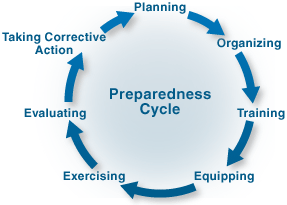
Very simply, we are looking at preparations for your agency’s role.  These preparations, although slightly different based on the agency, apply to all agencies; from first responder agencies, to local government, K-12 and higher education schools, hospitals, private sector, and not for profits.  Let’s break this down with the Preparedness Cycle:

The Preparedness Cycle - FEMA

The Preparedness Cycle – FEMA

Plans, policies, procedures – do you have them in place and up to date?  Depending on the role and function of your agency you can have several of the following – emergency operations plan, emergency procedures, infection control plan and procedures, public health plan, communicable disease or pandemic influenza plan.  You should engage with public health experts to ensure that your plans, policies, and procedures address everything known about Ebola.  You may need to create some procedures specifically addressing issues pertaining to Ebola and your agency’s role.  Do your plans, policies, and procedures link up to your agency’s critical activities for each Core Capability you are engaged in?  What agencies do you need to coordinate with to be effective?

Organizing – depending on your agency’s role, you may need to make some internal changes or designations within your organization to better streamline your activities.

Training – train everyone who has anything to do with any component of the plan in what they need to do.  This is a great opportunity to ensure that everyone is trained up in their role of the emergency operations plan.  If your agency has physical contact with the public, training in personal protective equipment (PPE), identification of signs and symptoms, and patient care are extremely important.  Given the detail of the activities and the just-in-time training, job aids will be a great help to your staff to ensure that they follow the procedures you provide for them.  Don’t get caught short… communicate to your staff in what is going on, what your agency is or may be responsible for, and what they will be called upon to do.

Equipping – your staff need the right equipment for the job.  Not only PPE, but the forms and databases used to record information, decontamination equipment, etc.  It is extremely important that staff are trained not only in how to use equipment but to prevent contamination of equipment and prevention of cross contamination.  Do you have all the equipment you need?  If not, who does?

Exercising – Conduct table top exercises to talk through policies and higher levels plans to validate and become familiar with them.  Identify shortfalls and correct them immediately.  Conduct drills to test the skills of staff for specific activities and larger exercises – functional or full scale – to test multiple functions and plans.

Evaluating – Evaluation is a constant throughout all of the preparedness cycle.  We need to evaluate every step within the preparedness cycle and make adjustments and improvements as needed.  Embrace best practices and fix shortfalls.  This leads directly to the next step…

Taking Corrective Action – Some corrective actions are quick and easy fixes while others can take a while or cost money above budget to address.  A corrective action plan (aka improvement plan) will help you keep track of what needs to be fixed, the priority it holds, who is responsible for making it happen, and a strategy to make it happen – it’s a living document.

The preparedness cycle can be applied to any hazard, be it Ebola or a flood.  With all this attention on Ebola, it’s a great opportunity to pull plans off the shelf and have discussions with internal and external stakeholders on these preparedness steps.

© 2014 – Timothy Riecker

Exercising Foundational Skills with Unorthodox Scenarios

Does the scenario of an exercise activity really matter?  Can we use a zombie scenario to exercise evacuation and sheltering?  Can we use a holiday food distribution to the needy to practice our POD (point of distribution) plan?  Do scenarios always have to be realistic or related to our jurisdiction’s hazards?

I’m a foodie.  As such I find myself occasionally watching shows like Cutthroat Kitchen and Chopped.  These are fun shows that strike a balance of cooking with game shows, including the cash prize in the end.  The competitors are legitimate cooks, some trained in culinary schools, some successful in their careers and earning the title of ‘chef’.  The competitors are given, on the spot, either a dish to create (Cutthroat Kitchen) or a box full of ingredients which must all be incorporated into a dish (Chopped), using a kitchen and pantry generally unfamiliar to them, within a relatively short amount of time – and make it better than their competitors.  Is competing on these shows anything like running a professional kitchen?  Hell no.  Does it make them better cooks?  From interviews I’ve heard, the answer is yes.

Can we recreate this in emergency management?  Of course we can, and we should.  How would this help emergency managers and other public safety professionals?  Recall that within the exercise design component of the HSEEP process the Core Capabilities to be focused on and the objectives to be tested are selected prior to determining the scenario.  This tells us that the activities to be performed are more important than the scenario in which they will be performed.  In these cooking competitions, the participants must fall back on their foundational skills to be successful.  It’s those foundational skills and the activities which they foster that we evaluate in our exercises.

Certainly a scenario has some importance.  It provides context, allowing the participants to get their head into what they are doing.  A scenario can be different, even a bit silly or fantastical (alien invasion, anyone?), but it still has to correlate to the objectives of the exercise; i.e. there must be a compelling reason to perform mass prophylaxis or to evacuate an area.  That said, the scenario is simply a vehicle to get our participants to perform what we intend to test.  Don’t we always tell our participants to not fight the scenario?  Well if it’s something they’ve never before experienced, they have little ground to stand on.

Another benefit to using an unfamiliar or alternate scenario is getting participants to break from the routine and face unexpected and new challenges.  What if digital communications fail?  What if they have to relocate to an alternate EOC? What if that alternate facility is likewise compromised?  Consider using the scenario to remove a critical resource from use.  How will the participants overcome this new problem?  In Cutthroat Kitchen, participants are faced with unseemly injects to their food preparation, such as replacing all cooking utensils with a Swiss Army knife or only being able to cook using a microwave.  Some of your participants may balk at such occurrences, but emergency management is about managing the unknown, the unfortunate, and the unexpected.

Regardless of the measure of reality we choose to base our exercises on, the scenarios we develop are really another level of fiction to help facilitate exercise participation.  Yes, often times we want to test hazard specific plans (a zombie apocalypse exercise can not replace the need of a hurricane exercise), but if the scenario itself doesn’t matter, consider using something ‘outside the box’.  Routine makes us complacent and complacency is very dangerous in emergency management.  We must always expect the unexpected and continually have the mindset to improvise, adapt, and overcome.

© 2014 – Timothy Riecker

4 Steps to Individual and Family Preparedness

As mentioned in earlier posts, September is National Preparedness Month.  Through the lens of whole community emergency management, individual and family preparedness is truly the foundation of all our efforts.  If families are not properly prepared our systems in emergency management, response, social services, healthcare, etc. will be completely overwhelmed in the event of a disaster.  If individuals have not prepared themselves for disasters they will not be able to go to work – effectively shutting down government, businesses, and not for profits which provide so many critical services – especially during disasters. 

While my focus lies generally on preparing governments, businesses, and not for profits for disaster, I often get asked questions about individual and family preparedness.  I also stress individual and family preparedness when I speak with clients, as the preparedness of their employees, suppliers, distributors, customers and clients is so important to their continuity of operations.  Every organization should promote preparedness concepts to their employees as part of their business continuity plan. 

There are an abundance of resources out there on individual and family preparedness.  Overall, the best of these resources is Ready.gov.  They make preparedness simple by breaking it down into four key activities:

  1. Get a kit
  2. Make a plan
  3. Be informed
  4. Get involved. 

1. Get a Kit – FEMA promotes getting (or better yet – building) an emergency kit that will sustain you and your family for at least 3 DAYS.  I would suggest that you prepare to be on your own for as long as you can.  If you can do 3 days, why not 4? 

Everyone’s kit is going to be a little bit different based on your needs and your budget. Here are some ideas to get you started.

  • Water.  It’s a biological essential.  Have AT LEAST 1 gallon of water per person per day for hydration and basic sanitation.  If you live in a warmer climate you will need more. 
    • Pro tip – While you should prepare for your water needs with gallon jugs, consider other water sources to supplement this such as the water in the tank of your toilet or your hot water heater. 
  • Food, another biological essential.  Be sure to have at least three days of non-perishable food per person.  Canned food is always an easy option, although it can be heavy (don’t forget the can opener!).  A lighter-weight option would be military MREs (meals ready to eat) or camping meals (found in most outdoors and hunting stores).  Protein bars and dried fruit are great options as well as they are high in calories (something you may need in a survival situation) and nutrient dense. 
    • Pay special attention to dietary needs or restrictions.  Food allergies are important to note when buying your food.  Also note the amount of sodium usually found in pre-packaged food in the event that a member of your family has sodium sensitivities. 
    • Have pets?  Don’t forget food and water for them, too!
  • Medications.  These can consist of over the counter medications such as ibuprofen, anti-histamines, or anti-diuretics which your family may need (and which you should pack!) as well as any prescription medications. 
    • All food, water, and medications have an expiration date.  Keep a list of your items in your kit with expiration dates noted.  Rotate new stock in when needed. 
  • First aid kit.  Injuries can and do occur during disasters so you should be prepared with a first aid kit.  This is something you can purchase in whole or in part, supplemented with additional items.  Rolled gauze, triangular bandages, and bandaids are important and often used – so stock up! 
    • Get training and know how to provide first aid!  Everyone in your family should take a first aid and CPR class.  Check with the Red Cross, your local community college, or ambulance squad.  Keep a small first aid book in your kit as well – you might not remember everything! 
  • Toiletry and sanitation supplies.  Garbage bags are excellent multi-purpose items.  They can be used to dispose of waste (human or otherwise), to carry goods, or to act as a barrier.  Be sure to have some rolls of toilet paper, feminine products, cleaning solution (a spray bottle of bleach solution is best!), and hand wipes.  Have a baby?  Be sure to pack diapers!
    • Toilet seats that fit on 5 gallon buckets are a great convenience and are available through many commercial outlets.  Before a disaster you can also store some of your emergency supplies in the bucket
  • Emergency communications.  Battery operated, solar, or hand crank radios are a great addition to your kit.  They will allow you to stay aware of the situation and receive important government messages.  These are available through many commercial outlets. 
    • Many of these radios also include features such as flashlights and cell phone chargers.  Be sure that you are familiar with their operation before disaster strikes! 
    • Consider how you will store your kit and how you might have to move it in the event of evacuation.  Plastic bins are a great storage solution buy may not be convenient to move.  Store all items in backpacks inside the bins.  Bright red bins are great to use and should be labeled and easy to find and access. 
    • You don’t have to assemble your kit all at once.  If it’s more cost effective for you and your family, create a preparedness budget and purchase items over a period of time. Tools and supplies.  Other tools and supplies may be necessary to help you survive depending on your situation.  Items to consider are duct tape, a good knife, a folding camping or military style shovel, a hatchet, a wrench, and rope or para-cord. 

2. Make a Plan –Along with checklists for your kit, you can also find checklists and templates on Ready.gov for your plans. A family communications plan is one of the most important plans you can make. How will family members contact each other during a disaster? Consider both cell phone and landline contact methods. Also, an out of state contact should be identified. If family members can’t contact each other, perhaps they can contact this out of state person to let them know they are OK.

Families should plan for sheltering in place by identifying the resources and actions necessary for staying where they are and staying safe. Likewise, families should create an evacuation plan in the event that an evacuation is ordered. What will you take with you?

Lastly, you should be knowledgeable of the emergency plans at school and work. How will notifications be made? What will schools do with children? Where will your meeting place be?

3. Be Informed. It is important to be informed about disasters, be notified of them when they are about to occur, and be able to receive emergency alerts and instructions from government in the event of a disaster. Most states have emergency notification systems established which are free to subscribe to. These systems will contact you per your instructions (cell phone, land line, text, email) to notify you of an emergency and provide you with emergency instructions. Some major cities also have their own similar alert systems. Know what is available in your area and subscribe.

4. Get Involved. Once you have prepared you and your family, help your community to become better prepared. There are a variety of organizations who can benefit from your interest in preparedness. Perhaps you would like to be a health and safety instructor with the American Red Cross or maybe you would like to volunteer through a faith based organization such as the Salvation Army or your local church, mosque, or temple. Local Citizen Corps Councils, if you have one, are focused on disaster preparedness and relief efforts. Volunteermatch.org is a great way to find local community organizations to volunteer with.

Remember, this is just a quick synopsis.  More information can be found from Ready.gov or from the other links provided.  More information on individual and family preparedness can also be found from fellow blogger Kathleen at oyoinfo.net

Be Proactive, Be Prepared! ™

 © 2014 – Tim Riecker