The POETE Analysis – Emergency Planning and Beyond

POETE stands for Planning, Organizing, Equipping, Training, and Exercising. These are the five elements that each jurisdiction should be examining their own capabilities by. By examining their capabilities through each of these elements, a jurisdiction can better define their strengths and areas for improvement.

The POETE analysis, often completed as part of a THIRA (Threat and Hazard Identification and Risk Assessment) is actually a component of the State Preparedness Report (SPR) (note that this was the definition of the acronym at the time of the original post. It is now Stakeholder Preparedness Report), which incorporates THIRA data into this annual submission. When properly conducted, a POETE analysis will examine a jurisdiction’s capability targets. These capability targets, through the THIRA process, are individually defined by each jurisdiction, based upon the capability definitions of each of the 31 Core Capabilities (Note: at the time of my original post there were 31 Core Capabilities. There are now 32). The Core Capabilities were identified in the National Preparedness Goal and are an evolution of the legacy Target Capabilities. Gone are the days when many jurisdictions struggled with the definitions of the Target Capabilities and trying to determine how they applied to jurisdictions large and small across the nation. The new Core Capabilities are divided amongst five mission areas – Prevention, Protection, Response, Recovery, and Mitigation. By referencing Core Capabilities in our preparedness efforts, we have a consistent definition of each area of practice.

When a jurisdiction’s stakeholders conduct a POETE analysis, each element is rated on a scale of 1 to 5 – a rating of 5 indicating that the jurisdiction has all the resources needed and has accomplished all activities necessary for that element within that capability area. Using the Core Capability of Fatality Management as an example the jurisdiction will identify a desired outcome and from that a capability target. CPG-201, the guidance published by DHS/FEMA for conducting a THIRA, outlines this process in detail and provides the following capability target for illustrative purposes:

“During the first 72 hours of an incident, conduct operations to recover 375 fatalities.”

The jurisdiction will examine their efforts and resources for each POETE element for this capability target. Below are thoughts on what could be considered for each element:

Planning: What is the state of their plans for mass fatality management? Do they have a plan? Is it up to date? Does it address best practices?

Organizing: Are all stakeholders on board with mass fatality preparedness efforts? Is there a member of the community yet to be engaged? Are lines of authority during a mass fatality incident clear?

Equipping: Does the jurisdiction have the equipment and supplies available to handle the needs of a mass fatality incident? Are MOUs and contracts in place?

Training: Do responders and stakeholders train regularly on the tasks associated with managing a mass fatality incident? Is training up to date? Is training conducted at the appropriate level?

Exercising: Have exercises been conducted recently to test the plans and familiarize stakeholders with plans and equipment? Has the jurisdiction conducted discussion-based and operations-based exercises? Have identified areas for improvement been addressed?

The jurisdiction’s responses to these questions and the subsequent ratings provided for each POETE element will help them identify areas for improvement which will contribute to the overall capability. From personal experience, I can tell you that the discussions that take place amongst stakeholders which reveal both the efforts applied for each element as well as the frustrations and barriers to progress for each are generally quite productive and great information sharing sessions. It is important to capture as many of the factual elements of this discussion as possible as they add context to the numerical value assigned. Having the right people participating in the effort is critical to ensuring that inputs are accurate and relevant.

Once the POETE analysis is completed, what’s next? As mentioned earlier, the POETE analysis is actually a required component of the annual State Preparedness Report, which must be submitted to FEMA/DHS by each state and territory. Ideally, the results of the POETE analysis should be translated from raw data (numbers) to a narrative, explaining the progress and accomplishments as well as future efforts and barriers; in other words, the ratings should be factually explained and these explanations should feed an actionable strategic plan. The priority rating inherent in the THIRA process will help establish relative priority for each Core Capability within the strategic plan. While this is a requirement for states and territories, a comprehensive strategic plan for any emergency management and homeland security program at any jurisdictional level is obviously beneficial and would reflect positively in an EMAP accreditation.

POETE elements should be incorporated into other emergency management activities as well. When needs are identified and defined based upon Core Capabilities, these should be outlined in the jurisdiction’s multi-year Training and Exercise Plan, which should serve as a guiding document for many preparedness activities. The focus that a POETE analysis provides for each Core Capability can help identify training objectives which can help maintain and improve capability

Consider integrating them into your evaluation of exercises. While the Homeland Security Exercise and Evaluation Program (HSEEP) doctrine makes no mention of POETE, much of HSEEP is based upon capabilities. With a POETE analysis being an integral component of measuring our progress toward a capability, I would suggest including it into exercise evaluations. POETE elements can be included in Exercise Evaluation Guides (EEGs) to capture evaluator observations and should be outlined in the After Action Report (AAR) itself for each observation – giving suggestions for improvements based upon each POETE element. Consider how you could incorporate the POETE elements into an AAR as an outline identifying areas for improvement for the EOC management activities of the Operational Coordination Core Capability. As an example:

Planning: The jurisdiction should update the EOC management plan to incorporate all critical processes. Job aids should be created to assist EOC staff in their duties.

Organizing: Lines of authority were not clear to exercise participants in the EOC. Tasks were assigned to agencies but status of tasks was not effectively monitored.

Equipping: There were not enough computers for participating agencies. EOC management software did not facilitate tracking of resources.

Training: EOC agency representatives were not all trained in the use of EOC management software, creating delays in action and missed assignments. The EOC Manager and Planning Section Chief were well versed in the Planning Process and used it well to facilitate the Planning Process.

Exercising: Isolated drills should be conducted to test notification systems on a regular basis. Discussion based exercises will assist in identifying policy issues associated with suspension of laws and their impact on EOC operations.

The POETE analysis is a process which can help us identify strengths and areas for improvement within our emergency management and homeland security programs. While the POETE analysis can be time consuming, the information gathered for each Core Capability is valuable to any preparedness effort. With such a variety of federally-driven programs and requirements extended throughout emergency management and homeland security, we can find the greatest benefit from those which have the ability to cross multiple program areas – such as the Core Capabilities – allowing us to consolidate the evaluation of these programs into one system, providing maximum benefit and minimizing efforts.

Have you conducted a POETE analysis for your jurisdiction?  Did you find it a worthwhile process?

Looking for help with a POETE analysis?  Emergency Preparedness Solutions, LLC can help!  www.epsllc.biz 

© 2014 Timothy Riecker

Business Continuity – More than just a plan

Don't throw away all of your effort to build your business - Be prepared!  (image courtesy of FEMA)

Don’t throw away all of your effort to build your business – Be prepared! (image courtesy of FEMA)

Every year businesses are forced to close due to the impacts of disaster.  Research from the National Federation of Independent Business (NFIB) tells us that the top four threats to business suffering the impact of disaster are:

  1. Power Loss
  2. Loss of Sales and Customers
  3. Length of Recovery
  4. Uninsured Loss

How can businesses protect themselves against these impacts?  Planning for them is, of course, the easy answer.  Just like governments, though, wouldn’t it make the most sense for a business to have an emergency preparedness program in place?

Consider that small business owners invest a great deal of time, energy, and funding to build and grow their business.  As an independent consultant I can be working on a variety of things on any given day including project management, marketing, and accounting.  Small business owners that deal with products (vs services) often times have even more to deal with including inventory, vendors, and distributors.  The foundation of these entrepreneurial efforts is often times the business plan.  Aspiring business owners put a lot of effort into creating this plan which describes what the business will do, what the market capacity is, what the competition looks like, and even trying to forecast revenues for several years.  A successful business may continue elements of this business plan years later through a strategic plan intended to guide growth and company-wide efforts.  Doesn’t it make sense that if we put so much effort into building and growing our businesses that we put some effort into ensuring that our businesses will survive a disaster?

As a society we generally like plans.  They are an organized tome capturing our assumptions, ideas, and strategies to accomplish something.  Plans are good and certainly help us through a great deal.  A disaster plan, though, is not a disaster program.  The plan may embody our program, helping to guide and inform our decisions in the event of a disaster, but our preparedness efforts must stretch beyond a plan if we are to be successful.  Consider DHS’ POETE capability elements – Planning, Training, Organizing, Equipping, Training, and Exercising.  With these elements in your head scroll back up to those top four threats from the NFIB and give them a moment of thought.  You probably now have some additional ideas as to how you can address and prevent each of those with activity which may go beyond planning.

This recent article from Small Business Trends (which provided my initial inspiration for this blog post) provides a good outline of initial considerations for every business relative to disaster preparedness.

What does your business do to be better prepared?

Shameless plug time: Need help building your business continuity program?  Emergency Preparedness Solutions can help!  Contact us at consultants@epsllc.biz or check out our website at www.epsllc.biz.

© 2014 Timothy Riecker


Engaging a Nation in Preparedness – Learning from History

June 14, 1954 saw the first nation-wide civil defense drill conducted in the United States.  The Civil Defense Administration organized and promoted the event, which included operations in 54 cities around the country, including Puerto Rico, the US Virgin Islands, Alaska, and Hawaii.  Canada had also participated in the event.  The History Channel website has a nice write-up on the event.  The History Channel’s article explains some of the activities conducted during the event, which largely consisted of sheltering drills.

Today we do see some nation-wide exercises which engage citizens through the Shake Out earthquake drills.  Their website has a great deal of information on the program, including how you can participate.  The statistics on their site are great, showing not only the US regional exercises but also Shake Out exercises conducted in nations around the world (something I was not familiar with until visiting their site this morning).  The earthquake hazard in the US and around the globe is significant – in fact we just saw two large earthquakes late yesterday – a 7.9 near Alaska and a 7.2 near New Zealand.  While the core activity of the Shake Out exercises is the ‘Drop, Cover, and Hold on’ (similar to the ‘duck and cover’ of the civil defense days), their website also promotes preparedness activities including a ‘hazard hunt’ for items which may fall during an earthquake, a family disaster plan, business and organizational continuity planning, and emergency supply kits.  This is the type of preparedness activity we need to continue, but we also need to do more.  Unfortunately the message still isn’t getting through to many people.

How do you think we should get the message out?


© 2014 Timothy Riecker


Kansas City Changing the Paradigm In Shooter Responses

Despite some discussions going back to late last year about changing they way we respond to mass shootings, I’ve not heard of any major municipalities actually make these changes – until now.  Responders in Kansas City, MO (KCM) have exercised their new plan regarding early insertion of EMS personnel into an active shooter scenario.  The exercise appears to be very early stage, using it as a learning experience from which to further develop plans.  (another great use of exercises!)

I commented on the discussed changes back in January and I still have the same concerns today that I did then.  I had posted some discussion threads similar to my blog post onto LinkedIn discussion boards which prompted some very spirited discussion.  Most people agreed that getting EMS into an active shooter area early can save lives, but it needs to be done the right way.  KCM seems to be going in the right direction by developing plans and protocols jointly with law enforcement and working out the kinks and questions via drills and other exercises.  Carrying the preparedness cycle further, I’m sure they will work toward training and equipping EMTs appropriately for such a situation.  Constant practice of these protocols by all parties will be very important.  Responder safety needs to be the utmost concern.  While there have been incidents to the contrary, we as responders and we as a society are not used to EMTs and firefighters being shot at, much less killed in action by an aggressor.  Certainly the first EMT fatality in an incident such with an early insertion protocol will result in the protocol being aggressively questioned – as it should.  I just hope that those doing the questioning keep the appropriate context.

Just as there is no easy answer on how to stop mass shootings, there are no easy answers on how best to respond to them.  I’m hoping KCM is willing to share their worked out plan and protocols with the responder community so we can learn from them.  Such sharing will be very important to the evolution of responses to these types of incidents.

© 2014 Timothy Riecker

Does Your Municipality Have an Emergency Management Handbook?

I recently came across an emergency management handbook assembled for municipalities in Connecticut.   First of all, I’m thrilled that officials in CT are openly sharing this handbook.  Doing so makes it easier for their municipal officials to find and, in the spirit of sharing found within emergency management, it is always great to share best practices.  There are a great deal of concepts, templates, checklists, and the sort which are benchmarked and shared throughout the emergency management community, by way of the Lessons Learned Information Sharing (LLIS) site and other means, which are of great help the collective profession.  If someone else has already done something and it seems to work, why not adapt it to your own needs instead of trying to create something completely different?

I recall early in my career when handbooks and reference guides assembled by states for their local governments were common practice.  For a period of time we seemed to get away from that for some reason, but the practice now is making a resurgence.  I consulted on a project a year ago for the creation of a UASI regional handbook and have seen others in use.  The CT handbook which I linked to at the beginning of the article is an excellent example of what should be included in a handbook and how it should be structured.  Recall from my training-related articles that my focus is always on the audience and their needs.  This audience-centered approach doesn’t only apply to training – it also applies perfectly well to document development. So who is the audience for these handbooks?  Certainly the chief elected officials of counties, cities, towns, and villages.  Their subordinates (department heads) can also benefit greatly from the content.  How about schools (primary and secondary education alike) and hospitals?  The more people who are familiar with the foundational concepts of emergency management and how it is applied in a particular state, the better.  With some modification to include more information for them, I’d also include private sector entities as well.

The structure of the CT document is also one to be benchmarked.  They make reference with brief explanations to federal and state laws and related authorities of individuals and agencies regarding emergency management and related topics, such as NIMS.  For these and other references throughout the document, they include external links where additional information can be found.  They include emergency management structure and flow, which helps local governments identify who they need to coordinate with and who they should request assistance from.  They break down the document into the phases of incident management and include information on each; including planning, training, exercises, and grants within Preparedness; communication, coordination, notification, resources, and other information within Response; debris management, PDAs, and recovery programs in Recovery; and the variety of common mitigation programs in Mitigation.  Appendices provide information sheets on things like the CT VOAD and 211, as well as templates and checklists for the critical elements of each phase of emergency management.

Recalling the needs of the audience, CT addresses them well with this document, which was a collaborative effort between their state emergency management department, emergency management association, state conference of municipalities, council of small towns, and association of regional planners.  These types of collaborative efforts help ensure that the right information is being conveyed.  Most new elected and appointed officials know little about emergency management and need to become familiarized with it before a disaster occurs.  While response is the most prominent phase of emergency management, the other phases are necessary to promote an effective response and a good, overall program.  Even for those experienced in emergency management, a guide such as this provides excellent references for the critical information.  The handbook is of reasonable size – only 90 pages – so it is easy to navigate.  While it has value in print, it is even more valuable electrically given the addition of hyperlinks which bring you to other information.  As a PDF, it’s handy to keep in the library of a iPad or other tablet where it can be referenced easily.  Overall, the information is succinct, giving only what is needed for foundational understanding.  The templates, checklists, and quick reference guide found in the appendices help turn the information into actionable content.

Lastly, the structure and content of the document lends itself well to a structured review (i.e. training), which gives people the opportunity to look at the document in-depth and ask questions.

Does your state or municipality have a handbook similar to this?  What are your thoughts on the one CT provides?  Would you like to see more content or less?  Have they missed something essential?


Tim Riecker

Is the Department of Defense Planning for a Zombie Attack?

No, not really.  But they are using the zombie scenario as highly effective training tool.

I reference, of course, the recent news releases (such as this one from ForeignPolicy.com) concerning the United States Strategic Command document titled: CONPLAN-8888 – Counter-Zombie Dominance (April 30, 2011).  You’ll see in the Disclaimer section of the document, beginning on the second page, that this scenario was selected because of its improbability of occurring, unlike other scenarios which may be used as the basis for training and exercises, which could be mis-perceived by the public.

The training they refer to is the Joint Operations Planning Process (JOPP).  Typically the word ‘Joint’ in military doctrine refers to activities which include two or more branches of military service. Not only do the US Military Services use joint planning and conduct joint operations, but the Army and Air National Guards do as well.  For as much as it makes sense, the concept of ‘jointness’ has really only seen large-scale attention in the last decade or so.  Having worked extensively with the National Guard in recent years, the ‘jointness’ has become the foundation of nearly all activity.  This is a great accomplishment as there is considerable competition between the branches, sometimes to the level of disdain, and certainly a great many differences, even in terminology and rank structure.  Despite the decades-long existence of the Joint Chiefs of Staff, true joint integration at an operational level rarely occurred and was generally not executed well.

Joint operations are simply a military version of the Incident Command System (ICS), where different disciplines and agencies – some often very different from each other – can function together within one organizational structure for the purpose of addressing an incident.  If you are interested in additional information on Joint Planning and Operations, I suggest you visit the DoD’s Joint Electronic Library where you can find documents which I have referenced often when working with the National Guard on preparedness and response activities – including the Universal Joint Task List (UJTL) (similar to the old DHS Universal Task List, in concept) and the Joint Publications (such as Joint Publication 5-0, Joint Operation Planning – which is the foundation for JOPP).

As mentioned in earlier posts, I love the integration of zombies and other apocalyptic lore into preparedness activities.  While tongue in cheek, they help planners and responders do away with pre-conceived notions they may have with other, more realistic scenarios.  In emergency management, we know that every incident is different.  While we learn from our experiences and hopefully apply what we learned to the new challenges we face, we sometimes go into the next incident with a bias.  The introduction of totally fictional scenarios, such as a zombie attack, help make the situation faced completely new – while many of the specific problems faced are things we do have plans for, such as mass fatalities, hazmat, contagious diseases, etc.  It’s a great approach which I strongly advocate.  The only caution we may have is that the premise of the scenario itself may cause some to not take the activity seriously or may cause a distraction.

Have you used any non-traditional or totally fictional scenarios?  What were they?  How were they received?

/s/

Tim Riecker

Managing an Exercise Program – Part 9: Conducting an Exercise

This post is part of a 10-part series on Managing an Exercise Program. In this series I provide some of my own lessons learned in the program and project management aspects of managing, designing, conducting, and evaluating Homeland Security Exercise and Evaluation Program (HSEEP) exercises. Your feedback is appreciated!

Managing an Exercise Program – Part 1

Managing an Exercise Program – Part 2: Develop a Preparedness Strategy

Managing an Exercise Program – Part 3: Identify Program Resources and Funding

Managing an Exercise Program – Part 4: Conduct an Annual Training & Exercise Planning Workshop.

Managing an Exercise Program – Part 5: Securing Project Funding

Managing an Exercise Program – Part 6: Conducting Exercise Planning Conferences

Managing an Exercise Program – Part 7: Develop Exercise Documentation

Managing an Exercise Program – Part 8: Preparing Support, Personnel, & Logistical Requirements

Managing an Exercise Program – Part 9: Conducting an Exercise

Managing an Exercise Program – Part 10: Evaluation and Improvement Planning
Image

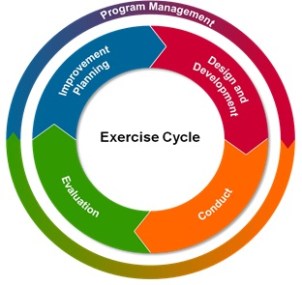
Since writing Part 8, the new HSEEP guidance (April 2013) was published. Thankfully this update didn’t dictate wholesale changes in the process we’ve all come to be familiar with. There were some subtle changes, such as changing ‘planning conferences’ to ‘planning meetings’, and stressing the involvement of elected officials in the exercise planning process. Similarly, I’m thankful that certain changes weren’t made – one of which was the proposed elimination of terminology of ‘discussion based exercises’ and ‘operations based exercises’. These general identifiers have become commonplace amongst exercise designers for decades. Upon having the opportunity to review a draft version of the new HSEEP guidance, I was quite opposed to that change.

Obviously conducting the exercise is the most exciting part of the process. It’s where all of your hard work comes together. That said, this is where it can all fall apart if you haven’t prepared property in the first eight parts and if you don’t pay attention to detail. I’m breaking exercise conduct down into four smaller parts: Set up, briefings, play, debrief. Remember that my intent with these postings is not to be fully comprehensive, but to emphasize areas where I have learned or have seen others struggle. In all facets of emergency management we need to continue a culture of sharing if we are to be successful.

Set up

The preparations for your exercise should have been finalized in Part 8 where you addressed logistical requirements. You should know where your exercise venue is, how people will be seated/where they will be working, the location and support for a SimCell (if you’re having one), and even matters such as parking, food, restrooms, and audiovisual equipment. Additionally, set up includes having print material available for all participants. When setting up, consider the flow of people, quite literally from the road to the parking lot, from the parking lot to the facility, into the facility through security, sign in, and to their first location for the exercise (this may be their only destination or it may be a large briefing room). Having conducted exercises in locations not familiar to some participants as well as these exercises being larger than the facility’s parking lot can handle, you must ensure that invitation packages have specific directions on how to get to the parking area and how to get from the parking area to the venue. Be sure that signage is prominently displayed. It may even help to have staff directing people. Be sure to also let them know what manner of identification is required to enter the facility. Again, signage is often necessary to get people from the building entrance to check in location and then to the meeting location. Signage for the refreshment area and restrooms may also be needed.

Have everything set up for people before they arrive. Use table tents, if needed, to help identify seating, and have copies of all necessary materials at their seating location. Materials like SitMans and ExPlans have a lot of content, so it’s nice to have these materials available for the early-comers to being reading through.

Be sure to set up early and test EVERYTHING. Make sure AV equipment and communications equipment are tested.

Briefings

Depending on the type of exercise you are conducting, there can be a number of briefings needed to take place before the exercise begins. Some of these briefings may need to take place well in advance, even a day or more before the exercise, depending on availability of audiences for each of them.

The new HSEEP guidance includes a specific briefing for elected and appointed officials. This is something to usually conduct well in advance of the actual exercise to outline the agenda/timeline of the exercise and what will be expected of them. They will likely want to interface with any media and should know what to say about the exercise. They may also want to ‘kick off’ the exercise at the player briefing.

Controllers, evaluators, and SimCell personnel should receive a briefing to ensure they are familiar with the exercise and their rolls. They all need to know what is expected of them and of the players, how and when to interact with the players, and what may need to be reported to their respective leaders and/or to the exercise director. Evaluators will need to become familiar with their assigned EEGs and what the expectations are for evaluating. Additional time will need to be spent with SimCell personnel to familiarize them with the equipment being used, how the MSEL is structured, and how injects will be delivered. If any actors are being used, they will also need to be briefed on their rolls and what their expectations are. Ensure that everyone is familiar with the safety word in the event of the necessity to immediately stop the exercise.

If observers are expected at the exercise, have a briefing ready for them. I suggest treating them like VIPs when possible (most of them usually are). Don’t just let them walk around to figure things out for themselves. Give them tour guides who can take them throughout the venue and talk about what is happening. Schedule their arrival when possible, and consider having an elected or appointed official there to greet them. Keep in mind that some observers will be very high tier VIPs. Vigilant Guard exercises are often visited by the head of the National Guard Bureau – a four star General. These visits are fantastic and very much emphasize the importance of the exercise, but they can also be a little disruptive. These high-tier VIPs will often come with their own entourage and/or security. They will want a brief tour and will stop often to shake hands and have pictures taken. They may even want a break in the exercise to speak. Try to be aware of these expectations up front if at all possible. If not, just go with the flow and be flexible.

The media is another form of observer. All media should be scheduled. Be sure to make it worth their while, where they can catch some video/picture footage of interesting activities. Maps and wall displays make for great footage as well. Remember operational security! If something is sensitive or classified, it should not be anywhere where it can be seen. The media should also be provided a tour and an opportunity to get a statement from the elected and/or appointed officials. They may also want to interview players. I generally don’t allow this without preparation of the specific player to ensure that the right messages are delivered. Also, be sure to let players know during the player brief that there will be observers and media coming through and what is expected of them.

Lastly, the player briefing. This briefing will introduce players to the purpose of the exercise, the ground rules, the facility, timeline, controllers and evaluators, and expectations. Players should be briefed on how and when to interact with the SimCell if you have one. It should always be reinforced that the exercise is ‘no fault’, and that they, individually, are not being evaluated, rather it is the plans, policies, and procedures they are using that are being evaluated. Lastly, players are briefed on the scenario. Be sure that the ExPlan/SitMan has the detailed scenario for their reference.

Exercise Play

Finally the moment of truth arrives! Remember that the purpose of the exercise is to accomplish the objectives, however, know that you may not accomplish all the objectives in the timeframe you have. Being flexible, and knowing you have to be flexible, are two very important aspects of running an exercise. Regardless of how well we think we’ve written an exercise, the responses to our prompts are entirely up to the players. They may accomplish the objectives faster or slower than you expected. Likewise, they may struggle a bit. This is where good exercise control comes in. Controllers/facilitators should observe the tempo of the exercise. Is everyone engaged? Are they needlessly overwhelmed and frustrated? Are they bored? Are they not following through on activities? All these observations should be reported back to the exercise director and SimCell so the tempo can be moderated.

Be sure to have contingencies in the event that players do or request the unexpected. Additional injects that are held back are always a good idea. You may need them to prompt certain activities in the event that players do not take the initiative to do so. Players may also ask questions or make requests of the SimCell that aren’t expected. While we can’t anticipate every need, we can be prepared for them. Have copies of plans, policies, procedures, and maps available to the SimCell. They may have to take some time to research and come up with an answer then get back to the individual. The SimCell manager should be smart when situations like this arise, however. They should always consider if a potentially inaccurate but reasonable answer is acceptable or if the answer must be completely accurate… or even if the answer is required for exercise play at all. There is no sense having SimCell personnel research an answer if the answer doesn’t much matter within the scope of the exercise.

Multi-day exercises may require the exercise staff to meet at the end of every day for a mini hotwash and to evaluate how the exercise is progressing. Where are the players in respect to where you expected them to be in your design of the exercise? Do you need to retool anything in the MSEL?

On large exercises, it helps for the exercise director to have an aide-de-camp, or assistant. Just like any individual in charge of a large operation, the exercise director is having their attention pulled in many directions and may simply not have the time to address everything, especially in large or multi-venue exercises. Having an assistant is also a great way to train up and coming exercise staff. Certainly consider the use of portable radios to help facilitate communication as well. The exercise director will spend most of their time managing and trouble shooting. They may also have to address some VIP concerns. Be sure to walk around to get a good sense for the exercise as a whole. Are evaluators properly positioned? Are controllers present and visible? Is the SimCell responding to questions adequately? Are players engaged and challenged? Perhaps most importantly, is the boss (the elected/appointed official) happy?

Evaluation is such an important aspect of exercise that I will cover it in its own section – Part 10.

Debriefs

Two significant debriefing activities should take place immediately following the exercise: 1) a player hotwash, 2) an exercise staff debriefing. Players should be led through a facilitated hotwash, reviewing the objectives of the exercise, with evaluators capturing their responses to if/how the objectives were accomplished. Encourage and capture responses both in the positive and the negative: i.e. what did we do well and what do we need to improve upon?

After the player hotwash, a similar process should take place with all exercise staff – controllers, evaluators, and SimCell. I like to not only capture their impressions of if/how objectives were accomplished, but I also like to discuss the conduct of the exercise, again capturing what went well and what needed to be improved upon.


How to Replace Five Common Vital Records

I was sent the following from USA.gov on Friday.  It’s a good reminder to keep copies of these documents so you at least have a starting point and can reference the registration numbers of each.  I also keep copies of my driver’s license and credit cards (all front and back).

From a business perspective, you should also consider what documents you maintain copies of.  What records are vital to you?  Are the copies up to date?  Are they stored off-site?


How to Replace Five Common Vital Records

Vital records, like birth and marriage certificates and military service records are often necessary to access a variety of government benefits and services. But sometimes life happens and those vital records go missing. Maybe they were misplaced in a move, were stolen or got damaged in a fire.

USA.gov has information to help you find copies and replacements of your vital records so you can apply for whatever benefits and services you need.

Birth, Marriage and Death Certificates

These records come from the states. To find a copy, you’ll have to contact that state office where the life event occurred. Find the contact information for state and territory offices that can help you.

Passport

Report lost or stolen passports to the State Department right away by calling 1-877-487-2778. To report and replace the lost or stolen passport, you’ll have to submit forms DS-11 and DS- 64 in person at a passport agency or acceptance facility. If you lose a passport, and then find it again, you won’t be able to use it to travel. You should return the lost passport and request a new one.

Military Service Records

You often need copies of military service records to apply for a variety of government programs available for veterans, like health care, retirement or education benefits. The National Archives keeps copies of all veterans’ services records, and you can apply online to receive a copy of yours or an immediate family member’s if they are deceased. If you prefer to mail or fax a request for your records, you can download form SF-180. You can also find out how to replace lost military medals and awards.

Social Security Card

If you can’t find your Social Security card, you may not actually need to replace it. As long as you know your Social Security number, you will still be able to collect Social Security benefits, get a job and apply for many government benefits and services. However, if you do want to replace the card, you’ll need to gather documents proving your identity and citizenship to mail or take to a local Social Security office.

Green Card

If you have a U.S. Permanent Resident (Green) Card, you may need to replace it if it was lost, stolen or damaged or if your name or other biographical information has legally changed since it was issued. You can easily request a new one online. If you’re outside the United States and have lost your green card, you should contact the nearest U.S. consulate or immigrations office before you apply online for a new card.

If you need help getting copies of other vital records like tax returns or school records, you can find the information you need to replace them at USA.gov.


Emergency Management and Considerations for Visiting Populations

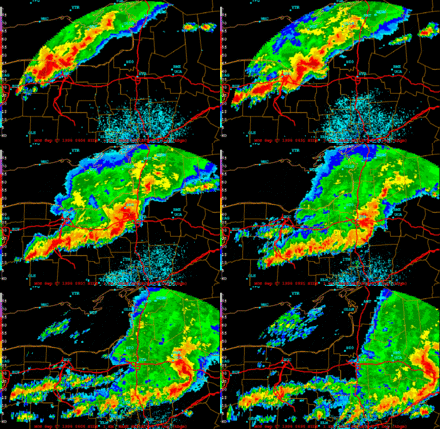
Radar loop, Labor Day 1998 Upstate New York.  This storm impacted the New York State Fair.

Radar loop, Labor Day 1998 Upstate New York. This storm impacted the New York State Fair.

The inspiration for this blog was a paper posted to LLIS by Dr. Susanne Becken, Professor of Sustainable Tourism at Griffith University (Australia) and Lincoln University (New Zealand).  The paper is titled The Christchurch Earthquake and the Visitor Sector, which is also available from this link if you don’t have LLIS access.

Dr. Becken highlights the Christchurch earthquake of February 22, 2011, which killed 185 people from more than 20 nations, 80 of which were listed as visiting, rather than residing in, Christchurch.  She states that as a result of this M 7.1 earthquake infrastructure was badly damaged, accommodation capacity was reduced by half, and the number of international visitors dropped by almost 30 percent in the aftermath.  Dr. Becken identifies many of the challenges visitors had, including loss of travel documentation and other important items, and the value of the tourism industry in the area to assist response efforts (such as providing lodging for displaced citizens as well as responders from out of the area).

This paper brings to mind the vast amounts of visitors and transient populations that are found in many communities across the nation.  When visiting an attraction such as an amusement park, where tens of thousands of people congregate on any given summer day, take a look around.  Many of the amusement parks I know of are in fairly rural areas.  These towns are likely to have small volunteer fire departments and may not even have their own police services, instead relying on a county Sheriff’s Department or State Police.  How about a small city that has popular attractions at certain times of the year, such as horse tracks or other sporting events?  These events will also draw tens of thousands of people from near and far, staying in hotels, motels, and campgrounds.  Sure, these small cities might have a 24-hour staffed fire department, and probably even a small police force.  But how prepared are these types of areas for an incident that can cause mass casualties and fatalities?

Incidents such as this underscore the need for our preparedness to be through and needs-based.  As part of our Threat and Hazard Identification and Assessment (THIRA), which is the latest evolution of the traditional hazard analysis (see CPG-201), we must be sure to recognize visitors and transient populations and the events that bring them to our areas.  We should consider tourist attractions, field days, concerts and performances, large conventions, sporting events, and even college populations.  The potential impacts, in the event of a disaster, are certainly greater with these populations given that they are likely to be unfamiliar with the area, don’t reside locally and probably have no local contacts, and aren’t familiar with the threats.  Given the nature of the event they are attending, they may very well be consuming alcohol, as well.  All this makes for a rather fragile and dependent population in the event of disaster.

Planning on the macro (community) level should consider the specifics mentioned above.  With this information you can estimate the resources needed for certain scenarios (this is part of your THIRA), which will lead you determine gaps which you then plan to address.  Take some time to examine the demographics of the visiting populations.  These demographics will help determine their level of need in the event of a disaster and some areas of support you may need to provide.  Your local chamber of commerce and/or tourism authority can be an important planning partner for this information and other purposes.  Certainly consider the nature of the events and the age range of the attendees.  Are there language or cultural issues that should be prepared for?  Much of this specific information can be obtained event by event, looking at the micro (event-specific) level of planning for these events.  In New York State, a mass gathering permit is supposed to be issued for any event estimating attendance over a certain number.  The primary purpose of these permits is to ensure that officials are aware of the event and that potable water and sanitation is appropriately available, as well as other caveats.  Most states have a similar type of permitting requirement.  Become familiar with it and use it to your advantage.

In any of these events, how will you handle alert and notification in the event of a disaster?  You may have sirens in place, but would a visitor know what it means?  Given that such a high percentage of people have cell phones, use of area blast messaging may be an appropriate consideration.

A lesson learned from airline crashes can and should be brought into your planning: family assistance centers.  Family assistance centers were brought about in the aftermath of the crash of TWA Flight 800, realizing the importance of providing support and information to the families and loved ones of victims.  This concept has been applied as a standard to other mass fatality incidents since then and has proven to be beneficial to all parties.

Be sure to conduct preparedness exercises on these plans, and include members of your local hospitality and tourism industry as they will certainly be involved in some aspect of the greater response should an incident occur.

Sometimes local communities view visiting populations as a hassle, particularly when they don’t have the care for the host community that the locals do.  These populations are usually important to the economy of the local area and, depending in the event, will be back year after year.  No matter what your take is on that argument, you must consider the safety of any visitors or tourists as if they were your own citizens.  Be prepared through regular planning, training, and exercising activities and be sure to include your local chamber of commerce, tourism and hospitality industry as they are not only stakeholders, but they have a great deal of support and information to provide.  Most importantly, remember that all good preparedness efforts begin with a solid needs assessment.  Conduct a THIRA for your community, you might be surprised with what you discover!

What experiences do you have with planning for visiting populations?