Most Disasters are NOT Extraordinary Occurrences – OR Crowdsourcing Volunteers

I listen to A LOT of podcasts.  While some are focused on emergency management and homeland security, most are pop culture related and have nothing at all to do with EM/HS.  At least not directly.

Listening to a recent podcast, it struck me how often the hosts mention disaster-related occurrences.  During this podcast there were several mentions of disaster related issues including the Louisiana theater shooting (which was breaking news while they were recording) and the Tom Selleck legal drama in California over stolen water (which ultimately relates back to their drought issues).  The same podcasters (one of which is in New England, the other in the National Capital Region) often comment through the year on weather-related incidents which impact them and others including winter storms, flooding, and warmer weather storm damages.

The point is that most disasters are not extraordinary occurrences.  Routine incidents aside, some measure of disaster occurs fairy regularly, certainly around the world and even just within any of our nations.  Turn on the news tonight and see for yourself.  So WHY, I ask, is there such a mentality with the general public (and maybe even with us public safety types) about disasters being out of the ordinary occurrences?  Sure they don’t happen within our own jurisdiction every day, but they happen somewhere EVERY DAY.  I’m not saying we have to be paranoid about it, but I see the COMPLACENCY getting WORSE.  We discuss preparedness often, and the aspect of getting the public better engaged in preparedness almost as much, yet we have yet to see real, meaningful success in this.

We’ve recently seen a bit of a paradigm shift in how we deal with climate change (insert groaning sound here).  For many years we tried to prevent it, as if we could.  The reality is that part of it is influenced by the actions of humanity and part of it by the natural cycle of our planet.  There are things we simply shouldn’t be doing and we still need to work on those, but we have also come to grips with the inevitability of the impacts.  We have realized that they will happen no matter what we do and we have decided that we need to ADAPT in order to survive.

Adaptation is an important realization for us (I’m now speaking in generality – not just climate change issues).  If there are things that we pound our heads against the wall over in futility, such as public engagement, maybe we are doing it all wrong?  I’m not saying that we stop trying to engage the public.  There are certainly successes we have seen, but I don’t think we are seeing the return on investment we should be.

Let’s look at society today.  People seem to have less time ability interest in volunteering or committing to efforts ahead of time.  We have to understand and acknowledge that first and foremost.  Have we turned into soulless uncaring creatures?  No, of course not.  We have just seen a shift in culture.  Trying to fight this culture is foolish.  Instead, we need to adapt.  How do we adapt?

Social media is the greatest embodiment of our need for instantaneous information and feedback.  It doesn’t take much preparation (download some apps, create accounts, find friends).  The vast majority of the information that rolls across the screen is crap, but every once in a while there is a worthwhile nugget that will garner some responses.  Sometimes (usually disasters or a new statement by Donald Trump) information that comes across garners a great deal of attention and people want to take action.  Do they know how to take meaningful action?  Often not.  But they will follow along with the good ideas of others.  (aka leaders).

Let’s broaden this concept within public engagement.  What this essentially comes down to is managing spontaneous volunteers – a concept we have seen much need for in EM for years.  I think we need to emphasize this more than ever.  We also need to update the way we think about it.  These spontaneous volunteers will not only show up at town hall, the fire house, local diner, or house of worship; they will show up online via Twitter and Facebook.  They will be locals, they will be from out of state, across the country, or across the planet.   ALL of them can be engaged.  Let’s crowdsource volunteers in emergency management.  We just need to identify how to engage them.  Identify gaps and figure out how these good natured people can fill those gaps with little no upfront investment of time or effort on their part.  Build plans that address spontaneous volunteer engagement – both in the physical aspect as well as virtual.  Train to these plans and test these plans.  Let’s stop struggling against old ways of thinking.  Improvise, adapt, and overcome.

As always, I’d love to hear your thoughts on this.

I do want to take a moment to thank my followers and readers – something I don’t do enough of.  Your support and comments are greatly appreciated.  Also, if you like my blog, spread the word.  Please feel free to forward/repost/retweet to friends, family, colleagues, and complete strangers.

©2015 – Timothy Riecker

EMERGENCY PREPAREDNESS SOLUTIONS, LLC
WWW.EPSLLC.BIZ

We need to talk MORE about Emergency Management

My company is currently finishing a contract which involved almost two dozen site visits to local government entities (cities and towns) to meet with local officials (emergency management, police, fire, EMS, schools, elected officials, public works/highway, etc.) to discuss certain emergency management and homeland security needs they may have.  The topics we needed to address were set in conjunction with our client and the meeting times were capped at 4 hours.  Based on the discussion generated by those we met with, discussions took anywhere between an hour and a half to all four hours.  At the end of most of these meetings, many people who we met with thanked us for bringing them the opportunity to discuss emergency management with such depth.

At first I was a bit puzzled about this gratitude… the meeting was intended for us to gather information from them, so it was us who thanked them for their time and input.  Why would they thank us?  They could talk about this stuff any time they wanted to, right?  In theory, yes.  In practice, NO.

Looking back at the project in retrospect we saw the value in the opportunity we provided these local stakeholders.  Absent a recent disaster or a specific issue of concern, it’s a rare occasion that local leadership takes the time to convene and discuss emergency management and homeland security matters.  We, rather serendipitously, provided them with an opportunity to do talk about many facets of EM/HS, to share thoughts and ideas, and to identify needs.

In many local government meetings (town/village/city council, selectboard, etc.) the topic of emergency management (or anything related to it) is generally not on the agenda.  Some may have a formal briefing by department heads, which would include the fire department or police department (if they have one), but these are usually fairly general statements.  Because of the depth of discussion that can take place, I don’t even think that these monthly governance meetings are the right venue for most discussion.  I would suggest that jurisdictions have a separate meeting, at least quarterly, to discuss emergency management in depth, with all department heads, elected officials, and others present and participating.  Preparedness should be discussed across the spectrum of all mission areas.

Many of the jurisdictions we met with had seen tropical storm impacts within the last few years – and that was the last time, for many of them, that the impacts and lessons learned were discussed.  What of their corrective actions?  Aside from a few largely individual efforts, little progress had been made.  Stakeholders self identified this gap, some commenting directly about the necessity to meet more often.  Many brought up gaps that were identified after the tropical storm, or even more recently, which were never addressed.

Along with the success of our intended project, we hope that at least some of those jurisdictions were able to get energized and organized to revisit some of those past concerns and move forward to make some progress with preparedness and mitigation efforts.

What do you do in your jurisdiction to prompt more discussion about EM/HS?

© 2015 – Timothy Riecker

Emergency Preparedness Solutions, LLC

WWW.EPSLLC.BIZ

The Need for More Scenario-Based Learning

Think back through all the courses you’ve taken.  It’s a lot – I know.  What ones stand out the most?  I’m willing to be they are the ones that were the most engaging.  Not only did you enjoy them, but you learned a lot from them and still remember quite a bit of it.

It’s no secret that training adults can be challenging.  Training professionals in emergency services is certainly no different.  The challenges are even greater as the number of required training courses continually increase, requiring more and more ass-in-chair time every year for responders and other professions.  A great deal of training programs we see out there still seem to be holding out for the sake of traditional delivery styles, much to the detriment of our learners.  Why?  Designing traditional lecture-based learning is easy to do!  Figure out what people need to learn, develop content, slap together some PowerPoint, and voila!  Hell, even I’m guilty.

The fact of the matter is that we all know this is wrong.  Yes, it’s easy to do on our end, but the value and impact of the learning is pretty low.  People don’t want to be lectured to for hours on end.  We know that learning is most effective when we mix things up and when we increase interaction.  One of the best ways of engaging learners effectively is through scenario-based learning.

Now I’m not just talking about using a scenario at the end of the course to see if people can apply what they’ve learned over the past two days.  Yes, scenarios can be used as a test of sorts, but they are most effective for actual learning.  So when should you use scenarios?  Why not start the course with one?  It immediately gets people thinking, which is a good thing especially with an 8 am start time to the course.   If you use a lot of scenarios in a course, can they all be related?  Sure.  Maybe.  Maybe not.  It all depends on what the purpose of the scenario is.  In training responders, threading a common scenario through a course is usually helpful.  Scenarios can get complicated when we need to establish a common understanding of what is going on, where it is, what resources are available, etc.  As such, it helps to use the same foundational scenario throughout the course (or at least regularly revisit it), and continue to introduce new problems or a different focus based upon the path of the training.  Using a common foundational scenario saves time so you don’t have to start anew introducing all new information each time and it keeps learners comfortable.  That said, it may occasionally be valuable to change things up a bit.

Do you need to use HSEEP to develop course scenarios?  No.  While these aren’t exercises in the strictest sense, we can benefit considerably from many of the principles and concepts of HSEEP.  Develop what you need to give learners the information they need to participate and the information you and/or other instructors need to properly facilitate and evaluate.

Adult learners like to be challenged.  Lecturing them for hours on end will only challenge their ability to not fall asleep – which may only be accomplished by their challenge for a new high score on the new app they just put on their phone.  The best way to challenge adult learners is to give them problems to solve.  A well written scenario will help introduce these problems in a framework which is both familiar and challenging to them.  Depending on how the scenario is provided, such as a compelling background story or use of video, learners will establish an emotional connection to the scenario which prompts a visceral desire to solve these problems.  Even one scenario is powerful and can prompt a lot of interaction.  It can prompt individual responses to questions, group discussions, and group collaborations.

Finally, don’t forget to evaluate both your learners and the scenario itself.  At the conclusion of each scenario conduct a hotwash and feedback session with learners to discuss what they accomplished and possible areas for improvement.  Also be sure to gain feedback from them and other instructors on how well the scenario worked and what can be improved upon.

Just like any other aspect of instructional design, the integration of scenarios can be time consuming but it’s an investment that will pay off.  To capitalize on the value of your scenarios, make sure the activities and expected outcomes of each scenario are associated with the learning objectives of the course and engage learners to the proper degree (i.e. the proper level of Bloom’s Taxonomy).  Yes, scenarios also take a fair amount of class time to execute.  That time needs to be well accounted for in your instructional design and course planning.  However, if properly designed, learners can learn just as much content if not more through interactive scenarios as compared to lecture-based training.

What types of scenarios have you integrated into courses?  How did learners respond to them?  How can we do a better job of integrating more scenario-based learning into our courses?

Need help designing scenario-based learning?  Let EPS help!

© 2015 – Timothy Riecker

Emergency Preparedness Solutions, LLC

WWW.EPSLLC.BIZ

Cybersecurity, Encryption, and Backdoors… the debate rages on

If you aren’t up on the debate regarding data encryption, you should be.  It’s an interesting debate with strong positions on either side.

Eric Geller with The Daily Dot authored an interesting article last week on the subject.  It’s quite in depth and lengthy, but worth the time to read.

http://www.dailydot.com/politics/encryption-crypto-war-james-comey-fbi-privacy/

What are your thoughts on encryption?

– TR

Incorporating Social Media Into Your Exercises

Incorporating Social Media Into Your Exercises, a post within the idisaster.wordpress.com blog.

This blog was first brought to my attention through the most recent DHS Capacity Building Webinar Series episode called Innovating with Disaster Drills and Exercises (also available on iTunes, which is how I usually listen to them).  The blog’s primary writer, Kim Stephens, is very well spoken and well versed in using social media in emergency management (#smem).  Claire Rubin, who I’ve referenced several times before, also guest posts on the idisaster blog.  I’ve spent some time looking through the blog and find it to be well written and very informative – they certainly gained a new follower!

Be sure to check out both idisaster.wordpress.com and the DHS Capacity Building Webinar Series.

– TR

Effectiveness and Efficiency in Incident Management – Resource Tracking

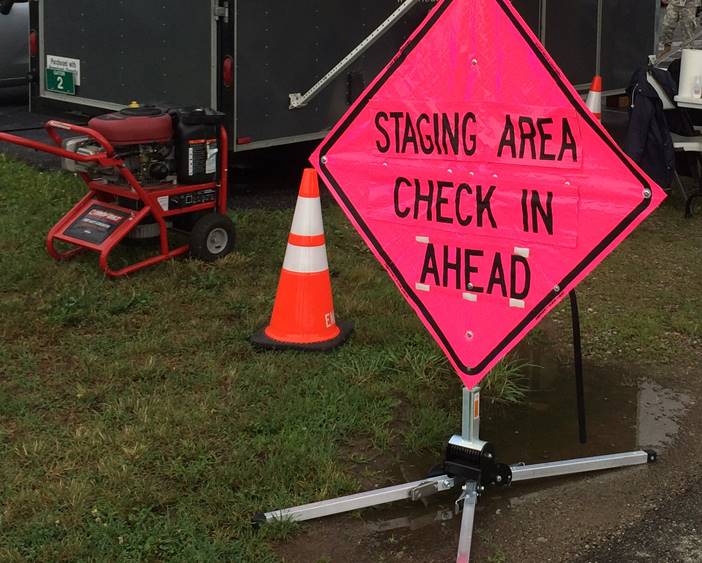
Incident Check In

Incident Check In

I recently took part in the management of an exercise in which a Type 3 incident management team (IMT) was among the players.  As part of their initial set up they immediately recognized the importance of checking in and tracking resources.  This is an activity which is often overlooked at the onset of an incident and is a royal pain to catch up on once the need is realized.  There were a few things which they could have improved upon, though, which seriously impacted their effectiveness and efficiency.

  1. They spent time checking in each vehicle as equipment. Not every vehicle needs to be tracked in an incident.  Generally, the sedan, pick up, or SUV you come in on isn’t special enough that it requires tracking.  Huge waste of time, people, and effort.  Consider the nature and capability of the equipment that is coming through your access point.  Is it a specialized resource?  Will it be applied tactically?  Will it be supporting logistical needs?  Is it rented or leased?  These are the conditions that should be considered when deciding what equipment to track.
  2. They marked equipment using bottled shoe polish. Not a bad idea, except it rained all week, and within hours of application most of the markings couldn’t be read.  Windshield markers, similar to what car dealerships use, are cost effective, waterproof, and clean off easily with mild window cleaners.
  3. Equipment that was checked in was never logged in detail. What’s the difference between E-01234 and E-01235?  We will never know as no descriptions were entered into their tracking system.
  4. As vehicles flowed in to the staging area, people will directed to check in at the command post. This is obviously excellent, except to get to the command post people had to pass by the main access to the incident site.  This meant that many people did not check in as directed.  They got distracted by the incident and associated response activity and never made it to the command post to check in.  This severely impacted the effectiveness of accountability.

Sometimes people would try to explain these things away by saying “It’s just an exercise”, but exercises are an opportunity to do things the right way, not skimp and cut corners.  While their intent was good, their process and results were quite poor.  If we are supposed to train the way we fight, as they say, this team has a ways to go to be more effective with resource accountability.  On the surface resource tracking looks easy… but it’s not.  There is a lot of complexity, variables, and attention to detail that must all work together well in order to be successful.  The Resource Unit Leader has one of the hardest jobs in the Incident Command System.

Being who I am, I’m left wondering why this all happened.  I have little choice but to blame poor planning and training.  Planning is to blame for a lack of clear procedures, guidance, and decision models.  The training which people receive tends to be just as vague.  By now, most, if not all of you are familiar with my opinions on the current ICS training.  While the referenced article does not go into the IMT/position training curricula, from what I recall of the courses I’ve taken, there are certain things taken for granted.  It’s easy to put an item on a checklist that says ‘Establish check in’.  OK… how?  Where?  When?  What?  Why?  The answer to those questions, or guidance to help answer those questions, should be provided through training.  Let’s tell people not only why check in is important, but what people and resources should be checked in, where to establish check in (what to look for and what to avoid), etc.  Once we’ve trained people on it, let’s provide job aids… not just the ICS forms, but job aids that will actually help people do their jobs.  While it may seem like minutia and unnecessary detail, keep in mind that we are training people to operate in austere and chaotic environments which they are trying to establish order over and only do these activities on rare occasion.  Those conditions signal the need for detailed training and job aids to support sustained performance and limit the degradation of the training they received.

Bottom line – let’s take a step back, fix what we have to based upon what we’ve learned, and proceed forward so we can operate more effectively and efficiently.

Thoughts and comments are always appreciated.  What have you learned or observed from incidents or exercises that needs to be addressed foundationally?

© 2015 – Timothy Riecker

Emergency Preparedness Solutions, LLC

WWW.EPSLLC.BIZ

What is Your Emergency Management Agenda?

We often hear, usually through the media, the term ‘agenda’ thrown around, usually in relation to political parties, corporations, and the like.  I think it’s time that we each have an emergency management agenda.

First of all, this isn’t exclusive.  Everyone can have their own – local, county, state, and federal emergency management agencies, and emergency managers with private and not for profit entities.  I’d also argue that we need a national emergency management agenda – every nation should.  And perhaps even a global emergency management agenda.  Why?  We need deliberate, purpose driven direction.  Too often we are scattered, doing some recovery from the past few disasters, and some mitigation and preparedness projects then WHAM! we get hit with another disaster.  After the disruption from that disaster, we usually fall back into the same groove or make up a bunch of new things we think will solve all of our problems.  So much of what we do is knee-jerk, despite the planning efforts we spend so much time on.  I really think we can do much better.

Part of doing better is having some longer-term goals and implementations to achieve those goals.  That’s really what a programmatic agenda is all about.  Much of this parallels a strategic plan, but people often roll their eyes at strategic planning, either because they have no time for a complex process or they have been through enough cheesy group think strategic planning sessions in their careers.  Strategic planning may also not be practical for many emergency management shops which are one or two person entities, especially at a local or county level or within a small corporation or not for profit.  I’m not knocking strategic planning, it has a lot of value (if followed through), but formulating an agenda is generally simpler by necessity.

Let’s consider components of an agenda:

  • Purpose/goal – what is the big picture of what you want to accomplish? This is also your elevator pitch.  It should simply state what you want to accomplish, in realistic terms.  This is not lofty like your corporate mission or vision statement, this is a programmatic goal.
  • Who will participate – who are your internal and external stakeholders and partners? Consider all the people and entities you need cooperation from to make this happen.
  • Expected outcomes – what benchmarks do we want to achieve? Write these like objectives – remember SMART: Specific, measurable, attainable, realistic, and timely.
  • Timeline – what is the timeline for each expected outcome and the goal itself? Set realistic timeframes.
  • Obstacles – what stands in our way of success internally and externally? Things like funding and personnel issues are obvious, but reach further while still being realistic.  Recognize that local disasters can be setbacks but can also create opportunity; and that many national-level disasters tend to result in politicians hitting a giant national reset button, changing the way we have been doing things (for better or worse) and stalling our momentum.

Of course this can all be revisited and adjusted as needed, but this agenda will help you lay the groundwork for future activities, giving you a path to follow instead of a series of ad-hoc activities.  Get it on paper and post it on the wall in your office where you will see it every day and can easily reflect on it, what it contains, and your progress in moving through it.

With that all said, I’m curious to know what the emergency management agenda is for the US (and every nation).  Yes, FEMA has a strategic plan, and while they are at the pointy end of the emergency management stick, they do not embody all that is emergency management.  Where do we, as professionals, see emergency management in this nation evolving to?  What do we (broadly) need to accomplish?  We tend to know the agendas of political parties and the politicians that are part of them, yet we don’t have a solid grasp on the direction of the emergency management enterprise.  Does this give you reason for concern?

© 2015 – Timothy Riecker

Emergency Preparedness Solutions, LLC

WWW.EPSLLC.BIZ

FEMA Releases a Consolidated Online Training Course Catalog for First Responder Training

This is a great resource I discovered last week that has just been officially announced this week. It is comprehensive and easy to use. Check it out and see what’s out there! – TR 

(Official release follows)

FEMA released a consolidated online training catalog for the First Responder Training System, including courses available through the Emergency Management Institute (EMI), the Center for Domestic Preparedness (CDP), the National Domestic Preparedness Consortium (NDPC) and the Continuing Training Grant (CTG) program. The site was developed in response to customer requests and is known as the “National Training & Education Online Course Catalog.” It allows users to search for all FEMA preparedness training initiatives in one location.  

The main entry page of the combined catalog briefly describes each training organization—EMI, CDP, and the National Training and Education Division—while providing a list of training courses in each catalog, along with links for scheduling and individual websites for each training organization. First responders can access the consolidated course catalog by clicking directly at www.firstrespondertraining.gov/NTE

The catalog itself is searchable and can be viewed in full or by the individual NTE training entities. Users are able to filter by organization and/or training provider, delivery type, discipline, core capability and mission area at www.firstrespondertraining.gov/ntecatalog.

Course catalog feedback can be sent to firstrespondertraining@fema.dhs.gov.

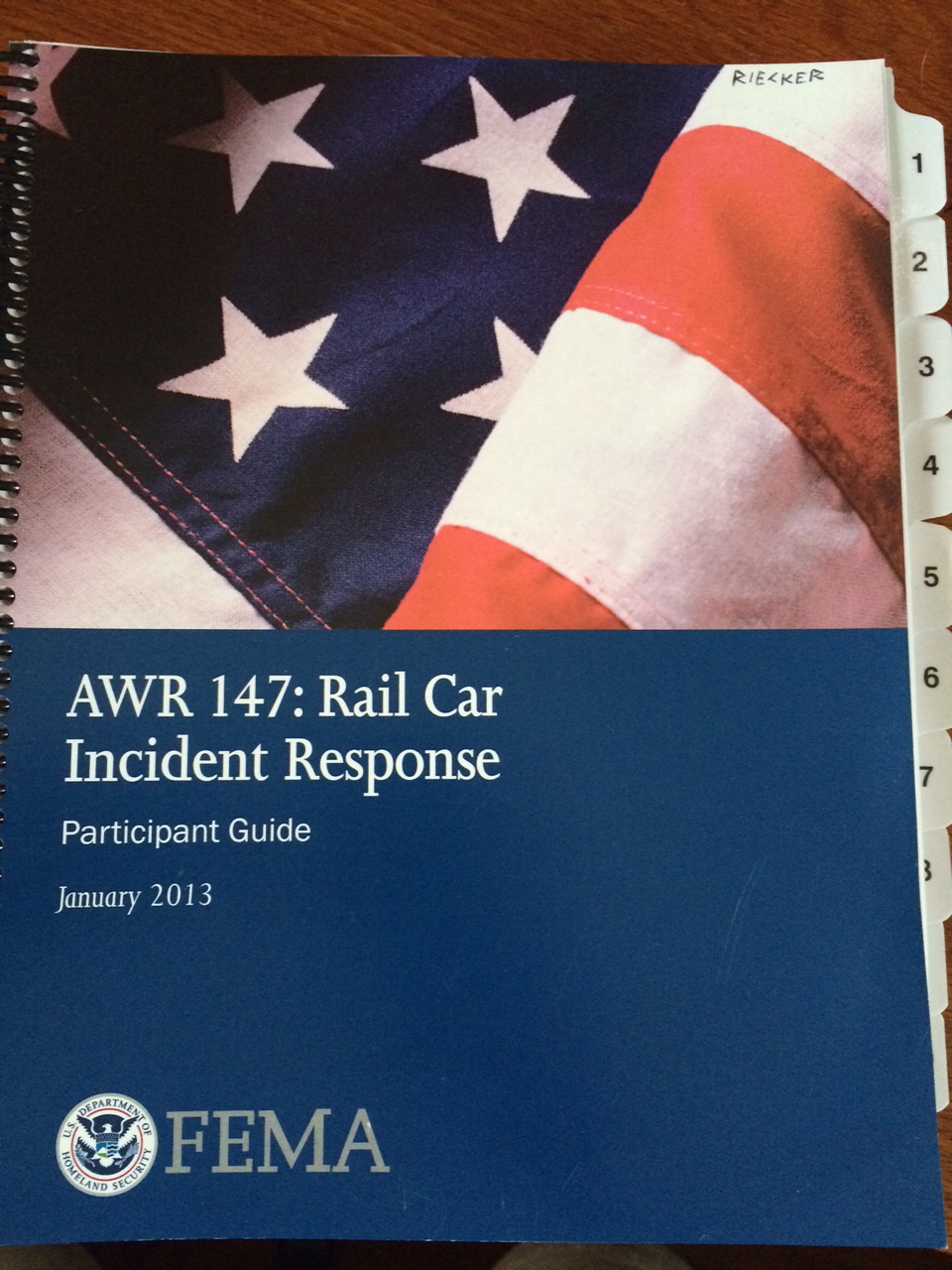
Course Review: AWR-147 Rail Car Incident Response

This past weekend I had the opportunity to attend AWR-147 Rail Car Incident Response conducted by the Rural Domestic Preparedness Consortium (RDPC) and Findlay University.  This is a one day awareness level course that focused on response to incidents involving freight rail cars and hazardous materials.

AWR-147 Participant Manual

AWR-147 Participant Manual

All in all this was a good course which I recommend to anyone who has the opportunity to attend it.  For those not familiar with the RDPC you can find their website at https://www.ruraltraining.org/.  Although only an awareness level course, it is suitable for any responder or emergency manager who has a jurisdiction with freight rail lines.  It’s also quite suitable as additional training for HazMat teams, as the information provided relative to the identification of the different types of rail cars and potential hazards associated with them is excellent.

The course construction follows the usual DHS format, including a pre and post test, plenty of student materials, and a mix of instruction, videos, and participant interaction and discussion.  Given the variety of rail cars which can be encountered and rail incidents do dissect, there are plenty of visuals and case studies to drive the program.

I would have liked to have seen the inclusion of a unit to discuss current topics, particularly Bakken crude and even a bit on HazMat associated with passenger train incidents.  Also, while the course focused on response, there was little mention of community preparedness measures which can/should be taken.  Of course I had a small ulcer form with one of the final units which was on NIMS/ICS.  I see little value in rehashing the primary components of NIMS and showing an ICS org chart, particularly when there is little/no discussion on the nuances of applicability relative to a rail incident.  It was all rather gratuitous.

There were some great activities which reinforced use of the DOT Emergency Response Guidebook as well as other sources of information which can be referenced during a rail response, including a worksheet which could easily be used as a job aid for real life application.  Along with the participant manual, all students received a copy of the current DOT Guidebook as well as the Association of American Railroads Field Guide to Tank Cars, which is a handy reference to help you identify the specific type of tank car you are dealing with and where key infrastructure on each (brakes, vents, valves, etc.) can be located.

This was the first course I had taken from the RDPC, although I have been aware of their course selection for quite some time and have referred others to their great array of courses.  Don’t let the term ‘rural’ fool you – the material they teach is relevant to rural, suburban, and urban responders alike.  I had taken CSX’s rail response course several years ago and this course blows it away.  Overall well done and highly recommended.

© 2015 – Timothy Riecker

Emergency Preparedness Solutions, LLC

WWW.EPSLLC.BIZ