Speed Networking

Last week our local chamber of commerce, of which my company – Emergency Preparedness Solutions – is a member held an event called speed networking.  Admittedly, prior to the announcements for said event, I had never heard of it.  Of course we’ve all heard of speed dating – and have even seen it on TV and in movies (i.e. Hitch) – where men typically circulate through an orderly room of women, having only a few minutes to ask questions about each other and perhaps make a love connection.  Speed networking is quite similar.

Representatives of various businesses and organizations were arranged opposite each other within a room (sadly, not the swanky, stylish room you witnessed the speed dating occurring in Hitch), having only two minutes to give their elevator speech and another two to listen to the pitch of the person across from them.  You both exchange business cards and any other materials you might have (I had a flyer highlighting our business continuity services).  At the ring of the bell everyone on one side of the table moved down a seat.

It was a pretty neat opportunity.  Two minutes isn’t long, and depending on the level of interaction, sometimes wasn’t long enough.  It was a very fast paced, near exhausting, activity.  In the end, I met with about twenty businesses and organizations.  With some there was clearly interest, with others – not so much.  But that’s how things go in the business world.  I was a bit disappointed that I didn’t get to meet with the other business representatives who were the ‘movers’, as I was.  I’m not sure how they would make that work… likely some complex algorithm of some sort which is well beyond my understanding.  Still, it was an engaging opportunity to meet with these businesses and pitch my services.

I’ve been to quite a few business networking events, all of which seem to be a bit awkward as people tend to gravitate to those they know.  You hate to break into a conversation at the risk of being rude or appearing overly pushy.  Once in a while you’ll get introduced to someone, which is the best opening, but that’s a fairly rare occurence.  The structure of the speed networking forces you to engage with someone new, and you are both there for the same purpose – what a great idea!  There was even someone attending who I have met with several times before to discuss partnering up and making mutual referrals.  Since we already knew what the other did, we took the opportunity to discuss what our next steps would be, which included a meet and greet with their top clients – score!

If you ever have an opportunity to take part in one of these events, I strongly encourage you to do so.  It’s a great deal for small businesses, especially new ones.  They are fun, engaging, and the best bang for your buck in terms of meeting people.  FYI – the chamber charged $10 for the event, which included lunch.  How can you go wrong?

Public Warning and The Science Behind EM

Rescuers at the L’AQUILA, Italy earthquake.

I was completely shocked to read this article at NBC News about six scientists and a government official in Italy being convicted of manslaughter and causing criminally negligent injury for their failure to predict an earthquake in 2009.  The article doesn’t give a lot of background, including what their statements or warnings may or may not have been.  It does mention that there were several smaller quakes in the months preceding a devastating 6.3 magnitude earthquake that killed over 300 people.  It goes on to elude that the scientists (seismologists, presumably) perhaps didn’t give these smaller quakes much consideration as possible precursors to a larger earthquake.

I’m not a geologist, nor do I play one on TV, but we all know that we can’t predict earthquakes with any measure of reliability.  Here in the northeast there are plenty of small quakes, which are generally no cause for alarm.  Italy, however, is earthquake prone.  One would think that people would have in their minds that the possibility of a sizeable earthquake is always present, especially after a series of smaller earthquakes.  Unless these scientists really downplayed that possibility (which would be ludicrous in that region of the world), I just don’t see how they can be held responsible.  Some disasters we can predict, others – such as earthquakes, we just can’t.  This is a dangerous precedent that I truly hope doesn’t catch on.  There are scientists in a variety of fields that are strong partners with emergency management.  While we know that the sciences (or the human interpretation of them) are often times imperfect, we go with the best information available to drive the planning and decisions we make.  Admittedly, it’s a gamble to a degree – a darn dangerous gamble – but I challenge anyone to find a better way.  If we cry wolf every time the possibility of something occurs, the population will become complacent and ignore our warnings.  We must strive for better science, achieve better balance, and maintain common sense.

Terrorist Arrested in NYC – Bomb Plot Foiled

A 21 year old Bangladeshi national in the US, here on a student visa, was arrested two days ago for attempting to detonate a 1,000 pound bomb outside the Federal Reserve bank in Manhattan.  This was the result of a three month long sting operation by the FBI and the local Joint Terrorism Task Force (JTTF).  Congratulations to the agents and officers of the FBI and coordinating agencies who foiled this plot, and thank you for keeping our nation safe!

Homeland Security Today provides some initial details of the plot in what is, surprisingly, not a top national news story.  I’m honestly shocked by this –   Folks, this is big news!  Based on the information provided, the detonation of a bomb this size (had it been real) would have done just as much damage as that caused by Timothy McVeigh at the Murrah Building in Oklahoma City.  That bomb killed 168 and injured almost 700 people.

While there have been a lot of criticisms of our nation’s intelligence functions lately (see my earlier post on Fusion Centers), this is one of the true success stories.  Let’s congratulate all of the officials involved in finding and catching this radical.  I’m sure the employees of the Manhattan Federal Reserve bank and their loved ones are truly thankful.

Red Cross ReadyRating Program

I recently sat through a webinar on the Red Cross ReadyRating Program.  Admittedly, I’ve perused their site before, and even recommended their services – which I certainly understood – but I never realized how in-depth their program goes.  The webinar was hosted by Agility Recovery, who regularly puts on brief and informative programs of good quality. 

The ReadyRating program is a web-based service, absolutely free of charge, that provides businesses, organizations, and schools with a free disaster readiness assessment tool.  The tool seems to be useful to entities large and small, even allowing larger businesses or organizations with multiple locations to conduct an assessment for each location folded in under the same account.  The user answers questions and the tool quantifies the entity’s measure of preparedness and provides customized reports showing various data in a variety of formats (charts, report card, etc).  ReadyRating apparently even grades the amount of community participation the entity has relative to preparedness efforts (see my previous post re: Public-Private Partnerships).  The tool also enables creation of a customized emergency response plan – something I’m a little cautious of (generally speaking, I’m not in favor of ‘fill in the blank’ planning) – but I’ve not actually used the tool, so I can’t speak from direct experience on it.

ReadyRating refers to their users as ‘members’ – and they have a fairly impressive membership, both in numbers (2,689 businesses and organizations, 570 schools) as well as in names (they list the likes of Anheuser Busch, Grainger, Monsanto, and others).  Feedback from members is very favorable, and the tool provides for the ability to do re-assessments and showing progress to the user – that’s great encouragement to them!  They even show comparisons with other members (anonymously) (comparisons are provided nationally, state-wide, number of employees, and by industry).

ReadyRating is quite an impressive tool – and it’s free!  I have it listed on the links page of my company’s website – Emergency Preparedness Solutions, LLC along with other resources.  Check it out!

Public-Private Partnerships: A Necessity in Emergency Management

Over the last several years there have been volumes of articles written on the value of public-private partnerships in Emergency Management.  So why is it still like pulling teeth?  Yes, we have great private sector partners in EM – the likes of WalMart, UPS, Grainger, and others.  The value of having these partnerships has certainly been demonstrated through the years, in both local disasters and national-level disasters.  Even in preparedness, these partnerships help carry our message to the masses.  FEMA promotes a program called PS-Prep, designed to engage private sector preparedness while encouraging their involvement locally in emergency management efforts.

Government simply can’t do it without the private sector.  It’s not because the public sector is lacking, it’s because of the position and resources available to the private sector.  They have more resources and greater flexibility.  Why wouldn’t they want to help?  Their customers and employees live in the area.  It’s a solid decision to invest in the community (or communities) in which your company is located.  It doesn’t always involve a financial commitment – it encourages preparedness for the business itself; it provides an opportunity to engage employees in community efforts (all with the company name being recognized – it’s free marketing!); and perhaps an opportunity to provide products – discounted or free – to relief efforts in the aftermath of a disaster.  Commodities such as building materials, water, and food are in great need in the aftermath of a disaster.  Even trucks and people.  Yes, these things all cost money, but there is a lot of free press and good will that goes along with it.

There are plenty of businesses that contribute after a disaster occurs – certainly they want to help.  They can all have more impact, however, by joining up with local emergency preparedness efforts before a disaster ever occurs.  Joining a community organization, such as a VOAD, or entering into memorandums of understanding with local emergency management agencies prior to a disaster makes a huge impact.  The partnerships made with other businesses, government agencies, and community organizations will also be to their benefit.

Businesses large and small – consider both the preparedness of your company and your community.  There are opportunities to be had with both!

Dual Status Command – An Evolution of Military Engagement in Domestic Emergencies

The publication Homeland Security Today has an analysis on dual status command, and the fight that states had to preserve their right to maintain control of National Guard forces – particularly in the event of a domestic emergency.  Most people don’t even realize the difference between National Guard and ‘Regular’ Army forces, so what difference does it make?  It’s a huge difference! 

Broadly, here are the differences… National Guard forces are created by Title 32 of the United States Code, whereas our US Armed Forces are created by Title 10 of the United States Code.  Very often, when military and emergency management folks talk about military forces active during a domestic emergency, they will mention that they are either ‘Title 10’ or ‘Title 32’.  The primary distinction is that Title 32 National Guard forces are under the control of the Governor of that state, whereas Title 10 military forces are under control of the President.  There is also the distinction of State Active Duty, which puts the forces under command of the Governor but with limited protections and paid by the state (which is often times lower and does not contribute to their federal retirement).  Title 32 does afford some federal law provisions and protections of the Guard forces, including federal pay.

A soldier or airman activated in one status can not command a soldier or airman activated in another status.  This has created some problems when federalized (Title 10) troops have been deployed to a disaster area and are working directly with National Guard (Title 32) troops.  First off, much of the problem actually stems from emergency management and public safety folks who aren’t aware of the difference (even if you knew the difference between Title 10 and Title 32, you really can’t tell the difference by looking at the soldier).  So when state or local emergency managers (perhaps from an EOC), make a request for military forces who have been assigned to the area, those requests, depending on the unit, must be handled differently.  Additionally, coordination between Title 10 and Title 32 isn’t as smooth and efficient as it should be.  On the surface, it seems like a silly problem, but the legalities behind it are significant.

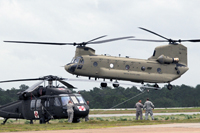
The solution to this confusion represents a brilliant compromise and an evolution in how military forces as a whole are led and coordinated jointly in the event of a domestic emergency – dual status command.  Under dual status command, a commanding officer (likely a general’s rank) approved by both the President and the governor of the state in question, is appointed to control all forces – Title 32 and Title 10 – assigned to a domestic emergency within a state.  At the time this concept was put forward I had significant interaction with National Guard forces and USNORTHCOM – the concept was the proverbial talk of the town, and largely all positive.  It was seen as a great step forward and an excellent compromise, maintaining the integrity and legality of both the Title 10 and Title 32 status.  The concept is trained and exercised, keeping military commanders up to date on the best ways to integrate forces, not only between federalized troops and National Guard forces, but also integration, interaction, and coordination with first responders.  The Defense Support to Civil Authorities (DSCA) mission is vitally important to our nation’s ability to respond effectively to major emergencies, and now our joint military forces have another tool to make them more effective in that mission area.

A great training resource, especially for emergency management and public safety personnel who aren’t familiar with all the ins and outs of military resources that can be applied during a disaster, is IS-75 Military Resources in Emergency Management, provided free of charge by FEMA’s Emergency Management Institute.  I’m proud to have been an early contributor to this much-needed training course.

FirstNet and Molasses

I’ve found something slower than molasses – and that’s the implementation of FirstNet: The result of the 9/11 Commission’s recommendations from 2004 (again, that’s 2004 – which was eight years ago.  Eight.) part of which outlines the necessity for a more substantial radio spectrum for public safety purposes.  Before I rant any further, I do want to mention that this particular post was brought on by an article in this month’s Emergency Management Magazine called FirstNet’s Challenges, in the print edition or First Net: Answers to Key Questions in the online version.

Eight years… the span of time it takes to obtain a bachelor’s degree, a master’s degree, and a doctoral degree.

An eight year old child demonstrates the ability to solve problems independently and can count to 1,000.

I’m severely doubting that most of our elected officials have a great deal of education or an ability to solve problems independently, much less as a group.

The difficulties that public safety has with communication networks are as old as the communication devices themselves.  First off, it shouldn’t have required the 9/11 Commission to raise this issue – it should have been addressed well before.  A committed, secure, interoperable, and durable information network for first responders is an absolute necessity.  The hopes of first responders everywhere was that, along with most of the Commission’s recommendations, this matter would be addressed with all haste.  We couldn’t be more wrong.  It took them eight years to pass legislation just to allow the creation of the entity to work on ideas on how to address this!  That legislation, by the way, was included in the Middle Class Tax Relief and Job Creation Action of 2012 – which largely deals with taxes, unemployment, and Medicare.  The creation of FirstNet is in no way directly related to any of these topics.

But wait – there’s more!  The Emergency Management Magazine article goes on to outline what needs to be accomplished next, including the formation of a board (done), development of policy, procedures, bylaws, and a charter.  Further, they must name a public safety advisory committee (isn’t public safety the primary purpose of this group to being with?  If so, why do we need an advisory committee?  Shouldn’t that be the primary focus of the board?), hire staff, and establish a budget (the enacting legislation provided $7 billion dollars as ‘seed money’… estimates for creating a nationwide network are as high as $40 billion – which does not include maintenance of the network and recurring costs.

I will grant that there are certainly challenges with this – financial, technological, and political.  There have been attempts at this (ref: a miserable failure of an attempt in New York State several years back which cost the tax payers millions of dollars).  But, gosh… perhaps we would be a bit further ahead had we not waited EIGHT YEARS to pass this enabling legislation in the first place!

Is my frustration apparent?

Presentations… Inspired

For those of you who may not know, I am, by trade, a trainer.  The emergency management stuff came after my early forays into training, and throughout my emergency management career I remained a trainer.  Obviously a big part of training is what we call ‘platform skills’ (aka being able to present).  I’ve been a trainer for over 17 years now and I’ve been sought after across the country for training and presentations – so I guess people like what I do.  I know, though, that I have a lot of room for improvement.  Through the years I’ve learned from many people – assimilating parts of their presentation style into mine, honing my skills.  I’ve learned to not be so stiff and to relax; I enjoy doing presentations and I learned that I’m a better presenter by simply showing the audience that I’m having a good time.  I try to always learn something from a speaker or presenter – and sometimes it’s not their content, but how they deliver it.

I’ve recently had the pleasure of reading material by Nancy Duarte.  Nancy is a communication expert who owns one of the most successful non-tech businesses in Silicon Valley.  Nancy has authored the books Slideology and Resonate, and just released a book for Harvard Business Review called Persuasive Presentations.  While I’ve not read Slideology, I can personally attest that Resonate was a great book – a great book made totally astounding in the ibook format.  Yes, ibook, not ebook.  If you are not familiar with ibooks, they are interactive books.  Resonate incorporated a great deal more content than could possibly be in the print version by including both internal and external links, video segments, and more.  Presentations, after all, are a multi-media experience – and she proves that point by the medium of the ibook.  Never fear – it’s not at all distracting, as the ibook format is a self guided experience.  Don’t want to watch a video?  Then you can skip it and continue reading.  Very user-friendly.  I believe the only means of getting it, however, is at the Apple Store.  Anyhow, Nancy’s approach to presentations is refreshing.  She has studied a history of great speeches, analyzed the patterns and flow of those speeches, and formulated methodologies to help bring you success by following those patterns.

As I mentioned, Nancy just put out a new book for Harvard Business Review called Persuasive Presentations.  I ordered it yesterday and I’m quite looking forward to receiving it.  It’s a paperback and Nancy explains that she has incorporated the best parts of her previous two books as well as some new content.  I find her material to be great for an experienced presenter as we continually seek to hone our skills.  While a new presenter or trainer might get a little overwhelmed, I still think they can learn a lot from her.

In case you’re wondering, I’m not being paid to advertise for Ms. Duarte – I’m just passing along some great resources.  I encourage you to check out her website.  She has some good info on there.  If you have 20 minutes to kill, sit through her TEDx presentation – it’ll give you a good overview of her philosophies.

Excelsior!

The Wonders of Post-Apocalyptic TV

I love post-apocalyptic themed TV shows: The Walking Dead, Revolution, and Falling Skies are my potato chips… I just can’t get enough!  Not only are these shows extremely well cast, produced, and directed, they have fantastic character development, and the story lines are riveting.  The sociological aspects, as mentioned in my previous post – The Monster Mash – What’s With the Zombie Thing in Emergency Management? – are extremely thought provoking.  What would people do to survive?  How would they act?

In case you aren’t familiar with the shows:  Revolution is a new show this season.  It uses as a scenario a global power outage and takes place 15 years after this outage.  The cause for the outage isn’t known, and it seems that the cause continues to suppress any and all electrical power.  Falling Skies takes place present day and is about a very diverse group surviving a brutal alien invasion.  The Walking Dead, just in case you happen to be living under a rock, is about a zombie apocalypse.  If there was just one to pick, it would be The Walking Dead – which actually has a great blend of the other two, with its own twists added in.

In all three shows, government, as we know it, does not exist – or at least has not revealed itself.  That said, in two of these shows – Revolution and Falling Skies – societal groups have formed a hierarchy, supposedly for the mutual benefit and protection of the group.  In Falling Skies the government structure is a bit more benevolent and focused on taking care of its people – to the point of taking an isolationist view with the rest of the world, including the alien invaders.  In Revolution, the government structure we see is very much a military dictatorship focused on control.  If you watch both shows, it’s evident that other government structures outside of these are certainly possible and very likely.  What would happen in our world absent government?

In The Walking Dead we see small groups of people coming together for mutual benefit and survival – certainly not as large as we see in the other two shows, and not large enough to be considered any attempt at ‘government’.  Aside from the central group of characters, we’ve seen other groups – all different, but all trying to survive in their own way.  Looting is accepted practice both in The Walking Dead as well as Falling Skies – mostly for durable foods and medical supplies.  You can have whatever vehicle you see on the side of the road, but fuel is a rare commodity.  Revolution is largely beyond looting as it takes place 15 years after the global power outage.  Hunting for food is practiced in all three shows, as is some measure of farming.

Commonly across all three shows are the themes that only the strongest-willed people survive and that there is (relative) safety in numbers.  Some people are able to utilize their pre-apocalypse skills (such as medical professionals), while others learn new skills and take on completely different roles.  People need to be inventive and need to be able to survive the worst and longest camping trip ever.  What will our society do?  We’ve seen it through many disasters our country has faced.  Will there be looting – sure there will.  We saw it happen in Katrina.  Of course there were the idiots lugging large screen TVs, but most looting was for food.  I’m not condoning it, but I’d certainly do it for my family if I had to.

For as much as we complain about our government, it’s difficult to imagine having no government.  Having some civil hierarchy gives us structure and order.  There have been countless studies done on the innate desire that humans have to be part of a structure or at least being comforted knowing that a structure exists.  I certainly think that groups of people would form some measure of government structure on their own.  The scary consideration, however, is those who would abuse that power.

Would our society recover?  I think it would – although society would look nothing like it looks today.

The Monster Mash – What’s with the Zombie Thing in Emergency Management?

In May of 2011 the Centers for Disease Control (CDC) unleashed its Zombie Preparedness campaign upon the world.  This campaign took off like a flesh-eating monster, encouraging preparedness throughout the nation and prompting similar campaigns in other countries.  My guess is that the CDC took a creative prompt from the current pop culture zombie craze (mostly fueled by AMC’s The Walking Dead series – yep, I’m a big fan – note: season 3 starts on October 14th) as well as from the common sense, yet tongue-in-cheek group known in Zombie Squad.  Zombie Squad, whose website says they have been around since 2003.  ZS (as they are known) “… is an elite zombie suppression task force ready to defend your neighborhood from the shambling hordes of the walking dead.” “When the zombie removal business is slow we focus our efforts towards educating ourselves and our community about the importance of disaster preparation.”

So how does this all make sense?  Actually, it fits very well.  Contrary to the other monster fad currently sweeping the globe – vampires – which seems to be intent on teenage-level love stories, this zombie business is serious, really.  The Walking Dead has spurred many conversations in on-line discussion boards and in my own home about people functioning and surviving when society has crumbled around them.  Zombieism is also a disease, so all the concepts that go with a major disease, such as transmission prevention, isolation and quarantine, treatment, vaccination, etc. all apply.

From a preparedness angle, the zombie concept works well. On the CDC website, their director, Dr. Ali Khan explains “If you are generally well equipped to deal with a zombie apocalypse you will be prepared for a hurricane, pandemic, earthquake, or terrorist attack.”  They then further encourage people to get a kit, make a plan, and be prepared.  It’s great that we’re all using the same message!  The Zombie Squad website also encourages the same.

Now how about from the prospective of emergency response and emergency management folks?  Surely, we can’t be swayed by this pop culture silliness as well?  We sure can – and I think it’s great!  For many of the same reasons explained earlier, we can draw many similarities between a zombie attack and an actual incident.  Sure, we take some liberties and we have a little fun with it, but why can’t we?  A successful exercise is one that tests our objectives, is it not?  Drawing the scenario similar to a pandemic or hazardous materials type of incident, agencies are testing objectives related to mass casualties, mass fatality management, isolation and quarantine, public messaging, incident command, crowd control, looting, disease prevention, points of distribution, etc.  So many times I had heard from those who taught me ‘the art of exercises’, that the scenario really doesn’t matter, it’s all about the objectives.  Sure, in the past we’ve always given consideration to the scenario being realistic so that the participants buy into it, but I think many can totally get into the zombie thing.  This local exercise is using the zombie theme later this month (they are even giving prizes for things such as ‘best zombie walk’ to encourage volunteers to come for this, and yes, they are holding a ‘Thriller’ dance!), and you’ve probably seen articles on National Guard and Department of Defense units using a zombie attack as their scenario.

Bottom line, it’s fun, it’s effective, and it’s a graveyard smash!