Must-Read Speaking Tips

From Forbes Magazine – originally written for entrepreneurs, but in general these are great tips for presenters and trainers!


For most of us, public speaking can be incredibly nerve-wracking. What if you mess up? What if no one claps? What if someone asks you a question you don’t know the answer to? What if you throw up on stage? (Seriously, you should at least stop worrying about that one.)

But with the right preparation, public speaking doesn’t have to be such a daunting, fretful experience. The chance to strut your stuff and raise awareness for your brand is actually really exciting, especially if you’re a young company looking to introduce your expertise—and offering—to the world.

Here, we outline five steps to take before you get up on that stage to make sure you most genuinely connect with your audience, get your point across in the time allotted, and (most importantly) don’t pass out.


1. Practice, Practice, Practice

The benefits of this old adage are twofold. First, becoming comfortable with the material you’ll be delivering will ease your nerves—after reading your speech to your mom, grandma, and six closest friends, the experience will feel much less intimidating.

Second, you’ll significantly improve your delivery. Audiences want to connect with the people they’re watching speak or present, and if you’re reading from a piece of paper for 20 minutes, they’re not going to have the opportunity to do so. The more you know your stuff, the more you’ll be able to make eye contact, throw in a joke, and ensure you pack in all of your crucial points before the buzzer.


2. Know Your Space

If you have the opportunity to do so—like at a conference or cocktail party—check out where you’re going to be speaking. Are you using a microphone? Do you have any AV requirements? The better you understand your surroundings, the more you can concentrate on the public speaking itself. And if you’re incorporating AV aspects into your presentation, back to #1 you go.


3. Know Your Audience

I’ve talked at great length about the importance of knowing your audience across all of the various ways you communicate. But this sentiment is arguably most important when it comes to communicating in person. Your number one goal for any public speaking opportunity is to really connect with your audience. Regardless of how well you address the topic at hand, if people don’t get it, it won’t resonate. And if you’re not getting your message across, what’s the point?

Research the event and check-in with the coordinators beforehand so you know who to expect, and then tailor your comments accordingly. For example, think about explaining the current social media landscape to a room full of senior citizens versus a room full college students. Different speech, right? (Answer: Yes.)

Another aspect to consider, thanks to our ever-evolving digital world, is any virtual audience that might be participating in the event. Is your presentation being live streamed? Live tweeted? It’s just as important to understand this community. Ask what platforms will be pushing out the content—like the event’s Facebook page—so you can further amend your speech to address this audience. And, as the technology behind this can get complicated (especially if you’re planning to engage with your digital audience in real-time!), apply tips #1 and #2 solely to this aspect prior to getting on that stage.


4. Find the Balance

If you’ve founded a content producing business, and you’re speaking at a Content Producing 101 workshop, it makes a lot of sense for you to talk about your company and your experience in the industry. But many times, the connection between what you do and what you’re speaking about isn’t so straightforward. And in these cases, remember that while you want to use the speaking opportunity to draw attention to your business, you also don’t want to come across as too salesy.

So how do you find the balance? Well, remember that you represent your brand, so if you give a kick-ass speech, people are going to want to know more about you. As long as there’s an easy place for them to find you and to learn about what you do (a.k.a., make sure your company’s name, website, and Twitter handle is in your slides or the event’s program), the connection will be made naturally—no awkward, forced interjections of your brand into your speech required.

That said, it’s also OK to find one or two places to seamlessly (and genuinely) tie together what you do and the topic you’re discussing as you’re crafting your remarks.

Finally, make sure to network at the event. One of the biggest benefits of public speaking is the opportunity to position yourself as an expert, so make yourself available for questions and meet-and-greets both before and after your speech so you can strut your stuff.


5. Breathe

Really, don’t forget to breathe. You’ll be great!


A Disasterous Trend: Cuts in Preparedness Funding

This post was initially inspired by an article from CBS News on funding cuts to disaster preparedness programs.  These cuts go further and deeper than the current sequester cuts we are now seeing.  These cuts are a dangerous and disastrous trend.  To quote the article…

“In fiscal year 2010, Congress appropriated $3.05 billion to FEMA for preparedness grants designed to strengthen “our nation’s ability to prevent, protect, respond to, and recover from terrorist attacks, major disasters and other emergencies, …. In fiscal year 2012, that appropriation was less than half that figure – $1.35 billion. The same trend could be seen in FEMA pre-disaster mitigation grants, which fell from $100 million in 2010 to $35.5 million two years later.”

Have all the terrorists gone away?  Has Mother Nature stopped having temper tantrums?  Have stupid people stopped doing stupid things?  I don’t think so!  So why the cuts?

Let’s put some things in perspective… On one hand, we do need to have a bit of fiscal prudence and restraint.  GAO reports have repeatedly shown that many state and local governments are simply not spending down the grant funds they have been allocated.  DHS grants are backed up several grant years with unspent funds.  That said, as we peel back the layers of the onion, there are certain facts that need to be mentioned.  Why aren’t they spending the money they have been given?  First, grant periods have generally been too short.  The most significant reason for this is the inefficiency of bureaucracy we live in.  Follow this trail… The federal fiscal year begins October 1st.  The budget gets passed at some undermined point around that.  DHS, along with all the other agencies, get their allocations.  They then need time to formulate their grant guidance for the funds going to states and locals.  By the time states see this grant guidance and their respective allocations it’s usually close to the end of the second quarter of the federal fiscal year.  States then have to formulate their own grant guidance as they pass through funds to locals.  All this bureaucracy delays the grant year about six months.  Recognizing that nothing could be done about the bureaucracy, DHS finally extended grant years only recently, giving folks a more reasonable amount of time to spend the money.

Another reason why grant funds are slow to spend is that in most cases the grantees don’t actually ask for the money, therefore they don’t have a budget prepared beforehand.  DHS distributes funds based upon a formula.  While an application exists, it’s nothing more than an afterthought and formality.  That leaves states and locals with a pile of cash and no plan on how to spend it.  Here lies the beginning of the breakdown in accountability.  Now most folks will say that it’s easy to spend money.  In government, not so much.  Especially when you consider a few factors: 1) every level of government has spending rules (accountability is a good thing, but that can get in the way of efficiency when RFPs have to be issued for darn near everything); 2) a great deal of equipment was purchased in the big push of funds immediately surrounding 9/11 – what else do we need?; and 3) grants are restricting what funds can be spent on (i.e. there are limits on personnel (salary) expenses, and the purchase of disposables and maintenance costs of equipment – which are of particular importance for exercises).

So governments don’t have a lot of time to spend the money and face a few obstacles in getting the money spent.  But how is this a factor of cuts?  One reason for these cuts is that Congress is seeing that states and locals have a lot of money left over going back several grant years.  Failing to realize the whys and wherefores of it all, they are simply giving less money (because, to them, it’s not needed – but nothing could be further from the truth!).  They are also looking to reduce spending overall, as the article cites, and that’s a hit that will impact nearly everyone.

Taking a look at the grantees, however, there are a few criticisms.  Better and more proactive fiscal planning needs to be implemented.  Costs should be forecasted out several years to better anticipate needs.  They may, sadly, have to trim programs and streamline operations (although most emergency management programs certainly are not living in the lap of luxury).  They also need to be more creative with the declining funds they receive, especially through partnerships and regionalization.  An area doesn’t need to be regarded as a UASI or Catastrophic Planning Zone to work cooperatively as a region, which should include some pooling of funds for collective projects.

What can be approached regionally?  Most preparedness efforts fit well into that category: planning, training, and exercising.  Think about it, you work with your neighbors all the time and disasters don’t seem to stop at the county line, so why not make your cooperation more effective and efficient?  In the absence of regional catastrophic planning, which most areas don’t need to do, consider planning for some credible worst case scenarios and cascading impacts such as flooding and mass care.  Obviously regional mutual aid planning is essential.  How about working with your public health partners?  What about the private sector – how can you strengthen your relationships with them?  Regional planning conferences are a good start!  Regionalized training is obviously a no-brainer and regional exercises are essential making sure that the planning and training are effective and to give folks an opportunity to practice what they have learned.  Lastly, speaking as someone who has experience working for government and as a consultant, in many cases it’s actually more cost-effective and easier to coordinate regional preparedness activities by hiring a consulting firm, some of which have proven experience and expertise in working with the multiple stakeholders that a regional effort would include.

As we face reduced funding, we have to be more creative, cooperative, and communicate specific needs on a regular basis up the chain of government.  If you are with county or local government, let the state know what your needs are.  And don’t just tell them once – be sure to repeat yourself – not in an annoying wintertime house fly kind of way, but when the appropriate opportunity presents itself.  Make sure that you show justification for your needs through after action reports and documented strategies and plans.  Ask the State to take these needs up to federal partners – and when you have the opportunity to speak with these federal partners directly, take advantage of it; be they representatives of FEMA or your local representative of Congress or US Senator.  Remember to be specific and cite the need.  Don’t complain but be direct.  With funding that emergency management programs simply receive without asking being on the decline, we need to be proactive about receiving funds.

Emergency management and, to a greater degree homeland security, have been fortunate to have a good deal of funding over the last decade.  There has been so much money, though, with such short time lines, that things haven’t been done as well as they should have.  Now is the time to re-tool and reexamine how we do business.  Conduct needs assessments to determine what should be focused on and build upon community partnerships.  Consider what the community as a whole – the citizens – are willing to help in preparedness; as well as the private sector.  Whole-community partnerships have perhaps never been so important as they are now.

Audience Analysis Worksheet

Go to this site to view the article posted about the audience analysis worksheet assembled by Andrew Dlugan with Six Minutes Speaking and Presentation Skills.  Andrew has a great website filled with plenty of tips on public speaking and presentations.  This worksheet is part of his recent Audience Analysis series.  This series and the worksheet are great reminders that in teaching and presenting we need to always be focused on our audience and their needs.  You should be able to run through this worksheet well in advance of the actual speaking engagement, and the data derived will help you to shape the format and content of your presentation and presentation style.

Visual Presentation Design

I’ve been following Alex’s blog for a while now – the work she and her peers do in presentation design is truly revolutionary. This post, in particular, is a great introduction to how she works. I’ve certainly been at fault for many years for designing presentations like documents. It’s a tough habit to break, but I’m committing to the visual design method from now on!

If you do any kind of training or presentations – FOLLOW HER BLOG! She gives a ton of great advice!

The Future of Virtual Learning and Collaboration – Free Webinar

Passing this along from the folks at training magazine.  It’s free!

The Future of Virtual Learning and Collaboration

Date: Thursday, January 31, 2013
Time: 10:00 AM Pacific / 1:00 PM Eastern

Join Training magazine on Thursday, January 31, for this complimentary Webinar, presented by UNC Executive Development, and learn to create rich, robust and collaborative learning environments that can be delivered anywhere and anytime.

Follow this link to register for this complimentary Webinar, The Future of Virtual Learning and Collaboration.

Attend this live Webinar and learn to:

  • Create an effective virtual environment that can be customized to deliver an interactive and engaging learning experience.
  • Increase collaborative learning through the use of virtual classrooms and social technology.
  • Blend formal learning programs with informal learning to increase engagement.

Register for this complimentary Webinar today!

WEBINAR SPEAKER

Stephen Green
President, Graduate Programs
2U, Inc.


ABOUT TRAINING MAGAZINE NETWORK

If you aren’t already a member, register to join 40,000+ global learning professionals and thought leaders at Training magazine Network. Registration and events are at no cost to members.

About Training magazine Network:
www.trainingmagnetwork.com/account/about

More Upcoming Webinars on Training magazine Network:
www.trainingmagnetwork.com/welcome/Webinar%20Calendar

Training magazine Network Webinar Archive:
www.trainingmagnetwork.com/welcome/webinar%20archive


15 Seconds to a Better Presentation

I was doing a lot of reading last night… Another article I came across was published on Inc.com and was written by Geoffrey James.  The article is all about first impressions and how to maximize that little bit of time (the article cites 15 seconds) that you have to grab an audience’s attention.  The information in this article is great for training programs, business presentations, and even meetings.  I’m certainly going to try these suggestions for my next presentation.

I’ve included the article below.

15 Seconds to a Better Presentation

These four simple rules will help ensure that your audience sits up and pays attention.

It takes an audience about 15 seconds (at most) to decide whether your presentation is worth their attention. Fritter away those fifteen seconds and your audience will either mentally check out or pull out their phones to start texting.

Here’s how to begin a presentation so that your audience really sits up and takes notice.

1. Have somebody else introduce you.

Don’t waste time explaining who you are and why you’re there. Write a short (100 word) bio and a short statement (50 words) of what you’ll be talking about. If you were invited to speak, have whoever invited you read this information to the audience. If you called the meeting yourself, put that information in the invite.

2. Do not tell a “warm-up” joke.

I have no idea how the “warm-up joke” became part of conventional business wisdom. Most of the time, the “joke” consists a weak attempt at situational humor (like “why are these meetings always on Monday?”) that merely communicates that you’re nervous and unsure of yourself. The rest of the time, the “joke” is a long story with an obvious punch line that tries everyone’s patience.

3. Do not begin with “background.”

Many presentations begin with a corporate background that’s intended to build credibility. (Example: “Our company has 100 years of expertise!”) The problem here is that at the start of a presentation nobody cares about your company. You’re asking them to translate your background information into something that’s meaningful to them and their business. Why should they bother?

4. Open with a startling and relevant fact.

To get an audience focused on what you’re going to tell them, you must first break through the “mental noise” that causes their attention to waver. This is best accomplished by a slide showing a fact that is new to the audience and important enough to capture their attention. Build the rest of your presentation to answer the business questions that this initial fact has raised in their minds.

Here are two samples presentations to help explain these points:

BAD:

“Hi, I’m John Doe from Acme and I’ve been working in the widget industry for 20 years. And boy, has it been an exiting time (just kidding!) Acme is the industry leader in widgets with over a million satisfied customers!! I’m here today to talk to you about how we can help you save big money on your purchases of high quality widgets.”

BETTER:

“Yes, one million dollars.” (Pause.) “That’s how much money you’re losing every year because of widget failure. Fortunately, there IS a better way and I’m going to explain how you can easily save that money rather than waste it.”

Needless to say, the slides in the above example are simplistic. The “better” example could probably be made more visually rich, perhaps with an illustration of money going down a drain (along with the $1m).

What’s important here is that you realize why the surprising and relevant first slide is far more likely to capture the audience’s attention than the typical rambling intro.

Please note that the “startling and relevant” fact need not be an attempt to generate fear.  The fact could just as easily be about possible opportunity, the achievement of a long held goal, or something else that inspires. As long as it’s surprising and relevant, the audience will listen.

Managing An Exercise Program – Part 2: Developing the Preparedness Strategy

This post is part of a 10-part series on Managing an Exercise Program. In this series I provide some of my own lessons learned in the program and project management aspects of managing, designing, conducting, and evaluating Homeland Security Exercise and Evaluation Program (HSEEP) exercises. Your feedback is appreciated!

Managing an Exercise Program – Part 1

Managing an Exercise Program – Part 2: Develop a Preparedness Strategy

Managing an Exercise Program – Part 3: Identify Program Resources and Funding

Managing an Exercise Program – Part 4: Conduct an Annual Training & Exercise Planning Workshop.

Managing an Exercise Program – Part 5: Securing Project Funding

Managing an Exercise Program – Part 6: Conducting Exercise Planning Conferences

Managing an Exercise Program – Part 7: Develop Exercise Documentation

Managing an Exercise Program – Part 8: Preparing Support, Personnel, & Logistical Requirements

Managing an Exercise Program – Part 9: Conducting an Exercise

Managing an Exercise Program – Part 10: Evaluation and Improvement Planning


In my last post, I outlined the initial needs of managing a preparedness exercise program, including sources of information for a preparedness assessment.  Recognized as a best practice, I’m following the model of the Homeland Security Exercise and Evaluation Program (HSEEP).  The next step of program management is developing a preparedness strategy.

HSEEP Cycle

HSEEP Cycle

The development of a preparedness strategy is an activity that will involve the highest levels of your organization.  Drawing upon the data collected in the last step (the preparedness assessment), the preparedness strategy will address overcoming the identified gaps in your preparedness.  The mnemonic to remember here is POETE or Planning, Organization, Equipment, Training, and Exercises.  The gaps you identified in your assessment should fall into one of these categories.

Once you have catalogued your gaps, you must develop strategies to overcome each gap.  Here are some helpful hints in strategic planning:

1) Define the gap and identify the underlying cause(s).

2) Create objectives to overcome each gap.  Remember that objectives must be SMART (Specific, Measurable, Attainable, Realistic, and Time-oriented).

3) Establish priorities.  Some gaps may have a higher priority to accomplish based on the vulnerability they pose, legal or regulatory requirements, or other matters.  Additionally, some objectives may need to be accomplished prior to others for many of the same reasons, as well as practical flow of processes.

4) Assign required actions – identify specific actions required to accomplish each objective (there may be several).  Identify who will be responsible for each action and who will be responsible for supporting their work.  Establish a realistic deadline.  NOTE: some gaps may take a long time (years) to overcome.  As such, do the best you can to outline objectives and keep in mind that strategic plans are ‘living documents’.  Early on, you may not be assigning tasks to overcoming certain gaps, but someone will be responsible for monitoring related issues.

5) Marry needed resources to each action item established above.  This may be personnel, funding, facilities, etc.

6) As work is being done to accomplish these tasks, continual monitoring and assessment is necessary to ensure that everyone is staying on track and that the strategic plan continues to reflect the direction and priorities of today.

There are many references out there for strategic planning.  With a bit of insight you can translate this guidance into something useful for these purposes.  The end goal of this step is to have a document in hand that identifies what your organization needs to accomplish to be better prepared.  From this, you will soon develop exercise goals which will be the cornerstone of your exercise program.

What successes have you found from your strategic planning experience?

Coming soon – Managing an Exercise Program Part 3: Identifying Program Resources and Funding.

Managing an Exercise Program – Part 1

This post is part of a 10-part series on Managing an Exercise Program. In this series I provide some of my own lessons learned in the program and project management aspects of managing, designing, conducting, and evaluating Homeland Security Exercise and Evaluation Program (HSEEP) exercises. Your feedback is appreciated!

Managing an Exercise Program – Part 1

Managing an Exercise Program – Part 2: Develop a Preparedness Strategy

Managing an Exercise Program – Part 3: Identify Program Resources and Funding

Managing an Exercise Program – Part 4: Conduct an Annual Training & Exercise Planning Workshop.

Managing an Exercise Program – Part 5: Securing Project Funding

Managing an Exercise Program – Part 6: Conducting Exercise Planning Conferences

Managing an Exercise Program – Part 7: Develop Exercise Documentation

Managing an Exercise Program – Part 8: Preparing Support, Personnel, & Logistical Requirements

Managing an Exercise Program – Part 9: Conducting an Exercise

Managing an Exercise Program – Part 10: Evaluation and Improvement Planning


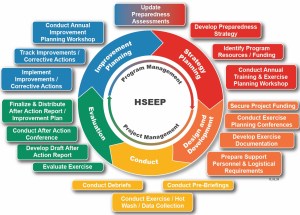
From inception to improvement planning, I think preparedness exercises provide great value to the jurisdictions, companies, and organizations that do them.  From a seminar to a full-scale exercise, there is much to be learned by participants as well as the strengths and areas for improvement identified from emergency plans.  I’ve been inspired to write a series of blog posts on each of the phases within the Homeland Security Exercise Evaluation Program (HSEEP) cycle.  The cycle, shown below, encompasses not just the steps in executing an exercise (project management), it includes exercise program management as well, which I think is often neglected.  Doings exercises is great, but to ensure continuity, quality, and continuous improvement, any entity that does exercises should have an exercise program.  Having a structured exercise program will ensure that your organization capitalizes on your exercise investments to the greatest degree possible.  Just like any other functional program, it needs to be managed.

HSEEP Cycle

Each blog post will give some insight and lessons learned from my own experiences with exercises large and small and I will reflect on exercise program management responsibilities throughout the cycle.  For more in-depth information on exercise program management, I refer you to HSEEP Volume I.  I will also have an update on this HSEEP volume in the near future as DHS will soon release a revision.

The first thing I want to cover is exercise program management as a general concept.  As stated in HSEEP Volume I, “Exercise program management is directed toward achieving the objectives established during the multi-year planning process…”.  As an exercise program grows, so should the responsibilities of managing it.  Most organizations don’t need a full-time exercise program manager, but they will require someone with the flexibility to vary how much time they spend on the exercise program.  The planning and conduct of an exercise can take up a considerable amount of time, and the program manager needs to shepherd this process.  In small organizations, the exercise program manager may be one of the few people involved in these activities as well.

Obviously the person in charge of an exercise program needs to be knowledgeable and experienced in exercises.  As with the oversight of any program, you need to have the right person in place.  Some caution should be used here, however – there are plenty of folks with LOTS of exercise experience… BUT the vast majority of experience out there is as a player.  Players, as a general rule, don’t experience all the machinations behind putting an exercise together.  Someone may have been a player in the largest exercise known to human kind, but that doesn’t make them adept at exercises.  There is plenty of training out there addressing various areas of exercises: the HSEEP training course, Exercise Design, Exercise Evaluation, and others.  These are great – but the world is full of ‘trained’ people.  Do they have the experience to do the job?  It doesn’t take a lot of experience, in fact, in my opinion, a little experience can go a long way – especially if it’s the right experience and they were taught the right way to do it from someone with a lot of experience.  I’ve fully immersed interns in many of the areas of exercise program management and would be fully confident in their ability to run a program for an organization.

As mentioned above, exercise program management centers on the multi-year training and exercise plan (MYTEP), which makes sense as this document will outline requirements, goals, and benchmarks for the program.  Building this plan is not the first, though.  We know that before we can write a plan, we need to do an analysis or an assessment of where we stand.  This is why the first step in the HSEEP cycle (above) is Updating Preparedness Assessments.  As much of a fan as I am of the HSEEP documents, they do fall rather short on providing guidance relative to this step.  It can be broken down easily enough, though.

A preparedness assessment, to me, would identify where we stand and where we want to be in terms of preparedness.  The resultant gap would then feed the second step in the HSEEP cycle – developing a preparedness strategy.  Let’s define preparedness: traditionally, it involves planning, training, and exercising; we can build from this to give us the data we need.  An absolute priority is identifying and assessing risk.  Hopefully your jurisdiction has a recent hazard analysis or THIRA, or your company or organization has a recent business impact analysis (BIA).  Having a recent hazard analysis done will identify the threats you need to be prepared for.  If you don’t have a recent one of these, I would suggest that you are way ahead of yourself with exercises and need to take a step back in emergency management to do one of these and build a plan.  Based upon the results of your hazard analysis, do you have the necessary plans (and are they up to date?) to address the hazards?

The second assessment should be a capabilities assessment.  You can reference FEMA‘s list of core capabilities to ensure that you are examining everything you need to.  Keep in mind that not everyone needs to have every capability.  You may not have a need for certain capabilities or it may not be feasible for you to have it based upon costs – so long as you can obtain that capability from someone else in times of disaster.  However, there are certain capabilities, based upon your hazards, that you want to ensure that you have.  If you don’t have them, they need to be developed.  That’s a gap.

A third assessment, related to the second, would be to identify needs to develop personnel capabilities – specifically through the means of training.  Yep, a Training Needs Assessment.  I’ve blogged previously about this.  Your identified needs become another gap to include in your preparedness assessment.

Lastly, you should do an assessment of exercises and real life events to date.  While you are just starting to formalize your exercise program, I still think an assessment of exercise progress to date is important.  While you may not have had a formal program, you have likely done some exercises or at least participated in someone else’s.  What plans have been tested with these exercises?  How long ago were they conducted?  Do you have After Action Reports?  (Read my article in Emergency Management Magazine on the importance of AARs and implementing corrective actions).  How about lessons learned and after action reports from actual incidents?  What gaps from these still need to be addressed?

All of this data and these documents can be pulled together and referenced in a simple, cohesive document outlining your preparedness needs.  It seems like a lot of work, but without identifying our needs, we can’t move forward with an effective exercise program.

What are your thoughts on identifying preparedness needs?  Is there anything I’ve missed?

Thanks for reading and be on the lookout for part two of Managing an Exercise Program where I will outline the development of a preparedness strategy.


Let’s Bring Human Interaction Back Into Training

I love technology.  I really do.  I generally don’t have any problems with the accomplishments or advancements we’ve made and I’m not looking to abolish any of the triumphs or practices we have in place as a result of technology, but there are some things we have to step back on a bit.  One of those things is the extreme volume of self-paced, internet learning, e-learning, independent study, etc. types of programs out there.  We’ve accomplished a great deal in regard to these self driven types of programs and they do have value – yet I think we’re losing touch with the human factor.

When I started in the training business, the internet was still fairly youthful and humanity hadn’t yet realized all the potential it held (we still don’t, but we were a much longer ways away from it then).  There was no such thing as online learning.  You could download training materials and references, maybe even submit test answers online (although the norm was still to fax answers), but that was about as interactive as it got.  The next step was pretty pathetic – uploading slides in a PowerPoint format or something similar, to the internet for people to view.  As time progressed, we saw great advances in online learning.  Now we have video, audio, in-course quizzes and learning checks, even biometrically-driven verification systems to ensure that it’s still you taking the course (don’t believe me?  take the defensive driving course on-line).  Courses are much more comprehensive and provide both internal and external links to additional information and content areas.  I think it’s fantastic and we can’t stop this advancement – but we can’t let it take over, either.  All things in moderation.

People need interaction.  In 1970, Malcolm Knowles identified, as one of his six characteristics of adult learners, that adult learners are generally autonomous and self-directed.  While this may be true, it doesn’t mean that all learning is to be accomplished in isolation or without facilitation.  Adult learners still need human interaction.  While the degree of interaction necessary may vary based upon each individual’s preferred learning styles and personality type, that need still exists.  This is an interaction that generally can’t be replaced by games or other interactive components in e-learning programs.  Yes, many adults love the concept and process of self discovery, and some will excel greatly at absorbing information completely on their own, but most people need and desire human interaction.  We can’t forget this.

Some content areas are much more suited (read: ideal) for e-learning.  I recently began working with a company that has employees nation-wide.  E-learning is certainly the best structure to disseminate required programs such as business ethics and workplace harassment.  In fact, these programs were extremely well done.  They used a lot of audio, pictures, and knowledge checks throughout the programs.  They were designed to provide variety and appeal to the senses.  They were well structured and didn’t contain any of the cheesy videos many of us remember from previous iterations of these types of programs.  I can honestly say that I preferred these in an e-learning format over any previous classroom experience in the same subject areas I’ve ever had.

Why do programs like ethics and workplace harassment work very well in an e-learning format?  Because, if designed well, they require very little human interaction to facilitate the learning process.  There are programs that I have taught for many years, however, that MUST have human interaction, such as incident management and emergency planning topics.  I think the key here is that they are complex topics, with a lot of variables, and the real world execution of these topics requires team work and human interaction.  You can’t manage an incident inside a barrel nor can you write an emergency plan (a good one) without input from an entire team of people.  The instructors have to have experience in these areas and be subject matter experts that the learners can consult throughout the class.  Access to an SME helps the learners become more comfortable with the topic.  All this said, do these courses need to be delivered in a classroom environment?  Not necessarily.  We can still be interactive with others without being face to face.  It’s all about creativity, leveraging technology and other resources, and paying attention to the needs of our learners as well as the objectives of the courses themselves.

We have a number of distance learning options we can leverage, from webinars, to video teleconference, to chat room types of environments (and these can be highly integrated such as the ones used by educational institutions).  Does course participation (in whole or in part) have to be synchronous (the instructor is present with all learners at the same time) or can it be asynchronous (the instructor and learners can log in at different times, able to download and upload materials and leave messages for each other)?  It all depends on what needs to be accomplished.  Once again, as in previous blogs, I defer back to the needs assessment.  The data collected from the needs assessment will provide an astute instructional designer with information necessary to identify the delivery modes that would be appropriate for the learners.

With all the technology we have available to us, I think many learning organizations are being seduced into using e-learning platforms for everything.  E-learning and content management systems are very powerful and valuable tools, but can’t forget the human factor.  We need to be very careful with what we use and how we use it – and ensure that we are meeting the needs of our learners in the best way possible.  I encourage you to use caution and always consider what is best for the learner.

It’s about the customer, stupid!

Yesterday I received my very first issue of Training Magazine in the mail.  After over 16 years as a training professional, I’m really not sure why I never read Training before – but I’m glad I started.  Right off the bat I was quite pleased with what I was reading.  Like many trade magazines, the edition opens with a letter from the editor.  Lorri Freifeld, the editor in chief of Training, does just that.  Her editorial is titled ‘Ask and You Shall Receive’, and includes an example from training professional Michael Marr, who mentions that training folks have a tendency to agree to developing and delivering training without out determining the true need.  Lorri expands on this by illustrating the simple process of going to a coffee shop.  They don’t just hand you a cup of coffee when you go in (well they do maybe if you are a regular there), instead they ask you what you would like.  As trainers we must always keep our finger on the pulse of the needs of the customers.

I’ve blogged previously about the necessity of conducting training needs assessments and how critical they are to learner outcomes.  Yes, sometimes the need seems very apparent, and you may be right, but peel back the layers of this anyway just to make sure.  Not only does this give you the opportunity to verify the purported need, but it will also give you insight into the driving forces behind that need – which may lend itself well as fodder for training content.  You may be surprised to find that the issue is not training related at all, but rather a fault in the process or equipment.   Remember, training is the greatest example of the ‘garbage in – garbage out’ theory.  If you don’t invest your time, energy, and resources into making a quality product that meets needs, then you are simply wasting the time, energy, and resources – and in this economy, more than ever, we can’t afford to waste those things.