Active Shooter Video – Run, Hide, Fight

Timothy RieckerAlabama Homeland Security, at the request of the Governor, modified the City of Houston’s Run, Hide, Fight video in the aftermath of the Sandy Hook school shooting.  Despite a few comments I’ve seen around the internet about the video being ‘sensationalized’, I think it’s a very well done video hitting emotions as best as possible through an instructional video.

It appears that the concept of ‘Run, Hide, Fight’ is the best approach we have against these types of horrific incidents.  It makes sense.

See the video here.


– Tim Riecker

Managing an Exercise Program – Part 4: Conduct an Annual Training & Exercise Planning Workshop

This post is part of a 10-part series on Managing an Exercise Program. In this series I provide some of my own lessons learned in the program and project management aspects of managing, designing, conducting, and evaluating Homeland Security Exercise and Evaluation Program (HSEEP) exercises. Your feedback is appreciated!

Managing an Exercise Program – Part 1

Managing an Exercise Program – Part 2: Develop a Preparedness Strategy

Managing an Exercise Program – Part 3: Identify Program Resources and Funding

Managing an Exercise Program – Part 4: Conduct an Annual Training & Exercise Planning Workshop.

Managing an Exercise Program – Part 5: Securing Project Funding

Managing an Exercise Program – Part 6: Conducting Exercise Planning Conferences

Managing an Exercise Program – Part 7: Develop Exercise Documentation

Managing an Exercise Program – Part 8: Preparing Support, Personnel, & Logistical Requirements

Managing an Exercise Program – Part 9: Conducting an Exercise

Managing an Exercise Program – Part 10: Evaluation and Improvement Planning
Timothy Riecker

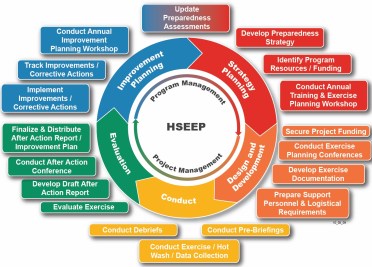
HSEEP Cycle

As HSEEP Volume 1 states, “The basis of effective exercise program management is a Multi-Year Training and Exercise Plan.”  The MYTEP is the product of a Training and Exercise Planning Workshop (TEPW), a collaborative which should be conducted annually to update the plan (and the collaborating partners!) with any changes in preparedness priorities, funding, or other influential factors.  I really can’t underscore the importance of the TEPW and MYTEP enough – they truly are the backbone of an effective exercise program.

First the TEPW needs to be scheduled and attendees invited.  This workshop should include not only your core planning team (discussed a bit in part 3), but should also expand to others within the sphere if influence and coordination.  States should invite relevant state agencies, a representation of counties (as it would be unwieldy to invite all of them), key cities and/or Urban Area Security Initiative groups, key Federal partners (like FEMA, EPA, DOE, USCG), as well as major not for profits or VOADS, and critical infrastructure private sector folks or authorities like utility or rail companies or regional transit authorities.  Counties should invite key county and state agencies, a representation of local governments, representatives of key groups like the county fire chief’s association, not for profits or VOADs, and those critical infrastructure folks within the county – including school districts and colleges.  Cities, towns, and villages should all follow suite similarly.  Not for profits and private sector folks need to ensure that they are invited to the table of the meetings of others (are you part of a local emergency planning committee – LEPC???) – and for conducting their own TEPWs (not required, but a good idea) need to consider where their primary operations take place and who they have significant relationships with relative to preparedness.  In the end it can be quite a crowd.  You want to be certain that the invites go to the right people (i.e. the exercise program managers, if they have them, or the emergency managers for these entities).  Stress that this is a workshop – where work gets done – so they can’t just send someone to ‘hold a seat’.  It needs to be someone who can represent the organization and its interests in the area of preparedness.  The invite should also state what key information they should be prepared with and prepared to discuss, like major preparedness training and exercise initiatives.

The HSEEP website provides some detailed guidance on TEPWs, a sample agenda, and even a draft invite letter and presentation on its resources website.  You’ll notice that the agenda is a VERY full day.  Don’t try to cut any corners – and I would even encourage a working lunch.  It’s frustrating to hold people longer than planned and even more frustrating to spend a full day in a workshop and not accomplish what you set out to do.  During the workshop, participants should review priority preparedness capabilities and coordinate exercise and training activities that can improve and validate those capabilities. As a result of the workshop, the Multi-Year Training and Exercise Plan outlines a multi-year schedule and milestones for execution of specific training and exercise activities.  Just as importantly, the TEPW helps to deconflict any exercise issues that may exist between these partners, like avoiding scheduling major exercises too closely to each other.  As part of this process, be sure to discuss major areas for improvement discovered from After Action Reports of earlier exercises – the implemented improvements should be tested.

During the TEPW, you will start to populate an exercise calendar.  Some partners will have dates set, others may only be able to narrow it down to a month or calendar quarter.  Around these exercise activities and their known major objectives, training programs can be identified and roughly scheduled as well.  This is the beginning of your MYTEP.

Conducting a TEPW and formulating a MYTEP is not only the first step toward HSEEP compliance, it is also the foundation of your program.  Through the TEPW, your organization and its partners will identify training and exercise requirements, goals, and benchmarks; ideally forecasted out three to five years.  You start with regulatory and other legal requirements, include grant and funding deliverables, and initiatives driven by the organizational mission and emergency management functions.  If the organization has a goal of revising a certain emergency plan by the end of the calendar year, then it would be a good idea to include an exercise testing that plan.  Through the process of the TEPW, you will identify what level of exercise is appropriate: ranging from a seminar to a full-scale exercise; and opportunities to capitalize on different exercise initiatives, merging exercises and leveraging combined efforts and funding – especially between different agencies and organizations.  Finally, you should identify training opportunities to ensure that personnel have the tools they need to function properly.

A TEPW can be complex and fast-paced.  There can be a lot of attendees all needing to get their information out.  The preparedness of the facilitator and attendees is absolutely critical to the success of the TEPW and the quality of the MYTEP.  If you’ve never done one, reach out to someone who has to help you along – including me.

Happy New Year to all and be on the look out for Managing an Exercise Program – Part 5: Securing Project Funding.

DANGER: Templates in use

Timothy Riecker

Sorry… I thought this image was really funny!

Last night I spent some time reviewing the Comprehensive Emergency Management and Continuity of Operations Plan (which should not be combined into one document) for a small town.  Having reviewed more plans from within the State of New York than I can count, it was readily obvious that a state-provided template was (mis)used in the making of this plan.  The end result: a poorly written plan that can’t be operationalized.

First off, I must say that there is nothing wrong with the template that was used.  This template has been provided and is regularly updated by the Planning staff of the State’s Office of Emergency Management.  Good templates help to ensure consistent formats are applied and all baseline legal and necessary content is included.  There are many planning templates out there across the nation and globally for emergency plans.  Some are good, many are not so good.  The closest I tend to get to a template is using it as a reference.  I generally see the use of templates akin to a Jean-Claude van Damme movie: you think it’s a good idea at first, you soon discover that you don’t really like it but for some reason can’t leave it, and in the end you are left wondering what really happened.

One must keep in mind when using a planning template that one size does not fit all… actually one size doesn’t fit anyone.  While a template, as stated earlier, will provide you with a format and essential content, they don’t provide YOUR detailed information.  If you simply use the template the way most people (wrongly) do, you are essentially doing the Mad Libs version of emergency planning by plugging in titles and locations where it tells you to.  But where does this get you?  Is the plan ‘customized’ simply because you filled in the blanks with your information?  Of course not.  The plan needs to make sense.  The easiest way to determine if it makes sense or not is to read it.  A good plan should provide a strategic-level narrative of how your company, jurisdiction, or organization will respond to and manage the impacts of a disaster.  Who is in charge, and of what?  What does the organization look like?  What priorities must be addressed?

Templates really should be viewed as guidance documents – this will help prevent most user errors.  Plans address needs – so a good needs assessment (threats and hazards) up front will help identify the content of the plan.  Don’t forget to read the plan while you are writing it to make sure that it makes sense.  Consider how it will be used and by whom.  Do we write emergency plans just to fulfill a legal requirement or do we write them so we can use them???

Tale of An Emergency Manager in Afghanistan

I want to share this story of Mike Cook, the Emergency Manager for the City of Edmonton who spent a year in Afghanistan helping them to improve their fire service and disaster response.  He tells a wonderful, but also sad story of the state of things there.  My congratulations and appreciation to Mike, and those like him, who are committed to helping not only their own communities, but those a world away.

Managing an Exercise Program – Part 3: Identifying Program Resources and Funding

This post is part of a 10-part series on Managing an Exercise Program. In this series I provide some of my own lessons learned in the program and project management aspects of managing, designing, conducting, and evaluating Homeland Security Exercise and Evaluation Program (HSEEP) exercises. Your feedback is appreciated!

Managing an Exercise Program – Part 1

Managing an Exercise Program – Part 2: Develop a Preparedness Strategy

Managing an Exercise Program – Part 3: Identify Program Resources and Funding

Managing an Exercise Program – Part 4: Conduct an Annual Training & Exercise Planning Workshop.

Managing an Exercise Program – Part 5: Securing Project Funding

Managing an Exercise Program – Part 6: Conducting Exercise Planning Conferences

Managing an Exercise Program – Part 7: Develop Exercise Documentation

Managing an Exercise Program – Part 8: Preparing Support, Personnel, & Logistical Requirements

Managing an Exercise Program – Part 9: Conducting an Exercise

Managing an Exercise Program – Part 10: Evaluation and Improvement Planning


Exercises can be very resource intensive, have no doubt about that.  Generally speaking, the more you invest in them, though, the more you get out of them.  Certainly discussion-based exercises are usually not as expensive as operations-based exercises.  For all exercise types, however, the largest costs are in the design (staff or consultant time, as well as meeting time), and conduct (again, staff or consultant time, plus the time of the participants).  What resources do you need for your exercise program as a whole?  How do you get them?

First of all, let’s discuss human resources.  In Managing an Exercise Program – Part 1, I discussed the importance of having an exercise program manager and what some of the qualifications should be for that person.  A program manager is probably the most important human resource you could have for exercises, but certainly this person can’t do it alone.  A good exercise program is able to leverage the experience, support, and ideas of others – both within and outside.  The exercise program manager needs to be a great networker, able to draw people from various agencies into a mutually beneficial partnership.  Some of these agencies will come and go, but some will be strong, permanent partners.  Each partner agency, including your own, should be contributing to the efforts of the group – not only with ideas, but with people to serve as controllers, evaluators, planning team members, etc., physical resources suitable for whatever types of exercises you conduct, and perhaps even funding.

In March of 2008, I founded and co-chaired the New York State Exercise Coordination Committee, composed of several state agencies, departments, authorities, and the Red Cross.  Meeting regularly and communicating often, we were able to pool our resources not only for each individual exercise, but for exercise program management as a whole throughout New York State.  We formulated consistent policies and practices, allocated Homeland Security funds state-wide for exercises and corrective actions, and developed and delivered exercise-related workshops and training courses.  We became the core group for the Training & Exercise Planning Workshop (more on this in the next part) and applied for and coordinated funding requests to FEMA for the Regional Exercise Support Program (RESP), which provided contractor resources to state and local exercise initiatives.  We were not only able to help each other, but we were able to benefit the state as a whole.  This model can be applied to other states; county and local governments; and consortia of public, private, and not for profit groups.

Keep in mind that the HSEEP cycle is just that, a cycle.  You will constantly be revisiting each of these steps – sometimes out-of-order – including determining needs and sourcing of resources.

HSEEP Cycle

HSEEP Cycle

What resources do you think you will need to manage your program?

Be on the lookout for Managing an Exercise Program – Part 4: Conducting an Annual Training & Exercise Planning Workshop.

Kudos to Cleveland

As I was typing away at the State Preparedness Report for a client late into the night last night, I would check new blog posts while the FEMA web tool would save and load new pages (the PREPCAST portal was gruelingly slow as the deadline for every state is December 31st).  Every couple of hours, a new post would go up in the WordPress Emergency Preparedness category from the Cleveland, Ohio Public Safety Department as they updated readers on the weather, road conditions, snow removal, parking, and safety matters.  Essentially, they would provide a mini situation report for the public and include whatever information residents needed to know.

This is certainly a best practice and excellent utilization of a blog to provide up to date information.  Great job Cleveland!

How does your jurisdiction disseminate emergency information?

Gunman Ambushed Firefighters in NYS

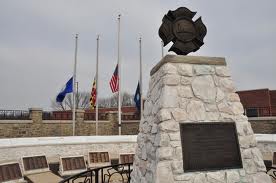
National Fallen Firefighter Memorial, National Fire Academy, Emmitsburg, MD

National Fallen Firefighter Memorial, National Fire Academy, Emmitsburg, MD

I’ve been following a news story today about a gunman who ambushed, shot, and killed two volunteer firefighters in Western New York this morning.  Two other firefighters were wounded in the incident as well.

This is an absolutely horrible occurrence, and provides another example of how first responders around the world risk their lives each and every day.  When the whistle blows at the fire station, those who respond expect to be responding to help someone who is sick or injured, to put out a fire, or to manage a motor vehicle accident.  They don’t expect to be shot at.  Sadly, on occasion, it does happen.  I’ve even had a shotgun aimed at me once when responding to a medical call as a firefighter/EMT – by the abuser in a domestic abuse situation.  These things aren’t supposed to happen to the good guys.

As the sun sets on the day of the eve of Christmas, my thoughts and my heart go out to the victims and the loved ones of those victims, not just of this incident, but of all incidents this year.  We’ve seen several horrific shootings and other acts of violence as well as devastation from mother nature.   Please keep these families in your thoughts and be sure to thank a veteran or a first responder for keeping us safe.

Active Shooter Info from DHS

Good active shooter info from DHS.

Bruce Harman's avatarThe Security Takeaway

The tragedy in Newtown, Conn.  raised awareness of the Active Shooter threat. Listed below please find links to a number of reference and training resources which highlight response to the Active Shooter threat.

DHS Reference Materials:

DHS, Active Shooter – Booklet:   How to Respond www.dhs.gov/xlibrary/assets/active_shooter_booklet.pdf

 FEMA Online Courses:

Active Shooter:  What You Can Do http://training.fema.gov/EMIWeb/IS/IS907.asp


View original post

10 Myths About Mass Shootings

Last night I came across a blog by James Alan Fox, a Professor of Criminology, Law, and Public Policy at Northeastern University.  The blog was posted in the Chronicle of Higher Education and provides some interesting information relative to mass shootings.  Sadly, it doesn’t provide us with any conclusions or solutions, but does dispel some of the concepts and information that are out there about mass shootings.  Information like this will hopefully prevent us from diving into knee-jerk reactions.

The worst part of all this is that there is often times not actionable intelligence that law enforcement can follow-up on to prevent these types of incidents.  It’s not anything like an organized terrorist effort that involves a great deal of communication between conspirators.  The result is that mass shootings can occur literally anywhere and at any time.  Schools, movie theaters, community centers, malls, restaurants, and post offices are all among the places we go and expect to be safe.  We all wish we had an answer.

Here’s Professor Fox’s blog…

Top 10 Myths About Mass Shootings

December 18, 2012, 2:42 pm

By James Alan Fox

Even before the death toll in last Friday’s school massacre in Newtown, Conn., was determined, politicians, pundits, and professors of varied disciplines were all over the news, pushing their proposals for change. Some talked about the role of guns, others about mental-health services, and still more about the need for better security in schools and other public places. Whatever their agenda and the passion behind it, those advocates made certain explicit or implied assumptions about patterns in mass murder and the profile of the assailants. Unfortunately, those assumptions do not always align with the facts.

Myth: Mass shootings are on the rise. Reality: Over the past three decades, there has been an average of 20 mass shootings a year in the United States, each with at least four victims killed by gunfire. Occasionally, and mostly by sheer coincidence, several episodes have been clustered closely in time. Over all, however, there has not been an upward trajectory. To the contrary, the real growth has been in the style and pervasiveness of news-media coverage, thanks in large part to technological advances in reporting.

Myth: Mass murderers snap and kill indiscriminately. Reality: Mass murderers typically plan their assaults for days, weeks, or months. They are deliberate in preparing their missions and determined to follow through, no matter what impediments are placed in their path.

Myth: Enhanced background checks will keep dangerous weapons out of the hands of these madmen. Reality: Most mass murderers do not have criminal records or a history of psychiatric hospitalization. They would not be disqualified from purchasing their weapons legally. Certainly, people cannot be denied their Second Amendment rights just because they look strange or act in an odd manner. Besides, mass killers could always find an alternative way of securing the needed weaponry, even if they had to steal from family members or friends.

Myth: Restoring the federal ban on assault weapons will prevent these horrible crimes. Reality: The overwhelming majority of mass murderers use firearms that would not be restricted by an assault-weapons ban. In fact, semiautomatic handguns are far more prevalent in mass shootings. Of course, limiting the size of ammunition clips would at least force a gunman to pause to reload or switch weapons.

Myth: Greater attention and response to the telltale warning signs will allow us to identify would-be mass killers before they act. Reality: While there are some common features in the profile of a mass murderer (depression, resentment, social isolation, tendency to blame others for their misfortunes, fascination with violence, and interest in weaponry), those characteristics are all fairly prevalent in the general population. Any attempt to predict would produce many false positives. Actually, the telltale warning signs come into clear focus only after the deadly deed.

Myth: Widening the availability of mental-health services and reducing the stigma associated with mental illness will allow unstable individuals to get the treatment they need. Reality: With their tendency to externalize blame and see themselves as victims of mistreatment, mass murderers perceive the problem to be in others, not themselves. They would generally resist attempts to encourage them to seek help. And, besides, our constant references to mass murderers as “wackos” or “sickos” don’t do much to destigmatize the mentally ill.

Myth: Increasing security in schools and other places will deter mass murder. Reality: Most security measures will serve only as a minor inconvenience for those who are dead set on mass murder. If anything, excessive security and a fortress-like environment serve as a constant reminder of danger and vulnerability.

Myth: Students need to be prepared for the worst by participating in lockdown drills. Reality: Lockdown drills can be very traumatizing, especially for young children. Also, it is questionable whether they would recall those lessons amid the hysteria associated with an actual shooting. The faculty and staff need to be adequately trained, and the kids just advised to listen to instructions. Schools should take the same low-key approach to the unlikely event of a shooting as the airlines do to the unlikely event of a crash. Passengers aren’t drilled in evacuation procedures but can assume the crew is sufficiently trained.

Myth: Expanding “right to carry” provisions will deter mass killers or at least stop them in their tracks and reduce the body counts. Reality: Mass killers are often described by surviving witnesses as being relaxed and calm during their rampages, owing to their level of planning. In contrast, the rest of us are taken by surprise and respond frantically. A sudden and wild shootout involving the assailant and citizens armed with concealed weapons would potentially catch countless innocent victims in the crossfire.

Myth: We just need to enforce existing gun laws as well as increase the threat of the death penalty. Reality: Mass killers typically expect to die, usually by their own hand or else by first responders. Nothing in the way of prosecution or punishment would divert them from their missions. They are ready to leave their miserable existence, but want some payback first.

In the immediate aftermath of the Newtown school shootings, there seems to be great momentum to establish policies and procedures designed to make us all safer. Sensible gun laws, affordable mental-health care, and reasonable security measures are all worthwhile, and would enhance the well-being of millions of Americans. We shouldn’t, however, expect such efforts to take a big bite out of mass murder. Of course, a nibble or two would be reason enough.

Apocalypse Inquiry

I must share a brief story which I found to be rather humorous.

Just a few minutes ago I received a phone call from a local news station.  The caller, a reporter, asked for me by name and verified that I was a partner of Emergency Preparedness Solutions, LLC – my consulting firm.  She then asked if I had received any calls recently from anyone asking what they should do for the apocalypse – since, apparently, it is coming on December 21st.  I laughed and said ‘no’.  Despite doing a handful of presentations recently for businesses and not for profits I’ve not gotten any serious inquiries about apocalyptic preparedness – nor do I expect to, unless this post happens to spur some.

While we can’t predict the future, I expect that this coming Friday will be just like any other day on our temperamental planet.  My advice to everyone is to be prepared all the time!  Be informed, make a plan, build a kit, and get involved.

Happy Apocalypse!