Deadly Explosions

By now I’m sure you’ve all heard of the two horrible explosions that took place over the last 24 hours – one in Tianjin, China; the other in Baghdad, Iraq.  The explosion in the port city of Tianjin occurred soon after fellow consultant Ralph Fisk and I had both separately published posts about the dangers of human caused disasters.  The explosion in Baghdad, the result of a terror attack, occurred less than 12 hours ago.

The explosions in Tianjin occurred in the port area of the city and originated as fires among shipping containers.  The origin of the fires is yet unknown or released to the public by the Chinese government.  Chemicals and explosives were within some of the containers, with reports of chemical odors still lingering there hours after the explosions occurred.  At this point, according to CNN, 50 persons are confirmed dead with more than 500 hospitalized.  Among the dead are 12 firefighters.  Many more people are missing, including dozens more firefighters.  If you’ve not seen any of video of the explosions, it is grimly spectacular.  CNN has obtained several videos from people who were recording the fire turned explosion.  http://www.cnn.com/2015/08/13/asia/china-tianjin-explosions/index.html.  This will certainly be a continuing story to keep an eye on.

In Baghdad, ISIS has reportedly claimed responsibility for a truck bomb which was detonated in in a busy market, killing dozens and injuring nearly 100 people.  Sadly we have become practically desensitized to occurrences of violence in the Middle East.  While each of them is horrible, this incident is particularly tragic with the loss of this many lives.

I rarely post about current disasters or incidents as there is plenty of commentary already out there from the media and quasi-media.  The tragedy of these, however, underscores our need to be aware of the potential for these incidents to occur and what we need to do to prepare for and respond to them.  We also need to be prepared to address the cascading impacts of these incidents – mass care, mass casualty, and mass fatality issues are certainly paramount, but we also need to consider matters such as business and government continuity.

Foundationally, it helps to know something about explosives.  For my readers who are US citizens, be sure to check out the first responder training available from the New Mexico Tech Energetic Materials Research and Testing Center (EMRTC).  They run DHS sponsored training programs such as Incident Response to Terrorist Bombings (IRTB).  These courses are intensive and greatly valuable, diving into the physics and chemistry of different explosive types and classes, terrorist methodologies, and plenty of show and tell in their range.  The course gives a solid appreciation for what explosives can do and gives you a relative awareness of how much explosive it takes to cause a certain amount of damage.  For those who are not US citizens, I believe they do work with the US State Department to review applications on a case by case basis.  I’m curious as to what type of similar training is available in other countries to domestic responders.

We are truly lucky to not suffer incidents such as these as often as other nations do.  Understand, though, that this is only due to safety and security measures that we have in place.  Accidents, however, are inevitable, as are the successful efforts of those who wish to do us harm.  We must continue to do what we can to prevent these types of incidents but also be ready for when they do occur.

© 2015 – Timothy Riecker

Emergency Preparedness Solutions, LLC

WWW.EPSLLC.BIZ

At what point are we FEAR-MONGERING?

By now we’ve all read or at least heard of the piece in The New Yorker about the impending doom that shall be wrought by the Cascadia subduction zone.  It brings about some interesting thoughts.  Certainly the foundational premise of the article is based in some measure of science.  There IS a Cascadia subduction zone and a major quake here COULD certainly be devastating.  This article has sparked a few pieces by others which took their bit of sensationalism to a much higher level.  Keep in mind, however, that sensationalism sells.

The situation begs some questions of our own profession, though.  Where is that line for emergency management and homeland security?  Of course we endeavor to be factual, but we also want to be convincing and COMPELLING.  We want people to take action.  How far do we have to go to get our point across that there are hazards which people need to prepare for?  How far do we have to go to describe the situations which people need to prepare for?  At what point are we SENSATIONALIZING?  At what point are we FEAR-MONGERING?  What kind of moral obligation do we have?

This post and these questions were actually inspired by this morning’s blog post from author Chuck Wendig titled “Fear is Fucking Us All Up”.  Mr. Wendig’s blog is raw, humorous, and insightful on a variety of topics.  I highly recommend giving it a look.  Reader beware – Chuck Wendig uses more than a bit of profanity (in case you couldn’t tell from the title of his post).  If you are offended, don’t read it!

© 2015 – Timothy Riecker

EMERGENCY PREPAREDNESS SOLUTIONS, LLC

WWW.EPSLLC.BIZ

We need to talk MORE about Emergency Management

My company is currently finishing a contract which involved almost two dozen site visits to local government entities (cities and towns) to meet with local officials (emergency management, police, fire, EMS, schools, elected officials, public works/highway, etc.) to discuss certain emergency management and homeland security needs they may have.  The topics we needed to address were set in conjunction with our client and the meeting times were capped at 4 hours.  Based on the discussion generated by those we met with, discussions took anywhere between an hour and a half to all four hours.  At the end of most of these meetings, many people who we met with thanked us for bringing them the opportunity to discuss emergency management with such depth.

At first I was a bit puzzled about this gratitude… the meeting was intended for us to gather information from them, so it was us who thanked them for their time and input.  Why would they thank us?  They could talk about this stuff any time they wanted to, right?  In theory, yes.  In practice, NO.

Looking back at the project in retrospect we saw the value in the opportunity we provided these local stakeholders.  Absent a recent disaster or a specific issue of concern, it’s a rare occasion that local leadership takes the time to convene and discuss emergency management and homeland security matters.  We, rather serendipitously, provided them with an opportunity to do talk about many facets of EM/HS, to share thoughts and ideas, and to identify needs.

In many local government meetings (town/village/city council, selectboard, etc.) the topic of emergency management (or anything related to it) is generally not on the agenda.  Some may have a formal briefing by department heads, which would include the fire department or police department (if they have one), but these are usually fairly general statements.  Because of the depth of discussion that can take place, I don’t even think that these monthly governance meetings are the right venue for most discussion.  I would suggest that jurisdictions have a separate meeting, at least quarterly, to discuss emergency management in depth, with all department heads, elected officials, and others present and participating.  Preparedness should be discussed across the spectrum of all mission areas.

Many of the jurisdictions we met with had seen tropical storm impacts within the last few years – and that was the last time, for many of them, that the impacts and lessons learned were discussed.  What of their corrective actions?  Aside from a few largely individual efforts, little progress had been made.  Stakeholders self identified this gap, some commenting directly about the necessity to meet more often.  Many brought up gaps that were identified after the tropical storm, or even more recently, which were never addressed.

Along with the success of our intended project, we hope that at least some of those jurisdictions were able to get energized and organized to revisit some of those past concerns and move forward to make some progress with preparedness and mitigation efforts.

What do you do in your jurisdiction to prompt more discussion about EM/HS?

© 2015 – Timothy Riecker

Emergency Preparedness Solutions, LLC

WWW.EPSLLC.BIZ

The Need for More Scenario-Based Learning

Think back through all the courses you’ve taken.  It’s a lot – I know.  What ones stand out the most?  I’m willing to be they are the ones that were the most engaging.  Not only did you enjoy them, but you learned a lot from them and still remember quite a bit of it.

It’s no secret that training adults can be challenging.  Training professionals in emergency services is certainly no different.  The challenges are even greater as the number of required training courses continually increase, requiring more and more ass-in-chair time every year for responders and other professions.  A great deal of training programs we see out there still seem to be holding out for the sake of traditional delivery styles, much to the detriment of our learners.  Why?  Designing traditional lecture-based learning is easy to do!  Figure out what people need to learn, develop content, slap together some PowerPoint, and voila!  Hell, even I’m guilty.

The fact of the matter is that we all know this is wrong.  Yes, it’s easy to do on our end, but the value and impact of the learning is pretty low.  People don’t want to be lectured to for hours on end.  We know that learning is most effective when we mix things up and when we increase interaction.  One of the best ways of engaging learners effectively is through scenario-based learning.

Now I’m not just talking about using a scenario at the end of the course to see if people can apply what they’ve learned over the past two days.  Yes, scenarios can be used as a test of sorts, but they are most effective for actual learning.  So when should you use scenarios?  Why not start the course with one?  It immediately gets people thinking, which is a good thing especially with an 8 am start time to the course.   If you use a lot of scenarios in a course, can they all be related?  Sure.  Maybe.  Maybe not.  It all depends on what the purpose of the scenario is.  In training responders, threading a common scenario through a course is usually helpful.  Scenarios can get complicated when we need to establish a common understanding of what is going on, where it is, what resources are available, etc.  As such, it helps to use the same foundational scenario throughout the course (or at least regularly revisit it), and continue to introduce new problems or a different focus based upon the path of the training.  Using a common foundational scenario saves time so you don’t have to start anew introducing all new information each time and it keeps learners comfortable.  That said, it may occasionally be valuable to change things up a bit.

Do you need to use HSEEP to develop course scenarios?  No.  While these aren’t exercises in the strictest sense, we can benefit considerably from many of the principles and concepts of HSEEP.  Develop what you need to give learners the information they need to participate and the information you and/or other instructors need to properly facilitate and evaluate.

Adult learners like to be challenged.  Lecturing them for hours on end will only challenge their ability to not fall asleep – which may only be accomplished by their challenge for a new high score on the new app they just put on their phone.  The best way to challenge adult learners is to give them problems to solve.  A well written scenario will help introduce these problems in a framework which is both familiar and challenging to them.  Depending on how the scenario is provided, such as a compelling background story or use of video, learners will establish an emotional connection to the scenario which prompts a visceral desire to solve these problems.  Even one scenario is powerful and can prompt a lot of interaction.  It can prompt individual responses to questions, group discussions, and group collaborations.

Finally, don’t forget to evaluate both your learners and the scenario itself.  At the conclusion of each scenario conduct a hotwash and feedback session with learners to discuss what they accomplished and possible areas for improvement.  Also be sure to gain feedback from them and other instructors on how well the scenario worked and what can be improved upon.

Just like any other aspect of instructional design, the integration of scenarios can be time consuming but it’s an investment that will pay off.  To capitalize on the value of your scenarios, make sure the activities and expected outcomes of each scenario are associated with the learning objectives of the course and engage learners to the proper degree (i.e. the proper level of Bloom’s Taxonomy).  Yes, scenarios also take a fair amount of class time to execute.  That time needs to be well accounted for in your instructional design and course planning.  However, if properly designed, learners can learn just as much content if not more through interactive scenarios as compared to lecture-based training.

What types of scenarios have you integrated into courses?  How did learners respond to them?  How can we do a better job of integrating more scenario-based learning into our courses?

Need help designing scenario-based learning?  Let EPS help!

© 2015 – Timothy Riecker

Emergency Preparedness Solutions, LLC

WWW.EPSLLC.BIZ

Effectiveness and Efficiency in Incident Management – Resource Tracking

Incident Check In

Incident Check In

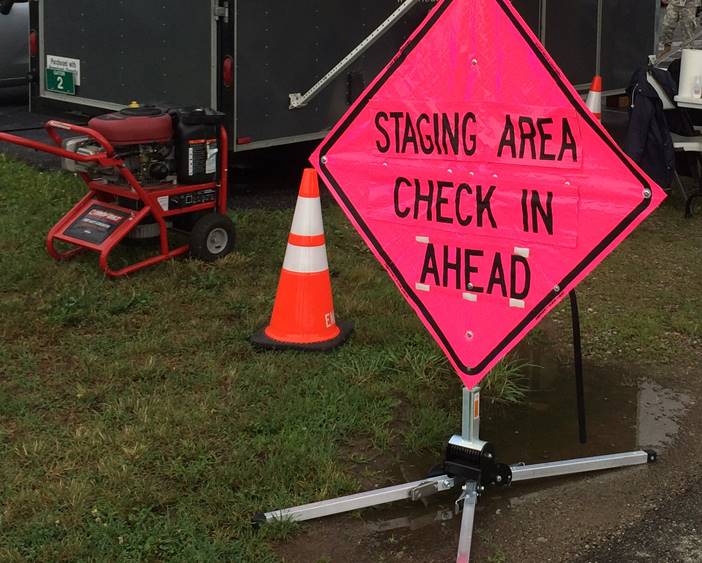
I recently took part in the management of an exercise in which a Type 3 incident management team (IMT) was among the players.  As part of their initial set up they immediately recognized the importance of checking in and tracking resources.  This is an activity which is often overlooked at the onset of an incident and is a royal pain to catch up on once the need is realized.  There were a few things which they could have improved upon, though, which seriously impacted their effectiveness and efficiency.

  1. They spent time checking in each vehicle as equipment. Not every vehicle needs to be tracked in an incident.  Generally, the sedan, pick up, or SUV you come in on isn’t special enough that it requires tracking.  Huge waste of time, people, and effort.  Consider the nature and capability of the equipment that is coming through your access point.  Is it a specialized resource?  Will it be applied tactically?  Will it be supporting logistical needs?  Is it rented or leased?  These are the conditions that should be considered when deciding what equipment to track.
  2. They marked equipment using bottled shoe polish. Not a bad idea, except it rained all week, and within hours of application most of the markings couldn’t be read.  Windshield markers, similar to what car dealerships use, are cost effective, waterproof, and clean off easily with mild window cleaners.
  3. Equipment that was checked in was never logged in detail. What’s the difference between E-01234 and E-01235?  We will never know as no descriptions were entered into their tracking system.
  4. As vehicles flowed in to the staging area, people will directed to check in at the command post. This is obviously excellent, except to get to the command post people had to pass by the main access to the incident site.  This meant that many people did not check in as directed.  They got distracted by the incident and associated response activity and never made it to the command post to check in.  This severely impacted the effectiveness of accountability.

Sometimes people would try to explain these things away by saying “It’s just an exercise”, but exercises are an opportunity to do things the right way, not skimp and cut corners.  While their intent was good, their process and results were quite poor.  If we are supposed to train the way we fight, as they say, this team has a ways to go to be more effective with resource accountability.  On the surface resource tracking looks easy… but it’s not.  There is a lot of complexity, variables, and attention to detail that must all work together well in order to be successful.  The Resource Unit Leader has one of the hardest jobs in the Incident Command System.

Being who I am, I’m left wondering why this all happened.  I have little choice but to blame poor planning and training.  Planning is to blame for a lack of clear procedures, guidance, and decision models.  The training which people receive tends to be just as vague.  By now, most, if not all of you are familiar with my opinions on the current ICS training.  While the referenced article does not go into the IMT/position training curricula, from what I recall of the courses I’ve taken, there are certain things taken for granted.  It’s easy to put an item on a checklist that says ‘Establish check in’.  OK… how?  Where?  When?  What?  Why?  The answer to those questions, or guidance to help answer those questions, should be provided through training.  Let’s tell people not only why check in is important, but what people and resources should be checked in, where to establish check in (what to look for and what to avoid), etc.  Once we’ve trained people on it, let’s provide job aids… not just the ICS forms, but job aids that will actually help people do their jobs.  While it may seem like minutia and unnecessary detail, keep in mind that we are training people to operate in austere and chaotic environments which they are trying to establish order over and only do these activities on rare occasion.  Those conditions signal the need for detailed training and job aids to support sustained performance and limit the degradation of the training they received.

Bottom line – let’s take a step back, fix what we have to based upon what we’ve learned, and proceed forward so we can operate more effectively and efficiently.

Thoughts and comments are always appreciated.  What have you learned or observed from incidents or exercises that needs to be addressed foundationally?

© 2015 – Timothy Riecker

Emergency Preparedness Solutions, LLC

WWW.EPSLLC.BIZ

What is Your Emergency Management Agenda?

We often hear, usually through the media, the term ‘agenda’ thrown around, usually in relation to political parties, corporations, and the like.  I think it’s time that we each have an emergency management agenda.

First of all, this isn’t exclusive.  Everyone can have their own – local, county, state, and federal emergency management agencies, and emergency managers with private and not for profit entities.  I’d also argue that we need a national emergency management agenda – every nation should.  And perhaps even a global emergency management agenda.  Why?  We need deliberate, purpose driven direction.  Too often we are scattered, doing some recovery from the past few disasters, and some mitigation and preparedness projects then WHAM! we get hit with another disaster.  After the disruption from that disaster, we usually fall back into the same groove or make up a bunch of new things we think will solve all of our problems.  So much of what we do is knee-jerk, despite the planning efforts we spend so much time on.  I really think we can do much better.

Part of doing better is having some longer-term goals and implementations to achieve those goals.  That’s really what a programmatic agenda is all about.  Much of this parallels a strategic plan, but people often roll their eyes at strategic planning, either because they have no time for a complex process or they have been through enough cheesy group think strategic planning sessions in their careers.  Strategic planning may also not be practical for many emergency management shops which are one or two person entities, especially at a local or county level or within a small corporation or not for profit.  I’m not knocking strategic planning, it has a lot of value (if followed through), but formulating an agenda is generally simpler by necessity.

Let’s consider components of an agenda:

  • Purpose/goal – what is the big picture of what you want to accomplish? This is also your elevator pitch.  It should simply state what you want to accomplish, in realistic terms.  This is not lofty like your corporate mission or vision statement, this is a programmatic goal.
  • Who will participate – who are your internal and external stakeholders and partners? Consider all the people and entities you need cooperation from to make this happen.
  • Expected outcomes – what benchmarks do we want to achieve? Write these like objectives – remember SMART: Specific, measurable, attainable, realistic, and timely.
  • Timeline – what is the timeline for each expected outcome and the goal itself? Set realistic timeframes.
  • Obstacles – what stands in our way of success internally and externally? Things like funding and personnel issues are obvious, but reach further while still being realistic.  Recognize that local disasters can be setbacks but can also create opportunity; and that many national-level disasters tend to result in politicians hitting a giant national reset button, changing the way we have been doing things (for better or worse) and stalling our momentum.

Of course this can all be revisited and adjusted as needed, but this agenda will help you lay the groundwork for future activities, giving you a path to follow instead of a series of ad-hoc activities.  Get it on paper and post it on the wall in your office where you will see it every day and can easily reflect on it, what it contains, and your progress in moving through it.

With that all said, I’m curious to know what the emergency management agenda is for the US (and every nation).  Yes, FEMA has a strategic plan, and while they are at the pointy end of the emergency management stick, they do not embody all that is emergency management.  Where do we, as professionals, see emergency management in this nation evolving to?  What do we (broadly) need to accomplish?  We tend to know the agendas of political parties and the politicians that are part of them, yet we don’t have a solid grasp on the direction of the emergency management enterprise.  Does this give you reason for concern?

© 2015 – Timothy Riecker

Emergency Preparedness Solutions, LLC

WWW.EPSLLC.BIZ

Incident Command System Training Sucks

There it is.  I said it.  Before you unleash the hounds, hear me out.

A bit of background:

As another grad course at American Military University was coming to a close last month I was racking my brain over the theme of my term paper.  In one of our final assignments I was dissecting NIMS – and that’s where it struck me.  ICS training is all wrong.  Now that my paper is all wrapped up and submitted, I wanted to get some discussion on my blog.  So, since I don’t want to bore everyone with the paper itself, what follows is a much less academic and more conversational version of my term paper.

For those of you who read my blog, you will be familiar with a few fairly recent posts that involve ICS:  The Human Aspect of ICS and Overcoming Transitional Incidents, Preparedness – ICS is Not EnoughTraining EOC Personnel – ICS is not Enough, and finally The Need for Practical Incident Command Training.  In that last one I feel I was headed in the right direction but not yet on the right road.

Before we go any further, here is my disclaimer.  I am a big believer in ICS.  If you take a look at the aforementioned posts, you’ll see that.  It’s a system that has been in use for a long time and has a proven track record of working well when properly applied.  Along with that, I’ve been an ICS practitioner, instructor, and instructor trainer – since before NIMS, in fact.  I’ve also been in positions influencing NIMS-related policy at both the state and national level.  So I have a fair amount of familiarity with the system, how it is used, and how it is taught.

Defining the need:

A great many after action reports (AARs) reflect on Operational Coordination (the current core capability which most heavily features ICS), On-Scene Incident Management (the previous iteration under the target capabilities), and just ICS in general.  These AARs often go on to recommend that responders need more ICS training.  How can they say that, though?  Following NIMS compliance requirements, darn near everyone who has been required to take ICS training has done so over the past 10 years.  So how could we be so off base?

The reality is summed up in this simple statement from John Morton: “With respect to using ICS from NIMS… training incorporated in the NIMS doctrine largely does not provide any actual skills training or development.”  If you aren’t yet familiar with John Morton’s work, I suggest you take a look here: Book Review – Next-Generation Homeland Security.  Brilliant guy.

Looking at the substance of Mr. Morton’s quote, it’s true that the foundational ICS courses (ICS-100 through ICS-400) don’t provide any skills training.  However, there is a significant expectation that taking these courses is somehow a magic bullet.

Much of my paper focuses on the ICS-300 and ICS-400 courses.  The ICS-100 and ICS-200 courses are probably not far off from where they actually need to be.  There exists, however, a higher expectation from people to have learned something from the ICS-300 and ICS-400 courses which can be readily applied in the field.  One of the foundations for my paper was an analysis of the course objectives from the current ICS-300 and ICS-400 courses through the lens of Bloom’s Taxonomy.  Bloom’s is a learning hierarchy which helps identify the depth of instruction and thus learning.  The revised version of Bloom’s is a scale of six levels, ranging from ‘Remembering’ to ‘Creating’, with remembering being pretty basic and creating being quite advanced.  The expectation of ICS training, obtained from a few sources as well as our perception, is that it falls somewhere in the middle under the taxonomy level of ‘Applying’.   The reality is that most of the objectives from these two courses fall short of that expectation.

How is it possible that we have been expecting more from people when we haven’t been giving them the proper training to do so?  In essence, all we have been training people in is theory.  Sorry, but theory doesn’t save lives, application does.  Why does the fire chief of even the small city (population ~62k) closest to me care what an incident complex or branch-level planning is?  It’s not something he can use.  He and his officers require proficiency in the system for not only the day to day type 4 and 5 incidents they deal with (which they generally have), but also enough for the type 3 incidents which occasionally occur from storms, hazmat incidents, and the like.

Yes, we do have position-specific courses for those who are members of incident management teams (IMTs).  Those courses presumably identify at a higher taxonomy level (I haven’t had a chance to do an analysis on them).  IMTs are great assets, but let’s have another brief shot of reality … not every jurisdiction is suited for an IMT.  Identifying potential members, getting them trained and experienced, and maintaining their skills is an investment that most jurisdictions simply aren’t willing or able to make.  The result is a huge gap between those who have only the core ICS training, which we have already identified does not meet the real need, and an IMT from a larger jurisdiction or region.  Jurisdictions need to be able to function for at least two days, if not longer, on their own.  Most incidents will be resolved at that point or ready for transition to an IMT.  If appropriate, the IMT can then apply things like branch-level planning.  That is the level of application expected from IMTs.

What can we do about it:

So what is needed?  Here are my rough ideas.  First off, at a micro level, we need a full rewrite of the ICS-300 and 400 courses.  Let’s make them more meaningful and focus on application.  Pull out all the theory and structure them around practical learning practices.  Second, we need refresher training.  Let’s stop the argument about that.  Knowledge and skills deteriorate over time, we all know that.  So let’s go with annual refresher training.  Not a day of being lectured, to, either.  Something more involved which reflects the identified need for applicable learning.  Third, continued reinforcement through exercises.  If you don’t use it you lose it.  The last ten years or so have seen a strong emphasis on exercises which we should certainly continue.  Lastly, all of this culminates at the macro level as a restructuring of the whole training program.  Why is that needed?  Well, aside from the current one being ineffective, we need to logically identify what training is needed for certain audiences based upon their roles and responsibilities and support it through accessible training programs.

In regard to restructuring the whole training program, I would suggest adoption of the Awareness, Management and Planning, and Performance course structure (AWR, MGT, PER).  ICS-100 is certainly awareness.  Awareness level training is appropriate for most responders and staff of assisting and supporting agencies who don’t have any leadership or decision-making roles and don’t need to have a high degree of interaction with larger system.  ICS-200 has some operational application for first line supervisors, so it’s probably a suitable introductory MGT course.  The ICS-300 should continue with a focus on the planning process but obviously needs to be bolstered with more application-level content and instruction.  With that, the target here is probably higher level management and planning.  The ICS-400, still needing a rewrite, is best left for those functioning at higher levels of incident management, such as EOC management and IMTs.  It will probably serve as a good foundational performance level course.  Now, just don’t leave it at that.  Let’s pull other courses in line to support this.  Many of those courses already exist, particularly those that have a strong ICS relationship, like the FEMA EOC and ICS/EOC courses (which are also in desperate need of rewrites to focus on application), the TEEX Enhanced Incident Management course (which is excellent), and others.  Let’s build a real, viable program for incident management as we have for other technical areas.  Without incident management we remain in chaos and the impacts of other activities are greatly minimized.  Let’s give it the respect it deserves.

Now that I’ve put all that out there, I’m absolutely prepared for your thoughts, ideas, and feedback.  I’m also hoping that someone forwards this on to Doc Lumpkins at the NIC.  Doc – let’s talk!  I might have an idea or two…

Unleash the hounds!

© 2015 – Timothy Riecker

Emergency Preparedness Solutions, LLC

WWW.EPSLLC.BIZ
Emergency planning – A linear approach or ‘choose your own adventure’?

When creating deliberate emergency operations plans, and especially the associated standard operating procedures/guidelines (SOPs/SOGs) that accompany them (you do develop these, right?) there is always a consideration for how to progress through the written plan – chronologically or topically.  There are pros and cons to both approaches you should be aware of.

Chronological progression of your planning efforts assume that an incident starts at A and progresses to Z, in a particular order.  At a glance, this is a lot of structure for emergency management, but an analysis of most incidents will show that they generally tend to progress in this fashion.  It’s human nature for us to like order and to try to put things into a logical progression.  There are, of course, the outliers – those incidents which have tangential or cascading impacts which don’t necessarily have a linear progression.  It’s these unknown factors that make us stumble a bit.  How do we account for these disruptions of our orderly progression?  We have to skip around in the plan.  If our plan isn’t designed for skipping around, it can be rather awkward and not easy to use.

A Choose Your Own Adventure book

A Choose Your Own Adventure book

The other side of the coin argues that if you are likely to skip around in the plan anyway, why not build a topical, or ‘choose your own adventure’ style, plan?  Remember choose your own adventure books?  The story always starts the same, building a foundation for the adventure you will face, but you, the reader, eventually get to decide what the main character will do.  At some point, you will be faced with a choice.  Should your hero take the left tunnel or the right?  If you take the left, go to page X, if you go right, turn to page Y.

Non-linear planning will chunk the content of your plan so individual sections focus on each potential impact and major activity – be it hazard-specific or function-specific – with reference back to a core plan, kind of a hub and spoke approach.  (By the way, ‘chunking’ is an actual term.  We use it primarily in instructional design).  It can make for some flipping around through the plan, and sometimes a bit of redundancy if each section starts with the same concept of operations (thus the need to reference back to a core plan), but it more easily accommodates the unknowns of an incident by looking at separate impacts or major activities as individual components related to a central response.

What are your thoughts?  Do we try to keep things orderly, or do we give in to a modular, ‘choose your own adventure’ approach?  Which do you think is more complex?  Which do you think is more effective?

© 2015 – Timothy Riecker

Emergency Preparedness Solutions, LLC

WWW.EPSLLC.BIZ

Finally – an Emergency Management Podcast Worth Listening To!

I’m a bit of a podcast addict.  I listen to them all the time – at the gym, mowing the lawn, long drives, etc.  There are podcasts out there for all interests.  I’ve struggled, however, these last few years, with finding a good emergency management podcast.  Sure, I’ve found a few, but I find them to generally have limited relevancy and also to be boring as hell.  Yes, I want to learn, but I also want to be entertained.  Last week, after seeing a tweet from Brandon Greenburg about guesting on a podcast, I was immediately intrigued.

First off, if you aren’t familiar with Brandon, you should be.  He blogs regularly about disasters and technology, usually together, and has great thoughts and ideas.  Brandon is not only a practitioner, but also an academic, currently pursuing a Ph.D. from GWU in technology and disaster management.  Brandon is one of those colleagues who I’ve never met, yet correspond with via our blogging and social media platforms.  Since he knows EM and he knows tech and social media, anything Brandon would be on immediately gives me cause to pay attention.  For more on Brandon, visit www.disasternet.co or on Twitter @disasternet.

Getting to the podcast, the name is the Dukes of Hazards, hosted by Mitch Stripling and Andrew McMahan.  From their website, the podcast is “… an irreverent (but useful) podcast about disaster response, emergency management, mobilization culture, community resilience, and life in emergency operations.  Also, drones.  Research.  Movie reviews.  Jokes.”  It really is all of that.  And a clever name!

Mitch and Andrew have clearly cracked the secret code of podcasting – talk about any subject (even one that is serious, like emergency management) and make it both informative and entertaining.  They clearly have a good time recording (the beer and cookies probably help with that), they are experienced in EM, and they continue to stay current in the practice.  Their discussion topics are interesting and relevant, and they fully use dialogue – with each other, guests, and written listener feedback – to help you feel engaged in their discussion.

Dukes of Hazards looks at current events in EM, new practices and ideas, and discusses the future direction of different facets of our field.  They even occasionally poke fun at some of our idiosyncrasies and common personality traits, which is a breath of fresh air! There are also some occasional pop culture references like Star Wars and The Walking Dead that make me quite happy.

Bottom line – informative, entertaining, beer and cookies.  Need I say more?

Check out Dukes of Hazards at www.hazardspodcast.com for more info.  You can listen to their podcasts from the website, iTunes, and other outlets.  They can also be found on Twitter at @hazardspodcast. You won’t be sorry.

© 2015 – Timothy Riecker

Emergency Preparedness Solutions, LLC

WWW.EPSLLC.BIZ

@EPS_LLC

The Aussie Model of Disaster Recovery

I had recently found a reference to the Emergency Management Victoria Disaster Recovery Toolkit for Local Government.  I’m always curious to see how other nations approach emergency management and even more curious to see the tools and resources they develop to accomplish their goals.  While there is a great deal of consistency between the US model of Disaster Recovery (documented primarily through the National Disaster Recovery Framework), one of the more interesting differences was in the focus areas of each.  While our National Disaster Recovery Framework identifies six recovery support functions (RSFs): Community Planning and Capacity Building, Health and Social Services, Infrastructure Systems, Economic, Housing, and Natural and Cultural Resources; the Aussie model identifies five environments of wellbeing: Natural Environment, Agricultural Environment, Social Environment, Economic Environment, and the Built Environment.

Australian Five Environments of Wellbeing

Australian Five Environments of Wellbeing

While there are certainly commonalities between the two models, each offers a unique perspective on the focus of disaster recovery and what is needed to support communities.  The Disaster Recovery Toolkit for Local Governments, referenced earlier, identifies that local governments are required through legislation to ensure wellbeing to be maintained in each community through each of these environments.

What interesting perspectives have you discovered looking at emergency management globally?

© 2015 – Timothy Riecker

Emergency Preparedness Solutions, LLC

WWW.EPSLLC.BIZ