Preparedness in the Pandemic Age

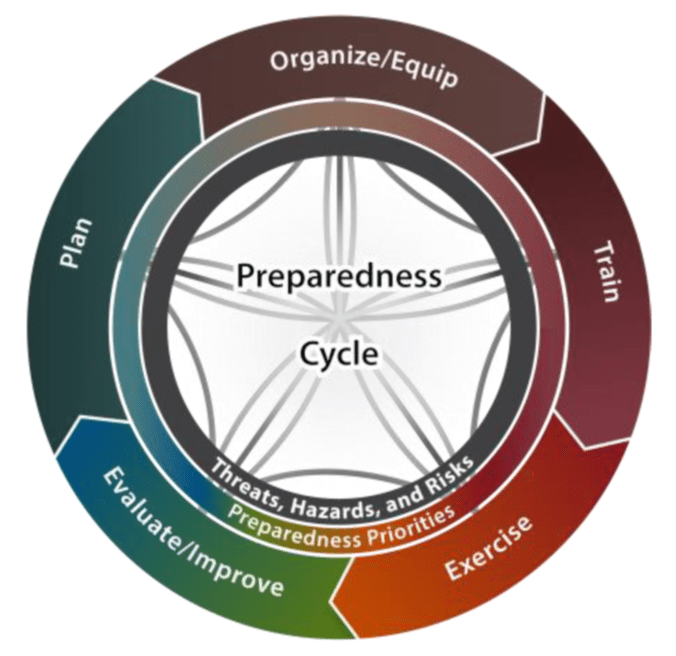
Planning, training, and exercises, as the foundational activities of preparedness, shouldn’t be stopping because of the pandemic. Preparedness is an ongoing activity which needs to forge ahead with little disruption – and there is always plenty to do! What must we do, though, to accommodate necessary precautions in the age of the Pandemic?

Let’s talk about planning first. The biggest relevant issue for planning is the conduct of stakeholder meetings. These may be larger group meetings to discuss and get buy-in on broader topics, or detailed small-group meetings to discuss very specific topics. Information, sometimes sensitive, is exchanged, presentations are given, and documents are reviewed. I’ve mentioned in various posts through the years the importance of properly preparing for meetings. Even for traditional in-person meetings, there are important things to consider, such as:

  1. Do you really need a meeting?
  2. Developing an agenda
  3. Having the right people in attendance
  4. Ensuring that all speakers and presenters are prepared
  5. Ensuring that all attendees are prepared to discuss the subject matter
  6. An adequate meeting space and support (technology, dry erase boards, etc)

All of these rules still apply in a virtual world, perhaps with even more emphasis. While we’ve obviously had video meeting technology for a long time, we’ve discovered this year that many people haven’t used it much or at all until earlier this year. The surge in use has also brought attention to the plethora of tools which can be facilitated through video conference platforms. While the simple sharing of video supports most of our meeting needs, we can share screens, conduct presentations, and use collaborative tools such as whiteboards and shared documents. Pretty much everything we do in an in-person meeting can be accomplished through video conference platforms – but those who arrange the calls need to take the time to become familiar with the tools and functionality; and if there is anything that needs to be done by participants (some of which are likely to be less tech-savvy) you need to be able to coach them through it. Some of these tools require integrations of other technology, such as cloud document storage or various apps. Remember that meetings should be interactive, so encourage people to use chatrooms to help queue up questions for presenters. If any documents or information are sensitive, be sure you are taking the appropriate precautions with how the meeting is set up, how participants are invited, and how documents are shared.

My tip… read reviews to determine which platform will best suit your needs and watch some tutorials on YouTube.

When it comes to remote training, so much of what I mentioned for stakeholder meetings will apply here. Being interactive is still incredibly important, as is the ability to integrate other technologies, such as videos, PowerPoint, and shared documents. When designing training that will be delivered remotely, if it helps, don’t think about the platform first – think about how you would do the training in person. Would you have breakout sessions for group work? That can be easily accomplished on video conference platforms, but it takes some preparation. Would you put things on a white board or chart paper? That can also be accomplished. Giving an exam? Having participants complete a survey or feedback form? Yes and yes. It can all be done, but preparation is key. Some instructors, especially in public safety, have gotten too used to simply showing up and delivering their material – not because they are lazy, but because they have done it dozens or hundreds of times. They have a routine. If you want participants to get a similar, or perhaps even better learning experience, some deliberate thought and preparation is required. Also, make sure you simply don’t become a talking head. Break things up and be dynamic. It’s easy for our own demeanor to elevate disinterest. I often stand (using a variable height standing desk) when giving presentations and conducting training. Being on my feet helps me push more energy into what I’m doing.

Tip… remember to give people breaks, just as you would in face-to-face training.

Lastly, exercises. A lot of this is a combination of the information I gave for planning and training. Exercise planning meetings need to be conducted, and every exercise has some extent of presentations, with discussion-based exercises having more emphasis on this obviously. To answer the big question – yes, most exercise can be conducted remotely! Obviously, discussion-based exercises are generally the lower-hanging fruit, so they can and should be happening remotely. Remember that exercises are supposed to be interactive experiences, so your exercise design absolutely must account for identifying the means and methods of engagement in the virtual environment. All the things I’ve mentioned already are prime options for this, such as breakout groups, shared documents, live polling, etc. Facilitators and evaluators can be assigned to specific breakout rooms or have access to all of them, allowing them to float from room to room.

What about operations-based exercises? Yes, there are options for conducting operations-based exercises remotely. First, we do need to acknowledge the obvious challenges associated with conducting drills and full-scale exercises via remote environments. Is it impossible? No, but it depends on what the focus of the exercise is. Something like a cyber-security or intelligence exercise may be more naturally brought into a virtual environment, depending on the exercise objectives or tasks. Games may be fully integrated into digital platforms already, which helps, but if they aren’t, these may need to be re-imagined and developed in a virtual environment. This can get expensive, so it really needs to be a properly thought through. Functional exercises, such as the typical command post exercise or emergency operations center (EOC) exercise, can absolutely be performed virtually. Many jurisdictions successfully ran their EOCs virtually during the height of the pandemic (many still are). If the actual activity can be performed virtually, it can (and should!) be exercised virtually. Again, preparation is key to ensuring that participants can do what they would normally do, while controllers and evaluators still have full access and visibility. Simulation Cells can be virtually integrated and most EOC management platforms are web-based. With some thought, we can bring most exercises into a virtual environment and still make them effective experiences while also meeting all HSEEP requirements.

Tip… For a virtual functional exercise, unless the time period of your exercise is set after the initial response, consider including an objective for the participants (and the tech support of their agencies, as needed) to set up everything that is needed in real time during the exercise – just like they would in real life. This would include all their video, file share, data tracking, etc. That set up is a considerable challenge of running a virtual EOC. If you didn’t want that activity to distract from your exercise, it’s also a great drill. Don’t let it just be tech support personnel, though, as EOC personnel should be expressing their needs.

Remote work environments have helped many organizations overcome challenges associated with the pandemic. Some organizations were better prepared than others to make it happen, but most seem to have achieved effective operational continuity. Hopefully your preparedness programs haven’t stalled out because people feel these activities can’t be done in a virtual environment. We also can’t use the excuse that we’re too busy because of the pandemic to not be preparing. While some niche organizations might still be quite busy, the pandemic response, for most, has become an integrated job duty for the medium term. We can’t let things fall to the wayside or we will never get back on track. The time is now!

I’d love to hear how you are using tech platforms to support preparedness efforts.

©2020 Timothy Riecker, CEDP

Emergency Preparedness Solutions, LLC

The Universal Adversary Mindset

Some of you are probably familiar with the concept of the Universal Adversary (UA). From previous Homeland Security Exercise and Evaluation Program (HSEEP) doctrine, UA is “a fictionalized adversary created by compiling known terrorist modifications, doctrine, tactics, techniques, and procedures in live, virtual, and constructive simulations. The UA is based on real realistic threats … providing participants with a realistic, capabilities-based opponent.” UA is often executed by a Red Team, which serves as an exercise-controlled opposing force for participants.

Over the past few years, I’ve heard less and less of the Universal Adversary concept. DHS used to have a UA Program supporting terrorism-based prevention and responses exercises, dating back to the early 2000s, but lately I’ve neither seen or heard anything about the continuation of the program or capability. (can any readers confirm the life or death of this capability?)

Regardless, the concept of UA offers a fair amount of opportunity, not only within the Prevention Mission Area, but across all of exercise design and perhaps other areas of preparedness – yes, even across all hazards. Of course, I recognize the difference between human perpetrators and other hazards, but just stick with me on this journey.

The fact of the matter is that we so often seem to have, as the 9/11 Commission Report made the phrase infamous, a failure of imagination in our preparedness. I’m not saying we need to go wild and crazy, but we do need to think bigger and a bit more creatively – not only in the hazards that threaten us, but also in our strategies to address them.

The UA concept is applied based on a set of known parameters, though even that gives me some concern. In the Prevention world, this means that a Red Team will portray a known force, such as ISIS, based upon real intel and past actions. We all know from seeing mutual fund commercials on TV that past performance does not predict future results. While humans (perpetrators and defenders alike) gravitate toward patterns, these rules can always and at any time be broken. The same can be said for instances of human error or negligence (see the recent and terrible explosion in the Port of Beirut), or in regard to someone who we have a love-hate relationship with… Mother Nature. We need to be ever vigilant of something different occurring.

There is the ever-prolific debate of scenario-based preparedness vs capability-based preparedness. In my opinion, both are wrong and both are right. The two aren’t and shouldn’t be set against each other as if they can’t coexist. That’s one mindset we need to move away from as we venture further into this. We need to continue with thinking about credible worst-case scenarios, which will still be informed by previous occurrences of a hazard, where applicable, but we need to keep our minds open and thinking creatively. Fundamentally, as the UA concept exists to foil and outthink exercise participants, we need to challenge and outthink ourselves across all areas of preparedness and all hazards.

A great example of how we were foiled, yet again, by our traditional thinking is the current Coronavirus pandemic. Practically every pandemic response plan I’ve read got it wrong. Why? Because most pandemic plans were based upon established guidance which emergency managers, public health officials, and the like got in line and followed to the letter, most without thinking twice about it. I’m not being critical of experts who tried to predict the next pandemic – they fell into the same trap most of us do in a hazard analysis – but the guidance for many years has remained fairly rigid. That said, I think the pandemic plans that exist shouldn’t be sent through the shredder completely. The scenarios those plans were based upon are still potentially valid, but Coronavirus, unfortunately, started playing the game in another ball field. We should have been able to anticipate that – especially after the 2003 SARS outbreak, which we pretty much walked away from with ignorant bliss.

It’s not to say that we can anticipate everything and anything thrown at us, but a bit of creativity can go a long way. Re-think and re-frame your hazards. Find a thread and pull it; see where it leads you. Be a little paranoid. Loosen up a bit. Brainstorm. Freeform. Improv. Have a hazard analysis party! (I come darn close to suggesting an adult beverage – take that as you will). We can apply the same concepts when designing exercises. Consider that in the world of natural hazards, Mother Nature is a Universal Adversary. Any time we hope to have out-thought her, she proves us wrong, and with considerable embarrassment. We also try to out-think the oft stupidity and negligence of our fellow humans… clearly, we’ve not been able to crack that nut yet.

“Think smarter, not harder” is such an easy thing to say, but difficult, often times, to do. So much of what we do in emergency management is based on traditional practices, most of which have valid roots, but so often we seem reluctant to think beyond those practices. When the media reports that a disaster was unexpected, why the hell wasn’t it expected? Consider that many of our worst disasters are the ones we never thought of. Challenge yourself. Challenge others. It is not in the best interests of this profession or for the people we serve to stay stuck in the same modes of thinking. Be progressive. Break the mold. Do better.

© 2020 Timothy Riecker, CEDP

Emergency Preparedness Solutions, LLC®

The Future of NFPA 1600

NFPA 1600: Standard on Continuity, Emergency, and Crisis Management is a standard I often reference. The contents of the standard, applicable to all organizations including government, non-profit, and private sector; compliments other standards and doctrine well, and is regularly updated to integrate new practices. The latest editions have gained even more value with what can be collectively referred to as implementation notes, which really help support putting the standard into action. The NFPA has also been releasing ‘Handbook’ editions of their standards, with even more professional commentary to support implementation. There is news, though… NFPA 1600 is going away – but don’t worry!

Last year, the NFPA announced the Emergency Response and Responder Safety Document Consolidation Plan. This is part of a larger movement within the NFPA to pull together a variety of similar codes and standards. NFPA 1600 will be combined into a new consolidated standard, NFPA 1660. NFPA 1660 will consist of the present NFPA 1600, NFPA 1616 (Standard on Mass Evacuation, Sheltering, and Re-Entry Programs), and NFPA 1620 (Standard for Pre-Incident Planning). The respective scopes of each of these documents are very complimentary and it absolutely makes sense for them to be in a combined edition. I appreciate that the combined editions will better allow readers to connect the dots of the continuity of activity.

The new NFPA 1660: Standard on Community Risk Assessment, Pre-Incident Planning, Mass Evacuation, Sheltering, and Re-entry Programs is in a public input period for the first draft through November 13, 2020; with a second draft scheduled for release in 2021; and a final draft by the end of 2022. So, don’t worry, NFPA 1600, or the other two standards it is being combined with, are not yet ‘obsolete’, but these standards on their own will no longer be updated.

For many years, NFPA 1600 has been available free digitally. I’m hoping the new combined standard will also be available for free as it will be an even more valuable resource and reference for a very broad range of emergency management and business continuity professionals, as well as students of these professions. I certainly expect the new NFPA 1660 to include new or modified standards as the result of lessons learned from the Coronavirus pandemic.

Is there anything you would like to see in the new standard?

©2020 Timothy Riecker, CEDP

Emergency Preparedness Solutions, LLC®

NIMS Guidance – Resource Management Preparedness

Last week FEMA issued a national engagement period for updated NIMS guidance on resource management preparedness. This is the first version of such a document, with most material on the subject matter, to date, being included in the NIMS doctrine and a few other locations. I regularly participate in the national engagement periods and encourage others to do so as I think it’s a great opportunity for practitioners and subject matter experts to provide input.

Some observations:

  1. The footer of the document states that it’s not for public distribution. I’m guessing that was an error.
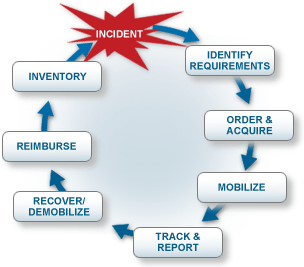
  2. The phrase of ‘resource management preparedness’ rubs me the wrong way. While I understand that there are resource management activities that take place within the preparedness phase of emergency management, we’re not preparing to manage resources. All the activities outlined in the document are actually part of resource management. If they want to put a time stamp on this set of activities, they can refer to them as ‘pre-incident’, but inventorying, typing, etc. are all actually part of the resource management cycle.
  3. I’d prefer to see a comprehensive NIMS Resource Management guide that addresses all aspects of resource management. Considering that resource management is a cycle, let’s actually cover the entire cycle. I think there will be far more value in that. Hopefully that’s eventually where this will go.
  4. The document is too stuck in NIMS. What do I mean by this? It seems that more and more people seem to forget that NIMS is a doctrinal component of incident management. While the document is focused on NIMS, it would have greater value if it addressed pre-incident resource management activities that might not found in the NIMS doctrine (though some are), but are none-the-less best practices in resource management. Many of these practices begin pre-incident.
  • One of the biggest things is resource tracking. Yes, resource tracking is a concept found in NIMS, but it’s not at all addressed here. How many jurisdictions struggle to figure out how to track resources in the middle of an incident (answer: most of them). The best time to figure out the means and methods of tracking resources is before an incident ever occurs. Resource tracking has a fair amount of complexity, involving the identification of what will be tracked, how, and by who; as well as how changes is resource status are communicated. Data visualization and dashboarding is also big. People want to see maps of where major resources are, charts that depict utilization, and summaries of resource status. All things best determined before an incident.
  • Resource inventories should identify operating requirements, such as maintenance and service. This is vaguely referenced in the guidance, but not well. Before any resource is deployed, you damn well better have the ability to operate and support that resource, otherwise it’s nothing more than a really large expensive paperweight. Do you only have one operator for that piece of equipment? That’s a severe limitation. All things to figure out before an incident.
  • How will resource utilization be tracked? This is important for cost controls and FEMA reimbursement. Figure that one out now.
  • What consumables are stockpiled or will be needed? What is the burn rate on those under various scenarios? (We’ve learned a lot about this in the pandemic)
  • What about resource security? When it’s not being used where and how will it be secured? What if the resource is left unattended? I have a great anecdote I often tell about a portable generator used in the aftermath of a devastating snow storm to power the traffic lights at a critical intersection. The maintenance crew doing their rounds found it to be missing, with the chain cut. Luckily the state’s stockpile manager had GPS trackers on all of them. It was located and re-acquired in little time, and the perpetrators charged. This success was due to pre-incident activity.
  • Resource ordering processes must also be established. What are the similarities and differences in the process between mutual aid, rental, leasing, or purchasing? What are your emergency procurement regulations and how are they implemented? How are the various steps in the ordering process assigned and tracked? This is highly complex and needs to be figured out before an incident.
  1. Resource typing. I honestly think this is the biggest push in emergency management that isn’t happening (maybe perhaps second to credentialing). Resource typing has been around for a long time, yet very very few jurisdictions I’ve worked with or otherwise interacted with have done it and done it well. I find that most have either not done it at all, started and gave up, or have done it rather poorly. I’ve been involved in resource typing efforts. It’s tough and tedious. I’ve done it for resources that we’re yet typed at the national level, leaving agencies and jurisdictions to define their own typing scheme. This literally can devolve into some heated discussions, particularly fueled by the volume of rather heavy customization we tend to do with resources as technology evolves, giving resources that may fundamentally appear to have similar capability to in reality be quite different. I’ve also done it for resources that have been typed at the national level. This certainly helps, as you aren’t first having to figure out your own thresholds, but it can still be challenging to pigeon hole resources that, again, may be heavily customized and don’t cleanly fit within a certain pre-defined category. It’s even more frustrating to have developed your own typing scheme in the absence of a national one, only to have national guidance issued a couple years later and needing to go back to those discussions.

I’m not saying resource typing is bad, in fact the benefits, both internally and externally, can be incredibly helpful. That said, it’s a time-consuming effort that, in the broader sense of limited time and other assets available to most emergency managers, is perceived to pay a lesser dividend than other activities such as developing and updating plans, training people on the implementation of those plans, and exercising those plans. It also can be difficult convincing agencies that it should be done. I can’t tell you how many times I get the response of ‘We know what we have’. I know that’s not the point, but that’s how the effort of typing resources is perceived. Even after some explanation of the benefits, most agencies (and I think rightfully so) would rather invest their time and effort into preparedness activities are that are seen as more beneficial. It leaves me wondering… is there a better way?

While it’s good to see information on the topic of early resource management steps being collated into one document, along with some resources and references that I’ve not seen before, this document is missing a lot. I just wrote last night about emergency managers being our own worst enemy. If we are just focused on implementing NIMS, we will absolutely fail. NIMS is not the end all/be all of incident management, but it is fundamentally promoted as such. Yes, the concepts of NIMS are all incredibly important, brought about from lessons learned and identified best practices of incident management through decades of experience. But the documents related to NIMS seem to pick and choose what they will focus on, while leaving out things that are highly critical. Perhaps some of these will be covered in future editions of resource management guidance, but they aren’t doing anyone any favors by omitting them from a document on pre-incident activity. We need to think broader and more comprehensive. We need to do better.

What are your observations on this document? What feedback do you have on my observations?

© 2020 Timothy Riecker, CEDP

Emergency Preparedness Solutions, LLC®

EOC Mission Planning

I’ve been wrong. I used to teach and otherwise espouse that emergency operations centers didn’t actually do operations. I was bought in to the traditional perspective that EOCs ONLY provided resource support and information coordination. I’m not sure how or why I bought into this when on incidents I was actually involved in planning and directing certain operations. This mentality goes back, for me, about 15 years. It’s important to break this myth and acknowledge the role that EOCs can and should play in incident management.  

EOCs being involved in directing field operations is certainly nothing new. If you don’t want to take my word for it, it’s also doctrinal. Check out the EOC section of the NIMS document. “EOC staff may share the load with on-scene incident personnel by managing certain operations, such as emergency shelters or points of distribution. When on-scene incident command is not established, such as in a snow emergency, staff in EOCs may direct tactical operations.”

This post has been in the works for a while. Several months ago, I was developing structured guidance on EOC mission planning for a client and realized it would be a good topic to write about. I recently made some social media posts on the topic, with responses encouraging me to write more. So, it was clearly time to do so.

As I had posted on social media, if you don’t think an EOC actually does operations, I’d suggest that the EOCs you are familiar with either haven’t had the opportunity to properly apply mission support or they are doing something wrong. Certainly not every incident will require an EOC to provide mission support, but EOCs should be ready to do so.

EOC missions are typically initiated one of three ways:

  1. A request by incident command to handle a matter which is outside their present area of responsibility or capability,
  2. EOC personnel recognize an operational need that isn’t being addressed, or
  3. The EOC is directed to take certain action from an executive level.

As the NIMS doctrine states, operations that are prime candidates for EOC-directed missions could be emergency shelters or points of distribution. Other operations, such as debris management, or (something recently experienced by many jurisdictions) isolation and quarantine operations are also often EOC-directed.

What makes these EOC-directed missions? Typically, they are planned, executed, and managed by an EOC. This could be a multi-agency EOC or a departmental operations center. Of course, there are ‘field’ personnel involved to execute the missions, but unlike tactical activity under the command of an Incident Commander, the chain of command for EOC-directed missions goes to the EOC (typically the EOC’s Operations Section or equivalent).

Ideally, jurisdictions or agencies should be developing deliberate plans for EOC-directed missions. Many do, yet still don’t realize that execution of the plans is managed from the EOC. These are often functional or specifically emergency support function (ESF) plans or components of those plans. For context, consider a debris management plan. As with many deliberate plans, those plans typically need to be operationalized, meaning that the specific circumstances of the incident they are being applied to must be accounted for, typically through what I refer to as a mission plan. In developing a mission plan, with or without the existence of a deliberate plan, I encourage EOCs to use the 6-step planning process outlined in CPG-101. As a refresher:

  1. Form a planning team
  2. Understand the situation and intent of the plan
  3. Determine goals and objectives of the plan
  4. Develop the plan
  5. Plan review and approval
  6. Plan implementation

The planning team for an EOC-driven mission should consist, at the very least, of personnel in the EOC with responsibility for planning and operations. If several mission plans are expected to be developed, the EOC’s Planning Section may consider developing a ‘Mission Planning Unit’ or something similar. Depending on the technical aspects of the mission, technical specialists may be brought into the planning team, and it’s likely that personnel with responsibility for logistics, finance, and safety, may need to be consulted as well.

If a deliberate plan is already in place, that plan should help support the intent, goals, and objectives of the mission plan, with a need to apply specific situational information and context to develop the mission plan.

Developing the plan must be comprehensive to account for all personnel, facilities, resources, operational parameters, safety, support, reporting, documentation, and chain of command. These may need to be highly detailed to support implementation. The mission may be organized at whatever organizational level is appropriate to the incident. This is likely to be a group within EOC Operations (or equivalent). Obviously having a deliberate plan in place can help address a fair amount of this proactively. Outlining processes and position descriptions, and providing job aids will support implementation considerably.

Plan review often seems an easy thing to do, but this needs to be more than an editorial review. The review should be comprehensive, considering the operations from every possible perspective. Consider various scenarios, notionally walking through processes, and even using a red team concept to validate the plan. While this is likely going into immediate implementation, it’s best to spend some time validating it in the review stages instead of having it fail in implementation. Approval will come at whatever level is appropriate within your organization.

Plan implementation should certainly include an operational briefing for the staff executing the plan, and it should ideally be supported through an incident action plan (IAP) or EOC action plan, or a part thereof. As with any implementation, it needs to be properly managed, meaning that progress must be monitored and feedback provided to ensure that the mission is being executed according to plan and that the plan itself is effective. Understand that complex missions, especially those of longer duration, may need to be adjusted as lessons are learned during implementation.

As is typically said in ICS courses, we should begin demobilization planning as early as possible. Missions may have a completion in whole, where the entire mission is demobilized at once, or there may be a phased demobilization. Many EOCs aren’t used to developing tactical-level demobilization plans, so they need to be prepared for this.

As with any operation, identifying and documenting lessons learned is important. Deliberate plans should be updated to reflect lessons learned (and even a copy of the mission plan as a template or sample), or if a deliberate plan didn’t exist prior to the mission, one should be developed based upon the implementation.

EOCs can, in fact, run operations. I’m sure a lot of you have seen this if you have been involved in responses such as the current Coronavirus pandemic, a hurricane response, and more. Sometimes in emergency management we aren’t good at actually acknowledging what’s going on, for better or for worse. We get stuck with old definitions and don’t realize that we need to evolve, or even already have evolved; or we don’t recognize that current ways of doing things simply don’t work as intended. We seem, sometimes, to be our own worst enemy.

How does your EOC execute mission planning?

© 2020 Timothy Riecker, CEDP

Emergency Preparedness Solutions, LLC®

Updated NIMS Training Program

FEMA recently released an updated NIMS Training Program document. While the document addresses new emergency operations center (EOC) and provides recommendations for joint information system (JIS) and Multi Agency Coordination (MAC) Group training, it doesn’t give us anything really visionary, it simply captures what is. Granted, no where in the document introduction does it say that it’s intended to be a visionary document or something that is goal setting in regard to NIMS training, but to be honest, it should be. I’d like to see a more frequently updated document that not only establishes a current standard, but establishes goals for forward motion and focus.

I’m also disappointed with the insistence that that ICS 400 remains yet another ‘check-the-box’ style of course. As has been mentioned in the past, the ICS 400 is truly an advanced level course that needs to have a bit more context applied in terms of the target audience – not simply ‘incident personnel designated as leaders/supervisors’. Most people taking this course simply don’t need it. In further regard for the ICS 400 course, however, I would say that should also be included in the more advanced levels of training for EOC personnel. Similar to the true need that does exist at higher levels of ICS training, the ICS 400 does have similar value in this track, as EOCs are often key elements of these more complex incident management structures and relationships that are discussed in the ICS 400.

Speaking of training for EOC personnel, I’ll continue to rail against the ELG 2300 course. While it does have some value and may have a place in the training program for EOC personnel (mostly for those planning EOCs, not necessarily working in EOCs), it is not an equivalent of the ICS 300 course for an EOC environment. The ICS 300 course still stands as the course with the highest utility for incident management personnel, though still itself requires considerable improvements.

It’s great to see that the NIMS Training Program does recommend other training opportunities within both the ICS and EOC tracks, such as the Integrated Emergency Management Course (IEMC) and incident management team (IMT) courses, but as I’ve written before, there is still a significant gap in training to meet incident management needs for most local personnel. They require more than just the ICS or EOC courses to bring them the actual realm of application, yet aren’t likely to become part of a formal incident management team. Incident management training as a whole also seems to be missing an extremely important key element – management. It’s one thing to teach someone about the Incident Command System, but the lack of training and guidance to make them good managers of the incident and assigned personnel and resources is considerably lacking. I see this issue more and more, and it’s become very apparent during the Coronavirus response where jurisdictions have very limited ability to call on mutual aid systems for incident management support and are forced to use organic personnel and others who clearly lack in incident management, despite having checked the boxes of completing identified training courses.

I do appreciate that the document encourages development of an organizational training plan, and provides a bit of guidance on that, though even a standard referenced in their guidance is out of date, as it references a multiyear Training and Exercise Plan (TEP), which was replaced in the revised HSEEP doctrine earlier this year with the Integrated Preparedness Plan (IPP). Is it too much to ask that two houses within FEMA communicate with each other?

While the NIMS Training Program document only gives us a view of the training program as it currently exists, it’s not the best picture. It’s clear that certain decision-makers are unwilling to break from traditions that are largely rooted in the history of ICS and the way we have, for far too long, done things in emergency management training. What’s the plan? How are we moving forward? How are we meeting needs? Is anyone even paying attention to needs or are we just recycling much of the same courses and content, simply changing dates and pictures every few years? While some progress has been made, I still see far too much of emergency management and incident management training hung up in approaches that predate 9/11. Where is the vision?

What are your thoughts? What is your vision of incident management training?

© 2020 Timothy Riecker, CEDP

Emergency Preparedness Solutions, LLC®

Using PPOST to Address Incident Priorities

In incident management we talk a lot about objectives, strategies, and tactics. Objectives being an identification of what needs to be accomplished; strategies outlining our approaches in how to achieve any given objective; and tactics providing the details of who, what, when, and where along with specific applications to support a specific strategy. With most responses being reasonably routine, many experienced responders go from objectives to tactics in the snap of a synapse. This is based on experience, training, standards, and lessons learned that are so practiced and ingrained in what we do, it’s practically an automatic response. But what of more complex incidents which challenge us with anything but the routine?

An extraordinary response often requires us to step back, take a breath, and think things through. The challenges are complex and necessitate that we approach things with deliberate procedure, and certainly documenting our outcomes, if not our entire thought process. While the formula of objectives, strategies, and tactics still inherently works, some are understandably so overwhelmed with what they face, that even developing objectives can seem to be too much in the weeds at the onset. For the solution, I turn to my northern neighbors – Canada.

While I’m not sure who to actually credit with the PPOST acronym, I know it’s most commonly cited in incident management practices, plans, and training in Canada. PPOST stands for:

  • Priorities
  • Problems
  • Objectives
  • Strategies
  • Tactics

Using PPOST in your approach can better help you to focus on what needs to be done. We know from ICS training and other courses that our immediate incident management priorities are:

  • Life safety
  • Incident stabilization
  • Property conservation

While additional priorities can be added later in the timeline of the incident these are the principle three we need to address. These priorities are fairly straightforward and help us to identify and classify our problems, placing them into the buckets of each of these priorities.

When we open our senses to a complex incident, we are often overwhelmed with problems. It can be difficult to figure out where to start brining order to the chaos. Fundamentally, list out every problem you identify. As you identify each problem, figure out which bucket (priority) it belongs in. Particularly at the onset of an incident, if it doesn’t relate to one of these three priorities, it’s not a problem that needs to be addressed (at least right now).

Now take a look at the problems you identified as being life safety issues. These are your first priority to address. It doesn’t mean you can’t also work on the problems identified in other priorities… that of course comes down to the resources you have available, though the second priority should of course be incident stabilization, followed by property conservation.

Even within these priority buckets, there are some problems which will have higher priority. A simple example: It may not be possible to affect a rescue of people until a fire is suppressed. So once we have a priority assigned to each of our problems, we still need to identify those problems which hold the greatest urgency within each of the priority areas.

To tackle the problems, we now develop objectives, strategies, and tactics for each, addressing them in order of priority and urgency.

If you are looking for additional information on PPOST, be sure to make ICS Canada your first stop.

Be smart and stay safe.

© 2020 Timothy Riecker, CEDP

Emergency Preparedness Solutions, LLC

Speculation on the Upcoming Role of Local Governments in Pandemic Recovery

Last night I remotely facilitated a session with the senior leadership of a mid-sized city discussing multi-agency coordination, incident management, and other concepts, mostly within the context of the coronavirus pandemic.  We spoke at great lengths about the role of local government in this, especially when they do not have their own health department, and what expectations there might be of them in the future.  In this discussion I had the realization of a potential scenario that seems to hold a fair amount of probability, and it’s one that is grounded in prior practice.

A bit of a disclaimer up front.  My regular readers know that I usually avoid speculation.  In the wrong context, speculation can cause undue stress or unnecessary effort.  Obviously, that is not my goal.  My goal is, as is typical of most of my articles, to promote thought and discussion on preparedness activities which are grounded in reality.  As I’ve said to people many times over the past several weeks, it’s not too late to prepare.  There are still plenty of things that we need to be preparing for in the midst of our response, including contingency plans for other potential hazards, and obviously continued operational needs.  The best emergency managers think ahead.  What I’m writing is not a call to action, but rather a call to thought. 

When it comes to vaccination (once a vaccine is developed), it’s apparent that everyone will need to be vaccinated.  While there are some factors which will force us to deploy vaccines in phases, including the supply of vaccine and the need to provide for fragile and critical populations first, there will eventually come a time when the population at-large will need to be vaccinated.  Obviously, our public health system is not equipped to administer inoculations for everyone in every jurisdiction in a timely fashion.  As such, there will be considerable reliance on local governments and advanced EMS providers, among others, to make this happen. 

First off, addressing the use of advanced EMS providers – this is not without precedent.  Advanced EMTs and paramedics have been used for a while now to support public health in mass inoculation needs, which have included H1N1, Hepatitis A outbreaks, and other viruses.  I expect that we will see these personnel used again to support the eventual vaccination of the global population against Coronavirus.  Because of the sheer volume needed, it is probable that we will see other medical practitioners likewise engaged.  When the time comes, state health departments and state EMS agencies will need to develop or update (if they have them already) protocols and just-in-time training for personnel on the proper administration of the vaccine.  Agreements in regard to paid third-party EMS service providers will also need to be addressed.  Overall, EMS will be a significant and necessary augmentation of our public health system in this regard. 

So what’s the role of local government that I expect?  Most public health outbreaks we deal with are fairly localized, allowing public health officials to establish and manage vaccination points of distribution where they are needed.  In a ‘typical’ outbreak, they can mobilize the resources needed, supported by state health departments and mutual aid from other public health offices.  The activities for these points of distribution include the development of protocol and record keeping standards and mechanism, identifying the population, securing suitable facilities, equipping those facilities (tables, chairs, internet, privacy screens, etc.), notifying the public, coordinating with local officials for control of traffic and movement of people, delivery and administration of the vaccine, securing of sharps and biological waste, and clean up; among other things.  In the scope of the coronavirus outbreak our public health offices doesn’t have the resources to do all this for every jurisdiction.  I suspect that along with providing the serum and supplies to administer it, public health will only be able to establish standards and provide guidance, but I don’t think it’s unreasonable to expect that jurisdictions will be asked to provide significant support in the non-clinical aspects of setting up and managing these points of distribution. 

What does this mean for local governments?  As I’m not a government official nor do I have an ability to definitively see the future, I certainly would not advise local governments to engage in any detailed efforts now to prepare for this scenario unless they have been advised by a public health entity to do so.  That said, it may be wise to pull together some stakeholders and at least outline a framework for how this can be done.  I’m confident that at least some of what is identified will be of use in the future of this pandemic.  Some jurisdictions may have already developed plans for points of distribution, which will be a good reference, but will likely be found to have inadequacies given current information on planning assumptions, the increased role of local governments I predict, and sheer numbers to be vaccinated. 

Who else has considered this future need?  I’m interested in hearing from others about their thoughts on these possibilities. 

Be smart, stay safe, stay healthy, and make a difference. 

© 2020 Timothy Riecker, CEDP

Emergency Preparedness Solutions, LLC

It’s Not Too Late To Prepare

The phrase I’ve been using lately when I speak to people has been “It’s not too late to prepare”.  Many people perceive that in the middle of a disaster we are unable to prepare.  Quite the contrary, we have the potential to integrate all of our preparedness steps into a response.  Because we have problems in front of us that need to be addressed, we have an opportunity to continuously improve, ensuring that organizationally we are offering the very best we can. 

There is a reason why there isn’t a mission area for preparedness in the National Preparedness Goal.  This is because preparedness is ongoing.  It’s not a separate or distinct activity.  Rather it is comprised of activities that support all mission areas, no matter when they are actioned.  Preparedness is continuous.

Assessment

Assessment is a key activity within preparedness.  In fact, assessment is foundational in understanding what’s going on.  During a disaster, good management practices dictate that we should be monitoring our response and adjusting as needed.  What exactly should we be monitoring?  Similar to evaluating an exercise, consider the following:

  • What was the effectiveness of deliberate planning efforts? 
    • Were planning assumptions correct?
    • Was the concept of operations adequate in scope and detail? 
    • What was lacking?
    • What worked well?
  • What was the effectiveness of plan implementation?
    • If aspects of plan implementation need improvement, what was the reason for the shortfall?
      • A poor plan
      • Lack of job aids
      • Lack of/poor/infrequent training
      • Lack of practice
      • Lack of the proper resources or capabilities
      • The plan wasn’t followed
  • Did resources and capabilities meet needs?  If not, why?

Planning

While some planning gaps will require a longer time period to address, I’m aware of many jurisdictions and organizations which have been developing plans in the midst of the pandemic.  They recognized a need to have a plan and convened people to develop those plans.  While some of the planning is incident-specific, many of the plans can be utilized in the future we as well, either in the form they were written or adjusted to make them more generally applicable without the specific details of this pandemic.  I’d certainly suggest that any plans developed during the pandemic are reviewed afterwards to identify the same points listed above under ‘assessment’ before they are potentially included in your organization’s catalogue of plans. Also consider that we should be planning for contingencies, as other incidents are practically inevitable.

Training

Training is another fairly easy and often essential preparedness activity which can performed in the midst of a disaster.  Many years ago FEMA embraced the concept of training during disasters.  FEMA Joint Field Offices mobilize with training personnel.  These personnel not only provide just in time training for new personnel or to introduce new systems and processes, but they provide continuing training a variety of topics throughout response and recovery, providing a more knowledgeable workforce.  I’ve seen some EOCs around the country do the same.  Recently, my firm has been contracted to provide remote training for the senior leadership of a jurisdiction on topics such as continuity of operations and multi-agency coordination, which are timely matters for them as they continue to address needs related to the pandemic. 

Exercises

While assessments, planning, and training are certainly activities that may take place during a disaster, exercises are probably less likely, but may, if properly scoped and conducted, still have a place.  Consider that the military will constantly conduct what they call battle drills, even in active theaters of war, to ensure that everyone is familiar with plans and protocols and practiced in their implementation.  Thinking back on new plans that are being written in the midst of the pandemic, it’s a good idea to validate that plan with a tabletop exercise.  We know that even the best written plans will still have gaps that during a blue-sky day we would often identify through an exercise.  Plans written in haste during a crisis are even more prone to have gaps simply because we probably don’t have the opportunity to think everything through and be as methodical and meticulous as we would like.  A tabletop exercise doesn’t have to be complex or long, but it’s good to do a talk through of the plan.  Depending on the scope of the plan and the depth of detail (such as a new procedure, conducting a walk-through of major movements of that plan (that’s a drill) can help ensure validity of the plan and identify any issues in implementation.  While you aren’t likely to go the extent of developing an ExPlan, an evaluator handbook, or exercise evaluation guides (yes, that’s totally OK), it’s still good to lay out a page of essential information to include objectives and methodology since taking the time to write these things down is one more step to ensure that you are doing everything you need for the validation to be effective.  Documentation is still important, and while it can be abbreviated, it shouldn’t be cut out entirely.  It’s also extremely important to isolate the exercise, ensuring that everyone is aware that what is being performed or discussed is not yet part of the response activity.  Evaluators should still give you written observations and documented feedback from participants.  You probably don’t need a full AAR, especially since the observations are going to be put into an immediate modification of the plan in question, but the documentation should still be kept together as there may still be some observations to record for further consideration. 

Evaluation and After Action

Lastly, incident evaluation is something we shouldn’t be missing.  We learn a lot about incident evaluation from exercise evaluation.   I’ve written on it before, which I encourage you to look at, but the fundamentals are ensuring that all actions and decisions are documented, that a hotwash is conducted (or multiple hotwashes to capture larger numbers of people or people who were engaged in very different functions), and that an after action report is developed.   Any incident should provide a lot of lessons learned for your organization, but the circumstances of a pandemic amplify that considerably.  Ensure that everyone in your organization, at all levels, is capturing observations and lessons learned daily.  Ensure that they are providing context to their observations as well, since once this is over, they may not recall the details needed for a recommendation. You may want to consider putting together a short form for people to capture and organize these observations – essentially identifying the issue, providing context, and putting forth a recommendation to address the issue. Don’t forget to encourage people to also identify best practices.  In the end, remember that if lessons learned aren’t actually applied, nothing will change. 

I welcome any insight on how we can continue to apply preparedness in the midst of a disaster. 

Be smart, stay safe, stay healthy, and be good to each other. 

©2020 Timothy Riecker, CEDP

Emergency Preparedness Solutions, LLC

8 Predicted Changes to Emergency Management Post-Pandemic

In public safety we learn from every incident we deal with.  Some incidents bring about more change than others.  This change comes not just from lessons learned, but an effort to apply change based upon those lessons. In recent history, we’ve seen significant changes in emergency management practice come from disasters like the 9/11 terrorist attacks and Hurricane Katrina, with many of the changes so significant that they are actually codified and have led to new doctrine and new practices at the highest levels.  What changes can we expect from the Coronavirus pandemic?

Of course, it’s difficult to predict the future.  We’re also still in the middle of this, so my thoughts may change a month or two into the future.  Any speculation will begin with idealism, but this must be balanced with pragmatism.  Given that, the items I discuss here are perhaps more along the lines of changes I would like to see which I think have a decent chance of actually happening. 

  1. Legislation.  Similar to the aforementioned major disasters, this too will spawn legislation from which doctrine and programs will be derived.  We are always hopeful that it’s not politicians who pen the actual legislation, but subject matter experts and visionaries with no political agendas other than advancing public health preparedness and related matters. 
  2. More public health resources. This one, I think, is pretty obvious.  We need more resources to support public health preparedness, prevention, and detection efforts.  Of course, this begins with funding which will typically be spawned from the legislation mentioned previous.  Public health preparedness is an investment, though like most preparedness efforts, it’s an investment that will dwindle over time if it’s not properly maintained and advanced to address emerging threats and best practices.  Funding must address needs, programs to address those needs, and the resources to implement those programs. 
  3. Further integration of public health into emergency management.  Emergency management is a team sport.  Regardless of the hazard or the primary agencies involved, disasters impact everyone and many organizations and practices are stakeholders in its resolution and can contribute resources to support the resolution of primary impacts and cascading effects.  Despite some gains following 9/11, public health preparedness has still been treated like an acquaintance from another neighborhood. The legislation, doctrine, programs, and resources that we see MUST support an integrated and comprehensive response.  No longer can we allow public health to be such an unfamiliar entity to the rest of the emergency management community (to be clear – the fault to date lies with everyone). 
  4. Improved emergency management preparedness.  Pulling back to look at emergency management as a whole, we have certainly identified gaps in preparedness comprehensively.  Plans that were lacking or didn’t exist at all.  Equipment and systems that were lacking or didn’t exist at all.  People who didn’t know what to do.  Organizations that weren’t flexible or responsible enough.  Processes that took too long.  Poor assumptions on what impacts would be. We can and must do better.
  5. An increase in operational continuity preparedness.  We’ve been preaching continuity of operations/government for decades, yet so few have listened. The Coronavirus pandemic has shown us so many organizations jumping through their asses as they figure it all out for the first time.  By necessity they have figured it out, some better than others.  My hope here is that they learned from their experience and will embrace the concepts of operational continuity and identify a need to leverage what they have learned and use that as a basis for planning, training, exercises, and other preparedness efforts to support future continuity events. 
  6. Further expansion of understanding of community lifelines and interdependencies of critical infrastructure.  This pandemic gave us real world demonstrations of how connected we are, how vulnerable some of our critical infrastructure is, and what metrics (essential elements of information) we should be monitoring when a disaster strikes.  I expect we will see some updated documents from DHS and FEMA addressing much of this. 
  7. More/better public-private partnerships.  The private sector stepped up in this disaster more than they previously ever had. Sure, some mistakes were made, but the private sector has been incredibly responsive and they continue to do so.  They have supported their communities, customers, and governments to address needs they identified independently as well as responding to requests from government.  They changed production.  Increased capacity.  Distributed crisis messages.  Changed operations to address safety matters.  Some were stretched to capacity, despite having to change their business models.  Many companies have also been providing free or discounted products to organizations, professionals, and the public.  We need to continue seeing this kind of awareness and responsiveness.  I also don’t want to dismiss those businesses, and their employees, that took a severe financial hit.  Economic stabilization will be a big issue to address in recovery from this disaster, and I’m hopeful that our collective efforts can help mitigate this in the future. 
  8. An improved preparedness mindset for individuals and families.  Despite the panic buying we saw, much of the public has finally seemed to grasp the preparedness messaging we have been pushing out for decades.  These are lessons I hope they don’t forget. Emergency management, collectively, absolutely must capitalize on the shared experience of the public to encourage (proper) preparedness efforts moving forward and to keep it regularly in their minds. 

In all, we want to see lasting changes – a new normal, not just knee-jerk reactions or short-lived programs, that will see us eventually sliding backwards.  I’m sure I’ll add more to this list as time goes on, but these are the big items that I am confident can and (hopefully) will happen.  I’m interested in your take on these and what you might add to the list.

Be smart, stay safe, stay healthy, and be good to each other. 

© 2020 Timothy Riecker, CEDP

Emergency Preparedness Solutions, LLC