HSEEP Training – Is it Required

Continuing from my previous blog post, I’ll answer a search phrase used to bring someone to my blog.  Earlier this month, someone searched ‘Is HSEEP training mandatory?’.  We speak, of course, of the Homeland Security Exercise and Evaluation Program, which is the DHS-established standard in exercise program and project management.

The short answer to the question: Maybe.

Generally speaking, if your exercise activities are funded directly or indirectly by a federal preparedness grant, then grant language usually requires that all exercises are conducted in accordance with HSEEP.  While most federal grant guidance doesn’t explicitly state that exercise personnel must be formally trained in HSEEP, it’s kind of a no-brainer that the fundamental way to learn the standards of practice for HSEEP so you can apply them to meet the funding requirement is by taking an HSEEP course.  If you are a jurisdiction awarded a sub-grant of a federal preparedness grant or a firm awarded a contract, there may exist language in your agreement, placed there by the principal grantee, that specifically requires personnel to be trained in HSEEP.

Beyond grant requirements, who you work for, who are you, and what you do generally don’t dictate any requirement for HSEEP training.  Aside from the federal grant funding or contracts mentioned, there is no common external requirement for any organization to have their personnel trained in HSEEP.  If your organization does require it, this is likely through a management-level decision for the organization or a functional part of it.

So, while HSEEP is a standard of practice, training in HSEEP, in general terms, is not a universal requirement.  That said, I would certainly recommend it if you are at all involved in the management, design, conduct, or evaluation of exercises.  FEMA’s Emergency Management Institute (EMI) offers HSEEP courses in both a blended learning and classroom format.  The emergency management/homeland security offices of many states and some larger cities offer them as well.

© 2018 Timothy Riecker, CEDP

Emergency Preparedness Solutions, LLC SM

The Hawaii Saga

I simply don’t think I can refrain from some extended commentary on the Hawaii missile notification incident any longer.  I’ve tossed a few Tweets on this topic in the past couple of weeks, but as the layers of this onion are peeled back, more and more is being revealed.  I’m not a conspiracy theorist, but the number of half-truths that have been reported on this incident lead me to believe we still don’t know everything that transpired that morning.  Now that the FCC has leaned into this investigation, more and more information is being revealed, despite reports that the employee at the center of it gave limited cooperation in the investigation (likely at the advice of an attorney).  Most of my commentary is based upon information reported by the Business Insider and Washington Post which includes information from the ongoing FCC investigation.

eas_logo_rev1_3

First, why was public notification of a false missile strike such a big deal?  The effective practice of notification and warning in emergency management relies on the transmission of accurate, timely, and relevant information.  Since emergency management is already challenged by a percentage of citizens that willfully don’t pay attention to warnings, don’t care about them enough to take action, or otherwise refuse to take action, the erosion of any of these pillars will degrade public trust in an already less than ideal environment.  We sometimes struggle to get accurate weather-related warnings issued, but when a warning is sent for a ballistic missile strike that isn’t occurring, that’s a significant error.  We certainly saw across social media the stories of people on the Hawaiian Islands as well as those in the continental US with friends and family in Hawaii.  The notification of an impending ballistic missile strike is terrifying to a population.  Imagine saying good bye to your family and loved ones for what you think is the last time.  What truly made this erroneous notification unforgivable was the 38-minute time span it took for it to be rectified.

While there is a lot of obvious focus on the employee who actually activated the alert, I see this person as only one piece of the chain of failures that occurred that morning.  It was first reported that the employee accidentally selected the wrong option in a drop-down menu; selecting an actual alert instead of a test.  While mistakes can and do happen in any industry, the processes we use should undergo reviews to minimize mistakes.  Those processes include the tools and technology we use to execute.  Certainly, any system that issues a mass notification should have a pop-up that says ‘ARE YOU REALLY SURE YOU WANT TO DO THIS???’ or a requirement for verification by another individual.  I’ll note that the Business Insider article says there is a verification pop-up in the system they used, so clearly that wasn’t enough.

Findings released from the initial FCC investigation found that the employee apparently thought this was a real incident instead of an exercise, therefore, their action was intentional.  So, we have another mistake.  As mentioned before, the processes and systems we have in place should strive to minimize mistakes.  A standard in exercise management is to use a phrase similar to ‘THIS IS AN EXERCISE’ in all exercise communications.  By doing so, everyone who receives these communications, intentionally or otherwise, is aware that what is being discussed is not real.  I would hope that if the warning point employee heard that phrase with the order to issue an emergency alert, the outcome would have been different.  According to the FCC report, the phrase ‘Exercise, exercise, exercise’ was used, but so was the phrase ‘this is not a drill’.  While reports indicate some issues with past performance of this employee, I would caution that messages such as this are confusing and should never be issued in this manner.  They need to take a serious look at their exercise program and how it is managed and implemented.

Next, 38 minutes of time passed before a retraction was issued.  Forgive me here, but what the hell happens in 38 minutes that you can’t issue a retraction?  There are timelines posted in the Business Insider and Washington Post articles on this matter.  I believe that what I’m reading is factual, but I shake my head at the ineptitude of leadership that existed, ranging from the employee’s supervisor, to the agency director, and all the way up to the Governor.  There is no reason a retraction could not have been issued within minutes of this false alarm.  We see things in this timeline such as ‘drafting a retraction’ and ‘lost Twitter password’.  Simply bullshit.  There isn’t much to draft for an initial retraction other than ‘False Alarm – No missile threat’.  We know from later in the timeline that this could have been sent through the same system that sent the initial message.

It’s noted that Hawaii EMA didn’t have a plan in place for issuing retractions on messages.  An easy enough oversight, I suppose, but when they report that this same employee had issued false messages on two previous occasions, a plan would have been developed for something that was an obvious concern.

A possible path to correction is a bill that may be introduced by Sen. Brian Schatz which would give the US Departments of Defense and Homeland Security the responsibility to notify the public of an incoming missile attack.  Is this a perfect fix? No.  Consider that weather alerts can be issued by the National Weather Service, or by state or local emergency management agencies based upon NWS information or what they are actually observing on the ground.  I’m a big believer in state’s rights as well as their ultimate responsibility to care for their populations, so I believe the states should have the ability to issue such alerts, however they should generally be defaulting to DoD, as DoD has the technology to detect an incoming attack.

There are numerous layers of failure in this situation which need to be examined and addressed through rigorous preparedness measures.  It obviously was an embarrassing occurrence for Hawaii EMA and I’m sure they are working to address it.  The intent of my article isn’t to harp on them, but to identify the potential points of failure found in many of our systems.  Unfortunately, this situation makes for a case study that we all can learn from.  Current technology provides every state, county, city, town, and village the ability to access an emergency alert system of some type.  Some are municipal systems, some are regional, some are state, and some are national (IPAWS).  We access these systems through custom developed programs or commercially available interfaces.  These systems will instantly issue alerts to cell phones, email accounts, social media, radio, and TV; and some will still activate sirens in certain localities.  The technology we have enables us to reach a high percentage of our populations and issue critical communications to them.  While the technology is great and the message we send is important, it’s only one element of a good public information and warning program.  Clearly, we see from the occurrence in Hawaii, that we need to have solid plans, policies, procedures, systems, training, and exercises to ensure that we can effectively and efficiently issue (and retract) those messages.  So crack open your own plans and start making a list of what needs to be improved.

© 2018 – Timothy M. Riecker, CEDP

Emergency Preparedness Solutions, LLC SM

Emergency Management Professional Organizations

Many professions have professional membership organizations which can be joined by those working in the field, retired from the field, or aspiring to work in the field.  The practice of emergency management, both broadly and specifically, has a number of professional organizations which you can join.  Professional organizations each have their own goals and benefits, which should be examined.  Some are simply mutually supportive, providing an opportunity to share and discuss professional ideas and network, supporting the practice from within.  Others are active in lobbying and political influence, helping to shape the legal and regulatory landscape of profession.  Most provide training and continuing education opportunities, and some even provide certifications.

Here are a few you may want to consider:

National Emergency Management Association (NEMA).  NEMA began as an organization for state emergency management directors in the US.  The State Directors are still the core group of membership, but NEMA has expanded membership opportunities for others.  NEMA’s focus is on supporting emergency management in the US, which they do through providing resources, conferences, and legislative influence.

International Association of Emergency Managers (IAEM).  IAEM, as their name indicates, is an international membership organization.  Similar to NEMA, they provide a variety of resources, conferences and other events (US regional, US national, and international), and legislative influence.  They also provide the credentials of Certified Emergency Manager and Associate Emergency Manager.

Disaster Recovery Institute (DRI).  DRI’s focus is on organizational emergency management, which includes the tech side of disaster recovery as well as all phases of emergency management and business continuity.  Along with resources, conferences, and training, they offer a variety of certifications in business continuity both generally and specific to certain sectors.

Personally, I think professional organizations can be great, but you must understand what they offer, what you want, and determine if you will gain value from membership, especially in consideration of membership dues.  These organizations and other offer substantially reduced dues to full time students, which provides a great opportunity for aspiring practitioners to network and learn.

From personal experience, I’ve found that the benefits gained from professional membership organizations often correspond to your amount of involvement.  While they all have resources available to members, networking and opportunities arise from involvement.  Going to meetings and conferences, getting involved in committees, and working on projects will often lead to gaining value from your membership.

What I will caution with professional organizations, also from experience, is that they are often cliquish.  The development of social groups is a matter of human nature, but I feel that organizations should do more to break down the barriers that can make new members feel unwelcome.  Also, examine organizations with a critical eye.  Are they simply supportive of their membership or are they supportive of the profession/community as a whole?  For example, my local Chamber of Commerce, which I had a very poor experience with, is typically only interested in supporting a certain part of their membership.

A number of membership organizations offer training and professional certifications.  Typically, these opportunities are open to everyone, with members often enjoying discounts.  The financial commitments should be evaluated based on your own needs.  I also suggest that you examine other avenues for training and certification.  Training from FEMA, state emergency management offices, and homeland security consortium agencies is usually free, although training obtained from professional organizations may be more targeted or contemporary.  As for certifications, as with anything else, you should weigh the benefits against the investment and explore what other opportunities may exist.  For example, the requirements for a certain popular emergency management credential are very similar to that of the Certified Emergency and Disaster Professional (CEDP), which is a credential I hold.  The CEDP is provided by the International Board for Certification of Safety Managers, a non-profit, independent credentialing organization which maintains credentials for a variety of safety-related professions.  Their focus is on professional credentialing, not membership.

The bottom line is that there are a lot of opportunities out there.  Professional memberships can be very valuable, but you should always go in knowing what you want from your membership, but also recognize that the real benefits of membership are often proportionate to your measure of involvement in the organization.  If you don’t feel you are getting what you want, give feedback to the organization.  If things don’t change, don’t feel compelled to keep throwing money at them.  Speaking of throwing money at them, non-profits are required to publish annual reports.  These can be helpful in seeing what the organization focuses on, what their goals are, and what they have accomplished in the past year.  Remember that you are entitled to ask questions, both as a member and a prospective member.

I’d love to hear your thoughts and experiences with professional organizations, particularly across emergency management. I know there are a number of organizations in the broader emergency management community which I didn’t list here, but I didn’t want to go too far down that rabbit hole.

As always, thanks for reading.

© 2018 – Timothy M. Riecker, CEDP

Emergency Preparedness Solutions, LLC SM

Studying Strange Disasters – The Boston Molasses Flood

27366-molasses_flood-flickr

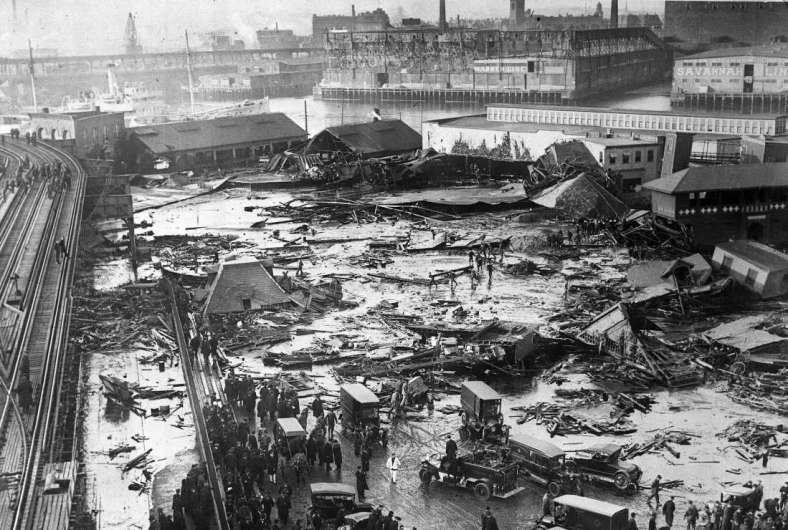
Aftermath of the Boston Molasses Flood.  Source: Boston Public Library

Anyone who has been in the trade of emergency management will likely tell you to always expect the unexpected.  No two disasters are ever the same.  While we can predict similarities from one flood, fire, or hurricane to another, there are always different impacts, needs, and circumstances which often give us cause to consider different means and methods in our response.  Some disasters are noted for specific uniquenesses in their impacts, needs, or circumstances which tend to be a theme of sorts for that disaster.  Every once in a while, however, a disaster occurs which was largely unexpected.

99 years ago this month, the City of Boston encountered one of those unexpected disasters when a flood of over two million gallons of molasses rushed through several blocks of Boson’s North End, killing 21 people and several horses, injuring 150 people, and destroying numerous buildings.  The molasses took weeks to clean and the cause and origin investigation took years, with a final ruling against the company which owned the massive storage tank being found liable.

While I had originally intended to write more about the incident in-depth, I think it most prudent to steer readers toward some of the sources I had looked at, as the information is quite interesting.

While an incident like this seems so unlikely as to never occur again, never say never.  In 2013 over 200,000 gallons of molasses was spilled into Honolulu Harbor.  While no people were killed or buildings destroyed from this pipe leak, the fish kill in the harbor was massive.

And yes, even a beer spill can be hazardous.  In 1814 several tanks containing over 300,000 gallons of beer ruptured in London.  The tidal wave of ale damaged and destroyed several structures and killed 8 people, aged 3 to 63.

We often think about hazardous materials as only being volatile chemicals which can ignite or cause harmful, noxious fumes.  We must consider that any substance in sufficient quantity introduced into a space where it’s not supposed to be can be extremely hazardous, both to people and the environment.  A flood is the most fundamental of these… I don’t think we need to detail the threat and impacts from flood waters.  But as you assess hazards in your community, consider that bulk storage of things like milk, grains, or other materials, which we often don’t consider hazardous, can cause great impact should they be unleashed on people, infrastructure, and the environment.  While our safety regulations (a mitigation measure) are certainly stronger than those which were in place in the 1800s and early 1900s, the hazards still exist.  Be smart and don’t dismiss those hazards outright.

What out of the ordinary hazards concern you?

© 2018 – Timothy M. Riecker, CEDP

Emergency Preparedness Solutions, LLC SM

NIMS Implementation Objectives and A Shot of Reality

Happy 2018 to all my readers!  Thanks for your patience while I took an extended holiday break.  A minor surgery and the flu had sidelined me for a bit, but I’m happy to be back.

This morning, FEMA issued NIMS Alert 01-18: National Engagement for Draft NIMS Implementation Objectives.  NIMS Implementation Objectives were last released in 2009, covering a period of FY 2009-FY2017.  With the release of the updated NIMS last year, FEMA is updating the implementation objectives and has established a national engagement period for their review.

So first, a bit of commentary on this document…

The new objectives are broken out by major content area of the updated NIMS document, including: Resource Management, Command and Coordination, and Communication and Information Management; as well as a General category to cover issues more related to management and administration of the NIMS program.  What we also see with these updated objectives are implementation indicators, which are intended to help ground each objective.  Overall, the number of objectives in this update has been cut in half from the 2009 version (28 objectives vs 14 objectives).

All in all, these objectives appear to be consistent with the current state of NIMS implementation across the nation.  They are certainly suitable for most matters in regard to the oversight of implementing NIMS and it’s various components.  The biggest sticking point for me is that this document is intended for use by states, tribal governments, and territories.  If the goal is to have a cohesive national approach to implementation, I’d like to know what the implementation objectives are for FEMA/DHS and how they compliment those included in this document.

Objectives 8 through 11 are really the crux of this document.  They are intended to examine the application of NIMS in an incident.  These objectives and their corresponding indicators (which are largely shared among these objectives) are the measure by which success will ultimately be determined.  While it’s a good start for these to exist, jurisdictions must be more open to criticism in their implementations of NIMS and ICS.  In addition, there should be an improved mechanism for assessing the application of NIMS and ICS.  While formal evaluations occur for exercises under the HSEEP model, we tend to see inconsistent application of the feedback and improvement activities to correct deficiencies.  Proper evaluations of incidents, especially at the local level, are often not performed or performed well. For those that are, the same issue of feedback and improvement often stands.

Extending this discussion into reality…

The reality is that many responders are still getting it wrong.  Last year my company conducted and evaluated dozens of exercises.  Rarely did we see consistently good performance as far as NIMS and ICS are concerned.  There are several links in this chain that have to hold firm.  Here’s how I view it:

First, the right people need to be identified for key roles.  Not everyone is suited for a job in public safety or emergency management in the broadest sense.  Organizations need to not set up individuals and their own organization for failure by putting the wrong person in a job.  If a certain job is expected to have an emergency response role, there must be certain additional qualifications and expectations that are met.  Further, if someone is expected to take on a leadership role in an ICS modeled organization during an incident, there are additional expectations.

Next, quality training is needed.  I wrote a couple years ago about how ICS Training Sucks.  It still does.  Nothing has changed.  We can’t expect people to perform if they have been poorly trained.  That training extends from the classroom into implementation, so we can’t expect someone to perform to standards immediately following a training course.  There is simply too much going on during a disaster for a newbie to process.  People need to be mentored.  Yes, there is a formal system for Qualification and Certification in ICS, but this is for proper incident management teams, something most local jurisdictions aren’t able to put together.

Related to this last point, I think we need a new brand of exercise.  One that more instructional where trainees are mentored and provided immediate and relevant feedback instead of having to wait for an AAR which likely won’t provide them with feedback at the individual level anyway.  The exercise methodology we usually see applied calls for players to do their thing: right, wrong, or otherwise; then read about it weeks later in an AAR.  There isn’t much learning that takes place.  In fact, when players are allowed to do something incorrectly and aren’t corrected on the spot, this is a form of negative reinforcement – not just for that individual, but also for others; especially with how interrelated the roles and responsibilities within an ICS organization are.

While I’m all for allowing performers to discover their own mistakes and I certainly recognize that there exist multiple ways to skin the proverbial cat (no animals were harmed in the writing of this blog), this is really done best at a higher taxonomy level.  Many people I see implementing portions of ICS simply aren’t there yet.  They don’t have the experience to help them recognize when something is wrong.

As I’ve said before, this isn’t a school yard game of kickball.  Lives are at stake.  We can do better.  We MUST do better.

As always, thoughts are certainly appreciated.

© 2018 – Timothy Riecker, CEDP

Emergency Preparedness Solutions, LLC SM


Learning From a 10-Year-Old Report

I’ll admit that I’m often dismissive of information, especially in the field of emergency management and homeland security, if it’s over 10 years old.  There is a lot that’s changed in the past 10 years, after all.  But, realistically, for as much as we’ve changed, things have stayed the same.  Arguably, the first decade of this millennium saw much more change in EM/HS than the second decade has, at least so far.  The first decade saw events like 9/11 and Hurricane Katrina.  Yes, there certainly have been major events in this second decade, but none, it seems, were as influential to our field of practice than those in the first decade.

It’s important to reflect upon lessons observed and to examine what lessons we’ve actually learned.  How far have we come in implementing improvements from the 9/11 Report?  What still needs to be accomplished to meet the intent of the Post-Katrina Emergency Management Reform Act (PKEMRA)?  Perhaps when I have some time to devote I’ll review those documents again and look on them reflectively and provide my thoughts here.

Yesterday I received the latest email from DomesticPreparedness.com.  I refer often to their work in my articles.  This weekly brief included an article from one of my favorite authors in this field, John Morton.  I’ve referenced his work in a few of my past articles.  This article, titled The What If Possibility: A Chilling Report, talks about planning for a rogue nuclear attack, the likely lead role the federal government would have to take in response to such an attack (versus a locally-led response), and what the situation would be the day after.  With the threat of North Korean nuclear weapons capability looming, this article was an interesting read and spot-on.  I noticed a problem, though… It referenced Ash Carter as an assistant secretary of defense in the Clinton administration.  While this was true, Carter’s highest office was SecDef under President Obama.  Surely John Morton, with his incredible attention to detail that I’ve come to recognize couldn’t have made this error.

Nope.  No error on his part.  I looked at the date of the article.  June 27, 2007 – over a decade old.  Incredibly, this article is still highly relevant today.  The article does reference the drafting of certain federal plans for nuclear attack.  Plans which I am not privy to, but that must assuredly exist today.  I’m curious as to the model these plans follow, what has been learned from exercising them, and how we might be able to apply elements of these plans to other catastrophic occurrences.

Despite change, so much seems to stay the same. Of course a decade isn’t that long.  Given that emergency management and homeland security are primarily government roles, we have to acknowledge that the (usually necessary) bureaucracy simply doesn’t move that quickly.  Unfortunately, there are things we are far too slow to adopt, not just from a government perspective, but socially.  As a lover of history and sociology, I see lessons observed from the 1900 Galveston hurricane as well as the eruption of Mt Vesuvius in 79 CE.  There is much that history can teach us, if we are willing to listen. Lessons observed, but not learned.

© 2017 – Timothy Riecker

Emergency Preparedness Solutions, LLC

Private Sector Logistics Support for Disasters, aka. To Stockpile or Not to Stockpile

I recently had an article brought to my attention by my friend Keri.  The article is titled Home Depot or Homeland Security and is written by Max Brooks. Before I dive into some commentary on the article and related matters, I want to give a bit of an introduction of Max Brooks.  While many of you may not know of him, you might know of his work; and I’m quite sure you know of his father and his father’s work.  What seems so unlikely is that this article, and others, have been written by Max for West Point’s Modern War Institute.

Max Brooks is the author of, among other books, the New York Times best seller World War Z.  His father is Mel Brooks, who, in my opinion, is the greatest comedic writer and director of all cinema.  Max is a non-resident fellow at the Modern War Institute (MWI).  He has published three zombie-themed books: World War Z, the Zombie Survival Guide, and The Zombie Survival Guide: Recorded Attacks.  I’ve written in the past about the perspective that unorthodox scenarios can bring to homeland security and emergency management.  Max’s writings inspire just that, bringing him to be recognized by the MWI and Naval War College.  You can check out his biography and other information about him here.

As a fellow of the MWI, Max Brooks has been working on a series of lectures and papers.  The one I’m discussing here was posted about a year ago by the MWI.  In his paper, he briefly outlines the role of the Defense Logistics Agency and the importance of the private sector in supporting disaster response and recovery as well as the military.  He smartly identifies this as a potential vulnerability, but I’ve also seen first-hand the reality behind it.

During the 9/11 response, a representative from Grainger sat in the Logistics Section of the NYS Emergency Operations Center.  While the State of New York owns a lot of resources, the availability of those resources, the practicality of moving those resources, and the timeliness of getting those resources to where they were needed (generally the metro-NYC area) sometimes wasn’t workable, despite the nature of the emergency – especially when those resources are more in the nature of supplies and small equipment, and needed in mass quantity.  With several warehouses in and around the metro-NYC area, Grainger could have orders processed and delivered quickly and efficiently.  The same holds true for other companies, which were also leveraged during this response.

Stockpiling is a smart practice, but it needs to be looked at from a practical and fiscal perspective.  The Civil Defense era saw a lot of stockpiling.  Food, water, cots, blankets, radiological detection equipment, fuel, and other supplies.  Most of this went unused for years until officials saw the utility of drawing on these stockpiles in times of natural disaster.  Still, food and water have a shelf life, as does fuel.  Stocks had to be rotated to ensure viability.  Rodents, insects, and water damage goods like cots and blankets.  Mechanical equipment needs to be maintained, even in dis-use.  The physical space, money, and people needed to manage these rarely used stockpiles have a limited return.

Still, stockpiling is a good thing.  You just have to be smart about what you stockpile and where you position it.  Many states maintain several emergency equipment stockpiles.  The purpose of the stockpiles is to support local governments in extended life-safety activities.  Generators, chain saws, and potable water distribution are among the equipment available.  These do, indeed take up space and require regular maintenance.  The prevalence of floods and storms in the northeast, however, make these high demand items by local governments.  The positioning of the stockpiles helps ensure a timely delivery, often with the support of other state agencies.

There are limits, though, to the ability of a government agency to store, maintain, and distribute supplies and equipment.  Some aren’t often requested, so don’t make sense to stockpile.  Others have such a short shelf life or require expensive maintenance that don’t make financial sense.  Still others may very often be available locally, albeit by the private sector.

Emergency management agencies in recent years have not only looked to private vendors to support supply needs, they have also looked to the private sector to model the management of logistics and resource tracking.  Companies like FedEx or UPS, despite leaving my packages at the wrong door, do an unparalleled job of moving and tracking goods.  Companies like WalMart and Target, who are often victims of local disaster impacts themselves, have a presence in disaster areas to not only restore their own operations, but to also provide as much as they can to communities in need.  Lowes and Home Depot have been better able to meet demands prior to and following disasters with tarps, building materials, generators, and sump pumps.  Despite improvements, the bureaucracy of government simply doesn’t have the capability or capacity to move the quantity of goods needed.

While I acknowledge that there is some vulnerability, as Max Brooks points out, in having a third party as a critical component of your supply chain, we also have strength and efficiency through these partnerships.  Emergency management must continue working with private sector partners, locally, nationally, and internationally to strengthen these partnerships and support the private sector in supporting response and recovery endeavors.

What are your thoughts on the depth of involvement of the private sector in supporting response and recovery?  Do we rely on them too much?  If so, what’s our alternative?

© 2017 – Timothy Riecker, CEDP

Emergency Preparedness Solutions, LLC


Taking Care of Your Staff After a Disaster

We are slowly seeing Continuity of Operations (COOP) Plans becoming more popular for organizations ranging from government, private sector, and not for profit.  There are numerous lessons learned that promote the benefits of these efforts to reduce the impacts from an incident on your organization, decrease down time, and increase the overall chances of your organization surviving a disaster.  Most COOP plans, however, are focused on organizational operations and mission essential functions, which is great, but organizations must remember that none of these can be performed without staff.

The ability of an organization to care for its staff, to the greatest extent possible, will not only support the organization’s recovery, it’s also the right thing to do.  Consider that taking care of staff also includes taking care of their families.  It’s difficult for a staff member to come to work focused on your mission when they have family members endangered by a disaster.

What can you do?  I don’t think anyone expects their employer to take care of all needs, but a bit of support and understanding go a long way.  If your organization has a direct role in emergency or disaster response or recovery, the support you provide your staff is even more critical.  While I have a number of tips and lessons learned from my own experiences on this, I came across a paper recently published by the US Department of Health and Human Services (HHS) Office of the Assistant Secretary for Preparedness and Response (ASPR).  While ASPR’s mission is to support hospitals and other healthcare facilities, this four-page document provides great information for all organizations.

Remember – the time to prepare is now!

© 2017 – Timothy Riecker, CEDP

Emergency Preparedness Solutions, LLC

Congressional Primer on Responding to Major Disasters and Emergencies

I believe the Congressional Research Service (CRS), which is a research arm of the Library of Congress, publishes an updated version of this document for each Congress.  While the primary audience is Congressional representatives, it provides a good overview of disaster response fundamentals and the relationship between the federal and state/territorial/tribal governments which can be a good reference for many, including practitioners, students, state and local officials, and members of the media.

Give it a look and pass it on to others.

https://www.hsdl.org/?abstract&did=804217

– TR

Nationwide EAS Test Scheduled

From FEMA~

Mandatory Nationwide Test of the Emergency Alert System to be Conducted September 27

The Federal Emergency Management Agency (FEMA), in coordination with the Federal Communications Commission (FCC), will conduct a mandatory nationwide test of the Emergency Alert System (EAS) on September 27, 2017 at 2:20 pm EDT. The test will assess the readiness for distribution of the national level test message, as well as verify its delivery.

The EAS test is made available to radio, television, cable, and direct broadcast satellite systems, and is scheduled to last approximately one minute. The test’s message will be similar to the regular monthly test message of the EAS with which the public is familiar, only inserting the word “national.” “This is a national test of the Emergency Alert System. This is only a test.”

Significant coordination and regional testing has been conducted with the broadcast community and emergency managers in preparation for this EAS national test. The test is intended to ensure public safety officials have the methods and systems that will deliver urgent alerts and warnings to the public in times of an emergency or disaster. Periodic testing of public alert and warning systems is also a way to assess the operational readiness of the infrastructure required for the distribution of a national message and determine whether technological improvements are needed.

Conducting the test following Hurricanes Harvey, Irma, Jose, and Maria will provide insight into the resiliency of our national-level alerting capabilities in impacted areas. The test will also provide valuable data into how the Integrated Public Alerts and Warning System performs during and following a variety of conditions. With two major hurricanes already making landfall, and a potential for two more impacting our nation, we need to have the ability to maintain the continuity of critical infrastructure under various conditions.

Receiving preparedness tips and timely information about weather conditions or other emergency events can make all the difference in knowing when to take action to be safe. FEMA and our partners are working to ensure alerts and warnings are received quickly through several different technologies, no matter whether an individual is at home, at school, at work, or out in the community. The FEMA App, which can be downloaded on both Android and Apple devices, is one way to ensure receipt of both preparedness tips and weather alerts. The FEMA App can be downloaded at https://www.fema.gov/mobile-app.

The back-up date for the test is October 4, 2017, at 2:20 pm EDT, in case the September 27 test is cancelled. More information on the IPAWS and Wireless Emergency Alerts is available at https://www.ready.gov/alerts.

This is the third mandatory nationwide test of the EAS. The first test was conducted in November 2011, in collaboration with the FCC, broadcasters, and emergency management officials. The second mandatory test was conducted in September 2016. You can also access a video, FEMA Accessible Emergency Alert System IPAWS Test Message, in American Sign Language.

In 2007, FEMA began modernizing the nation’s public alert and warning system by integrating new technologies into the existing alert systems. The new system, known as IPAWS became operational in 2011. Today, IPAWS supports more than 900 local, state, tribal, and federal users through a standardized message format. IPAWS enables public safety alerting authorities such as emergency managers, police, and fire departments to send the same alert and warning message over multiple communication pathways at the same time to citizens in harm’s way, helping to save lives. For more information on FEMA’s IPAWS, go to: www.fema.gov/ipaws. For more preparedness information, go to www.ready.gov.