Is New Media Really Journalism?

This is a concept I’ve been struggling with for a while.  I see bloggers, podcasters, and YouTubers portray themselves as journalists quite often.  But are they?

The more traditional part of me wants to laugh at their pipe dream, considering that newspapers, TV and radio, and magazines fit into the definition of media and journalism that I’ve had most of my life.  But times, they are a changin’.  The term ‘new media’ isn’t new anymore.  Bloggers, podcasters, and YouTubers, as a whole, are mainstream and it appears they are here to stay.

While I’ve seen this on occasion in governmental and emergency management media relations, I see this most often in another facet of my life – pop culture.  Along with being a blogger on emergency management and homeland security matters, I’m also a co-host on several pop-culture and entertainment related podcasts.  Looking at things like fan conventions (think ComicCon and similar events), dozens and even hundreds of media badges are given to bloggers, podcasters, and YouTubers.  While some media credentials go to more traditional media outlets, the proportion is rather staggering.  In entertainment and pop culture this makes sense to a great extent.  Many who pay heed to pop culture also seem likely to consume blogs, podcasts, and YouTube content.  It’s also not necessarily location-bound (i.e. following a new media provider because they are local to you and report on local things – although some do).  The free media badges given out by convention organizers turns into free promotion of the goings-on of their events – so it makes sense, but what are the limits?  The sheer number of people applying for media badges for these events is staggering, and many are denied.

Why is new media so popular?  On the provider end, the barriers to entry are insanely low.  Generally, you need a computer, an internet connection, and an account to whatever portal you want to push your content through.  There are a few other resources needed depending on the actual medium, such as cameras and microphones, editing software, etc., but good quality in all of these can be found at very reasonable prices.  You can also go really lean and do it all from your smart phone.  Certainly there are the intangibles such as talent, good ideas, and persistence, which all tends to cull the herd.

On the consumer end, people crave new media content to read, hear, or see more about the things that entertain and interest them.  Despite things said about people’s attention spans, most blogs I read (as well as my own) have a reasonable length to them.  Most podcasts run 30-90 minutes.  YouTube videos tend to be shorter, but obviously tend to have a higher production value.  There is also a huge variety of new media available, with differing opinions and formats, and generally something for everyone.

But the question still remains, is new media actually journalism?  Obviously, I haven’t missed the irony in this.  Despite having and maintaining a blog for several years as well as my involvement in podcasts, I don’t consider myself a journalist.  At best, I’m an op-ed writer on the blogging side; and whatever the equivalent is on the podcasting side.  I appreciate that people value the content and opinions I put out there, but I’m no Walter Cronkite (really who is, but Walter himself?).

At the risk of taking heavy fire from my fellow bloggers and podcasters, I’m reluctant to broadly categorize much of new media as journalism.  It just seems there needs to be something that qualifies you to use the title.  I’m not saying a certification or anything bureaucratic like that, but honestly I don’t know what it should be.  When any person on any given day with little investment can suddenly announce that they are a journalist (or honestly anything), that tends to not sit well with me.  There needs to be a demonstration of commitment and professionalism.

There are some bloggers, podcasters, and YouTubers that I would consider journalists because of their longevity, their professionalism, and their following, but these are few.  I think most new media folks are entertainers.  Some are informers, yet still not journalists.  But there are some that are journalists, and they should be respected as such.

On the event management side of this (both in regard to pop culture as well as emergency management), where does the paradigm sit and does it need to change? How do you determine who you will give a media badge to?  In emergency management and government as a whole, it’s long been a best practice to maintain positive relationships with media outlets.  What kind of relationships, if any, are you maintaining with bloggers, podcasters, and YouTubers?  Do you need to?

I’m interested in thoughts and opinions on this – from everyone.  Are you a producer of new media – Do you consider yourself a journalist?  Are you a traditional journalist – what’s your take on this?  On the government and emergency management side – are you involved in media relations, and if so, what are your ideas?  Are you not involved in either, but have an opinion?  Please share it!

© 2017 – Timothy Riecker, CEDP

Emergency Preparedness Solutions, LLC


Exercises: Simple is Usually Better

I find often that people want to run exercises they aren’t quite ready for.  Sometimes those exercises are too complex, or they simply aren’t the appropriate type.  Most often, we run exercises to test plans, policy, and procedures; but sometimes those plans, policies, and procedures aren’t quite ready to be tested.  Last year I advised a client to run a workshop instead of a tabletop exercise.  The initial goal of the tabletop was to validate a new plan, but this plan wasn’t ready to be validated.  The problem was that many stakeholders hadn’t yet seen the plan, and the review of that plan by our team in preparedness for the exercise wasn’t favorable.  The plan had much of the needed content, but it was disjointed and didn’t have any logical flow.  By conducting a scenario-based workshop, we were able to identify not only the ideal flow of the plan by flagging benchmark activities, but we were also able to discuss expectations of and for each stakeholder agency in the plan.  The client was then able to apply the results of the workshop to restructure their plan and make some needed substantive changes.

Similarly, I’ve encouraged a current client to conduct a workshop instead of a tabletop.  The initial goal of this tabletop was to identify how a new group of stakeholders could integrate into an existing plan.  In this situation, the tabletop would have been less than effective as the new stakeholder group isn’t yet identified in the plan.  The outcome of the workshop will be to identify how this integration can occur.

I think that sometimes people gravitate to certain exercises simply because they are more popular in a certain application.  That preconceived notion might be too complex or simply a poor choice for what you really need to accomplish.  When it comes to discussion-based exercises, most people default to a tabletop.  With operations-based exercises, it can vary.  Drills are often used for tactical applications, but we don’t see them as much in EOCs.  Drills certainly have a place in an EOC if you are looking to test a very specific function or activity.  While full-scale exercises are fun and sexy, I’ve been to the site of plenty that are total chaos because the fundamental premise of certain plans hasn’t been worked out (or some stakeholders aren’t familiar with them), which perhaps should have been done through a discussion-based exercise or a drill or functional exercise first.  Running a drill to test and familiarize the process of setting up key equipment prior to doing it for the first time in a full scale will pay a lot of benefits, and certainly prevent dozens or hundreds of other people being held up in a full scale.

Another issue I often see with exercises is very long and complex Master Scenario Events Lists (MSELs).  The MSEL is essentially the timeline or script of the exercise.  Along with listing all injects, it also identifies all benchmarks in the management of the exercise, such as StartEx and EndEx, and the introduction of new elements or transition to a different segment.  While there is no particular rule of thumb for how many injects are needed for different exercise types, everything needs to associate back to the objectives of the exercise.  I hate injects that are crafted simply for ‘noise’ (unless it’s an intel exercise), or injects intended to just give someone something to do.  Arguably, if the participants take an exercise seriously, such as a functional exercise, and play out the situation as they would in real life, you can engage an entire EOC for a few hours with even ten well-crafted injects.  While some functions are very focused, consider that the vast majority of what we do in emergency management requires coordination among a variety of elements and functions.  Capitalize on that.  One inject may engage multiple agencies or functions because of the need to coordinate and problem solve.  It’s not enough to identify a solution to the problem, but work through where the resources will come from, how they will get to where they need to go, and what support is needed for them and how long.  That’s a lot of problems to solve and will often transcend every function within the incident command system.  Exercises don’t need to be complex to be effective.  Create a handful of objectives and make sure everything relates back to them.  Simplicity can work.

My last recommendation is to keep your exercise planning team a manageable size.  I’ve been the lead planner for some very large exercises.  These exercises, largely due to their sponsors, ended up involving massive exercise planning teams – and by massive I mean over five or six dozen people – or more.  These are just sheer insanity.  Not every agency or organization involved in the exercise needs to be directly represented, nor does each organization need to send a small army of people.  What you do need is consensus from those organizations on the objectives and their scope of play.  That doesn’t mean they have to be involved in every aspect of planning the exercise.  Just like any other meeting or group project, a large exercise planning team can be cumbersome and management by committee is never efficient.  If need be, stakeholder groups can be developed based upon function.  For example, a fire service exercise planning team would develop their contributions to the exercise.  Just make sure that these groups are well coordinated and the overall exercise planning effort is unified, otherwise you’ll end with a disjointed exercise effort.

In the end, simplicity rules.  As you begin planning your exercise, consider, in every step if it can or should be simplified.  Always refer back to your intent and your objectives.  Chances are you can create a simpler exercise that is just as impactful, or perhaps more impactful.  When our inclination is to make things overly complicated, we often miss the point entirely.

© 2017 – Timothy Riecker, CEDP

Emergency Preparedness Solutions, LLC


Awareness of Public Health Preparedness Requirements – CMS

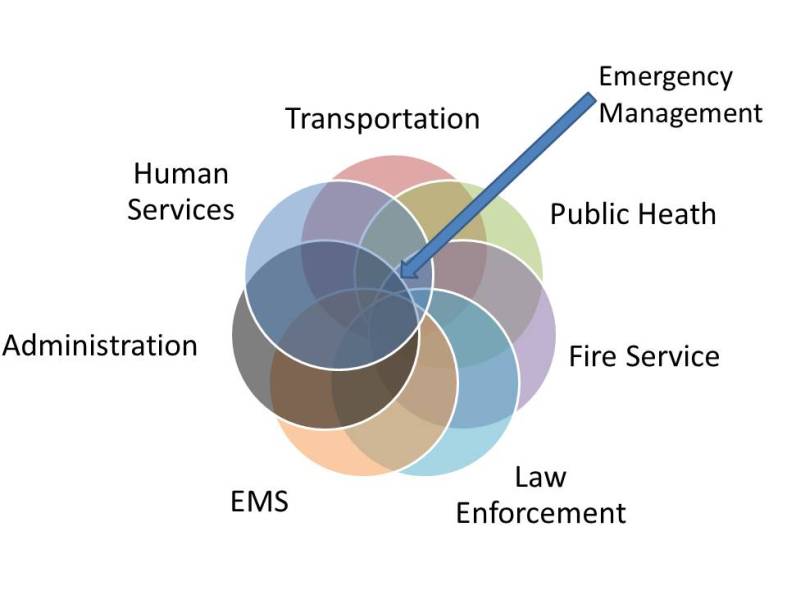
Emergency management and homeland security are collaborative spaces.  Think of these areas a Venn diagram, with overlapping rings.  Some of the related professions overlap with each other separately, but all of them overlap in the center.  This overlap represents the emergency management and homeland security space.  What’s important in this representation is the recognition that emergency managers and homeland security professionals, regardless of what specific agency they may work for, need to have awareness of that shared space and the areas of responsibility of each contributing profession.  One of the biggest players in this shared space is public health.Presentation1

For nearly a year, public health professionals have been talking about new requirements from CMS, which stands for The Centers for Medicare and Medicaid Services.  How does Medicare and Medicaid impact emergency management?  CMS, part of the Department of Health and Human Services (HHS) covers over 100 million people across the US – far more than any private insurer.  As an arm of HHS and a significant funding stream within public health, they set standards.

The most relevant standard to us is the Final Rule on Emergency Preparedness Requirements for Medicare and Medicaid Participating Providers and Suppliers.  The rule establishes consistent emergency preparedness requirements across healthcare providers participating in Medicare and Medicaid with the goal of increasing patient safety during emergencies and establishing a more coordinated response to disasters.

The CMS rule incorporates a number of requirements, which include:

  • Emergency planning
  • Policies and procedures
  • Communications planning with external partners
  • Training and exercises

These are all things we would expect from any emergency management standard.  Given the different types of facilities and providers, however, the implementation of the CMS rule can be complex.  A new publication released by the HHS ASPR (Office of the Assistant Secretary for Preparedness and Response) through their TRACIE program (Technical Resources, Assistance Center, and Information Exchange), provides some streamlined references to the CMS rule.  It’s a good document to study up on and keep on hand to help keep you aware of the requirements of one of our biggest partners.

© 2017 – Timothy Riecker, CEDP

Emergency Preparedness Solutions, LLC

Public Area Security National Framework

The Transportation Security Administration (TSA) recently released this report in cooperation with a variety of stakeholders which provides information and guidance on preparedness, prevention, and response activities to strengthen the public spaces of transportation venues.  While the focus of the document is on airports, the information in the document is great not only across all transportation venues, but other public spaces as well.  I think there are great takeaways for other areas of vulnerability, such as malls, convention centers, event spaces, and others.

To be honest, there is nothing particularly earthshattering in this document.  The document is brief and identifies a number of best practices across emergency management and homeland security which will help agencies and organizations prevent, protect, prepare, and respond to threats, particularly attacks.  That said, the document does accomplish providing concise information in one document on key activities that absolutely should be considered by entities which control public-access spaces.  I would also suggest that this document is still 100% relevant to those which have some access controls or entry screenings.

Information in the document is segmented into three key tenets: Information Sharing, Attack Prevention, and Infrastructure and Public Protection.  Within these tenets are found recommendations such as relationship building, communication strategies, vulnerability assessments, operations centers, planning, training, and exercises.  Most of the recommendations provide examples or leading best practices (although no links or sources of additional information, which is a bit disappointing).

The framework is worth a look and can probably serve as an early foundation of activity for those who haven’t yet done much to prepare their spaces for an attack.

© 2017 – Timothy Riecker, CEDP

Emergency Preparedness Solutions, LLC

Can we Require Preparedness?

The City of Pittsburgh recently lost an effort to require emergency preparedness training for security officers and building service employees.  The Commonwealth Court ruled that the City did not have the authority to require such an ordinance.  This is just another example we’ve seen with difficulties across the US with requirements for preparedness measures.  Why is it so challenging?  It often comes down to the legality of the requirement.

When it comes to the interface of local jurisdictions with states, we often see the concept of home rule providing one of the greatest challenges.  Some interpretations of home rule laws identify that states can’t require local (often to include county) jurisdictions to conduct certain activities, such as have certain plans, attend training, or conduct exercises.  In some states, we see law or regulation that states that if a jurisdiction is to have an emergency plan, then there is a required format of said plan.  But if there is no stick, there is often a carrot.

If requirements can’t be established, then incentives are often the best alternative.  Again, in the local/state relationship, states have grant allocations which can be provided to local governments.  Grant rules can be established that identify certain requirements as conditions of funding.  This tends to be highly effective, especially when funding is expected to continue year after year, and the grants continue to reinforce sustained maintenance on these requirements, such as periodic updates to emergency plans.  Generally, I see no down side to this alternative, so long as the required initiatives are well thought out and realistic given the amount of funds the jurisdiction is receiving.  To ensure effectiveness, however, there must be accountability and quality control measures in place to monitor execution of these requirements; such as reviewing plans, After Action Reports, and auditing training programs. This same methodology is typically how DHS/FEMA is able to get states and funded urban areas (UASIs) to comply with their wishes for various initiatives.

Outside of government, requirements can still be difficult.  While regulations may be put into place for certain industries and under certain conditions, we often have to rely on other, more practical, means of getting businesses, industry, and even not for profits on board.  This often comes with certifications.  An example would be ISO certifications, which some businesses and industry need to compete in certain markets.  Yes, there is even an ISO standard for emergency management.

Unfortunately, many entities, be they public, private, or even individuals, don’t want to be bothered with preparedness.  Most will agree that it’s a good idea, but it takes time, money, and effort.  It’s long been said that you can’t legislate preparedness, and that is often true.  Even if a requirement is able to be established, the extent of implementation can range widely, depending on the internal motivations and resources available to the entity.  Establish whatever requirements you want, but I guarantee there are some that will barely meet those requirements, and in doing so likely not meet the actual intent of the requirement; while others who are believe in the requirement and have available resources, will exceed the requirement.  Largely, organizations are motivated by funding and certification standards.

I’m interested in the perspectives you have on requiring preparedness, both in the US as well as other nations.

© 2017 – Timothy Riecker, CEDP

Emergency Preparedness Solutions, LLC

Supporting a Public Safety Training Program

Today happens to be National Teacher’s Day.  Be sure to show some appreciation for the teachers and professors who have influenced you and provide quality experiences for your kids.  Also consider expanding the definition of ‘teacher’.  In the public safety professions, we do a lot of training.  Some of us have structured academies, and while others may not, there are a lot of training opportunities provided locally, state-wide, and nationally.  Depending on the size and scope of your agency, you may run your own training program for internal, and potentially external stakeholders.

For a few years, I ran the training and exercise program of a state emergency management agency.  We delivered training programs state-wide to a variety of stakeholders.  We also developed some training programs to address needs which curricula from FEMA or other national providers could not meet.  Fundamentally, delivering training is easy, but properly managing a training program can have challenges.  Some thoughts…

  • Find the right people for the job. While we hired some personnel full time to be trainers, we also used people from elsewhere in the agency, as well as personnel from partner agencies, and hired some as 1099 employees.  There are a lot of highly qualified individuals in public safety – if you don’t know any, just ask, and they will be sure to tell you!  Assuming their qualifications are valid, are the most experienced and knowledgeable people always the best instructors?  Absolutely not.  While they may be subject matter experts, it doesn’t mean they have good presentation skills, much less comfort in doing so.  On the flip side, you might also have someone with little experience who has great delivery skills.  That might be a person to develop.
  • Quality control. When people are delivering training, peek in once in a while.  I traveled around the state regularly, and once in a while would see if one of our courses was being held somewhere along my route.  If I had the time, I would stop in and see how things were going.  While the visit was a surprise, our instructors knew this is something that might happen.  There are a few things this accomplishes.  First of all, it gives you an opportunity to observe and provide feedback.  Everyone can improve, and hopefully they can handle some constructive feedback.  Evaluation, formal or informal, is positive for the instructor and the program.  Look for consistency of practice (see the next bullet point) and professionalism.  On one of my surprise visits, I found an instructor wearing jeans and a sweatshirt.  When I discussed it with him, his response was that he was ‘retired’ (teaching for the agency was a retirement job for him) and that he could do whatever he wanted to.  After that discussion was happy to retire him further. Stopping in also shows support for your instructors and for the program as a whole.  Weather traveling across the state or down the hall, instructors want to know they are being supported.  A big part of support is simply being present.
  • Consistency counts. Training programs should be consistent.  While we might change around some examples or in-class scenarios, training delivered in one location by instructor a should largely match the training delivered another day, in a different location by instructor b.  Coming up through the ranks as a field trainer, I was part of a group that wanted to heavily modify the courses we delivered.  As I rose to management, I realized how detrimental this was.  If improvements are warranted, work with your instructors to integrate those improvements into the course.  Make sure that improvements are in line with best practices, not only in instructional design (remember: content must match objectives), but also with the subject matter.  Consistency not only ensures that all your learners are provided the same information, but also makes your curriculum and instructors more legally sound.  Too often we see instructors ‘going rogue’, thinking that they know a better way.
  • Programs need systems. A big part of building and maintaining a program is having adequate systems in place.  Systems require policies, procedures, and tools.  This is largely the behind the scenes stuff of a training program.  This includes annual curriculum reviews, performance reviews of instructors, selection/hiring and firing of instructors, maintaining instructors (see the next bullet), ordering course materials, maintaining training records, posting a course, course registrations, course cancellations, and so much more.  While it sounds bureaucratic, there should be a piece of paper that covers every major activity, identifying how it’s done, by who, with what approvals, and at what time.  Systems make sure that things aren’t missed, give you a basis of performance to evaluate the system and to train new staff, and help ensure consistency.  Systems contribute to your professionalism and are also good practices for business continuity.  Lots of credit to Cindy who was highly dedicated to establishing systems!
  • Keep instructors engaged. With either a large or small training shop, it’s important to maintain contact with your instructors.  Not just in handing them assignments and shuffling paperwork, but to really engage them.  We established twice a year ‘instructor workshops’, bringing our instructors together for two days.  From a management and administrative perspective, we used some of this time to express appreciation for their work, and provide information on curriculum updates and other information.  We encouraged much of the workshop agenda to be developed by the instructors themselves, with professional development provided by their peers.  This could include instructor development, after action reviews of incidents, case studies, and a variety of other activities and information.

Those are just a few tips and lessons learned.  I’m sure you may also have some to add to the list – and please do!

© 2017 – Timothy Riecker, CEDP

Emergency Preparedness Solutions, LLC

Emergency Alerting – A Case Study

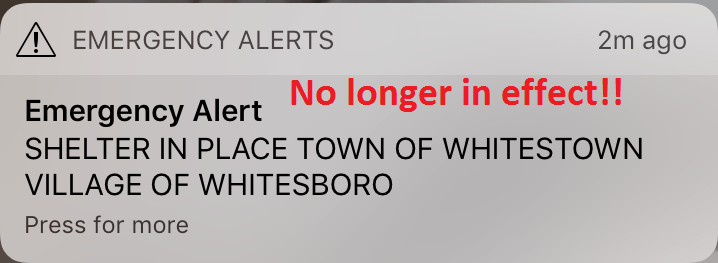
Two days ago, much of the northeast was subject to a powerful storm front, which brought high winds, torrential rains, lightning, and several yet to be confirmed tornadoes.  Corresponding with these threats, areas saw a variety of National Weather Service warnings and watches.  Needless to say, when this emergency alert came up on my phone in the midst of these storms, I assumed the shelter in place order was weather related.  Well, you know what they say about assuming things… and of course I should have known better.

While the area of the alert didn’t impact me, Whitestown is just a couple of towns over, so after a few minutes I figured I should do a bit of research to see if whatever prompted the alert might eventually impact my area.  Unfortunately, ‘pressing for more’, as the alert message indicates, gave no further information.  News media in my area is notoriously slow and uninformative for a period of time, something that held true with this event as well.  Approximately 20 minutes later, a local news outlet Tweeted a message about law enforcement activity in that area related to an armed suspect.

Public information and warning is a big deal.  When we don’t communicate clearly and concisely with the public, we can suffer unintended consequences. While I’m not aware of any severe unintended consequences from the lack of any additional information from this emergency alert, officials must understand that the public (and other public safety professionals) want additional information.  They may also need it so they can make better decisions.

This particular example certainly should have included some brief context as to why the alert was issued.  Given the standing tornado watch which was in place at the time, I’m sure there were plenty of others who assumed this was for a tornado or other storm activity.  Such an occurrence would give me cause to gather my family in the basement for safety, rather than locking my doors, closing my blinds, and ensure that no family members left the house.  Shelter in place can mean a lot of things to different people and adding context could have assisted with ensuring better public safety.  There was also no follow up to this alert lifting the shelter in place message.  (Note: the ‘No longer in effect’ tag is my own, as an effort to be responsible with the image)

While I applaud the use of public alerting tools, issues such as this are seen far too often.  Jurisdictions should have public information and warning components to their emergency operations plans, with specific procedures outlined for not only how to activate an alert, but the proper messaging which should be included to maximize message effectiveness.  Sure, you do it, but do you do it well?

What do you do to ensure effectiveness of your messaging?

© 2017 – Timothy Riecker, CEDP

Emergency Preparedness Solutions, LLC

A New Standard for Emergency Management Programs

Over two years ago I wrote on the two primary standards for emergency management programs in the United States – the Emergency Management Accreditation Program (EMAP) and the National Fire Protection Association (NFPA) 1600: Standard on Disaster/Emergency Management and Business Continuity Programs.  These two standards are voluntary in their adoption and provide common sense guidelines on proven effectiveness and best practices for emergency management programs.  EMAP goes the additional step in offering accreditation for jurisdictions and/or programs based upon compliance with their standards.

Recently, New York’s Governor Cuomo announced what is apparently the nation’s first state-coordinated local emergency management accreditation program.  New York’s program is based upon 21 standards, created and maintained by a committee co-chaired by the NYS Emergency Management Association and the NYS Office of Emergency Management.  The accreditation process identified by NYS’ program guidance is fairly similar to EMAP’s, with application, preparation, a site visit, and committee review.

On the plus side, New York’s system is a further encouragement of the use and application of standards and has enough similarity to EMAP which puts the two accreditations on a close enough path that a jurisdiction can pursue both with little deviation.  The processes of preparation, an on-site review, and final accreditation council review are very similar. Further, agencies accredited through the New York State program are granted the ability to display the accreditation program logo, similar to EMAP, as a matter of pride and recognition.  New York’s system also requires a periodic reaccreditation, which encourages jurisdictions to maintain their accreditation standards.

Where New York’s program differs from EMAP…

  • EMAP accreditation is available to any entity, whereas New York’s appears to be specifically designed for local/county emergency management offices, although it does acknowledge the need for a whole community approach to emergency management
  • EMAP standards identify what components must be in place, not the means and methods used to accomplish those components. This is a significant difference from New York State’s program, which rather heavy handedly dictates means and methods, including mandatory completion of New York State’s emergency management and certification training by key staff, completion of the State’s County Emergency Preparedness Assessment (CEPA) program, and active use of the NY Responds system.  While fundamentally, I agree with promoting these as standards across the state, requiring them for accreditation can lead to a stagnated or stalled program if better training or systems are made available and the standard is not able to be kept current.  Required means and methods also stall innovation, which is another reason by NFPA 1600 and EMAP shy away from this practice.  That said, the aforementioned means and methods are the standard of practice in New York State, so this is a good opportunity to reinforce use of those standards.

New York’s new standard provides a solid exploration into the new territory of state-coordinated accreditation.  I’m a big proponent of states’ rights, and firmly believe this to be a good practice, especially when such accreditations reflect the principles of nationally recognized standards such as EMAP and NFPA 1600.  I don’t view New York’s system as being competitive with EMAP, rather it is quite complimentary.  With additional interests in standards, I’m hopeful that all standards will remain contemporary and cutting edge, constantly encouraging excellence and striving for improvements.

As always, I’m interested in your thoughts on state-coordinated accreditation and emergency management standards in general.

© 2017 – Timothy Riecker, CEDP

Emergency Preparedness Solutions, LLC

Thinking Beyond the Active Shooter

While there is obviously a great deal of attention placed on preparing for, preventing, and responding to active shooter events, is that where the focus really needs to be?  Yes, active shooter incidents are devastating, but they aren’t taking into consideration the full potential of we might be facing.  The DHS definition of ‘active shooter’ actually allows room for additional potential, but the term is still misleading and indicates the presence of only one perpetrator.  (DHS definition: “Active shooter is an individual actively engaging in killing or attempting to kill people in a confined and populated area.”)

First, let’s consider that more than one person could be perpetrating the incident.  Second, let’s consider that the perpetrator/perpetrators might be using something other than or in addition to firearms.  This could include edged weapons, blunt weapons, improvised explosives, or other threats.  Third, let’s consider an increased complexity, including synchronized attacks conducted by one or more independent teams occurring at multiple locations sequentially or in close succession.

To address these potentials, we’ve heard the terms ‘Active Assailant’, which certainly addresses individual(s) using any form of weapon(s) in their attack methodology.  This can also address the more highly complex incident type, which is commonly referred to as a ‘Complex Coordinated Attack’ or ‘Complex Coordinated Terrorist Attack’.  In essence, we are talking about the same conceptual incident, with varying complexity.  But what’s the difference?

The difference is that we should be preparing for a credible worst-case scenario.  While a single shooter is more likely to occur in most places, we’ve seen incidents of knife attacks such as those in recent months in London and Japan.  We’ve also seen motor vehicle attacks in Berlin and NiceThe Columbine High School attack involved firearms, knives, and improvised explosive devices, although the latter weren’t successfully detonated.  For their own reasons, none of these seem to match up with the impression most have with the term ‘Active Shooter’.  ‘Active Assailant’ might be better a better term generally for these kinds of incidents.   More specifically, by current standards, Columbine would likely meet the definition of ‘Complex Coordinated Attack’.  A complex coordinated attack doesn’t necessarily require a high value target or an international terrorist group to perpetrate.

When a jurisdiction plans for a flood, they generally don’t prepare for a couple of road washouts that might occur with a hard rain storm.  They should be preparing for the sudden destructive power of flash floods and the slower but equally devastating potential of areal flooding.   If the jurisdiction is prepared for the credible worst-case scenario, their preparations should be able to address flooding of a lower magnitude.  I’d argue the same for the range of active assailant incidents.  Active shooter incidents are one specific type of active assailant incident, but are not what our preparedness activities should be focused on, as these kinds of incidents can be much more complex and devastating.  Preparedness efforts should, instead, focus on the complex coordinated attack, which is arguably the most multifaceted and impactful type of this incident.  Preparing for the credible worst-case scenario will help ensure our preparedness across the entire spectrum of this kind of incident.

As always, feedback is appreciated.

© 2017 – Timothy Riecker, CEDP

Emergency Preparedness Solutions, LLC