Active Shooter Info from DHS

Good active shooter info from DHS.

Bruce Harman's avatarThe Security Takeaway

The tragedy in Newtown, Conn.  raised awareness of the Active Shooter threat. Listed below please find links to a number of reference and training resources which highlight response to the Active Shooter threat.

DHS Reference Materials:

DHS, Active Shooter – Booklet:   How to Respond www.dhs.gov/xlibrary/assets/active_shooter_booklet.pdf

 FEMA Online Courses:

Active Shooter:  What You Can Do http://training.fema.gov/EMIWeb/IS/IS907.asp


View original post

10 Myths About Mass Shootings

Last night I came across a blog by James Alan Fox, a Professor of Criminology, Law, and Public Policy at Northeastern University.  The blog was posted in the Chronicle of Higher Education and provides some interesting information relative to mass shootings.  Sadly, it doesn’t provide us with any conclusions or solutions, but does dispel some of the concepts and information that are out there about mass shootings.  Information like this will hopefully prevent us from diving into knee-jerk reactions.

The worst part of all this is that there is often times not actionable intelligence that law enforcement can follow-up on to prevent these types of incidents.  It’s not anything like an organized terrorist effort that involves a great deal of communication between conspirators.  The result is that mass shootings can occur literally anywhere and at any time.  Schools, movie theaters, community centers, malls, restaurants, and post offices are all among the places we go and expect to be safe.  We all wish we had an answer.

Here’s Professor Fox’s blog…

Top 10 Myths About Mass Shootings

December 18, 2012, 2:42 pm

By James Alan Fox

Even before the death toll in last Friday’s school massacre in Newtown, Conn., was determined, politicians, pundits, and professors of varied disciplines were all over the news, pushing their proposals for change. Some talked about the role of guns, others about mental-health services, and still more about the need for better security in schools and other public places. Whatever their agenda and the passion behind it, those advocates made certain explicit or implied assumptions about patterns in mass murder and the profile of the assailants. Unfortunately, those assumptions do not always align with the facts.

Myth: Mass shootings are on the rise. Reality: Over the past three decades, there has been an average of 20 mass shootings a year in the United States, each with at least four victims killed by gunfire. Occasionally, and mostly by sheer coincidence, several episodes have been clustered closely in time. Over all, however, there has not been an upward trajectory. To the contrary, the real growth has been in the style and pervasiveness of news-media coverage, thanks in large part to technological advances in reporting.

Myth: Mass murderers snap and kill indiscriminately. Reality: Mass murderers typically plan their assaults for days, weeks, or months. They are deliberate in preparing their missions and determined to follow through, no matter what impediments are placed in their path.

Myth: Enhanced background checks will keep dangerous weapons out of the hands of these madmen. Reality: Most mass murderers do not have criminal records or a history of psychiatric hospitalization. They would not be disqualified from purchasing their weapons legally. Certainly, people cannot be denied their Second Amendment rights just because they look strange or act in an odd manner. Besides, mass killers could always find an alternative way of securing the needed weaponry, even if they had to steal from family members or friends.

Myth: Restoring the federal ban on assault weapons will prevent these horrible crimes. Reality: The overwhelming majority of mass murderers use firearms that would not be restricted by an assault-weapons ban. In fact, semiautomatic handguns are far more prevalent in mass shootings. Of course, limiting the size of ammunition clips would at least force a gunman to pause to reload or switch weapons.

Myth: Greater attention and response to the telltale warning signs will allow us to identify would-be mass killers before they act. Reality: While there are some common features in the profile of a mass murderer (depression, resentment, social isolation, tendency to blame others for their misfortunes, fascination with violence, and interest in weaponry), those characteristics are all fairly prevalent in the general population. Any attempt to predict would produce many false positives. Actually, the telltale warning signs come into clear focus only after the deadly deed.

Myth: Widening the availability of mental-health services and reducing the stigma associated with mental illness will allow unstable individuals to get the treatment they need. Reality: With their tendency to externalize blame and see themselves as victims of mistreatment, mass murderers perceive the problem to be in others, not themselves. They would generally resist attempts to encourage them to seek help. And, besides, our constant references to mass murderers as “wackos” or “sickos” don’t do much to destigmatize the mentally ill.

Myth: Increasing security in schools and other places will deter mass murder. Reality: Most security measures will serve only as a minor inconvenience for those who are dead set on mass murder. If anything, excessive security and a fortress-like environment serve as a constant reminder of danger and vulnerability.

Myth: Students need to be prepared for the worst by participating in lockdown drills. Reality: Lockdown drills can be very traumatizing, especially for young children. Also, it is questionable whether they would recall those lessons amid the hysteria associated with an actual shooting. The faculty and staff need to be adequately trained, and the kids just advised to listen to instructions. Schools should take the same low-key approach to the unlikely event of a shooting as the airlines do to the unlikely event of a crash. Passengers aren’t drilled in evacuation procedures but can assume the crew is sufficiently trained.

Myth: Expanding “right to carry” provisions will deter mass killers or at least stop them in their tracks and reduce the body counts. Reality: Mass killers are often described by surviving witnesses as being relaxed and calm during their rampages, owing to their level of planning. In contrast, the rest of us are taken by surprise and respond frantically. A sudden and wild shootout involving the assailant and citizens armed with concealed weapons would potentially catch countless innocent victims in the crossfire.

Myth: We just need to enforce existing gun laws as well as increase the threat of the death penalty. Reality: Mass killers typically expect to die, usually by their own hand or else by first responders. Nothing in the way of prosecution or punishment would divert them from their missions. They are ready to leave their miserable existence, but want some payback first.

In the immediate aftermath of the Newtown school shootings, there seems to be great momentum to establish policies and procedures designed to make us all safer. Sensible gun laws, affordable mental-health care, and reasonable security measures are all worthwhile, and would enhance the well-being of millions of Americans. We shouldn’t, however, expect such efforts to take a big bite out of mass murder. Of course, a nibble or two would be reason enough.

Apocalypse Inquiry

I must share a brief story which I found to be rather humorous.

Just a few minutes ago I received a phone call from a local news station.  The caller, a reporter, asked for me by name and verified that I was a partner of Emergency Preparedness Solutions, LLC – my consulting firm.  She then asked if I had received any calls recently from anyone asking what they should do for the apocalypse – since, apparently, it is coming on December 21st.  I laughed and said ‘no’.  Despite doing a handful of presentations recently for businesses and not for profits I’ve not gotten any serious inquiries about apocalyptic preparedness – nor do I expect to, unless this post happens to spur some.

While we can’t predict the future, I expect that this coming Friday will be just like any other day on our temperamental planet.  My advice to everyone is to be prepared all the time!  Be informed, make a plan, build a kit, and get involved.

Happy Apocalypse!

Hurricane Sandy was a Surprise?

The second to last paragraph of this ABC News article contains a pretty shocking statement made by NYC Mayor Michael Bloomberg: “The city was not expecting Sandy.”  Really?  I think Mayor Bloomberg should have spoken to the good folks in his Emergency Management agency.  Or read one of the several reports cited in this article.  Or spoken to Michael Balboni who has been involved in emergency management and homeland security in New York State for many years.  Or looked at a map.

Optimistically, I think the Mayor’s intent here was to say that the chances of something like Hurricane Sandy happening were so low that there wasn’t much focus on it.  I’m still not thrilled with that, either, but I think that’s where he was going.

Folks, while the chance of such a strong system making landfall in the greater New York City area was pretty slim, it was still a possibility – and a very dangerous one.  A possibility, in fact, that a great deal of discussion and preparation had gone into.  The preparations that were done were good, but clearly not enough.  There needed to be massive investments of resilient, disaster mitigating infrastructure that would protect against the impacts of a storm such as this.  But we’re not too late.  We can still do these things.  Sadly, there isn’t a lot of money behind it, but we need to engage the political momentum behind this storm – just as we’ve seen in the aftermath of other major disasters such as 9/11 or Hurricane Katrina – which have funded massive projects.  We’ve seen ideas like a giant sea wall, which I’ve previously blogged about.  Or the mitigation projects engineered in, under, and around the city of Hong Kong, which I’ve also recently blogged about.  All these things are possible and very much necessary for the City of New York and other high risk coastal areas.

It’s time for our elected officials to take emergency management seriously.  The investments made in preparedness and mitigation can drastically reduce the loss of lives and property.

Disaster Preparedness – Hong Kong

Seal of Hong Kong

Seal of Hong Kong

I’m interrupting my series on exercise program management (which I’m sure I’ll do several more times) to highlight a news spot I first saw on last night’s NBC News.  The segment was about Storm Preparedness in Hong Kong.  In it they briefly outline the threats to Hong Kong, including being struck by a cyclone seven times a year on average, and they highlight the preparations they’ve taken.  These preparations include underground reservoirs to contain flood waters and runoff and a system of barrier fences to mitigate against landslides.  I always like to see how other people around the world are prepared for their hazards.  Necessity is the mother of invention, as they say, and other places around the globe have come up with innovative ways to protect themselves from natural disasters.  Comparisons were made in this brief segment between NYC and Hong Kong – with the silent inference that if these measures are already being taken elsewhere, then certainly the City of New York can do it.

One thing I noticed wasn’t actually discussed in the video – they showed a brief clip of a Hong Kong area news broadcast which was alerting citizens. Broadcasts are the cornerstone of their notification and alert system and use levels of ‘signals’ to communicate the severity of the threat (the Hong Kong broadcast clip that NBC includes shows them issuing a Signal 10, their most serious).  An easy internet search led me to the Hong Kong Security Bureau which handles emergency management.  This preparedness guide explains their signal system and shows how they color code other hazards based on level of severity such as wild fires and storms.  Their documents are in both Chinese and English.

A little more poking around their website found versions of their contingency plans.  I quickly perused their contingency plan for natural disasters which seemed to include all the right elements.  Certainly, with an average of seven cyclones annually along with the threat of wild fires and landslides all around the city, Hong Kong is well versed in preparedness.  While a quick search for any studies on citizen preparedness didn’t come up with much, I’m hopeful that the preparedness message is getting to them as well.  The broadcast indicated that Hong Kong had recently suffered through a storm event of similar strength as Hurricane Sandy, and survived with no fatalities.  Based on this alone, it would seem to me that the citizens of Hong Kong do take this seriously.

We can always learn from others – especially those who haven’t been jaded by our way of doing things, which I think more often than not holds us all back.  We need to look beyond our borders and share ideas.  It seems to be done in many other fields, but not so much in emergency management.

Managing An Exercise Program – Part 2: Developing the Preparedness Strategy

This post is part of a 10-part series on Managing an Exercise Program. In this series I provide some of my own lessons learned in the program and project management aspects of managing, designing, conducting, and evaluating Homeland Security Exercise and Evaluation Program (HSEEP) exercises. Your feedback is appreciated!

Managing an Exercise Program – Part 1

Managing an Exercise Program – Part 2: Develop a Preparedness Strategy

Managing an Exercise Program – Part 3: Identify Program Resources and Funding

Managing an Exercise Program – Part 4: Conduct an Annual Training & Exercise Planning Workshop.

Managing an Exercise Program – Part 5: Securing Project Funding

Managing an Exercise Program – Part 6: Conducting Exercise Planning Conferences

Managing an Exercise Program – Part 7: Develop Exercise Documentation

Managing an Exercise Program – Part 8: Preparing Support, Personnel, & Logistical Requirements

Managing an Exercise Program – Part 9: Conducting an Exercise

Managing an Exercise Program – Part 10: Evaluation and Improvement Planning


In my last post, I outlined the initial needs of managing a preparedness exercise program, including sources of information for a preparedness assessment.  Recognized as a best practice, I’m following the model of the Homeland Security Exercise and Evaluation Program (HSEEP).  The next step of program management is developing a preparedness strategy.

HSEEP Cycle

HSEEP Cycle

The development of a preparedness strategy is an activity that will involve the highest levels of your organization.  Drawing upon the data collected in the last step (the preparedness assessment), the preparedness strategy will address overcoming the identified gaps in your preparedness.  The mnemonic to remember here is POETE or Planning, Organization, Equipment, Training, and Exercises.  The gaps you identified in your assessment should fall into one of these categories.

Once you have catalogued your gaps, you must develop strategies to overcome each gap.  Here are some helpful hints in strategic planning:

1) Define the gap and identify the underlying cause(s).

2) Create objectives to overcome each gap.  Remember that objectives must be SMART (Specific, Measurable, Attainable, Realistic, and Time-oriented).

3) Establish priorities.  Some gaps may have a higher priority to accomplish based on the vulnerability they pose, legal or regulatory requirements, or other matters.  Additionally, some objectives may need to be accomplished prior to others for many of the same reasons, as well as practical flow of processes.

4) Assign required actions – identify specific actions required to accomplish each objective (there may be several).  Identify who will be responsible for each action and who will be responsible for supporting their work.  Establish a realistic deadline.  NOTE: some gaps may take a long time (years) to overcome.  As such, do the best you can to outline objectives and keep in mind that strategic plans are ‘living documents’.  Early on, you may not be assigning tasks to overcoming certain gaps, but someone will be responsible for monitoring related issues.

5) Marry needed resources to each action item established above.  This may be personnel, funding, facilities, etc.

6) As work is being done to accomplish these tasks, continual monitoring and assessment is necessary to ensure that everyone is staying on track and that the strategic plan continues to reflect the direction and priorities of today.

There are many references out there for strategic planning.  With a bit of insight you can translate this guidance into something useful for these purposes.  The end goal of this step is to have a document in hand that identifies what your organization needs to accomplish to be better prepared.  From this, you will soon develop exercise goals which will be the cornerstone of your exercise program.

What successes have you found from your strategic planning experience?

Coming soon – Managing an Exercise Program Part 3: Identifying Program Resources and Funding.

Managing an Exercise Program – Part 1

This post is part of a 10-part series on Managing an Exercise Program. In this series I provide some of my own lessons learned in the program and project management aspects of managing, designing, conducting, and evaluating Homeland Security Exercise and Evaluation Program (HSEEP) exercises. Your feedback is appreciated!

Managing an Exercise Program – Part 1

Managing an Exercise Program – Part 2: Develop a Preparedness Strategy

Managing an Exercise Program – Part 3: Identify Program Resources and Funding

Managing an Exercise Program – Part 4: Conduct an Annual Training & Exercise Planning Workshop.

Managing an Exercise Program – Part 5: Securing Project Funding

Managing an Exercise Program – Part 6: Conducting Exercise Planning Conferences

Managing an Exercise Program – Part 7: Develop Exercise Documentation

Managing an Exercise Program – Part 8: Preparing Support, Personnel, & Logistical Requirements

Managing an Exercise Program – Part 9: Conducting an Exercise

Managing an Exercise Program – Part 10: Evaluation and Improvement Planning


From inception to improvement planning, I think preparedness exercises provide great value to the jurisdictions, companies, and organizations that do them.  From a seminar to a full-scale exercise, there is much to be learned by participants as well as the strengths and areas for improvement identified from emergency plans.  I’ve been inspired to write a series of blog posts on each of the phases within the Homeland Security Exercise Evaluation Program (HSEEP) cycle.  The cycle, shown below, encompasses not just the steps in executing an exercise (project management), it includes exercise program management as well, which I think is often neglected.  Doings exercises is great, but to ensure continuity, quality, and continuous improvement, any entity that does exercises should have an exercise program.  Having a structured exercise program will ensure that your organization capitalizes on your exercise investments to the greatest degree possible.  Just like any other functional program, it needs to be managed.
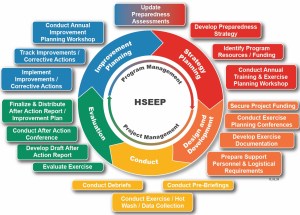
HSEEP Cycle

Each blog post will give some insight and lessons learned from my own experiences with exercises large and small and I will reflect on exercise program management responsibilities throughout the cycle.  For more in-depth information on exercise program management, I refer you to HSEEP Volume I.  I will also have an update on this HSEEP volume in the near future as DHS will soon release a revision.

The first thing I want to cover is exercise program management as a general concept.  As stated in HSEEP Volume I, “Exercise program management is directed toward achieving the objectives established during the multi-year planning process…”.  As an exercise program grows, so should the responsibilities of managing it.  Most organizations don’t need a full-time exercise program manager, but they will require someone with the flexibility to vary how much time they spend on the exercise program.  The planning and conduct of an exercise can take up a considerable amount of time, and the program manager needs to shepherd this process.  In small organizations, the exercise program manager may be one of the few people involved in these activities as well.

Obviously the person in charge of an exercise program needs to be knowledgeable and experienced in exercises.  As with the oversight of any program, you need to have the right person in place.  Some caution should be used here, however – there are plenty of folks with LOTS of exercise experience… BUT the vast majority of experience out there is as a player.  Players, as a general rule, don’t experience all the machinations behind putting an exercise together.  Someone may have been a player in the largest exercise known to human kind, but that doesn’t make them adept at exercises.  There is plenty of training out there addressing various areas of exercises: the HSEEP training course, Exercise Design, Exercise Evaluation, and others.  These are great – but the world is full of ‘trained’ people.  Do they have the experience to do the job?  It doesn’t take a lot of experience, in fact, in my opinion, a little experience can go a long way – especially if it’s the right experience and they were taught the right way to do it from someone with a lot of experience.  I’ve fully immersed interns in many of the areas of exercise program management and would be fully confident in their ability to run a program for an organization.

As mentioned above, exercise program management centers on the multi-year training and exercise plan (MYTEP), which makes sense as this document will outline requirements, goals, and benchmarks for the program.  Building this plan is not the first, though.  We know that before we can write a plan, we need to do an analysis or an assessment of where we stand.  This is why the first step in the HSEEP cycle (above) is Updating Preparedness Assessments.  As much of a fan as I am of the HSEEP documents, they do fall rather short on providing guidance relative to this step.  It can be broken down easily enough, though.

A preparedness assessment, to me, would identify where we stand and where we want to be in terms of preparedness.  The resultant gap would then feed the second step in the HSEEP cycle – developing a preparedness strategy.  Let’s define preparedness: traditionally, it involves planning, training, and exercising; we can build from this to give us the data we need.  An absolute priority is identifying and assessing risk.  Hopefully your jurisdiction has a recent hazard analysis or THIRA, or your company or organization has a recent business impact analysis (BIA).  Having a recent hazard analysis done will identify the threats you need to be prepared for.  If you don’t have a recent one of these, I would suggest that you are way ahead of yourself with exercises and need to take a step back in emergency management to do one of these and build a plan.  Based upon the results of your hazard analysis, do you have the necessary plans (and are they up to date?) to address the hazards?

The second assessment should be a capabilities assessment.  You can reference FEMA‘s list of core capabilities to ensure that you are examining everything you need to.  Keep in mind that not everyone needs to have every capability.  You may not have a need for certain capabilities or it may not be feasible for you to have it based upon costs – so long as you can obtain that capability from someone else in times of disaster.  However, there are certain capabilities, based upon your hazards, that you want to ensure that you have.  If you don’t have them, they need to be developed.  That’s a gap.

A third assessment, related to the second, would be to identify needs to develop personnel capabilities – specifically through the means of training.  Yep, a Training Needs Assessment.  I’ve blogged previously about this.  Your identified needs become another gap to include in your preparedness assessment.

Lastly, you should do an assessment of exercises and real life events to date.  While you are just starting to formalize your exercise program, I still think an assessment of exercise progress to date is important.  While you may not have had a formal program, you have likely done some exercises or at least participated in someone else’s.  What plans have been tested with these exercises?  How long ago were they conducted?  Do you have After Action Reports?  (Read my article in Emergency Management Magazine on the importance of AARs and implementing corrective actions).  How about lessons learned and after action reports from actual incidents?  What gaps from these still need to be addressed?

All of this data and these documents can be pulled together and referenced in a simple, cohesive document outlining your preparedness needs.  It seems like a lot of work, but without identifying our needs, we can’t move forward with an effective exercise program.

What are your thoughts on identifying preparedness needs?  Is there anything I’ve missed?

Thanks for reading and be on the lookout for part two of Managing an Exercise Program where I will outline the development of a preparedness strategy.


The Emergence of Whole Community Planning

FEMA has contracted the development of a national Whole Community disaster training program.  This should result in some of the best planning guidance ever put forward by FEMA since CPG-101.  What is ‘Whole Community’ planning?  Whole Community planning takes into account everything in your community, not just the hazards, but also the vulnerable populations, as well the community’s resources – all of them, to include the private sector.  This is smart planning!

Timothy RieckerI don’t know what the final guidance will look like, but I’m imagining a process, imbedded within our existing planning process, which is similar to a SWOT analysis (strengths, weaknesses, opportunities, and threats) which has long been used as a business analysis tools.  Strengths and weaknesses are internal reflections, while opportunities and threats have you looking to the outside.  From the perspective of an emergency planner for a community, strengths and weaknesses would reference their innate government-based capabilities (remember capabilities-based planning?  I’m still a big fan); while opportunities and weaknesses would reference what is brought to the table by the rest of the community (i.e. private sector, NGO, and even the citizens themselves – such as a neighborhood watch or CERT).

In many ways, good planners and emergency managers have already been doing this.  They have been capitalizing on relationships with the private sector and NGOs and building plan annexes based upon these relationships – such as human services oriented plans and logistics plans.  Moving forward as a ‘branded’ concept, Whole Community planning will become the standard, not just a best practice, and will evolve as more people do it and make it better.  This concerted effort will ensure that the entire community is moving forward in a coordinated fashion and with common goals in the response to and recovery from an incident.  I’m also hopeful that this Whole Community guidance will give some input on community preparedness as well.

The project will be released in phases over the next three years, so be looking out for it.

Let’s Bring Human Interaction Back Into Training

I love technology.  I really do.  I generally don’t have any problems with the accomplishments or advancements we’ve made and I’m not looking to abolish any of the triumphs or practices we have in place as a result of technology, but there are some things we have to step back on a bit.  One of those things is the extreme volume of self-paced, internet learning, e-learning, independent study, etc. types of programs out there.  We’ve accomplished a great deal in regard to these self driven types of programs and they do have value – yet I think we’re losing touch with the human factor.

When I started in the training business, the internet was still fairly youthful and humanity hadn’t yet realized all the potential it held (we still don’t, but we were a much longer ways away from it then).  There was no such thing as online learning.  You could download training materials and references, maybe even submit test answers online (although the norm was still to fax answers), but that was about as interactive as it got.  The next step was pretty pathetic – uploading slides in a PowerPoint format or something similar, to the internet for people to view.  As time progressed, we saw great advances in online learning.  Now we have video, audio, in-course quizzes and learning checks, even biometrically-driven verification systems to ensure that it’s still you taking the course (don’t believe me?  take the defensive driving course on-line).  Courses are much more comprehensive and provide both internal and external links to additional information and content areas.  I think it’s fantastic and we can’t stop this advancement – but we can’t let it take over, either.  All things in moderation.

People need interaction.  In 1970, Malcolm Knowles identified, as one of his six characteristics of adult learners, that adult learners are generally autonomous and self-directed.  While this may be true, it doesn’t mean that all learning is to be accomplished in isolation or without facilitation.  Adult learners still need human interaction.  While the degree of interaction necessary may vary based upon each individual’s preferred learning styles and personality type, that need still exists.  This is an interaction that generally can’t be replaced by games or other interactive components in e-learning programs.  Yes, many adults love the concept and process of self discovery, and some will excel greatly at absorbing information completely on their own, but most people need and desire human interaction.  We can’t forget this.

Some content areas are much more suited (read: ideal) for e-learning.  I recently began working with a company that has employees nation-wide.  E-learning is certainly the best structure to disseminate required programs such as business ethics and workplace harassment.  In fact, these programs were extremely well done.  They used a lot of audio, pictures, and knowledge checks throughout the programs.  They were designed to provide variety and appeal to the senses.  They were well structured and didn’t contain any of the cheesy videos many of us remember from previous iterations of these types of programs.  I can honestly say that I preferred these in an e-learning format over any previous classroom experience in the same subject areas I’ve ever had.

Why do programs like ethics and workplace harassment work very well in an e-learning format?  Because, if designed well, they require very little human interaction to facilitate the learning process.  There are programs that I have taught for many years, however, that MUST have human interaction, such as incident management and emergency planning topics.  I think the key here is that they are complex topics, with a lot of variables, and the real world execution of these topics requires team work and human interaction.  You can’t manage an incident inside a barrel nor can you write an emergency plan (a good one) without input from an entire team of people.  The instructors have to have experience in these areas and be subject matter experts that the learners can consult throughout the class.  Access to an SME helps the learners become more comfortable with the topic.  All this said, do these courses need to be delivered in a classroom environment?  Not necessarily.  We can still be interactive with others without being face to face.  It’s all about creativity, leveraging technology and other resources, and paying attention to the needs of our learners as well as the objectives of the courses themselves.

We have a number of distance learning options we can leverage, from webinars, to video teleconference, to chat room types of environments (and these can be highly integrated such as the ones used by educational institutions).  Does course participation (in whole or in part) have to be synchronous (the instructor is present with all learners at the same time) or can it be asynchronous (the instructor and learners can log in at different times, able to download and upload materials and leave messages for each other)?  It all depends on what needs to be accomplished.  Once again, as in previous blogs, I defer back to the needs assessment.  The data collected from the needs assessment will provide an astute instructional designer with information necessary to identify the delivery modes that would be appropriate for the learners.

With all the technology we have available to us, I think many learning organizations are being seduced into using e-learning platforms for everything.  E-learning and content management systems are very powerful and valuable tools, but can’t forget the human factor.  We need to be very careful with what we use and how we use it – and ensure that we are meeting the needs of our learners in the best way possible.  I encourage you to use caution and always consider what is best for the learner.