Apocalypse Inquiry

I must share a brief story which I found to be rather humorous.

Just a few minutes ago I received a phone call from a local news station.  The caller, a reporter, asked for me by name and verified that I was a partner of Emergency Preparedness Solutions, LLC – my consulting firm.  She then asked if I had received any calls recently from anyone asking what they should do for the apocalypse – since, apparently, it is coming on December 21st.  I laughed and said ‘no’.  Despite doing a handful of presentations recently for businesses and not for profits I’ve not gotten any serious inquiries about apocalyptic preparedness – nor do I expect to, unless this post happens to spur some.

While we can’t predict the future, I expect that this coming Friday will be just like any other day on our temperamental planet.  My advice to everyone is to be prepared all the time!  Be informed, make a plan, build a kit, and get involved.

Happy Apocalypse!

Hurricane Sandy was a Surprise?

The second to last paragraph of this ABC News article contains a pretty shocking statement made by NYC Mayor Michael Bloomberg: “The city was not expecting Sandy.”  Really?  I think Mayor Bloomberg should have spoken to the good folks in his Emergency Management agency.  Or read one of the several reports cited in this article.  Or spoken to Michael Balboni who has been involved in emergency management and homeland security in New York State for many years.  Or looked at a map.

Optimistically, I think the Mayor’s intent here was to say that the chances of something like Hurricane Sandy happening were so low that there wasn’t much focus on it.  I’m still not thrilled with that, either, but I think that’s where he was going.

Folks, while the chance of such a strong system making landfall in the greater New York City area was pretty slim, it was still a possibility – and a very dangerous one.  A possibility, in fact, that a great deal of discussion and preparation had gone into.  The preparations that were done were good, but clearly not enough.  There needed to be massive investments of resilient, disaster mitigating infrastructure that would protect against the impacts of a storm such as this.  But we’re not too late.  We can still do these things.  Sadly, there isn’t a lot of money behind it, but we need to engage the political momentum behind this storm – just as we’ve seen in the aftermath of other major disasters such as 9/11 or Hurricane Katrina – which have funded massive projects.  We’ve seen ideas like a giant sea wall, which I’ve previously blogged about.  Or the mitigation projects engineered in, under, and around the city of Hong Kong, which I’ve also recently blogged about.  All these things are possible and very much necessary for the City of New York and other high risk coastal areas.

It’s time for our elected officials to take emergency management seriously.  The investments made in preparedness and mitigation can drastically reduce the loss of lives and property.

Disaster Preparedness – Hong Kong

Seal of Hong Kong

Seal of Hong Kong

I’m interrupting my series on exercise program management (which I’m sure I’ll do several more times) to highlight a news spot I first saw on last night’s NBC News.  The segment was about Storm Preparedness in Hong Kong.  In it they briefly outline the threats to Hong Kong, including being struck by a cyclone seven times a year on average, and they highlight the preparations they’ve taken.  These preparations include underground reservoirs to contain flood waters and runoff and a system of barrier fences to mitigate against landslides.  I always like to see how other people around the world are prepared for their hazards.  Necessity is the mother of invention, as they say, and other places around the globe have come up with innovative ways to protect themselves from natural disasters.  Comparisons were made in this brief segment between NYC and Hong Kong – with the silent inference that if these measures are already being taken elsewhere, then certainly the City of New York can do it.

One thing I noticed wasn’t actually discussed in the video – they showed a brief clip of a Hong Kong area news broadcast which was alerting citizens. Broadcasts are the cornerstone of their notification and alert system and use levels of ‘signals’ to communicate the severity of the threat (the Hong Kong broadcast clip that NBC includes shows them issuing a Signal 10, their most serious).  An easy internet search led me to the Hong Kong Security Bureau which handles emergency management.  This preparedness guide explains their signal system and shows how they color code other hazards based on level of severity such as wild fires and storms.  Their documents are in both Chinese and English.

A little more poking around their website found versions of their contingency plans.  I quickly perused their contingency plan for natural disasters which seemed to include all the right elements.  Certainly, with an average of seven cyclones annually along with the threat of wild fires and landslides all around the city, Hong Kong is well versed in preparedness.  While a quick search for any studies on citizen preparedness didn’t come up with much, I’m hopeful that the preparedness message is getting to them as well.  The broadcast indicated that Hong Kong had recently suffered through a storm event of similar strength as Hurricane Sandy, and survived with no fatalities.  Based on this alone, it would seem to me that the citizens of Hong Kong do take this seriously.

We can always learn from others – especially those who haven’t been jaded by our way of doing things, which I think more often than not holds us all back.  We need to look beyond our borders and share ideas.  It seems to be done in many other fields, but not so much in emergency management.

Managing an Exercise Program – Part 1

This post is part of a 10-part series on Managing an Exercise Program. In this series I provide some of my own lessons learned in the program and project management aspects of managing, designing, conducting, and evaluating Homeland Security Exercise and Evaluation Program (HSEEP) exercises. Your feedback is appreciated!

Managing an Exercise Program – Part 1

Managing an Exercise Program – Part 2: Develop a Preparedness Strategy

Managing an Exercise Program – Part 3: Identify Program Resources and Funding

Managing an Exercise Program – Part 4: Conduct an Annual Training & Exercise Planning Workshop.

Managing an Exercise Program – Part 5: Securing Project Funding

Managing an Exercise Program – Part 6: Conducting Exercise Planning Conferences

Managing an Exercise Program – Part 7: Develop Exercise Documentation

Managing an Exercise Program – Part 8: Preparing Support, Personnel, & Logistical Requirements

Managing an Exercise Program – Part 9: Conducting an Exercise

Managing an Exercise Program – Part 10: Evaluation and Improvement Planning


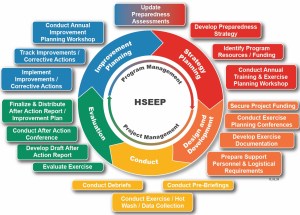
From inception to improvement planning, I think preparedness exercises provide great value to the jurisdictions, companies, and organizations that do them.  From a seminar to a full-scale exercise, there is much to be learned by participants as well as the strengths and areas for improvement identified from emergency plans.  I’ve been inspired to write a series of blog posts on each of the phases within the Homeland Security Exercise Evaluation Program (HSEEP) cycle.  The cycle, shown below, encompasses not just the steps in executing an exercise (project management), it includes exercise program management as well, which I think is often neglected.  Doings exercises is great, but to ensure continuity, quality, and continuous improvement, any entity that does exercises should have an exercise program.  Having a structured exercise program will ensure that your organization capitalizes on your exercise investments to the greatest degree possible.  Just like any other functional program, it needs to be managed.

HSEEP Cycle

Each blog post will give some insight and lessons learned from my own experiences with exercises large and small and I will reflect on exercise program management responsibilities throughout the cycle.  For more in-depth information on exercise program management, I refer you to HSEEP Volume I.  I will also have an update on this HSEEP volume in the near future as DHS will soon release a revision.

The first thing I want to cover is exercise program management as a general concept.  As stated in HSEEP Volume I, “Exercise program management is directed toward achieving the objectives established during the multi-year planning process…”.  As an exercise program grows, so should the responsibilities of managing it.  Most organizations don’t need a full-time exercise program manager, but they will require someone with the flexibility to vary how much time they spend on the exercise program.  The planning and conduct of an exercise can take up a considerable amount of time, and the program manager needs to shepherd this process.  In small organizations, the exercise program manager may be one of the few people involved in these activities as well.

Obviously the person in charge of an exercise program needs to be knowledgeable and experienced in exercises.  As with the oversight of any program, you need to have the right person in place.  Some caution should be used here, however – there are plenty of folks with LOTS of exercise experience… BUT the vast majority of experience out there is as a player.  Players, as a general rule, don’t experience all the machinations behind putting an exercise together.  Someone may have been a player in the largest exercise known to human kind, but that doesn’t make them adept at exercises.  There is plenty of training out there addressing various areas of exercises: the HSEEP training course, Exercise Design, Exercise Evaluation, and others.  These are great – but the world is full of ‘trained’ people.  Do they have the experience to do the job?  It doesn’t take a lot of experience, in fact, in my opinion, a little experience can go a long way – especially if it’s the right experience and they were taught the right way to do it from someone with a lot of experience.  I’ve fully immersed interns in many of the areas of exercise program management and would be fully confident in their ability to run a program for an organization.

As mentioned above, exercise program management centers on the multi-year training and exercise plan (MYTEP), which makes sense as this document will outline requirements, goals, and benchmarks for the program.  Building this plan is not the first, though.  We know that before we can write a plan, we need to do an analysis or an assessment of where we stand.  This is why the first step in the HSEEP cycle (above) is Updating Preparedness Assessments.  As much of a fan as I am of the HSEEP documents, they do fall rather short on providing guidance relative to this step.  It can be broken down easily enough, though.

A preparedness assessment, to me, would identify where we stand and where we want to be in terms of preparedness.  The resultant gap would then feed the second step in the HSEEP cycle – developing a preparedness strategy.  Let’s define preparedness: traditionally, it involves planning, training, and exercising; we can build from this to give us the data we need.  An absolute priority is identifying and assessing risk.  Hopefully your jurisdiction has a recent hazard analysis or THIRA, or your company or organization has a recent business impact analysis (BIA).  Having a recent hazard analysis done will identify the threats you need to be prepared for.  If you don’t have a recent one of these, I would suggest that you are way ahead of yourself with exercises and need to take a step back in emergency management to do one of these and build a plan.  Based upon the results of your hazard analysis, do you have the necessary plans (and are they up to date?) to address the hazards?

The second assessment should be a capabilities assessment.  You can reference FEMA‘s list of core capabilities to ensure that you are examining everything you need to.  Keep in mind that not everyone needs to have every capability.  You may not have a need for certain capabilities or it may not be feasible for you to have it based upon costs – so long as you can obtain that capability from someone else in times of disaster.  However, there are certain capabilities, based upon your hazards, that you want to ensure that you have.  If you don’t have them, they need to be developed.  That’s a gap.

A third assessment, related to the second, would be to identify needs to develop personnel capabilities – specifically through the means of training.  Yep, a Training Needs Assessment.  I’ve blogged previously about this.  Your identified needs become another gap to include in your preparedness assessment.

Lastly, you should do an assessment of exercises and real life events to date.  While you are just starting to formalize your exercise program, I still think an assessment of exercise progress to date is important.  While you may not have had a formal program, you have likely done some exercises or at least participated in someone else’s.  What plans have been tested with these exercises?  How long ago were they conducted?  Do you have After Action Reports?  (Read my article in Emergency Management Magazine on the importance of AARs and implementing corrective actions).  How about lessons learned and after action reports from actual incidents?  What gaps from these still need to be addressed?

All of this data and these documents can be pulled together and referenced in a simple, cohesive document outlining your preparedness needs.  It seems like a lot of work, but without identifying our needs, we can’t move forward with an effective exercise program.

What are your thoughts on identifying preparedness needs?  Is there anything I’ve missed?

Thanks for reading and be on the lookout for part two of Managing an Exercise Program where I will outline the development of a preparedness strategy.


Looking Ahead – Hazards of Concern in the US

A multi-agency/discipline group called the National Homeland Security Consortium has released a white paper – Protecting Americans in the 21st Century: Priorities for 2012 and Beyond.  The paper highlights eight areas of concern requiring a national focus.

Sidebar – The entity called the National HOMELAND SECURITY Consortium has assembled a document that is clearly meant for the EMERGENCY MANAGEMENT community (a concept much broader and far-reaching than homeland security).  I really wish they would get this straightened out… and now back to your regularly scheduled blog…

The eight areas are as follows:

  • Cyber Hazards
  • Climate Change
  • Demands on Global Resources
  • Changing Demographics
  • Emerging Technologies
  • Violent Extremist Ideologies
  • WMD Proliferation
  • Mega-Hazards and Catastrophic Cascading Consequences

The Consortium has recognized and stresses in their white paper the hazard that is larger than any of these individually, and that is the potential for any of these hazards to interact or influence each other – an observation and warning that I feel is long overdue.  They are also not encouraging us to lose focus on the more immediate hazards we may have at hand, but are encouraging stakeholders and relevant parties to give some attention to these emerging hazards and consider how we will prepare for, mitigate against, respond to, and recover from their impacts.

I won’t comment on each of these items now, but reserve the right to do so in the near future.  I do, however, leave you with this… consider what impacts these hazards may have on you.

Marketing the Preparedness Message

There are some great ideas in Jim McKay’s article – The Preparedness Message Isn’t Reaching the Public, featured in Emergency Management Magazine.  Just like any good marketing campaign, we have to push with multiple strategies.  Billboards and television campaigns are great but they aren’t going to hit home with everyone.  We need to be more creative in our approach.  Our methods will resonate differently with various people.  The CDC’s zombie campaign got a lot of attention (see my blog post on it!).  Why?  Because they not only used something trendy, they considered their audiences.  Not all audiences respond to the zombie campaign; some think it’s ridiculous – but they were able to engage a lot of people.  Different people require different methods.  Once you reach an audience, then you can convey a message.  Preparedness is boring, let’s face it.  We need creative and diverse solutions to reach and engage audiences.

The CDC’s Zombie Banner


There are four major challenges we’re facing when it comes to preparedness that I speak about in presentations.  These are many of the thoughts of many folks when it comes to disasters:

1) It’s not going to happen here.

2) It’s not going to be that bad.

3) There is nothing I can do about it.

4) Government will take care of me.

These aren’t rocket science, but they can be tough nuts to crack – especially when we don’t want to be the ‘doom and gloom’ people.

Let’s look at what has worked.  McKay’s article mentions coupons to Target for preparedness kits.  This is an effective methodology that has worked well for years in California and other places around the country.  In Central New York, where I’m from, a county health department capitalized creatively on a point of distribution exercise to get the beginnings of preparedness kits in the hands of residents.  The 300 slots they had available filled very quickly.  The event got great press and all positive comments from those who participated.  Good or bad economy, people like free or discounted things.  The lesson learned here is to get preparedness underwritten.  Be it by grant funds or corporate sponsors.  If Pepsi wants to put out a preparedness kit, so be it.

Grassroots Recovery with a National Impact

This morning I took some time to browse through the variety of TED talks to see if anything struck some interest with me.  First of all, if you aren’t familiar with TED, they host a variety of free talks and presentations on various topics.  They get some great speakers and the presentations are short… usually 10-20 minutes.  Most of the topics are about something new and innovative – their tag line is ‘Ideas Worth Spreading’, and they certainly abide by that.  Sometimes I watch their presentations because the subject area interests me, and other times I watch it to see some innovative or refreshing presentation skills.

The TED presentation I watched this morning is titled: Caitria and Morgan O’Neill: How to step up in the face of disaster.  It’s a short, 10 minute presentation which I highly recommend.  Their background is on the TED page, but in short these two sisters, both in grad school, experienced an F 3 tornado in their hometown in Massachusetts.  From their explanation, it seems that there wasn’t much organization or leadership in their town relative to supporting volunteers.  If you’ve been in emergency management for a while, you’ve probably experienced this.  There are a wealth of volunteers who want to help in the event of a disaster, but they must be organized and supported.  Often times local governments either don’t have the resources to deal with spontaneous volunteers or simply don’t want to – they may not want the trouble, the liability, or would prefer that another organization, often times someone like the American Red Cross, to deal with them.

The main trouble is that most jurisdictions don’t plan for volunteer management.  A volunteer management plan is a plan that should absolutely be part of the Comprehensive Emergency Management Plan (CEMP) of any jurisdiction.  Yes, not for profits often times do take on this role, especially with a localized disaster and if they have the capability to do so, but in the event of a regional disaster they simply don’t have the people to dedicate to this task – and it’s not something that’s easily done or simply managed.  The bottom line is that local jurisdictions are responsible for taking care of their people, and this is one more way to make it happen.

The O’Neill sisters, learning from their home town experiences and leveraging their educations and other experiences, eventually put together a company called recovers.org.  They have applied simple but effective methodologies to manage resources, including volunteers, in the event of a disaster.  They have traveled across the country applying their system and seem to be quite successful in doing so.  One of the things that encourages me the most about them is that they advocate community preparedness.  They know that for any system to reach its potential of effectiveness, it must be integrated into preparedness efforts, not just show up after the disaster.  It seems they have a product and service that can be applied to any jurisdiction and would work well with existing structures, like a VOAD, and with volunteer management and recovery planning efforts.  The information on their website indicates that they are busy helping communities impacted by Hurricane Sandy.  It’s great to see local efforts and innovation in emergency management!  Best of luck to Caitria and Morgan O’Neill.

Hurricane Sandy – Be Prepared and Stay Safe!

I’m finishing my preparations for a quick trip to California to help evaluate an earthquake exercise.  All the while, I’m watching Hurricane Sandy come up the coast after creating some havoc in the Caribbean.  According to the latest National Hurricane Center advisory, Sandy will make landfall in southern New Jersey, and progress inland to central Pennsylvania before turning north and heading through New York State, the track taking it through the Finger Lakes area.  From there, the current advisory predicts that the storm will turn to the northeast, saturating New England.  It’s going to be a very wet, rainy week as Sandy slows soon after making landfall.  Of particular concern here in New York is the western portion of the state which has received a fair amount of rainfall over the last couple of days from the cold front that has progressed here from the mid west.


Thus far, there seems to be an appropriate amount of concern over this storm.  While I’ve heard some folks say that people are overly concerned, I don’t think officials are crying wolf with this.  First, as I’m sure you’ve read in the media, many factors of this storm are unprecedented or rarely seen, particularly the collision with the cold front – resulting in many of the hurricane advisories including snow in their forecast – SNOW for a HURRICANE!  Who would have ever thought that would happen?  Second, the storm is maintaining hurricane strength right up to landfall, bringing significant winds and storm surge with it.  New York City is taking actions which to my recollection are fully in compliance with their hurricane plans, such as low elevation evacuations, closing of mass transit and tunnels ahead of the storm, and other protective actions.  States of emergency have been declared all along the northeast states, with the President declaring an emergency in Maryland, which will be the first to feel the full effects of the category 1 storm with sustained winds of 75 miles per hour.  I expect the President will make similar declarations ahead of the storm reaching subsequent states.  States along the projected impact path all have activated their emergency operations centers (EOCs), pulling together local, state, and federal agencies, as well as some not for profits such as the American Red Cross and The Salvation Army, to coordinate efforts and situational information.

I’ve received storm preparedness information from several sources already, including Ready.gov, the Small Business Administration, Time Warner Cable, and National Grid.  I’m certain utility companies in other area are doing the same outreach to their customers.  Locally, the Erie Canal is being closed and water levels dropped to help mitigate against flooding, which has devastated communities along the waterway in the past.  Local governments are putting out preparedness public service announcements to citizens to help ensure they are prepared.  You’ve heard me comment before about the complacency of much of our population when it comes to emergency preparedness.  Please pay heed to what is being suggested and spread the word that preparedness for this storm is serious.  Be sure to have a few days of water, food, medications, and batteries for flashlights.  Keep your cell phone charged and pay attention to weather information and emergency alerts.  If you are a New Yorker, now is a great time to subscribe to NY-ALERT to be certain to receive emergency information.  If you are outside of New York, many states now have similar alerting systems.  Even clearing away leaves and debris, which is plentiful this time of year, from storm sewers and culverts will be a big help.  If you manage or own a business, be sure to pull out your emergency and continuity plans (you have these, right?) and be sure to keep your employees and other stakeholders informed of what’s going on.

I’m sure that when I return I’ll be helping with some disaster response and recovery activities in the area.  The better you prepare and the smarter you are, the less responders have to risk their lives and valuable resources, so be smart, be prepared, and stay safe!